PXC2102G2-01 - Server Lantronix - Free user manual and instructions
Find the device manual for free PXC2102G2-01 Lantronix in PDF.


| Product Type | Rackmount Server |
| Model | PXC2102G2-01 |
| Brand | Lantronix |
| Dimensions (H x W x D) | 1U (1.75" x 19" x 20") |
| Weight | Approx. 15 lbs (6.8 kg) |
| Power Supply | Dual redundant, 400W AC |
| Processor | Intel Xeon E-2300 series (4-8 cores) |
| Memory | Up to 64GB DDR4 ECC |
| Storage | 2x 2.5" SATA/SAS bays, RAID supported |
| Network Interfaces | 2x 1GbE, optional 10GbE |
| Management | IPMI 2.0, web GUI |
| Operating Temperature | 0°C to 40°C |
| Humidity | 5% to 90% non-condensing |
| Certifications | FCC, CE, RoHS |
| Maintenance | Clean with dry cloth; avoid liquids |
| Safety | Use grounded outlet; do not block vents |
| Spare Parts | Contact Lantronix support for replacement parts |
| Warranty | 3 years limited hardware warranty |
| Software Included | Lantronix ConsoleFlow, CLI |
Frequently Asked Questions - PXC2102G2-01 Lantronix
update.User questions about PXC2102G2-01 Lantronix
0 question about this device. Answer the ones you know or ask your own.
Ask a new question about this device
Download the instructions for your Server in PDF format for free! Find your manual PXC2102G2-01 - Lantronix and take your electronic device back in hand. On this page are published all the documents necessary for the use of your device. PXC2102G2-01 by Lantronix.
USER MANUAL PXC2102G2-01 Lantronix
natural_image
Exterior view of a LAMRONX wireless device with antenna and ports (no readable text or symbols beyond branding)PremierWave®
Intelligent Gateway
User Guide
Intellectual Property
© 2014 Lantronix, Inc. All rights reserved. No part of the contents of this book may be transmitted or reproduced in any form or by any means without the written permission of Lantronix.
Lantronix and PremierWave are registered trademark of Lantronix, Inc. in the United States and other countries. DeviceInstaller is a trademark of Lantronix, Inc. U.S. Patents 7,698,405; 8,024,446; 8,219,661. Additional patents pending. Windows and Internet Explorer are registered trademarks of Microsoft Corporation. Mozilla and Firefox are registered trademarks of the Mozilla Foundation. Chrome is a trademark of Google Inc. Safari is a registered trademark of Apple Inc. Wi-Fi is a trademark of Wi-Fi Alliance Corporation. All other trademarks and trade names are the property of their respective holders.
Warranty
For details on the Lantronix warranty policy, please go to our web site at www.lantronix.com/support/warranty.
Contacts
Lantronix, Inc. Corporate Headquarters
167 Technology Drive Irvine, CA 92618, USA
Toll Free: 800-526-8766 Phone: 949-453-3990 Fax: 949-453-3995
Technical Support
Online: www.lantronix.com/support
Sales Offices
For a current list of our domestic and international sales offices, go to the Lantronix web site at www.lantronix.com/about/contact.
Disclaimer
All information contained herein is provided “AS IS.” Lantronix undertakes no obligation to update the information in this publication. Lantronix does not make, and specifically disclaims, all warranties of any kind (express, implied or otherwise) regarding title, non-infringement, fitness, quality, accuracy, completeness, usefulness, suitability or performance of the information provided herein. Lantronix shall have no liability whatsoever to any user for any damages, losses and causes of action (whether in contract or in tort or otherwise) in connection with the user’s access or usage of any of the information or content contained herein. The information and specifications contained in this document are subject to change without notice.
Revision History
| Date Rev. Comments | ||
| June 2012 A Initial Document for firmware release 7.2.0.0. | ||
| May 2014 B Updated to firmware | 7.8.0.0. | |
Table of Contents
Intellectual Property 2
Warranty 2
Contacts 2
Disclaimer 2
Revision History 2
1: Using This Guide 18
Purpose and Audience 18
Summary of Chapters 18
Additional Documentation 19
2: Introduction 20
Key Features 20
Applications 21
Protocol Support 21
Troubleshooting Capabilities 22
Configuration Methods 22
Addresses and Port Numbers 22
Hardware Address 22
IP Address 23
Port Numbers 23
Product Information Label 23
3: Installation of PremierWave XC Device 25
Package Contents 25
User-Supplied Items 25
Hardware Components 26
Top Panel 26
Back Panel 27
Reset Button 29
Side Panel 29
Bottom Panel 30
Installing the PremierWave XC Device 31
4: Device Discovery and Quick Setup 34
Accessing the PremierWave XC Device Using UPnP 34
Accessing the PremierWave XC Device Using DeviceInstaller 35
Device Detail Summary 35
5: Configuration Using Web Manager 37
Accessing Web Manager 37
Device Status Page 38
Web Manager Components 39
Web Manager pages have these sections: ____ 40
Navigating Web Manager 40
6: Network Settings 42
Network 1 (Ethernet "eth0") Interface Settings ____ 42
To Configure Network 1 Interface Settings ____ 43
Using Web Manager 43
Using the CLI 43
Using XML 43
To View Network 1 Interface Status 44
Using Web Manager 44
Network 1 (Ethernet "eth0") Link Settings ____ 44
To Configure Network 1 Link Settings ____ 44
Using Web Manager 44
Using the CLI 44
Using XML 44
Network 1 (Ethernet "eth0") QoS 45
To Configure Network 1 QoS Settings 46
Using Web Manager 46
Using the CLI 46
Using XML 46
Network 1 (Ethernet "eth0") Failover 46
To Configure Network 1 Failover Settings ____ 47
Using Web Manager 47
Using the CLI 47
Using XML 47
Network 2 (Cellular "wwan0") Interface Settings 47
To Configure Network 2 Interface Settings ____ 48
Using Web Manager 48
Using the CLI 48
Using XML 48
Network 2 (Cellular "wwan0") Link Settings ____ 48
To Configure Network 2 Link Settings ____ 48
Using Web Manager 48
Using the CLI 48
Using XML 48
Network 2 (Cellular "wwan0") QoS ____ 49
To Configure Network 2 QoS Settings ____ 50
Using Web Manager 50
Using the CLI 50
Using XML 50
Gateway 50
WAN 50
WAN MAC Address Filters 51
To Configure Gateway WAN Settings 51
Using Web Manager 51
Using the CLI 51
Using XML 51
Port Forwarding 51
To Configure Gateway Port Forwarding Settings 52
Using Web Manager 52
Using the CLI 52
Using XML 52
Static Routes 53
To Configure Gateway Static Route Settings 53
Using Web Manager 53
Using the CLI 53
Using XML 53
DHCP Server 54
To Configure Gateway DHCP Server Settings 54
Using Web Manager 54
Using the CLI 54
Using XML 54
Static Lease Listing 54
DDNS 55
To Configure Gateway WAN Settings 55
Using Web Manager 55
Using the CLI 55
Using XML 55
7: Cellular 56
To Configure Cellular Settings 56
Using Web Manager 56
Using the CLI 56
Using XML 56
Typical Cellular Error (errcodes) 56
8: Input/Output Ports 57
Relay Output 57
To Configure Relay Settings 57
Using Web Manager 57
Using the CLI 57
Using XML 57
Digital Input 58
To Configure Digital Input Settings 58
Using Web Manager 58
Using the CLI 58
Using XML 58
9: Action Settings 59
Alarms and Reports 59
Actions 59
To Configure Action Settings 60
Using Web Manager 60
Using the CLI 60
Using XML 61
10: Line and Tunnel Settings 62
Line Settings 62
To Configure Line Settings 64
Using Web Manager 64
Using the CLI 64
Using XML 64
To View Line Statistics 64
Using Web Manager 64
Using the CLI 64
Using XML 64
Tunnel Settings 64
Serial Settings 64
To Configure Tunnel Serial Settings 65
Using Web Manager 65
Using the CLI 65
Using XML 65
Packing Mode 65
To Configure Tunnel Packing Mode Settings 66
Using Web Manager 66
Using the CLI 66
Using XML 66
Accept Mode 66
To Configure Tunnel Accept Mode Settings 68
Using Web Manager 68
Using the CLI 68
Using XML 68
Connect Mode 68
To Configure Tunnel Connect Mode Settings 70
Using Web Manager 70
Using the CLI 70
Using XML 70
Disconnect Mode 70
To Configure Tunnel Disconnect Mode Settings 71
Using Web Manager 71
Using the CLI 71
Using XML 71
Modem Emulation 71
To Configure Tunnel Modem Emulation Settings 72
Using Web Manager 72
Using the CLI 72
Using XML 72
Statistics 72
To View Tunnel Statistics 72
Using Web Manager 72
Using the CLI 72
Using XML 72
11: Terminal and Host Settings 73
Terminal Settings 73
To Configure the Terminal Network Connection ____ 74
Using Web Manager 74
Using the CLI 74
Using XML 74
To Configure the Terminal Line Connection 74
Using Web Manager 74
Using the CLI 74
Using XML 74
Host Configuration 74
To Configure Host Settings 75
Using Web Manager 75
Using the CLI 75
Using XML 75
12: Network Services 76
DNS Settings 76
To View or Configure DNS Settings: ____ 76
Using Web Manager 76
Using the CLI 76
Using XML 76
FTP Settings 76
To Configure FTP Settings 77
Using Web Manager 77
Using the CLI 77
Using XML 77
Syslog Settings 77
To View or Configure Syslog Settings 78
Using Web Manager 78
Using the CLI 78
Using XML 78
HTTP Settings 78
To Configure HTTP Settings 79
Using Web Manager 79
Using the CLI 79
Using XML 79
To Configure HTTP Authentication 80
Using Web Manager 80
Using the CLI 80
Using XML 80
RSS Settings 80
To Configure RSS Settings 81
Using Web Manager 81
Using the CLI 81
Using XML 81
SNMP Settings 81
To Configure SNMP Settings 81
Using Web Manager 81
Using the CLI 81
Using XML 82
Discovery and Query Port 82
To Configure Discovery 82
Using Web Manager 82
Using the CLI 82
Using XML 82
SMTP Settings 82
To Configure SMTP Settings 83
Using Web Manager 83
Using the CLI 83
Using XML 83
Email Settings 83
To View, Configure and Send Email 84
Using Web Manager 84
Using the CLI 84
Using XML 84
13: SMS Settings 85
Inbound SMS 85
Outbound SMS 85
To Configure SMS 86
Using Web Manager 86
Using the CLI 86
Using the XML 86
To Configure Outbound SMS 86
Using Web Manager 86
Using the CLI 86
Using the XML 86
14: Updating Firmware 87
Obtaining Firmware 87
Loading New Firmware through Web Manager 87
To upload new firmware: 87
Loading New Firmware through FTP 88
15: Security Settings 89
Public Key Infrastructure 89
TLS (SSL) 89
Digital Certificates 90
Trusted Authorities 90
Obtaining Certificates 90
Self-Signed Certificates 90
Certificate Formats 90
OpenSSL 91
Steel Belted RADIUS 91
Free RADIUS 91
SSH Settings 92
SSH Server Host Keys 92
SSH Client Known Hosts 93
SSH Server Authorized Users 93
SSH Client Users 94
To Configure SSH Settings 95
Using Web Manager 95
Using the CLI 95
Using XML 95
SSL Settings 95
Certificate and Key Generation 95
To Create a New Credential 96
Using Web Manager 96
Using the CLI 96
Using XML 96
Certificate Upload Settings 97
To Configure an Existing SSL Credential 97
Using Web Manager 97
Using the CLI 97
Using XML 97
Trusted Authorities 98
To Upload an Authority Certificate 98
Using Web Manager 98
Using the CLI 98
Using XML 98
16: Maintenance and Diagnostics Settings 99
Filesystem Settings 99
File Display 99
To Display Files 99
Using Web Manager 99
Using the CLI 99
Using XML 99
File Modification 100
File Transfer 100
To Transfer or Modify Filesystem Files 101
Using Web Manager 101
Using the CLI 101
Using XML 101
Protocol Stack Settings 101
IP Settings 101
To Configure IP Protocol Stack Settings 101
Using Web Manager 101
Using the CLI 101
Using XML 101
ICMP Settings 102
To Configure ICMP Protocol Stack Settings 102
Using Web Manager 102
Using the CLI 102
Using XML 102
ARP Settings 102
To Configure ARP Network Stack Settings 102
Using Web Manager 102
Using the CLI 102
Using XML 102
Diagnostics 103
Hardware 103
To View Hardware Information 103
Using Web Manager 103
Using the CLI 103
Using XML 103
IP Sockets 103
To View the List of IP Sockets 103
Using Web Manager 103
Using the CLI 103
Using XML 103
Ping 103
To Ping a Remote Host 104
Using Web Manager 104
Using the CLI 104
Using XML 104
Traceroute 104
To Perform a Traceroute 104
Using Web Manager 104
Using the CLI 104
Using XML 104
Log 105
To Configure the Diagnostic Log Output 105
Using Web Manager 105
Using the CLI 105
Using XML 105
Memory 105
To View Memory Usage 105
Using Web Manager 105
Using the CLI 105
Using XML 105
Processes 106
To View Process Information 106
Using Web Manager 106
Using the CLI 106
Using XML 106
Threads 106
To View Thread Information 106
Using Web Manager 106
Using the CLI 106
Clock 106
To Specify Clock Setting Method 107
Using Web Manager 107
Using the CLI 107
Using the XML 107
System Settings 107
To Reboot or Restore Factory Defaults 108
Using Web Manager 108
Using the CLI 108
Using XML 108
17: Management Interface Settings 109
Command Line Interface Settings 109
Basic CLI Settings 109
To View and Configure Basic CLI Settings 109
Using Web Manager 109
Using the CLI 109
Using XML 109
Telnet Settings 110
To Configure Telnet Settings 110
Using Web Manager 110
Using the CLI 110
Using XML 110
SSH Settings 110
To Configure SSH Settings 111
Using Web Manager 111
Using the CLI 111
Using XML 111
XML Settings 111
XML: Export Configuration 111
To Export Configuration in XML Format 112
Using Web Manager 112
Using the CLI 112
Using XML 112
XML: Export Status 112
To Export in XML Format 112
Using Web Manager 112
Using the CLI 112
Using XML 112
XML: Import Configuration 113
Import Configuration from External File 113
Import Configuration from Filesystem 113
Line(s) from single line Settings on the Filesystem 113
To Import Configuration in XML Format 113
Using Web Manager 113
Using the CLI 113
Using XML 113
18: Branding the PremierWave XC Device 114
Web Manager Customization 114
Short and Long Name Customization 115
To Customize Short or Long Names 115
Using Web Manager 115
Using the CLI 115
Using XML 115
Appendix A: Compliance 116
Appendix B: Troubleshooting 119
Appendix C: Lantronix Technical Support 120
Appendix D: Binary to Hexadecimal Conversions 121
Converting Binary to Hexadecimal 121
Conversion Table 121
Scientific Calculator 121
List of Figures
Figure 2-1 Unit Product Label 24
Figure 3-1 PremierWave XC Top View 26
Figure 3-2 PremierWave XC Male DB9 DTE Serial Ports 26
Figure 3-3 PremierWave XC Pinout Configuration for RS-232 27
Figure 3-4 PremierWave XC Pinout Configuration for Full Duplex RS-422/485 (4-wire) ____ 27
Figure 3-5 PremierWave XC Pinout Configuration for Half Duplex RS-422/485 (2-wire) ____ 27
Figure 3-6 PremierWave XC Back Panel View Unit 27
Figure 3-11 PremierWave XC Side View 30
Figure 3-13 PremierWave XC, Bottom View 30
Figure 3-14 PremierWave XC Connections 32
Figure 3-15 PremierWave XC SIM Insertion 32
Figure 3-16 PremierWave XC Unit Dimensions in Inches (in) ____ 33
Figure 5-1 PremierWave XC Device Status Page 38
Figure 5-2 Components of the Web Manager Page 39
Figure 14-1 Uploading New Firmware 87
List of Tables
Table 3-7 Ethernet LEDs 28
Table 3-8 PremierWave XC LEDs and Descriptions 28
Table 3-9 Fault Conditions Indicated by Blink Patterns 28
Table 3-10 Cellular Signal Strength Indicator 29
Table 3-12 PremierWave XC Connections (Side) 30
Table 5-3 Web Manager Pages 40
Table 6-1 Network Interface Settings 42
Table 6-2 Network 1 (eth0) Link Settings ____ 44
Table 6-3 Network 1 (eth0) QoS Settings 45
Table 6-4 Adding or Deleting Network 1 (eth0) QoS Settings ____ 45
Table 6-5 Network 1 (eth0) Failover Settings 46
Table 6-6 Network 2 (wwan0) Interface Settings ____ 47
Table 6-7 Network 2 (wwan0) QoS Settings 49
Table 6-8 Adding or Deleting Network 2 (wwan0) QoS Settings 49
Table 6-9 WAN Configuration ____ 50
Table 6-10 Adding a New MAC Address Filters 51
Table 6-11 Port Forwarding Rules List ____ 52
Table 6-12 Adding a New Port Forwarding Rule 52
Table 6-13 Static Route Setting Routes ____ 53
Table 6-14 Adding a New Static Route 53
Table 6-15 DHCP Settings 54
Table 6-16 Static Lease Listing ____ 54
Table 6-17 Add a Static Lease 55
Table 6-18 DDNS Configuration 55
Table 8-1 Relay Output Settings 57
Table 8-2 Digital Input Settings 58
Table 9-1 Action Settings ____ 59
Table 10-1 Line Configuration Settings 62
Table 10-2 Line Command Mode Settings 63
Table 10-3 Tunnel Serial Settings 65
Table 10-4 Tunnel Packing Mode Settings 65
Table 10-5 Tunnel Accept Mode Settings 67
Table 10-6 Tunnel Connect Mode Settings 69
Table 10-7 Tunnel Disconnect Mode Settings 70
Table 10-8 Tunnel Modem Emulation Settings 71
Table 11-1 Terminal on Network and Line Settings ____ 73
Table 11-2 Host Configuration 74
Table 12-1 DNS Settings 76
Table 12-2 FTP Settings 77
Table 12-3 Syslog Settings 77
Table 12-4 HTTP Settings ____ 78
Table 12-5 HTTP Authentication Settings 79
Table 12-6 RSS Settings 80
Table 12-7 SNMP Settings 81
Table 12-8 Discovery Settings 82
Table 12-9 SMTP Settings 82
Table 12-10 Email Configuration 83
Table 13-1 Inbound SMS Settings 85
Table 13-2 Outbound SMS Settings 85
Table 15-1 SSH Server Host Keys 92
Table 15-2 SSH Client Known Hosts 93
Table 15-3 SSH Server Authorized Users 93
Table 15-4 SSH Client Users 94
Table 15-5 Certificate and Key Generation Settings 95
Table 15-6 Upload Certificate Settings 97
Table 15-7 Trusted Authority Settings 98
Table 16-1 File Display Settings ____ 99
Table 16-2 File Modification Settings 100
Table 16-3 File Transfer Settings 100
Table 16-4 IP Protocol Stack Settings 101
Table 16-5 ICMP Protocol Stack Settings 102
Table 16-6 ARP Protocol Stack Settings 102
Table 16-7 Ping Settings 103
Table 16-8 Traceroute Settings 104
Table 16-9 Log Settings 105
Table 16-10 Clock Settings 106
Table 16-11 System Settings 107
Table 17-1 CLI Configuration Settings 109
Table 17-2 Telnet Settings 110
Table 17-3 SSH Settings 110
Table 17-4 XML Exporting Configuration ____ 111
Table 17-5 Exporting Status 112
Table 17-6 Import Configuration from Filesystem Settings ____ 113
Table 18-1 Short and Long Name Settings 115
1: Using This Guide
Purpose and Audience
This guide provides the information needed to configure, use, and update the Lantronix® PremierWave® XC intelligent gateway and application server. It is intended for software developers and system integrators who are this product into their designs.
Summary of Chapters
The remaining chapters in this guide include:
| Chapter Description | |
| 2: Introduction Main features of the product and the protocols it supports.Includes technical specifications. | |
| 3: Installation of PremierWave XC Device | Instructions for installing the PremierWave XC device. |
| 4: Device Discovery and Quick Setup | Instructions for viewing the device and configuration using UPnP and the Devicelnstaller utility. |
| 5: Configuration Using Web Manager | Instructions for accessing Web Manager and using it to configure settings for the device. |
| 6: Network Settings Instructions for configuring network settings. | |
| 7: Cellular Instructions for configuring cellular settings. | |
| 8: Input/Output Ports | Instructions for configuring relay output and digital input settings. |
| 9: Action Settings Instructions for configuring alarm settings. | |
| 10: Line and Tunnel Settings Instructions for configuring line and tunnel settings. | |
| 11: Terminal and Host Settings Instructions for configuring terminal and host settings. | |
| 12: Network Services | Instructions for configuring DNS, FTP, HTTP and Syslog settings. |
| 13: SMS Settings Instructions for configuring SMS Settings. | |
| 14: Updating Firmware | Instructions for obtaining and updating the latest firmware for the PremierWave XC device. |
| 15: Security Settings | Instructions for configuring SSL security settings. |
| 16: Maintenance and Diagnostics Settings | Instructions to view statistics, files, and diagnose problems. |
| 17: Management Interface Settings | Instructions for configuring CLI and XML settings. |
| 18: Branding the PremierWave XC Device | Instructions on how to brand your device. |
| Appendix A: Compliance | Lantronix compliance information. |
| Appendix B: Troubleshooting | Describes common problems and error messages. |
| Appendix C: Lantronix Technical Support | Instructions for contacting Lantronix Technical Support. |
| Appendix D: Binary to Hexadecimal Conversions | Instructions for converting binary values to hexadecimals. |
Additional Documentation
Visit the Lantronix Web site at www.lantronix.com/support/documentation for the latest documentation and the following additional documentation.
| Document Description | |
| PremierWave XC Intelligent Gateway Command Reference | Instructions for accessing Command Mode (the command line interface) using a Telnet connection, SSH connection or through the serial port. Detailed information about the commands. Also provides details for XML configuration and status. |
| PremierWave XC Intelligent Gateway Quick Start Guide | Instructions for getting the PremierWave device up and running. |
| DeviceInstaller Utility Online Help | Instructions for using the Windows operating system-based utility to locate the intelligent gateway and to view its current settings. |
| Com Port Redirector Quick Start and Online Help | Instructions for using the Windows operating system-based utility to create virtual com ports. |
| Secure Com Port Redirector User Guide | Instructions for using the Windows operating system-based utility to create secure virtual com ports. |
2:Introduction
The PremierWave XC Intelligent Gateway is an industrial grade GSM/GPRS 2G cellular solution that enables customers to quickly connect their machines and assets for out-of-the-box internet access, remote monitoring, control and cloud platform connectivity.
With highly configurable and easy to use software offering enterprise level security, the PremierWave XC intelligent gateway makes it possible to combine multiple application use cases in a compact, ruggedized platform.
Key Features
Communicate with Industrial Equipment and Machines Remotely and Securely
- Setup secure communication channels with serial and Ethernet based devices
Cellular Routing
◆ Ethernet to Cellular Routing
NAT, Port Forwarding, Firewall
WAN Failover and Failback Support
◆ Support mission critical applications with a secondary path to the internet via cellular WAN
Device Server Application Suite
- Control and monitor serial port based devices over the IP network
◆ Supporting multiple virtual serial connections
Multiple connection modes and configuration options to enable transparent tunneling of hundreds of serial protocols
Enterprise Class Management Features
◆ Powerful and flexible Web browser based UI
- CLI for advanced administration tasks
XML for batch configuration and status
Advanced SMS Features
◆ SMS Control and Status Features
◆ SMS Actions on Event Triggers
◆ Number White-listing by application
Global Cellular Coverage
Quad Band GSM/GPRS/EDGE (850/900/1800/1900 MHz)
Industrial Grade
Operating Temperature Range: -40°C to +85°C.
◆ Storage Temperature Range: -40°C to +85°C
- Wide Voltage Range: 9 - 30VDC input voltage through locking barrel connector
◆ Redundant hot failover power supply (via Power 1 and Power 2)
Flexible Connectivity Options
Serial Ports: Two RS-232/422/485 ports with support from 300 to 921 kbps data rate
- Ethernet port: Auto-Sensing and Auto MDIX (cross-over) 10/100
Digital Inputs: Two configurable inputs suitable for TTL input levels and tolerant up to 30VDC input voltage
◆ Relay Output: One independently isolated mechanical form-C relay
USB: One USB host port
Applications
The PremierWave XC intelligent gateway is very suitable for these application scenarios:
Remote Monitoring/Control Out-of-Band Connectivity
◆ Data Display Services/Digital Signage
Oil and Gas Exploration
Smart Metering
◆ Street Lighting
Gas Station Pump Control
- Irrigation Pump Control
- Industrial Controls and Instrumentation
Fixed Telemetry
- Railway Maintenance
◆ Food and Beverage Temperature Control
◆ Security and Access Control Panels
In-home Monitoring
Point-of-Sale/Kiosks
Call Boxes
Business Continuity Solutions
Primary WAN Link
◆ Secondary WAN Failover/Failback
Protocol Support
The PremierWave XC intelligent gateway contains a full-featured IP networking stack:
ARP, HTTP, HTTPS, SMTP AUTH, SNMP v1/v2c/v3, UDP/IP, TCP/IP, SSH, SSL, TLS, RSS, UPnP, ICMP, BOOTP, DHCP, Auto IP, Telnet, SNTP, FTP, FTPS, DNS, TFTP, XML and Syslog for network communications and management
FTP and HTTP/HTTPS web server for firmware upgrades and uploading/downloading files
TCP/IP, UDP/IP, Telnet, SSH, SSL, TCP AES and UDP AES for command/response based data acquisition application or alarm triggered connection
- HTTP/HTTPS web based monitoring of input readings, chart and data logging
SMTP AUTH, SMS, HTTP/HTTPS Post, FTP/FTPS Put and SNMP Traps for alarm-triggered notification
- SNTP and Cellular Network for device clock synchronization
Troubleshooting Capabilities
The PremierWave XC device offers a comprehensive diagnostic toolset that lets you troubleshoot problems quickly and easily. Available from the CLI or Web Manager, the diagnostic tools let you:
View critical hardware, memory, MIB-II, buffer pool, IP socket information and routing table
◆ Perform ping and traceroute operations
- Conduct forward or reverse DNS lookup operations
View all processes currently running on the PremierWave XC device including CPU utilization
◆ View system log messages
Configuration Methods
After installation, the PremierWave XC intelligent gateway unit requires configuration. For the unit to operate correctly on a network, it must have a unique IP address on the network. There are four basic methods for logging into the PremierWave XC device and assigning IP addresses and other configurable settings:
Web Manager: View and configure all settings easily through a web browser using the Lantronix Web Manager. (See Configuration Using Web Manager on page 37.)
◆ DeviceInstaller: Configure the IP address and related settings and view current settings on the PremierWave XC intelligent gateway using a Graphical User Interface (GUI) on a PC attached to a network. You will need the latest version of the Lantronix® DeviceInstaller™ utility. (See Accessing the PremierWave XC Device Using DeviceInstaller on page 35.)
Command Mode: There are a few methods for accessing Command Mode (CLI): making a Telnet connection, or connecting a PC or other host running a terminal emulation program to the unit's serial port. (See the PremierWave XC Intelligent Gateway Command Reference Guide for instructions and available commands.)
XML: The PremierWave XC intelligent gatewaysupports XML-based configuration and setup records that make device configuration transparent to users and administrators. XML is easily editable with a standard text or XML editor. (See the PremierWave XC Intelligent Gateway Command Reference Guide for instructions and commands.)
Addresses and Port Numbers
Hardware Address
The hardware address is also referred to as the Ethernet address, physical address, or MAC address. The first three bytes of the Ethernet address are fixed and identify the unit as a Lantronix product. The fourth, fifth, and sixth bytes are unique numbers assigned to each unit. Sample hardware address:
00-80-A3-14-1B-18
00:80:A3:14:1B:18
IP Address
Every device connected to an IP network must have a unique IPv4 address. This address references the specific unit.
Port Numbers
Every TCP connection and every UDP datagram is defined by a destination and source IP address, and a destination and source port number. For example, a Telnet server commonly uses TCP port number 23.
The following is a list of the default server port numbers running on the :
TCP Port 22: SSH Server (Command Mode configuration)
TCP Port 23: Telnet Server (Command Mode configuration)
TCP Port 80: HTTP (Web Manager configuration)
TCP Port 443: HTTPS (Web Manager Configuration)
◆ UDP Port 161: SNMP
TCP Port 21: FTP
◆ UDP Port 30718: LDP (Lantronix Discovery Protocol) port
TCP/UDP Port 10001: Tunnel 1 (see note below)
◆ UDP Port 1900 and TCP Port 30179: UPnP
Note: Additional TCP/UDP ports and tunnels will be available, depending on the product type. The default numbering of each additional TCP/UDP port and corresponding tunnel will increase sequentially (i.e., TCP/UDP Port 1000X: Tunnel X).
Product Information Label
The product information label on the unit contains the following information about the specific unit:
Part Number
- International Mobile Equipment Identity (IMEI) Number
Serial Number (MAC Address)
Country of Origin
Product Revision
◆ Manufacturing Date Code
Note: The hardware address on the label is also the product serial number. The hardware address on the label is the address for the Ethernet (eth0) interface. For example, if the product label hardware address is 00-80-A3-14-1B-18, then the Ethernet address is 00-80-A3-14-1B-18.
Figure 2-1 Unit Product Label
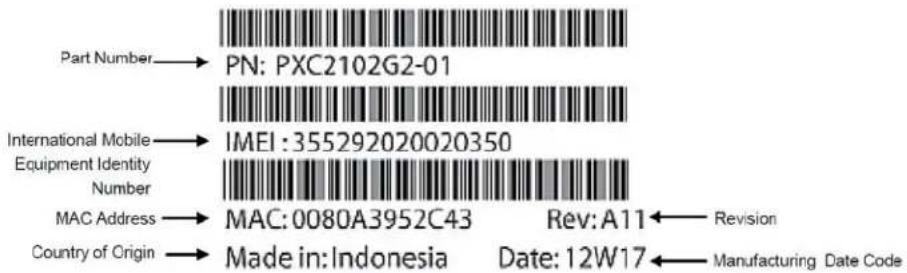
text_image
Part Number→ PN: PXC2102G2-01 International Mobile→ IMEI:355292020020350 Equipment Identity Number MAC Address→ MAC:0080A3952C43 Rev:A11←Revision Country of Origin→ Made in:Indonesia Date:12W17←Manufacturing Date Code3: Installation of PremierWave XC Device
This chapter describes how to install the PremierWave XC intelligent gateway. It contains the following sections:
Package Contents
User-Supplied Items
Hardware Components
Installing the PremierWave XC Device
Package Contents
The PremierWave XC package includes the following items:
PremierWave XC device
◆ 3-pin terminal mating connector
◆ 6-pin terminal mating connector
◆ RJ-45 Ethernet Straight CAT5 cable, 1.5 meter
◆ External antenna with an RP-SMA connector
Power supply 12 VDC with international adapters
- Mounting components (DIN rail mounting adapter, cover plates, and rubber feet)
Quick Start Guide
User-Supplied Items
To complete your installation, you need the following items:
RS-232/422/485 serial devices that require network connectivity
- A serial cable, as listed below, for each serial device. One end of the cable must have a female DB9 connector for the serial port.
- A null modem cable to connect the serial port to another DTE device.
- A straight-through modem cable to connect the serial port to a DCE device.
An available connection to your Ethernet network and an Ethernet cable.
A working SIM Card with your Network Carrier or Service Provider
A working DDNS Account with DynDNS.com.
A working AC power outlet if the unit will be powered from an AC outlet using the included 12 VDC power supply
An additional power supply (9-30VDC) to power the device using the 3-pin terminal connector.
Hardware Components
The PremierWave XC intelligent gateway has two male DB9 serial ports that support RS-232/422/485. Figure 3-2 shows the front view of the device. The default serial port settings are 9600 baud, 8 bits, no parity, 1 stop bit, no flow control.
Top Panel
Figure 3-1 shows the top panel of the PremierWave XC intelligent gateway. Lists and describes the LEDs.
Figure 3-1 PremierWave XC Top View
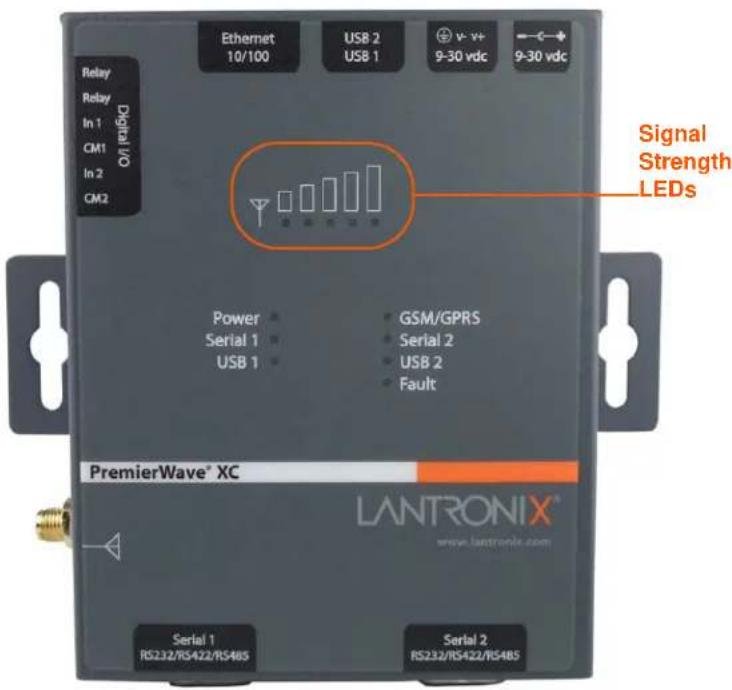
text_image
Ethernet 10/100 USB 2 USB 1 v- v+ 9-30 vdc 9-30 vdc Relay Relay In 1 CM1 In 2 CM2 Digital I/O Signal Strength LEDs Power Serial 1 USB 1 GSM/GPRS Serial 2 USB 2 Fault PremierWave® XC LANTRONIX® www.lantronix.com Serial 1 RS232/RS422/RS4BS Serial 2 RS232/RS422/RS4BSFigure 3-2 PremierWave XC Male DB9 DTE Serial Ports
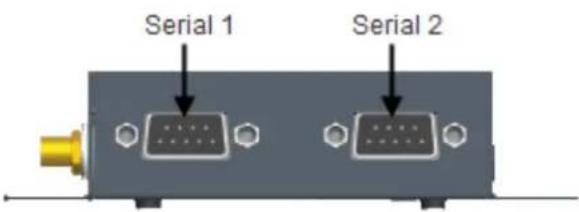
text_image
Serial 1 Serial 2Figure 3-3 PremierWave XC Pinout Configuration for RS-232
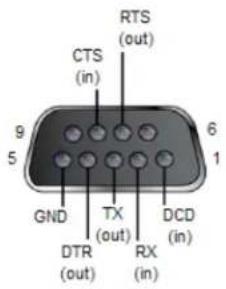
text_image
RTS (out) CTS (in) 9 5 GND TX (out) DCD (in) 6 1 DTR (out) RX (in)Figure 3-4 PremierWave XC Pinout Configuration for Full Duplex RS-422/485 (4-wire)

text_image
TX+ RX- 9 5 6 1 GND TX- RX+Figure 3-5 PremierWave XC Pinout Configuration for Half Duplex RS-422/485 (2-wire)
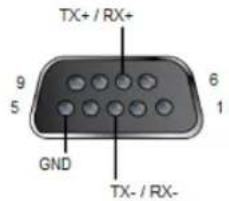
text_image
TX+ / RX+ 9 5 GND 6 1 TX- / RX-Back Panel
On the PremierWave XC back panel, there is a Barrel Connector for Primary Power (Power 1), a 3-Pin Terminal Connector for Secondary Power (Power 2), USB 1, USB2, RJ-45 Ethernet Port and Reset button as shown in Figure 3-6.
Figure 3-6 PremierWave XC Back Panel View Unit

text_image
Power 2 (9-30VDC) USB 2 Reset Button (pin hole) Power 1 (9-30VDC) USB 1 Ethernet PortThe Ethernet Port has two LEDs that indicate the status connection as follows:
Table 3-7 Ethernet LEDs
| Ethernet LEDs Description | |
| Left (L) | GREEN ON - 100 Mbps link establishedGREEN Blink - 100 Mbps activityAMBER ON - 10 Mbps link establishedAMBER Blink - 10 Mbps activity |
| Right (R) GREEN | ON - Full duplexOFF - Half duplex |
The Ethernet port can connect to an Ethernet (10 Mbps) or Fast Ethernet (100 Mbps) network.
Table 3-8 PremierWave XC LEDs and Descriptions
| LED Description | |
| Power | ◆ GREEN - displays a solid light when power is properly supplied ◆ OFF - no power supplied |
| GSM/GPRS | ◆ GREEN - displays a solid light when GPRS is connected (e.g. after an APN has been properly configured). ◆ AMBER - displays a solid light when GSM is connected. Once the radio connection has been established with the cellular carrier. ◆ OFF - no connection. Reasons for OFF are that it cannot register with cellular provider (wrong PIN code, cellular provider unavailable, or incorrect APN). |
| Serial 1 | ◆ GREEN - flashes when Serial port 2 is transmitting data ◆ AMBER - flashes when Serial port 2 is receiving data ◆ OFF - when no data is being transmitted or received through Serial port 2 |
| Serial 2 | ◆ GREEN - flashes when Serial port 2 is transmitting data ◆ AMBER - flashes when Serial port 2 is receiving data ◆ OFF - when no data is being transmitted or received through Serial port 2 |
| USB 1 | ◆ GREEN - displays a solid light when a USB device is connected to USB 1 Host port and is functioning properly ◆ OFF- when no USB device is connected to USB 1 Host port |
| USB 2 | ◆ GREEN - displays a solid light when a USB device is connected to USB 2 Host port and is functioning properly. ◆ OFF- when no USB device is connected to USB 2 Host port. |
| Fault/Diagnostic | ◆ RED - flashes when events or errors have occurred ◆ OFF - when system is functioning normally |
| GSM Signal Strength | ◆ GREEN – 3 to 5 LEDs lighted indicates good to strong signal strength ◆ AMBER/GREEN – 1 to 2 bi-colored LEDs lighted indicates a weak signal strength |
Table 3-9 Fault Conditions Indicated by Blink Patterns
| Fault Conditions Blink Pattern | |
| No Ethernet link when eth0 (Ethernet Network) is enabled | Long, long, short, short, 2 seconds off (pattern repeats) |
| No IP obtained from ethernet network when eth0 (Ethernet Network) is enabled. | Long, long, long, short, short, short, 2 seconds off (pattern repeats) |
| No link (no detected) Long (pattern repeats) | |
| Fault Conditions (continued) Blink Pattern | |
| No cellular link when wwan0 (Cellular Network) is enabled Long, long, long, long, short, 2 seconds off (pattern repeats) | |
| No IP obtained from when wwan0 (Cellular Network) is enabled | Long, long, long, short, short, short, 2 seconds off (pattern repeats) |
| When the internal device temperature is below operating limit. | Short, short, short, short, 2 seconds off (pattern repeats) |
| When the internal device temperature is above operating limit. | Long, short, short, short, 2 seconds off (pattern repeats) |
| Loss of power or when barrel power input is below 9 volts Long, short, short, 2 seconds off (pattern repeats) | |
Table 3-10 Cellular Signal Strength Indicator
| Signal Strength Color & Number of LED Signal Bars | |
| Greater than or equal to -64 dBm 5 Green | |
| Greater than or equal to -85 dBm and less than -64 dBm 4 Green | |
| Greater than or equal to -75 dBm and less than -85 dBm 3 Green | |
| Greater than or equal to -86 dBm and less than -75 dBm 2 Amber | |
| Greater than or equal to -112 dBm and less than -86 dBm 1 Amber | |
| Less than -113 dBm or unmeasurable All Off |
Notes:
For Table 3-9 above, a "long" blink is 0.7 seconds of light followed by 0.3 seconds of no light. A "short" blink is a light that is on for only 0.2 seconds and followed by 0.2 seconds of no light.
The diagnostic blink patterns reflect the highest priority fault condition. Also, the Diagnostic LED will give an initial, identifying blink pattern to indicate the type of diagnostic information it will display. All power and other non-network related diagnostic patterns begin with one long blink. All wired LAN related diagnostics patterns begin with two long blinks. All cellular-related diagnostics patterns begin with three long blinks.
Reset Button
You can reset the PremierWave XC intelligent gateway to factory default settings, including clearing the network settings. The IP address, gateway, and netmask are set to 00s.
To reset the unit to factory defaults:
- Place the end of a paper clip or similar object into the RST (reset) opening (see Figure 3-6) and press and hold down micro switch during a power cycle for a minimum of 10-15 seconds.
- Remove the paper clip to release the button. The unit will continue the boot process restoring it back to the original factory default settings.
Side Panel
On the PremierWave XC side panel, there is a 6-pin Terminal Connector for Relay, I/Os, and an SMA Connector for Antenna as shown in Figure 3-11.
Figure 3-11 PremierWave XC Side View

text_image
I/Os Relay CM1 CM2 Relay | In1 | In2 | Antenna ConnectorTable 3-12 PremierWave XC Connections (Side)
| Connector Description | |||
| Relay Output Outputs Support 1A 24V | |||
| Inputs Inputs accept voltage 0 to 30 VDC. | |||
| ON Max 30 VDC | |||
| Min 2 VDC | |||
| OFF Max 0.7 VDC | |||
| Min 0 VDC | |||
| Antenna Connect the provided SMA Antenna. | |||
Bottom Panel
On the PremierWave XC bottom panel, there is the cover for the SIM card as shown in Figure 3-13.
Figure 3-13 PremierWave XC, Bottom View

text_image
SIM Cover LM-201X® Power/Power/DC L.T. E: 600V © 1598 PCC ID: R@PXC PL: PCC17003-01 PL: PCC17003-02 PL: PCC17003-03 PL: PCC17003-04 PL: PCC17003-05 PL: PCC17003-06 PL: PCC17003-07 PL: PCC17003-08 PL: PCC17003-09 PL: PCC17003-10 PL: PCC17003-11 PL: PCC17003-12 PL: PCC17003-13 PL: PCC17003-14 PL: PCC17003-15 PL: PCC17003-16 PL: PCC17003-17 PL: PCC17003-18 PL: PCC17003-19 PL: PCC17003-20 PL: PCC17003-21 PL: PCC17003-22 PL: PCC17003-23 PL: PCC17003-24 PL: PCC17003-25 PL: PCC17003-26 PL: PCC17003-27 PL: PCC17003-28 PL: PCC17003-29 PL: PCC17003-30 PL: PCC17003-31 PL: PCC17003-32 PL: PCC17003-33 PL: PCC17003-34 PL: PCC17003-35 PL: PCC17003-36 PL: PCC17003-37 PL: PCC17003-38 PL: PCC17003-39 PL: PCC17003-40 PL: PCC17003-41 PL: PCC17003-42 PL: PCC17003-43 PL: PCC17003-44 PL: PCC17003-45 PL: PCC17003-46 PL: PCC17003-47 PL: PCC17003-48 PL: PCC17003-49 PL: PCC17003-50 PL: PCC17003-51 PL: PCC17003-52 PL: PCC17003-53 PL: PCC17003-54 PL: PCC17003-55 PL: PCC17003-56 PL: PCC17003-57 PL: PCC17003-58 PL: PCC17003-59 PL: PCC17003-60 PL: PCC17003-61 PL: PCC17003-62 PL: PCC17003-63 PL: PCC17003-64 PL: PCC17003-65 PL: PCC17003-66 PL: PCC17003-67 PL: PCC17003-68 PL: PCC17003-69 PL: PCC17003-70 PL: PCC17003-71 PL: PCC17003-72 PL: PCC17003-73 PL: PCC17003-74 PL: PCC17003-75 PL: PCC17003-76 PL: PCC17003-77 PL: PCC17003-78 PL: PCC17003-79 PL: PCC17003-80 PL: PCC17003-81 PL: PCC17003-82 PL: PCC17003-83 PL: PCC17003-84 PL: PCC17003-85 PL: PCC17003-86 PL: PCC17003-87 PL: PCC17003-88 PL: PCC17003-89 PL: PCC17003-90 PL: PCC17003-91 PL: PCC17003-92 PL: PCC17003-93 PL: PCC17003-94 PL: PCC17003-95 PL: PCC17003-96 PL: PCC17003-97 PL: PCC17003-98 PL: PCC17003-99 PL: PCC17003-1,2,4,5,6,8,9,12,14,26,28,29,42,44,46,48,5,6,8,9,12,24,26,28,42,44,46,48,5,6,8,9,12,24,26,28,42,44,46,48,5,6,8,9,12,24,26,28,42,44,46,48,5,6,8,9,12,24,26,28,42Installing the PremierWave XC Device
Be sure to place or mount the device securely on a flat horizontal or vertical surface. The device comes with brackets for mounting it, for example, on a wall. If using AC power, do not use outlets controlled by a wall switch.
Observe the following guidelines when connecting the serial devices:
The PremierWaveXC unit serial ports support RS-232/422/485.
Use a null modem cable to connect the serial port to another DTE device. Use a straight-though (modem) cable to connect the serial port to a DCE device.
Connect your RJ-45 Ethernet cable to the RJ-45 port of the unit.
The PremierWave XC device supports a power range of 9 to 30 VDC. You can power up the device with barrel-power connector and/or the 3-pin terminal connector for backup power supply.
Note: As soon as you plug the device into power, the device powers up automatically, the self-test begins, and LEDs would indicate the device's status
Perform the following steps to install your device:
-
With the power unplugged, insert your SIM card (see Figure 3-15).
a. Remove SIM compartment door, secured by two screws. b. Open SIM slot fastener (sliding top fastener towards power connector).
c. Insert the SIM Card in SIM slot (with contacts facing toward main board).
d. Close and lock SIM slot fastener (sliding top fastener away from power connector).
e. Secure SIM compartment door accordingly and secure with screws provided. -
Connect an RJ-45 Ethernet cable between the unit and your Ethernet network.
-
Connect the antennas to the SMA connectors on the backside. Do note that the safe distance due to RF exposure from antenna is 23 cm. (See Figure 3-14.)
Note: Antennas must be installed prior to powering on the unit. Do not remove or connect the antennas while the unit power is on.
- Connect serial devices to the serial port of the unit.
- Plug the PremierWave XC device into the power outlet by using the power supply that was included in the packaging.
- Power up serial devices.
Figure 3-14 PremierWave XC Connections

text_image
10/100Base-T Ethernet Cat5 Ethernet Cable Antenna UNTRONIX Serial DevicesFigure 3-15 PremierWave XC SIM Insertion
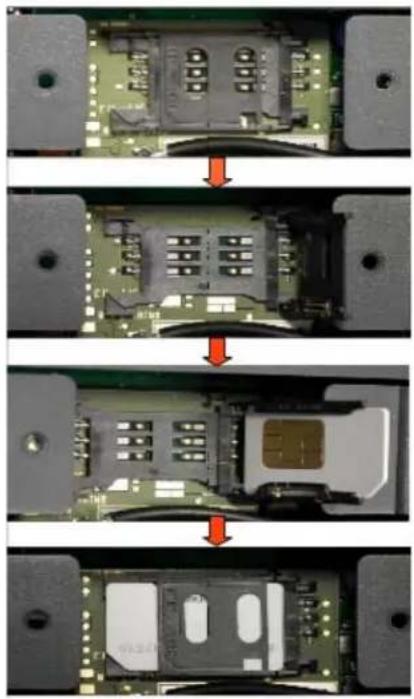
natural_image
Four-panel diagram showing a computer motherboard with internal components and a close-up view of the interior (no text or symbols)Figure 3-16 PremierWave XC Unit Dimensions in Inches (in)

text_image
Ethernet 16/100 USB 2 USB 1 + 20 vdc + 30 vdc + 30 vdc Delay Relay In 1 GMI In 2 GMS 4.25 Power Serial 1 USB 1 GSM/GPRS Serial 2 USB 2 Fault PremierWave® XC LANTRONIX® www.Lantronix.com Serial 1 RS22/RS422/RS485 Serial 2 RS22/RS422/RS485 1.14 3.354: Device Discovery and Quick Setup
Software embedded within the PremierWave XC intelligent gateway enables the device to be easily discovered via the Ethernet network without any knowledge of the IP address or default network configuration of the device.
The two methods supported are:
- Accessing the PremierWave XC Device Using UPnP
- Accessing the PremierWave XC Device Using DeviceInstaller
Accessing the PremierWave XC Device Using UPnP
This section covers the steps for locating a PremierWave XC unit and viewing its properties and device details using UPnP (Network Discovery). You may also use the DeviceInstaller utility to discover PremierWave XC units. See Accessing the PremierWave XC Device Using DeviceInstaller on page 35.
The PremierWave XC units can be discovered automatically from Microsoft Windows® platforms using UPnP (Network Discovery). UPnP enables devices to be discovered and a refreshed list of devices available under "Network Places" within Windows Explorer as devices come online or go offline.
Using the operations described below, it becomes a "plug and play" mechanism to reach the device's Web UI (Web Manager) and complete the rest of the configuration.
Note: There is no new software to install as UPnP support is built-into Windows operating systems, however it must be enabled on the Windows PC. Please see notes on enabling UPnP (Network Discovery) on Windows XP and Windows 7 operating systems.
To search devices on Windows XP operating system:
- Click Start->My Network Places. Lantronix PremierWave XC devices will be listed like other network devices.
- Double-click your device to view the device web page.
To search devices on Windows 7 operating system:
- Click Start->Computer->Network. Lantronix PremierWave XC devices will be listed like other network devices.
- Double-click or right click your device and select "View device webpage" to view the device web page.
To view device properties on Windows XP operating system:
- Click Start->My Network Places. Lantronix PremierWave XC devices will be listed like other network devices.
- Right click your device and select Properties to view the device properties.
To search device properties on Windows 7 operating system:
- Click Start->Computer->Network. Lantronix PremierWave XC device will be listed like other network devices.
- Right click your device and select Properties to view the device properties.
Accessing the PremierWave XC Device Using Devicelnstaller
This section covers the steps for locating a PremierWave XC unit and viewing its properties and device details. The DeviceInstaller application is a free utility program provided by Lantronix that discovers, configures, upgrades and manages Lantronix device servers.
Notes:
For instructions on using the DeviceInstaller utility to configure the IP address and related settings or for more advanced features, see the DeviceInstaller Online Help.
Auto IP generates a random IP address in the range of 169.254.0.1 to 169.254.255.254, with a netmask of 255.255.0.0, if no BOOTP or DHCP server is found. These addresses are not routable.
- Accessing the PremierWave XC Device Using UPnP on page 34
Make note of the MAC address. It may be needed to perform various functions in DeviceInstaller.
To use the DeviceInstaller utility, first install the latest version from the downloads page on the Lantronix web site www.lantronix.com/downloads.
- Run the executable to start the installation process and respond to the installation wizard prompts. (If prompted to select an installation type, select Typical.)
- Click Start -> All Programs -> Lantronix -> Devicelnstaller 4.4 -> Devicelnstaller.
- When DeviceInstaller starts, it will perform a network device search. To perform another search, click Search.
- Expand the PremierWave folder by clicking the + symbol next to the folder icon. The list of available Lantronix PremierWave devices appears.
- Select the PremierWave XC unit by expanding its entry and clicking on its IP address to view its configuration.
- On the right page, click the Device Details tab. The current PremierWave XC configuration appears. This is only a subset of the full configuration; the full configuration may be accessed via Web Manager, CLI or XML.
Device Detail Summary
Note: The settings are Display Only in this table unless otherwise noted
| Current Settings Description | |
| Name Shows PremierWave XC device name. | |
| DHCP Device Name | Displays one of the names the PremierWave XC device unit will send to the DHCP server if it is configured to obtain an address in this manner. |
| Group | Configurable field. Enter a group to categorize the PremierWave unit. Double-click the field, type in the value, and press Enter to complete. This group name is local to this PC and is not visible on other PCs or laptops using DeviceInstaller. |
| Current Settings | Description |
| Comments | Configurable field. Enter comments for the PremierWave unit. Double-click the field, type in the value, and press Enter to complete. This description or comment is local to this PC and is not visible on other PCs or laptops using Devicelnstaller. |
| Device Family Shows the PremierWave device family type as “PremierWave”. | |
| Short Name Shows "premierwave_xcby default. | |
| Long Name Shows Lantronix PremierWave XC by default. | |
| Type Shows the device type as “PremierWave XC”. | |
| ID Shows the “PremierWave” ID embedded within the unit. | |
| Hardware Address Shows the PremierWave hardware (MAC) address. | |
| Firmware Version Shows the firmware currently installed on the PremierWave unit. | |
| Extended Firmware Version Provides additional information on the firmware version. | |
| Online Status | Shows the PremierWave unit status as Online, Offline, Unreachable (the PremierWave is on a different subnet), or Busy (the PremierWave is currently performing a task). |
| IP Address Shows the PremierWave current IP address. To change the IP address, click the Assign IP button on the Devicelnstaller menu bar. | |
| IP Address was Obtained | Appears “Dynamically” if the PremierWave device automatically received an IP address (e.g., from DHCP). Appears “Statically” if the IP address was configured manually.If the IP address was assigned dynamically, the following fields appear:Obtain via DHCP with values of True or False.Obtain via BOOTP with values of True or False. |
| Subnet Mask | Shows the subnet mask specifying the network segment on which the PremierWave unit resides. |
| Gateway | Shows the IP address of the router of this network.There is no default. |
| Number of Serial Ports | Shows the number of serial ports on unit. |
| Number of Relay Outputs | Shows the number of relay outputs on the PremierWave intelligent gateway. |
| Supports Configurable Pins | Shows unit. |
| Supports Email Triggers | Shows True, indicating email triggers are available on the PremierWave unit |
| Telnet Supported | Indicates whether Telnet is enabled on this PremierWave unit. |
| Telnet Port | Shows the PremierWave port for Telnet sessions. |
| Web Port | Shows the PremierWave port for Web Manager configuration (if Web Enabled field is True). |
| Firmware Upgradable | Shows True, indicating the PremierWave firmware is upgradable as newer versions become available. |
5: Configuration Using Web Manager
This chapter describes how to configure the PremierWave XC intelligent gateway using Web Manager, the Lantronix browser-based configuration tool. The unit's configuration is stored in non-volatile memory and is retained without power. All changes take effect immediately, unless otherwise noted. It contains the following sections:
- Accessing Web Manager
Device Status Page
Web Manager Components
♦ Navigating Web Manager
Accessing Web Manager
Note: You can also access the Web Manager by selecting the Web Configuration tab on the DeviceInstaller application window.
To access Web Manager, perform the following steps:
- Open a standard web browser. Lantronix supports the latest versions of Internet Explorer, Mozilla Firefox, Safari or Chrome web browsers.
- Enter the IP address or hostname of the PremierWave XC unit in the address bar. The IP address may have been assigned manually using Devicelnstaller (see the PremierWave XC Intelligent Gateway Quick Start Guide) or automatically by DHCP.
- Enter your username and password. The factory-default username is "admin" and "PASS" is the default password. The Device Status web page displays configurations including network settings, line settings, tunneling settings, and product information.
Device Status Page
The Device Status page is the first to appear after you log into Web Manager. The Device Status page also appears when you click Status in the menu bar in Web Manager.
Figure 5-1 PremierWave XC Device Status Page
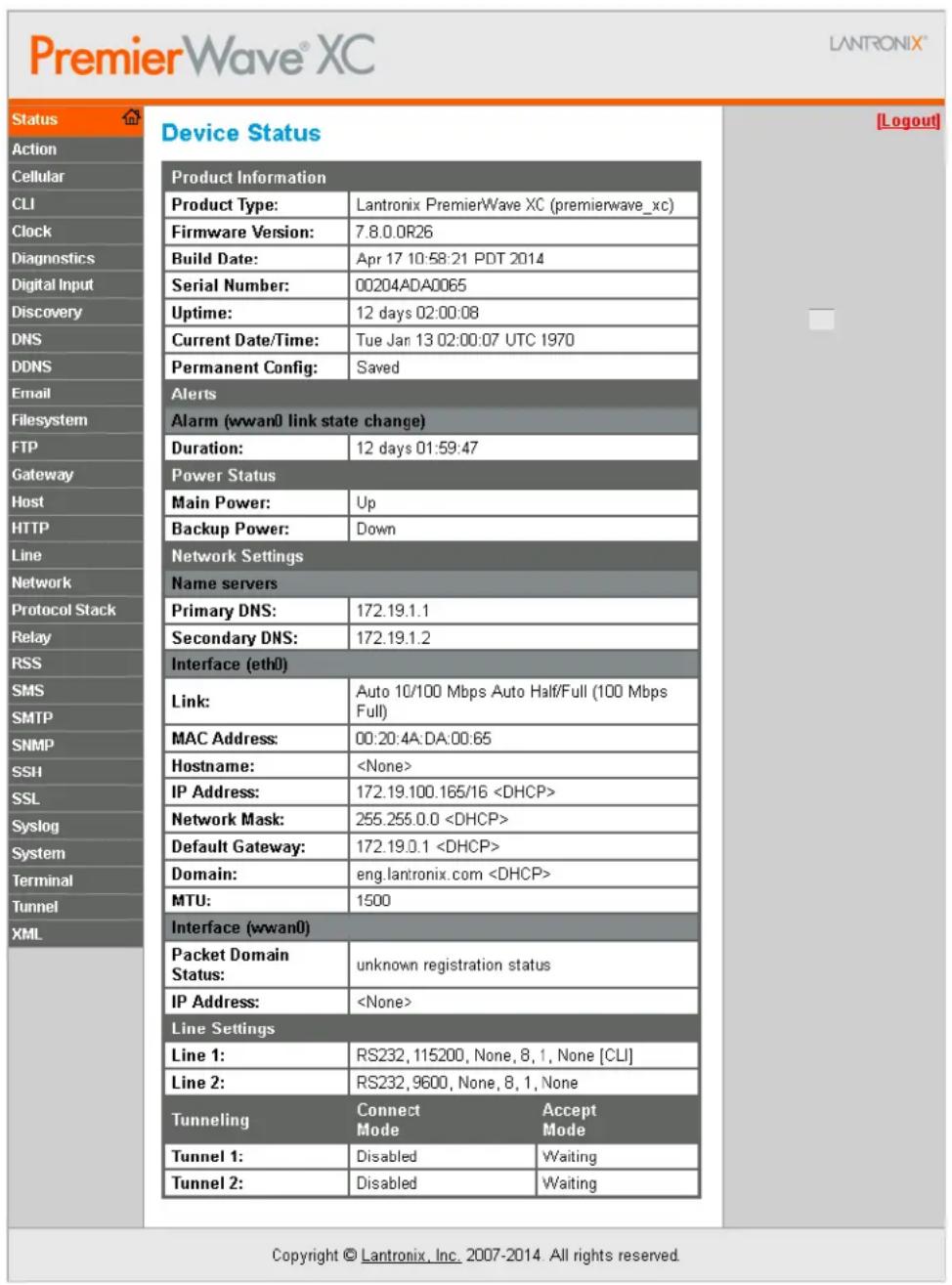
text_image
PremierWave® XC LANTRONIX® Status Action Cellular CLI Clock Diagnostics Digital Input Discovery DNS DDNS Email Filesystem FTP Gateway Host HTTP Line Network Protocol Stack Relay RSS SMS SMTP SNMP SSH SSL Syslog System Terminal Tunnel XML Device Status Product Information Product Type: Lantronix PremierWave XC (premierwave_xc) Firmware Version: 7.8.0.0R26 Build Date: Apr 17 10:58:21 PDT 2014 Serial Number: 00204ADA0065 Uptime: 12 days 02:00:08 Current Date/Time: Tue Jan 13 02:00:07 UTC 1970 Permanent Config: Saved Alerts Alarm (wwan0 link state change) Duration: 12 days 01:59:47 Power Status Main Power: Up Backup Power: Down Network Settings Name servers Primary DNS: 172.19.1.1 Secondary DNS: 172.19.1.2 Interface (eth0) Link: Auto 10/100 Mbps Auto Half/Full (100 Mbps Full) MAC Address: 00:20:4A:DA:00:65 Hostname: IP Address: 172.19.100.165/16Note: The Logout button is available on any web page. Logging out of the web page forces re-authentication the next time the web page is accessed.
Web Manager Components
The layout of a typical Web Manager page is below.
Figure 5-2 Components of the Web Manager Page

text_image
Items to configure Links to subpages Logout button PremierWave® XC Header Status Action Cellular CLI Clock Diagnostics Digital Input Discovery DNS DDNS Email Filesystem FTP Gateway Host HTTP Line Network Protocol Stack Relay RSS SMS SMTP SNMP SSH SSL Syslog System Terminal Tunnel XML Menu Bar Network 1 Network 2 Interface Link QoS Status Configuration Network 2 (wwan0) QoS Configuration WARNING QoS is disabled. QoS Configuration: State: Enabled Disabled Import filters: Enabled Disabled Uplink Speed: 12.96 kbps MAC Address filters Delete MAC Address Priority Network filters Delete Network Priority Port filters Delete Port or Port Range Priority Add a new filter Filter type: MAC Address MAC Address: Priority: Excellent Effort Submit Footer Configuration and/or Status Area Items to configure Logout This page is used to configure QoS. Use State to enable or disable QoS. Use Import filters to import filter configuration from other interfaces. This is helpful when more than one interface is enabled and traffic route is determined based on interface priority. Use Uplink speed to specify the maximum uplink speed in kbps. Set 'c' to use the default Note: Default is set to 90 percent of the maximum link speed. Use MAC Address filter to prioritize traffic from a particular device without a IP address on your LAN. Use Network filter to prioritize traffic from a device on your LAN or to a device on WAN. These are entered as hostname or in CIDR notation including the network prefix. For example, to prioritize traffic from a single IP address enter xxxxxx.xxx.xx/32. Use Port Range filter to prioritize traffic from and to a specific port or port range. The port range is entered as start-end. Filter priorities are checked in the following order: MAC Address, Network, and Port. Priority is priority of the filter. Network Control and Internetwork Control are typically used for network control packets such as ICMP and have the highest priorities. Bandwidth allocation is minimum 5% each. Voice: Bandwidth allocation is minimum 30%. Video: Bandwidth allocation is minimum 20%. Critical Applications: Bandwidth allocation is minimum 15%. Excellent Effort: Bandwidth allocation is minimum 10%. Best Effort: Bandwidth allocation is minimum 10%. Background: Bandwidth allocation is minimum 5% and has the lowest priority. Copyright © Lantronix, Inc. 2007-2014. All rights reserved. Information and Help AreaWeb Manager pages have these sections:
The menu bar always appears at the left side of the page, regardless of the page shown. The menu bar lists the names of the pages available in the Web Manager. To bring up a page, click it in the menu bar.
The main area of the page has these additional sections:
- Links near the top of many pages, such as the one in the example above, enable you to link to additional subpages. On some pages, you must also select the item you are configuring, such as a tunnel.
In the middle of many pages, you can select or enter new configuration settings. Some pages show status or statistics in this area rather than allow you to enter settings.
At the bottom of most pages, the current configuration is displayed. In some cases, you can reset or clear a setting.
When a parameter is changed on the page, a Submit button will appear. Click on this button to save the change.
The information or help area shows information or instructions associated with the page.
A Logout link is available at the upper right corner of every page. In Chrome or Safari, it is necessary to close out of the browser to completely logout. If necessary, reopen the browser to log back in.
The footer appears at the very bottom of the page. It contains copyright information and a link to the Lantronix home page.
Navigating Web Manager
The Web Manager provides an intuitive point-and-click interface. A menu bar on the left side of each page provides links you can click to navigate from one page to another. Some pages are read-only, while others let you change configuration settings.
Note: There may be times when you must reboot the PremierWave XC device for the new configuration settings to take effect. The chapters that follow indicate when a change requires a reboot. Anytime you reboot the unit, this operation will take some time to complete. Please wait a minimum of 25-30 seconds after rebooting the unit before attempting to make any subsequent connections.
Table 5-3 Web Manager Pages
| Web Manager Page Description See | Page | |
| Status | Shows product information, network, line, and tunneling settings. | 38 |
| Action | Allows you to view and configure the actions for a specific alarm or report. | 59 |
| Cellular | Shows cellular statistics and lets you change the current CLI configuration settings. | 56 |
| CLI | Shows Command Line Interface (CLI) statistics and lets you change the current CLI configuration settings. | 109 |
| Clock Allows you to view and configure the current date, time and time zone as it displays in web manager. | 106 | |
| Web Manager Page (continued) | Description | See Page |
| Diagnostics | Lets you perform various diagnostic procedures. | 103 |
| Digital Input | Allows you to view and configure digital input, shows current input status and allows you to scale and modify display of both digital inputs. | 61 |
| Discovery | Allows you to view and modify the configuration and statistics for device discovery. | 82 |
| DNS | Shows the current configuration of the DNS subsystem and the DNS cache. | 76 |
| Email Shows email statistics and lets you clear the email log, configure email settings, and send an email. | 83 | |
| Filesystem | Shows file system statistics and lets you browse the file system to view a file, create a file or directory, upload files using HTTP, copy a file, move a file, or perform TFTP actions. | 99 |
| FTP | Shows statistics and lets you change the current configuration for the File Transfer Protocol (FTP) server. | 76 |
| Gateway | Shows statistics and lets you change the current configuration for the gateway. | 50 |
| Host | Lets you view and change settings for a host on the network. | 74 |
| HTTP | Shows HyperText Transfer Protocol (HTTP) statistics and lets you change the current configuration and authentication settings. | 78 |
| Line | Shows statistics and lets you change the current configuration and Command mode settings of a serial line. | 62 |
| Network | Shows status and lets you configure the network interface. | 42 |
| Protocol Stack | Lets you perform lower level network stack-specific activities. | 101 |
| Query Port | Lets you change configuration settings for the query port. | 103 |
| Relay Allows you to view and configure relay output, shows current relay output statuses and allows you to modify display of both relays. | 72 | |
| RSS | Lets you change current Really Simple Syndication (RSS) settings. | 80 |
| SMS | Shows and allows modification to the current configuration of SMS. | 85 |
| SMTP | Shows and allows modification the current configuration of SMTP. | 82 |
| SNMP | Shows and allows modification the current configuration of SNMP. | 81 |
| SSH | Lets you change the configuration settings for SSH server host keys, SSH server authorized users, SSH client known hosts, and SSH client users. | 92 |
| SSL | Lets you upload an existing certificate or create a new self-signed certificate. | 95 |
| Syslog | Lets you specify the severity of events to log and the server and ports to which the syslog should be sent. | 77 |
| System | Lets you reboot device, restore factory defaults, upload new firmware, and change the device long and short names. | 107 |
| Terminal | Lets you change current settings for a terminal. | 73 |
| Tunnel | Lets you change the current configuration settings for an incoming tunnel connection. | 64 |
| XML | Lets you export XML configuration and status records, and import XML configuration records. | 111 |
6: Network Settings
The Network Settings show the status of the Network interface/link and lets you configure the settings on the device. Interface settings are related to the configuration of the IP and related protocols. Link settings are related to the physical link connection, which carries the IP traffic.
The PremierWave XC intelligent gateway contains one Ethernet and one Cellular interface. The Ethernet interface is also called Network 1 or eth0, and the Cellular interface is also called Network 2 or wwan0.
Notes:
Some settings require a reboot to take effect. These settings are noted below.
- Wait a minimum of 25-30 seconds after rebooting the unit before attempting to make any subsequent connections.
The blue text in the XML command strings of this chapter are to be replaced with a user-specified name.
Network 1 (Ethernet "eth0") Interface Settings
Table 6-1 shows the network interface settings that can be configured.
Table 6-1 Network Interface Settings
| Network Interface Settings | Description |
| State Select to enable or | disable the interface. |
| BOOTP Client | Select to turn On or Off. At boot up, after the physical link is up, the PremierWave XC device will attempt to obtain IPv4 settings from a BOOTP server.Note:Overrides the configured IPv4 address/mask, gateway, hostname, and domain. When DHCP is Enabled, the system automatically uses DHCP, regardless of whether BOOTP is Enabled. Changing this value requires you to reboot the device. |
| DHCP Client | Select to turn On or Off. At boot up, after the physical link is up, the PremierWave XC unit will attempt to obtain IPv4 settings from a DHCP server and will periodically renew these settings with the server.Note:Overrides BOOTP, the configured IPv4 address/mask, gateway, hostname, and domain. Changing this value requires you to reboot the device.Note:Within Web Manager, click Renew to renew the DHCP lease. |
| Priority It ranges from 0-10. | Note:Lower priority number means higher preference. |
| Network Interface Settings (continued) | Description |
| IP Address | Enter the static IPv4 address to use for the interface. You may enter it alone or in CIDR format.Note: This setting will be used if Static IP is active (both DHCP and BOOTP are Disabled). Changing this value requires you to reboot the device. When DHCP or BOOTP is enabled, the PremierWave XC device tries to obtain an IPv4 address from a DHCP or BOOTP server. If it cannot, the PremierWave XC unit generates and uses an Auto IP address in the range of 169.254.xxx.xxx, with a network mask of 255.255.0.0. |
| Default Gateway Enter the IPv4 address of the router for this network.Note: This setting will be used if Static IP is active (both DHCP and BOOTP are Disabled). | |
| Hostname | Enter the hostname for the interface. It must begin with a letter or number, continue with a sequence of letters, numbers, or hyphens, and end with a letter or number. This setting will take effect immediately, but will not register the hostname with a DNS server until the next reboot. |
| Domain Enter the domain name suffix for the interface.Note: This setting will be used when either Static IP or Auto IP is active, or if DHCP/BOOTP is active and no Domain Suffix was acquired from the server. | |
| DHCP Client ID | Enter the ID if the DHCP server requires a DHCP Client ID option. The DHCP server's lease table shows IP addresses and MAC addresses for devices. The lease table shows the Client ID, in hexadecimal notation, instead of the PremierWave XC MAC address. |
| Primary DNS Enter the IP address of the primary Domain Name Server.Note: This setting will be used when either Static IP or Auto IP is active, or if DHCP/BOOTP is active and no DNS server was acquired from the server. | |
| Secondary DNS | Enter the IP address of the secondary Domain Name Server.Note: This setting will be used when either Static IP or Auto IP is active, or if DHCP/BOOTP is active and no DNS server was acquired from the server. |
| MTU | When DHCP is enabled, the MTU size is (usually) provided with the IP address. When not provided by the DHCP server, or using a static configuration, this value is used. The MTU size can be from 576 to 1500 bytes, the default being 1500 bytes. |
To Configure Network 1 Interface Settings
Using Web Manager
To modify Ethernet (eth0) settings, click Network on the menu and select Network 1 -> Interface -> Configuration.
Using the CLI
To enter the eth0 command level: enable -> config -> if 1
To enter the wlan0 command level: enable -> config -> if 2
Using XML
◆ Include in your file:
To View Network 1 Interface Status
Using Web Manager
In Network Interface Status, you can view both the current operational settings as well as the settings that would take effect upon a device reboot.
To view Ethernet (eth0) Status, click Network on the menu and select Network 1 -> Interface -> Status.
Network 1 (Ethernet "eth0") Link Settings
Physical link parameters can be configured for an Ethernet (eth0) Network Interface (see Table 6-2).
Table 6-2 Network 1 (eth0) Link Settings
| Network 1 Ethernet (eth0) Link Settings | Description |
| Speed Select the Ethernet link speed. (Default is Auto)◆Auto = Auto-negotiation of Link Speed◆10 Mbps = Force 10 Mbps◆100 Mbps = Force 100 Mbps | |
| Duplex Select the Ethernet link duplex mode. (Default is Auto)◆Auto = Auto-negotiation of Link Duplex◆Half = Force Half Duplex◆Full = Force Full Duplex | |
Notes:
When speed is Auto, duplex must be Auto or Half.
When speed is not Auto, duplex must be Half or Full.
Fixed speed Full duplex will produce errors connected to Auto, due to duplex mismatch.
To Configure Network 1 Link Settings
Using Web Manager
To modify Ethernet (eth0) Link information, click Network on the menu and select Network 1 > Link > Configuration.
Using the CLI
To enter the eth0 Link command level: enable -> config -> if 1 -> link
Using XML
◆ Include in your file:
Network 1 (Ethernet "eth0") QoS
QoS (Quality of Service) can be enabled and configured for both Network 1 (eth0) and Network 2 (wwan0). If enabled, the router will control the flow of outbound traffic according to the user-defined filters. In other words, QoS improves performance by allowing the user to prioritize applications. Filters can be defined to prioritize traffic based on the source or destination network, source or destination port, or the source MAC address. Up to 32 user-defined filters can be added. The following are predefined priority classes:
- Network Control and Internetwork Control are typically used for network control packets such as ICMP and have the highest priorities.
- Move bandwidth allocation is a minimum 5% each to Network control.
◆ Voice: Bandwidth allocation is minimum 30%.
◆ Video: Bandwidth allocation is minimum 20%.
Critical Applications: Bandwidth allocation is minimum 15%.
Excellent Effort: Bandwidth allocation is minimum 10%.
Best Effort: Bandwidth allocation is minimum 10%.
◆ Background: Bandwidth allocation is minimum 5% and has the lowest priority.
Table 6-3 shows the network QoS settings that can be configured including adding new filters.
Table 6-3 Network 1 (eth0) QoS Settings
| Network 1 (QoS) Settings Description | |
| State Click to enable or disable state. | |
| Import filters | Click to enable or disable import filters to import configurations from other interfaces. |
| Uplink Speed Enter the maximum uplink speed. Set 0 to set speed to default. | |
| Filter type Select the filter type from the drop-down window:◆ Network◆ Port | |
| Network Enter the Network, if the Network filter type is selected. | |
| Ports Enter the Port, if the Port filter type is selected. | |
| Priority | Select the priority of the filter from the drop-down menu. |
Table 6-4 Adding or Deleting Network 1 (eth0) QoS Settings
| Adding or Deleting Network 1 (QoS) Settings | Description |
| Delete | Click the checkbox to the left of any existing QoS filter to be deleted and click the Submit button. |
| Filter type Select the filter type from the drop-down window:◆ Network◆ Port | |
| Network Enter the Network, if the Network filter type is selected. | |
| Ports Enter the Port, if the Port filter type is selected. | |
| Priority | Select the priority of the filter from the drop-down menu. |
To Configure Network 1 QoS Settings
Using Web Manager
To modify Ethernet (eth0) QoS information, click Network on the menu and select Network 1 > QoS > Configuration.
Using the CLI
To enter the eth0 QoS command level: enable -> config -> if 1 -> qos
Using XML
◆ Include in your file:
Network 1 (Ethernet "eth0") Failover
PremierWave XC intelligent gateway provides basic Ethernet-to-Cellular failover, in the form of a "dead remote host reachability" mechanism (essentially a ping against a known host). If the remote host is determined to be not reachable, the device will failover to the cellular interface. If the remote host is determined to be reachable, the device will failback to the Ethernet interface.
Table 6-5 Network 1 (eth0) Failover Settings
| Network 1 (Failover) Settings | Description |
| State Click to enable or disable state. | |
| Failover Interface Always select wwan0 in the PremierWave XC intelligent gateway. | |
| Hostname Enter the remote host to test reachability. | |
| Ping Protocol Select ICMP or TCP based ping. | |
| Timeout Indicate the interval to wait for ping response from remote host. | |
| Interval Indicate the interval in which to test reachability | |
| Failover Threshold | Indicate the allowed number of failed pings – after which the device will failover to the cellular interface. |
| Failback Threshold | Indicate the number of successful pings – after which the device will failback to the Ethernet interface. |
To Configure Network 1 Failover Settings
Using Web Manager
To modify Failover settings, click Network on the menu and select Network 1 > Failover > Configuration.
Using the CLI
To enter the eth0 link command level: enable -> config -> if 1 -> failover
Using XML
◆ Include in your file:
Network 2 (Cellular "wwan0") Interface Settings
This page is used to view the status of the cellular interface on the device.
Note: Statistics are as measured by the device since bootup. Your service provider may account for data usage differently.
This page is used to configure the Cellular interface on the device. To see the effect of these items after a reboot, view the Status page.
Table 6-6 Network 2 (wwan0) Interface Settings
| Network 2 (wwan0) Interface Settings | Description |
| State Enable or Disable the interface. | |
| Priority It ranges from 0-10. Note: Lower priority number means higher preference. | |
| Connection Mode | ◆ The Always On connection mode keeps the device always connected to the cellular network. ◆ The On Demand connection mode leaves the link quiescent until an application attempts to make use of the cellular network connection. Be aware that in this mode, the first attempt to initiate a connection from the device server may fail, since a new IP address may need to be negotiated. ◆ The Shoulder Tap connection mode requires a short message (SMS) to make the link active. See the SMS Inbound configuration for details on the message syntax requirements. |
| Idle Timeout | If the connection mode is 'On Demand' or 'Shoulder Tap' and there is no network activity for Idle Timeout duration the device will automatically disconnect from the cellular network. |
| Primary DNS Enter the IP address of the primary Domain Name Server. Note: This setting will be used when either Static IP or Auto IP is active, or if DHCP/BOOTP is active and no DNS server was acquired from the server. | |
| Secondary DNS Enter the IP address of the secondary Domain Name Server. | |
| Note: This setting will be used when either Static IP or Auto IP is active, or if DHCP/BOOTP is active and no DNS server was acquired from the server. | |
To Configure Network 2 Interface Settings
Using Web Manager
To modify network 2 cellular interface information, click Network on the menu and select Network 2 > Interface > Configuration.
Using the CLI
To enter the cellular command level: enable -> config -> if 2
Using XML
◆ Include in your file:
Network 2 (Cellular "wwan0") Link Settings
This page shows configuration of an Cellular Link on the device.
| Network 2 Link Settings | Description |
| APN Enter the configurable network identifier used by a mobile device when connecting to a GSM carrier. | |
| Username | Enter the Username for dial up to cellular carrier, if required. |
| Password | Enter the Password for dial up to cellular carrier, if required. |
| Dialup String | Enter the modem string used for making connection to carrier. |
| Roaming Enable or disable the network roaming. | |
To Configure Network 2 Link Settings
Using Web Manager
To modify network 2 cellular interface information, click Network on the menu and select Network 2 > Link > Configuration.
Using the CLI
To enter the link command level: enable -> if 2 -> link
Using XML
◆ Include in your file:
Network 2 (Cellular "wwan0") QoS
QoS (Quality of Service) can be enabled and configured for both Network 1 (eth0) and Network 2 (wwan0). If enabled, the router will control the flow of outbound traffic according to the user-defined filters. In other words, QoS improves performance by allowing the user to prioritize applications. Filters can be defined to prioritize traffic based on the source or destination network, source or destination port, or the source MAC address. Up to 32 user-defined filters can be added. The following are predefined priority classes:
- Network Control and Internetwork Control are typically used for network control packets such as ICMP and have the highest priorities.
◆ Bandwidth allocation is a minimum 5% each.
◆ Voice: Bandwidth allocation is minimum 30%.
◆ Video: Bandwidth allocation is minimum 20%.
Critical Applications: Bandwidth allocation is minimum 15%.
Excellent Effort: Bandwidth allocation is minimum 10%.
Best Effort: Bandwidth allocation is minimum 10%.
◆ Background: Bandwidth allocation is minimum 5% and has the lowest priority.
Table 6-7 shows the network QoS settings that can be configured including adding new filters.
Table 6-7 Network 2 (wwan0) QoS Settings
| Network 2 (QoS) Settings Description | |
| State Click to enable or disable state. | |
| Import filters | Click to enable or disable import filters to import configurations from other interfaces. |
| Uplink Speed Enter the maximum uplink speed. Set 0 to set speed to default. | |
Table 6-8 Adding or Deleting Network 2 (wwan0) QoS Settings
| Adding or Deleting Network 2 (QoS) Settings | Description |
| Delete | Click the checkbox to the left of any existing QoS filter to be deleted and click the Submit button. |
| Filter type Select the filter type from the drop-down window:◆ Mac Address◆ Network◆ Port | |
| MAC Address | Enter the MAC address, if the MAC Address filter type is selected. |
| Network Enter the Network, if the Network filter type is selected. | |
| Ports Enter the Port, if the Port filter type is selected. | |
| Priority | Select the priority of the filter from the drop-down menu. |
To Configure Network 2 QoS Settings
Using Web Manager
To modify Ethernet (eth0) QoS information, click Network on the menu and select Network 2 > QoS > Configuration.
Using the CLI
To enter the eth0 QoS command level: enable -> config -> if 2 -> qos
Using XML
◆ Include in your file:
Gateway
PremierWave XC intelligent gateway can be configured as a cellular router with DHCP server functionality.
WAN
Table 6-9 WAN Configuration
| Gateway Settings Description | |
| Operating Mode Select the type of operating mode: | |
| Disabled: prevents the device to be used as a gateway; use the device normally.Gateway: allows the device to be used as a router with NAT.Router: allows the device to be used as a router without NAT. | |
| Firewall Select to enable or disable firewall: | |
| Enabled: enables the device firewall. Disabled: disable the device firewall. | |
| MAC Address filter Select to enable or disable the MAC address filter. | |
| Interface | Specify the WAN interface. Generally wwan0 (cellular) interface. |
| IP Address Assign a static IP address to the gateway. | |
| Primary DNS Enter the IP address of the primary Domain Name Server. | |
| Note: This setting will be used when either Static IP or Auto IP is active, or if DHCP/BOOTP is active and no DNS server was acquired from the server. | |
| Secondary DNS Enter the IP address of the secondary Domain Name Server. | |
| Note: This setting will be used when either Static IP or Auto IP is active, or if DHCP/BOOTP is active and no DNS server was acquired from the server. | |
WAN MAC Address Filters
Accept or drop traffic from specified MAC addresses using the settings below.
Table 6-10 Adding a New MAC Address Filters
| Adding or Deleting New MAC Address Filter Settings | Description |
| Delete Click the checkbox to the left of any existing mac address filter to be deleted and click the Submit button. | |
| MAC Address Enter a new mac address to add a new filter. | |
| Action | Select to Accept or Drop above indicated MAC Address field. |
To Configure Gateway WAN Settings
Using Web Manager
To modify gateway WAN information, click Gateway on the menu and select Configuration > WAN.
Using the CLI
To enter the gateway command level: enable -> config -> gateway
Using XML
◆ Include in your file:
Port Forwarding
Port forwarding allows remote computers (for example, computers on the Internet) to connect to a specific computer or service within a private local-area network (LAN). Port Forwarding rules apply to inbound traffic and will not work under these conditions:
The IP of the cellular device is not directly reachable from outside of the cellular providers network. The port forwarding rules will not work if there is no traffic.
- Hosts within the cellular providers network cannot reach the device.
- The port is blocked by the cellular provider.
If traffic to certain ports is blocked before it reaches the PremierWave device, the port forwarding rules will still not work even with a public and accessible IP.
Table 6-11 Port Forwarding Rules List
| Port Forwarding Rule Description | |
| Enabled Enables the port forwarding rule. | |
| Delete Deletes the port forwarding rule. | |
| Name User friendly name for the rule. Click on the [Edit] icon to make changes. | |
| Ingress IP Address: Port Range | Port or Port range for the rule. |
| Protocol Protocols for the rule: TCP, UDP, or Both. | |
| IP Address: Target Port Target for the port forwarding rule. | |
Table 6-12 Adding a New Port Forwarding Rule
| Adding New Port Forwarding Rule Settings | Description |
| Name User Friendly name for the rule (optional) | |
| Ingress IP Address(Optional) | Enter the destination address of the packets. This option can only be used with single ports and not with port range. |
| Start Port Starting port number | |
| End Port | End port number (optional). If start port and end port are same it assumes a single port. If start port and end port are not the same – it is a port range. |
| Protocol Protocols for the rule. TCP, UDP, or Both | |
| IP Address Target for the port forwarding rule. | |
| Target Port | Indicate the target port. This is the port which the packets are to be forwarded. This options can only be used with single ports andnot with port range. If this value is not specified. If this value is not specified, the packets are forwarded to same port or pot range. Optional field. |
To Configure Gateway Port Forwarding Settings
Using Web Manager
To modify gateway port forwarding information, click Gateway on the menu and select Configuration > Port Forwarding.
Using the CLI
To enter the gateway command level: enable -> config -> gateway -> port forwarding rule
Using XML
Include in your file:
Static Routes
Allows the user to add routes to the device routing table.
Table 6-13 Static Route Setting Routes
| Static Route Settings Description | |
| Enabled Enables the static route | |
| Delete Deletes the static route | |
| Name | User friendly name for the route. Click on the [Edit] icon to make changes. |
| Route Network or Host for the route | |
| Applied If the route was successfully applied. Routing table updates require a reboot and route needs to be valid as per other device configurables. | |
Table 6-14 Adding a New Static Route
| Adding New Static Route Settings | Description |
| Name User friendly name for the route | |
| Network Network or Host for the route | |
| Gateway Gateway for the route | |
| Interface Interface for the route | |
| Metric | Priority for the route. Lower metric means higher priority. |
To Configure Gateway Static Route Settings
Using Web Manager
To modify gateway static route information, click Gateway on the menu and select Configuration > Static Routes.
Using the CLI
To enter the gateway command level: enable -> config -> gateway -> static route
Using XML
◆ Include in your file:
DHCP Server
Allows the user to configure the device as a DHCP server.
Table 6-15 DHCP Settings
| DHCP Settings Description | |
| State Enable or Disable the DHCP server◆ Enabled: DHCP server is enabled◆ Disabled: DHCP server is disabled. | |
| Start IP Address Start IP Address of address pool | |
| End IP Address End IP Address of address pool | |
| Lease time | Duration for which lease is initially assigned. Clients must renew after this duration. |
To Configure Gateway DHCP Server Settings
Using Web Manager
To modify gateway DHCP server information, click Gateway on the menu and select Configuration > DHCP Server.
Using the CLI
To enter the gateway command level: enable -> config -> gateway -> dhcp server
Using XML
◆ Include in your file:
Static Lease Listing
The device also provides the ability to pre-assign specific IP addresses to connected devices using static leases. This would ensure that the connected device (identified by the MAC address) always gets the same IP address even while using DHCP.
Table 6-16 Static Lease Listing
| Static Lease List Settings Description | |
| Delete Click checkbox beside | existing static lease MAC Address/IP Address to delete, if available and if desired. |
| MAC Address MAC Address | of existing static leases are listed here. |
| IP Address Static IP Address | of existing static leases are listed here. |
Table 6-17 Add a Static Lease
| Add a Static Lease Settings | Description |
| MAC Address Enter the MAC | Address of the static lease to be added. |
| IP Address Enter static IP address of the static lease to be added. | |
DDNS
PremierWave XC intelligent gateway displays and allows configuration of the DDNS.
Table 6-18 DDNS Configuration
| DDNS Settings Description | |
| State Select to enable or disable the DDNS state. | |
| User Name Enter a user name for the DDNS account. | |
| Password Enter a password for the DDNS account. | |
| Host Name | Specify the host name to be used to update the DDNS. |
| Interval | Indicate the interval of minutes the IP address will be checked. The DDNS will be updated if the IP address has changed. |
To Configure Gateway WAN Settings
Using Web Manager
To view or configure DDNS information, click DDNS in the menu.
Using the CLI
To enter the gateway command level: enable -> config -> ddns
Using XML
Not any.
7: Cellular
The Cellular page displays the configuration and status for the Cellular module.
| Cellular Settings Description | |
| PIN Lock | Enable to prevent unauthorized use of the SIM card. |
| PIN | Enter PIN combination to enable PIN Lock. Caution: If you enter the PIN incorrectly 3 times, the SIM card will lock, and you will need a PIN Unblocking Key (PUK) to unlock your SIM card. PUK is required to unlock SIM cards that have become locked following 3 successive incorrect PIN entries. Caution: If you enter the PUK incorrectly 10 times, the SIM card will be permanently locked and no longer operable. |
| Allowed Bands | Select the allowed bands, determining the frequency band usage of the device. Select/Unselect individual bands to restrict the allowed bands to a specific band or band combination. |
To Configure Cellular Settings
Using Web Manager
Click Cellular on the menu.
Using the CLI
To enter the cellular command level: enable -> config -> cellular
Using XML
◆ Include in your file:
Typical Cellular Error (errcodes)
The following is a list of all errors that may appear in the Cellular module.
◆ PH-SIM PIN required
◆ PH-FSIM PIN required
PH-FSIM PUK required
SIM not inserted
SIM PIN required
SIM PUK required
SIM failure
SIM busy
SIM wrong
- incorrect password
SIM PIN2 required
SIM PUK2 required
8: Input/Output Ports
Relay Output
Note: When the relay is energized/turned on, the relay is closed, connecting both relay ports on the I/O connector through the relay. When the relay is turned off, the signal path is open, disconnecting the relay ports on the I/O connector.
Table 8-1 Relay Output Settings
| Relay Output Settings | Description |
| State | This field is found in the Relay Status page. Indicates state of the relay. Select On or Off to change the state of the relay. |
| Title | Enter the relay title as it will appear in web manager, XML and CLI. Leave this field blank to utilize the default “Relay N”, where N is the relay number. For example, you can name the reading, “Buzzer”, if a buzzer is connected to the PremierWave device. |
| Latch | Enable or disable Latch controls which determine how a relay will be turned off.◆ Selecting Enabled will require a user to explicitly reset latched relay and then turn it off.◆ Selecting Disabled, the relay will automatically turn off after any and all of the alarm triggers are no longer active. |
To Configure Relay Settings
Using Web Manager
To configure relay output, click Relay > Relay 1 > Status in the menu.
To change relay state, click Relay > Relay 1 > Configuration in the menu.
Using the CLI
To enter the relay command level: enable -> config -> relays -> relay
Using XML
◆ Include in your file: <configgroup name="relay" instance="
Digital Input
Table 8-2 contains additional configuration options for Digital Input 1 and Digital Input 2 settings:
Table 8-2 Digital Input Settings
| Digital Input Settings | Description |
| State | This field is found in the Digital Input Status page. Indicates state of the digital input. |
| Title | Fill in Title to customize how the digital input status will appear in the CLI, Web Manager, and XML status. Leave Title blank for the default title of "Digital Input N", where N is the digital input number. |
| Normal State | Select Normal State to Low or High. When input state anges, Normal State is used to compare with the input state. If the states are different, an alarm will be triggered which is configured under "Action" menu. |
To Configure Digital Input Settings
Using Web Manager
To modify digital input information, click Digital Input on the menu, select either Digital Input 1 or Digital Input 2, and click the Configuration link.
Using the CLI
To enter the digital input command level: enable -> config -> action -> digital input 1 state change
To enter the digital input command level: enable -> config -> action -> digital input 2 state change
Using XML
- Include in your file:
- Include in your file:
9: Action Settings
Actions can be configured for alarms and reports available in the PremierWave XC intelligent gateway device.
Alarms and Reports
PremierWave XC intelligent gateway updates the action settings page to display and configure the alarms. The following alarm and report actions are available in PremierWave XC device:
◆ Ethernet (eth0) Link State Change
◆ Cellular (wwan0) Link State Change
◆ Digital Input 1 State Change
◆ Digital Input 2 State Change
One or more types of "action" can be configured and triggered when an event occurs.
Actions
Table 9-1 contains the configuration options for all the alarms and reports listed above.
Table 9-1 Action Settings
| Action Settings Description | |
| Delay Use Delay to defer alarm processing. | Alarm actions will not be executed if the cause is corrected within this time. |
| Email Use Email to send an email to configured Email recipients. | If an Alarm Email profile number is selected, that email will be sent when the alarm is turned on. The contents of Alarm Message will be placed into the email body when an alarm email is sent. If the alarm stays on longer than the Reminder Interval, another alarm email is sent.If a Normal Email profile number is selected, that email will be sent when the alarm is turned off. The contents of Normal Message will be placed into the email body when a normal email is sent. If the alarm stays off longer than the Reminder Interval, another normal email is sent. |
| FTP Put Use FTP Put to put a file on configured FTP server. | Filename will be used to upload to remote FTP server. The IP Address or hostname is the FTP server to connect. Port number is port on which FTP server is listening on. Use Protocol to connect to FTP server. FTPS is a SSL encrypted communication channel and SSL Trusted Authorities must be setup with FTP server SSL certificate. Username is used to logon to FTP server. If FTP server does not require authentication, use anonymous. Password is used to logon to FTP server. If FTP server does not require authentication, a common practice is to use user's email address. If the alarm stays on or off longer than the Reminder Interval, another FTP Put is performed. In Sequential mode, connections will be attempted starting with number 1 until a connection is successful. In Simultaneous mode, all possible connections will be made. |
Action Settings Description
| HTTP Post Use HTTP | Post post to configured HTTP server.The URL appears behind the HTTP server IP address or hostname. E.g. http:// some_http_server/some_url The IP Address or hostname is the HTTP server to connect to. Port number is the port which HTTP server is listening on. Use Protocol to connect to HTTP server. HTTPS is a SSL encrypted communication channel and SSL Trusted Authorities must be setup withHTTP server SSL certificate. Username used to logon to HTTP server if authentication is required. Password used to logon to HTTP server if authentication is required. If the alarm stays on or off longer than the Reminder Interval, another HTTP Post is performed. In Sequential mode, connections will be attempted starting with number 1 until a connection is successful. In Simultaneous mode, all possible connections will be made. |
| Relay | Select a Relay to switch on when this alarm is activated. Select “None” so this alarm state will have no effect on any Relay. |
| GPRS Roaming | Select to enable or disable GPRS roaming when this alarm is on. Select No Change so this alarm State will have no effect on GPRS roaming. |
| SMS | Use SMS to send SMS to a configured Recipient.The contents of Alarm Message will be placed into the SMS body when an alarm SMS is sent. If the alarm stays on longer than the Reminder Interval, another alarm SMS is sent. The contents of Normal Message will be placed into the SMS body when a normal SMS is sent. If the alarm stays off longer than the Reminder Interval, another normal SMS is sent. |
| SNMP Trap Use SNMP | Trap to send SNMP trap to configured trap destinations.The contents of Alarm Message are included when an alarm SNMP trap is sent. If the alarm stays on longer than the Reminder Interval, another alarm SNMP Trap is sent. The contents of Normal Message are included when a normal SNMP trap is sent. If the alarm stays off longer than the Reminder Interval, another normal SNMP Trap is sent. |
To Configure Action Settings
Using Web Manager
To modify Action information, click Action on the menu and select a specific action from the drop-down menu. Alarms and Reports (on page 59) lists the options.
Using the CLI
To enter the eth0 link state change command level: enable -> config -> action -> eth0 link state change
To enter the wwan0 link state change command level: enable -> config -> action -> wwan0 link state change
To enter digital input 1 state change command level: enable -> config -> action -> digital input 1 state change
To enter digital input 2 state change command level: enable -> config -> action -> digital input 2 state change
Using XML
- Include in your file:
- Include in your file:
10: Line and Tunnel Settings
The PremierWave XC intelligent gateway has two tunnels through which you may view statistics or configure the Accept Mode. The PremierWave XC intelligent gateway contains two lines. All lines use standard RS232/RS485 serial ports. All lines can be configured to operate in the following modes:
RS232
◆ RS485 Full Duplex (also compatible with RS-422)
RS485 Half Duplex, with and without termination impedance
All serial settings such as Baud Rate, Parity, Data Bits, etc, apply to these lines.
Line Settings
The Line Settings allow configuration of the serial lines (ports).
Table 10-1 Line Configuration Settings
| Line Settings Description | |
| Name | Enter a name or short description for the line, if desired. By default, there is no name specified. A name that contains white space must be quoted. |
| Interface | Set the interface type for the Line. The default is RS232.Choices are:◆RS232◆RS485 Full-Duplex◆RS485 Half-Duplex |
| Termination | Select to Enable or Disable Line Termination. The default is Disable.Note: This setting is only relevant for Interface type RS485 Half-Duplex. |
| State | Select to Enable or Disable the operational state of the Line. The default is Enabled. |
| Protocol | Set the operational protocol for the Line. The default is Tunnel. Choices are:◆None◆Tunnel = Serial-Network tunneling protocol. |
| Baud Rate | Set the Baud Rate (speed) of the Line. The default is 9600.Any set speed between 300 and 921600 may be selected: 300, 600, 1200, 2400, 4800, 9600, 19200, 38400, 57600, 115200, 230400, 460800, 921600.When selecting a Custom baud rate, you may manually enter any value between 300 and 5000000.Note: The maximum baud rate in RS232 mode is 1000000 bps. Custom baud rates are not supported when a line is configured for Command Mode. |
| Parity | Set the Parity of the Line. The default is None. |
| Data Bits | Set the number of data bits for the Line. The default is 8. |
| Stop Bits | Set the number of stop bits for the Line. The default is 1. |
| Flow Control | Set the flow control for the Line. The default is None. This field becomes available if RS232 or RS485 Full-Duplex is selected under Interface above. |
| Xon Char Set Xon Char to be used when Flow Control is set to Software. Prefix decimal with \ or prefix hexadecimal with 0x or prefix a single control character.Note: This field becomes available for configuration when Software is selected under Flow Control. | |
| Xoff Char | Set Xoff Char to be used when Flow Control is set to Software. Prefix decimal with \ or prefix hexadecimal with 0x or prefix a single control character.Note: This field becomes available for configuration when Software is selected under Flow Control. |
| Gap Timer | Set the Gap Timer delay to Set the number of milliseconds to pass from the last character received before the driver forwards the received serial bytes. By default, the delay is four character periods at the current baud rate (minimum 1 msec). |
| Threshold | Set the number of threshold bytes which need to be received in order for the driver to forward received characters. |
Table 10-2 Line Command Mode Settings
| Line Command Mode Settings | Description |
| Mode Set the Command Mode state of the Line. When in Command Mode, a CLI session operates exclusively on the Line. Choices are:◆ Always◆ User Serial String◆ DisabledNote: In order to enable Command Mode on the Line, Tunneling on the Line must be Disabled (both Connect and Accept modes). Also, custom baud rates are not supported in Command Mode. | |
| Wait Time | Enter the amount of time to wait during boot time for the Serial String. This timer starts right after the Signon Message has been sent on the Serial Line and applies only if mode is “Use Serial String”.Note: This field becomes available when Use Serial String is selected for Mode. |
| Serial String | Enter the Text or Binary string of bytes that must be read on the Serial Line during boot time in order to enable Command Mode. It may contain a time element to specify a required delay in milliseconds x, formed as {x}. Applies only if mode is “User Serial String”. It may contain a binary character(s) of the form [x]. For example, use decimal [12] or hex [0xc].Note: This field becomes available when Use Serial String is selected for Mode. |
| Echo Serial String | Select Enable or Disable for Echo Serial String. Applies only if mode is “User Serial String”. Select enable to echo received characters backed out on the line while looking for the serial string.Note: This field becomes available when Use Serial String is selected for Mode. |
| Signon Message | Enter the string of bytes to be sent to the Serial Line during boot time. It may contain a binary character(s) of the form [x]. For example, use decimal [12] or hex [0xc]. |
To Configure Line Settings
Note: The following section describes the steps to view and configure Line 1 settings; these steps apply to other line instances of the device.
Using Web Manager
To configure a specific line, click Line in the menu and select Line 1 -> Configuration (Table 10-1).
To configure a specific line in Command Mode, click Line in the menu and select Line 1 -> Command Mode (Table 10-2).
Using the CLI
To enter Line 1 command level: enable -> line 1
Using XML
◆ Include in your file:
◆ Include in your file:
To View Line Statistics
Using Web Manager
To view statistics for Line 1, click Line in the menu and select Line 1 -> Statistics.
Using the CLI
To view Line statistics: enable -> line 1, show statistics
Using XML
◆ Include in your file:
Tunnel Settings
Tunneling allows serial devices to communicate over a network, without “being aware” of the devices that establish the network connection between them. Tunneling parameters are configured using the Tunnel menu and submenus. The Tunnel settings allow you to configure how the Serial-Network tunneling operates. Tunneling is available on all serial lines. The connections on one serial line are separate from those on another serial port.
Notes: The following section describes the steps to view and configure Tunnel 1 settings; these steps apply to other tunnel instances of the device.
Serial Settings
These serial settings for the tunnel apply to the Serial Line interface. The Line Settings and Protocol are displayed for informational purposes and must be configured from the Line settings.
Table 10-3 Tunnel Serial Settings
| Tunnel Serial Settings | Description |
| Line Settings | Line Settings information here is display only. Go to the section,To Configure Line Settingsto modify these settings. |
| Protocol | Protocol information here is display only. Go to the section,To Configure Line Settingsto modify these settings. |
| DTR Select the conditions in which the Data Terminal Ready (DTR) control signal on the serial line are asserted. Choices are:UnassertedTruPort= the DTR is asserted whenever either a connect or an accept mode tunnel connection is active with the Telnet Protocol RFC2217 saying that the remote DSR is asserted.Asserted while connected= the DTR is asserted whenever either a connect or an accept mode tunnel connection is active.Continuously asserted | |
To Configure Tunnel Serial Settings
Using Web Manager
To configure the Serial Settings for a specific tunnel, click Tunnel in the menu and select Tunnel 1 -> Serial Settings.
Using the CLI
To enter Tunnel 1 command level: enable -> tunnel 1 -> serial
Using XML
◆ Include in your file:
Packing Mode
With Packing, data from the serial Line is not sent over the network immediately. Instead, data is queued and sent in segments, when either the timeout or byte threshold is reached. Packing applies to both Accept and Connect Modes.
Table 10-4 Tunnel Packing Mode Settings
| Tunnel Packing Mode Settings | Description |
| Mode Configure the Tunnel | Packing Mode. Choices are:◆ Disable = Data not packed.◆ Timeout = data sent after timeout occurs.◆ Send Character = data sent when the Send Character is read on the Serial Line. |
| Threshold Set the threshold | (byte count). If the received serial data reaches this threshold, then the data will be sent on the network. Valid range is 100 to 1450 bytes. Default is 512. |
| Tunnel Packing Mode Settings (continued) | Description |
| Timeout | Set the timeout value, in milliseconds, after the first character is received on the serial line, before data is sent on the network. Valid range is 1 to 30000 milliseconds. Default is 1000. |
| Send Character Enter Control Characters in any of the following forms:◆J◆ 0xA (hexadecimal)◆\10 (decimal)If used, the Send Character is a single printable character or a control character that, when read on the Serial Line, forces the queued data to be sent on the network immediately. | |
| Trailing Character Enter Control Characters in any of the following forms:◆J◆ 0xA (hexadecimal)◆\10 (decimal).If used, the Trailing Character is a single printable character or a control character that is injected into the outgoing data stream right after the Send Character. Disable the Trailing Character by blanking the field (setting it to). | |
To Configure Tunnel Packing Mode Settings
Using Web Manager
To configure the Packing Mode for a specific tunnel, click Tunnel in the menu and select Tunnel 1 -> Packing Mode.
Using the CLI
To enter the Tunnel 1 Packing command level: enable -> tunnel 1 -> packing
Using XML
◆ Include in your file:
Accept Mode
In Accept Mode, the PremierWave XC device listens (waits) for incoming connections from the network. A remote node on the network initiates the connection.
The configurable local port is the port the remote device connects to for this connection. There is no remote port or address. Supported serial lines and associated local port numbers progress sequentially in matching value. For instance, the default local port is 10001 for serial line 1 and the default local port for serial line 2 is 10002, and so on for the number of serial lines supported.
Serial data can still be received while waiting for a network connection, keeping in mind serial data buffer limitations.
Table 10-5 Tunnel Accept Mode Settings
| Tunnel Accept Mode Settings | Description |
| Mode Set the method used to start a tunnel in Accept mode. Choices are:◆ Disable = do not accept an incoming connection.◆ Always = accept an incoming connection (default).◆ Any Character = start waiting for an incoming connection when any character is read on the serial line.◆ Start Character = start waiting for an incoming connection when the start character for the selected tunnel is read on the serial line.◆ Modem Control Asserted = start waiting for an incoming connection as long as the Modem Control pin (DSR) is asserted on the serial line until a connection is made.◆ Modem Emulation = start waiting for an incoming connection when triggered by modem emulation AT commands. Connect mode must also be set to Modem Emulation. | |
| Local Port | Set the port number for use as the network local port. The default local port number for each supported serial line number progresses sequentially in equal value so that Tunnel X: 1000X. For example:◆ Tunnel 1: 10001◆ Tunnel 2: 10002 |
| Protocol Select the protocol type for use with Accept Mode:◆ SSH◆ SSL◆ TCP (default protocol)◆ TCP AES◆ Telnet | |
| Credentials | Specifies the name of the set of RSA and/or DSA certificates and keys to be used for an SSL connection. |
| AES Encrypt Key | Specify the text or hexadecimal advanced encryption standard (AES) key for encrypting outgoing data for a TCP AES connection. |
| AES Decrypt Key | Specify the text or hexadecimal AES key for decrypting incoming data for a TCP AES connection. |
| TCP Keep Alive | Enter the time, in milliseconds, the PremierWave XC module waits during a silent TCP connection before checking if the currently connected network device is still on the network. If the unit gets no response after 1 attempt, it drops the connection. Enter 0 to disable. |
| Flush Serial Set whether the serial line data buffer is flushed upon a new network connection. Choices are:◆ Enabled = serial data buffer is flushed on network connection◆ Disabled = serial data buffer is not flushed on network connection (default) | |
| Block Serial Set whether Block | Serial is enabled for debugging purposes. Choices are:◆ Enabled = if Enabled, incoming characters from the serial line will not be forwarded to the network. Instead, they will be buffered and will eventually flow off the serial line if hardware or software flow control is configured.◆ Disabled = this is the default setting; incoming characters from the Serial Line are sent on into the network. Any buffered characters are sent first. |
| Tunnel Accept Mode Settings (continued) | Description |
| Block Network Set whether Block Network is enabled for debugging purposes. Choices are:◆ Enabled = if Enabled, incoming characters from the network will not be forwarded to the Serial Line. Instead, they will be buffered and will eventually flow off the network side.◆ Disabled = this is the default setting; incoming characters from the network are sent on into the Serial Line. Any buffered characters are sent first. | |
| Password Enter a password. This password can be up to 31 characters in length and must contain only alphanumeric characters and punctuation. When set, clients must send the correct password string to the unit within 30 seconds from opening network connection in order to enable data transmission. The password sent to the unit must be terminated with one of the following:◆ 0A (Line Feed)◆ 00 (Null)◆ 0D 0A (Carriage Return/Line Feed)◆ 0D 00 (Carriage Return/Null)If, Prompt for Password is set to Enabled and a password is provided, the user will be prompted for the password upon connection. | |
| Prompt for Password | Select Enabled or Disabled (to enable or disable). This option will only appear if a password is specified above. |
| Email on Connect | Select an email profile number to which an email notification will be sent upon the establishment of an accept mode tunnel. |
| Email on Disconnect | Select an email profile number to which an email notification will be sent upon the disconnection of an accept mode tunnel. |
To Configure Tunnel Accept Mode Settings
Using Web Manager
To configure the Accept Mode for a specific tunnel, click Tunnel in the menu and select Tunnel 1 -> Accept Mode.
Using the CLI
To enter Tunnel 1 Accept Mode command level: enable -> tunnel 1 -> accept
Using XML
◆ Include in your file:
Connect Mode
In Connect Mode, the PremierWave XC intelligent gateway continues to attempt an outgoing connection on the network, until established. If the connection attempt fails or the connection drops, then it retries after a timeout. The remote node on the network must listen for the Connect Mode's connection.
For Connect Mode to function, it must be enabled, have a remote station (node) configured, and a remote port configured (TCP or UDP). When established, Connect Mode is always on. Enter the
remote station as an IP address or DNS name. The PremierWave XC device will not make a connection unless it can resolve the address.
For Connect Mode using UDP, the PremierWave XC module accepts packets from any device on the network. It will send packets to the last device that sent it packets.
Note: The Port in Connect Mode is not the same port configured in Accept Mode.
The TCP keepalive time is the time in which probes are periodically sent to the other end of the connection. This ensures the other side is still connected.
Table 10-6 Tunnel Connect Mode Settings
| Tunnel Connect Mode Settings | Description |
| Mode Set the method to be used to attempt a connection to a remote host or device.Choices are:◆ Disable = an outgoing connection is never attempted. (default)◆ Always = a connection is attempted until one is made. If the connection gets disconnected, the device retries until it makes a connection.◆ Any Character = a connection is attempted when any character is read on the serial line.◆ Start Character = a connection is attempted when the start character for the selected tunnel is read on the serial line.◆ Modem Control Asserted = a connection is attempted as long as the Modem Control pin (DSR) is asserted, until a connection is made.◆ Modem Emulation = a connection is attempted when triggered by modem emulation AT commands. | |
| Local Port | Enter an alternative Local Port. The Local Port is set to <Random> by default but can be overridden. Blank the field to restore the default. |
| Host 1 | Click on the displayed information to expand it for editing. Ifis displayed, clicking it will allow you to configure a new host. At least one Host is required to enable Connect Mode as this information is necessary to connect to that host. Once you start to edit Host 1, a box for Host 2 will show up. Editing Host 2 will cause a Host 3 box to appear. Up to 16 hosts are available. |
| Host Mode Once a second host is added, a box will appear that will allow you select whether all of the hosts are connected at once (Simultaneous) or if only the first host on the list is connected (Sequential), trying the next host in the list only if the first connection fails. | |
| Reconnect Timer | Set the value of the reconnect timeout (in milliseconds) for outgoing connections established by the device. Valid range is 1 to 65535 milliseconds. Default is 15000. |
| Flush Serial Data | Set whether the serial Line data buffer is flushed upon a new network connection. Choices are:◆ Enabled = serial data buffer is flushed on network connection◆ Disabled = serial data buffer is not flushed on network connection (default) |
| Block Serial | Set whether Block Serial is enabled for debugging purposes. Choices are:◆ Enabled = If Enabled, incoming characters from the Serial Line will not be forwarded to the network. Instead, they will be buffered and will eventually flow off the Serial Line if hardware or software flow control is configured.◆ Disabled = this is the default setting; incoming characters from the Serial Line are sent on into the network. Any buffered characters are sent first. |
| Tunnel Connect Mode Settings (continued) | Description |
| Block Network | Set whether Block Network is enabled for debugging purposes. Choices are:◆ Enabled = If Enabled, incoming characters from the network will not be forwarded to the Serial Line. Instead, they will be buffered and will eventually flow off the network side.◆ Disabled = this is the default setting; incoming characters from the network are sent on into the Serial Line. Any buffered characters are sent first. |
| Email on Connect | Select an email profile number to which an email notification will be sent upon the establishment of an accept mode tunnel. |
| Email on Disconnect | Select an email profile number to which an email notification will be sent upon the disconnection of an accept mode tunnel. |
To Configure Tunnel Connect Mode Settings
Using Web Manager
To configure the Connect Mode for a specific tunnel, click Tunnel in the menu and select Tunnel 1 -> Connect Mode.
Using the CLI
To enter the Tunnel 1 Connect Mode command level: enable -> tunnel 1 -> connect
Using XML
◆ Include in your file:
Disconnect Mode
Specifies the optional conditions for disconnecting any Accept Mode or Connect Mode connection that may be established. If any of these conditions are selected but do not occur and the network disconnects to the device, a Connect Mode connection will attempt to reconnect. However, if none of these conditions are selected, a closure from the network is taken as a disconnect.
Table 10-7 Tunnel Disconnect Mode Settings
| Tunnel Disconnect Mode Settings | Description |
| Stop Character | Enter the Stop Character which, when received on the Serial Line, disconnects the tunnel. The Stop Character may be designated as a single printable character or as a control character. Control characters may be input in any of the following forms:J or 0xA(hexadercimal) or \10 (decimal). Disable the Stop Character by blanking the field to set it to. |
| Modem Control | Set whether Modem Control enables disconnect when the Modem Control pin is not asserted on the Serial Line. Choices are:EnabledDisabled (default) |
| Timeout | Enter the number of milliseconds a tunnel may be idle before disconnection. The value of zero disables the idle timeout. |
| Flush Serial Data | Set whether to flush the Serial Line when the Tunnel is disconnected. Choices are:◆ Enabled◆ Disabled (default) |
To Configure Tunnel Disconnect Mode Settings
Using Web Manager
To configure the Disconnect Mode for a specific tunnel, click Tunnel in the menu and select Tunnel 1 -> Disconnect Mode.
Using the CLI
To enter the Tunnel 1 Disconnect command level: enable -> tunnel 1 -> disconnect
Using XML
◆ Include in your file:
Modem Emulation
Some older equipment is designed to attach to a serial port and dial into a network with a modem. This equipment uses AT commands to control the connection. For compatibility with these older devices on modern networks, our product mimics the behavior of the modem.
Table 10-8 Tunnel Modem Emulation Settings
| Tunnel Modem Emulation Settings | Description |
| Echo Pluses | Set whether the pluses will be echoed back during a “pause +++ pause” escape sequence on the Serial Line. Choices are:◆ Enabled◆ Disabled (default) |
| Echo Commands | Set whether characters read on the Serial Line will be echoed, while the Line is in Modem Command Mode. Choices are:◆ Enabled◆ Disabled (default) |
| Verbose Response | Set whether Modem Response Codes are sent out on the Serial Line. Choices are:◆ Enabled◆ Disabled (default) |
| Response Type | Select a representation for the Modem Response Codes sent out on the Serial Line. Choices are:◆ Text (ATV1) (default)◆ Numeric (ATV0) |
| Error Unknown Commands | Set whether the Error Unknown Commands is enabled (ATU0) and ERROR is returned on the Serial Line for unrecognized AT commands. Otherwise (ATU1) OK is returned for unrecognized AT commands. Choices are:◆ Enabled◆ Disabled (default) |
| Incoming Connection | Set how and if requests are answered after an incoming RING (ATS0=2). Choices are:◆ Disabled (default)◆ Automatic◆ Manual |
| Connect String | Enter the customized Connect String sent to the Serial Line with the Connect Modem Response Code. |
| Display Remote IP | Set whether the Display Remote IP is enabled so that the incoming RING sent on the Serial Line is followed by the IP address of the caller. Choices are:◆ Enabled◆ Disabled (default) |
To Configure Tunnel Modem Emulation Settings
Using Web Manager
To configure the Modem Emulation for a specific tunnel, click Tunnel in the menu and select Tunnel 1 -> Modem Emulation.
Using the CLI
To enter the Tunnel 1 Modem command level: enable -> tunnel 1 -> modem
Using XML
◆ Include in your file:
Statistics
Tunnel statistics contains data counters, error counters, connection time and connection information. Statistics are available at each individual connection and aggregated across all connections.
To View Tunnel Statistics
Using Web Manager
To view statistics for a specific tunnel, click Tunnel in the menu and select the Tunnel 1 -> Statistics.
Using the CLI
To view Tunnel 1 statistics: enable -> tunnel 1, show statistics
Using XML
◆ Include in your file:
11: Terminal and Host Settings
Predefined connections are available via Telnet, SSH, or a serial port. A user can choose one of the presented options and the device automatically makes the predefined connection.
Either the Telnet, SSH, or serial port connection can present the CLI or the Login Connect Menu. By default, the CLI is presented when the device is accessed. When configured to present the Login Connect Menu, the hosts configured via the Host selections, and named serial lines are presented.
Terminal Settings
You can configure whether each serial line or the Telnet/SSH server presents a CLI or a Login Connect menu when a connection is made.
Table 11-1 Terminal on Network and Line Settings
| Terminal on Network and Line Settings | Description |
| Terminal Type | Enter text to describe the type of terminal. The text will be sent to a host via IAC.Note: IAC means, “interpret as command.” It is a way to send commands over the network such as send break or start echoing IAC is only supported in Telnet. |
| Login Connect Menu | Select the interface to display when the user logs in. Choices are:◆ Enabled = shows the Login Connect Menu.◆ Disabled = shows the CLI (default) |
| Exit Connect Menu | Select whether to display a choice for the user to exit the Login Connect Menu and reach the CLI. Choices are:◆ Enabled = a choice allows the user to exit to the CLI.◆ Disabled = there is no exit to the CLI (default) |
| Send Break | Enter a Send Break control character, e.g.,Y, or blank to disable.When the Send Break control character is received from the network on its way to the serial line, it is not sent to the line; instead, the line output is forced to be inactive (the break condition).Note: This configuration option is only available for Line Terminals. |
| Break Duration | Enter how long the break should last in milliseconds, up to 10000. Default is 500.Note: This configuration option is only available for Line Terminals. |
| Echo Select whether to enable echo:◆ Enabled◆ DisabledNote: Applies only to Connect Mode Telnet connections, not to Accept Mode. Only disable Echo if your terminal echoes, in which case you will see double of each character typed. Default is enabled. | |
To Configure the Terminal Network Connection
Using Web Manager
To configure the Terminal on Network, click Terminal on the menu and select Network -> Configuration.
To configure the Terminal on Network, click Line 1 on the menu and select Network -> Configuration.
To configure the Terminal on Network, click Line 2 on the menu and select Network -> Configuration.
Using the CLI
To enter the Terminal Network command level: enable -> config -> terminal network
Using XML
◆ Include in your file:
To Configure the Terminal Line Connection
Note: The following section describes the steps to view and configure Terminal 1 settings; these steps apply to other terminal instances of the device.
Using Web Manager
To configure a particular Terminal Line, click Terminal on the menu and select Line 1 -> Configuration.
Using the CLI
To enter the Terminal Line command level: enable -> config -> terminal 1
Using XML
◆ Include in your file:
Host Configuration
Table 11-2 Host Configuration
| Host Settings Description | |
| Name Enter a name for the host. This name appears on the Login Connect Menu. To leave a host out of the menu, leave this field blank. | |
| Protocol Select the protocol to use to connect to the host. Choices are:◆ Telnet◆ SSHNote: SSH keys must be loaded or created on the SSH page for the SSH protocol to work. | |
| SSH Username | Appears if you selected SSH as the protocol. Enter a username to select a pre-configured Username/Password/Key (configured on the SSH: Client Users page), or leave it blank to be prompted for a username and password at connect time.Note: This configuration option is only available when SSH is selected for Protocol. |
| Remote Address Enter | an IP address for the host to which the device will connect. |
| Remote Port Enter the port on the host to which the device will connect. | |
To Configure Host Settings
Note: The following section describes the steps to view and configure Host 1 settings; these steps apply to other host instances of the device.
Using Web Manager
To configure a particular Host, click Host on the menu and select Host 1 -> Configuration.
Using the CLI
To enter the Host command level: enable -> config -> host 1
Using XML
◆ Include in your file:
12: Network Services
DNS Settings
This section describes the active run-time settings for the domain name system (DNS) protocol. The primary and secondary DNS addresses come from the active interface. The static addresses from the Network Interface configuration settings may be overridden by DHCP.
Note: The blue text in the XML command strings of this chapter are to be replaced with a user-specified name.
Table 12-1 DNS Settings
| Setting / Field Description | |
| Lookup Perform one of the following: | ◆ Enter an IP address, and perform a reverse Lookup to locate the hostname for that IP address◆ Enter a hostname, and perform a forward Lookup to locate the corresponding IP address |
To View or Configure DNS Settings:
Using Web Manager
To view DNS current status, click DNS in the menu.
To lookup DNS name or IP address, click DNS in the menu to access the Lookup field.
Note: To configure DNS for cases where it is not supplied by a protocol, click Network in the menu and select Interface -> Configuration.
Using the CLI
To enter the DNS command level: enable -> dns
Using XML
◆ Include in your file:
FTP Settings
The FTP protocol can be used to upload and download user files, and upgrade the PremierWave XC device firmware. A configurable option is provided to enable or disable access via this protocol.
Table 12-2 FTP Settings
| FTP Settings Description | |
| State Select to enable or disable the FTP server:Enabled (default)Disabled | |
To Configure FTP Settings
Using Web Manager
To configure FTP, click FTP in the menu.
Using the CLI
To enter the FTP command level: enable -> config -> ftp
Using XML
◆ Include in your file:
Syslog Settings
The Syslog information shows the current configuration and statistics of the syslog. Here you can configure the syslog host and the severity of the events to log.
Note: The system log is always saved to local storage, but it is not retained through reboots unless diagnostics logging to the filesystem is enabled. Saving the system log to a server that supports remote logging services (see RFC 3164) allows the administrator to save the complete system log history. The default port is 514.
Table 12-3 Syslog Settings
| Syslog Settings Description | |
| State Select to enable | or disable the syslog:◆ Enabled◆ Disabled (default) |
| Host | Enter the IP address of the remote server to which system logs are sent for storage. |
| Remote Port | Enter the number of the port on the remote server that supports logging services.The default is 514. |
| Severity Log Level | Specify the minimum level of system message the PremierWave device should log.This setting applies to all syslog facilities. The drop-down list in the Web Manager is in descending order of severity (e.g., Emergency is more severe than Alert.) |
To View or Configure Syslog Settings
Using Web Manager
To configure the Syslog, click Syslog in the menu.
Using the CLI
To enter the Syslog command level: enable -> config -> syslog
Using XML
◆ Include in your file:
HTTP Settings
Hypertext Transfer Protocol (HTTP) is the transport protocol for communicating hypertext documents on the Internet. HTTP defines how messages are formatted and transmitted. It also defines the actions web servers and browsers should take in response to different commands. HTTP Authentication enables the requirement of usernames and passwords for access to the device.
Table 12-4 HTTP Settings
| HTTP Settings Description | |
| State Select to enable or disable the HTTP server:◆ Enabled (default)◆ Disabled | |
| Port | Enter the port for the HTTP server to use. The default is 80. |
| Secure Port | Enter the port for the HTTPS server to use. The default is 443. The HTTP server only listens on the HTTPS Port when an SSL certificate is configured. |
| Secure Protocols Select to enable or disable the following protocols:◆ SSL3 = Secure Sockets Layer version 3◆ TLS1.0 = Transport Layer Security version 1.0. TLS 1.0 is the successor of SSL3 as defined by the IETF.◆ TLS1.1 = Transport Layer Security version 1.1The protocols are enabled by default.Note:A server certificate and associated private key need to be installed in the SSL configuration section to use HTTPS. | |
| Secure Credentials | Specify the name of the set of RSA and/or DSA certificates and keys to be used for the secure connection. |
| Max Timeout | Enter the maximum time for the HTTP server to wait when receiving a request. This prevents Denial-of-Service (DoS) attacks. The default is 10 seconds. |
| Max Bytes Enter the maximum number of bytes the HTTP server accepts when receiving a request. The default is 40 KB (this prevents DoS attacks).Note:You may need to increase this number in some cases where the browser is sending data aggressively within TCP windows size limit, when file (including firmware upgrade) is uploaded from webpage. | |
HTTP Settings (continued) Description
Logging State Select to enable or disable HTTP server logging:
Enabled (default)
Disabled
Max Log Entries
Set the maximum number of HTTP server log entries. Only the last Max Log Entries are cached and viewable.
Log Format
Set the log format string for the HTTP server. Follow these Log Format rules:
- %a - remote IP address (could be a proxy)
- %b - bytes sent excluding headers
- %B - bytes sent excluding headers (0 = '-'')
♦ %h - remote host (same as '%a') - %{h}i - header contents from request (h = header string)
- %m - request method
- %p - ephemeral local port value used for request
- %q - query string (prepend with '?' or empty '-')
- %t - timestamp HH:MM:SS (same as Apache '%(%H:%M:%S)t' or '%(%T)t')
- %u - remote user (could be bogus for 401 status)
- %U - URL path info
- %r - first line of request (same as '%m %U%q
") - %s - return status
Authentication Timeout
The timeout period applies if the selected authentication type is either Digest or SSL/Digest. After this period of inactivity, the client must authenticate again.
To Configure HTTP Settings
Using Web Manager
To configure HTTP settings, click HTTP in the menu and select Configuration.
To view HTTP statistics, click HTTP in the menu and select Statistics.
Using the CLI
To enter the HTTP command level: enable -> config -> http
Using XML
◆ Include in your file:
Table 12-5 HTTP Authentication Settings
HTTP Authentication Description Settings
URI Enter the Uniform Resource Identifier (URI).
Note: The URI must begin with '/' to refer to the filesystem.
| HTTP Authentication Settings (continued) | Description |
| Auth Type Select the authentication type:None = no authentication is necessary.Basic = encodes passwords using Base64.Digest = encodes passwords using MD5.SSL = can only be accessed over SSL (no password is required).SSL/Basic = is accessible only over SSL and encodes passwords using Base64.SSL/Digest = is accessible only over SSL and encodes passwords using MD5.Note:When changing the parameters of Digest or SSL Digest authentication, it is often best to close and reopen the browser to ensure it does not attempt to use cached authentication information. | |
To Configure HTTP Authentication
Using Web Manager
To configure HTTP Authentication, click HTTP in the menu and select Authentication.
Using the CLI
To enter the HTTP command level: enable -> config -> http
Using XML
- Include in your file:
RSS Settings
Really Simple Syndication (RSS) (sometimes referred to as Rich Site Summary) is a method of feeding online content to Web users. Instead of actively searching for configuration changes, RSS feeds permit viewing only relevant and new information regarding changes made via an RSS publisher. The RSS feeds may also be stored to the file system cfg_log.txt file.
Table 12-6 RSS Settings
| RSS Settings Description | |
| RSS Feed | Select On or Off for RSS feeds to an RSS publisher. The default setting is off. |
| Persistent | Select On or Off for RSS feed to be written to a file (cfg_log.txt) and to be available across reboots. The default setting is off. |
| Max Entries | Set the maximum number of log entries. Only the last Max Entries are cached and viewable. |
| View Click the button to | view RSS feeds. |
| Clear Click the button to | clear RSS feed data. |
To Configure RSS Settings
Using Web Manager
To configure RSS, click RSS in the menu.
Using the CLI
To enter the RSS command level: enable -> config -> rss
Using XML
◆ Include in your file:
SNMP Settings
Simple Network Management Protocol (SNMP) settings may be viewed and configured in this section.
Table 12-7 SNMP Settings
| SNMP Settings Description | |
| State | Select to enable or disable the SNMP agent state. |
| Version Select the SNMP version used by the SNMP agent. | |
| Read Community | Specify the read community used by the agent (defaults to public community). |
| Write Community | Specify the write community used by the agent (defaults to private community). |
| System Contact Specify the system contact. | |
| System Name | Update the system name, as necessary. The default system name is . |
| System Description | Update the system description, as necessary. The default system information includes the manufacturer name, model name, version and the serial number of the device. |
| System Location Specify a system location for the SNMP setting. | |
| Lantronix MIB File | Click the Lantronix MIB file name to save and load it into the MIB browser and trap receiver. This is the base MIB file for Lantronix products. Load or compile this file first. |
| MIB File | Click the MIB file name to save and load it into the MIB browser and trap receiver. This is the product specific MIB file. Load or compile this after the Lantronix MIB File. |
To Configure SNMP Settings
Using Web Manager
To configure SNMP, click SNMP in the menu.
Using the CLI
To enter the SNMP command level: enable -> config -> snmp
Using XML
◆ Include in your file:
Discovery and Query Port
The current statistics and configuration options for device discovery, including Query Port are available for the PremierWave XC intelligent gateway.
Table 12-8 Discovery Settings
| Discovery Description | |
| Query Port Server State | Select to enable or disable the query port server from responding to autodiscovery messages on port 0x77FE. |
| UPnP Server State | Select to enable or disable the UPnP server from discovering devices in Windows network places. |
| UPnP Server Port | Update the UPnP server port. Leaving this field blank will restore the default settings. |
To Configure Discovery
Note: If you are utilizing Windows XP, make sure to select UPnP User Interface under Windows Components > Networking Services > Details before setting up the PremierWave device to utilize Discovery.
Using Web Manager
To access the area with options to configure discovery, click Discovery in the menu.
Using the CLI
To enter the command level: enable -> config -> discovery
Using XML
◆ Include in your file:
SMTP Settings
Table 12-9 SMTP Settings
| SMTP Settings Description | |
| From Address | Enter the From Address here. This is an email address and is required. If you wish to direct oubtound email messages through a mail server, put your client email address here. |
| SMTP Settings | Description |
| Server Address | Enter the Server Address to direct outbound email messages through a mail server. |
| Server Port | Enter the SMTP server port number. The default is 25 |
| Username Enter a Username to direct outbound email messages through a mail server. | |
| Password Enter a Password to direct outbound email messages through a mail server. | |
| Overriding Domain | Enter the domain name to override the current domain name in EHLO (Extended Hello). |
To Configure SMTP Settings
Using Web Manager
To configure SMTP protocol settings, click SMTP in the menu and selectSMTP.
Using the CLI
To enter the command level: enable -> config -> smtp
Using XML
◆ Include in your file:
Email Settings
View and configure email alerts relating to events occurring within the system.
Table 12-10 Email Configuration
| Email – Configuration Settings | Description |
| From | Click this link to configure SMTP:SMTP Settings (on page 82). |
| To Enter the email address to which the email alerts will be sent. Multiple addresses are separated by semicolon (;). Required field if an email is to be sent. | |
| CC Enter the email address to which the email alerts will be copied. Multiple addresses are separated by semicolon (;). | |
| Reply To Enter the email address to list in the Reply-To field of the email alert. | |
| Subject Enter the subject for the email alert. | |
| Message File | Enter the path of the file to send with the email alert. This file appears within the message body of the email. |
| Priority Select the priority level for the email alert:◆ Urgent◆ High◆ Normal◆ Low◆ Very Low | |
To View, Configure and Send Email
Note: The following section describes the steps to view and configure Email 1 settings; these steps apply to other emails available for the device.
Using Web Manager
To view Email statistics, click Email in the menu and select Email 1 -> Statistics.
To configure basic Email settings, click Email in the menu and select Email 1 -> Configuration.
To send an email, click Email in the menu and select Email 1 -> Send Email.
Using the CLI
To enter Email command level: enable -> email 1
Using XML
◆ Include in your file:
13: SMS Settings
SMS settings allows the user to view and configure inbound/outbound SMS to/from the device. Adding a number to the SMS whitelist allows the SMS from the number to trigger one or more control functions on the device. The following control functions are available:
Shoulder-Tap function can be used to bring up the cellular connection. Since this function has only one action ("on"), the message text should be "shoulder-tap".
Relay Control function can be used to turn a relay on or off. To turn a relay on, the text should be "relay 1 on", or on a device with a single relay, just "relay on". To turn a relay off, the text should be "relay 1 off", or on a device with a single relay, just "relay off".
Inbound SMS
Table 13-1 Inbound SMS Settings
| Inbound SMS Settings Description | |
| Delete Click beside an existing SMS | Sender Configuration to delete it. |
| Number Enter the sender number of | a new SMS Sender to add. |
| Shoulder Tap | Check to allow incoming SMS with content containing ‘shoulder tap’ from this sender to start the cellular interface. |
| Relay Control Check to allow incoming SMS with content containing ‘relay N On/Off’ from this sender to open and close the device relays. | |
| Number Enter the new SMS Sender | number to be added. |
| Whitelists Check to select a specific whitelist to be associated with newly added SMS sender number:◆ Shoulder Tap◆ Relay Control | |
Outbound SMS
Table 13-2 Outbound SMS Settings
| Outbound SMS Settings Description | |
| Message Center Default Number | Displays the Message Center number as configured in the SIM. |
| Message Center Override Number | Enter a number to override the existing Message Center number. |
| Band Select a band from the drop-down menu:◆ GSM only◆ GPRS only◆ GSM preferred◆ GPRS preferred | |
| Number | Enter the Recipient Number. |
| Mode | Select the SMS encoding mode:◆ ASCII 7-bit◆ ASCII 8-bit◆ UCS-2 |
| Message Enter the SMS message content. | |
| Note: Entering more than 70 characters in the SMS message may cause splitting of text messages. | |
| Remaining Characters Displays remaining characters. | |
To Configure SMS
Using Web Manager
To view and configure inbound SMS, click SMS in the menu and select Inbound.
Using the CLI
To enter the command level: enable -> configure -> sms -> inbound
Using the XML
◆ Include in your file:
To Configure Outbound SMS
Using Web Manager
To view and configure outbound SMS, click SMS in the menu and select Outbound
Using the CLI
To enter the command level: enable -> configure -> sms -> outbound
Using the XML
◆ Include in your file:
14: Updating Firmware
Obtaining Firmware
Obtain the most up-to-date firmware and release notes for the unit from the Lantronix Web site (www.lantronix.com/support/downloads/) or by using anonymous FTP (ftp://ftp.lantronix.com/).
Loading New Firmware through Web Manager
Upload the firmware using the device web manager System page.
To upload new firmware:
- Select System in the menu bar. The System page appears.
Figure 14-1 Uploading New Firmware

text_image
PremierWave® XC LANTRONIX® Status Action Cellular CLI Clock Diagnostics Digital Input Discovery DNS DDNS Email Filesystem FTP Gateway Host HTTP Line Network Protocol Stack Relay RSS SMS SMTP SNMP SSH SSL Syslog System Terminal Tunnel XML System Reboot Device Reboot Restore Factory Defaults Factory Defaults Upload New Firmware Browse... No file selected. Upload Name Short Name: Long Name: Submit Current Configuration Firmware Version: 7.8.0.0R26 Short Name: premierwave_xc Long Name: Lantronix PremierWave XC Copyright © Lantronix, Inc. 2007-2014 All rights reserved- Click Browse (under the Upload New Firmware heading) to browse to the firmware file.
- Select the file and click Open.
- Click Upload to install the firmware on the PremierWave XC unit.
- Click OK in the confirmation popup which appears. The firmware will be installed and the device will automatically reboot afterwards.
- Close and reopen the web manager internet browser to view the device's updated web pages.
Note: You may need to increase HTTP Max Bytes in some cases where the browser is sending data aggressively within TCP windows size limit when file (including firmware upgrade) is uploaded from webpage.
Loading New Firmware through FTP
Firmware may be updated by sending the file to the PremierWave XC over an FTP connection. The destination file name on the PremierWave XC unit must have a "firmware.rom". The device will reboot upon successful completion of the firmware upgrade.
Example FTP session:
$ ftp 192.168.10.127
Connected to 192.168.10.127.
220 (vsFTPd 2.0.7)
Name (192.168.10.127:user): admin
331 Please specify the password.
Password:
230 Login successful.
Remote system type is UNIX.
Using binary mode to transfer files.
ftp> put premierwave_xc_7.8.0.0r26.rom
200 PORT command successful. Consider using PASV.
150 Ok to send data.
226 File receive OK.
9308164 bytes sent in 3.05 seconds (3047859 bytes/s)
ftp> quit
221 Goodbye.
15: Security Settings
The PremierWave XC device supports Secure Shell (SSH) and Secure Sockets Layer (SSL). SSH is a network protocol for securely accessing a remote device. SSH provides a secure, encrypted communication channel between two hosts over a network. It provides authentication and message integrity services.
Secure Sockets Layer (SSL) is a protocol that manages data transmission security over the Internet. It uses digital certificates for authentication and cryptography against eavesdropping and tampering. It provides encryption and message integrity services. SSL is widely used for secure communication to a web server. SSL uses certificates and private keys.
Note: The device supports SSLv3 and its successors, TLS1.0 and TLS1.1. An incoming SSLv2 connection attempt is answered with an SSLv3 response. If the initiator also supports SSLv3, SSLv3 handles the rest of the connection.
Public Key Infrastructure
Public key infrastructure (PKI) is based on an encryption technique that uses two keys: a public key and private key. Public keys can be used to encrypt messages which can only be decrypted using the private key. This technique is referred to as asymmetric encryption, as opposed to symmetric encryption, in which a single secret key is used by both parties.
TLS (SSL)
Transport Layer Security (TLS) and its predecessor, Secure Sockets Layer (SSL), use asymmetric encryption for authentication. In some scenarios, only a server needs to be authenticated, in others both client and server authenticate each other. Once authentication is established, clients and servers use asymmetric encryption to exchange a secret key. Communication then proceeds with symmetric encryption, using this key.
SSH and some wireless authentication methods on the PremierWave XC intelligent gateway make use of SSL. The PremierWave XC unit supports SSLv2, SSLv3, and TLS1.0.
TLS/SSL application hosts use separate digital certificates as a basis for authentication in both directions: to prove their own identity to the other party, and to verify the identity of the other party. In proving its own authenticity, the PremierWave XC intelligent gateway will use its own "personal" certificate. In verifying the authenticity of the other party, the PremierWave XC device will use a "trusted authority" certificate.
In short:
When using EAP-TLS, the PremierWave XC intelligent gateway needs a personal certificate with matching private key to identify itself and sign its messages.
When using EAP-TLS, EAP-TTLS or PEAP, the PremierWave XC unit needs the authority certificate(s) that can authenticate those it wishes to communicate with.
Digital Certificates
The goal of a certificate is to authenticate its sender. It is analogous to a paper document that contains personal identification information and is signed by an authority, for example a notary or government agency. With digital certificates, a cryptographic key is used to create a unique digital signature.
Trusted Authorities
A private key is used by a trusted certificate authority (CA) to create a unique digital signature. Along with this private key is a certificate of authority, containing a matching public key that can be used to verify the authority's signature but not re-create it.
A chain of signed certificates, anchored by a root CA, can be used to establish a sender's authenticity. Each link in the chain is certified by a signed certificate from the previous link, with the exception of the root CA. This way, trust is transferred along the chain, from the root CA through any number of intermediate authorities, ultimately to the agent that needs to prove its authenticity.
Obtaining Certificates
Signed certificates are typically obtained from well-known CAs, such as VeriSign, Inc. This is done by submitting a certificate request for a CA, typically for a fee. The CA will sign the certificate request, producing a certificate/key combo: the certificate contains the identity of the owner and the public key, and the private key is available separately for use by the owner.
As an alternative to acquiring a signed certificate from a CA, you can act as your own CA and create self-signed certificates. This is often done for testing scenarios, and sometimes for closed environments where the expense of a CA-signed root certificate is not necessary.
Self-Signed Certificates
A few utilities exist to generate self-signed certificates or sign certificate requests. The PremierWave XC intelligent gateway also has the ability to generate its own self-signed certificate/key combo. You can use XML to export the certificate in PEM format, but you cannot export the key. Hence, the internal certificate generator can only be used for certificates that are to identify that particular PremierWave XC module.
Certificate Formats
Certificates and private keys can be stored in several file formats. Best known are PKCS12, DER and PEM. Certificate and key can be in the same file or in separate files. Additionally, the key can be either be encrypted with a password or left in the clear. However, the PremierWave XC intelligent gateway currently only accepts separate PEM files, with the key unencrypted.
Several utilities exist to convert between the formats.
OpenSSL
OpenSSL is a widely used open source set of SSL related command line utilities. It can act as server or client. It can also generate or sign certificate requests, and can convert from and to several different of formats.
OpenSSL is available in binary form for Linux and Windows.
To generate a self-signed RSA certificate/key combo:
openssl req -x509 -nodes -days 365 -newkey rsa:1024 -keyout mp_key.pem -out mp_cert.pem
See www.openssl.org or www.madboa.com/geek/openssl for more information.
Note: Signing other certificate requests is also possible with OpenSSL but the details of this process are outside the scope of this document.
Steel Belted RADIUS
Steel Belted RADIUS is a commercial RADIUS server from Juniper Networks that provides a GUI administration interface. It also provides a certificate request and self-signed certificate generator.
The self-signed certificate has extension .sbrpvk and is in the PKCS12 format. OpenSSL can convert this into a PEM format certificate and key:
openssl pkcs12 -in sbr_certkey.sbrpvk -nodes -out sbr_certkey.pem
The sbr_certkey.pem file contains both certificate and key. If loading the SBR certificate into PremierWave XC intelligent gateway as an authority, you will need to edit it:
- Open the file in any plain text editor.
- Delete all info before "---- BEGIN CERTIFICATE----" and after "---- END
CERTIFICATE----", and then save as sbr_cert.pem.
SBR accepts trusted-root certificates in the DER format. Again, OpenSSL can convert any format into DER:
openssl x509 -inform pem -in mp_cert.pem -outform der -out mp_cert.der
Note: With SBR, when the identity information includes special characters such as dashes and periods, SBR changes the format it uses to store these strings and becomes incompatible with the current PremierWave XC release. Support may be added for this and other formats in future releases.
Free RADIUS
Free RADIUS is another versatile Linux open-source RADIUS server.
SSH Settings
SSH is a network protocol for securely accessing a remote device over an encrypted channel. This protocol manages the security of internet data transmission between two hosts over a network by providing encryption, authentication, and message integrity services.
Two instances require configuration: when the PremierWave device is the SSH server and when it is an SSH client. The SSH server is used by the CLI (Command Mode) and for tunneling in Accept Mode. The SSH client is fortunneling in Connect Mode.
To configure the PremierWave unit as an SSH server, there are two requirements:
Defined Host Keys: both private and public keys are required. These keys are used for the Diffie-Hellman key exchange (used for the underlying encryption protocol).
Defined Users: these users are permitted to connect to the PremierWave XC SSH server.
SSH Server Host Keys
The SSH Server Host Keys are used by all applications that play the role of an SSH Server. Specifically Tunneling in Accept Mode. These keys can be created elsewhere and uploaded to the device or automatically generated on the device.
If uploading existing keys, take care to ensure the Private Key will not be compromised in transit. This implies the data is uploaded over some kind of secure private network.
Note: Some SSH Clients require RSA Host Keys to be at least 1024 bits in size.
Table 15-1 SSH Server Host Keys
| SSH Settings Description | |
| Private Key | Enter the path and name of the existing private key you want to upload. In Web Manager, you can also browse to the private key to be uploaded. Be sure the private key will not be compromised in transit. This implies the data is uploaded over some kind of secure private network. |
| Public Key | Enter the path and name of the existing public key you want to upload. In Web Manager, you can also browse to the public key to be uploaded. |
| Key Type Select a key type to use for the new key:◆ RSA◆ DSA | |
| Bit Size Select a bit length for the new key:◆ 512◆ 768◆ 1024 | |
Note: SSH Keys from other programs may be converted to the required PremierWave unit format. Use Open SSH to perform the conversion.
SSH Client Known Hosts
The SSH Client Known Hosts are used by all applications that play the role of an SSH Client. Specifically in Connect Mode. Configuring these public keys are optional but if they exist another layer of security is offered which helps prevent Man-in-the-Middle (MITM) attacks.
Table 15-2 SSH Client Known Hosts
| SSH Settings Description | |
| Server | Specify either a DNS Hostname or IP Address when adding public host keys for a Server. This Server name should match the name used as the Remote Address in Connect Mode Tunneling. |
| Public RSA Key | Enter the path and name of the existing public RSA key you want to use with this user. In Web Manager, you can also browse to the public RSA key to be uploaded. If authentication is successful with the key, no password is required. |
| Public DSA Key | Enter the path and name of the existing public DSA key you want to use with this user. In Web Manager, you can also browse to the public DSA key to be uploaded. If authentication is successful with the key, no password is required. |
Note: These settings are not required for communication. They protect against Man-In-The-Middle (MITM) attacks.
SSH Server Authorized Users
The SSH Server Authorized Users are used by all applications that play the role of an SSH Server and specifically Tunneling in Accept Mode. Every user account must have a Password.
The user's Public Keys are optional and only necessary if public key authentication is wanted. Using public key authentication will allow a connection to be made without the password being asked at that time.
Note: When uploading the security keys, ensure the keys are not compromised in transit.
Table 15-3 SSH Server Authorized Users
| SSH Settings Description | |
| Username Enter a new username or edit an existing one. | |
| Password Enter a new password or edit an existing one. | |
| Public RSA Key | Enter the path and name of the existing public RSA key you want to use with this user. In Web Manager, you can also browse to the public RSA key to be uploaded. If authentication is successful with the key, no password is required. |
| Public DSA Key | Enter the path and name of the existing public DSA key you want to use with this user. In Web Manager, you can also browse to the public DSA key to be uploaded. If authentication is successful with the key, no password is required. |
SSH Client Users
The SSH Client Users are used by all applications that play the role of an SSH Client. Specifically Tunneling in Connect Mode. To configure the PremierWave device as an SSH client, an SSH client user must be both configured and also exist on the remote SSH server.
At the very least, a Password or Key Pair must be configured for a user. The keys for public key authentication can be created elsewhere and uploaded to the device or automatically generated on the device.
If uploading existing Keys, take care to ensure the Private Key will not be compromised in transit. This implies the data is uploaded over some kind of secure private network.
The default Remote Command is '
Note: If you are providing a key by uploading a file, make sure that the key is not password protected.
Table 15-4 SSH Client Users
| SSH Settings Description | |
| Username Enter the name that the device uses to connect to an SSH server. | |
| Password Enter the password associated with the username. | |
| Remote Command | Enter the command that can be executed remotely. Default is shell, which tells the SSH server to execute a remote shell upon connection. This command can be changed to anything the remote host can perform. |
| Private Key | Enter the path and name of the existing private key you want to upload. In Web Manager, you can also browse to the private key to be uploaded. Be sure the private key will not be compromised in transit. This implies the data is uploaded over some kind of secure private network. |
| Public Key | Enter the path and name of the existing public key you want to upload. In Web Manager, you can also browse to the public key to be uploaded. |
| Key Type Select a bit length for the key:◆ RSA◆ DSA | |
| Bit Size Select the bit length of the new key:◆ 512◆ 768◆ 1024Using a larger Bit Size takes more time to generate the key. Approximate times are:◆ 1 second for a 512 bit RSA key◆ 1 second for a 768 bit RSA key◆ 1 second for a 1024 bit RSA key◆ 2 seconds for a 512 bit DSA key◆ 2 seconds for a 768 bit DSA key◆ 20 seconds for a 1024 bit DSA keyNote: Some SSH clients require RSA host keys to be at least 1024 bits long. This device generates keys up to 2048 bits long. | |
To Configure SSH Settings
Using Web Manager
To configure SSH, click SSH in the menu.
Using the CLI
To enter the SSH command level: enable -> ssh
Using XML
◆ Include in your file:
SSL Settings
Secure Sockets Layer (SSL) is a protocol for managing the security of data transmission over the Internet. It provides encryption, authentication, and message integrity services. SSL is widely used for secure communication to a web server.
Certificate/Private key combinations can be obtained from an external Certificate Authority (CA) and uploaded into the unit. Self-signed certificates with associated private key can be generated by the device server itself.
Note: The blue text in the XML command strings of this chapter are to be replaced with a user-specified name.
Certificate and Key Generation
The PremierWave XC device can generate self signed certificates and their corresponding keys. This can be done for both the rsa and dsa certificate formats. Certificates can be identified on the PremierWave XC unit by a name provided at generation time.
Table 15-5 Certificate and Key Generation Settings
| Certificate Generation Settings | Description |
| Country (2 Letter Code) | Enter the 2-letter country code to be assigned to the new self-signed certificate.Examples: US for United States and CA for Canada |
| State/Province | Enter the state or province to be assigned to the new self-signed certificate. |
| Locality (City) | Enter the city or locality to be assigned to the new self-signed certificate. |
| Organization | Enter the organization to be associated with the new self-signed certificate. |
| Organization Unit | Enter the organizational unit to be associated with the new self-signed certificate. |
| Certificate Generation Settings (continued) | Description |
| Common Name Enter the common name to be associated with the new self signed certificate, preferably matching the host name or the ip address of the device, whichever will be the intended access approach. This is a required field. | |
| Expires | Enter the expiration date, in mm/dd/yyyy format, for the new self-signed certificate.Example: An expiration date of May 9, 2012 is entered as 05/09/2012. |
| Type Select the type of key: | ◆ RSA = Public-Key Cryptography algorithm based on large prime numbers, invented by Rivest Shamir and Adleman. Used for encryption and signing.◆ DSA = Digital Signature Algorithm also based on large prime numbers, but can only be used for signing. Developed by the US government to avoid the patents on RSA. |
| Key Length | Select the bit size of the new self-signed certificate. Choices are:◆ 512 bits◆ 768 bits◆ 1024 bits◆ 2048 bitsThe larger the bit size, the longer it takes to generate the key. |
To Create a New Credential
Using Web Manager
To create a new credential, click SSL in the menu and select Credentials.
Using the CLI
To enter the SSL command level: enable -> ssl
To enter the Credentials command level: enable -> ssl -> credentials
Using XML
Not applicable.
Certificate Upload Settings
SSL certificates identify the PremierWave XC device to peers. Certificate and key pairs can be uploaded to the PremierWave XC unit through either the CLI or XML import mechanisms. Certificates can be identified on the PremierWave XC by a name provided at upload time.
Table 15-6 Upload Certificate Settings
| Upload Certificate Settings | Description |
| New Certificate SSL | certificate to be uploaded.RSA or DSA certificates are allowed.The format of the certificate must be PEM. It must start with “----BEGIN CERTIFICATE----” and end with “----END CERTIFICATE----”. Some Certificate Authorities add comments before and/or after these lines. Those need to be deleted before upload. |
| New Certificate Type | Select the certificate type being uploaded:◆ PEM◆ PKCS7◆ PKCS12◆ None |
| New Private Key The key needs to belong to the certificate entered above. | The format of the file must be PEM. It must start with “----BEGIN RSA PRIVATE KEY----” and end with “----END RSA PRIVATE KEY----”. Read DSA instead of RSA in case of a DSA key. Some Certificate Authorities add comments before and/or after these lines. Those need to be deleted before upload. |
| New Key Type Select the key type being uploaded:◆ PEM◆ PKCS12◆ None | |
To Configure an Existing SSL Credential
Using Web Manager
To configure an existing SSL Credential, click SSL in the menu and select Credentials.
Using the CLI
To enter the SSL command level: enable -> ssl
To enter the Credential command level: enable -> ssl -> credentials
Using XML
- Include in your file:
Trusted Authorities
One or more authority certificates are needed to verify a peer's identity. These certificates do not require a private key.
Table 15-7 Trusted Authority Settings
| Trusted Authorities Settings | Description |
| Authority SSL authority | certificate.RSA or DSA certificates are allowed.The format of the authority certificate can be PEM or PKCS7. PEM files must start with “----BEGIN CERTIFICATE----” and end with “----END CERTIFICATE----”. Some Certificate Authorities add comments before and/or after these lines. Those need to be deleted before upload. |
| Authority Certificate Type | This field will be automatically updated depending upon extension of the certificate entered. If the field is NONE i.e., certificate is not supported then it will not load. If the field is PKCS12, In the Password: field corresponding PKCS12 password should be entered. |
| Delete | Click the Delete button beside a specific certificate authority to delete it. |
To Upload an Authority Certificate
Using Web Manager
To upload an Authority Certificate, click SSL in the menu and select Trusted Authorities.
Using the CLI
To enter the SSL command level: enable -> ssl
To enter the Trusted Authorities command level: enable -> ssl -> trusted authorities
Using XML
◆ Include in your file:
<configgroup name="ssl">
and <configitem name="trusted authority" instance="1">
and <configitem name="intermediate authority" instance="1">
16: Maintenance and Diagnostics Settings
Filesystem Settings
Use the file system to list, view, create, upload, copy, move, remove, and transfer files. The PremierWave XC intelligent gateway uses a flash file system to store files.
File Display
It is possible to view the list of existing files, and to view their contents in the ASCII or hexadecimal formats.
Table 16-1 File Display Settings
| File Display Commands Description | |
| Is Displays a list of files on the file in ASCII format. | |
| cat Displays the specified file in ASCII format. | |
| dump Displays the specified file in a combination of hexadecimal and ASCII formats. | |
| pwd Print working directory. | |
| cd Change directories. | |
| show tree Display file/directory tree. |
To Display Files
Using Web Manager
To view existing files and file contents, click Filesystem in the menu and select Browse.
Using the CLI
To enter the Filesystem command level: enable -> filesystem
Using XML
Not applicable.
File Modification
The PremierWave XC unit allows for the creation and removal of files on its filesystem.
Table 16-2 File Modification Settings
| File Modification Commands | Description |
| rm Removes the specified file from the file system. | |
| touch Creates the specified file as an empty file. | |
| cp Creates a copy of a file. | |
| mkdir Creates a directory on the file system. | |
| rmdir Removes a directory from the file system. | |
| format Format the file system and remove all data. | |
File Transfer
Files can be transferred to and from the PremierWave XC device via the TFTP protocol. This can be useful for saving and restoring XML configuration files. Files can also be uploaded via HTTP.
Table 16-3 File Transfer Settings
| File Transfer Settings Description | |
| Create | Type in a File or Directory name and click the Create button. The newly created File or Directory will appear above. |
| Upload File | Click Browse to browse to location of the file to be uploaded via HTTP. Click Upload to upload the chosen file. |
| Copy File | Enter the Source and Destination name for file to be copied and click the Copy button. |
| Move | Enter the Source and Destination name for file to be moved and click the Move button. |
| Action Select the action that is | to be performed via TFTP:◆ Get = a “get” command will be executed to store a file locally.◆ Put = a “put” command will be executed to send a file to a remote location. |
| Local File | Enter the name of the local file on which the specified “get” or “put” action is to be performed. |
| Remote File | Enter the name of the file at the remote location that is to be stored locally (“get”) or externally (“put”). |
| Host | Enter the IP address or name of the host involved in this operation. |
| Port | Enter the number of the port involved in TFTP operations. |
To Transfer or Modify Filesystem Files
Using Web Manager
To create a new file or directory, upload an existing file, copy or move a file, click Filesystem in the menu and select Browse.
Using the CLI
To enter the Filesystem command level: enable -> filesystem
Using XML
Not applicable.
Protocol Stack Settings
There are various low level network stack specific items that are available for configuration. This includes settings related to IP, ICMP, ARP and SMTP, which are described in the sections below.
IP Settings
Table 16-4 IP Protocol Stack Settings
| Protocol StackIP Settings | Description |
| IP Time to Live | This value typically fills the Time To Live in the IP header. SNMP refers to this value as "ipDefaultTTL".Enter the number of hops to be transmitted before the packet is discarded. |
| Multicast Time to Live | This value fills the Time To Live in any multicast IP header. Normally this value will be one so the packet will be blocked at the first router. It is the number of hops allowed before a Multicast packet is discarded.Enter the value to be greater than one to intentionally propagate multicast packets to additional routers. |
To Configure IP Protocol Stack Settings
Using Web Manager
To configure IP protocol settings, click Protocol Stack in the menu and select IP.
Using the CLI
To enter the command level: enable -> config -> ip
Using XML
- Include in your file:
ICMP Settings
Table 16-5 ICMP Protocol Stack Settings
| Protocol Stack ICMP Settings | Description |
| State | The State selection is used to turn on/off processing of ICMP messages. This includes both incoming and outgoing messages. Choose Enabled or Disabled. |
To Configure ICMP Protocol Stack Settings
Using Web Manager
To configure ICMP protocol settings, click Protocol Stack in the menu and select ICMP.
Using the CLI
To enter the command level: enable -> config -> icmp
Using XML
◆ Include in your file:
ARP Settings
Table 16-6 ARP Protocol Stack Settings
| Protocol Stack ARP Settings | Description |
| IP Address Enter | the IP address to add to the ARP cache. |
| MAC Address Enter | the MAC address to add to the ARP cache. |
| Remove | Click the Remove link beside a specific address to remove it. |
| Remove All | Click the Remove All link underneath all listed addresses to remove all the addresses. |
To Configure ARP Network Stack Settings
Using Web Manager
To configure ARP protocol settings, click Protocol Stack in the menu and select ARP.
Using the CLI
To enter the command level: enable -> config -> arp
Using XML
◆ Include in your file:
Diagnostics
The PremierWave XC has several tools for diagnostics and statistics. Various options allow for the configuration or viewing of IP socket information, ping, traceroute, memory, and processes.
Hardware
To View Hardware Information
Using Web Manager
To view hardware information, click Diagnostics in the menu and select Hardware.
Using the CLI
To enter the command level: enable -> device, show hardware information
Using XML
◆ Include in your file:
IP Sockets
You can view the list of listening and connected IP sockets.
To View the List of IP Sockets
Using Web Manager
To view IP Sockets, click Diagnostics in the menu and select IP Sockets.
Using the CLI
To enter the command level: enable, show ip sockets
Using XML
◆ Include in your file:
Ping
The ping command can be used to test connectivity to a remote host.
Table 16-7 Ping Settings
| Diagnostics: Ping Settings (continued) | Description |
| Host | Enter the IP address or host name for the PremierWave unit to ping. |
| Count Enter the number of ping packets PremierWave device should attempt to send to the Host. The default is 5. | |
| Timeout | Enter the time, in seconds, for the PremierWave to wait for a response from the host before timing out. The default is 5 seconds. |
To Ping a Remote Host
Using Web Manager
To ping a Remote Host, click Diagnostics in the menu and select Ping.
Using the CLI
To enter the command level: enable, ping
Using XML
Not applicable.
Traceroute
Here you can trace a packet from the PremierWave XC unit to an Internet host, showing how many hops the packet requires to reach the host and how long each hop takes. If you visit a web site whose pages appear slowly, you can use traceroute to determine where the longest delays are occurring.
Table 16-8 Traceroute Settings
| Diagnostics:Traceroute Settings | Description |
| Host Enter the IP address or DNS hostname. This address is used to show the path between it and the PremierWave device when issuing the traceroute command. | |
| Protocol Specify the traceroute protocol. | |
To Perform a Traceroute
Using Web Manager
To perform a Traceroute, click Diagnostics in the menu and select Traceroute.
Using the CLI
To enter the command level: enable, trace route
Using XML
Not applicable.
Log
Table 16-9 Log Settings
| Diagnostics: Log Description | |
| Output Select a diagnostic log output type:◆ Disable - Turn off the logging feature.◆ Filesystem - Directs logging to /log.txt.◆ Line (1 2) - Directs logging to the selected serial line. | |
| Max Length | Set the maximum length of the log.txt file. Valid length is 10 to 1000Kbytes.Note: This setting becomes available when Filesystem is selected. |
To Configure the Diagnostic Log Output
Using Web Manager
To configure the Diagnostic Log output, click Diagnostics in the menu and select Log.
Using the CLI
To enter the command level: enable -> config -> diagnostics -> log
Using XML
◆ Include in your file:
<configgroup name="diagnostics">
and
<configitem name="log">
Memory
The memory information shows the total, used, and available memory (in kilobytes).
To View Memory Usage
Using Web Manager
To view memory information, click Diagnostics in the menu and select Memory.
Using the CLI
To enter the command level: enable -> device, show memory
Using XML
◆ Include in your file:
Processes
The PremierWave XC device shows all the processes currently running on the system. It shows the Process ID (PID), Parent Process ID (PPID), user, CPU percentage, percentage of total CPU cycles, and process command line information.
To View Process Information
Using Web Manager
To view process information, click Diagnostics in the menu and select Processes.
Using the CLI
To enter the command level: enable, show processes
Using XML
◆ Include in your file:
Threads
The PremierWave unit threads information shows details of threads in the ltrx_evo task which can be useful for technical experts in debugging.
To View Thread Information
Using Web Manager
To view thread information, click Diagnostics in the menu and select Threads.
Using the CLI
To enter the command level: enable -> device, show task state
Clock
The Clock settings page can be updated by one of three methods: manually entering the date and time, synchronizing with the SNTP, or synchronizing with the cellular network. If the network synchronization method is selected, the user can also choose the time zone to be detected automatically.
Table 16-10 Clock Settings
| Clock Description | |
| Method Select a clock change method: | |
| ◆Manual: this option allows you to directly set the date and time.◆SNTP: this option keeps the time synchronized with the NTP Server.◆Network: this option allows the time to be synchronized with the cellular network. | |
| Date | Use the drop-down menu to select the Year, Month and Day. This option becomes available when the Manual method is selected. |
| Time (24 hour) | Use the drop-down menu to select the Hour, Min and Sec. This option becomes available when the Manual method is selected. |
| Time Zone | Select the Time Zone of the device according to Coordinated Universal Time (UTC). Syslog and other applications may use UTC. The UTC offset form is HHMM (H=hour, M=minute). Device will make seasonal changes required for daylight savings time. |
To Specify Clock Setting Method
Using Web Manager
To view thread information, click Clock in the menu.
Using the CLI
To enter the command level: enable -> config -> clock
Using the XML
◆ Include in your file:
System Settings
The PremierWave XC unit system settings allow for rebooting the device, restoring factory defaults, uploading new firmware and updating a system's short and long name.
Note: Anytime you reboot the unit, this operation will take some time to complete. Please wait a minimum of 10-20 seconds after rebooting the unit before attempting to make any subsequent connections.
Table 16-11 System Settings
| System Settings Description | |
| Reboot Device | Reboots the device. |
| Restore Factory Defaults | Restores the device to the original factory settings. All configuration will be lost. The PremierWave unit automatically reboots upon setting back to the defaults. |
| Upload New Firmware | FTP to the PremierWave device. Write the new firmware file to firmware.rom on the PremierWave unit. The device automatically reboots upon the installation of new firmware. See the section, FTP Settings on page 76. |
| Short Name | Enter a short name for the system name. A maximum of 32 characters are allowed. |
| Long Name Enter a long name for the system name. A maximum of 64 characters are allowed. | |
To Reboot or Restore Factory Defaults
Using Web Manager
To access the area with options to reboot, restore to factory defaults, upload new firmware, update the system name (long or short names) or to view the current configuration, click System in the menu.
Using the CLI
To enter the command level: enable
Using XML
◆ Include in your file:
17: Management Interface Settings
Command Line Interface Settings
The Command Line Interface settings allow you to control how users connect to and interact with the command line of the PremierWave XC intelligent gateway. It is possible to configure access via the Telnet and SSH protocols, in addition to general CLI options.
Basic CLI Settings
The basic CLI settings control general CLI access and usability options.
Table 17-1 CLI Configuration Settings
| Command Line Interface Configuration Settings | Description |
| Login Password | Enter the password for the admin account. “PASS” is the default password. |
| Enable Level Password | Enter the password for access to the Command Mode Enable level. There is no password by default. |
| Quit Connect Line | Enter the Quit Connect Line string to be used to terminate a Telnet and SSH session and resume the CLI. Typebefore the key to be pressed while holding down the [Ctrl] key (example:L) |
| Inactivity Timeout | Set a time period in which the CLI session should disconnect if no data is received. Enter 0 to disable. Blank the display field to restore the default. |
| Line Authentication | Enable or Disable authentication for CLI access on the serial lines. |
To View and Configure Basic CLI Settings
Using Web Manager
To view CLI statistics, click CLI in the menu and select Statistics.
To configure basic CLI settings, click CLI in the menu and select Configuration.
Using the CLI
To enter CLI command level: enable -> config -> cli
Using XML
◆ Include in your file:
Telnet Settings
The Telnet settings control CLI access to the PremierWave XC telnet over the Telnet protocol.
Table 17-2 Telnet Settings
| Telnet Settings Description | |
| Telnet State | Enable or Disable CLI access via Telnet |
| Telnet Port | Enter an alternative Telnet Port to override the default used by the CLI server. Blank the field to restore the default. |
| Telnet Max Sessions | Specify the maximum number of concurrent Telnet sessions that will be allowed. |
| Telnet Authentication | Enable or Disable authentication for Telnet logins. |
To Configure Telnet Settings
Using Web Manager
To configure Telnet settings, click CLI in the menu and select Configuration.
Using the CLI
To enter the Telnet command level: enable -> config -> cli -> Telnet
Using XML
- Include in your file:
<configgroup name="Telnet">
and
<configitem name="state">
and
<configitem name="authentication">
SSH Settings
The SSH settings control CLI access to the PremierWave XC device over the SSH protocol.
Table 17-3 SSH Settings
| SSH Settings Description | |
| SSH State | Select to Enable or Disable CLI access via telnet. |
| SSH Port | Specify the SSH Port and override the default, as needed. Blank the field to restore the default. |
| SSH Max Sessions | Specify the maximum number of concurrent SSH sessions that will be allowed. |
To Configure SSH Settings
Using Web Manager
To configure SSH settings, click CLI in the menu and select Configuration.
Using the CLI
To enter the SSH command level: enable -> config -> cli -> ssh
Using XML
◆ Include in your file:
<configgroup name="ssh"> and <configitem name="state">
XML Settings
The PremierWave XC intelligent gateway allows for the configuration of units using an XML configuration record (XCR). Export a current configuration for use on other PremierWave XC unit or import a saved configuration file.
XML: Export Configuration
You can export the current system configuration in XML format. The generated XML file can be imported later to restore a configuration. It can also be modified and imported to update the configuration on this PremierWave XC unit or another. The XML data can be dumped to the screen or exported to a file on the file system.
By default, all groups are exported. You may also select a subset of groups to export.
Table 17-4 XML Exporting Configuration
| XML Export Configuration Settings | Description |
| Export to browser | Select this option to export the XCR data in the selected fields to the browser. Use the “xcr dump” command to export the data to the browser. |
| Export to local file | Select this option to export the XCR data to a file on the device. If you select this option, enter a file name for the XML configuration record. Use the “xcr export” command to export the data to a local file. |
| Export secrets | Select to export secret password and key information. Use only with a secure link, and save only in secure locations.Note: Only use with extreme caution. |
| Comments Select this option to include descriptive comments in the XML. | |
| Lines to Export | Select instances to be exported in the line, serial, tunnel and terminal groups. |
| Groups to Export | Check the configuration groups that are to be exported to the XML configuration record. The group list should be comma delimited and encased in double quotes. The list of available groups can be viewed with the “xcr list” command. |
To Export Configuration in XML Format
Using Web Manager
To export configuration format, click XML in the menu and select Export Configuration.
Using the CLI
To enter the XML command level: enable -> xml
Using XML
Not applicable.
XML: Export Status
You can export the current status in XML format. By default, all groups are exported. You may also select a subset of groups to export.
Table 17-5 Exporting Status
| XML Export Status Settings | Description |
| Export to browser | Select this option to export the XCR data in the selected fields to the browser. Use the “xcr dump” command to export the data to the browser. |
| Export to local file | Select this option to export the XCR data to a file on the device. If you select this option, enter a file name for the XML configuration record. Use the “xcr export” command to export the data to a local file. |
| Lines to Export | Select instances to be exported in the line, serial, tunnel and terminal groups. |
| Groups to Export | Check the configuration groups that are to be exported to the XML configuration record. The group list should be comma delimited and encased in double quotes. The list of available groups can be viewed with the “xcr list” command. |
To Export in XML Format
Using Web Manager
To export configuration format, click XML in the menu and select Export Status.
Using the CLI
To enter the XML command level: enable -> xml
Using XML
Not applicable.
XML: Import Configuration
Here you can import a system configuration from an XML file.
The XML data can be imported from a file on the file system or pasted into a CLI session. The groups to import can be specified at the command line, the default is all groups.
Import Configuration from External File
This import option requires entering the path and file name of the external XCR file you want to import.
Import Configuration from Filesystem
This import option picks up settings from a file and your import selections of groups, lines, and instances. The list of files can be viewed from the filesystem level of the CLI.
Line(s) from single line Settings on the Filesystem
This import option copies line settings from an the input file containing only one Line instance to all of the selected Lines.
Table 17-6 Import Configuration from Filesystem Settings
| Import Configuration from Filesystem Settings | Description |
| Filename | Enter the name of the file on the PremierWave unit (local to its filesystem) that contains XCR data. |
| Lines to Import | Select filter instances to be imported in the line, serial, tunnel and terminal groups. This affects both Whole Groups to Import and Text List selections. |
| Whole Groups to Import | Select the configuration groups to import from the XML configuration record. This option imports all instances of each selected group. |
| Text List | Enter the string to import specific instances of a group. The textual format of this string is:;...Each group nameis followed by a colon and the instance valueand eachvalue is separated by a semi-colon. If a group has no instance then only the group nameshould be specified. |
To Import Configuration in XML Format
Using Web Manager
To import configuration, click XML in the menu and select Import Configuration.
Using the CLI
To enter the XML command level: enable -> xml
Using XML
Not applicable.
18: Branding the PremierWave XC Device
This chapter describes how to brand your PremierWave XC by using Web Manager and Command Line Interface (CLI). It contains the following sections on customization:
Web Manager Customization
Short and Long Name Customization
Web Manager Customization
Customize the Web Manager's appearance by modifying index.html, style.css, and the product logo. The style (fonts, colors, and spacing) of the Web Manager is controlled with style.css. The text and graphics are controlled with index.html. The product logo is the image in top-left corner of the page and defaults to a product name image.
Note: The recommended dimensions of the new graphic are 300px width and 50px height.
The Web Manager files are hidden and are incorporated directly into the firmware image but may be overridden by placing the appropriate file in the appropriate directory on the PremierWave XC unit file system.
Web Manager files can be retrieved and overridden with the following procedure:
- FTP to the PremierWave XC device.
- Make a directory (mkdir) and name it http/config.
- Change to the directory (cd) that you created in step 2 (http/config).
- Save the contents of index.html and style.css by using a web browser and navigating to http://
/config/index.html and http:// /config/style.css. - Modify the file as required or create a new one with the same name.
- To customize the product logo, save the image of your choice as logo.gif
- Put the file(s) by using put
. - Type quit. The overriding files appear in the file system's http/config directory.
- Restart any open browser to view the changes.
- If you wish to go back to the default files in the firmware image, simply delete the overriding files from the file system.
Short and Long Name Customization
You can customize the short and long names in your PremierWave XC device. The names display in the CLI show command and in the System web page in the Current Configuration table. The short name is used for the show command. Both names display in the CLI Product Type field.
Table 18-1 Short and Long Name Settings
| Name Settings Description | |
| Short Name | Enter a short name for the system name. A maximum of 32 characters are allowed. |
| Long Name | Enter a long name for the system name. A maximum of 64 characters are allowed. |
To Customize Short or Long Names
Using Web Manager
To access the area with options to customize the short name and the long name of the product, or to view the current configuration, click System in the menu.
Using the CLI
To enter the command level: enable
Using XML
◆ Include in your file:
Appendix A: Compliance
(According to ISO/IEC Guide 17050-1, 17050-2 and EN 45014)
Manufacturer's Name & Address:
Lantronix, Inc.
167 Technology Drive, Irvine, CA 92618 USA
Product Name Model:
PremierWave® XC
Conforms to the following standards or other normative documents:
◆ FCC Part 15 Class B
◆ FCC Part 22H, Part 24E
CE 1588
EN 301 511 V9.02
EN 301 489-1 V1.8.1
EN 301 489-7 V1.3.1
EN 62311:2008
EN 50385:2002
EN 60950-1:2006 + A11:2009
UL 60950-1
PTCRB
R&TTE
RoHS
REACH
Figure A-1 Device Label with CE Mark and FCC ID

text_image
LANTRONIX® PremierWave®XC PXC2102G2-01 www.lantronix.com I.T.E Equipment This device complies with Part 15, Part 22 and 24 of the FCC Rules. Operation is subject to the following two conditions: (1) this device may not cause harmful interference (2) this device must accept any interference received, including interference that may cause undesired operation. 9-30VDC === 3.0 Watt Max. ——€—+ CULUS LISTED UL 60950-1 4HE6 CE1588 FCC ID: R68PWXC PN: PXC2102G2-01 IMEI: 355292020254011 MAC: 0080A3952B97 REV: A11 Made in: Indonesia Date: 12W17Warning: Please keep a safety distance of 23 cm from antenna due to RF exposure.
Manufacturer's Contact:
Lantronix, Inc.
167 Technology Drive, Irvine, CA 92618 USA
Tel: 949-453-3990
Fax: 949-453-3995
RoHS Notice
All Lantronix products in the following families are China RoHS-compliant and free of the following hazardous substances and elements:
Lead (Pb)
Mercury (Hg)
◆ Polybrominated biphenyls (PBB)
♦ Cadmium (Cd)
Hexavalent Chromium (Cr (VI))
◆ Polybrominated diphenyl ethers (PBDE)
| Product Family Name Toxic or hazardous Substances and Elements | ||||||
| Lead (Pb) | Mercury (Hg) | Cadmium (Cd) | Hexavalent Chromium (Cr (VI)) | Polybrominated biphenyls (PBB) | Polybrominated diphenyl ethers (PBDE) | |
| DSC 0 0 0 0 0 0 | ||||||
| EDS 0 0 0 0 0 | 0 | |||||
| IntelliBox | 0 0 0 | 0 0 0 | ||||
| MatchPort | 0 0 0 | 0 0 | 0 | |||
| Micro | 0 0 0 | 0 0 0 | ||||
| MSS100 | 0 0 0 | 0 0 0 | ||||
| PremierWave | 0 0 0 | 0 0 0 | ||||
| SCS 0 0 0 0 0 0 | ||||||
| SecureBox | 0 0 0 | 0 0 | 0 | |||
| SLB | 0 0 0 | 0 0 | 0 | |||
| SLC | 0 0 0 | 0 0 0 | ||||
| SLP | 0 0 0 | 0 0 | 0 | |||
| Spider and Spider Duo | 0 0 0 | 0 0 0 | ||||
| UBox | 0 0 0 | 0 0 0 | ||||
| UDS1100 and 2100 | 0 0 0 | 0 0 0 | ||||
| WiBox | 0 0 0 | 0 0 0 | ||||
| WiPort | 0 0 0 | 0 0 0 | ||||
| xDirect | 0 0 0 | 0 0 0 | ||||
| xPico | 0 0 0 | 0 0 0 | ||||
| xPico Wi-Fi | 0 0 0 | 0 0 0 | ||||
| XPort | 0 0 0 | 0 0 0 | ||||
| XPort Pro | 0 0 0 | 0 0 0 | ||||
| xPress DR & xPress-DR+ | 0 0 0 | 0 0 0 | ||||
| xPrintServer | 0 0 0 | 0 0 0 | ||||
| xSenso | 0 0 0 | 0 0 0 | ||||
O: toxic or hazardous substance contained in all of the homogeneous materials for this part is below the limit requirement in SJ/T11363-2006.
X: toxic or hazardous substance contained in at least one of the homogeneous materials used for this part is above the limit requirement in SJ/T11363-2006.
Appendix B: Troubleshooting
This chapter discusses how you can diagnose and fix errors quickly without having to contact a dealer or Lantronix. When troubleshooting, always ensure that the physical connections (power cable, network cable, serial cable, antenna, SIM card) are secure.
Table B-1 Diagnostic LED States
| Condition Status LED | |
| No GSM/GPRS Connection GSM/GPRS LED off | |
| Event Triggered Fault LED Blinking | |
| DDNS not configured Fault LED Blinking | |
| Wrong APN GSM/GPRS LED off | |
| SIM card not present GSM/GPRS LED off | |
Table B-2 Problems and Error Messages
| Problem/Message Reason Solution | ||
| Network not allowed.GSM is not available. | Network Carrier is not properly selected. | Verify Carrier Connection and select the correct home network or appropriate roaming network. |
| SIM is locked by PIN Code | SIM PIN is required Input the SIM PIN (maximum 3 tries)Check with operator for SIM Pin. | |
| SIM is not present SIM card | is not properly inserted or missing. | Verify the SIM card after powering down the device. |
| SIM WRONG PIN SIM PIN | is required. Input the SIM PIN (maximum 3 tries)Check with operator for SIM PIN. | |
| SIM card is locked by PUK | SIM PUK is required. Input the SIM PUK (maximum 3 tries)Check with operator for SIM PUK code. | |
| GSM is not available | Antenna is not properly attached. | Verify if antenna is properly attached to device. |
| wwan0 DIALUP FAILURE | APN is wrong or SIM card has no GPRS data enabled. | Verify APN settings with Network Operator.Do ensure that SIM has GPRS-enabled. |
| APN/user name/password is blank. | APN, user name or password that is required, are missing. | Verify APN settings with Network Operator.Do ensure that SIM has GPRS-enabled. |
| Open GSM/GPRS tunnel failed | Unable to open GSM/GPRS tunnel. | Verify if device is on the GSM/GPRS network.Verify APN settings with Network Operator.Do ensure that SIM has GPRS-enabled. |
| DDNS no username/password/domain name | Required field missing. | Verify Login detail is entered. |
| Update DDNS failed, check your account state. | DynDNS is not active. | Verify if DynDNS account is active. |
Appendix C: Lantronix Technical Support
Lantronix offers many resources to support our customers and products at http://www.lantronix.com/support. For instance, ask a question, find firmware downloads, access the FTP site and search through tutorials, FAQs, bulletins, warranty information, extended support services, and product documentation.
To contact technical support or sales, look up your local office at http://www.lantronix.com/about/contact.html. When you report a problem, please provide the following information:
- Your name, company name, address, and phone number
- Lantronix product and model number
- Lantronix MAC address or serial number
◆ Firmware version and current configuration
◆ Description of the problem
Status of the unit when the problem occurred (please try to include information on user and network activity at the time of the problem).
Appendix D: Binary to Hexadecimal Conversions
Many of the unit's configuration procedures require you to assemble a series of options (represented as bits) into a complete command (represented as a byte).
The resulting binary value must be converted to a hexadecimal representation.
Use this chapter to learn to convert binary values to hexadecimals or to look up hexadecimal values in the tables of configuration options. The tables include:
◆ Command Mode (serial string sign-on message)
AES Keys
Converting Binary to Hexadecimal
Following are two simple ways to convert binary numbers to hexadecimal notation.
Conversion Table
Hexadecimal digits have values ranging from 0 to F, which are represented as 0-9, A (for 10), B (for 11), etc. To convert a binary value (for example, 0100 1100) to a hexadecimal representation, treat the upper and lower four bits separately to produce a two-digit hexadecimal number (in this case, 4C). Use the following table to convert values from binary to hexadecimal.
Scientific Calculator
Another simple way to convert binary to hexadecimal is to use a scientific calculator, such as the one available on the Windows operating systems. For example:
- On the Windows Start menu, click Programs -> Accessories -> Calculator.
- On the View menu, select Scientific. The scientific calculator appears.
- Click Bin (Binary), and type the number you want to convert.
Table D-1 Binary to Hexadecimal Conversion
| Decimal Binary Hex | |
| 0 0000 0 | |
| 1 0001 1 | |
| 2 0010 2 | |
| 3 0011 3 | |
| 4 0100 4 | |
| 5 0101 5 | |
| 6 0110 6 | |
| 7 0111 7 | |
| 8 1000 8 | |
| 9 1001 9 | |
| 10 1010 A | |
| 11 1011 B | |
| 12 1100 C | |
| 13 1101 D | |
| 14 1110 E | |
| 15 1111 F |
Figure D-2 Windows Scientific Calculator
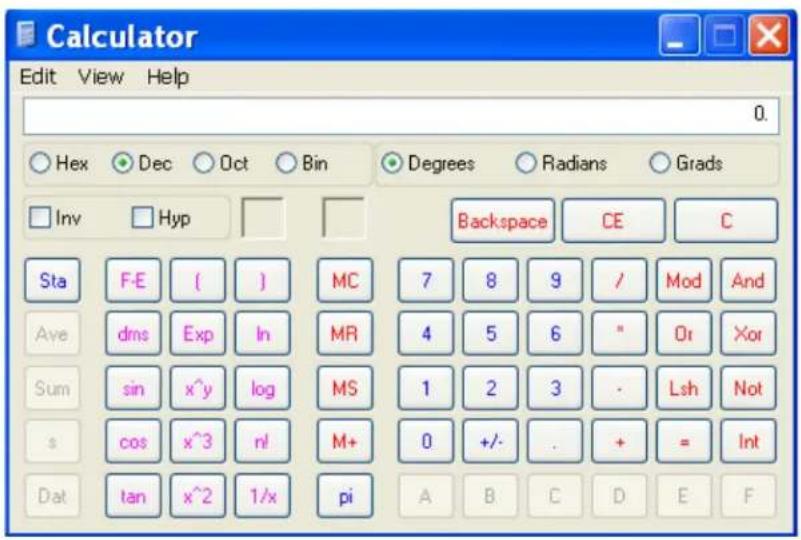
text_image
Calculator Edit View Help Hex Dec Oct Bin Degrees Radians Grads Inv Hyp Backspace CE C Sta F-E ( ) MC 7 8 9 / Mod And Ave dms Exp In MR 4 5 6 " Or Xor Sum sin x^y log MS 1 2 3 - Lsh Not s cos x^3 n! M+ 0 +/- . + = Int Dat tan x^2 1/x pi A B C D E F- Click Hex. The hexadecimal value appears.
Figure D-3 Hexadecimal Values in the Scientific Calculator
