EW 335 G3-A-EU - Receiver SENNHEISER - Free user manual and instructions
Find the device manual for free EW 335 G3-A-EU SENNHEISER in PDF.


User questions about EW 335 G3-A-EU SENNHEISER
0 question about this device. Answer the ones you know or ask your own.
Ask a new question about this device
Download the instructions for your Receiver in PDF format for free! Find your manual EW 335 G3-A-EU - SENNHEISER and take your electronic device back in hand. On this page are published all the documents necessary for the use of your device. EW 335 G3-A-EU by SENNHEISER.
USER MANUAL EW 335 G3-A-EU SENNHEISER
evolutionwireless G3
300 Series
Contents
Important safety instructions 2
System 2
Receiver 2
Bodypack transmitter and radio microphone 3
The ew 300 G3 evolution wireless series 4
The frequency bank system 4
Product overview 5
Overview of the EM 300 receiver .... 5
Overview of the displays of the EM 300 receiver 6
Overview of the SK 300 bodypack transmitter 8
Overview of the displays of the SK 300 bodypack transmitter 9
Overview of the SKM 300 radio microphone 10
Overview of the displays of the SKM 300 radio microphone 11
Putting the devices into operation 12
EM 300 receiver 12
SK 300 bodypack transmitter 14
SKM 300 radio microphone 15
Using the devices 17
Switching the devices on/off 18
Synchronizing a transmitter with the receiver 21
Deactivating the lock mode temporarily 21
Muting the audio signal or deactivating the RF signal 22
Selecting a standard display 25
Overview of the operating menus 25
Cleaning the devices 29
Specifications 32
Manufacturer Declarations 36

For an animated instruction manual, visit the respective product pages at www.sennheiser.com.
There you will also find detailed instruction manuals for the individual devices.
Important safety instructions
System
- Read this instruction manual.
- Keep this instruction manual. Always include this instruction manual when passing the devices and the mains unit on to third parties.
- Heed all warnings and follow all instructions in this instruction manual.
- Only clean the devices when they are not connected to the mains. Use a cloth for cleaning.
- Only use attachments/accessories specified by Sennheiser.
- Refer all servicing to qualified service personnel.
Servicing is required if the devices or the mains unit have been damaged in any way, liquid has been spilled, objects have fallen inside, the devices have been exposed to rain or moisture, do not operate properly or have been dropped. - WARNING: To reduce the risk of fire or electric shock, do not use the devices and the mains unit near water and do not expose them to rain or moisture.
Receiver
- Only use the supplied mains unit.
- Unplug the mains unit from the wall socket
– to completely disconnect the device from the mains,
– during lightning storms or
– when unused for long periods of time. - Only operate the mains unit from the type of power source specified in the chapter "Specifications" (see page 32).
- Ensure that the mains unit is
– in a safe operating condition and easily accessible,
– properly plugged into the wall socket,
– only operated within the permissible temperature range, - not covered or exposed to direct sunlight for longer periods of time in order to prevent heat accumulation (see "Specifications" on page 32).
- Do not block any ventilation openings. Install the device in accordance with the instructions given in this instruction manual.
- Do not install the device and the mains unit near any heat sources such as radiators, heat registers, stoves, or other devices (including amplifiers) that produce heat.
- Do not overload wall outlets and extension cables as this may result in fire and electric shock.
• Danger due to high volumes
This device is capable of producing sound pressure exceeding 85 dB(A). 85 dB(A) is the sound pressure corresponding to the maximum permissible volume which is by law (in some countries) allowed to affect your hearing for the duration of a working day. It is used as a basis according to the specifications of industrial medicine. Higher volumes or longer durations can damage your hearing. At higher volumes, the duration must be shortened in order to prevent hearing damage. The following are sure signs that you have been subjected to excessive noise for too long a time:
- You can hear ringing or whistling sounds in your ears.
- You have the impression (even for a short time only) that you can no longer hear high notes.
Bodypack transmitter and radio microphone
Do not place the devices near any heat sources such as radiators, heat registers, stoves, or other devices (including amplifiers) that produce heat.
Intended use of the system
Intended use of the ew 300 G3 series devices includes:
- having read this instruction manual especially the chapter "Important safety instructions",
- using the devices within the operating conditions and limitations described in this instruction manual.
"Improper use" means using the devices other than as described in these instructions, or under operating conditions which differ from those described herein.
The ew 300 G3 evolution wireless series
With the ew 300 G3 evolution wireless series, Sennheiser offers high-quality state-of-the-art RF transmission systems with a high level of operational reliability and ease of use. Transmitters and receivers permit wireless transmission with studio-quality sound.
The frequency bank system
Please note: Frequency usage is different for each country. Your Sennheiser partner will have all the necessary details on the available legal frequencies for your area.
The devices are available in 6 UHF frequency ranges with 1,680 frequencies per frequency range:

line
| Range | Value | |---|---| | Range A: | 516 - 558 | | Range G: | 608 - 626 | | Range B: | 734 - 776 | | Range C: | 780 - 822 | | Range D: | 823 - 865 | | Range E: | 865 |Each frequency range (A–E, G) offers 26 frequency banks with up to 24 channels each:

flowchart
graph TD
    A["Frequency bank 1... 20"] --> B["Channel 1 – frequency preset"]
    A --> C["Channel 2 – frequency preset"]
    A --> D["..."]
    A --> E["Channel 24 – frequency preset"]
    F["Frequency bank U1 ... U6"] --> G["Channel 1 – freely selectable frequency"]
    F --> H["Channel 2 – freely selectable frequency"]
    F --> I["..."]
    F --> J["Channel 24 – freely selectable frequency"]
Each of the channels in the frequency banks "1" to "20" has been factory-preset to a fixed frequency (frequency preset). The factory-preset frequencies within one frequency bank are intermodulation-free. These frequencies cannot be changed.
For an overview of the frequency presets, please refer to the supplied frequency information sheet. Updated versions of the frequency information sheet can be downloaded from the product page on our website at www.sennheiser.com.
The frequency banks "U1" to "U6" allow you to freely select and store frequencies. It might be that these frequencies are not intermodulation-free.
Product overview
Overview of the EM 300 receiver

text_image
A SENNHEISER TRUE DIVERSITY REC. ENVER SYNCE 1 2 3 4 5 6 7 B.Ch: 20.24 ew300 G3 543.200MHz EQ: SKM300 RF AF P + 12dB MUTE ANT II SENNHEISER TRUE DIVERSITY REC. ENVER CM 333 TREG RANGS: X 300-XXX MHz EXT NO: 00000 OUT NO: 80000000 KJUNNA: 3000000 CE0682 FC DC IN = 2V/350mA ANT I AF OUT BAL/UNBAL +14dBu MAX THERNET I J-65 DC IN = 12V/35 mAA Operating elements – front panel Open B y elements – rear panel
1 Headphone output, 14'' (6.3 mm) jack socket (☐)
2 Headphone volume control
③ button, backlit
4 Infra-red interface
5 Display panel, backlit in orange
6 Jog dial
7 STANDBY button, serves as the ESC (cancel) key in the operating menu
8 Antenna input II (ANT II) with remote power supply input, BNC socket
9 Type plate
10 Antenna input I (ANT I) with remote power supply input, BNC socket
11 Audio output (AF OUT UNBAL), 14 " (6.3 mm) jack socket, unbalanced
12 Audio output (AF OUT BAL), XLR-3M socket, balanced
13 LED (yellow) for network activity indication
14 LAN socket (ETHERNET RJ-45)
15 Cable grip for power supply DC cable
16 DC socket (DC IN) for connection of NT 2-3 mains unit
Overview of the displays of the EM 300 receiver
After switch-on, the receiver displays the standard display "Receiver Parameters". For further illustrations and examples of the different standard displays, please refer to page 25.
This standard display displays the operating states of the receiver and provides the most important information on the received transmitter – provided the linked transmitter supports this function.
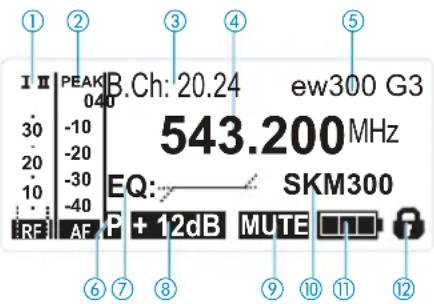
text_image
I II PEAK 040 30 -10 20 -20 10 -30 RF AE F + 12dB MUTE B.Ch: 20.24 ew300 G3 543.200MHz EQ: SKM300| Display Meaning | |
| 1 RF level “RF”(Radio Frequency) | Diversity display:IT Antenna input I is activeIT Antenna input II is active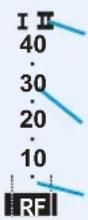 RF signal level:Field strength of the transmitted signalSquelch threshold level RF signal level:Field strength of the transmitted signalSquelch threshold level |
| 2 Audio level “AF”(Audio Frequency) | Modulation of the transmitter with peak hold function. When the level display for audio level shows full deflection, the audio input level is excessively high. When the transmitter is overmodulated frequently or for extended periods of time, the “PEAK” display is shown inverted. When the level display for audio level shows full deflection, the audio input level is excessively high. When the transmitter is overmodulated frequently or for extended periods of time, the “PEAK” display is shown inverted. |
| 3 Frequency bank and channel | Current frequency bank and channel number |
| 4 Frequency Current receiving frequency | |
| 5 Name Freely selectable name of the receiver | |
| 6 Pilot tone “P” | Activated pilot tone evaluation |
| 7 Equalizer setting Current equalizer setting | |
| 8 Output gain Current output gain | |
| 9 Muting function “MUTE” | Receiver is mutedReceiver does not output an audio signal (see also page 30). |
| 10 Transmitter type | Product name of the linked ew G3 transmitterThe product name is displayed only if the linked transmitter supports this function. |
Display Meaning
⑪ Transmitter battery status
Charge status:

approx. 100%

approx. 70%

approx. 30%

Battery icon is flashing; charge status is critical
When the battery charge status is critical, "LOW BATT" additionally appears on the display panel.
⑫ Lock mode icon Lock mode is activated
Overview of the SK 300 bodypack transmitter
text_image
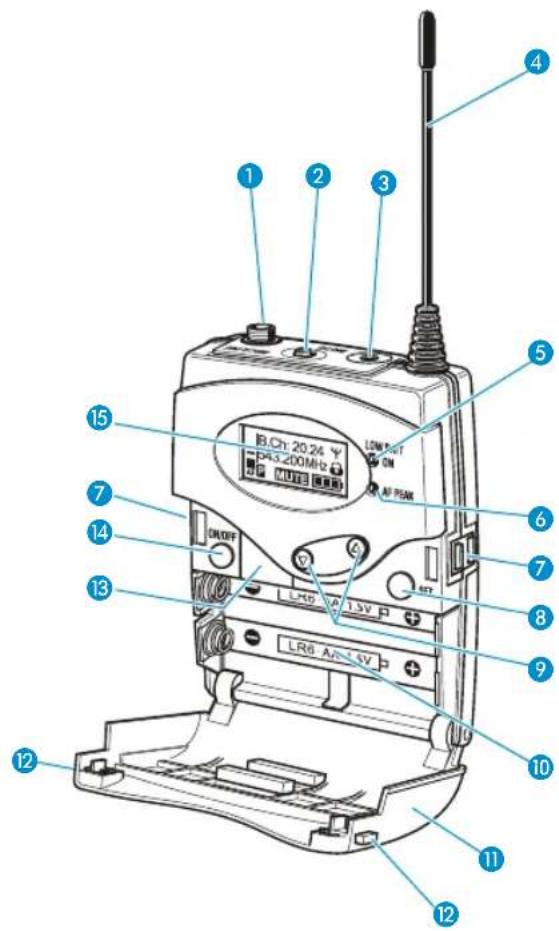
B.Ch: 20.24 Y P43.200MHz ON OFF LX9 LRS AP-5V +1 +2 +3 +4 +5 +6 +7 +8 +9 +10 +11 +12 +13 +14 +15 +16 +17 +18 +19 +20 +21 +22 +23 +24 +25 +26 +27 +28 +29 +30 +31 +32 +33 +34 +35 +36 +37 +38 +39 +40 +41 +42 +43 +44 +45 +46 +47 +48 +49 +50Operating elements
1 Microphone/instrument input (MIC/LINE), 3.5 mm jack socket, lockable
2 MUTE switch
3 Socket for connection of RMS 1 external mute switch, 2.5 mm jack socket
4 Antenna
5 Operation and battery status indicator, red LED (lit = ON/flashing = LOW BATTERY)
6 Audio overmodulation indicator, yellow LED (lit = AF PEAK)
7 Charging contacts
8 SET button
9 ▲/▼ rocker button (UP/DOWN)
10 Battery compartment
11 Battery compartment cover
12 Battery compartment catches
13 Infra-red interface
14 ON/OFF button, serves as the ESC (cancel) key in the operating menu
15 Display panel, backlit in orange
Overview of the displays of the SK 300 bodypack transmitter
After switch-on, the bodypack transmitter displays the standard display "Frequency/Name". For further illustrations and examples of the different standard displays, refer to page 25. The display backlighting is automatically reduced after approx. 20 seconds.
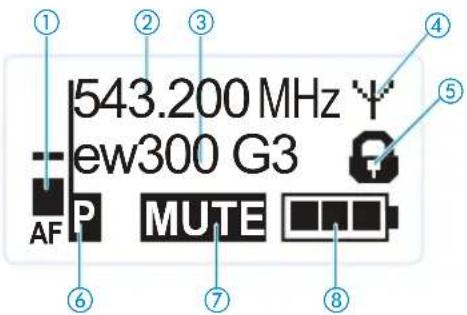
text_image
543.200 MHz ew300 G3 AF P MUTEDisplay Meaning
① Audio level "AF"
Modulation of the bodypack transmitter with peak hold function
When the transmitter's audio input level is excessively high, the "AF" display shows full deflection and, in addition, the yellow AF PEAK LED ⑥ lights up:
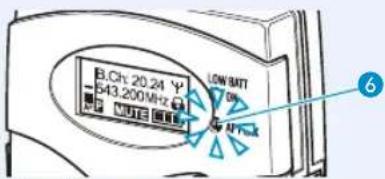
text_image
B.Ch: 20.24 Y 543.200MHz LOW BATT ON 6② Frequency Current transmission frequency
③ Name Freely selectable name of the bodypack transmitter
④ Transmission icon RF signal is being transmitted
⑤ Lock mode icon Lock mode is activated
⑥ "P" (Pilot) Pilot tone transmission is activated
⑦ "MUTE" Microphone or line input is muted
⑧ Battery status Charge status:

approx. 100%

approx. 70%

approx. 30%

Charge status is critical,
the red LOW BATT LED 5 is flashing:
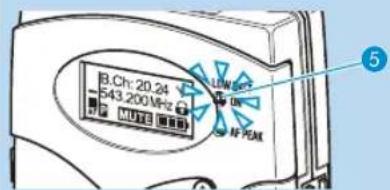
text_image
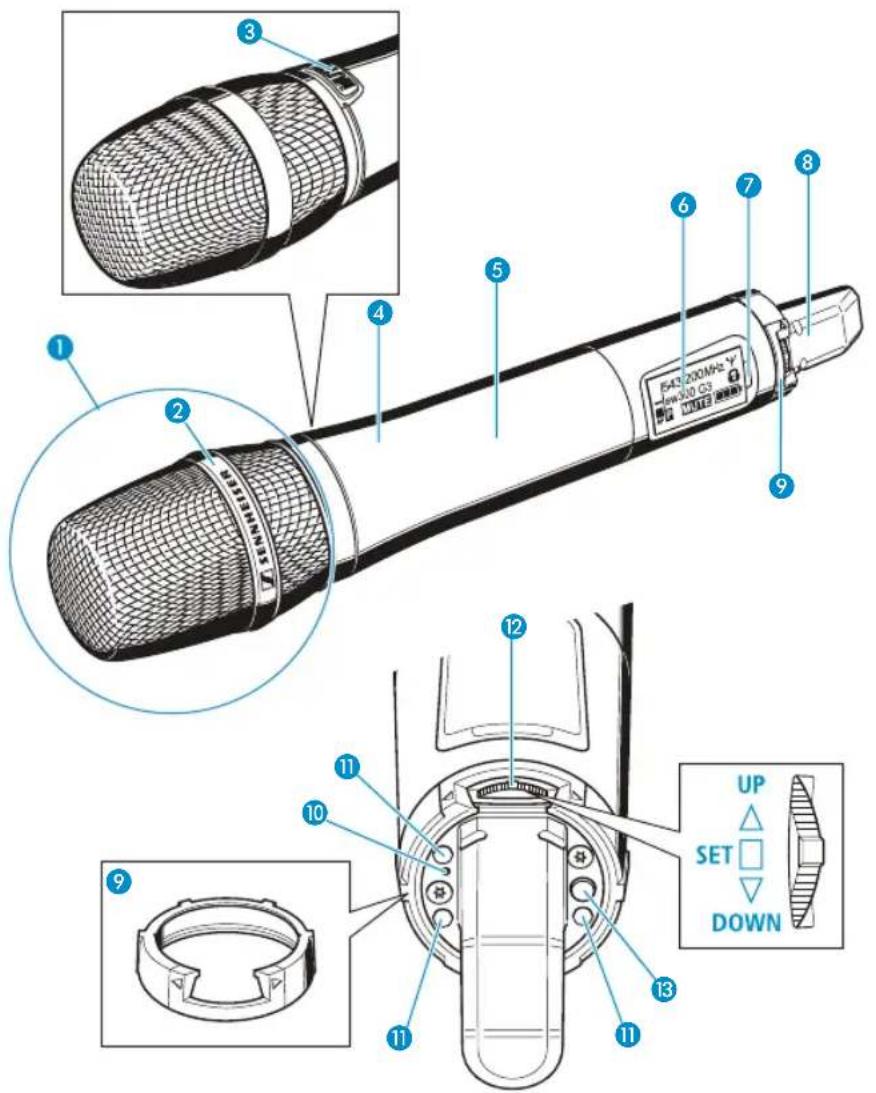
B.Ch: 20.24 543.200MHz NOTE NF PEAK 5Overview of the SKM 300 radio microphone
text_image
1 2 3 4 5 6 7 8 9 UP SET DOWNOperating elements
1 Microphone head (interchangeable)
2 Name and pick-up pattern of the microphone head (not visible here)
3MIC button
4 Body of radio microphone
5 Battery compartment (not visible from outside)
6 Display panel, backlit in orange
7 Infra-red interface
8 Antenna
9 Color-coded protection ring; available in different colors
10 Operation and battery status indicator, red LED
(lit = ON/flashing = LOW BATTERY)
11 Charging contacts
12 Multi-function switch:
▼ (DOWN), ▲ (UP) and ■ (SET)
13 ON/OFF button,
serves as the ESC (cancel) key in the
operating menu
Overview of the displays of the SKM 300 radio microphone
After switch-on, the radio microphone displays the standard display "Frequency/Name". For further illustrations and examples of the different standard displays, refer to page 25. The display backlighting is automatically reduced after approx. 20 seconds.
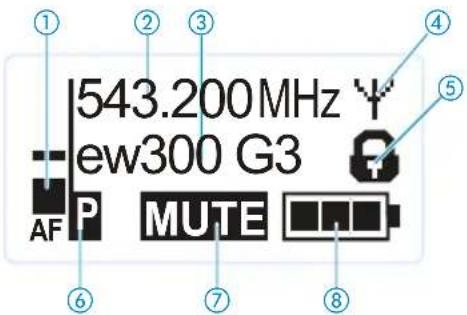
text_image
543.200MHz ew300 G3 AF P MUTE| Display Meaning | |
| 1 Audio level “AF” | Modulation of the radio microphone with peak hold function |
| 2 Frequency Current transmission frequency | |
| 3 Name Freely selectable name of the radio microphone | |
| 4 Transmission icon RF signal is being transmitted | |
| 5 Lock mode icon Lock mode is activated | |
| 6 “P” (Pilot) | Pilot tone transmission is activated |
| 7 “MUTE” | Audio signal is muted |
| 8 Battery status Charge status: | |
 approx. 100% approx. 100% | |
 approx. 70% approx. 70% | |
 approx. 30% approx. 30% | |
 Charge status is critical, the red LOW BATT LED 10 is flashing: Charge status is critical, the red LOW BATT LED 10 is flashing: | |
 | |
Putting the devices into operation
EM 300 receiver

You can set up the receiver on a flat surface or mount it into a 19" rack. For information on rack mounting, refer to the instruction manual of the EM 300 receiver available on the ew G3 product page at www.sennheiser.com.
Setting up the receiver on a flat surface
Place the receiver on a flat, horizontal surface. Please note that the device feet can leave stains on delicate surfaces.
Fitting the device feet
Clean the base of the receiver where you want to fix the device feet.
▶ Fit the device feet to the four corners of the receiver.
Mounting the rack mount "ears"

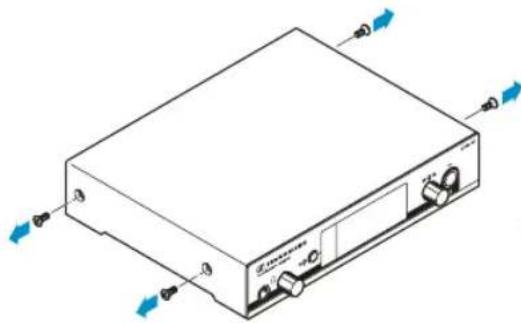
The rack mount "ears" are designed to help protect the operating elements from damage or deformation, e.g. if the receiver is dropped. Therefore, fasten the stacking elements, even if you do not want to rack mount your receivers.
To fasten the rack mount "ears" 20:
Unscrew and remove the two recessed head screws (M4x8) on each side of the receiver (see diagram).
Secure the rack mount "ears" 20 to the sides of the receiver using the previously removed recessed head screws.
natural_image
Isometric line drawing of a rectangular electronic device with ports and directional arrows indicating orientation (no text or symbols)
natural_image
Technical line drawing of a server rack unit with mounting brackets and labeled component (no text or symbols beyond part number)Connecting the rod antennas
The supplied rod antennas 17 are suitable for use in good reception conditions.
Connect the antennas. You have the following options:
- You can connect the rod antennas to the rear of the receiver.
- You can use the optional AM 2 antenna front mount kit and mount the rod antennas to the front of the receiver (see the instruction manual of the EM 300 receiver available on the ew G3 product page at www.sennheiser.com).
▶ Align the antennas in a V-shape.

When using more than one receiver, we recommend connecting remote antennas and, if necessary, using Sennheiser antenna accessories. Fore more information, visit the ew G3 product page at www.sennheiser.com.
Connecting an amplifier/mixing console

text_image
MT W1 AF OUT BAL/ANAL +100% MAX ETHORNET A- 11 12The receiver's 1/4" (6.3 mm) jack socket 11 and the XLR-3M socket 12 are connected in parallel.
Use a suitable cable to connect the amplifier and/or the mixing console to the 14 " (6.3 mm) jack socket ⑪ and/or the XLR-3M socket ⑫.
Via the operating menu, adjust the audio output level ("AF Out") of the receiver to the input of the amplifier or mixing console (see page 26). The audio output level is adjusted via the operating menu and is common for both sockets.
Connecting receivers in a network

flowchart
graph TD
    A["Switch"] --> B["WSM"]
    C["Switch"] --> B["WSM"]
    D["Switch"] --> B["WSM"]
    E["Switch"] --> B["WSM"]
    F["Switch"] --> B["WSM"]
    G["Switch"] --> B["WSM"]
    H["Switch"] --> B["WSM"]
    I["Switch"] --> B["WSM"]
    J["Switch"] --> B["WSM"]
    K["Switch"] --> B["WSM"]
    L["Switch"] --> B["WSM"]
    M["Switch"] --> B["WSM"]
    N["Switch"] --> B["WSM"]
    O["Switch"] --> B["WSM"]
    P["Switch"] --> B["WSM"]
    Q["Switch"] --> B["WSM"]
    R["Switch"] --> B["WSM"]
    S["Switch"] --> B["WSM"]
    T["Switch"] --> B["WSM"]
    U["Switch"] --> B["WSM"]
    V["Switch"] --> B["WSM"]
    W["Switch"] --> B["WSM"]
    X["Switch"] --> B["WSM"]
    Y["Switch"] --> B["WSM"]
    Z["Switch"] --> B["WSM"]
    AA["Switch"] --> B["WSM"]
    AB["Switch"] --> B["WSM"]
    AC["Switch"] --> B["WSM"]
    AD["Switch"] --> B["WSM"]
    AE["Switch"] --> B["WSM"]
    AF["Switch"] --> B["WSM"]
    AG["Switch"] --> B["WSM"]
    AH["Switch"] --> B["WSM"]
    AI["Switch"] --> B["WSM"]
    AJ["Switch"] --> B["WSM"]
    AK["Switch"] --> B["WSM"]
    AL["Switch"] --> B["WSM"]
    AM["Switch"] --> B["WSM"]
    AN["Switch"] --> B["WSM"]
    AO["Switch"] --> B["WSM"]
    AP["Switch"] --> B["WSM"]
    AQ["Switch"] --> B["WSM"]
    AR["Switch"] --> B["WSM"]
    AS["Switch"] --> B["WSM"]
    AT["Switch"] --> B["WSM"]
    AU["Switch"] --> B["WSM"]
    AV["Switch"] --> B["WSM"]
    AW["Switch"] --> B["WSM"]
    AX["Switch"] --> B["WSM"]
    AY["Switch"] --> B
    AZ["Switch"] --> B
    BA["Switch"] --> B
    BB["Switch"] --> B
    BC["Switch"] --> B
    BD["Switch"] --> B
    BE["Switch"] --> B
    BF["Switch"] --> B
    BG["Switch"] --> B
    BH["Switch"] --> B
    BI["Switch"] --> B
    BJ["Switch"] --> B
    BK["Switch"] --> B
    BL["Switch"] --> B
    BM["Switch"] --> B
    BN["Switch"] --> B
    BO["Switch"] --> B
    BP["Switch"] --> B
    BPB["Switch"] --> B
    BPJ["Switch"] --> B
    BPJB["Switch"] --> B
    BPK["Switch"] --> B
    BPL["Switch"] --> B
    BPLJ["Switch"] --> B
    BPKJ["Switch"] --> B
    BPKJB["Switch"] --> B
    BPKJN["Switch"] --> B
    BPKJKN["Switch"] --> B
You can connect several receivers in a network. To do so, use the LAN socket 14. The receivers are remote controlled via a PC running the supplied "Wireless Systems Manager" (WSM) software. For information on network operation, refer to the instruction manual of the EM 300 receiver available on the ew G3 product page at www.sennheiser.com.
Connecting the mains unit
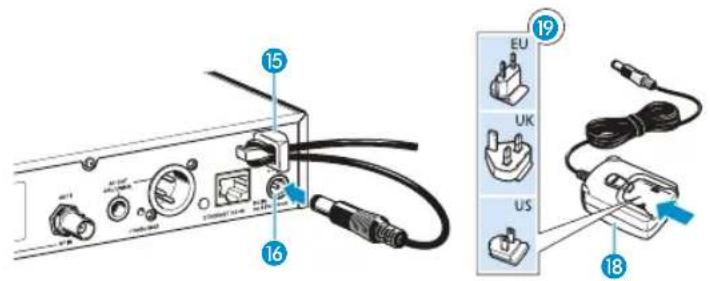
Only use the supplied mains unit. It is designed for the receiver and ensures safe operation.
To connect the mains unit:
Insert the yellow connector of the NT 2-3 mains unit 18 into the yellow socket 16 of the receiver.
Pass the cable of the mains unit through the cable grip 15.
Slide the supplied country adapter 19 onto the mains unit 18.
Plug the mains unit 18 into a wall socket. The STANDBY button is backlit in red.
text_image
Diagram showing connections of electronic equipment with labeled ports and connectors, including EU, UK, US, and numbered parts 15, 16, 18.SK 300 bodypack transmitter
Inserting the batteries/accupack
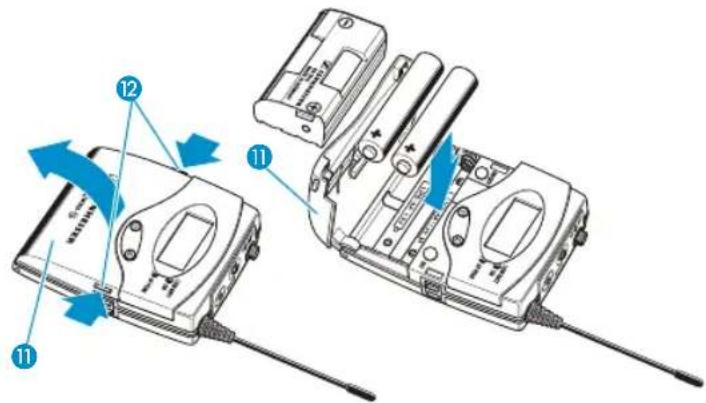
For powering the bodypack transmitter, you can either use two 1.5 V AA size batteries or the rechargeable Sennheiser BA 2015 accupack.
▶ Push the two catches 12 in the direction of the arrows and open the battery compartment cover 11.
text_image
Diagram showing two electronic devices with labeled parts and directional arrows indicating movement or assembly.Insert the two batteries or the accupack as shown above. Observe correct polarity when inserting the batteries/accupack.
▶ Close the battery compartment. The battery compartment cover 11 locks into place with an audible click.
Charging the accupack
To charge the BA 2015 accupack:
▶ Insert the bodypack transmitter into the L 2015 charger (optional accessory).

The L 2015 charger can only charge the combination BA 2015 accupack/bodypack transmitter. Standard batteries (primary cells) or individual rechargeable battery cells cannot be charged.
Connecting the microphone cable/line cable
The audio input is designed for the connection of both condenser microphones and other audio sources. DC powering of the condenser microphones is via the audio input.
Use one of the recommended Sennheiser microphones or the optional CL 2 line cable.
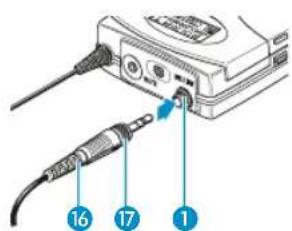
Connect the 3.5 mm jack plug 16 from the Sennheiser microphone or line cable to the 3.5 mm jack socket MIC/LINE 1.
Lock the 3.5 mm jack plug by screwing down the coupling ring 17 of the cable.
Via the operating menu, adjust the sensitivity of the microphone/line input.
text_image
16 17 1Attaching and positioning the corresponding microphones
ME 2/ME 4

natural_image
Illustration of a microphone device connected to a small human figure, labeled with number 18 (no text or symbols on the diagram itself)Use the microphone clip 18, to attach the microphone to clothing (e.g. tie, lapel).
The ME 2 clip-on microphone (shown on the right in the diagram) has an omni-directional pick-up pattern. It is therefore not necessary to position it precisely.
Attach the ME 2 microphone as close as possible to the sound source.
The ME 4 clip-on microphone (shown on the left in the diagram) has a cardioid pick-up pattern.
Position the ME 4 microphone so that its sound inlet is directed towards the sound source (e.g. mouth).
Adjust the ME 3 headmic so that a comfortable and secure fit is ensured.
The ME 3 headmic has a cardioid pick-up pattern.
▶ Position the microphone so that its sound inlet is directed towards the sound source (e.g. mouth).
Attaching the bodypack transmitter to clothing
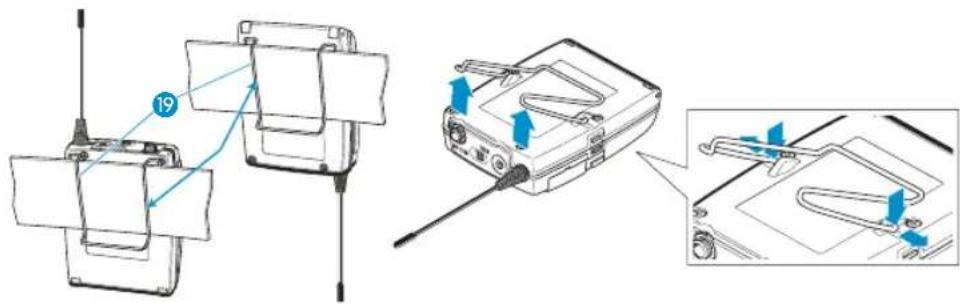
You can use the belt clip 19 to attach the bodypack transmitter to clothing (e.g. belt, waist-and).
The belt clip is detachable so that you can also attach the transmitter with the anter pointing downwards. To do so, withdraw the belt clip 19 from its fixing points and attach it the other way round. The belt clip 19 is secured so that it cannot slide out of its fixing points accidentally.
To detach the belt clip:
Lift one side of the belt clip as shown in the diagram on the right-hand side.
Press down the belt clip at one fixing point and pull it out of the transmitter housing.
▶ Repeat for the other side.
text_image
Technical diagram showing assembly steps of a device with labeled components and directional arrows indicating motionSKM 300 radio microphone
Inserting the batteries/accupack
For powering the radio microphone, you can either use two 1.5 V AA size batteries or the rechargeable Sennheiser BA 2015 accupack.
CAUTION!
Danger of damage to the radio microphone!
When unscrewing the radio microphone during operation while pressing the MIC button ③ at the same time, the latter can be damaged.
Do not press the MIC button ③ while unscrewing the radio microphone.
text_image
Diagram showing a hand holding a pen with a blue arrow labeled '4' pointing to the pen tip, alongside a blue square on the left.
natural_image
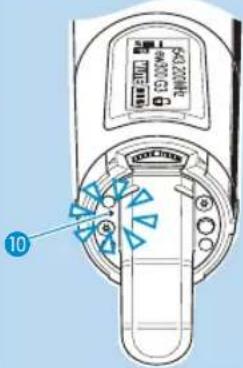
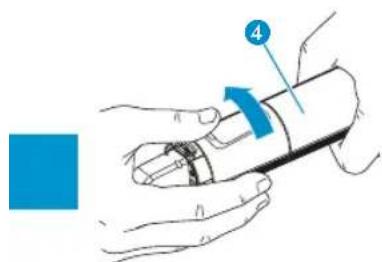
Technical line drawing of a mechanical component with an arrow indicating direction (no text or symbols)Unscrew the lower part of the radio microphone from the radio microphone's body 4 by turning it counterclockwise.

When unscrewing the radio microphone during operation, the muting function is automatically activated. "MUTE" appears on the display panel.
When screwing the lower part of the radio microphone back to the radio microphone's body, the muting function is deactivated.
▶ Slide back the lower part of the radio microphone as far as it will go.
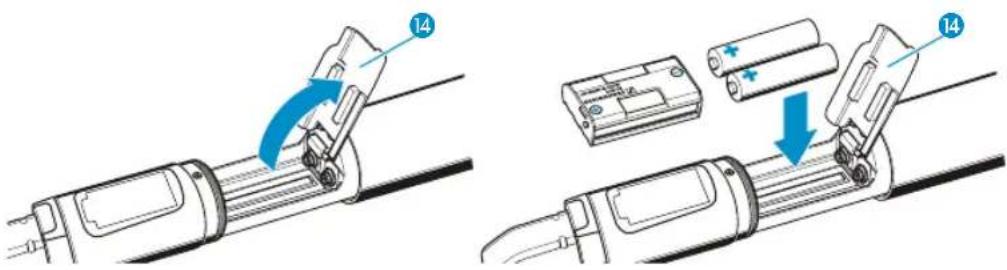
Open the battery compartment cover 14.
Insert the batteries or the BA 2015 accupack as shown on the battery compartment cover. Observe correct polarity when inserting the batteries/accupack.
text_image
Technical diagram showing mechanical assembly steps with labeled components and directional arrows indicating movement or force.Close the battery compartment cover 14.
Push the battery compartment into the radio microphone's body.
Screw the lower part of the radio microphone back to the radio microphone's body 4.
Charging the accupack
To charge the radio microphone with the inserted BA 2015 accupack (optional accessory):
Use the LA 2 charging adapter to insert the radio microphone into the L 2015 charger (both the charger and the charging adapter are available as optional accessories).
Changing the microphone head
The microphone head is easy to change.
▶ Unscrew the microphone head.

natural_image
Illustration of hands holding a device with a numbered arrow pointing to the component (no text or symbols present)
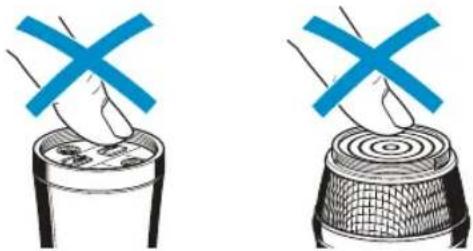
Do not touch the contacts of the radio microphone nor the contacts of the microphone head. The contacts can become dirty or damaged if touched.
natural_image
Two diagrams showing a container with liquid and a textured base, each marked with a blue X (no text or symbols present)When unscrewing the microphone head during operation, the muting function is automatically activated. "MUTE" appears on the display panel.
When screwing the microphone head back to the radio microphone, the muting function is deactivated.
Screw the desired microphone head to the radio microphone.
Put the radio microphone back into operation.
Changing the color-coded protection ring
The color-coded protection ring ⑨ prevents the multi-function switch ⑫ from accidental operation. Protection rings in different colors are available as accessories. The protection rings allow you to clearly identify each radio microphone.
Remove the color-coded protection ring as shown in the left-hand diagram.
Put on a new protection ring as shown in the right-hand diagram.

text_image
Diagram showing four steps of installing a device component with blue arrows indicating movement from step 9 to 8.Using the devices
To establish a transmission link, proceed as follows:
- Switch the receiver on.
- Switch a transmitter on.
The transmission link is established and the and the display backlighting of the receiver changes from red to orange.
If you cannot establish a transmission link between transmitter and receiver:
Make sure that transmitter and receiver are set to the same frequency bank and to the same channel.
If necessary, read the chapter "If a problem occurs ..." on page 30.

It is vital to observe the following notes:
Make sure that the desired frequencies are listed in the enclosed frequency information sheet.
Make sure that the desired frequencies are approved and legal in your country and, if necessary, apply for an operating license.
Switching the devices on/off
EM 300 receiver
To switch the receiver on:

text_image
w300 G3 00 MHz KM300 7
Briefly press the STANDBY button 7. The receiver switches on and the "Receiver Parameters" standard display appears.
To switch the receiver to standby mode:
If necessary, deactivate the lock mode (see page 21).

Keep the STANDBY button 7 pressed until "OFF" appears on the display panel.

When in the operating menu, pressing the STANDBY button ⑦ will cancel your entry (ESC function) and return you to the current standard display.
To completely switch the receiver off:
Disconnect the receiver from the mains by unplugging the mains unit from the wall socket.
SK 300 bodypack transmitter
text_image
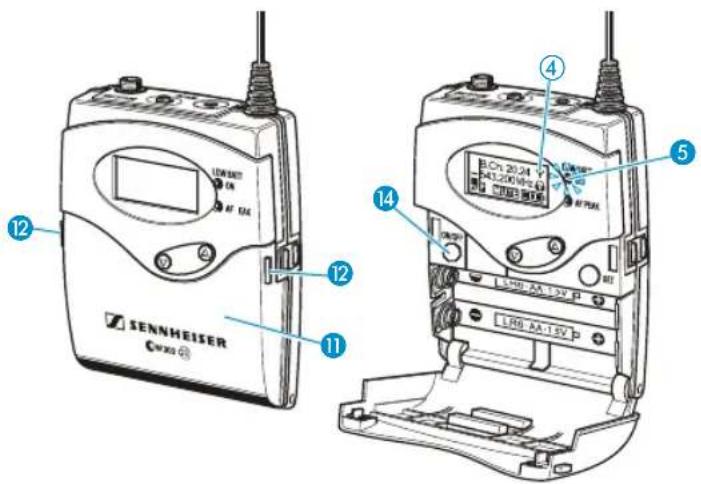
12 LEWART ON AF 50A 12 SENNEISER C6830 11 4 BCh 20.24 V AC1200MHz RPM 14 LHD-AA-T5Y P LHD-AA-T5Y P 5 ④ ⑤To switch the bodypack transmitter on (online operation):
▶ Push the two catches 12 and open the battery compartment cover 11.
ON/OFF

Briefly press the ON/OFF button 14.
The bodypack transmitter transmits an RF signal. The transmission icon ④ is displayed.
The red ON LED 5 lights up and the standard display "Frequency/Name" appears on the display panel.

You can switch the bodypack transmitter on and deactivate the RF signal on switch-on. For more information, see below.
To switch the bodypack transmitter off:
If necessary, deactivate the lock mode (see page 21).
ON/OFF

Press the ON/OFF button 14 until "OFF" appears on the display panel. The red ON LED 5 goes off and the display panel turns off.

When in the operating menu, pressing the ON/OFF button 14 will cancel your entry (ESC function) and return you to the current standard display.
To switch the bodypack transmitter on and to deactivate the RF signal on switch-on (offline operation):
ON/OFF

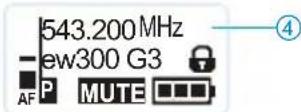
Press the ON/OFF button 14 until "RF Mute On?" appears on the display panel.
SET

Press the SET button 8.
The transmission frequency is displayed but the bodypack transmitter does not transmit an RF signal. The transmission icon ④ is not displayed. When the pilot tone function is activated on both bodypack transmitter and receiver, "RF Mute" appears on the receiver's display panel.


Use this function to save battery power or to prepare a bodypack transmitter for use during live operation without causing interference to existing transmission links.
To activate the RF signal:
ON/OFF

Briefly press the ON/OFF button 14.
"RF Mute Off" appears on the display panel.
SET

Press the SET button 8.
The transmission icon ④ is displayed again.
SKM 300 radio microphone

text_image
Technical diagram showing three labeled parts of a device handle, including a pen-like tool, a close-up of the internal component, and a microphone.To switch the radio microphone on (online operation):

Briefly press the ON/OFF button 13. The radio microphone transmits an RF signal. The transmission icon ④ is displayed. The red ON LED 10 lights up and the standard display "Frequency/Name" appears on the display panel. The MIC button ③ lights up red.

You can switch the radio microphone on and deactivate the RF signal on switch-on. For more information, see below.
To switch the radio microphone off:
If necessary, deactivate the lock mode (see page 21).

Press the ON/OFF button 13 until "OFF" appears on the display panel. The red ON LED 10 goes off. The MIC button 3 goes off. The display panel turns off.

When in the operating menu, pressing the ON/OFF button 13 cancel your entry (ESC function) and return you to the current standard display.
To switch the radio microphone on and to deactivate the RF signal on switch-on (offline operation):

Press the ON/OFF button 13 until "RF Mute On?" appears on the display panel.
Press the multi-function switch 12. The transmission frequency is displayed but the radio microphone does not transmit an RF signal. The transmission icon ④ is not displayed and the MIC button does not light up. When the pilot tone function is activated on both radio microphone and receiver, "RF Mute" appears on the receiver's display panel.

Use this function to save battery power or to prepare a radio microphone for use during live operation without causing interference to existing transmission links.
To activate the RF signal:
ON/OFF


Briefly press the ON/OFF button 13.
"RF Mute Off" appears on the display panel.
Press the multi-function switch 12.
The transmission icon ④ is displayed again.

Synchronizing a transmitter with the receiver
You can synchronize a suitable transmitter of the ew 300 G3 series with the receiver. During synchronization, the following parameters are transferred to the transmitter:
Setting Transferred parameters
"Frequency Preset" Currently set frequency
"Name" Freely selectable name currently set on the receiver
"Pilot Tone"
Current pilot tone setting of the receiver ("Inactive"/"Active")
To transfer the parameters:
▶ Switch the transmitter and the receiver on.
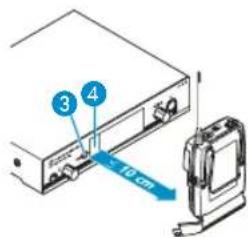
Press the sync button 3 on the receiver.
"Sync" appears on the display panel of the receiver.
Place the infra-red interface of the transmitter (see page 8 and page 10) in front of the infra-red interface of the receiver 4.
The parameters are transferred to the transmitter. When the transfer is completed, "√" appears on the display panel. The receiver then switches back to the current standard display.
To cancel the transfer:
▶ Press the STANDBY button on the receiver.
"X" appears on the display panel of the receiver. "X" also appears if:
- no transmitter was found or the transmitter is not compatible,
- no transmitter was found and the synchronization process was canceled after 30 seconds,
- you canceled the transfer.

Via the "Sync Settings" submenu, you can adjust the parameters to be transferred to the transmitters (see page 27).
Deactivating the lock mode temporarily
You can activate or deactivate the automatic lock mode via the "Auto Lock" menu item (see page 25). If the lock mode is activated, you have to temporarily deactivate it In order to be able to operate the devices:
EM 300

▶ Turn the jog dial. "Unlock?" appears on the display panel.
text_image
3 4 10 cm
text_image
3 4 - 10 cm
▶ Press the jog dial. The lock mode is temporarily deactivated (see below).
SK 300

▶ Press the rocker button. "Unlock?" appears on the display panel.

▶ Press the SET button. The lock mode is temporarily deactivated (see below).
SKM 300

▶ Move the multi-function switch upwards/downwards. "Unlock?" appears on the display panel.

▶ Press the multi-function switch. The lock mode is temporarily deactivated (see below).
How you are using the devices determines how long the lock mode remains deactivated:
When in the operating menu
The lock mode is deactivated as long as you are working with the operating menu.
When one of the standard displays is shown
The lock mode is automatically activated after 10 seconds.
Prior to this, the lock mode icon flashes, indicating that the lock mode is being activated.
Muting the audio signal or deactivating the RF signal
EM 300
To mute the audio signal:

When one of the standard displays is shown on the display panel, press the STANDBY button. "RX Mute On?" appears on the display panel.

▶ Press the jog dial. The audio signal is muted. "RX Mute" appears in alternation with the current standard display.
To unmute the audio signal:

Press the STANDBY button. "RX Mute Off?" appears on the display panel.

▶ Press the jog dial. The muting is canceled.
SK 300

natural_image
Close-up of a mechanical component with a pin and screw (no visible text or symbols)
text_image
543.200 MHz ew300 G3 AF P MUTE ④ ⑦The MUTE switch ② allows you to mute the audio signal or to deactivate the RF signal. Via the "Mute Mode" menu item, you can set the desired function of the MUTE switch ②:
| Setting | Slide the MUTE switch 2 ... | Function |
| "Disabled" | ... to the left (position MUTE) | None |
| "RF On/Off" | ... to the left (position MUTE) | Deactivates the RF signal (offline operation) |
| ... to the right Activates the RF signal (online operation) | ||
| "AF On/Off" | ... to the left (position MUTE) | Mutes the audio signal |
| ... to the right Unmutes the audio signal | ||
The "Push to mute" and "Push to talk" menu items are only available in conjunction with the RMS 1 external mute switch (optional accessory).
From the "Mute Mode" menu item, select the desired setting (see page 28).
Exit the operating menu.
Slide the MUTE switch ② to the left, to the position MUTE.
The bodypack transmitter reacts as indicated in the table.
The current state of the muting function or the RF signal is displayed on the display panel of the bodypack transmitter. An additional display appears on the receiver's display panel when the pilot tone function is activated on both bodypack transmitter and receiver and, in addition, this display has been activated via the "Warnings" menu item on the receiver (see page 27).
| Audio signal is muted | |
| Transmitter's display panel: | "MUTE" 7 is displayed |
| Receiver's display panel: | "TX Mute" is displayed* |
* only when activated on the receiver (see above)
| Audio signal is activated (muting is deactivated) | |
| Transmitter's display panel: | "MUTE" 7 is not displayed |
| Receiver's display panel: | "TX Mute" is not displayed |
| RF signal is deactivated | |
| Transmitter's display panel: | Transmission icon 4 is not displayed |
| Receiver's display panel: | "RF Mute" is displayed* |
* only when activated on the receiver (see above)
| RF signal is activated | |
| Transmitter's display panel: | Transmission icon 4 is displayed |
RF signal is activated
Receiver's display panel:
"RF Mute" is not displayed

You can also deactivate the RF signal on switch-on. For more information, refer to the chapter "Switching the devices on/off" on page 19.
Using the ON/OFF button, you can also activate/deactivate the RF signal during operation. To do so, briefly press the ON/OFF button and proceed as described on page 19.
SKM 300
The MIC button ③ allows you to mute the audio signal or to deactivate the RF signal. Via the "Mute Mode" menu item, you can set the desired function of the MIC button ③:
| Setting | Mic button 3 ... | Function |
| "Disabled" Press briefly/keep pressed | None | |
| "RF On/Off" | Press briefly | Deactivates the RF signal (offline operation) |
| Activates the RF signal (online operation) | ||
| "AF On/Off" | Press briefly | Mutes the audio signal permanently |
| Unmutes the audio signal permanently | ||
| "Push to mute" | Keep pressed | Mutes the audio signal temporarily (cough function) |
| "Push to talk"* | Keep pressed Unmutes | the audio signal temporarily (speech function) |
* If you select "Push to talk", the radio microphone is muted.
From the "Mute Mode" menu item, select the desired setting (see page 25).
▶ Exit the operating menu.
Briefly press the MIC button ③ or keep it pressed.
The radio microphone reacts as indicated in the table.
As with the SK 300, the current state of the muting function or the RF signal is displayed on the display panel of the radio microphone and, if applicable, on the display panel of the EM 300 receiver. Possible displays are described above in the section on the SK 300 bodypack transmitter.
You can deactivate the RF signal on switch-on. For more information, refer to the chapter "Switching the devices on/off" on page 20.
To deactivate the RF signal during operation:

When one of the standard displays is shown on the display panel, press the ON/OFF button.
"RX Mute On?" appears on the display panel.
▶ Proceed as described on page 20.
Selecting a standard display
EM 300

▶ Press the jog dial to select a standard display:
Contents of the display Selectable standard display
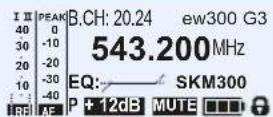
"Receiver Parameters"
appears after switch-on of the receiver and displays the receiver parameters (see page 5).
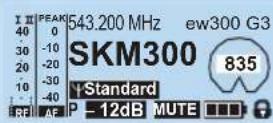
"Transmitter Parameters" (transmitter type/microphone)
displays the microphone head (SKM only) and the transmitter type.
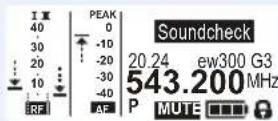
"Soundcheck" (display with additional function)
displays the signal quality within the transmission area.
Information on the soundcheck function can be found in the instruction manual of the EM 300 receiver available on the ew G3 product page at www.sennheiser.com.
SK 300 and SKM 300
To select a standard display:
SK 300 SKM 300

Press the rocker button.

Move the multi-function switch.
You can select the following standard displays: "Frequency/Name", "Channel/Frequency", "Channel/Name".
Overview of the operating menus

For more detailed information on the operating menus, refer to the individual instruction manuals of the devices. These instruction manuals can be downloaded from the respective product pages at www.sennheiser.com.
EM 300

flowchart
graph TD
    A["Main menu "Menu""] --> B["Extended menu "Advanced Menu"]
    B --> C["Warnings"]
    C --> D["Sub-menu "Sync Settings"]
    D --> E["SKM Settings/ SK Settings"]
    E --> F["SKM Settings/ SK Settings"]
    B --> G[""Squelch Easy Setup Frequency Preset Name AF Out Equalizer AutoLock Advanced Exit"]
    B --> H[""Easy Setup" Reset List Current List Scan New List Exit"]
    B --> I["Tune Sync Settings Pilot Tone Warnings LCD Contrast Reset IP-Address Software Revision Exit"]
    C --> J["AF-Peak Low RF-Signal RF-Mute TX-Mute RX-Mute Low Battery Exit"]
When one of the standard displays is shown on the display panel, you can get into the main menu by pressing the jog dial 6. The extended menu "Advanced Menu" and the submenus can be accessed via the corresponding menu items.
Display Function of the menu item
Main menu "Menu"
Squelch Adjusts the squelch threshold
Adjustment range: 5 to 25 dBμV in 2-dB steps, can be switched off
Special function (for servicing purposes only): With the jog dial 6 set to the "5 dB" setting, you switch the squelch off by turning the jog dial to the left and keeping it in this position. If you then turn the jog dial to the right, you switch the squelch on again.
CAUTION!

Danger of hearing damage and material damage!
If you switch the squelch off or adjust the squelch threshold to a very low value, loud hissing noise can occur in the receiver.
The hissing noise can be loud enough to cause hearing damage or overload the loudspeakers of your system!
▶ Always make sure that the squelch is switched on (see above).
Before adjusting the squelch threshold, set the volume of the audio output level to the minimum.
▶ Never change the squelch threshold during a live transmission.
Easy Setup
Scans for unused frequency presets, releases and selects frequency presets
Frequency Preset Changes the frequency bank and the channel
Name Enters a freely selectable name
AF Out Adjusts the audio output level
Adjustment range: -24 dB to +24 dB, adjustable in 3-dB steps, 6 dB gain reserve Special function "gain reserve":
When you have adjusted a level of +18 dB, turn the jog dial 6 to the right and keep it in this position until the next higher value appears.
| Display | Function of the menu item |
| Equalizer Changes the frequency response of the output signal | |
| Auto Lock Activates/deactivates the automatic lock mode | |
| Advanced | Calls up the extended menu "Advanced Menu" |
| Exit | Exits the operating menu and returns to the current standard display |
| "Easy Setup" | |
| Reset List | Releases all locked frequency presets and selects an unused frequency preset |
| Current List Selects an unused frequency preset | |
| Scan New List Scans for unused receiving frequencies (frequency preset scan) | |
| Exit | Exits the submenu "Easy Setup" and returns to the main menu |
| Extended menu "Advanced Menu" | |
| Tune | Sets the receiving frequencies for the frequency banks "U1" to "U6" |
| Special function: Sets a channel and a receiving frequency for the frequency banks "U1" to "U6":Select this menu item and call it up by pressing the jog dial 6 until the channel selection appears. | |
| Sync Settings | Activates/deactivates the parameters to be transferred to the transmitters |
| Pilot Tone | Activates/deactivates the pilot tone evaluation |
| Warnings Activates/deactivates the warning messages | |
| LCD Contrast Adjusts the contrast of the display panel | |
| Reset Resets the receiver | |
| IP-Address | Adjusts the IP address of the receiver |
| Software Revision | Displays the current software revision |
| Exit | Exits the extended menu "Advanced Menu" and returns to the main menu |
| Submenu "Sync Settings" | |
| SKM Settings | Activates/deactivates the parameters to be transferred to the SKM radio microphones |
| SK Settings | Activates/deactivates the parameters to be transferred to the SK bodypack transmitters |
| Exit | Exits the submenu "Sync Settings" and returns to the extended menu "Advanced Menu" |
| "SK Settings"/"SKM Settings" | |
| Here you can activate/deactivate the transfer of the following transmitter parameters: Sensitivity, Auto Lock, Mute Mode and RF Power (see page 28) | |
| "Warnings" | |
| Activates/deactivates warnings (color change and warning messages): | |
| AF-Peak | Audio overmodulation |
| Low RF-Signal | RF signal is weak |
| RF-Mute | RF signal is too weak or no RF signal |
| TX-Mute | Transmitter is muted orno pilot tone |
| RX-Mute | Receiver is muted |
| Low Battery | Charge status of the transmitter battery/the BA 2015 accupack is critical |
| Exit | Exits the submenu "Warnings" and returns to the extended menu "Advanced Menu" |
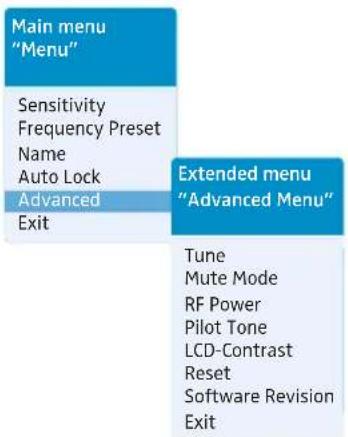
SK 300 and SKM 300
text_image
Main menu "Menu" Sensitivity Frequency Preset Name Auto Lock Advanced Exit Extended menu "Advanced Menu" Tune Mute Mode RF Power Pilot Tone LCD-Contrast Reset Software Revision Exit| Display Meaning | |
| Main menu “Menu” | |
| Sensitivity | Adjusts the sensitivity “AF” |
| Frequency Preset* Changes the frequency bank and the channel | |
| Name* Enters a freely selectable name | |
| Auto Lock Activates/deactivates the automatic lock mode | |
| Advanced | Calls up the extended menu “Advanced Menu” |
| Exit | Exits the operating menu and returns to the current standard display |
| Extended menu “Advanced Menu” | |
| Tune | Sets the transmission frequencies for the frequency banks “U1” to “U6” |
| Special function: Sets a channel and a transmission frequency for the frequency banks “U1” to “U6”:Select this menu item and call it up by pressing the SET button (SK)/the multi-function switch (SKM) until the channel selection appears. | |
| Mute Mode | Sets the mode for the MUTE switch |
| RF Power Adjusts the transmission power | |
| Pilot Tone* Activates/deactivates the pilot tone transmission | |
| LCD Contrast Adjusts the contrast of the display panel | |
| Reset Resets the bodypack transmitter/radio microphone | |
| Software Revision | Displays the current software revision |
| Exit | Exits the extended menu “Advanced Menu” and returns to the main menu |
* For information on the synchronization of transmitters with receivers, refer to page 21.
Cleaning the devices
CAUTION! Liquids can damage the electronics of the devices!

Liquids entering the housing of the devices can cause a short-circuit and damage the electronics.
▶ Keep all liquids away from the devices.
EM 300
Before cleaning, disconnect the device from the mains.
Use a slightly damp cloth to clean the receiver from time to time. Do not use any solvents or cleansing agents.
SK 300
Use a slightly damp cloth to clean the bodypack transmitter from time to time. Do not use any solvents or cleansing agents.
SKM 300
Use a slightly damp cloth to clean the radio microphone from time to time. Do not use any solvents or cleansing agents.
To clean the radio microphone's sound inlet basket (MMD 835-1, MMD 845-1, MMD 935-1, MMD 945-1, MME 865-1):
Unscrew the upper sound inlet basket from the microphone head by turning it counterclockwise.
CAUTION! Liquids can damage the microphone head!
Liquids can damage the microphone head.
▶ Only clean the upper sound inlet basket.
Remove the foam insert.
There are two ways to clean the sound inlet basket:
- Use a slightly damp cloth to clean the upper sound inlet basket from the inside and outside
- or scrub with a brush and rinse with clear water.
If necessary, clean the foam insert with a mild detergent or replace the foam insert.
Dry the upper sound inlet basket.
Dry the foam insert.
▶ Reinsert the foam insert.
Replace the sound inlet basket on the microphone head and screw it tight.
You should also clean the contact rings of the microphone head from time to time:
Wipe the contact rings of the microphone head with a dry cloth.

For information on cleaning the MMK 965-1 microphone head, refer to its instruction manual.
If a problem occurs ...
EM 300
| Problem Possible cause Possible solution | ||
| Receiver cannot be operated, “Locked” appears on the display panel | Lock mode is activated Deactivate the lock mode (see page 21). | |
| No operation indication | No mains connection | Check the connections of the mains unit. |
| No RF signal Transmitter and receiver are not on the same channel | Set the transmitter and receiver to the same channel. To do so, use the synchronization function (see page 21). | |
| Transmitter is out of range Check the squelch threshold setting (see page 26).Reduce the distance between transmitter and receiving antennas. | ||
| RF signal available, no audio signal, “MUTE” appears on the display panel | If “TX Mute” additionally appears on the display panel:transmitter is muted (“MUTE”)or transmitter doesn’t transmit a pilot tone | Cancel the muting (see page 22).Switch the pilot tone transmission on the transmitter on (see page 28).Switch the pilot tone evaluation on the receiver off (see page 27). |
| Receiver’s squelch threshold is adjusted too high | Reduce the squelch threshold (see page 26).Reposition the antennas. | |
| Audio signal has a high level of background noise | Transmitter sensitivity is adjusted too low/high | Adjust the transmitter sensitivity correctly (“Sensitivity”, see page 28). |
| Audio signal is distorted Transmitter sensitivity is adjusted too high | Adjust the transmitter sensitivity correctly (“Sensitivity”, see page 28). | |
| Receiver’s audio output level is adjusted too high | ||
| No access to a certain channel | During scanning, an RF signal has been detected on this channel and the channel has been locked | Set the transmitter operating on this channel to a different channel and redo the frequency preset scan (see page 26). |
| During scanning, a transmitter of your system operating on this channel has not been switched off | Switch the transmitter off and redo the frequency preset scan (see page 26). | |
| None of the diversity displays I or II appears on the display panel | Receiver’s squelch threshold is adjusted too high | Reduce the squelch threshold (see page 25). |
| Transmitter’s RF signal is too weak Increase the transmission power of the transmitter.Reduce the distance between transmitter and receiver. | ||
| Antennas are not connected correctly Check the antenna cables or the antennas. | ||
| During the soundcheck, only one diversity display (I or II) appears on the display panel | One of the antennas is not connected correctly | Check the antenna cable or the antenna. |
| Antennas are not optimally positioned Reposition the antennas. | ||
SK 300 and SKM 300
| Problem Possible cause Possible solution | ||
| Devices cannot be operated, “Locked” appears on the display panel | Lock mode is activated | Deactivate the lock mode (see page 21). |
| No operation indication Batteries are flat or accupack is flat | Replace the batteries or recharge the accupack (see page 15). | |
| No RF signal at the receiver | Bodypack transmitter/radio microphone and receiver are not on the same channel | Synchronize the bodypack transmitter/radio microphone with the receiver (see page 21). |
| Set the bodypack transmitter/radio microphone to the same channel as the receiver. | ||
| Bodypack transmitter/radio microphone is out of range | Check the squelch threshold setting on the receiver. | |
| Reduce the distance between bodypack transmitter/radio microphone and receiving antennas. | ||
| Increase the transmission power (see page 28). | ||
| RF signal is deactivated (“RF Mute”) | Activate the RF signal (see page 23). | |
| RF signal available, no audio signal, “MUTE” appears on the display panel of the receiver | Bodypack transmitter/radio microphone is muted (MUTE) | Cancel the muting (see page 22). |
| Receiver’s squelch threshold is adjusted too high | Reduce the squelch threshold setting on the receiver. | |
| Bodypack transmitter/radio microphone doesn’t transmit a pilot tone | Activate or deactivate the pilot tone transmission (see page 28). | |
| Audio signal has a high level of background noise or is distorted | Bodypack transmitter’s/radio microphone’s sensitivity is adjusted too low/ too high | Adjust the input sensitivity (see page 28). |
If a problem occurs that is not listed in the above table or if the problem cannot be solved with the proposed solutions, please contact your local Sennheiser partner for assistance. To find a Sennheiser partner in your country, search at www.sennheiser.com under "Service & Support".
Specifications
EM 300
RF characteristics
| Modulation wideband FM | |
| Receiving frequency ranges 516–558, 566–608, 626–668, 734–776, 780–822, 823–865 MHz (A to E, G, see page 4) | |
| Receiving frequencies 1,680 frequencies, tuneable in steps of 25 kHz | |
| 20 frequency banks, each with up to 24 factory-preset channels, intermodulation-free | |
| 6 frequency banks, each with up to 24 user programmable channels | |
| Switching bandwidth 42 MHz | |
| Nominal/peak deviation | ±24 kHz / ±48 kHz |
| Receiver principle true diversity | |
| Sensitivity (with HDX, peak deviation) | < 2 μV for 52 dBA rms S/N |
| Adjacent channel rejection typ. ≥ 75 dB | |
| Intermodulation attenuation typ. ≥ 70 dB | |
| Blocking ≥ 75 dB | |
| Squelch Off, 5 to 25 dBμV in steps of 2 dB | |
| Pilot tone squelch can be switched off | |
| Antenna inputs 2 BNC sockets | |
| AF characteristics | |
| Compander system | Sennheiser HDX |
| EQ presets (switchable, affect the line and monitor outputs): | |
| Preset 1: "Flat" | |
| Preset 2: "Low Cut" | -3 dB at 180 Hz |
| Preset 3: "Low Cut/High Boost" | -3 dB at 180 Hz+6 dB at 10 kHz |
| Preset 3: "High Boost" | +6 dB at 10 kHz |
| S/N ratio (1 mV, peak deviation) | ≥ 115 dBA |
| THD | ≤0.9% |
| AF output voltage(at peak deviation, 1 kHz AF) | 1⁄4" (6.3 mm) jack socket (unbalanced): +12 dBu XLR socket (balanced): +18 dBu |
| Adjustment range of audio output level | 48 dB (in steps of 3 dB)+6 dB gain reserve |
| Overall device | |
| Temperature range | -10°C to +55°C |
| Power supply | 12 V = = = |
| Current consumption | 350 mA |
| Dimensions | approx. 202 x 212 x 43 mm |
| Weight | approx. 980 g |
In compliance with (EM)
Europe:

EMC EN 301489-1/-9
Radio EN 300422-1/-2
Safety EN 60065
USA:

47 CFR 15 subpart B
Approved by
Canada: Industry Canada RSS 210, IC: 2099A-G3SKMEM
Mains unit
Input voltage 100 to 240 V\~, 50/60 Hz
Power/current consumption max. 120 mA
Output voltage 12 V
Secondary output current 400 mA
Temperature range -10^ to +40^
In compliance with
Europe:

EMC EN 55022, EN 55024,
EN 55014-1/-2
Safety EN 60065
USA:

47 CFR 15 subpart B
ICES 003
Canada:
Certified by cCSAus KL, 60065, CSA.

For accessories and information on connector assignment, visit the ew G3 product page at www.sennheiser.com.
SK 300 and SKM 300
RF characteristics
Modulation
Frequency ranges
Transmission frequencies
Switching bandwidth
Nominal/peak deviation
Frequency stability
RF output power at 50 Ω
Pilot tone squelch
wideband FM
516-558, 566-608, 626-668, 734-776,
780-822, 823-865 MHz (A to E, G, see page 4)
1,680 frequencies, tuneable in steps of 25 kHz
20 frequency banks, each with up to 24 factory-preset channels, intermodulation-free
6 frequency banks, each with up to 24 user programmable channels
42 MHz
±24 kHz / ±48 kHz
≤±15 ppm
typ. 10/30 mW, switchable
can be switched off
AF characteristics
Compander system Sennheiser HDX
AF frequency response
SK microphone: 80–18,000 Hz
SKM 80–18,000 Hz
S/N ratio (1 mV, peak deviation) ≥ 115 dBA
THD ≤ 0.9%
Max. input voltage (SK) microphone/line 3 V
Input impedance (SK) microphone/line
Adjustment range of input sensitivity SK: 60 dB, adjustable in steps of 3 dB
line: 25–18,000 Hz
rms
40 kΩ unbalanced/1 MΩ
e in steps of 3 dB
SKM: 48 dB, adjustable in steps of 6 dB
Overall device
Temperature range -10^ to +55^
Power supply 2 AA size batteries, 1.5 V
Nominal voltage 2.4 V
Current consumption:
- at nominal voltage
• with switched-off transmitter
Operating time
Dimensions
Weight (incl. batteries)
or BA 2015 accupack
- - -
typ. 180 mA (30 mW)
≤ 25 μA
typ. 8 hrs
SK: approx. 82 x 64 x 24 mm
SKM: approx. ∅ 50 x 265 mm
SK: approx. 160 g
SKM: approx. 450 g
In compliance with (SK and SKM)
Europe:
CE EMC EN 301489-1/-9
Radio EN 300422-1/-2
Safety EN 60065, EN 62311 (SAR)
Approved by (SK)
Canada:
Industry Canada RSS 210, IC 2099A-G3SK
limited to 806 MHz
FCC-Part 74, FCC-ID: DMO G3SK
limited to 698 MHz
USA:
Approved by (SKM)
Canada:
Industry Canada RSS 210, IC: 2099A-G3SKMEM
limited to 806 MHz
USA: FCC-Part 74, FCC-ID: DMO G3SKMEM
limited to 698 MHz
Microphones (SK 300)
| ME 2 ME 3 ME 4 | |||
| Microphone type condenser condenser condenser | |||
| Sensitivity | 20 mV/Pa | 1.6 mV/Pa | 40 mV/Pa |
| Pick-up pattern omni-directional cardioid cardioid | |||
| Max. SPL | 130 dB SPL | 150 dB SPL | 120 dB SPL |
Microphone heads (SKM 300)
| MMD 835-1 MMD 845-1 MME 865-1 | |||
| Radio microphone type | dynamic | dynamic | condenser |
| Sensitivity | 2.1 mV/Pa | 1.6 mV/Pa | 1.6 mV/Pa |
| Pick-up pattern | cardioid | super-cardioid | super-cardioid |
| Max. SPL | 154 dB SPL | 154 dB SPL | 152 dB SPL |
Polar diagrams and frequency response curves of the microphone heads (SKM 300)
Polar diagram MMD 835-1
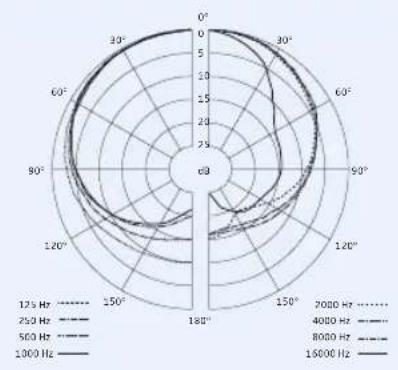
radar
| Frequency (Hz) | Value | |---|---| | 125 Hz | 12 | | 250 Hz | 2 | | 500 Hz | 3 | | 800 Hz | 4 | | 1000 Hz | 5 | | 1200 Hz | 6 | | 1500 Hz | 7 | | 1800 Hz | 8 | | 2000 Hz | 9 | | 4000 Hz | 10 | | 8000 Hz | 11 | | 16000 Hz | 12 |Frequency response curve MMD 835-1
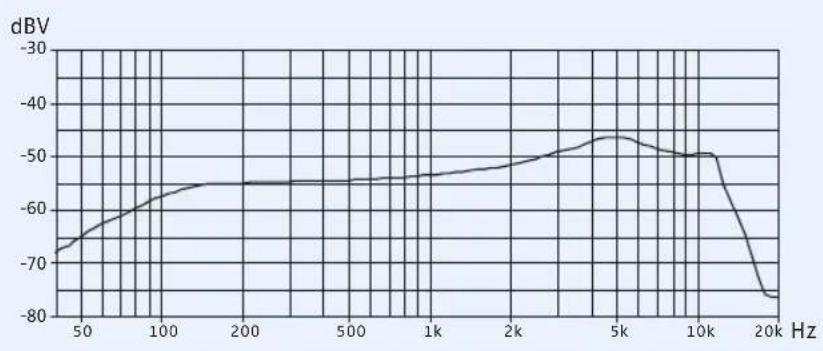
line
| Hz | dBV | | ---- | ---- | | 50 | -70 | | 100 | -60 | | 200 | -55 | | 500 | -55 | | 1k | -55 | | 2k | -50 | | 5k | -45 | | 10k | -50 | | 20k | -80 |Polar diagram MMD 845-1
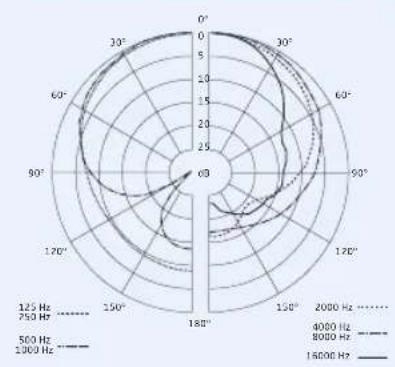
radar
| Frequency | Angle (°) | Value | |---|---|---| | 4000 Hz | 0 | 5 | | 4000 Hz | 30 | 15 | | 4000 Hz | 60 | 25 | | 4000 Hz | 90 | 25 | | 4000 Hz | 120 | 25 | | 4000 Hz | 150 | 25 | | 4000 Hz | 180 | 25 | | 4000 Hz | 210 | 25 | | 4000 Hz | 240 | 25 | | 4000 Hz | 270 | 25 | | 4000 Hz | 300 | 25 | | 4000 Hz | 330 | 25 | | 4000 Hz | 360 | 25 | | 8000 Hz | 0 | 5 | | 8000 Hz | 30 | 15 | | 8000 Hz | 60 | 25 | | 8000 Hz | 90 | 25 | | 8000 Hz | 120 | 25 | | 8000 Hz | 150 | 25 | | 8000 Hz | 180 | 25 | | 8000 Hz | 210 | 25 | | 8000 Hz | 240 | 25 | | 8000 Hz | 270 | 25 | | 8000 Hz | 300 | 25 | | 8000 Hz | 330 | 25 | | 8000 Hz | 360 | 25 | | 16000 Hz | 0 | 5 | | 16000 Hz | 30 | 15 | | 16000 Hz | 60 | 25 | | 16000 Hz | 90 | 25 | | 16000 Hz | 120 | 25 | | 16000 Hz | 150 | 25 | | 16000 Hz | 180 | 25 | | 16000 Hz | 210 | 25 | | 16000 Hz | 240 | 25 | | 16000 Hz | 270 | 25 | | 16000 Hz | 300 | 25 | | 16000 Hz | 330 | 25 | | 16000 Hz | 360 | 25 | The chart displays a single data series with two distinct lines representing different frequency bands. The x-axis represents the angle in degrees (from -∞ to +∞), and the y-axis represents the magnitude of the measured variable (labeled 'a'). The legend indicates three frequency bands: '4'Hz, '7'Hz, and '9'Hz. The data is presented in a circular format with each line corresponding to a specific frequency band. The chart lacks explicit numerical labels but visually conveys that all three frequency bands are plotted as identical along the circular axis, suggesting a comparison of their magnitudes across the angular range. The chart is annotated with a note that these values correspond to the frequency bands.Frequency response curve MMD 845-1
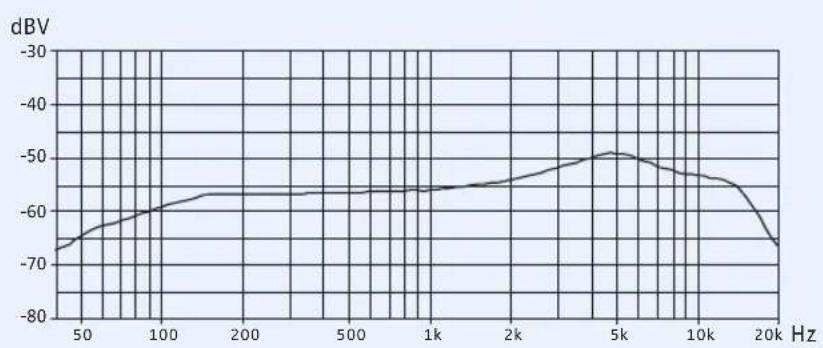
line
| Hz | dBV | | ---- | ---- | | 50 | -68 | | 100 | -62 | | 200 | -58 | | 500 | -57 | | 1k | -56 | | 2k | -54 | | 5k | -50 | | 10k | -55 | | 20k | -68 |Polar diagram MME 865-1 Frequency response curve MME 865-1
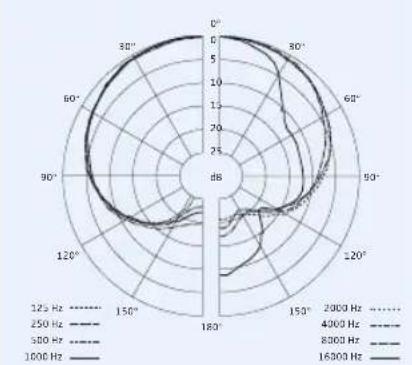
radar
| Frequency | Frequency (Hz) | | :--- | :--- | | 125 | 1.0 | | 250 | 1.0 | | 500 | 1.0 | | 800 | 1.0 | | 1600 | 1.0 | | 2000 | 1.0 | | 4000 | 1.0 | | 8300 | 1.0 | | 125 | 2.0 | | 250 | 2.0 | | 500 | 2.0 | | 800 | 2.0 | | 125 | 2.0 | | 250 | 2.0 | | 500 | 2.0 | | 800 | 2.0 | | 125 | 3.0 | | 250 | 3.0 | | 500 | 3.0 | | 800 | 3.0 | | 125 | 3.0 | | 250 | 3.0 | | 500 | 3.0 | | 800 | 3.0 | | 16300 | 1.0 | | 16300 | 1.0 | | 16300 | 1.0 | | 16300 | 1.0 | | 16300 | 1.0 | | 16300 | 1.0 | | 16300 | 1.0 | | 16300 | 1.0 | | 16399 | 1.0 | | 16399 | 1.0 | | 16399 | 1.0 | | 16399 | 1.0 | | 16399 | 1.0 | | 16399 | 1.0 | | 16399 | 1.0 | | 16399 | 1.0 | | 47777 | 1.0 | | 47777 | 1.0 | | 47777 | 1.0 | | 47777 | 1.0 | | 47777 | 1.0 | | 47777 | 1.0 | | 47777 | 1.0 | | 47777 | 1.0 | | 58884 | 1.0 | | 58884 | 1.0 | | 58884 | 1.0 | | 58884 | 1.0 | | 58884 | 1.0 | | 58884 | 1.0 | | 58884 | 1.0 | | 58884 | 1.0 | | 99664 | 1.0 | | 99664 | 1.0 | | 99664 | 1.0 | | 99664 | 1.0 | | 99664 | 1.0 | | 99664 | 1.0 | | 99664 | 1.0 | | 99664 | 1.0 | | The chart displays a radar plot of frequency (Hz) against angular position (degrees). The data is presented in a grid format with three distinct frequency bands: the center band (left) has a value of approximately -2 dB, the middle band (center) has a value of approximately +2 dB, and the right band (right) has a value of approximately +2 dB (with some values not explicitly labeled). The frequency values are annotated on the chart as follows: 'dB' indicates the magnitude of the measured variable.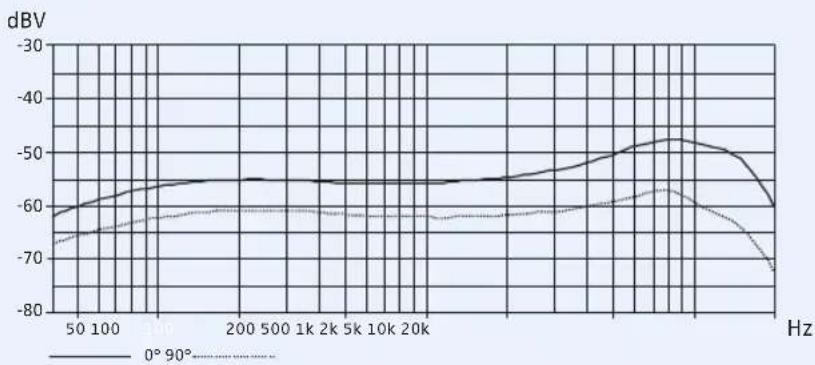
Manufacturer Declarations
Warranty
Sennheiser electronic GmbH & Co. KG gives a warranty of 24 months on this product.
For the current warranty conditions, please visit our web site at www.sennheiser.com or contact your Sennheiser partner.
In compliance with the following requirements
• RoHS Directive (2002/95/EU)
• WEEE Directive (2002/96/EU)

Please dispose of these products at the end of their operational lifetime by taking it to your local collection point or recycling center for such equipment.
• Battery Directive (2006/66/EU)

The supplied batteries or rechargeable batteries of the transmitters can be recycled. Please dispose of them as special waste or return them to your specialist dealer. In order to protect the environment, only dispose of exhausted batteries.
CE Declaration of Conformity
• EM 300: SK€/06KM 300:
CE0682①
• R&TTE Directive (1999/5/EU), EMC Directive (2004/108/EU), Low Voltage Directive (2006/95/EU)
The declarations are available at www.sennheiser.com. Before putting the devices into operation, please observe the respective country-specific regulations.
Statements regarding FCC and Industry Canada
These devices comply with Part 15 of the FCC Rules and with RSS-210 of Industry Canada. Operation is subject to the following two conditions: (1) these devices may not cause harmful interference, and (2) these devices must accept any interference received, including interference that may cause undesired operation.
This equipment has been tested and found to comply with the limits for a Class B digital device, pursuant to Part 15 of the FCC Rules. These limits are designed to provide reasonable protection against harmful interference in a residential installation. This equipment generates, uses and can radiate radio frequency energy and, if not installed and used in accordance with the instructions, may cause harmful interference to radio communications. However, there is no guarantee that interference will not occur in a particular installation. If this equipment does cause harmful interference to radio or television reception, which can be determined by turning the equipment off and on, the user is encouraged to try to correct the interference by one or more of the following measures:
- Reorient or relocate the receiving antenna.
- Increase the separation between the equipment and receiver.
- Connect the equipment into an outlet on a circuit different from that to which the receiver is connected.
- Consult the dealer or an experienced radio/TV technician for help.
These class B digital devices comply with the Canadian ICES-003.
Changes or modifications made to this equipment not expressly approved by Sennheiser electronic Corp. may void the FCC authorization to operate this equipment.
Before putting the devices into operation, please observe the respective country-specific regulations!
Sennheiser electronic GmbH & Co. KG Am Labor 1, 30900 Wedemark, Germany www.sennheiser.com
Printed in Germany Publ. 01/09 529661/A01