
5575LE - Mikrofon SHURE - Kostenlose Bedienungsanleitung
Finden Sie kostenlos die Bedienungsanleitung des Geräts 5575LE SHURE als PDF.


| Produkttyp | Dynamisches Mikrofon mit Nierencharakteristik |
| Modell | 5575LE (Limited Edition) |
| Wandlerprinzip | Moving-Coil (Dynamisch) |
| Richtcharakteristik | Niere (kardioid), einseitig gerichtet |
| Frequenzgang | 50 Hz – 16.000 Hz |
| Ausgangsimpedanz | 270 Ω (bei 1 kHz) |
| Empfindlichkeit (Leerlauf) | -56 dBV/Pa (1 kHz, 0°) |
| Empfindlichkeit (1000 Ω Last) | -58 dBV/Pa |
| Anschlussstecker | XLR 3-polig, männlich |
| Gehäusematerial | Zink-Druckguss, gebürstet verchromt |
| Gewicht | 1,8 lbs (ca. 820 g) |
| Abmessungen (H x B x T) | 198 mm x 81 mm x 90 mm (Gesamthöhe mit Korb: 197 mm) |
| Schwenkbereich | Kopf um 90° schwenkbar |
| Mitgeliefertes Zubehör | Tischstativ S36B, rechtwinkliges XLR-Kabel (1,5 ft) |
| Stoßdämpfung | Internes pneumatisches Stoßdämpfersystem |
| Stromversorgung | Keine (passives dynamisches Mikrofon) |
| Phasenlage | Positiver Druck erzeugt positive Spannung an Pin 2 |
| Brummstörfeld | -35 dBV (60 Hz, 10 Oersted) |
| Anwendungsbereiche | PA, Rundfunk, Aufnahme, Bühne |
| Wartung | Mit trockenem Tuch reinigen; keine aggressiven Reiniger |
| Sicherheitshinweise | Starke Stöße vermeiden; vor Feuchtigkeit schützen |
| Reparierbarkeit | Ersatzteile über Shure Service; Kapsel und Kabel austauschbar |
Häufig gestellte Fragen - 5575LE SHURE
Benutzerfragen zu 5575LE SHURE
0 Frage zu diesem Gerät. Beantworten Sie die, die Sie kennen, oder stellen Sie Ihre eigene.
Eine neue Frage zu diesem Gerät stellen
Laden Sie die Anleitung für Ihr Mikrofon kostenlos im PDF-Format! Finden Sie Ihr Handbuch 5575LE - SHURE und nehmen Sie Ihr elektronisches Gerät wieder in die Hand. Auf dieser Seite sind alle Dokumente veröffentlicht, die für die Verwendung Ihres Geräts notwendig sind. 5575LE von der Marke SHURE.
BEDIENUNGSANLEITUNG 5575LE SHURE
55 Series "Unidyne" Microphones
(Cardoid-Type Unidirectional Moving-Coil Dynamic)
GENERAL :
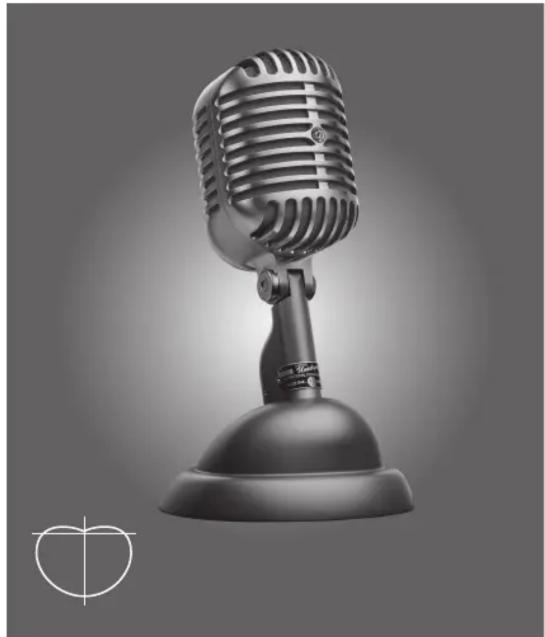
Model 5575LE is a cardioid type unidirectional moving coil dynamic microphone providing wide-range high quality repro-
duction of sound. The true unidirectional characteristic of the "Unidyne" obtained by the "uniphase" principle* provides highly satisfactory operation under adverse acoustic conditions where a conventional microphone would be practically useless. (See "Acoustic Considerations").
The microphone has a specially designed moving system containing a new type moving-coil element, operating in conjunction with a high flux magnet in the magnetic circuit providing high efficiency and smooth peak free response from 50 to 16,000 cycles. The rear response is down approximately 20 dB due to the "uniphase" unidirectional acoustic network.
The housing is modern in design with attractive streamlining and grille treatment. The head tilts through an angle of 90^ to permit aiming at the source of sound for best pickup. A built-in cable connector and attractive desktop stand are provided.
APPLICATIONS:
Model 5575LE is suitable for high quality public address, broadcasting, recording and similar applications. The true unidi-
rectional characteristic of the "Unidyne" provides an easy solution to the feedback problem in reverberant locations, facilitates orchestral placement, permits best utilization of space in small broadcast studios, and allows practically complete exclusion of unwanted noises. The swivel allows the head to be tilted through an angle of 90^ permitting the microphone to be aimed at the source of sound.
The 5575LE is unusually rugged and is practically immune to the effects of moisture, temperature and mechanical vibration.
INSTALLATION:
All microphones have the standard 5/8"-27 thread and may be mounted on any Shure desk, banquet, or floor stand. Shure
floor stands are especially recommended because of the effective isolation against floor vibration which they provide. The furnished Shure S36B desk stand provides an elegant and functional desktop solution.
CONNECTIONS:
Model 5575LE terminates in a male XLR style connector which mates with any XLR cable for direct connection to a high-
quality microphone preamplifier. The furnished S36B desk stand includes a right-angle XLR cable.
Model Impedance Cable Furnished
5575LE 250-300 ohms 1.5 ft. three-
conductor XLR type
This low impedance model 5575LE is suitable for applications where long cable lengths are required. The permissible line length is practically unlimited since neither the level nor the frequency response is appreciably affected by reasonable lengths of line.
natural_image
Black-and-white illustration of a vintage-style microphone on a stand, with a small geometric crosshair symbol below (no text or symbols on the microphone itself)OPERATION:
The microphone should be placed in its operating position before turning up the volume controls of the amplifier. Jarring
or excessive moving of the microphone should be avoided, however the patented internal pneumatic shock mount system effectively reduces mechanically-borne vibrations while the system is in operation in order to minimize the production of undesirable noises.
No special precautions beyond ordinary care are necessary in the operation of 55 Series Dynamic Microphones. They will operate efficiently and dependably under all ordinary conditions in hot and cold climates. To retain the full strength of the highly efficient permanent magnet and to maintain alignment of the structure, dropping or other severe mechanical shocks should be avoided.
ACOUSTIC
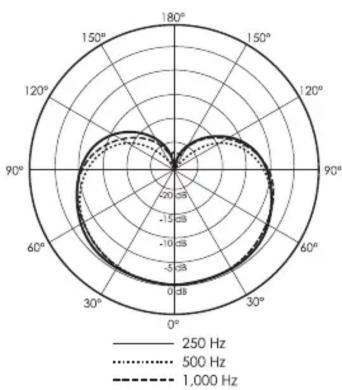
The expression "cardioid type" response simply means that the horizontal polar characteristic approximates a cardioid of revolution. There is a wide, useful pickup
CONSIDERATIONS:
angle at the front of the microphone while the response at the sides is down 6 dB from the front response. The rear response in practical cardioid type microphones is down of the order of 20 dB from the front side response. The patented "Unidyne III" microphone element fulfills these requirements over a broad range or frequencies.
The true unidirectional characteristic of "Unidyne" elements should not be confused with the relatively slight directional effect at high frequencies only which can be produced by baffle effects in the conventional pressure microphone.
Shure Patent Number 2,237,298 issued April 8, 1941.
The result of this unidirectional characteristic is a complete elimination of acoustic feedback at volume levels which would cause considerable feedback with conventional semidirectional microphones. In practically all cases it is possible to increase loudspeaker levels when a Unidyne microphone is installed. By directing the dead side (rear) of the microphone towards the audience or other source of interfering sound, pickup can be concentrated on the desired source. Reverberation energy pickup is decreased approximately two thirds. The microphone can be placed close to reflecting surfaces without objectionable effects if the rear side of the microphone is toward the reflecting surface. This is particularly valuable in small broadcast studios.
It is desirable to experiment with microphone placement and orientation in order to secure the greatest benefits from the unidirectional characteristics.
SPECIFICATIONS
Transducer Type:
Electrical response is provided by a moving coil element operating in conjunction with a high flux magnet in the magnetic circuit.
Horizontal Polar Characteristic:
Approximate of one cardioid of revolution with highest rejection at 180 degrees from the front of the microphone.
Voltage Sensitivity:
56 dB below 1 volt per Pascal open circuit with 1 kHz signal directed on-axis from two feet, or 58 dB below 1 volt per Pascal when loaded with 1000 ohms.
Output Impedance:
270 ohms when subjected to a 1 kHz signal.
Electromagnetic Hum Pickup:
-35 dBV when exposed to a 60 Hz, 10 oersted field while held in Fixture L 1-24-3.
Phase:
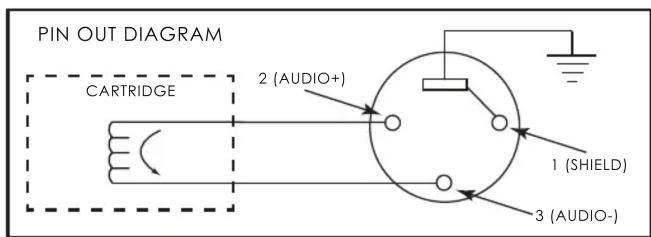
Upon application of positive pressure from the sound wave, the resulting voltage output relative to ground at pin 2 of the XLR connector is also positive.
Frequency Response:
50 to 16,000 Hz
Connector:
Three-pin professional XLR, male
Housing:
Zinc die casting with brushed chrome plating
Net Weight:
1.8 lbs.
Dimensions:
Height, Overall (a)* 7-25/32"
Height, Case (h)* 4-7/16"
Width (b)* 3-3/16"
Thickness (c)* 3-9/16"
* See Fig. C

line
| FREQUENCY -- CYCLES PER SECOND | RELATIVE RESPONSE DECBLES | | ------------------------------ | -------------------------- | | 30 | -10 | | 40 | -8 | | 60 | -5 | | 80 | -2 | | 100 | 0 | | 1M | 0 | | 2M | 0 | | 4M | 2 | | 6M | 4 | | 8M | 3 | | 10M | 1 | | 20M | -15 |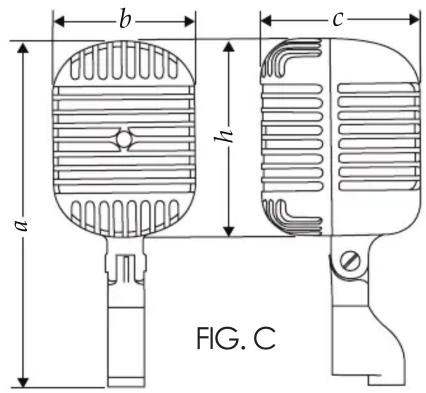
radar
| Angle | 250 Hz | 500 Hz | 1,000 Hz | |-------|--------|--------|----------| | 0° | -5.0 | -7.5 | -10.0 | | 30° | -4.5 | -7.0 | -9.5 | | 60° | -4.0 | -6.5 | -9.0 | | 90° | -3.5 | -6.0 | -8.5 | | 120° | -3.0 | -5.5 | -8.0 | | 150° | -2.5 | -5.0 | -7.5 | | 180° | -2.0 | -4.5 | -7.0 |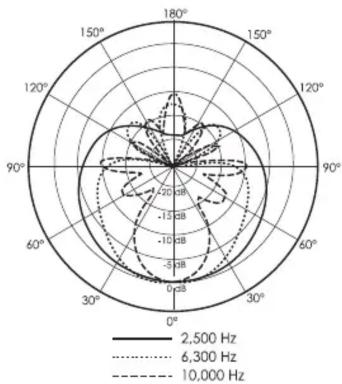
radar
| Angle | Frequency (Hz) | |---|---| | 0° | -2.5 | | 30° | -5.8 | | 60° | -10.2 | | 90° | -15.6 | | 120° | -2.1 | | 150° | -1.4 | | 180° | -0.7 | | 210° | -0.3 | | 240° | -0.1 | | 270° | -0.2 | | 300° | -0.4 | | 330° | -0.6 | | 360° | -0.8 | | 390° | -1.1 | | 420° | -1.4 | | 450° | -1.7 | | 480° | -2.0 | | 510° | -2.3 | | 540° | -2.6 | | 570° | -2.9 | | 600° | -3.2 | | 630° | -3.5 | | 660° | -3.8 | | 690° | -4.1 | | 720° | -4.4 | | 750° | -4.7 | | 780° | -5.0 | | 810° | -5.3 | | 840° | -5.6 | | 870° | -5.9 | | 900° | -6.2 | | 930° | -6.5 | | 960° | -6.8 | | 990° | -7.1 | | 1020° | -7.4 | | 1050° | -7.7 | | 1080° | -8.0 | | 1110° | -8.3 | | 1140° | -8.6 | | 1170° | -8.9 | | 1200° | -9.2 | | 1230° | -9.5 | | 1260° | -9.8 | | 1290° | -10.1 | | 1320° | -10.4 | | 1350° | -10.7 | | 1380° | -11.0 | | 1410° | -11.3 | | 1440° | -11.6 | | 1470° | -11.9 | | 1500° | -12.2 | | 1530° | -12.5 | | 1560° | -12.8 | | 1590° | -13.1 | | 1620° | -13.4 | | 1650° | -13.7 | | 1680° | -14.0 | | 1710° | -14.3 | | 1740° | -14.6 | | 1770° | -14.9 | | 1800° | -15.2 | | 1830° | -15.5 | | 1860° | -15.8 | | 1890° | -16.1 | | 1920° | -16.4 | | 1950° | -16.7 | | 1980° | -17.0 | | 2010° | -17.3 | | 2040° | -17.6 | | 2070° | -17.9 | | 2100° | -18.2 | | 2130° | -18.5 | | 2160° | -18.8 | | 2190° | -19.1 | | 2220° | -19.4 | | 2250° | -19.7 | | 2280° | -20.0 | | 2310° | -20.3 | | 2340° | -20.6 | | 2370° | -20.9 | | 2400° | -21.2 | | 2430° | -21.5 | | 2460° | -21.8 | | 2490° | -22.1 | | 2520° | -22.4 | | 2550° | -22.7 | | 2580° | -23.0 | | 2610° | -23.3 | | 2640° | -23.6 | | 2670° | -23.9 | | 2700° | -24.2 | | 2730° | -24.5 | | 2760° | -24.8 | | 2790° | -25.1 | | 2820° | -25.4 | | 2850° | -25.7 | | 2880° | -26.0 | | 2910° | -26.3 | | 2940° | -26.6 | | 2970° | -26.9 | | 3000° | -27.2 | | 3030° | -27.5 | | 3060° | -27.8 | | 3090° | -28.1 | | 3120° | -28.4 | | 3150° | -28.7 | | 3180° | -29.0 | | 3210° | -29.3 | | 3240° | -29.6 | | 3270° | -29.9 | | 3300° | -30.2 | | 3330° | -30.5 | | 3360° | -30.8 | | 3390° | -31.1 | | 3420° | -31.4 | | 3450° | -31.7 | | 3480° | -32.0 | | 3510° | -32.3 | | 3540° | -32.6 | | 3570° | -32.9 | | 3600° | -33.2 | | 3630° | -33.5 | | 3660° | -33.8 | | 3690° | -34.1 | | 3720° | -34.4 | | 3750° | -34.7 | | 3780° | -35.0 | | 3810° | -35.3 | | 3840° | -35.6 | | 3870° | -35.9 | | 3900° | -36.2 | | 3930° | -36.5 | | 3960° | -36.8 | | 3990° | -37.1 | | 4020° | -37.4 | | 4050° | -37.7 | | 4080° | -38.0 | | 4110° | -38.3 | | 4140° | -38.6 | | 4170° | -38.9 | | 4200° | -39.2 | | 4230° | -39.5 | | 4260° | -39.8 | | 4290° | -40.1 | | 4320° | -40.4 | | 4350° | -40.7 | | 4380° | -41.0 | | 4410° | -41.3 | | 4440° | -41.6 | | 4470° | -41.9 | | 4500° | -42.2 | | 4530° | -42.5 | | 4560° | -42.8 | | 4590° | -43.1 | | 4620° | -43.4 | | 4650° | -43.7 | | 4680° | -44.0 | | 4710° | -44.3 | | 4740° | -44.6 | | 4770° | -44.9 | | 4800° | -45.2 | | 4830° | -45.5 | | 4860° | -45.8 | | 4890° | -46.1 | | 4920° | -46.4 | | 4950° | -46.7 | | 4980° | -47.0 | | 5� | -47.3 | | ... (repeated) for all angles are not included in the provided code text in the image.) The data is presented in a single column format with 'Hz' as the label on the chart.ABOUT THIS GUIDE
This data sheet was written and styled based on the original 1939 data sheet for the Model 55 Unidyne microphone.
SHURE®
LEGENDARY
PERFORMANCE™

- Series "Unidyne" Microphones
- (Cardoid-Type Unidirectional Moving-Coil Dynamic)
- GENERAL :
- APPLICATIONS:
- INSTALLATION:
- CONNECTIONS:
- Model Impedance Cable Furnished
- OPERATION:
- ACOUSTIC
- CONSIDERATIONS:
- SPECIFICATIONS
- Transducer Type:
- Horizontal Polar Characteristic:
- Voltage Sensitivity:
- Output Impedance:
- Electromagnetic Hum Pickup:
- Phase:
- Frequency Response:
- Connector:
- Housing:
- Net Weight:
- Dimensions:
- ABOUT THIS GUIDE
- SHURE®
- LEGENDARY
- PERFORMANCE™
Marke : SHURE
Modell : 5575LE
Kategorie : Mikrofon