
NVR-4707 - Waschmaschine NEVIR - Kostenlose Bedienungsanleitung
Finden Sie kostenlos die Bedienungsanleitung des Geräts NVR-4707 NEVIR als PDF.


Benutzerfragen zu NVR-4707 NEVIR
0 Frage zu diesem Gerät. Beantworten Sie die, die Sie kennen, oder stellen Sie Ihre eigene.
Eine neue Frage zu diesem Gerät stellen
Laden Sie die Anleitung für Ihr Waschmaschine kostenlos im PDF-Format! Finden Sie Ihr Handbuch NVR-4707 - NEVIR und nehmen Sie Ihr elektronisches Gerät wieder in die Hand. Auf dieser Seite sind alle Dokumente veröffentlicht, die für die Verwendung Ihres Geräts notwendig sind. NVR-4707 von der Marke NEVIR.
BEDIENUNGSANLEITUNG NVR-4707 NEVIR
nevir
Antes de usar su lavadora, por favor, lea este manual cuidadosamente y consérvelo para su futura referencia.
■ Este manual también estará disponible para enviar al cliente por e-mail.
MANUAL DE USUARIO DE LA LAVADORA
natural_image
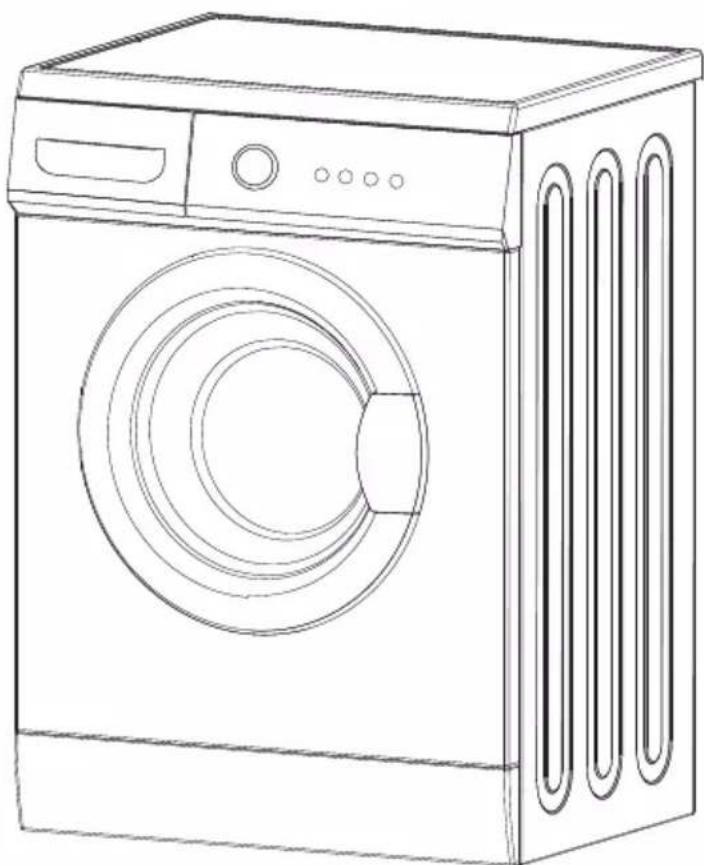
Line drawing of a washing machine with circular vent and side panel (no text or symbols)La imagen de la lavadora en el manual es utilizada solo para el manual de instrucciones. Puede variar con respecto a la lavadora que usted compra.
NEVIR S.A.
Contenido
Instrucciones de seguridad 3
Descripción general de la lavadora 7
Instalar lavadora....8
Operar la lavadora.... 11
Lista de verificación y preparación antes de lavar la ropa 11
Vista del panel de control 15
Selecciona el procedimiento 16
Tabla de Procedimientos de Lavado 19
Mantenimiento.... 20
Caja de detergente limpia y surcos 21
Solución de problemas 23
Quita los problemas.... 24
Apéndice 25
Etiqueta de cuidado 25
Especificaciones del producto 26
Ficha de producto.... 27
Los aparatos que no llevan identificado número de fábrica o que éste haya sido alterado o borrado conllevará pérdida de garantía.
Instrucciones de seguridad
■ Instrucciones de seguridad
- Si el cable de alimentación está dañado, debe ser reemplazado por el fabricante, su agente de servicio o personas con calificaciones similares para evitar un peligro.
- Los nuevos juegos de mangueras suministrados con el aparato deben utilizarse y los juegos de mangueras antiguos no deben reutilizarse.
- Esta lavadora es sólo para uso en interiores.
- Las aberturas no deben estar obstruidas por una alfombra. (Esta advertencia es solo para el mercado EUROPEO) Este aparato puede ser utilizado por niños de 8 años en adelante y personas con capacidades físicas, sensoriales o mentales reducidas o falta de experiencia y conocimiento. si se les ha dado supervisión o instrucciones sobre el uso del aparato en un modo seguro y sencillo, y sobre los peligros involucrados. Los niños no deben jugar con el aparato. La limpieza y el mantenimiento del usuario no deben ser realizados por niños sin supervisión.
- (Esta advertencia no es para el mercado EUROPEO) Este aparato no está diseñado para ser utilizado por personas (incluidos niños) con capacidades físicas, sensoriales o mentales reducidas, o por falta de experiencia y conocimiento, a menos que hayan recibido supervisión o instrucciones sobre el uso de el aparato por una persona responsable de su seguridad. Los niños deben ser supervisados para asegurarse de que no jueguen con el aparato.
- Retire el enchufe de la toma de corriente antes de la limpieza o el mantenimiento.
Instrucciones de seguridad
- Asegúrate de que todos los bolsillos estén vacíos.
- Los artículos afilados y rígidos, como monedas, broches, clavos, tornillos o piedras, etc. pueden causar graves daños a esta máquina.
- Retire el tapón y corte el suministro de agua después de la operación.
- Compruebe si el agua del interior del tambor se ha drenado antes de abrir la puerta. No abra la puerta si hay agua visible.
- Las mascotas y los niños pueden subirse a la máquina. Revise la máquina antes de cada operación.
- La puerta de vidrio puede estar muy caliente durante la operación. Mantenga a los niños y las mascotas alejados de la máquina durante la operación.
- Tenga cuidado de que la tensión y la frecuencia de alimentación sean idénticas a las de la lavadora.
- No utilice ningún enchufe con una corriente nominal inferior a la de la lavadora. Nunca tire del enchufe con la mano húmeda.
- Para garantizar su seguridad, el enchufe del cable de alimentación debe insertarse en un enchufe de tres polos con conexión a tierra. Verifique con cuidado y asegúrese de que su enchufe esté conectado a tierra de manera adecuada y confiable.
- Los niños menores de 3 años deben mantenerse alejados a menos que sean supervisados continuamente.
- Los niños deben ser supervisados para asegurarse de que no jueguen con la máquina.
- Los materiales de embalaje pueden ser peligrosos para los niños. Mantenga todos los materiales de embalaje (bolsas de plástico, espumas, etc.) lejos de los niños.
- Tenga cuidado de no quemarse cuando la lavadora drena el agua de lavado caliente.
Instrucciones de seguridad
- La lavadora no debe instalarse en cuartos de baño o cuartos muy húmedos, así como en cuartos con explosiones.
- Gases vivos o cáusticos.
- Asegúrese de que el agua y los dispositivos eléctricos deben ser conectados por un técnico calificado de acuerdo con las instrucciones del fabricante y las normas de seguridad locales.
- Antes de operar esta máquina, todos los paquetes y tran.
- deben quitarse los tornillos deportivos. De lo contrario, la lavadora podría dañarse seriamente mientras lava la ropa.
- Antes de lavar la ropa por primera vez, la lavadora debe operarse en una ronda de todos los procedimientos sin la ropa dentro.
- La lavadora con válvula de entrada única solo se puede conectar al suministro de agua fría. La lavadora con válvulas de doble entrada se puede conectar al suministro de agua caliente y agua fría.
- Su lavadora es solo para uso en el hogar y está diseñada solo para los textiles adecuados para el lavado a máquina.
- Los disolventes inflamables y explosivos o tóxicos están prohibidos. La gasolina y el alcohol, etc. No deben utilizarse como detergentes. Seleccione únicamente los detergentes adecuados para el lavado a máquina, especialmente para el tambor.
- Está prohibido lavar alfombras.
- Nunca vuelva a llenar el agua con la mano durante el lavado.
- Una vez completado el programa, espere dos minutos para abrir la puerta.
Instrucciones de seguridad
- Recuerde desconectar el suministro de agua y electricidad inmediatamente después de lavar la ropa.
- No trepe y siéntese en la cubierta superior de la máquina.
- No se apoye contra la puerta de la máquina.
- Por favor, no cierre la puerta con fuerzas excesivas. Si le resulta difícil cerrar la puerta, verifique si la ropa excesiva está bien colocada o bien distribuida.
- La lavadora doméstica no está diseñada para ser incorporada.
-
Precauciones durante la manipulación de la máquina
-
Los pernos de transporte deben ser reinstalados en la máquina por una persona especializada.
- El agua acumulada se drenará de la máquina.
- Maneje la máquina con cuidado. Nunca sostenga cada parte saliente en la máquina mientras la levanta. La puerta de la máquina no se puede usar como manija durante el transporte.
- Notas sobre la eliminación:
Esta marca indica que este producto no debe desecharse con otros desechos domésticos en toda la UE. Para evitar posibles daños al medio ambiente o la salud humana por la eliminación incontrolada de desechos, recíclelo de manera responsable para promover la reutilización sostenible de los recursos materiales. Para devolver su dispositivo usado, utilice los sistemas de recolección o comuníquese con el distribuidor donde adquirió el producto. Vuelven y pueden tomar este producto para reciclarlo de forma segura para el medio ambiente.

La máquina es para uso doméstico.
Descripción general de la lavadora
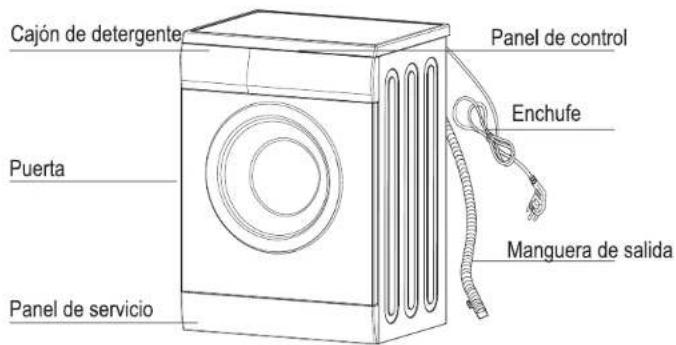
■ Componente
text_image
Cajón de detergente Panel de control Puerta Enchufe Manguera de salida Panel de servicio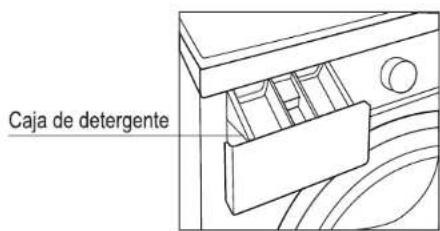
text_image
Caja de detergente■ Accesorios
text_image
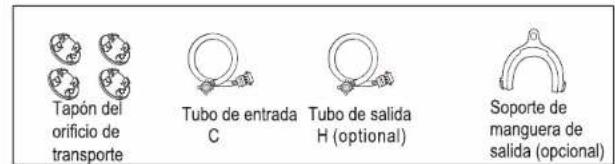
Tapón del orificio de transporte Tubo de entrada C Tubo de salida H (optional) Soporte de manguera de salida (opcional)Instalar lavadora
■ Desembalaje de la lavadora
Desembale su lavadora y verifique si hay algún daño durante el transporte. Asegúrese también de que se reciban todos los artículos (como se muestra en la página 5) en la bolsa adjunta. Si hay algún daño en la lavadora durante el transporte, o falta algún artículo, comuníquese con el distribuidor local de inmediato.
■ Disponer de los materiales de embalaje.
Los materiales de embalaje de esta máquina pueden ser peligrosos para los niños. Por favor, deséchelos adecuadamente y evite que los niños los toquen fácilmente. Deseche los materiales de embalaje correspondientes de acuerdo con las normativas locales pertinentes. No deseche los materiales de embalaje junto con las demás basuras de la vida diaria.
■ Quitar los pernos de transporte
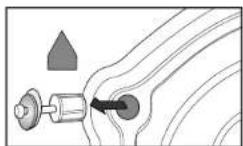
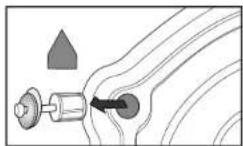
Antes de usar esta lavadora, los pernos de transporte deben retirarse de la parte posterior de
esta maquina. Por favor, siga los siguientes pasos para quitar los tornillos:
- Afloje todos los pernos con la llave y luego retirelos.
- Detenga los orificios con los tapones de transporte.
- Mantenga los pernos de transporte correctamente para uso futuro.
■ Seleccione la ubicación
Antes de instalar la lavadora, se seleccionará la ubicación caracterizada de la siguiente manera:
- Superficie rigida, seca y nivelada (si no está nivelada, nivélela con referencia a la siguiente figura "Ajustar pierna")
- Evitar la luz solar directa.
- Ventilación suficiente.
- La temperatura ambiente es superior a 0 C.
- Manténgase alejado de los recursos de calor como el carbón o el gas.
Asegúrese de que la lavadora no se apoye en el cable de alimentación. No instale la lavadora en el piso de la alfombra.
Ajustar la pierna
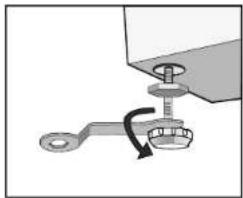
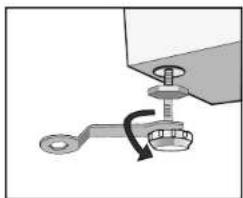
- Al colocar la lavadora, primero verifique si las patas están unidas al gabinete. De lo contrario, gírelos a sus posiciones originales con la mano o la llave y apriete las tuercas con la llave.
- Después de colocar la lavadora, presione cuatro esquinas en la tapa superior de la lavadora en secuencia. Si la lavadora no es estable cuando se presiona, esta pata se ajustará.
natural_image
Mechanical assembly diagram showing a lever mechanism with a curved arrow indicating motion (no text or symbols)Instalar lavadora
- Asegurar el estado de posicionamiento de la lavadora. Afloje la tuerca de bloqueo con llave y gire la pierna con la mano hasta que entre en contacto con el suelo. Presione la pierna con una mano y apriete la tuerca cerca del gabinete con la otra mano.
- Después de bloquearse correctamente, vuelva a presionar las cuatro esquinas para asegurarse de que se hayan ajustado correctamente. Si aún es inestable, debe repetir los pasos 2 y 3.
- Coloque un cilindro sólido (por ejemplo, latas de pop) opuesto en la tapa superior de la lavadora desde las direcciones izquierda, derecha, delantera y trasera. Si el cilindro se mantiene estable, la lavadora se posiciona nivelada. Si rueda, la lavadora se coloca deslevel. La dirección de rodadura es la dirección de la superficie del terreno inferior. Luego, las dos patas en esta dirección se levantarán al mismo tiempo hasta que la lavadora esté nivelada. Los pasos 1 \~ 3 se repiten para hacer que las patas inferiores estén cerca del suelo y las tuercas deben estar firmemente cerradas.
■ Conecte el tubo de entrada
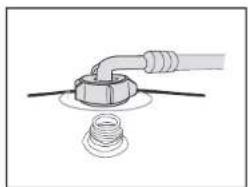
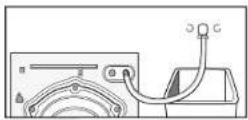
Conecte el tubo de entrada como se indica en la figura. Para el modelo que tiene válvula caliente, conecte el valle caliente al grifo de agua caliente. La energía disminuirá automáticamente para algunos programas.
Instale el tubo de entrada
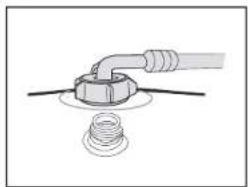
- Conecte el codo a la toma y sujételo en el sentido de las agujas del reloj.
- Conecte el otro extremo del tubo de entrada a la válvula de entrada en la parte posterior de la lavadora y apriete el tubo firmemente hacia la derecha.
Notas: después de la conexión, si hay alguna fuga en la manguera, repita los pasos para conectar el tubo de entrada. El tipo de grifo más común se utilizará para suministrar agua. Si el grifo es cuadrado o demasiado grande, se cambiará el grifo estándar.
natural_image
Simple line drawing of a hand holding a pipe fitting over a coiled spring (no text or symbols)■ Coloque la manguera de salida
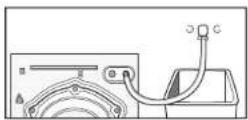
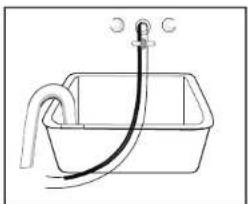
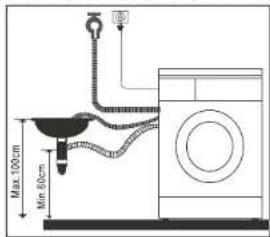
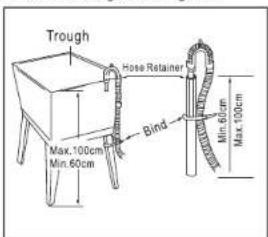
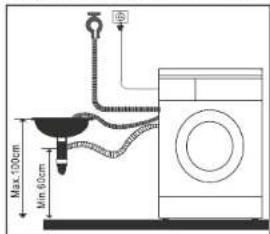
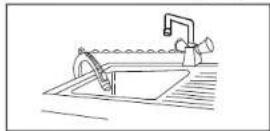
Hay dos formas de colocar el extremo de la manguera de salida: 1. Póngala junto a la cubeta de agua.
natural_image
Simple line drawing of a bathtub with a coiled tube and two circular feet above it (no text or symbols)Instalar lavadora
- Conéctelo al tubo de desagüe de la canaleta.
text_image
Max 100cm Min 60cm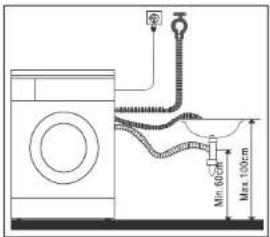
text_image
Min 60cm Max 100cm- Puede drenar el agua hacia amba y hacia abajo, la manguera de salida no debe instalarse a una altura superior a 100 cm y su extremo no debe sumergirse en agua
Coloque la manguera de salida correctamente para que el suelo no se dañe por las fugas de agua. Notas:
Si la máquina tiene soporte de manguera de salida, instálela como en las siguientes imágenes.
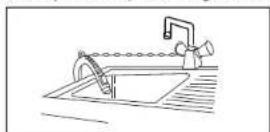
- Al instalar la manguera de salida, fijela correctamente con una cuerda.
- Coloque la manguera de salida correctamente para que el suelo no se dañe por las fugas de agua.
text_image
Trough Hose Retainer Max.100cm Min.60cm Bind Min.60cm Max 100cm- Si la manguera de salida es demasiado larga, no la fuerce en la lavadora, ya que causará ruidos anormales.
■ Conexión eléctrica
- Como la corriente máxima a través de la unidad es de 10A cuando utiliza su función de calefacción, asegúrese de que el sistema de suministro de energía (corriente, voltaje de alimentación y cable) de su hogar cumpla con los requisitos normales de carga de los aparatos eléctricos.
- Conecte la alimentación a una toma que esté correctamente instalada y conectada a tierra.
- Asegúrese de que la tensión de alimentación en su lugar sea la misma que se indica en la etiqueta de clasificación de la máquina.
- El enchufe de alimentación debe coincidir con el zócalo y el gabinete debe estar conectado a tierra de manera adecuada y efectiva.
- No utilice un enchufe o enchufe de usos múltiples como cable de extensión.
- No conecte y saque el enchufe con las manos mojadas.
- Cuando conecte y extraiga el enchufe, sujételo firmemente y luego sáquelo. No tire del cable de alimentación a la fuerza.
- Si el cable de alimentación está dañado o tiene algún signo de que está roto, debe seleccionar o comprar un cable de alimentación especial de su fabricante o centro de servicio para reemplazarlo.
Instalar lavadora
CUIDADO
- Esta máquina debe estar correctamente conectada a tierra. Si hay algún cortocircuito, la conexión a tierra puede reducir el peligro de descarga eléctrica.
Esta máquina está equipada con un cable de alimentación, que incluye un enchufe, un cable de puesta a tierra en el terminal de tierra. - La lavadora debe ser operada en un circuito separado de otros aparatos eléctricos. De lo contrario, el protector de energía podría dispararse o quemarse el fusible.
PRECAUCIÓN
- La máquina debe estar perfectamente nivelada y estabilizada cuando las cuatro patas de soporte estén sobre el suelo. Baje las patas el máximo posible para que la máquina quede nivelada.
- Una nivelación incorrecta puede provocar ruidos, vibraciones de la máquina, desplazamiento de la máquina y otros fenómenos anormales.
- En la parte inferior de la máquina hay aberturas de ventilación (que no deben bloquearse). Instale la máquina sobre una base sólida, nivelada y antideslizante. No sitúe la máquina sobre una moqueta blanda ni sobre suelo de madera ni otro tipo de bases, ya que se podrían producir lesiones.
ADVERTENCIA
- Esta máquina debe estar puesta a tierra correctamente. Si existe un cortocircuito, la puesta a tierra puede reducir el peligro de electrocución.
- La lavadora debe conectarse a un circuito independiente de otros electrodomésticos. De lo contrario, el protector eléctrico puede dispararse o fundirse el fusible.
Funcionamiento de la lavadora
NOTA :
Asegúrese de que su máquina esté correctamente instalada antes de usarla.
Antes de empezar a utilizar la lavadora por primera vez debe realizar un ciclo completo en vacío.
Operar la lavadora
- Lista de verificación y preparación antes de lavar la ropa
Lea atentamente este método de operación para evitar los problemas de la lavadora y los daños de la ropa.
Compruebe si la ropa lavada primero se decolorará.
Después de usar una toalla blanca tocada con detergente líquido para lavar las esquinas invisibles de la ropa, verifique si la toalla blanca tiene manchas.
Color original de la ropa.
En cuanto a las bufandas y esas ropas que fácilmente
decolorarse entre ropa importada, por favor
Lavarlos por separado antes de lavarlos.
En cuanto a las manchas en mangas, cuellos y bolsillos,
Usa el detergente líquido y lávalo con un cepillo.
suavemente. Finalmente los metemos en la lavadora.
Para lograr más efectos de lavado ideales.
En cuanto a la ropa sensible a la temperatura, deberán
Lavarse según lo requerido en las etiquetas. De otra manera,
Puede causar cambio de color o distorsión.
Tenga en cuenta:
Nunca ponga la ropa a lavar en la lavadora durante un largo período de tiempo. De lo contrario, puede enmohecerse y causar manchas. Por lo tanto, por favor lavar la ropa a tiempo. La ropa también puede cambiar de color o distorsionarse si no se lava según la temperatura de lavado indicada.
Ropa que no se puede lavar con lavadora.
La ropa que se puede distorsionar si se sumerge en agua:
Las corbatas, chalecos, ropa de estilo occidental, prendas exteriores, etc. pueden tener una obvia retracción si se sumergen en agua; Las prendas decoloradas, como las prendas mezcladas de fibra artificial, etc.
La ropa de estilo arrugado, la ropa en relieve, la ropa de resina, etc. pueden distorsionarse al sumergirse en agua. Entre los materiales de algodón y lana, la ropa que se distorsiona fácilmente es la seda estilo arruga, los productos de piel y las decoraciones de piel;
Ropa con decoración, vestido largo y ropa tradicional, etc. son los productos que se decoloran fácilmente.
Por favor, no lave la ropa sin etiquetas de materiales y requisitos de lavado.
Nunca lave la ropa manchada con productos químicos como gasolina, petróleo, benceno, disolvente de pintura y alcohol.
Por favor, preste atención a los detergentes.
El detergente o el detergente de baja burbuja o el detergente especial para lavadoras de tambor se seleccionarán segun los tipos de fibra (algodón, fibra sintética, productos blandos y productos de lana), colores, temperaturas de lavado, grados y tipos de suciedad. De lo contrario, se pueden generar burbujas excesivas y desbordarse del cajón para que puedan ocurrir accidentes.
El blanqueador es de tipo alcalino y puede dañar la ropa, por lo que se sugiere usar lo menos posible.
natural_image
Illustration of a woven basket being lifted by a bag, with arrows indicating the process (no text or symbols present)Operar la lavadora
Los detergentes en polvo pueden dejar fácilmente los residuos en la ropa para generar el mal olor, por lo que deben enjuagarse lo suficiente.
El detergente no se disuelve fácilmente si hay demasiado detergente o la temperatura del agua es bastante baja. Puede permanecer en la ropa, tuberías y lavadoras para contaminar la ropa.
El lavado debe seguir el peso de la ropa, los grados de suciedad, la dureza del agua local y las recomendaciones de los fabricantes de detergentes. Consulte a la compañía de agua si no está libre de dureza del agua.
Notas:
Mantenga los detergentes y aditivos en lugares seguros y secos fuera del contacto de los niños.
■ Lista de verificación y preparación antes de lavar la ropa
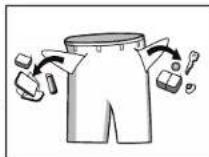
Por favor, saque los artículos de los bolsillos.
Por favor revisa los bolsillos de la ropa a ser.
lavado, vaciar los artículos rígidos tales como
Decoraciones y monedas, de lo contrario lavado.
La máquina puede estar dañada o tener un funcionamiento anormal. nubes.
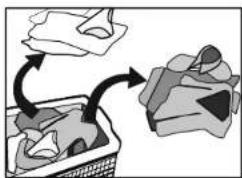
Para la ropa a lavar, se clasifican.
Según las siguientes características:
Los tipos de símbolos de las etiquetas de cuidado: la ropa a ser.
Los lavados se clasifican en algodón, fibra mezclada, fibra sintética, seda, lana y fibra artificial.
Color: se identificarán los colores blanco y colorido. Todos los nuevos artículos coloridos se lavarán de forma separada.
Tamaño: los artículos de diferentes tamaños se lavan juntos para aumentar los efectos de lavado.
Sensibilidad: los artículos blandos se lavarán por separado. En cuanto a los nuevos tejidos de lana pura, cortinas y sedas, se seleccionará el procedimiento de lavado suave. Revise las etiquetas en todos los artículos de lavado.
La ropa debe ser clasificada antes de ser puesta en la lavadora. En cuanto a las cortinas con ganchos, los ganchos deben retirarse antes de lavarse.
Las decoraciones en la ropa pueden dañar la lavadora. En cuanto a la ropa con botones o bordados, deben volverse antes de lavarse.
Limpie los sujetadores:
Las cremalleras se cerrarán con cremallera y los botones o ganchos se fijarán. La banda o cinta suelta deben estar unidas entre sí.
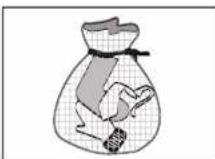
"Advertencia: Prendas pequeñas o con accesorios susceptibles de desprenderse de la ropa durante el proceso de lavado deben introducirse en unas boisas especiales. Obstrucciones por objetos ajenos a la máquina, la reparación no está cubierta por la garantía"
Operar la lavadora

Se sugiere poner bras en la almohada.
Con cremallera o botones sellados para evitar el acero.
El cable salta de los sujetadores hacia el tambor y Dañando la máquina.
Tejidos especialmente delicados como cortinas con cordones,
Chaquetas rectas, artículos pequeños (calcetines ajustados,
pañuelos, corbatas, etc.) se pondrán en cuerda Bolsa para el lavado.
Al lavar un solo vestido grande y pesado tal
Como toallas turcas, jeans, chaquetas acolchadas etc.
Fácilmente puede causar gran excentricidad y dar.
Alarma por gran desequilibrio. Por tanto, es
Se sugiere agregar una o dos prendas más para ser
lavados juntos para que el drenaje se pueda hacer suavemente.
Limpie el polvo, las manchas y los pelos de las mascotas.
La ropa puede dañarse y alterar los efectos de lavado durante la fricción entre el polvo, las manchas y la ropa.
Para proteger la piel del bebé
Los artículos para bebés (ropa y toallas para bebés), incluidas las servilletas, se lavarán por separado. Si se lavan junto con la ropa de los adultos, pueden infectarse. Los tiempos de enjuague deben aumentarse para garantizar el enjuague y la limpieza a fondo sin los residuos de detergente.
Se sugiere que las piezas que se tiñen fácilmente, como las tomas blancas, los cuellos y las mangas, etc., se laven a mano antes de colocarlas en la lavadora para lograr efectos de lavado más ideales.
Por favor use detergentes en polvo o líquidos. Los residuos del jabón podrian permanecer en los huecos de la ropa si se usa jabón.
Confirmar la capacidad de lavado:
No ponga lavados excesivos; De lo contrario puede afectar los efectos de lavado. Por favor, confirme la cantidad máxima de lavado asequible de acuerdo con la siguiente tabla.
| Tejido | Capacidad máxima de carga |
| 7.0kg | |
| Algodón | 3.5kg |
| Sintético | 3.5kg |
La ropa que se desvanece fácilmente se debe voltear para lavar.
La ropa que se desvanece fácilmente se lava por separado; de lo contrario, los otros artículos pueden mancharse con polvo y basura, etc. Preferiblemente, la ropa negra y la ropa de algodón deben lavarse por separado, ya que pueden mancharse fácilmente con las paredes de otros colores cuando se lavan juntos.
Por favor, compruebe antes de lavar.
La lavadora no debe lavar materiales a prueba de agua (trajes de esquí, almohadillas exteriores para servilletas, cortinas).
Operar la lavadora
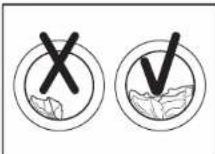
En cuanto a los productos de fibra que el agua no puede absorber fácilmente, como cojines a prueba de agua y ropa, es mejor no lavarse. De lo contrario, saldrá agua o una vibración anormal que causará peligro al enjuagar y drenar para que la ropa también pueda dañarse. (Por ejemplo, almohadillas exteriores para la servilleta, impermeables, paraguas, trajes de esqui, fundas para automóviles, sacos de dormir, etc.)
Precauciones durante el drenaje
Drenaje de ropa normal:
Las humedades de los lavados se drenan a través del orificio de drenaje.
Drenaje de prendas impermeables y productos de fibra:
En el estado normal de lavado y drenaje, las humedades de las prendas impermeables y los productos de fibra no pueden drenarse mientras el agua de lavado se acumula en una dirección, de modo que la excentricidad de la lavadora es demasiado grande y se producen vibraciones o movimientos.
■ Vista del panel de control
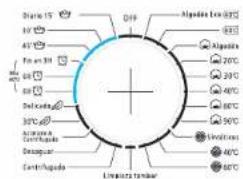
text_image
Diario 15 HV 40°C Fen en 300 600 600 Del konda 30°C Acrivada Carinuado Desquamar Centra/Ugado DHP Algoude Low 825 Algoude 20°C 30°C 40°C 50°C 50°C Evolutions 40°C 50°C Limpura normar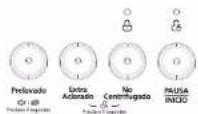
■ Función de interruptor giratorio
Hay 10 tipos de funciones de selección de lavado en pantalla. Por ejemplo: Algodón: con
las selecciones de temperatura correspondientes: 20,30,40, 60, 90 C, lavado diario en
frío: 15', 30', 45'
Sintético: 40, 60 C, frío.
Algodón ECO: 40, 60 C
Giro de enjuague
Solo drenaje
Girar solamente
Delicado: 30 C, frío.
Finaliza en: 3h, 6h, 9h
Tambor Limpio: 90 C
Notas:
-
El cuadro de líneas del panel de control es solo para referencia. Consulte el producto real como estándar.
-
El panel de control se puede cambiar sin previo aviso por escrito. Visite el sitio web www.nevir.es o llame a la línea de servicio para consultas.
Operar la lavadora
■ Lavar la ropa a la primera.
Antes de lavar la ropa por primera vez, la lavadora debe operarse en una ronda de todos los procedimientos sin ropa de la siguiente manera:
-
Conecte la fuente de alimentación y el agua.
-
Ponga un poco de detergente en la caja y ciérrelo.
-
Gire el interruptor giratorio y seleccione los procedimientos correspondientes.
4.Pulse el botón "Inicio / Pausa". El cajón está separado de la siguiente manera: I: Detergente o detergente en polvo. II: Detergente principal, suavizante, pre-inmersión, blanqueo o descontaminación de productos.
: Aditivo de lavado, como suavizante de telas o agente de pegajosidad.
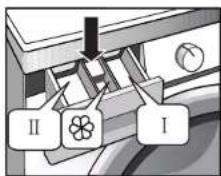
■ Ponga detergente en la lavadora.
- Saque el cajón.
- Rellene el detergente previo en la caja I (cuando sea necesario).
- Rellene el detergente en el estuche I
- Rellene el suavizante en el estuche (cuando sea necesario).
Notas:
- En cuanto al detergente o aditivo aglomerado o ropy, antes de verterio en la caja de detergente, se sugiere usar un poco de agua para diluir para evitar que la entrada de la caja de detergente se bloquee y se desborde mientras se llena el agua.
- Elija el tipo de detergente adecuado para las diferentes temperaturas de lavado para obtener el mejor efecto de lavado con menos consumo de agua y energía.
Arranque lavadora
Conecte el poder. Compruebe si las tuberías de agua están conectadas correctamente. Abra el grifo por completo. Poner la ropa a lavar y rellenar el detergente y el agente de pegajosidad. Seleccione los procedimientos y funciones adecuados y presione el botón "Inicio / Pausa".
■ Selecciona el procedimiento
Los procedimientos de lavado adecuados se seleccionarán de acuerdo con los tipos, las cantidades y la suciedad de la ropa que se va a lavar en combinación con la siguiente tabla de temperatura de lavado.
| 90°C | Algodón o lino blanco puro gravemente manchado (por ejemplo: paños de mesa de café, paños de mesa de cantina, toallas, sábanas) |
Operar la lavadora
| 60°C | Lino colorido, algodón y artículos sintéticos moderadamente manchados con cierto grado de decoloración (por ejemplo: camisas, pijamas de noche; Lino blanco puro ligeramente manchado (por ejemplo: ropa interior) |
| 40°C,30°C,20°C Agua fría | Artículos normalmente manchados (incluso sintéticos y delicados) |
- Cargar la ropa y agregar detergente.
2 Gire el interruptor giratorio para seleccionar un programa de acuerdo con la tabla de programas. - Seleccione la función opcional si es necesario
- Presione el botón de inicio / pausa.
TENGA EN CUENTA:
Los principales procedimientos de lavado dependen de los tipos de ropa a lavar. Los principales programas de lavado se pueden seleccionar de la siguiente manera:
- algodón
Puede seleccionar este procedimiento para lavar la ropa diaria lavable. El período de lavado es bastante largo con intensiones de lavado bastante fuertes. Se recomienda lavar los artículos de algodón diarios,
por ejemplo: sábanas, colchas, fundas de almohadas, batas, ropa interior, etc.
- sintético
Puedes seleccionar este procedimiento para lavar la ropa bastante delicada. El procedimiento es más corto en comparación con el de los algodones y la intención de lavado es bastante suave. Se recomienda lavar artículos sintéticos, por ejemplo: camisas, abrigos, mezclas. Como para Cortinas y tejidos con cordones, se seleccionará el procedimiento "Sintético". Mientras lava los tejidos de punto, la cantidad de detergente se reducirá debido a la construcción de la cuerda suelta y la formación de burbujas.
-Lavado diario
Este procedimiento es adecuado para lavar poca ropa y no muy sucia rápidamente.
-Algodón ecológico
Para aumentar los efectos de lavado, se incrementa el tiempo de lavado adicional principal.
Se recomienda lavar la ropa para bebés o para personas con piel alérgica.
-Girar solamente
Procedimiento de giro separado. El agua de jabón o enjuague se debe drenar antes de girar. -Giro de enjuague
Procedimiento separado de enjuague y centrifugado.
- Sólo drenaje
Procedimiento de drenaje solo por separado.
- delicado
Puede seleccionar este procedimiento para lavar su ropa delicada. Su intención de lavado es más suave y la velocidad de centrifugado es menor en comparación con el procedimiento "Sintético". Es recomendado
Para que los artículos se laven suavemente.
Operar la lavadora
- Limpiar el tambor
Este ciclo está especialmente configurado en esta máquina para limpiar el tambor y el tubo. Aplica una esterilización a alta temperatura de 90 °C para hacer que la ropa se lave más verde. Cuando se realiza este procedimiento, no se puede agregar la ropa u otro lavado. Cuando se coloca la cantidad adecuada de agente de blanqueo con cloro, el efecto de limpieza del barril será mejor.
El cliente puede utilizar este procedimiento regularmente según la necesidad.
-Fin
El Funciton se puede configurar con este procedimiento, todo el tiempo, incluido el tiempo de lavado y el tiempo de demora, son
3h, 6h o 9h.
Notas:
Si desea cambiar el programa en condición de bloqueo para niños, primero debe desbloquear el bloqueo para niños, luego gire la perilla a la posición de APAGADO, finalmente elija el programa que desea.
La función principal se puede seleccionar de la siguiente manera:
- Prelavado
La función de prelavado puede obtener un lavado adicional antes del lavado principal.
- Enjuague extra
La ropa se someterá a un enjuague adicional una vez que la selecciones.
- Sin giro
La máquina no girará si elige esta función.
-Bloqueo para niños
Para evitar que el procedimiento de lavado no funcione normalmente debido a un mal funcionamiento de los niños durante el procedimiento de lavado, puede seleccionar esta función. En este caso, los otros botones, excepto el botón Desactivado, no pueden funcionar. En este estado, la máquina se apaga cuando prensa
la tecla de encendido / apagado. La máquina recuerda el bloqueo para niños del programa y el programa durante el apagado cuando se presiona la tecla de encendido / apagado nuevamente. Presione "Extra Rinse" y "No Spin" juntos durante 3 segundos durante el proceso de ejecución, el zumbador emitirá un pitido, el botón de Inicio / Pausa y el interruptor giratorio están bloqueados.
Presione los dos botones durante 3 segundos juntos y el zumbador emitirá un pitido para liberar el bloqueo. Pero al cortar la fuente de alimentación, la protección del niño también se libera al bloqueo. La protección del niño no se cancelará después de que se completen todos los procedimientos.
- Supresión de las señales acústicas.
Esta es una función de timbre adicional en su aparato. Después de desactivar la función del zumbador, el zumbador se cerrará.
Después de encender la máquina, presione el botón "Prelavado" durante 3 segundos y escuchará un pitido, luego el zumbador se cerrará. Para reiniciar la función del zumbador, vuelva a presionar el botón "Temp. & Girar" durante 3 segundos. El ajuste se mantendrá hasta el próximo reinicio.
Advertencia: Después de desactivar la función del zumbador, los sonidos ya no se activarán. - Función de eliminación de burbujas
Función de comprobación de burbujas: se producirán burbujas redundantes cuando haya un exceso de detergente, lo que afectará los efectos de lavado y enjuague. El procedimiento se verificará automáticamente y se agregará automáticamente un procedimiento de eliminación de burbujas para eliminar las burbujas cuando se verifican burbujas excesivas.
Operar la lavadora
■ Tabla de Procedimientos de Lavado
| Procedimiento/Descripción | Carga (Kg) | Caja del Detergente | Temperat. Estándar(°C) | Tiempo Estándar(H) | Velocidad Estándar (Rpm) | ||
| 7.0 | Caja I | Caja II | Caja do Suaviz. | 7.0 | 7.0 | 7.01200 | |
| Algodón Eco 40°C | 7.0 | × | ● | ○ | 40 | 3:45 | 1200 |
| Algodón Eco 60°C | 7.0 | × | ● | ○ | 60 | 3:23 | 1200 |
| Algodón | 7.0 | ○ | ● | ○ | 0 | 1:35 | 1200 |
| Algodón 20°C | 7.0 | ○ | ● | ○ | 20 | 1:19 | 1200 |
| Algodón 30°C | 7.0 | ○ | ● | ○ | 30 | 1:20 | 1200 |
| Algodón 40°C | 7.0 | ○ | ● | ○ | 40 | 1:40 | 1200 |
| Algodón 60°C | 7.0 | ○ | ● | ○ | 60 | 1:45 | 1200 |
| Algodón 90°C | 7.0 | ○ | ● | ○ | 90 | 2:40 | 1200 |
| Sintético | 3.5 | ○ | ● | ○ | 0 | 1:18 | 1000 |
| Sintético 40°C | 3.5 | ○ | ● | ○ | 40 | 1:33 | 1000 |
| Sintético 60°C | 3.5 | ○ | ● | ○ | 60 | 1:43 | 1000 |
| Limpieza de tambor | — | × | × | × | 90 | 1:21 | 400 |
| Centrifugado | 7.0 | × | × | × | — | 0:12 | 1200 |
| Desagüe | — | × | × | × | — | 0:01 | — |
| Adarado& Centrifugado | 7.0 | × | × | ○ | — | 0:31 | 1200 |
| Delicado 30°C | 2.5 | × | ● | ○ | 30 | 1:00 | 600 |
| Delicado | 2.5 | × | ● | ○ | 0 | 0:55 | 600 |
| Programa diferido 9H | 7.0 | × | ● | ○ | 40 | 1:13 | 1000 |
| Programa diferido 6H | 7.0 | × | ● | ○ | 40 | 1:13 | 1000 |
| Programa diferido 3H | 7.0 | × | ● | ○ | 40 | 1:13 | 1000 |
| Lavado diario 45' | 2.0 | × | ● | ○ | 30 | 0:45 | 800 |
| Lavado diario 30' | 2.0 | × | ● | ○ | 20 | 0:30 | 800 |
| Lavado diario 15' | 2.0 | × | ● | ○ | 0 | 0:15 | 800 |
La clase energética es A++ para 7kg
Programa de prueba de energía: Cotton ECO 60 °C / 40, Velocidad: la velocidad más alta; Otro como el predeterminado. Media carga para la máquina de 7.0Kg: 3.5Kg.
"Cotton ECO 60 °C / 40" es el programa "algodón estándar 60 °C / 40 °C" y el
programas de lavado estándar a los que se refiere la información en la etiqueta y la ficha, y
Son adecuados para limpiar ropa de algodón normalmente sucia y son los más eficientes.
programas en términos de consumo combinado de energía y agua para el lavado de ese tipo de
Ropa de aigodón, que la temperatura real del agua puede diferir de la temperatura del ciclo declarado. • Medios deben o Medios opcionales Medios no necesarios ✗
Notas: Los parámetros en esta tabla son solo para referencia del usuario. Los parámetros reales pueden ser diferentes con los parámetros en la tabla mencionada anteriormente.
Mantenimiento
Antes de que comience el mantenimiento, saque el enchufe de alimentación o desconecte la alimentación y cierre el grifo.

WARNING
- Los disolventes están prohibidos para evitar que la lavadora se dañe y se generen o exploten gases
tóxicos.
- Nunca use agua para rociar y lavar la lavadora.
- Está prohibido que los detergentes que contienen PCMX se utilicen para limpiar la lavadora.
■Limpieza y mantenimiento del gabinete de la lavadora
El mantenimiento adecuado de la lavadora puede prolongar su vida útil. La superficie se puede limpiar con detergentes neutros no abrasivos diluidos cuando sea necesario. Si hay un exceso de agua, use el paño húmedo para limpiarlo inmediatamente. No se permiten artículos afilados para golpear el gabinete.
Notas: el ácido fórmico y sus disolventes diluidos o equivalentes están prohibidos.
■ Limpiar el tambor interno
Las oxidaciones dejadas dentro del tambor por los artículos metálicos deben eliminarse
inmediatamente con detergentes libres de cloro.
Nunca use lana de acero.
■ Deseche una lavadora congelada
Cuando la temperatura desciende por debajo de cero y su lavadora se congela, puede 1. 1. Desconecte la fuente de alimentación de la lavadora.
- Lave el grifo con agua tibia para aflojar el tubo de entrada.
- Baje la tubería de entrada y sumérjala en agua tibia.
- Vierta agua tibia en el tambor de lavado y espere 10 minutos.
- Vuelva a conectar el tubo de entrada al grifo y compruebe si la entrada y la salida funcionan normalmente.
Notas: cuando se reutiliza la lavadora, asegúrese de que la temperatura ambiente sea superior a 0 °C:
Anticongelante
Si su lavadora está ubicada en la habitación donde se puede congelar fácilmente, drene completamente el agua restante dentro de la tubería de drenaje y la tubería de entrada.
Retire el agua restante en la tubería de entrada:
-
Cierre el grifo.
-
Desatomille el tubo de entrada del grifo y coloque su extremo en el recipiente.
-
Inicie cualquier procedimiento, excepto el procedimiento de lavado o drenaje
único. El agua se drenará por la tubería de entrada si la hubiera.
Durante unos 40 segundos.
- Vuelva a conectar el tubo de entrada para golpear.
Retire el agua restante en la bomba de drenaje

WARNING
Para evitar quemaduras, debe hacerse después de que el agua caliente del interior de la máquina se enfrie.
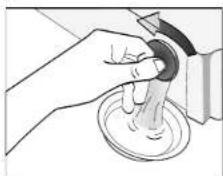
natural_image
Illustration of a hand holding a circular object with a ring, possibly a tool or device (no text or symbols visible)Mantenimiento
■ Caja de detergente limpia y surcos
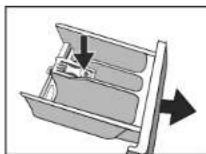
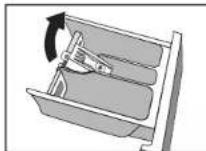
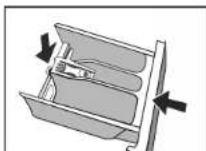
Limpie el cajón de detergente y las ranuras
1. Presione hacia abajo la ubicación de la flecha en la cubierta del suavizador dentro del cajón.
2. Levante el clip y saque la cubierta del suavizante y lave todas las ranuras con agua.
3. Restaure la cubierta del ablandador y empuje el cajón hasta su posición.
■ Limpie el filtro de entrada
El filtro de entrada debe limpiarse si no hay agua o hay suficiente agua cuando se abre el grifo. Limpie el filtro de grifo:
1. Cierre el grifo.
2. Seleccione cualquier procedimiento excepto el procedimiento "Lavar" o "Drenar".
3. Presione el botón "Inicio / Pausa" y continúe el procedimiento durante unos 40 segundos.
4. Retire el tubo de entrada del grifo.
5. Use agua para lavar el filtro.
6. Vuelva a conectar el tubo de entrada.
Lavado del filtro en lavadora:
1. Desatornille el tubo de entrada de la parte posterior de la máquina.
2. Extraiga el filtro con unos alicates largos y vuelva a instalario.
Vuelve después de ser lavado.
3. Vuelva a conectar el tubo de entrada.
4. Abra el grifo y asegúrese de que no haya fugas de agua.
5. Cierre el grifo.
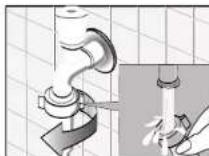
Notas: Generalmente, el filtro del grifo se lava primero y luego el filtro en la lavadora se lavará. Si solo se lava el filtro de la lavadora, se deben repetir los pasos 1 \~ 3 para limpiar el filtro del gnfo.

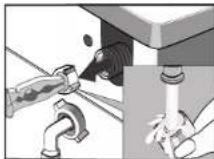
Mantenimiento
WARNING
Desenchufe el cable de alimentación para evitar descargas eléctricas antes de lavarlo.
Después de usar la lavadora, saque el cable de alimentación y cierre bien la puerta para evitar pellizar a los niños.
■ Eliminar asuntos extranjeros
Filtro de la bomba de drenaje:
El filtro de la bomba de drenaje puede filtrar los hilos y pequeñas materias extrañas de los lavados. Limpie el filtro periódicamente para asegurar el funcionamiento normal de la lavadora.
WARNING
Primero, drene el agua con la bomba de drenaje y luego abra la bomba de drenaje para limpiar las materias extrañas del filtro de la bomba de drenaje.
Tenga cuidado si el agua drenada está caliente.
Limpiando la bomba
¡Importante!
De acuerdo con el nivel del suelo dentro de los ciclos y la frecuencia de los ciclos, debe inspeccionar y limpiar el filtro regularmente.
Se debe inspeccionar la bomba si la máquina no se vacía y / o hace girar;
La máquina hace un ruido inusual durante el drenaje debido a objetos como pasadores de seguridad, monedas, etc. que bloquean la bomba.
Proceder de la siguiente:

natural_image
Four-step diagram showing mechanical assembly steps with arrows indicating motion (no text or symbols)Abra el panel de servicio-Desatormille la cubierta de la bomba-Retire la cubierta de la bomba-Cierre el panel de servicio
1 Desconecte el aparato;
2 Si es necesario, esperar hasta que el agua se haya enfriado.
3 Abra el panel de servicio. Coloque un recipiente cerca para recoger cualquier derrame.
4 Cuando ya no salga más agua, desenrosque la tapa de la bomba y retirela.
Mantenga siempre un trapo cerca para secar el derrame de agua cuando retire la cubierta. 5 Retire cualquier objeto del impulsor de la bomba girándolo.
6 Enrosque completamente la tapa de la bomba.
7 Cierre el panel de servicio.
¡Advertencia!
Cuando el aparato está en uso y, dependiendo del programa seleccionado, puede haber agua caliente en la bomba. Nunca retire la tapa de la bomba durante un ciclo de lavado, siempre espere hasta que el aparato haya terminado el ciclo y esté vacío. Cuando vuelva a colocar la cubierta, asegúrese de que esté bien ajustada para evitar fugas y que los niños pequeños puedan quitarla.
Solución de problemas
| Problemas | Razón | Solución |
| La lavadora no puede arrancar | Compruebe si la puerta está bien cerrada.Compruebe si el enchufe de alimentación está bien insertado. Compruebe si el grifo de suministro de agua está abierto. Compruebe si el botón "inicio / Pausa" está presionado. Compruebe si se presiona el botón "Power". | |
| Puerta no se puede abrir | El diseño de protección de seguridad de la máquina está funcionando. | Desconecta la alimentación. |
| Falla de calentamiento | NTC está dañado y la tubería de calefacción está envejeciendo. | Normalmente se puede lavar la ropa.Sólo no se puede lavar con calefacción.Debe ponerse en contacto con el centro de servicio de inmediato. |
| Fuga de agua | La conexión entre el tubo de entrada o la manguera de salida y el grifo o la lavadora no está apretada. El tubo de desagüe en la habitación está bloqueado. | Comprobar y sujetar las tuberías de agua. Limpie la manguera de salida y pida a una persona especializada que la repare cuando sea necesario. |
| El agua se desborda desde la parte inferior de la máquina. | El tubo de entrada no está conectado firmemente.La manguera de salida tiene fugas de agua. | Fijar el tubo de entrada. Vuelva a colocar la manguera de drenaje. |
| El indicador o pantalla no enciende | El poder está desconectado. Tablero de PC tiene problemas. El amés tiene un problema de conexión. | Compruebe si la alimentación está apagada y el enchufe de alimentación está conectado correctamente. Si no, llame a la línea de servicio. |
| Residuos detergentes en la caja. | El detergente en polvo está humedecido y aglomerado. | Limpie y limpie la caja.Use detergentes líquidos o los detergentes especiales para tambor. |
| Los efectos de lavado no son buenos | La ropa está muy sucia.Cantidad insuficiente de detergente. | Seleccione un procedimiento adecuado.Agregue la cantidad de detergente adecuada de acuerdo con las instrucciones del paquete de detergente. |
| Ruido anormal gran vibración | Compruebe si se ha quitado la fijación (tornillos).Si el gabinete está instalado en el piso sólido y nivelado.Compruebe si hay barrettes o artículos metálicos en el interior.Compruebe si las piernas en la lavadora están ajustadas al nivel. Vea la página 6. |
Quita los problemas
| Estado de los IndicadoresCorrespondientes | Descripción | Causa | Solución | |||
| Temp. 90 | Temp. 60 | Temp. 40 | Temp. 20 | |||
| Apagado | Apagado | Apagado | Flash | Problema en el bloqueo de la puerta | La puerta no está cerrada correctamente. | Reinicie después de que la puertadesté |
| Por favor contacte la asistencia técnica si siguen existiendo problemas. | ||||||
| Apagado | Apagado | Flash | Apagado | Problema de inyección de agua durante el lavado (el tiempo excede los 7 minutos) | El grifo está abierto o el agua fluye muy lentamente.El filtro de la válvula de entrada está obstruido.El tubo de entrada está doblado.No existe suministro de agua. | Abra el grifo o espere hasta que el suministro de agua se restablezca.Verifique el filtro de la válvula de entrada.Enderece el tubo de agua.Verifique los demás grifos de la habitación. |
| Por favor contacte la asistencia técnica si siguen existiendo problemas. | ||||||
| Apagado | Apagado | Flash | Flash | Problema de drenaje durante el lavado (tiempo de drenaje excede los 3 minutos) | La mangueira de salida está obstruida o está doblada. La bomba de drenaje está obstruida. | Lave y enderece la manguera de salida.Lave el filtro de la bomba de drenaje. |
| Por favor contacte la asistencia técnica si siguen existiendo problemas. | ||||||
| Por favor contacte la asistencia técnica si existe cualquier otro problema. | ||||||
Apéndice
■ Etiquetas de cuidados
| Símbolo | Significado | Símbolo | Significado |
 | Lavado a Mano | ☒ | No Lavar en la Lavadora |
| Lavado (incluyendo Lavado en Lavadora e Lavado a Mano) | ☒ | No Lavar | |
 | Lavado en Seco | ☒ | No Lavar en Seco |
| Lavado en Seco Caliente | ☒ | Sin Hilos | |
| [57K2] | Lejía | ☒ | Sin Lejía |
| Secar en la Lavadora | ☒ | No Secar en la Lavadora | |
 | Planchar | ☒ | No Planchar |
| Planchar a Vapor | ☒ | Planchar con un Paño | |
| [7C37] | Temperatura Media y Máxima de150°C | ☐ | Secar tras Lavado |
 | Secar en Tendedero | ☐ | Secar en Tendedero en la Sombra |
Conexión Eléctrica:
Para evitar incendios, descargas eléctricas y otros accidentes, por favor recuerde lo siguiente:
-Solamente puede usar el voltaje indicado en la etiqueta de clasificación. Si no está seguro de su voltaje doméstico, contacte la empresa de suministro eléctrico local.
-Cuando use la función de calentamiento, la corriente máxima que pasa a través de la lavadora alcanzará los 10A. Por eso, por favor certifíquese de que las fuentes de alimentación (corriente, voltaje y cable) están de acuerdo con los requisitos normales de carga para la lavadora.
-Proteja adecuadamente el cable de alimentación. El cable de alimentación debe ser fijado correctamente para que ninguna persona se tropiece u otros objetos pueden ser dañados. Debe prestar una atención especial a la toma eléctrica a la que va a enchufar su aparato. Debe enchufar este aparato fácilmente en las tomas y debe prestar atención a la localización de las mismas.
-No sobrecargue una toma eléctrica ni use un cable extensible. La sobrecarga del sistema eléctrico podrá provocar incendios o descargas eléctricas. No retire el cable de alimentación con las manos mojadas.
-Para asegurar su seguridad, debe introducir el cable de alimentación en una toma de tres polos con conexión de tierra. Verifique cuidadosamente y certifíquese de que está correctamente conectada a tierra.
Especificaciones de producto
| Capacidad de lavado | 7.0kg |
| Dimensiones(W*D*H) | 595*495*850 |
| Peso | 61kg |
| Potencia | 1950W |
| Corriente | 220-240V-,50Hz |
| Amperaje | 10A |
| Presión del agua estándard | 0.05MPa~1MPa |
Ficha de producto
Modelo: NVR-4707 7K 1200 B
Capacidad nominal: 7kg
Clase de eficiencia energética: A ++
Etiqueta ecológica de la UE: N / A
Consumo de energía 197kwh por año, basado en 220 ciclos de lavado estándar para programas de algodón ECO a 60 °C y 40 °C en carga completa y parcial, y el consumo de los modos de bajo consumo. El consumo de energía real dependerá de cómo esté el aparato usado.
Consumo de agua 10000 litros por año, basado en 220 ciclos de lavado estándar para programas de algodón ECO a 60 °C y 40 °C a carga completa y parcial. El consumo real de agua dependerá de cómo se utilice el aparato.
Eficiencia de secado por centrifugación clase D en una escala de G (menos eficiente) a A (más eficiente) Velocidad de centrifugado máxima: 1200 rpm
Valores de consumo (1200 rpm):
| Programa estándard | Carga | Consumo energético | Consumo de agua | Contenido de humedad restante | Duración del programa |
| Cotton ECO 60°C | 7kg | 0.98kwh | 50L | 50% | 230min |
| Cotton ECO 60°C | 3.5kg | 0.85kwh | 41L | 55% | 215min |
| Cotton ECO 40°C | 3.5kg | 0.70kwh | 41L | 55% | 210min |
Notas:
- Configuración del programa para pruebas de acuerdo con la norma EN60456-2011 aplicable
- Cuando utilice los programas de prueba, lave la carga especificada utilizando la velocidad máxima de centrífugado.
- Los parámetros reales dependerán de cómo se use la aplicación, y quizás sean diferentes con los parámetros en la tabla mencionada anteriormente.
Modo apagado consumo de energía: 0.5W
Consumo de energía en modo encendido: 1.0W
Ruido acústico aerotransportado (lavado): 59
Ruido acústico en el aire (spinning): 76
Notas: Las emisiones de ruido acústico en el aire durante el lavado / hilado para el programa de algodón estándar de 60 °C a plena carga.
NEVIR S.A., declara bajo su responsabilidad que el aparato indicado cumple los requisitos de las siguientes directivas:
EMC DIRECTIVE
LOW VOLTAGE EEC DIRECTIVE
EN 55014-1:2017
EN 60335-1: 2012 + A11:2014 + A13:2017
EN 55014-2:2015
EN 60335-2-7:2010+A1:2013 + A11:2013
EN 61000-3-2: 2014
EN 62233:2008
EN 61000-3-3: 2013
EC DIRECTIVE
2011/65/EU (RoHS) Directive and 2015/863/EU (ROHS amendment) Directive
Descripción del aparato:
LAVADORA 7KG INVERTER 1200 RPM BLANCA
Modelo NEVIR
NVR-4707 7K 1200 B
Importador: NEVIR, S.A.
Dirección del Importador: NEVIR, S.A.
C/ Canteros, 14
Parque Empresarial Puerta de Madrid
28830 San Fernando de Henares, Madrid, España
Contents
Safety Precautions 3
Overview of Washing Machine 7
Install Washing Machine 8
Operate Washing Machine 11
Checklist and Preparation before Washing Clothes 11
View of Control Panel 15
Select the procedure 16
Table of Washing Procedures 19
Maintenance....20
Clean detergent box and grooves 21
Troubleshooting 23
Remove the problems.... 24
Appendix 25
Care Lable 25
Product Specifications 26
Product Fiche....27
Safety Precautions
■ Safety Precautions
- If the supply cord is damaged, it must be replaced by the manufacturer, its service agent or similarly qua -lified persons in order to avoid a hazard.
- The new hose-sets supplied with the appliance are to be used and that old hose-sets should not be reused.
- This washing machine is for indoor use only.
- The openings must not be obstructed by a carpet.
- (This warning is only for EUROPEAN market) This appliance can be used by children aged from 8 years and above and persons with reduced physical, sens -ory or mental capabilities or lack of experience and knowledge if they have been given supervision or in -struction concerning use of the appliance in a safe -way and underst and the hazards involved. Children shall not play with the appliance. Cleaning and user maintenance shall not be made by children without supervision.
- (This warning is not for EUROPEAN market) This ap -pliance is not intended for use by persons (including children) with reduced physical, sensory or mental capabilities, or lack of experience and knowledge, unless they have been given supervision or instruction concerning use of the appliance by a person respon -sible for their safety. Children should be supervised to ensure that they do not play with the appliance.
- Pull out its plug from the power socket before cleaning or maintenance.
Safety Precautions
- Make sure that all pockets are emptied.
- Sharp and rigid items such as coin, brooch, nail, screw or stone etc. may cause serious damages to this machine.
- Pull out its plug and cut off water supply after the operation.
- Please check whether the water inside the drum has been drained before opening its door. Please do not open the door if there is any water visible.
- Pets and kids may climb into the machine. Check the machine before every operation.
- Glass door may be very hot during the operation. Keep kids and pets far away from the machine during the operation.
- Take care that power voltage and frequency shall be identical to those of washing machine.
- Do not use any socket with rated current less than that of washing machine. Never pull out power plug with wet hand.
- To ensure your safety, power cord plug must be inserted into an earthed three-pole socket. Check carefully and make sure that your socket is properly and reliably earthed.
- Children of less than 3 years should be kept away unless continuously supervised.
- Kids should be supervised to ensure that they do not play with the machine.
- Packing materials may be dangerous to the kids. Please keep all packing materials(plastic bags,foams etc) far away from the kids.
- Be careful of burning when washing machine drains hot washing water.
Safety Precautions
- Washing machine shall not be installed in bath room or very wet rooms as well as in the rooms with explos -ive or caustic gases.
- Make sure that the water and electrical devices must be connected by a qualified technician in accordance with the manufacturer's instructions and local safety regulations.
- Before operating this machine, all packages and tran-sport bolts must be removed. Otherwise, the washing machine may be seriously damaged while washing the clothes.
- Before washing the clothes at first time, the washing machine shall be operated in one round of the whole procedures without the clothes inside.
- The washing machine with single inlet valve only can be connected to the cold water supply. The washing machine with double inlet valves can be connected to the hot water and cold water supply.
- Your washing machine is only for home use and is only designed for the textiles suitable for machine washing.
- Flammable and explosive or toxic solvents are forbi-dden.Gasoline and alcohol etc.Shall not be used as detergents.Please only select the detergents suitable for machine washing, especially for drum.
- It is forbidden to wash carpets.
- Never refill the water by hand during washing.
- After the program is completed, Please wait for two minutes to open the door.
Safety Precautions
- Please remember to disconnect water and power supply immediately after the clothes are washed.
- Do not climb up and sit on top cover of the machine.
- Do not lean against machine door.
- Please do not close the door with excessive forces. If it is found difficult to close the door, please check if the excessive clothes are put in or distributed well.
- The household washing machine isn't intended to be built-in.
-
Cautions during Handling Machine
-
Transport bolts shall be reinstalled to the machine by a specialized person.
- The accumulated water shall be drained out of the machine.
- Handle the machine carefully. Never hold each prot -ruDED part on the machine while lifting. Machine door can not be used as the handle during the conveyance.
- Notes on disposal:
This marking indicates that this product should not be disposed with other household wastes throughout the EU. To prevent possible harm to the

environment or human health from uncontrolled waste disposal, recycle it responsibly to promote the sustainable reuse of material resources. To return your used device, please use the collection systems or contact the retailer where the product was purchased. They return and can take this product for environmental safe recycling.
Overview of Washing Machine
■ Component
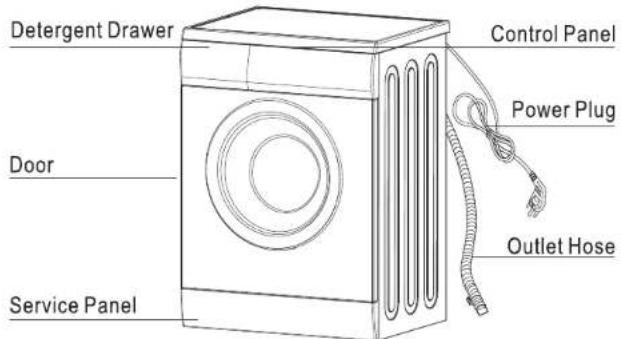
text_image
Detergent Drawer Control Panel Power Plug Door Service Panel Outlet Hose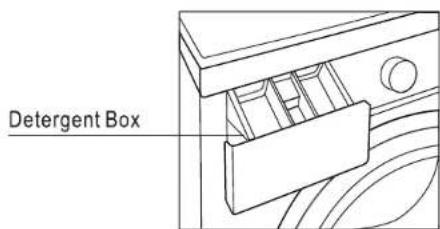
text_image
Detergent Box■ Accessories
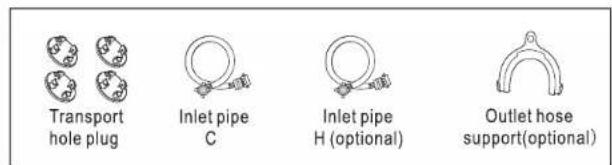
text_image
Transport hole plug Inlet pipe C Inlet pipe H (optional) Outlet hose support(optional)Install Washing Machine
■ Unpacking the washing machine
Unpack your washing machine and check if there is any damage during the transportation. Also make sure that all the items (as shown in Page 5) in the attached bag are received. If there is any damage to the washing machine during the transportation, or any item is missing, please contact the local dealer immediately.
■ Dispose the packing materials
The packing materials of this machine may be dangerous to kids. Please dispose them properly and avoid easy touch by kids. Please dispose the related packing materials according to the relevant local regulations. Please do no throw the packing materials away together with the other daily living rubbishes.
■ Remove transport bolts
Before using this washing machine, transport bolts must be removed from the backside of this machine. Please take the following steps to remove the bolts:
-
Loosen all bolts with spanner and then remove them.
-
Stop the holes with transport hole plugs.
-
Keep the transport bolts properly for future use.
■ Select the location
Before installing the washing machine, the location characterized as follows shall be selected:
- Rigid, dry, and level surface (if not level, please make it level with reference to the following figure "Adjust Leg")
- Avoid direct sunlight
- Sufficient ventilation
- Room temperature is above 0°C
- Keep far away from the heat resources such as coal or gas.
Make sure that the washing machine will not stand on power cord.
Do not install the washing machine on the carpet floor.
■ Adjust Leg
-
When positioning the washing machine, please first check if the legs are closely attached to the cabinet. If not, please turn them to their original positions with hand or spanner and tighten the nuts with spanner.
-
After positioning the washing machine, press four corners on top cover of washing machine in sequence. If the washing machine is not stable when being pressed, this leg shall be adjusted.
natural_image
Mechanical assembly diagram showing a lever mechanism with a rotating knob (no text or symbols)Install Washing Machine
- Ensure the positioning status of washing machine. Loosen the lock nut with spanner and turn the leg with hand until it closely contacts with the floor. Press the leg with one hand and fasten the nut closely to the cabinet with the other hand.
- After being locked properly, press four corners again to make sure that they has been adjusted properly. If it is still unstable, it has to repeat Steps 2 and 3.
- Put a solid cylinder (e.g. pop cans) oppositely on the top cover of the washing machine from in the left, right, front and back directions. If the cylinder keeps stable, the washing machine is positioned level. If it rolls, the washing machine is positioned unlevel. The rolling direction is the direction of lower ground surface. Then, the two legs in this direction shall be raised at the same time until the washing machine is level. Steps 1\~3 are repeated to make the bottom legs closely against the ground and the nuts shall be locked tightly.
■ Connect inlet pipe
Connect the inlet pipe as indicated in the figure. For the model which has hot valve, please connect the hot vale to hot water tap. Energy will decrease automatically for some program.
■ Install inlet pipe
- Connect the elbow to tap and fasten it clockwise.
- Connect the other end of inlet pipe to the inlet valve at the backside of washing machine and fasten the pipe tightly clockwise.
Notes: after connection, if there is any leakage with hose, then repeat the steps to connect inlet pipe. The most common type of tap shall be used to supply water. If tap is square or too big, then standard tap shall be changed.
natural_image
Simple line drawing of a hand holding a pipe fitting over a screw (no text or symbols)Place outlet hose
There are two ways to place the end of outlet hose: 1. Put it beside the water trough.

natural_image
Simple line drawing of a bathtub with a curved tube and a hanging hook (no text or symbols)Install Washing Machine
- Connect it to the branch drain pipe of the trough.
text_image
Max 100cm Min 60cm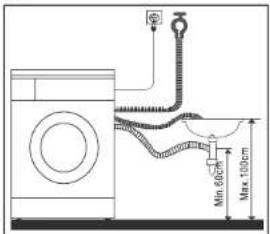
text_image
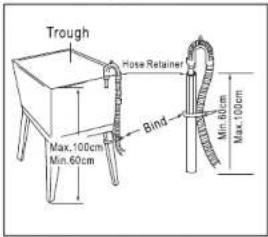
Min 60cm Max 100cm- It can drain the water up and down, outlet hose shall not be installed at a height beyond 100cm and its end shall not be immersed in water.
Position outlet hose properly so that the floor will not be damaged by water leakage. Notes:
If the machine has outlet hose support, please install it like the following pictures.
- When installing outlet hose, fix it properly with a rope.
- Position outlet hose properly so that the floor will not be damaged by water leakage.
text_image
Trough Hose Retainer Max. 100cm Min. 60cm Bind Max. 100cm- If outlet hose is too long, do not force it into washing machine as it will cause abnormal noises.
■ Electrical Connection
- As the maximum current through the unit is 10A when you are using its heating function, please make sure the power supply system (current, power voltage and wire) at your home can meet the normal loading requirements of the electrical appliances.
- Please connect the power to a socket which is correctly installed and properly earthed.
- Make sure the power voltage at your place is same to that in the machine's rating label.
- Power plug must match the socket and cabinet must be properly and effectively earthed.
- Do not use multi-purpose plug or socket as extension cord.
- Do not connect and pull out plug with wet hand.
- When connecting and pulling out the plug, hold the plug tightly and then pull it out. Do not pull power cord forcibly.
- If power cord is damaged or has any sign of being broken, special power cord must be selected or purchased from its manufacturer or service center for replacement.
Install Washing Machine

WARNING
- This machine must be earthed properly. If there is any short circuit, earthing can reduce the danger of electrical shock.
This machine is equipped with power cord, which includes plug, earthing wire at earthing terminal. - Washing machine shall be operated in a circuit separate from other electrical appliances. Otherwise, power protector may be tripped or fuse may be burned out.
Operate Washing Machine
■ Checklist and Preparation before Washing Clothes
Please read this operation method carefully to avoid the troubles of washing machine and damages of clothes.
Check if the first-washed clothes will bed decolorized.
After a white towel touched with liquid detergent is used to wash the invisible corners of the clothes, check if the white towel is stained with clothes' original color.
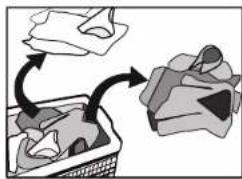
As for the scarves and those clothes that easily get decolorized among imported clothes, please wash them separately before washing.
As for the stains on sleeves, collars and pockets, use the liquid detergent and wash it with brush gently. Finally put them into the washing machine to achieve more ideal washing effects.
As for temperature-sensitive clothes, they shall be washed as required in the labels. Otherwise, it may cause color change or distortion.
natural_image
Illustration of a food sorting process showing leaves being transferred into a basket (no text or symbols)Keep in Mind:
Never put the clothes to be washed in washing machine for a long period of time.
Otherwise it may get moldy and cause spots. Therefore, please wash the clothes in time. The clothes also may get color changed or distorted if they are not washed according to the stated washing temperature.
Clothes that can not be washed by washing machine
The clothes that may get distorted if being immersed in water:
Ties, waistcoats, western-style clothes, outer garments etc. may have obvious shrinkage if being immersed in water; the decolorized clothes such as blended spinning clothes of artificial fiber etc.
Operate Washing Machine
Wrinkle-style clothes, embossed clothes, resin clothes etc. may get distorted when being immersed in water. Among cotton and wool materials, the clothes that get easily distorted are wrinkle-style silk, fur products and fur decorations;
Clothes with decoration, long dress and traditional clothes etc are the products to get decolorized easily.
Please do not wash the clothes without material labels and washing requirements.
Never wash the clothes stained with the chemicals such as gasoline, petroleum, benzene, paint thinner and alcohol.
Please pay attention with regard to detergents
"Low bubble" detergent or washing powder or washing powder special for drum washing machine shall be selected according to fiber types (cotton, synthetic fiber, soft products and wool products), colors, washing temperatures, dirty degrees and types. Otherwise,
excessive bubbles may be generated and overflowed out of the drawer so that accidents may take place.
Bleacher belongs to alkali type and can damage clothes, so it is suggested to use as little as possible.
Powder detergents can easily leave the residues in the clothes so as to generate the bad smell, so they shall be sufficiently rinsed.
Detergent can not easily get dissolved completely if there is too much detergent or water temperature is rather low. It can remain in clothes, pipes and washing machines to pollute the clothes.
Washing shall follow the weight of clothes, dirty degrees, local water hardness as well as the recommendations from the detergent manufacturers. Please consult the water company if you are not clear of water hardness.
Notes:
Keep detergents and additives in safe and dry places out of touch by kids.
■ Checklist and Preparation before Washing Clothes
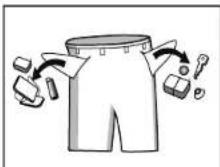
Please take out the items out of the pockets.
Please check the pockets of the clothes to be washed, empty the rigid items such as decorations and coins, otherwise washing machine may be damaged or have abnormal troubles.
For the clothes to be washed, they are classified according to the following characteristics:
The symbol types of care labels: the clothes to be
washed are classified into cotton, blended fiber, synthetic fiber, silk, wool and artificial fiber.
Operate Washing Machine
Color: white and colorful colors shall be identified. All new colorful articles shall be washed in a separate way.
Size: the articles of different sizes are washed together to increase the washing effects. Sensitivity: soft articles shall be washed separately. As for new pure wool textiles, curtains and silks, the soft washing procedure shall be selected. Check the labels in all washing articles.
The clothes shall be sorted before being put into washing machine. As for the curtains with hooks, the hooks shall be removed before being washed.
The decorations on the clothes may damage the washing machine. As for the clothes with buttons or embroideries, they shall be turned over before being washed.
Clean up fasteners:
Zips shall be zipped close and buttons or hooks shall be fixed. The loose band or ribbon shall be bound together.

It is suggested to put bras into the pillow slip up or buttons sealed to prevent the steel from popping out of bras into the drum and ringing the machine.
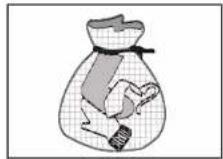
Especially delicate textiles such as laced curtains, straight jackets, small articles (tight socks, handkerchiefs, ties etc.) shall be put into string bag for washing.
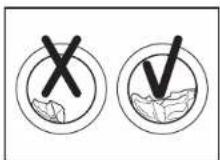
When washing a single big and heavy dress such as Turkish towels, jeans, wadded jackets etc., it may easily cause great eccentricity and give alarm due to great unbalance. Therefore it is suggested to add one or two more clothes to be washed together so that draining can be done smoothly.
Clean away dusts, stains and pet hairs from the clothes.
The clothes may be damaged and disturb washing effects during the friction between dusts, stains and clothes.
To protect baby skin
Baby articles (baby clothes and towels) including napkins shall be washed separately. If they are washed together with the adults' clothes, they may be infected. Rinsing times shall be increased to ensure the thorough rinsing and cleaning without the detergent residues.
It is suggested that the parts that are easily stained such as white sockets, collars and sleeves etc. shall be hand washed before being put into washing machine to achieve more ideal washing effects.
Please use powder or liquid detergents. The residues of the soap could remain in the gaps of the clothes if soap is used.
Operate Washing Machine
Confirm the washing capacity:
Do not put excessive washings; otherwise it may affect the washing effects. Please confirm the maximum affordable washing quantity according to the following table.
| Fiber Type | Maximum Loading Capacity |
| 7.0kg | |
| Cotton | 7.0kg |
| Synthetic | 3.5kg |
The clothes which easily get fuzzed shall be turned over for washing
The clothes which easily get fuzzed shall be washed separately; otherwise the other articles can be stained with dust and thrum etc. Preferably, black clothes and cotton clothes shall be washed separately because they can easily get stained with the thrums of other colors when being washed together.
Please check before washing.
Washing machine shall not wash water-proof materials (ski suits, outside napkin pads, curtains).
As for the fiber products that water can not get soaked easily into such as water-proof cushions, and clothes, it is better not to wash. Otherwise there will be water bursting out or abnormal vibration to cause danger while rinsing and draining so that the clothes also may be damaged. (Such as outside napkin pads, raincoats, umbrella, ski suits, car covers, sleeping sacks etc.)
Cautions during Draining
Draining of normal clothes:
Moistures of washings are drained through drain hole.
Draining of water-proof clothes and fiber products:
In the normal washing and draining status, moistures of water-proof clothes and fiber products can not be drained while washing water is gathered in one direction so that the eccentricity of washing machine is too great and vibration or moving is caused.
Operate Washing Machine
■ View of Control Panel
text_image
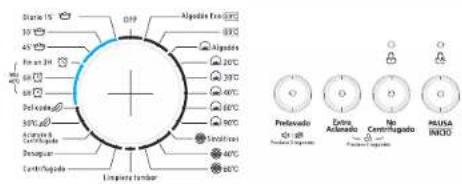
Diario IX 30 45 60 70 80 90 100 110 120 130 140 150 160 170 180 190 200 210 220 230 240 250 260 270 280 290 300 310 320 330 340 350 360 370 380 390 400 410 420 430 440 450 460 470 480 490 500 Longente tumbor Algodina Eno Algodina Eno Algodina Eno Algodina Eno Algodina Eno Algodina Eno Algodina Eno Algodina Eno Algodina Eno Algodina Eno Algodina Eno Algodina Eno Algodina Eno Algodina Eno Algodina Eno Algodina Eno Algodina Eno Algodino Eno Algodino Eno Algodino Eno Algodino Eno Algodino Eno Algodino Eno Algodino Eno Algodino Eno Algodino Eno Algodino Eno Algodino Eno Algodino Eno Algodino Eno Algodino Eno Algodino Eno Algodino Eno Algodino Eno ALFONADO ENO ENO ENO ENO ENO ENO ENO ENO ENO ENO ENO ENO ENO ENO ENO ENO ENO ENO ENO ENO ENO ENO ENO ENO ENO ENO ENO ENO ENO ENO ENO ENO ENO ENO ENO ENO ENO ENO ENO ENO ENO ENO ENO ENO ENO ENO ENO ENO ENO ENO EN OEN OEN OEN OEN OEN OEN OEN OEN OEN OEN OEN OEN OEN OEN OEN OEN OEN OEN OEN OEN OEN OEN OEN OEN OEN OEN OEN OEN OEN OEN OEN OEN OEN OEN OEN OEN OEN OEN OEN OEN OEN OEN OEN OEN OEN OEN OEN OEN OEN OEN OEM OEM OEM OEM OEM OEM OEM OEM OEM OEM OEM OEM OEM OEM OEM OEM OEM OEM OEM OEM OEM OEM OEM OEM OEM OEM OEM OEM OEM OEM OEM OEM OEM OEM OEM OEM OEM OEM OEM OEM OEM OEM OEM OEM OEM OEM OEM OEM OEM NORMA NORMA NORMA NORMA NORMA NORMA NORMA NORMA NORMA NORMA NORMA NORMA NORMA NORMA NORMA NORMA NORMA NORMA NORMA NORMA NORMA NORMA NORMA NORMA NORMA NORMA NORMA NORMA NORMA NORMA NORMA NORMA NORMA NORMA■ Rotary Switch Function
There are 10 types of washing selection functions in display. For example:
Cotton: With the corresponding temperature selections: 20,30,40, 60, 90°C, Cold
Daily Wash: 15',30',45'
Synthetic: 40, 60 °C, Cold
Cotton ECO: 40, 60 ℃
Rinse&Spin
Drain Only
Spin Only
Delicate: 30 ℃, Cold
Ends in:3h, 6h, 9h
Drum Clean:90°C
Notes:
-
The Control panel line chart is for reference only. Please refer to real product as standard.
-
The Control panel could be changed without written notice. Please visit the website of Washing Machine or call up the service line for consultation.
Operate Washing Machine
■ Washing Clothes at first time
Before washing clothes at first time, the washing machine shall be operated in one round of the whole procedures without clothes in as follows:
-
Connect power source and water.
-
Put a little detergent into the box and close it.
-
Turn the rotary switch and select the corresponding procedures.
-
Press the button "Start/Pause"
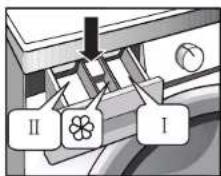
The drawer is separated as follows:
I: Pre-detergent or washing powder.
II: main detergent, softener, pre-dip,
bleaching or decontaminating products.
✿: washing additive, such as fabric softener or tackifier.
- Put detergent into washing machine.
-
Pull out the drawer.
-
Fill pre-detergent into Case I (when necessary).
-
Fill detergent into Case II.
-
Fill softener into Case ☐ (when necessary).
Notes:
- As for the agglomerated or ropy detergent or additive, before they are poured into the detergent box, it is suggested to use some water for dilution to prevent the inlet of detergent box from being blocked and overflowing while filling water.
- Please choose suitable type of detergent for the various washing temperature to get the best washing effect with less water and energy consumption.
■ Start up washing machine
Connect the power. Check if water pipes are connected properly. Open the tap completely. Put in the clothes to be washed and fill in the detergent and tackifier.
Select the proper procedures and functions and press the button "Start/Pause".
■ Select the procedure
The proper washing procedures shall be selected according to the types, quantities, and dirtiness of the clothes to be washed in combination with the following washing temperature table.
| 90°C | Seriously besmirched, pure white cotton or flax (for example: coffee table cloths, canteen table cloths, towels, bed sheets) |
Operate Washing Machine
| 60°C | Moderately besmirched, colorful flax, cotton and synthetic articles with certain decolorizing degree (for example: shirts, night pajamas; Slightly besmirched, pure white flax (for example: underwear) |
| 40°C,30°C,20°C Cold water | Normally besmirched articles (including synthetic and delicate) |
- Load the laundry and add Detergent
2 Turn the rotary switch to select a program according to the program table. - Select optional function if needed
- Press start/pause button.
PLEASE NOTE:
The main washing procedures depend on the types of the clothes to be washed. The main washing programs can be selected as follows:
- Cotton
You can select this procedure to wash the daily washable clothes. The washing period is quite long with quite strong washing intensions. It is recommended to wash the daily cotton articles, for example: bed sheets, quilt covers, pillowcases, gowns, underwear etc.
- Synthetic
You can select this procedure to wash the quite delicate clothes. The procedure is shorter compared with that for cottons and the washing intension is quite gentle. It is recommended to wash synthetic articles, for example: shirts, coats, blending. As for curtains and laced textiles, the procedure "Synthetic" shall be selected. While washing the knitting textiles, detergent quantity shall be reduced due to its loose string construction and easily forming bubbles.
- Daily Wash
This procedure is suitable for washing few and not very dirty clothes quickly.
- Cotton ECO
To increase the washing effects, main additional washing time is increased.
It is recommended to wash the clothes for babies or worn by the persons with allergic skin.
- Spin Only
Separate Spin Procedure. Soap water or rinse water shall be drained out before spinning.
- Rinse&Spin
Separate Rinse&Spin Procedure.
- Drain Only
Separate Drain only Procedure.
- Delicate
You can select this procedure to wash your delicate clothes. Its washing intension is gentler and spin speed is lower compared with the procedure "Synthetic". It is recommended for the articles to be washed softly.
Operate Washing Machine
- Drum Clean
This cycle is specially set in this machine to clean the drum and tube. It applies 90 C high temperature sterilization to make the clothes washing more green. When this procedure is performed, the clothes or other washing cannot be added. When proper amount of chlorine bleaching agent is put in, the barrel cleaning effect will be better.
The customer can use this procedure regularly according to the need.
- Ends in
The Funciton can be set with this procedure, all the time including washing time and delaying time are 3h, 6h or 9h.
Notes:
If you want to change the program on child lock condition, you should unlock the child lock first, then rotate the knob to OFF position, finally choose the program you want.
The main function can be selected as follows:
Prewash
The Prewash function can get an extra wash before main wash.
- Extra Rinse
The laundry will undergo extra rinse once after you select it.
- No Spin
The machine will not spin if you choose this function.
- Child Lock
To avoid that the washing procedure cannot operate normally due to the mis operation by kids during the washing procedure, you can select this function. In this case, the other buttons except Off button can not work, at this state, the machine power off when press the key on/off. The machine remembers the program child lock and the program during powered off when press the key on/off again.
Press "Extra Rinse" and "No Spin" together 3 seconds during the running procedure, the buzzer will beep, Start/Pause button as well as the rotary switch are locked. Press the two buttons for 3 seconds together and buzzer will beep to release to locking. But cut off the power supply, the kid's protection is also release to locking. The kid's protection will not be cancelled after all procedures are completed.
- Suppression of the acoustic signals
This is an additional buzzer function on your appliance. After deactivating the buzzer function, the buzzer will be closed.
After starting the machine, press the "Prewash" button for 3 seconds and you will hear a beep, then the buzzer will be closed. To restart the buzzer function, press the "Temp.&Spin" button again for 3 seconds. The setting will be kept until the next reset.
Warning: After deactivating the buzzer function, the sounds will not be activated any more.
- Bubble Removal Function
Bubble Check Function: Redundant bubbles will occur when there is excessive detergent, which will affect wash and rinse effects. The procedure will check automatically and one bubble removal procedure will be added automatically to remove bubbles when excessive bubbles are checked.
Operate Washing Machine
■ Table of Washing Procedures
| Procedure Description | Load(kg) | Detergent Box | Default Temp.(C) | Default Time (H) | Default Speed(rpm) | ||
| 7.0 | Case I | Case II | Softener Case | 7.0 | 7.0 | 7.01200 | |
| Cotton Eco 40°C | 7.0 | × | ● | ○ | 40 | 3:45 | 1200 |
| Cotton Eco 60°C | 7.0 | × | ● | ○ | 60 | 3:23 | 1200 |
| Cotton | 7.0 | ○ | ● | ○ | 0 | 1:35 | 1200 |
| Cotton 20°C | 7.0 | ○ | ● | ○ | 20 | 1:19 | 1200 |
| Cotton 30°C | 7.0 | ○ | ● | ○ | 30 | 1:20 | 1200 |
| Cotton 40°C | 7.0 | ○ | ● | ○ | 40 | 1:40 | 1200 |
| Cotton 60°C | 7.0 | ○ | ● | ○ | 60 | 1:45 | 1200 |
| Cotton 90°C | 7.0 | ○ | ● | ○ | 90 | 2:40 | 1200 |
| Synthetic | 3.5 | ○ | ● | ○ | 0 | 1:18 | 1000 |
| Synthetic 40°C | 3.5 | ○ | ● | ○ | 40 | 1:33 | 1000 |
| Synthetic 60°C | 3.5 | ○ | ● | ○ | 60 | 1:43 | 1000 |
| Drum Clean | - | × | × | × | 90 | 1:21 | 400 |
| Spin Only | 7.0 | × | × | × | — | 0:12 | 1200 |
| Drain Only | - | × | × | × | — | 0:01 | — |
| Rinse & Spin | 7.0 | × | × | ○ | — | 0:31 | 1200 |
| Delicate 30°C | 2.5 | × | ● | ○ | 30 | 1:00 | 600 |
| Delicate | 2.5 | × | ● | ○ | 0 | 0:55 | 600 |
| Ends in 9H | 7.0 | × | ● | ○ | 40 | 1:13 | 1000 |
| Ends in 6H | 7.0 | × | ● | ○ | 40 | 1:13 | 1000 |
| Ends in 3H | 7.0 | × | ● | ○ | 40 | 1:13 | 1000 |
| Daily Wash 45' | 2.0 | × | ● | ○ | 30 | 0:45 | 800 |
| Daily Wash 30' | 2.0 | × | ● | ○ | 20 | 0:30 | 800 |
| Daily Wash 15' | 2.0 | × | ● | ○ | 0 | 0:15 | 800 |
The energy class is A++ for 7kg
Energy test program: Cotton ECO 60°C/40°C, Speed: the highest speed; Other as the default. Half load for 7.0 Kg machine:3.5 Kg
"Cotton ECO 60°C/40°C" are the "standard cotton 60°C/40°C" programme and the standard washing programs to which the information in the label and the fiche relates, and they are suitable to clean normally soiled cotton laundry and that they are the most efficient programmes in terms of combined energy and water consumptions for washing that type of cotton laundry, that the actual water temperature may differ from the declared cycle temperature.
● Means must ○ Means optional × Means not necessary
Notes: The parameters in this table are only for user's reference. The actual parameters maybe different with the parameters in above mentioned table.
Maintenance
Before your maintenance starts, please do pull out the power plug or disconnect power and close the tap.

WARNING
- Solvents are forbidden to avoid that the washing machine is damaged, and toxic gases are generated or exploded.
- Never use water to sprinkle and wash the washing machine.
- It is forbidden that the detergents containing PCMX are used to clean the washing machine.
Cleaning and Maintenance of Washing Machine Cabinet
Proper maintenance on the washing machine can extend its working life. The surface can be cleaned with diluted non-abrasive neutral detergents when necessary. If there is any water overflow, use the wet cloth to wipe it off immediately. No sharp items are allowed to strike the cabinet.
Notes: formic acid and its diluted solvents or equivalent are forbidden.
■ Clean Internal Drum
The rusts left inside the drum by the metal articles shall be removed immediately with chlorine-free detergents.
Never use steel wool.
■ Dispose a Frozen Washing Machine
When the temperature drops below zero and your washing machine gets frozen, you may:
-
Disconnect the power supply for the washing machine.
-
Wash the tap with warm water to loosen inlet pipe.
-
Take down inlet pipe and immerse it in warm water.
-
Pour warm water into washing drum and wait for 10 minutes.
-
Reconnect inlet pipe to the tap and check whether inlet and outlet are working normally. Notes: when the washing machine is reused, make sure the ambient temperature is above 0°C
Anti-freeze
If your washing machine is located in the room where it can get frozen easily, please drain the remaining water inside drain pipe and inlet pipe thoroughly.
Remove the remaining water in inlet pipe:
-
Close the tap.
-
Screw off the inlet pipe from tap and put its end into the container.
-
Start up any procedure except single Wash or Drain procedure. Water will be drained out of inlet pipe if any for about 40 seconds.
-
Reconnect the inlet pipe to tap.
Remove the remaining water in drain pump

WARNING
To avoid burning, it shall be done after the hot water inside the machine cools down.
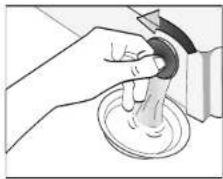
natural_image
Illustration of a hand holding a circular object with a ring, no text or symbols presentMaintenance
■ Clean detergent box and grooves
Clean detergent drawer and grooves
■ Clean inlet filter
- Press down the arrow location on softener cover inside the drawer.
- Lift the clip up and take out softener cover and wash all grooves with water.
- Restore the softener cover and push the drawer into position.
Inlet filter shall must be cleaned if there is not any or insufficient water in when the tap is opened. Clean the tap filter: - Close the tap
- Select any procedure except "Wash" or "Drain" procedure.
- Press the button "Start/Pause" and keep the procedure running for about 40 seconds.
- Remove the inlet pipe from the tap.
- Use water to wash the filter.
- Reconnect the inlet pipe.
Washing the filter in washing machine: - Screw off the inlet pipe from the backside of the machine.
- Pull out the filter with long nose pliers and reinstall it back after being washed.
- Reconnect the inlet pipe.
4.Open the tap and make sure there is no water leakage.
5.Close the tap.
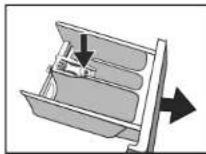
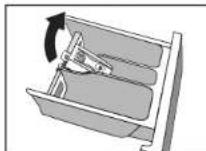
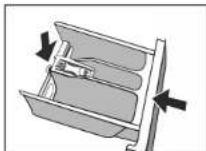
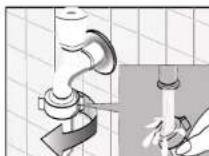
Notes: Generally, the tap filter is washed first and then the filter in washing machine will be washed. If only the filter in washing machine is washed, then the steps 1\~3 in cleaning the tap filter shall be repeated.
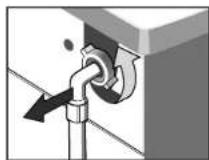
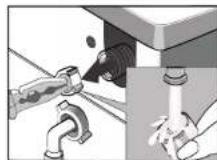
Maintenance
WARNING
Pull out the power plug to avoid electrical shock before washing.
After using the washing machine, pull out the power cord and close the door tightly to avoid pinching the kids.
■ Remove foreign matters
Drain Pump Filter:
Drain pump filter can filter the yarns and small foreign matters from the washings.
Clean the filter periodically to ensure the normal operation of washing machine.
WARNING
First, drain the water with drain pump and then open the drain pump to clean away foreign matters from drain pump filter.
Take care if the drained water is hot.
Cleaning the pump
Important!
According to the soil level within the cycles and the frequency of the cycles, you have to inspect and clean the filter regularly.
The pump should be inspected if the machine does not empty and/or spin;
The machine makes an unusual noise during draining due to objects such as safety pins, coins etc. blocking the pump.
Proceed as follows:

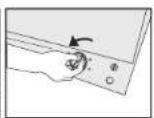
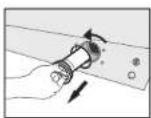
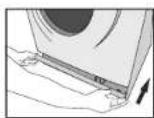
Open the service panel
Unscrew the pump cover
Remove the pump cover
Close the service panel
1 Disconnect the appliance;
2 If necessary wait until the water has cooled down.
3 Open the service panel. Place a container close to collect any spillage.
4 When no more water comes out, unscrew the pump cover and remove it.
Always keep a rag nearby to dry up spillage of water when removing the cover.
5 Remove any objects from the pump impeller by rotating it.
6 Screw the pump cover fully in.
7 Close the service panel.
Warning!
When the appliance is in use and depending on the programme selected there can be hot water in the pump. Never remove the pump cover during a wash cycle, always wait until the appliance has finished the cycle, and is empty. When replacing the cover, ensure it is securely retightend so as to stop leaks and young children being able to remove it.
Troubleshooting
| Troubles | Reason | Solution |
| Washing machine cannot start up | Check if the door is closed tightly.Check if power plug is inserted well.Check if water supply tap is opened.Check if button "Start/Pause" is pressed.Check if button "Power" is pressed. | |
| Door cannot be opened | Machine's safety protection design is working. | Disconnect the power. |
| Heating fault | NTC is damaged and heating pipe is aging. | Can normally wash the clothes.Only cannot wash with heating.Shall contact the service center promptly. |
| Water leakage | The connection between inlet pipe or outlet hose and tap or washing machine is not tight.Drain pipe in the room is blocked. | Check and fasten water pipes.Clean up outlet hose and ask a specialized person to repair it when necessary. |
| Water is overflowed from the bottom of the machine | The inlet pipe is not connected firmly.Outlet hose has water leakage. | Fix the inlet pipe.Replace the drain hose. |
| Indicator or display does not light. | Power is disconnected.PC board has problems.Harness has connection problem. | Check if the power is shut down and power plug is connected correctly.If not, please call up service line. |
| Detergent residues in the box | Washing powder is dampened and agglomerated. | Clean and wipe the box.Use liquid detergents or the detergents special for drum. |
| Washing effects are not good | The clothes are too dirty.Insufficient detergent quantity. | Select a proper procedure.Add the proper detergent quantity according to the instructions in detergent package. |
| Abnormal noise Great vibration | Check if the fixing (bolts) has been removed.If cabinet is installed on the solid and level floor.Check if there are any barrettes or metal articles inside.Check if the legs in the washing machine are adjusted level. See page 6. |
Remove the problems
| Status of Corresponding indicators | Description | Reason | Solution | ||||||
| ∅ | G | PhaseStar | No Spin | Econ Rate | Prewash | ||||
| Flash | Off | Flash | Off | Off | Off | Door lock problem | Door is not closed properly. | Restart after the door is closed | |
| Please call up service line if there are still troubles. | |||||||||
| Off | Off | Off | Flash | Off | Off | Water injecting problem when washing (water injecting time exceeds 7 minutes) | Tap is not opened or water flows too slowly.Inlet valve filter is blocked.Inlet pipe is twisted.If water is not supplied | Open the tap or wait till the water supply becomes normal.Check inlet valve filter.Straighten the water pipeCheck the other taps in the room. | |
| Please call up service line if there are still troubles. | |||||||||
| Off | Off | Flash | Flash | Off | Off | Drain problem while washing (drain time exceeds 3 minutes) | Outlet hose is blocked or twistedDrain pump is blocked | Wash and straighten outlet hose.Wash drain pump filter | |
| Please call up service line if there are still troubles. | |||||||||
| Please call up the service line if there is any other problem. | |||||||||
Appendix
Care Lable
| Graphic Symbol Illustration | Graphic Symbol Illustration | ||
| Hand Wash | No Machine Wash | ||
| Washing (including Machine Wash and Hand Wash) | Do not Wash | ||
| Dry Clean | No Dry Clean | ||
| Warmly Dry Clean | No Wring | ||
| Bleach | No Bleach | ||
| Tumble dry | Do not Tumble Dry | ||
| Iron | Do not Iron | ||
| Steam Iron | Iron with Cloth | ||
| Medium Temperature and Max. Temperature 150°C | Dry after Wash | ||
| Line Dry | Line Dry in Shade | ||

Electrical Warning
To avoid fire, electrical shock and other accidents, please remember the following reminding:
- Only the voltage indicated in power label can be used. If you are not clear of the voltage at home, please contact the local power bureau.
- When you are using the heating function, the maximum current through the washing machine will reach 10A. Therefore, please make sure the power supply units (current, voltage and cable) can meet the normal load requirements for the machine.
- Protect the power cord properly. Power cord shall be fixed well so that it will not trip the people or other things and be damaged. Special attention shall be paid to the socket. It shall be plugged into the sockets easily and attention shall be paid to the plug location.
- Do not make the wall-mounted socket overloaded or cable extended. Overloading of the wiring may cause fire or electrical shock. Do not pull out power plug with wet hand.
- To ensure your safety, power plug shall be inserted into an earthed three-pole socket. Carefully check and ensure that your socket is properly and reliably earthed.
Product Specifications
| Parameter | |
| Washing Capacity | 7.0kg |
| Dimension(W*D*H) | 595*495*850 |
| Weight | 61kg |
| Rated Power | 1950W |
| Power Supply | 220-240V-,50Hz |
| Rated Current | 10A |
| Standard Water Pressure | 0.05MPa-1MPa |
Product Fiche
Model:NVR-4707 7K 1200 B
Rated capacity:7kg
Energy efficiency class: A++
EU Ecolabel:N/A
Energy consumption 197kwh per year, based on 220 standard washing cycles for cotton ECO programmes at 60^ and 40^ at full and partial load, and the consumption of the low-power modes. Actual energy consumption will depend on how the appliance is used.
Water consumption 10000 litres per year, based on 220 standard washing cycles for cotton ECO programmes at 60°C and 40°C at full and partial load. Actual water consumption will depend on how the appliance is used.
Spin-drying efficiency class D on a scale from G (least efficient) to A (most efficient) Maximum spin speed:1200rpm
Consumption values(1200rpm):
| Standard Programme | Load | Energy consumption | Water consumption | Remaining moisture content | Programme duration |
| Cotton ECO 60°C | 7kg | 0.98kw | 50L | 50% | 230min |
| Cotton ECO 60°C | 3.5kg | 0.85kwh | 41L | 55% | 215min |
| Cotton ECO 40°C | 3.5kg | 0.70kwh | 41L | 55% | 210min |
Notes:
- Programme setting for testing in accordance with applicable standard EN60456-2011.
- When using the test programmes, wash the specified load using the maximum spin speed.
- The actual parameters will depend on how the applicance is used, and maybe different with the parameters in above mentioned table.
Off mode power consumption:0.5W
Left-on mode power consumption:1.0W
Airborne acoustical noise (washing):59
Airborne acoustical noise (spinning):76/76
Notes: The airborne acoustical noise emissions during washing/spinning for the standard 60°C cotton programme at full load.