
BPHS1-XF4 - Kopfhörer Audio-Technica - Kostenlose Bedienungsanleitung
Finden Sie kostenlos die Bedienungsanleitung des Geräts BPHS1-XF4 Audio-Technica als PDF.


| Produkttyp | Kommunikations-Headset |
| Kopfhörertyp | Geschlossene, dynamische Ohrmuscheln |
| Mikrofontyp | Dynamisch, mit N-Magnetsystem |
| Mikrofon-Richtcharakteristik | Nierencharakteristik |
| Frequenzbereich Kopfhörer | 20 – 20.000 Hz |
| Frequenzbereich Mikrofon | 40 – 20.000 Hz |
| Impedanz Kopfhörer | 65 Ohm |
| Impedanz Mikrofon | 560 Ohm |
| Empfindlichkeit Kopfhörer | 100 dB |
| Leerlaufempfindlichkeit Mikrofon | 1,4 mV/Pa (57 dB) |
| Maximale Eingangsleistung | 1.600 mW bei 1 kHz |
| Treibergröße | 40 mm, Neodym-Magnet |
| Kabellänge | 2 m (6,6 ft) |
| Steckertyp | 4-poliger XLRF-Stecker (Kopfhörer), 8-poliger Stecker am Headset |
| Gewicht | 264 g (9,3 oz) |
| Abmessungen (Ohrmuschel) | 82,0 mm (3,23 Zoll) breit |
| Abmessungen (Kopfbügel) | 46,0 mm (1,81 Zoll) breit |
| Abmessungen (Mikrofonarm) | 180,1 mm (7,09 Zoll) Länge (ausgefahren) |
| Material Polsterung | Gepolsterte Ohrpolster, gepolsterter Kopfbügel |
| Besonderheiten | Schwenkbarer Mikrofonarm für linke/rechte Seite, austauschbares Kabel und Ohrpolster |
| Lieferumfang | 3 Windschutz, Ersatzschraube |
| Hersteller | Audio-Technica |
Häufig gestellte Fragen - BPHS1-XF4 Audio-Technica
Benutzerfragen zu BPHS1-XF4 Audio-Technica
0 Frage zu diesem Gerät. Beantworten Sie die, die Sie kennen, oder stellen Sie Ihre eigene.
Eine neue Frage zu diesem Gerät stellen
Laden Sie die Anleitung für Ihr Kopfhörer kostenlos im PDF-Format! Finden Sie Ihr Handbuch BPHS1-XF4 - Audio-Technica und nehmen Sie Ihr elektronisches Gerät wieder in die Hand. Auf dieser Seite sind alle Dokumente veröffentlicht, die für die Verwendung Ihres Geräts notwendig sind. BPHS1-XF4 von der Marke Audio-Technica.
BEDIENUNGSANLEITUNG BPHS1-XF4 Audio-Technica
Communications Headset
broadcast & production microphones
natural_image
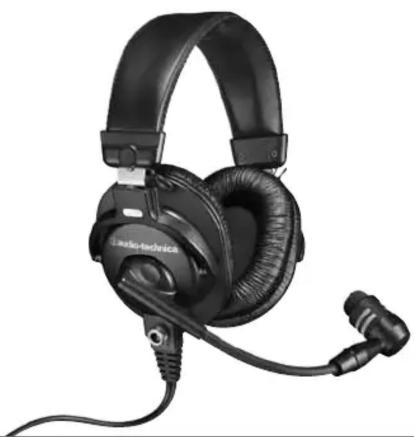
Black audio/video headset with earbuds and microphone (no visible text or symbols)Features
- Microphone features polar pattern and frequency response tailored for natural, highly intelligible vocal reproduction
- Closed-back circumaural ear cups help seal out crowd noise and other background distractions
- Neodymium magnets in microphone and headphones for high output level & detailed sound reproduction
- Rugged design with user-replaceable cable and ear pads
- Cardioid pickup pattern in dynamic microphone rejects off-axis sounds
- Boom-mounted microphone can be positioned on the left or right side
- Adjustable cushioned headband and lightweight design for long-wearing comfort
- The included BPCB4 cable is terminated in a 4-pin XLRF-type connector for use with intercom systems
- Also functions as broadcast stereo headset with use of available 3-pin XLR / stereo jack cable (BPCB1)
Description
The BPHS1-XF4 is a rugged communications headset with closed-back circumaural (around-the-ear) ear cups and a professional boom-mounted microphone that can be worn on either side. It is designed to be used with intercom systems.
The headset's microphone has a cardioid polar pattern tailored for pickup of speech with maximum voice intelligibility over a wide range of frequencies. It is more sensitive to sound originating directly in front of the element, making it useful in reducing pickup of unwanted sounds. The flexible gooseneck boom swivels for easy positioning on either the right or left side.
The dual earphones offer an extended frequency response of 20-20,000 Hz and smooth, natural sound reproduction. At the heart of each earpiece, a 40 mm neodymium driver offers impressive power handling ideal for high maximum sound pressure levels. Generously padded circumaural ear cups provide acoustic isolation and long-wearing comfort; the adjustable headband is also crafted and cushioned for listening comfort.
The headset includes a user-replaceable detachable 2 m (6.6') cable terminated in a 4-pin XLRF-type connector providing unbalanced audio from the microphone and delivering a mono signal to the headphone. Three windscreens are also included to protect against noise from breath and wind.
Operation & Maintenance
The BPHS1-XF4 communications headset features a flexible microphone boom that pivots so that it can be worn on either side of the face. Put on the headset with the microphone boom on the desired side. Adjust the boom as needed to follow the contour of your face, positioning the microphone near the corner of your mouth. Experiment with placement for
optimal performance: Positioning the microphone closer to your mouth will increase the low-end response for a more robust, full-range sound. As you move the microphone away from your mouth, the low-end response will diminish.
The included 2 m (6.6') shielded cable (BPCB4) features a 4-pin XLRF-type connector. To remove cable, loosen and remove the thumb screw and pull the multi-pin connector out of its socket. To replace the cable, plug the multi-pin connector into the socket, replace and tighten the thumb screw.
Output from the microphone is low impedance (Lo Z) unbalanced. The microphone signal appears across Pin 2 and Pin 1; Pin 1 is ground (shield). Output phase is "Pin 2 hot" – positive acoustic pressure produces positive voltage at Pin 2. The cable is configured for mono headphone operation: Pin 4 carries the signal; Pin 3 carries the ground.
Take care to keep foreign particles from entering the windscreen. An accumulation of iron or steel filings on the diaphragm, and/or foreign material in the windscreen's mesh surface, can degrade performance.
Architect's and Engineer's Specifications
The headset shall be a communications headset with closed-back ear cups and a boom-mounted microphone that can be positioned on the left or right side.
Padded circumaural ear cups shall provide acoustic isolation; the headband shall be adjustable and cushioned. The earphones shall have an extended frequency response of 20 Hz to 20,000 Hz, and shall be equipped with 40 mm neodymium drivers.
The microphone shall be a moving coil dynamic with a neodymium magnet. It shall have a cardioid polar pattern and a frequency response of 40 Hz to 20,000 Hz. Nominal open-circuit output voltage shall be 1.4 mV at 1V, 1 Pascal. Output shall be low impedance balanced (560 ohms). The boom shall be of a pivoting, flexible design.
The headset shall have a 2 m (6.6') user-replaceable detachable cable terminating in a 4-pin XLRF-type connector providing unbalanced audio from the microphone and delivering a mono signal to the headphone.
Weight shall be 264 g (9.3 oz). The headset shall include three windscreens. Finish shall be low-reflectance black.
The Audio-Technica BPHS1-XF4 is specified.


Marke : Audio-Technica
Modell : BPHS1-XF4
Kategorie : Kopfhörer