
20135 - Ferngläser BRAUN - Kostenlose Bedienungsanleitung
Finden Sie kostenlos die Bedienungsanleitung des Geräts 20135 BRAUN als PDF.


| Produkttyp | Marine-Fernglas mit beleuchtetem Kompass |
| Vergrößerung | 7× |
| Objektivdurchmesser | 50 mm |
| Sehfeld | 132 m auf 1000 m |
| Austrittspupille | 6,8 mm |
| Augenabstand | 23 mm (lang, für Brillenträger) |
| Dioptrieneinstellung | -5 bis +5 Dioptrien |
| Pupillenabstand | 56–72 mm |
| Auflösung | ≤ 5" |
| Abmessungen (L×B×H) | 200 × 80 × 150 mm |
| Gewicht (Fernglas) | ≤ 0,9 kg |
| Gewicht (komplett) | ≤ 1,2 kg |
| Stromversorgung Kompassbeleuchtung | 2 Batterien (vorinstalliert) |
| Kompass | Integriert, beleuchtet, Gradskala |
| Entfernungsmessung | Mils-Strichplatte und Drehrechner |
| Stativanschluss | Gewinde am Gelenk |
| Lieferumfang | Fernglas, Trageriemen, Okularschutz, Objektivdeckel, Putztuch, Softcase, Anleitung |
| Material | Gummiarmierung, wasserabweisend |
| Reinigung | Optiktuch, keine Fingerabdrücke |
| Lagerung | Trocken, belüftet, Dioptrie auf 0 |
Häufig gestellte Fragen - 20135 BRAUN
Benutzerfragen zu 20135 BRAUN
0 Frage zu diesem Gerät. Beantworten Sie die, die Sie kennen, oder stellen Sie Ihre eigene.
Eine neue Frage zu diesem Gerät stellen
Laden Sie die Anleitung für Ihr Ferngläser kostenlos im PDF-Format! Finden Sie Ihr Handbuch 20135 - BRAUN und nehmen Sie Ihr elektronisches Gerät wieder in die Hand. Auf dieser Seite sind alle Dokumente veröffentlicht, die für die Verwendung Ihres Geräts notwendig sind. 20135 von der Marke BRAUN.
BEDIENUNGSANLEITUNG 20135 BRAUN
Marine-Fernglas
Gebrauchsanweisung
DE
- Allgemeine Übersicht 2
- Technische Daten 2
- Konstruktionsspezifikationen 2
- Verwendung des Fernglases 4
- Stativmontage 8
- Fernglas und Zubehör 9
- Lagerung und Wartung 9
1. Allgemeine Übersicht
1.1 Produktbeschreibung
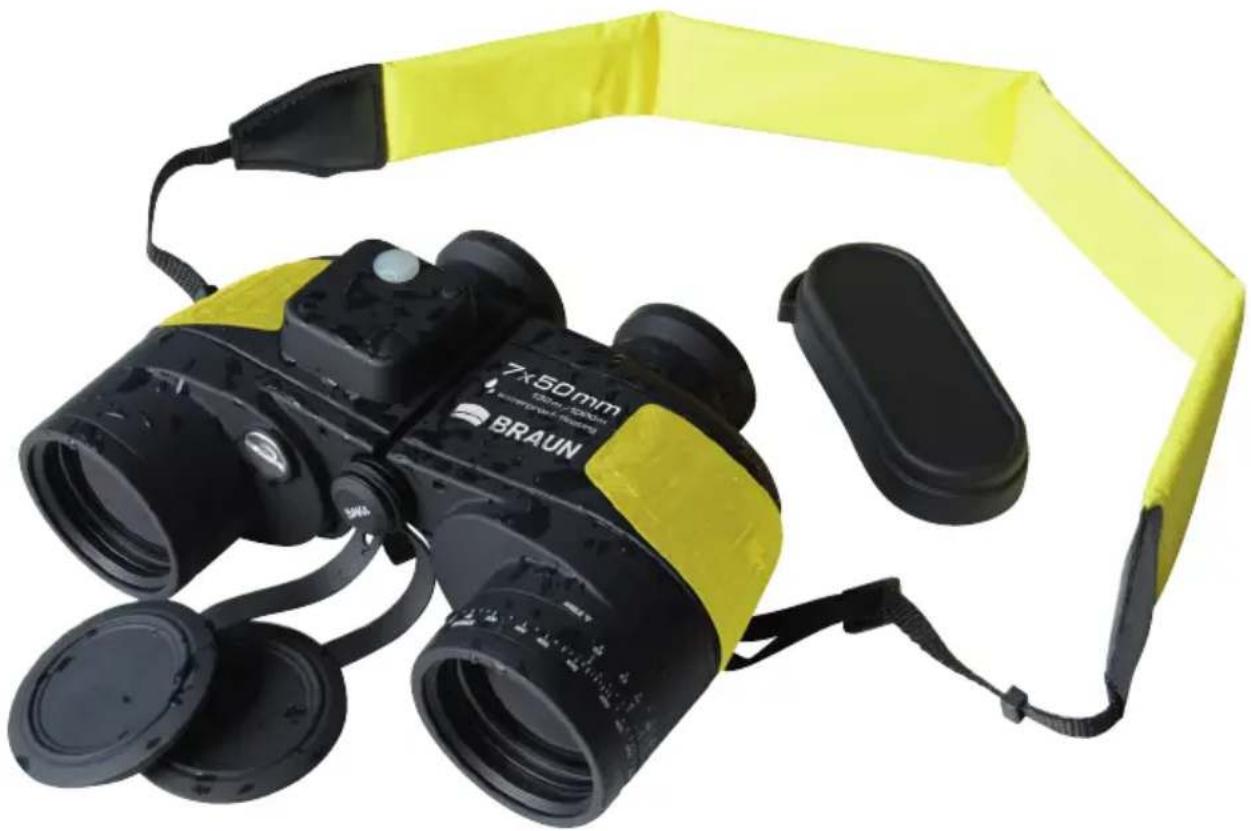
Dieses 7x50-Fernglas ist ein schwimmfähiges Modell mit beleuchtetem Kompass. Es verfügt über zwei Entfernungsmesswerkzeuge. Mit der Mils-Strichplatte im Okular und der Rechenscheibe können Sie die Entfernung zu einem Objekt schätzen, wenn dessen Größe bekannt ist, oder umgekehrt. Die Optik ist präzisionsgefertigt für Helligkeit und Bildschärfe.
1.2 Modell 7×50 mit Kompass
2. Technische Daten
2.1 Optische Leistung
Vergrößerung: 7×
Sehfeld bei 7x: (132m/1000m)
Austrittspupillendurchmesser: 6,8 mm
Austrittspupillenabstand: 23 mm (langer Augenabstand für Brillenträger)
Dioptrieneinstellbereich: -5 \~ +5 DIOPTRIEN
Pupillenabstand: 56 \~ 72mm
Auflösung: ≤ 5"
2.2 Abmessungen und Gewicht
Abmessungen (Länge x Breite x Höhe): 200 × 80 × 150mm
Gewicht: Fernglas: ≤0,9kg (1,98 lbs)
Komplettes Produkt: ≤1,2 kg (2,65 lbs.)
3. Konstruktionsspezifikationen
3.1 Optisches System
3.1.1 Grundlegende Fernglaskonstruktion
Die grundlegende optische Konstruktion eines Fernglases besteht, wie in Abbildung 1 dargestellt, aus (1) dem Objektiv, (2) den Porro-Prismen, (3) dem Absehen und (4) dem Okular. Das Absehen (3) und die Kompass-Projektionssysteme (5) sind in die rechte Hälfte des Fernglaskörpers eingebaut.
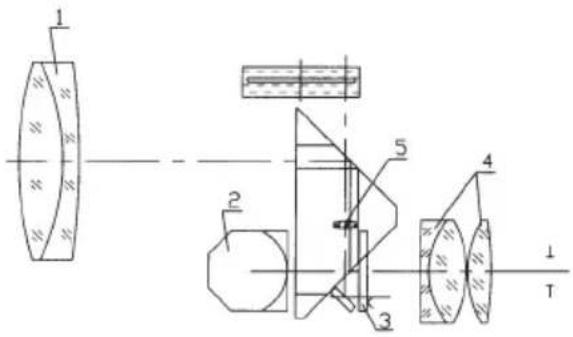
Abb. 1
3.1.2 Funktionsweise des Fernglases
Das Licht des Objekts oder Ziels, das Sie betrachten, tritt durch das Objektivsystem (Punkt 1, Abb. 1) in das Fernglas ein. Durch das Objektiv werden die Strahlen zu einem umgekehrten Bild gebündelt. Dann durchlaufen die Lichtstrahlen des Bildes das Prismensystem (bekannt als Porro-Prisma) (Punkt 2, Abb. 1) und werden umgekehrt, um das Bild am Absehen (Punkt 3, Abb. 1) aufrecht zu stellen. Dieses Bild wird durch die Okulare (Punkt 4, Abb. 1) vergrößert, sodass der Beobachter nun das entfernte Objekt sehen kann.
3.1.3 Absehen-Skala (siehe Abb. 3)
Auf dem Absehen (3) befinden sich vertikale und horizontale Linien. Jede kleine Einteilung auf sowohl vertikalen als auch horizontalen Linien entspricht 5 mil und jede nummerierte Einteilung entspricht 10 mil (ein Vollkreis = 6400 mil).
Daher entspricht "1" auf der Skala 10 mil.
3.2 Gehäusebaugruppe (Abb. 2)
Das Fernglas besteht aus zwei identischen Teleskopen. Jede Hälfte besteht aus Folgendem:
- Okular
- Hauptfernglasgehäuse, das die Porro-Prismenbaugruppe beherbergt
- Objektiv
- Verbindungswelle
- Pupillenabstandsskala (56 mm - 72 mm)
- Dioptrieneinstellring mit Indexmarkierungen (jede Teilung = 1 Dioptrie)
- Gummiaugenmuscheln, umklappbar
- Rechenscheibe
- Fenster für die Kompassbeleuchtung
- Schalter für die Kompassbeleuchtung Ein/Aus
- Batteriefach
- Staubschutzkappe für das Objektiv
- Staubschutzkappen für die Okulare
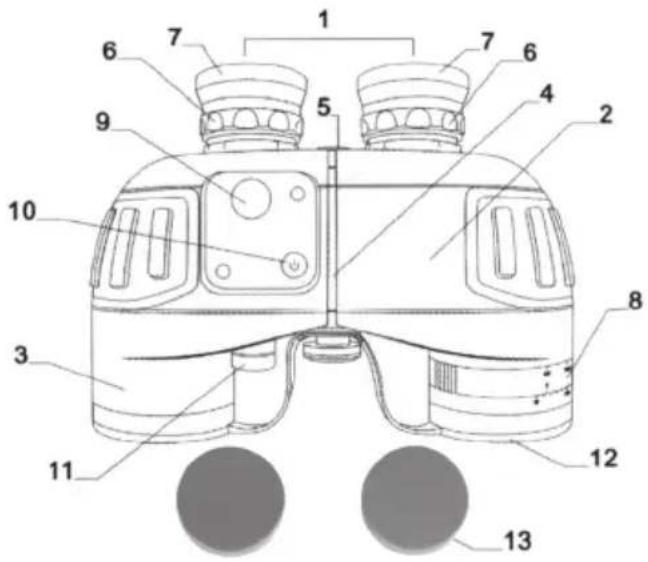
Abb. 2
4. Verwendung des Fernglases
4.1 Fokussieren des Fernglases
4.1.1 Einstellung des Augenabstands
Stellen Sie das Fernglas zunächst so ein, dass beide Okulare direkt vor Ihren Augen sind. Halten Sie das Fernglas dazu mit beiden Händen und biegen Sie das Gehäuse, bis Sie ein einziges rundes Bild sehen.
Hinweis: Das Bild ist noch nicht scharf. Die Schärfeeinstellung erfolgt im nächsten Schritt. Sie müssen zuerst den Augenabstand des Fernglases an Ihre Augen anpassen. Die Einstellung für Ihre Augen wird auf der Augenabstandsskala (Abb. 2, 5) angezeigt. Notieren Sie sich diese Skaleneinstellung, um sie später schneller wieder einstellen zu können.
4.1.2 Gummiaugenmuscheln, umklappbar
Dieses Fernglas hat einen langen Augenabstand. Es ermöglicht Brillenträgern, ohne Abnehmen der Brille ein normales Bild zu sehen. Diese praktischen Augenmuscheln lassen sich für die Verwendung mit Brille umklappen und für die Verwendung ohne Brille aufklappen. Drücken Sie die Augenmuscheln leicht an, um sie einfach umzuklappen.
4.1.3 Fokussierung
Um ein klares Bild zu erhalten, müssen Sie das Fernglas fokussieren. Dieses Modell hat zwei individuelle Dioptrien-Einstellringe an jedem Okular, sodass Sie die Optik an Ihre Augen anpassen können. Sie müssen jedes Okular einstellen. Nachdem Sie das Fernglas an die Augen gehalten und ein Objekt betrachtet haben, schließen Sie das linke Auge. Drehen Sie den rechten Dioptrien-Einstellring, bis das Objektbild in Ihrem rechten Auge scharf und klar erscheint. Dann öffnen Sie das linke Auge und schließen das rechte Auge. Drehen Sie den linken Dioptrien-Einstellring, bis das Objektbild in Ihrem linken Auge scharf und klar erscheint.
Wenn Sie Ihr Fernglas mit einer anderen Person teilen, notieren Sie zuerst die Dioptrien-Indexmarkierung an der Basis der Okulare (6). Dann können Sie die Okulare einfach wieder auf diese Einstellungen zurückstellen, wenn Sie das Fernglas das nächste Mal verwenden, um ein Objekt in derselben Entfernung zu betrachten.
4.2 Verwendung des Mil-Strich-Platten- und Rechenrings zur Entfernungsmessung
4.2.1 Was ist der Sehwinkel?
Der Sehwinkel eines Objekts ist der Winkel von Ihrem Fernglas zu den Kanten des Objekts. Er wird in Mil mit der Mil-Strich-Platte auf Ihrem Fernglas berechnet. Mit dieser Messung können Sie die Entfernung zu einem Objekt berechnen, wenn die Höhe oder Breite dieses Objekts bekannt ist. Diese Messung wird entweder horizontal oder vertikal durchgeführt und als horizontaler Sehwinkel oder vertikaler Sehwinkel bezeichnet.
4.2.2 Berechnung des horizontalen Sehwinkels eines Objekts
Wenn das Objekt in den horizontalen Skalenbereich (-40\~+40 Mil) im Fernglas passt, richten Sie eine Kante des Objekts an einem Punkt auf der horizontalen Skalenlinie aus und lesen Sie den Wert ab, an dem die andere Kante die horizontale Skala trifft. In Abb. 4 liegt die rechte Kante des Segelboots bei Null und die linke Kante bei 2, sodass der horizontale Sehwinkel 20 Mil beträgt. (1 auf der Skala = 10 Mil, 2 = 20 Mil usw.)
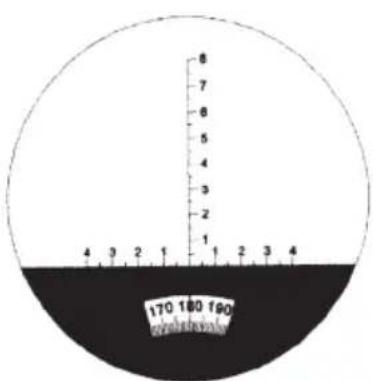
Abb. 3
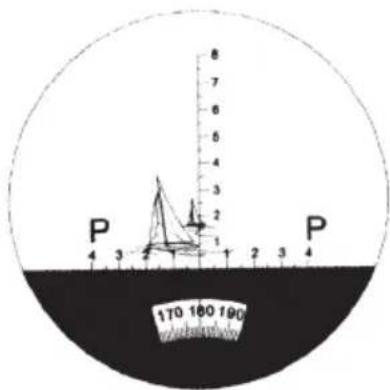
Abb. 4
4.2.2b. Berechnung des Sehwinkels, wenn das Objekt größer als die Skala ist
Wenn das Objekt größer als die Skala ist, wählen Sie einen Mittelpunkt, messen Sie den Sehwinkel dieses Punkts und multiplizieren Sie ihn mit 2.
4.2.3 Berechnung des vertikalen Sehwinkels eines Objekts
Verwenden Sie dieselbe Methode wie in 4.2.2 beschrieben, aber verwenden Sie die vertikale Skala.
In Abb. 5 trifft die Basis des Leuchtturms die vertikale Skala bei Null und die Spitze des Leuchtturms trifft die Skala bei 6, sodass der vertikale Sehwinkel 60 Mil beträgt.
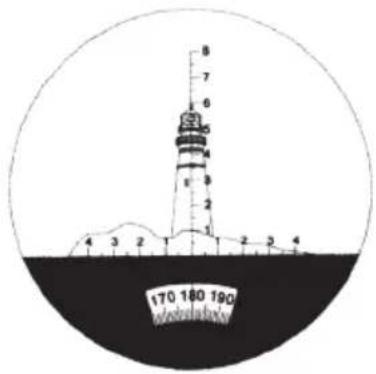
Abb. 5
4.2.4 So verwenden Sie Ihr Fernglas zur Entfernungsmessung
(Dieser Abschnitt zeigt Ihnen, wie Sie die Entfernung manuell berechnen. Um die Rechenskala zu verwenden, springen Sie zu Abschnitt 4.2.5)
Die Formel zur Entfernungsmessung lautet L(km) = H(m) / w(mils)
Wobei:
L = die Entfernung zwischen Beobachter und Objekt in km
H = die Höhe des Objekts in m (dies muss ein bekannter Wert sein)
w = der Sichtwinkel des Objekts, gemessen mit der Mil-Strich-Platte Ihres Fernglases (siehe Abb. 4.2.2 und 4.2.3)
Bei der Entfernungsmessung schätzen Sie zuerst die Höhe des Objekts, dann lesen Sie den Sichtwinkel an Ihrem Fernglas ab und setzen beide in die Formel ein.
Zum Beispiel:
Ein Leuchtturm ist 12 m hoch. (H = 12 m)
Der Sichtwinkel am Fernglas beträgt 60 mil (siehe Abb. 6)
Mit der Formel L(km) = H(m) / w(mils) können wir die Entfernung schätzen.
L = 12 / 60 = 0,2 km (200 m)
Daher beträgt die Entfernung zwischen Beobachter und Leuchtturm 200 m.
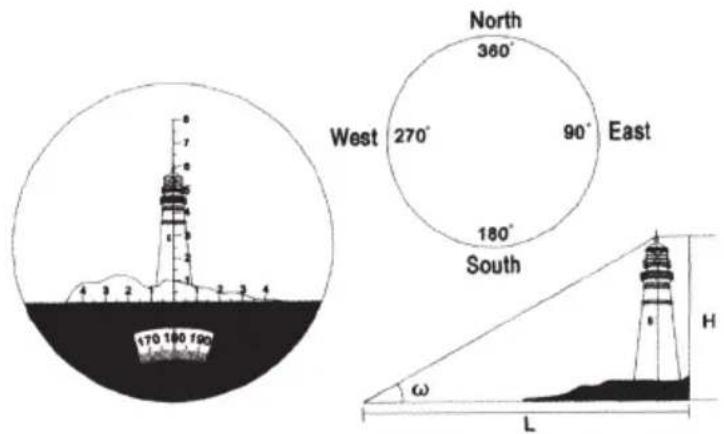
Abb. 6
4.2.5 Verwendung des Rechners am Fernglas zur Entfernungsmessung
Die Rechenscheibe kann verwendet werden, um die Entfernung schnell und einfach zu bestimmen, ohne die obige Berechnung durchzuführen. Die Rechenscheibe besteht aus einem drehbaren aktiven Ring mit einer dreieckigen "WINKEL"-Markierung und einer festen Skala mit der Bezeichnung "ENTFERNUNG". Auf dem aktiven Ring gibt es zwei Skalen: Die obere Skala ist der Sehwinkel und die untere ist eine Größenskala mit der Bezeichnung "OBJEKTGRÖSSE".
Messen Sie zuerst den Sehwinkelwert eines Objekts, drehen Sie den aktiven Ring und platzieren Sie diesen Wert an der Winkelindexmarkierung. Suchen Sie dann die Teilung, die die Größe des Objekts angibt. Dort, wo die Größe auf die Entfernungsskala trifft, wird die Entfernung zum Objekt angezeigt.
Zum Beispiel: Siehe Abb. 7. Sie beobachten einen Leuchtturm und sein gemessener vertikaler Sehwinkel beträgt 60 mil. Drehen Sie den aktiven Ring und platzieren Sie die mit "6" markierte Teilung der Winkelskala an der Winkelindexmarkierung. Seine Höhe beträgt 12 m. Die mit "12" markierte Teilung der Größenskala fluchtet mit der mit "200" markierten Teilung der festen Skala. Dies zeigt uns, dass die Entfernung des Leuchtturms 200 m beträgt.
Wenn die Größe des beobachteten Objekts außerhalb des Skalenbereichs liegt, teilen Sie die Objektgröße durch eine Zahl, die die Objektgröße in den Skalenbereich bringt, und teilen Sie den Sehwinkel durch dieselbe Zahl. Da die Werte auf einer festen Skala im Verhältnis stehen, ist der resultierende Wert auf der Scheibe korrekt. (Es ist nicht erforderlich, das Ergebnis zu multiplizieren.)
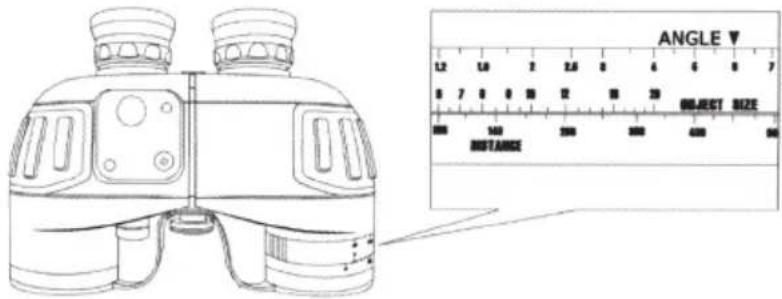
Abb. 7
4.2.6 Messung der Objektgröße (Höhe und Breite)
Gemäß der Formel für die Entfernungsmessung können Sie die Höhe mit H = L × w berechnen. Bei der Größenmessung schätzen Sie zuerst die Entfernung zum Objekt und messen dann den Sehwinkel. Mit diesen Messungen können Sie die Höhe des Ziels mit der Formel berechnen.
Zum Beispiel:
Die Entfernung zwischen Beobachter und Objekt beträgt 0,6 km. Der horizontale Sehwinkel beträgt 60 mil und der vertikale Sehwinkel 30 mil. Mit der Formel erhalten Sie:
Die Höhe: H = 0,6 × 30 = 18 m
Die Breite: W = 0,6 × 60 = 36 m
4.3 Verwendung des Kompasses
Der Azimutwinkel kann mit dem in der rechten Hälfte des Gehäuses eingebauten Kompass gemessen werden. Er zeigt den Azimut des Objekts relativ zum Beobachter an. Jede Teilung des Kompasses entspricht einem Grad. Wenn sich das Objekt im Norden befindet, zeigt der Kompass 0 Grad an. Er erhöht sich, wenn Sie im Uhrzeigersinn drehen. 90° bedeutet, dass sich das Objekt im Osten befindet, 180° bedeutet Süden und 270° bedeutet Westen.
Um präzise Winkelmessungen zu gewährleisten, sollte das Fernglas beim Ablesen des Kompasses horizontal und eben gehalten werden. Das Objekt sollte sich in der Mitte des Fadenkreuzes befinden.
Die Skala des Kompasses muss beleuchtet werden, um sie bei unzureichendem Tageslicht gut ablesen zu können. (Verwenden Sie das batteriebetriebene Innenbeleuchtungssystem nicht, wenn die äußeren Sichtbedingungen hell genug sind, um die Kompassskala und die Markierungen klar zu erkennen.) Durch Drücken der Beleuchtungstaste wird die Kompassskala rot beleuchtet.
4.4 Wechseln der Batterien
Die Batterien für den Kompass werden entladen, wenn das Innenbeleuchtungssystem über längere Zeit verwendet wurde. Batterien können auch schwach werden, wenn sie über einen längeren Zeitraum nicht verwendet werden. Wenn das Licht schwach wird, öffnen Sie den Batteriefachdeckel und ersetzen Sie die Batterien durch neue.
Batterien sind im Lieferumfang enthalten und in Ihrem Fernglas vorinstalliert. Wenn ein Austausch erforderlich ist, schrauben Sie den Batteriefachdeckel mit einer Münze oder einem Schraubendreher ab und ersetzen Sie die Batterien durch denselben Typ. Achten Sie darauf, die Batterien in derselben Richtung wie die Originale einzulegen, mit der flachen positiven (+) Seite nach oben zum Deckel hin bei beiden Batterien. Schrauben Sie den Batteriefachdeckel wieder fest auf und drücken Sie die Kompassbeleuchtungstaste, um das Licht zu testen. Ein Leuchten sollte um den Kompass herum sichtbar sein (möglicherweise müssen Sie die rechte Objektivlinse abdecken, wenn Sie sich im hellen Freien befinden).
Hinweis: Die beiden Batterien sollten gleichzeitig ersetzt werden. Die Batterien sollten entfernt werden, wenn das Fernglas längere Zeit nicht verwendet wird. Batterien, die über längere Zeiträume ohne Verwendung im Fernglas verbleiben, können auslaufen und Schäden am Fernglas verursachen.
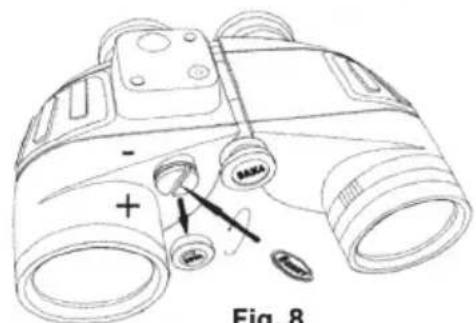
Abb. 8
5. Stativmontage
Ein Gewinde für eine Stativbefestigung befindet sich an der Basis des Fernglasgelenks (Abb. 9). Setzen Sie einen Fernglas-Stativadapter ein und befestigen Sie Ihre Stativschraube an der Basis des Adapters.
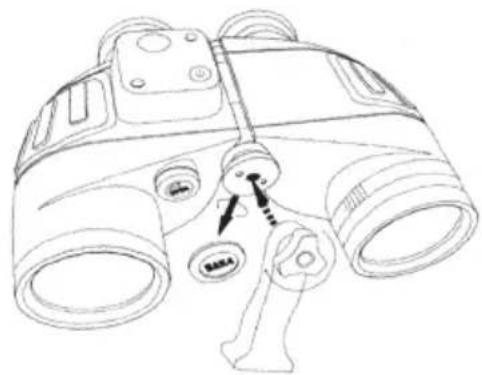
Abb. 9
6. Fernglas und Zubehör
| 7×50 binoculars | 1 pc |
| Carrying strap | 1 pc |
| Eyepiece cap | 1 pc |
| Lens cleaning cloth | 1 pc |
| Instructions | 1 cop |
| Soft case with carrying strap | 1 pc |
| Objective Lens Cap | 2 pc |
7. Lagerung und Wartung
Ferngläser sind Präzisionsoptikinstrumente. Sie sollten sorgfältig behandelt und gewartet werden, um sie in gutem Betriebszustand zu halten.
7.1 Allgemeine Wartung
7.1.1 Linsen: Reinigen Sie die Linsen nach jedem Gebrauch und bevor Sie das Fernglas wieder in die Tragetasche legen. Entfernen Sie nach jedem Gebrauch Staub oder Schmutz mit einer Bürste von den Linsen. Wischen Sie danach jede Linse vorsichtig mit dem speziellen Optiktuch ab. Verwenden Sie niemals Ihre Finger zum Reinigen der Linsen, da Hautfett auf die Linsen gelangen und diese möglicherweise beschädigen kann. Verwenden Sie zum Reinigen der Linsen ausschließlich spezielle Optiktücher. Bewahren Sie Ihr Optiktuch immer in der Fernglastasche auf, damit Sie es beim Reinigen griffbereit haben. 7.1.2 Obwohl die Okulare für die individuelle Dioptrieneinstellung drehbar sind, drehen Sie sie nicht über den werkseitig eingestellten Anschlag hinaus. Ein gewaltsames Weiterdrehen beschädigt die Okularoptik und macht das Fernglas unbrauchbar. 7.1.3 Denken Sie nach dem Gebrauch immer daran, die Dioptrieneinstellung auf "0" zurückzudrehen, um Schäden am Okularsystem zu vermeiden. 7.1.4 Vermeiden Sie starke Erschütterungen oder das Fallenlassen des Fernglases. Dies kann die interne Optik und die Prismen beschädigen. Lagern Sie das Fernglas an einem trockenen und gut belüfteten Ort.
Marine-Fernglas
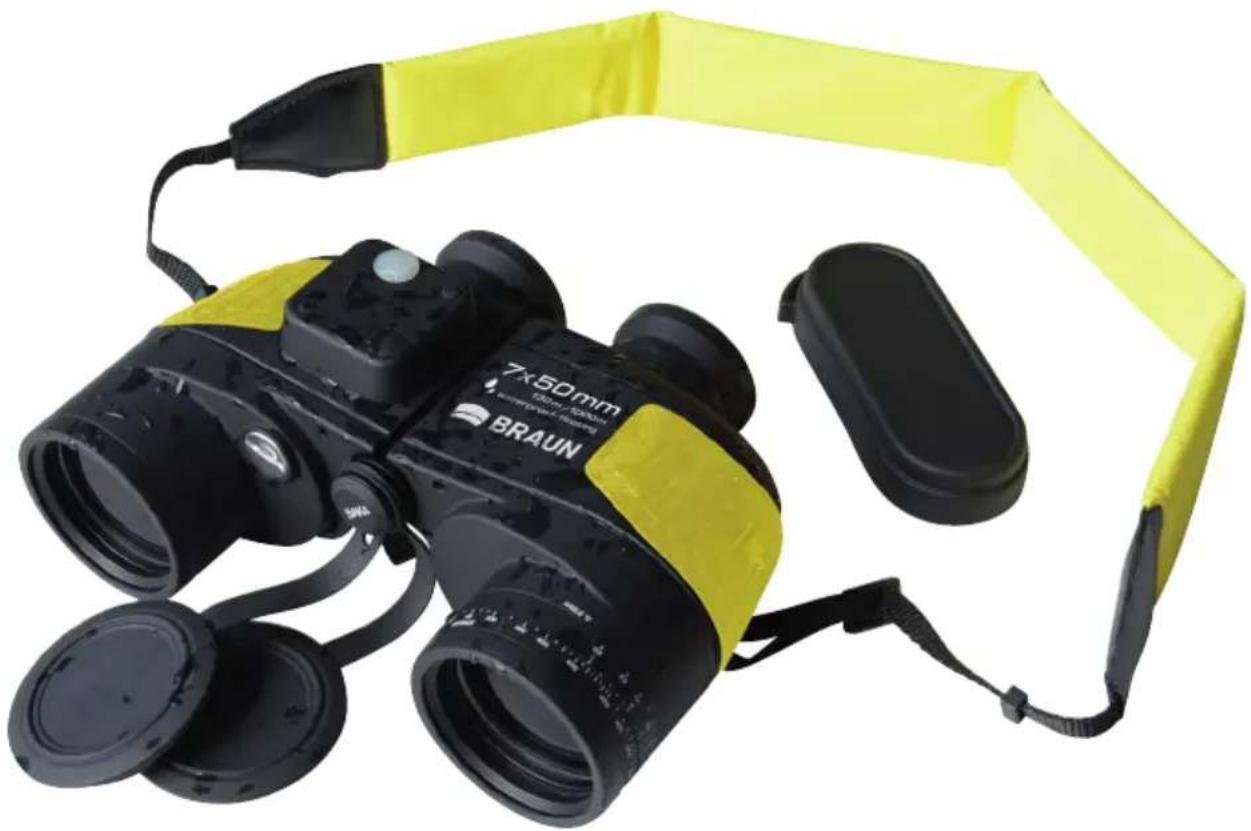
Bedienungsanleitung
DE
- Allgemeine Übersicht 2
- Technische Daten 2
- Konstruktionsmerkmale 2
- Verwendung des Fernglases 4
- Stativmontage 8
- Fernglas und Zubehör 9
- Lagerung und Wartung
1. Allgemeine Übersicht
1.1 Produktbeschreibung
Dieses 7x50-Fernglas ist ein schwimmfähiges Modell mit beleuchtetem Kompass. Es verfügt über zwei Entfernungsmesswerkzeuge. Mit der Mil-Strich-Entfernungsmessskala im Okular und der Rechenscheibe können Sie die Entfernung zu einem Objekt schätzen, wenn dessen Größe bekannt ist, oder umgekehrt. Die Optik ist präzisionsgefertigt für Helligkeit und Bildschärfe.
1.2 Modell 7×50 mit Kompass
2. Technische Spezifikation
2.1 Optische Leistung
Vergrößerung: 7×
Sehfeld bei 7x: (132m/1000m)
Austrittspupillendurchmesser: 6,8 mm
Austrittspupillenabstand: 23 mm (langer Augenabstand für Brillenträger)
Dioptrieneinstellbereich: -5 \~ +5 Dioptrien
Pupillenabstand: 56 \~ 72mm
Auflösung: ≤ 5"
2.2 Größe und Gewicht
Größe (Länge x Breite x Höhe): 200 × 80 × 150mm
Gewicht: Fernglas: ≤0,9kg (1,98 lbs)
Gesamtprodukt: ≤1,2 kg (2,65 lbs.)
3. Konstruktionsspezifikationen
3.1 Optisches System
3.1.1 Grundlegender Aufbau des Fernglases
Der grundlegende optische Aufbau des Fernglases besteht, wie in Abbildung 1 gezeigt, aus (1) dem Objektiv, (2) den Porro-Prismen, (3) dem Fadenkreuz und (4) dem Okular. Fadenkreuz (3) und Kompass-Projektionssystem (5) sind in die rechte Hälfte des Fernglaskörpers eingebaut.
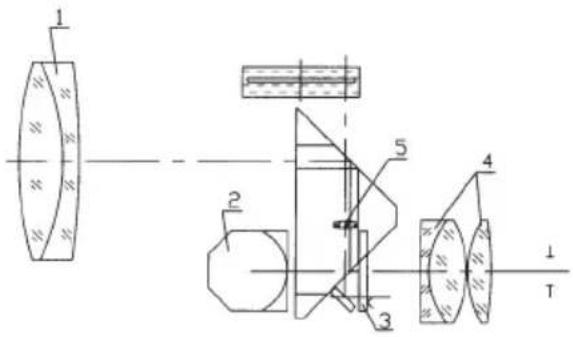
Abb. 1
3.1.2 Funktionsweise des Fernglases
Das Licht des Objekts oder Ziels, das Sie betrachten, tritt durch das Objektivsystem (Punkt 1, Abb. 1) in das Fernglas ein. Durch das Objektiv werden die Strahlen zu einem umgekehrten Bild gebündelt. Dann durchlaufen die Lichtstrahlen des Bildes das Prismensystem (bekannt als Porro-Prisma) (Punkt 2, Abb. 1) und werden umgekehrt, um das Bild am Fadenkreuz (Punkt 3, Abb. 1) aufzurichten. Dieses Bild wird durch die Okulare (Punkt 4, Abb. 1) vergrößert, sodass der Beobachter nun das entfernte Objekt sehen kann.
3.1.3 Fadenkreuz-Skala (siehe Abb. 3)
Auf dem Fadenkreuz (3) befinden sich vertikale und horizontale Linien. Jede kleine Einteilung auf sowohl vertikalen als auch horizontalen Linien entspricht 5 mil, und jede nummerierte Einteilung entspricht 10 mil (ein Vollwinkel = 6400 mil).
Somit entspricht "1" auf der Skala 10 mil.
3.2 Gehäusemontage (Abb. 2)
Das Fernglas besteht aus zwei identischen Teleskopen. Jede Hälfte besteht aus Folgendem:
- Okular
- Hauptfernglasgehäuse, das die Porro-Prismenanordnung beherbergt
- Objektiv
- Verbindungswelle
- Pupillendistanz-Skala (56 mm - 72 mm)
- Dioptrieneinstellring mit Markierungen (jede Markierung = 1 Dioptrie)
- Gummiaugenmuscheln, umklappbar
- Rechenscheibe
- Fenster für die Kompassbeleuchtung
- Schalter für die Kompassbeleuchtung Ein/Aus
- Batteriefach
- Staubschutzkappe für das Objektiv
- Staubschutzkappen für die Okulare
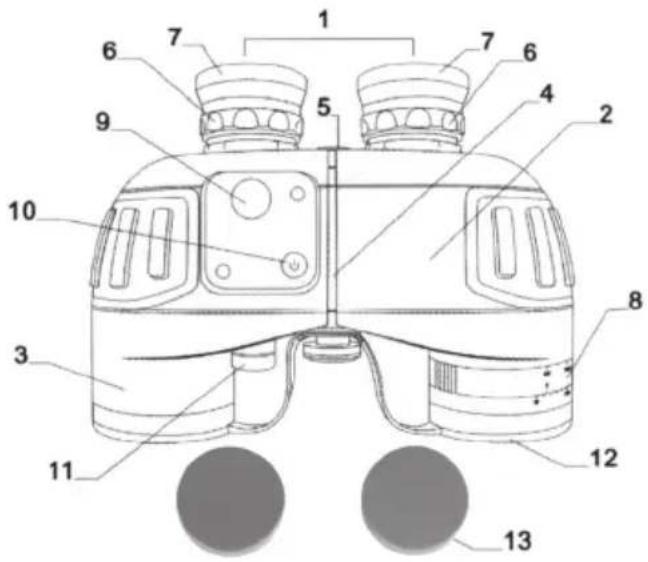
Abb. 2
4. Verwendung des Fernglases
4.1 Fokussierung des Fernglases
4.1.1 Einstellung des Augenabstands
Stellen Sie das Fernglas zunächst so ein, dass beide Okulare direkt vor Ihren Augen sind. Halten Sie das Fernglas mit beiden Händen und biegen Sie das Gehäuse, bis Sie ein einziges rundes Bild sehen.
Hinweis: Das Bild ist noch nicht scharf. Die Schärfeeinstellung erfolgt im nächsten Schritt. Sie müssen zuerst den Augenabstand des Fernglases an Ihre Augen anpassen. Die Einstellung für Ihre Augen wird auf der Augenabstandsskala (Abb. 2, 5) angezeigt. Notieren Sie sich diese Skaleneinstellung für ein schnelleres erneutes Einstellen.
4.1.2 Gummiaugenmuscheln, umklappbar
Diese Ferngläser haben einen langen Augenabstand. Sie ermöglichen es Brillenträgern, ohne Abnehmen der Brille normale Bilder zu sehen. Diese praktischen Augenmuscheln lassen sich für die Verwendung mit Brille herunterklappen und für die Verwendung ohne Brille hochklappen. Drücken Sie die Augenmuscheln leicht an, um sie einfach herunterzuklappen.
4.1.3 Fokussierung
Um ein klares Bild zu erhalten, müssen Sie das Fernglas fokussieren. Dieses Modell hat zwei individuelle Dioptrieneinstellringe an jedem Okular, sodass Sie die Optik an Ihre Augen anpassen können. Sie müssen jedes Okular einstellen. Nachdem Sie das Fernglas an die Augen gehalten und ein Objekt betrachtet haben, schließen Sie das linke Auge. Drehen Sie den rechten Dioptrieneinstellring, bis das Objektbild in Ihrem rechten Auge scharf und klar erscheint. Dann öffnen Sie das linke Auge und schließen das rechte Auge. Drehen Sie den linken Dioptrieneinstellring, bis das Objektbild in Ihrem linken Auge scharf und klar erscheint.
Wenn Sie Ihr Fernglas mit anderen Personen teilen, notieren Sie zuerst die Dioptrienindexmarkierung an der Basis der Okulare (6). Dann können Sie die Okulare einfach auf diese Einstellungen zurückstellen, wenn Sie das Fernglas das nächste Mal verwenden, um ein Objekt in derselben Entfernung zu betrachten.
4.2 Verwendung der Mils-Skala und des Rechners zur Entfernungsmessung
4.2.1 Was ist der Sehwinkel?
Der Sehwinkel eines Objekts ist der Winkel von Ihrem Fernglas zu den Kanten des Objekts. Er wird in Mil unter Verwendung der Mils-Skala auf Ihrem Fernglas berechnet. Mit dieser Messung können Sie die Entfernung zu einem Objekt berechnen, wenn die Höhe oder Breite dieses Objekts bekannt ist. Diese Messung wird entweder horizontal oder vertikal durchgeführt und als horizontaler Sehwinkel oder vertikaler Sehwinkel bezeichnet.
4.2.2 Berechnung des horizontalen Sehwinkels eines Objekts
Wenn das Objekt innerhalb des horizontalen Skalenbereichs (-40\~+40 Mil) im Fernglas liegt, richten Sie eine Kante des Objekts an einem Punkt auf der horizontalen Skalenlinie aus und lesen Sie den Wert ab, an dem die andere Kante die horizontale Skala schneidet. In Abb. 4 liegt die rechte Kante des Segelboots bei Null und die linke Kante bei 2, sodass der horizontale Sehwinkel 20 Mil beträgt. (1 auf der Skala = 10 Mil, 2 = 20 Mil usw.)
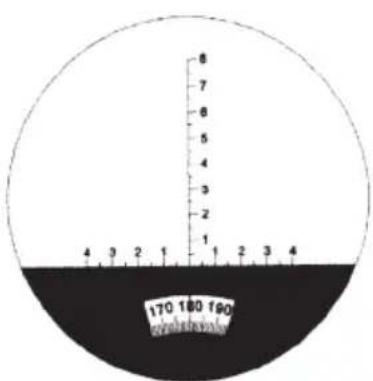
Abb. 3
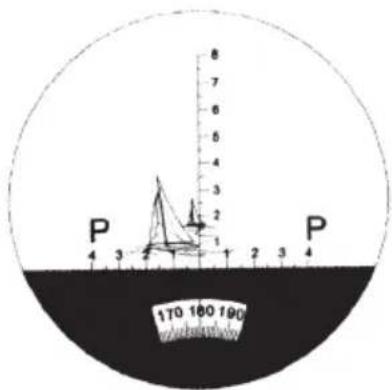
Abb. 4
4.2.2b. Berechnung des Sehwinkels, wenn das Objekt größer als die Skala ist
Wenn das Objekt größer als die Skala ist, wählen Sie einen Mittelpunkt, messen Sie den Sehwinkel dieses Punktes und multiplizieren Sie ihn mit 2.
4.2.3 Berechnung des vertikalen Sehwinkels eines Objekts
Verwenden Sie dieselbe Methode wie in 4.2.2 beschrieben, aber verwenden Sie die vertikale Skala.
In Abb. 5 trifft die Basis des Leuchtturms die vertikale Skala bei Null und die Spitze des Leuchtturms trifft die Skala bei 6, so dass der vertikale Sichtwinkel 60 mils beträgt.
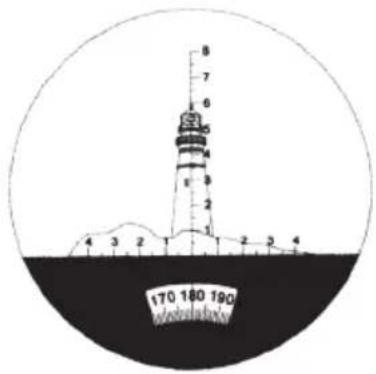
Abb. 5
4.2.4 So verwenden Sie Ihr Fernglas zur Entfernungsschätzung
(Dieser Abschnitt zeigt, wie Sie die Entfernung manuell berechnen. Um die Rechenskala zu verwenden, springen Sie zu Abschnitt 4.2.5)
Die Formel zur Entfernungsmessung lautet L(km) = H(m) / w(mils)
Wobei:
L = die Entfernung zwischen Beobachter und Objekt in km
H = die Höhe des Objekts in m (dies muss ein bekannter Wert sein)
w = der Sichtwinkel des Objekts, gemessen mit der Mil-Strich-Platte Ihres Fernglases (siehe Abb. 4.2.2 und 4.2.3)
Bei der Entfernungsmessung schätzen Sie zuerst die Höhe des Objekts, dann messen Sie den Sichtwinkel mit Ihrem Fernglas und setzen beide in die Formel ein.
Zum Beispiel:
Ein Leuchtturm ist 12 m hoch. (H = 12 m)
Der Sichtwinkel im Fernglas beträgt 60 mils (siehe Abb. 6)
Mit der Formel L(km) = H(m) / w(mils) können wir die Entfernung schätzen.
L = 12 / 60 = 0,2 km (200 m)
Daher beträgt die Entfernung zwischen dem Beobachter und dem Leuchtturm 200 m.
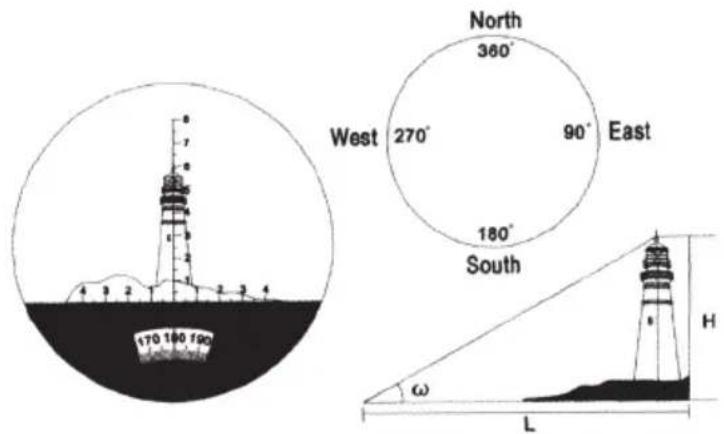
Abb. 6
4.2.5 Verwendung des Rechners an Ihrem Fernglas zur Entfernungsschätzung
Die Rechenscheibe kann verwendet werden, um die Entfernung schnell und einfach zu bestimmen, ohne die obige Berechnung durchzuführen. Die Rechenscheibe besteht aus einem drehbaren aktiven Ring mit einer dreieckigen "WINKEL"-Markierung und einer festen Skala mit der Bezeichnung "ENTFERNUNG". Es gibt zwei Skalen im aktiven Ring: Die obere Skala ist der Sehwinkel und die untere ist eine Größenskala mit der Bezeichnung "OBJEKTGRÖSSE".
Messen Sie zuerst den Sehwinkelwert eines Objekts, drehen Sie den aktiven Ring und platzieren Sie diesen Wert an der Winkelindexmarkierung. Suchen Sie dann die Teilung, die die Größe des Objekts angibt. Dort, wo die Größe auf die Entfernungsskala trifft, wird die Entfernung zum Objekt angezeigt.
Zum Beispiel: Siehe Abb. 7. Sie beobachten einen Leuchtturm und sein gemessener vertikaler Sehwinkel beträgt 60 mil. Drehen Sie den aktiven Ring und platzieren Sie die mit "6" markierte Teilung in der Sehwinkelskala an der Winkelindexmarkierung. Seine Höhe beträgt 12 m. Die mit "12" markierte Teilung in der Größenskala fluchtet mit der mit "200" markierten Teilung in der festen Skala. Dies zeigt uns, dass die Entfernung zum Leuchtturm 200 m von uns beträgt.
Wenn die Größe des beobachteten Objekts außerhalb der Skala liegt, teilen Sie die Größe des Objekts durch eine Zahl, die die Objektgröße in den Skalenbereich bringt, und teilen Sie den Sehwinkel durch dieselbe Zahl. Da die Werte in einem festen Skalenverhältnis stehen, ist der resultierende Wert auf der Skala korrekt. (Es ist nicht erforderlich, das Ergebnis zu multiplizieren).
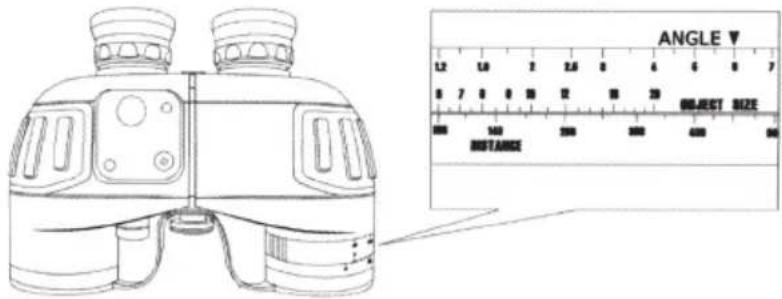
Abb. 7
4.2.6. Messung der Größe eines Objekts (Höhe und Breite)
Gemäß der Formel für die Entfernungsmessung können Sie die Höhe mit H = L × w berechnen. Bei der Größenmessung schätzen Sie zuerst die Entfernung zum Objekt und messen dann den Sehwinkel. Mit diesen Messungen können Sie die Höhe des Ziels mit der Formel berechnen.
Zum Beispiel:
Die Entfernung zwischen Beobachter und Objekt beträgt 0,6 km. Der horizontale Sehwinkel beträgt 60 mil und der vertikale Sehwinkel 30 mil. Mit der Formel erhalten Sie:
Die Höhe: H = 0,6 × 30 = 18 m
Die Breite: W = 0,6 × 60 = 36 m
4.3 Verwendung des Kompasses
Der Azimutwinkel kann mit dem in die rechte Gehäusehälfte eingebauten Kompass gemessen werden. Er zeigt das Azimut des Objekts relativ zum Beobachter an. Jede Teilung des Kompasses entspricht einem Grad. Wenn sich das Objekt im Norden befindet, zeigt der Kompass 0 (Grad) an. Und er erhöht sich, wenn Sie im Uhrzeigersinn drehen. 90° bedeutet, dass sich das Objekt im Osten befindet, 180° bedeutet Süden und 270° bedeutet Westen.
Um präzise Winkelmessungen zu gewährleisten, sollten die Ferngläser beim Ablesen des Kompasses horizontal und waagerecht gehalten werden. Das Objekt sollte sich in der Mitte des Fadenkreuzes befinden.
Die Teilungen des Kompasses müssen beleuchtet werden, um sie bei unzureichendem Tageslicht gut ablesen zu können. (Verwenden Sie das batteriebetriebene Innenbeleuchtungssystem nicht, wenn die äußeren Sichtbedingungen hell genug sind, um die Kompassskala und die Markierungen klar zu erkennen.) Durch Drücken der Beleuchtungstaste wird die Kompassskala rot beleuchtet.
4.4 Wechseln der Batterien
Die Batterien für den Kompass sind erschöpft, wenn das Innenbeleuchtungssystem über längere Zeiträume verwendet wurde. Batterien können auch schwach werden, wenn sie über einen längeren Zeitraum nicht verwendet werden. Wenn das Licht schwach wird, öffnen Sie den Batteriefachdeckel und ersetzen Sie die Batterien durch neue.
Batterien sind im Lieferumfang enthalten und in Ihrem Fernglas vorinstalliert. Wenn ein Austausch erforderlich ist, schrauben Sie den Batteriefachdeckel mit einer Münze oder einem Schraubendreher ab und ersetzen Sie die Batterien durch denselben Typ. Achten Sie darauf, die Batterien in derselben Richtung wie die Originale einzusetzen, wobei die flache positive (+) Seite bei beiden Batterien nach oben zum Deckel zeigt. Schrauben Sie den Batteriefachdeckel wieder fest auf und drücken Sie die Kompassbeleuchtungstaste, um das Licht zu testen. Ein Leuchten sollte um den Kompass herum sichtbar sein (möglicherweise müssen Sie die rechte Objektivlinse abdecken, wenn Sie sich bei hellem Licht im Freien befinden).
Bitte beachten Sie: Die beiden Batterien sollten gleichzeitig ersetzt werden. Die Batterien sollten entfernt werden, wenn das Fernglas längere Zeit nicht verwendet wird. Batterien, die über längere Zeiträume unbenutzt im Fernglas verbleiben, können auslaufen und Schäden am Fernglas verursachen.
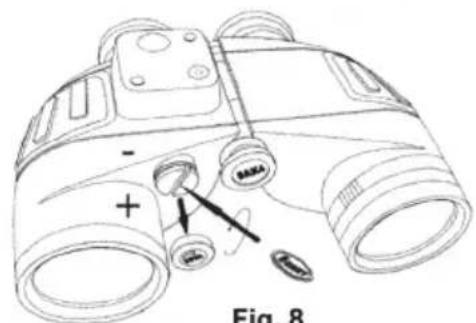
Abb. 8
5. Stativmontage
Eine Gewindebuchse für eine Stativbefestigung befindet sich an der Basis des Fernglasscharniers (Abb. 9). Setzen Sie einen Fernglas-Stativadapter ein und befestigen Sie Ihre Stativschraube an der Basis des Adapters.
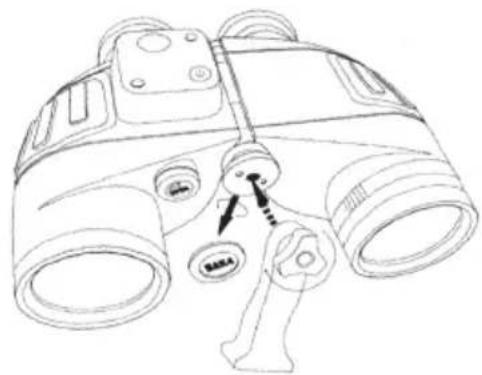
Abb. 9
6. Fernglas und Zubehör
| 7×50 binoculars | 1 pc |
| Carrying strap | 1 pc |
| Eyepiece cap | 1 pc |
| Lens cleaning cloth | 1 pc |
| Instructions | 1 cop |
| Soft case with carrying strap | 1 pc |
| Objective Lens Cap | 2 pc |
7. Lagerung und Wartung
Ferngläser sind ein Präzisionsoptikinstrument. Sie sollten sorgfältig behandelt und gewartet werden, um sie in gutem Betriebszustand zu halten.
7.1 Allgemeine Wartung
7.1.1 Linsen: Reinigen Sie die Linsen nach jedem Gebrauch und bevor Sie das Fernglas wieder in die Tragetasche legen. Entfernen Sie nach jedem Gebrauch Staub und Schmutz mit einer Bürste von den Linsen. Wischen Sie anschließend jede Linse vorsichtig mit dem speziellen Optiktuch ab. Verwenden Sie niemals Ihre Finger zum Reinigen der Linsen, da Hautfett auf die Linsen gelangen und diese möglicherweise beschädigen kann. Verwenden Sie zum Reinigen der Linsen ausschließlich spezielle Optiktücher. Bewahren Sie Ihr Optiktuch immer in der Fernglastasche auf, damit Sie es beim Reinigen griffbereit haben. 7.1.2 Obwohl die Okulare für die individuelle Dioptrieneinstellung drehbar sind, drehen Sie sie nicht über den werkseitig eingestellten Anschlag hinaus. Ein gewaltsames Weiterdrehen beschädigt die Okularoptik und macht das Fernglas unbrauchbar. 7.1.3 Denken Sie nach dem Gebrauch immer daran, den Dioptrieneinstellring auf die Position "0" zu stellen, um Schäden am Okularsystem zu vermeiden. 7.1.4 Vermeiden Sie starke Erschütterungen oder das Fallenlassen des Fernglases. Dies kann die interne Optik und die Prismen beschädigen. Lagern Sie das Fernglas an einem trockenen und gut belüfteten Ort.
- MARINE-FERNGLAS
- ALLGEMEINE ÜBERSICHT
- PRODUKTBESCHREIBUNG
- MODELL 7×50 MIT KOMPASS
- TECHNISCHE DATEN
- OPTISCHE LEISTUNG
- ABMESSUNGEN UND GEWICHT
- KONSTRUKTIONSSPEZIFIKATIONEN
- OPTISCHES SYSTEM
- GRUNDLEGENDE FERNGLASKONSTRUKTION
- FUNKTIONSWEISE DES FERNGLASES
- ABSEHEN-SKALA (SIEHE ABB. 3)
- GEHÄUSEBAUGRUPPE (ABB. 2)
- VERWENDUNG DES FERNGLASES
- FOKUSSIEREN DES FERNGLASES
- EINSTELLUNG DES AUGENABSTANDS
- GUMMIAUGENMUSCHELN, UMKLAPPBAR
- FOKUSSIERUNG
- VERWENDUNG DES MIL-STRICH-PLATTEN- UND RECHENRINGS ZUR ENTFERNUNGSMESSUNG
- WAS IST DER SEHWINKEL
- BERECHNUNG DES HORIZONTALEN SEHWINKELS EINES OBJEKTS
- B. BERECHNUNG DES SEHWINKELS, WENN DAS OBJEKT GRÖSSER ALS DIE SKALA IST
- BERECHNUNG DES VERTIKALEN SEHWINKELS EINES OBJEKTS
- SO VERWENDEN SIE IHR FERNGLAS ZUR ENTFERNUNGSMESSUNG
- VERWENDUNG DES RECHNERS AM FERNGLAS ZUR ENTFERNUNGSMESSUNG
- MESSUNG DER OBJEKTGRÖSSE (HÖHE UND BREITE)
- VERWENDUNG DES KOMPASSES
- WECHSELN DER BATTERIEN
- STATIVMONTAGE
- FERNGLAS UND ZUBEHÖR
- LAGERUNG UND WARTUNG
- ALLGEMEINE WARTUNG
- TECHNISCHE SPEZIFIKATION
- GRÖSSE UND GEWICHT
- GRUNDLEGENDER AUFBAU DES FERNGLASES
- FADENKREUZ-SKALA (SIEHE ABB. 3)
- GEHÄUSEMONTAGE (ABB. 2)
- FOKUSSIERUNG DES FERNGLASES
- VERWENDUNG DER MILS-SKALA UND DES RECHNERS ZUR ENTFERNUNGSMESSUNG
- SO VERWENDEN SIE IHR FERNGLAS ZUR ENTFERNUNGSSCHÄTZUNG
- VERWENDUNG DES RECHNERS AN IHREM FERNGLAS ZUR ENTFERNUNGSSCHÄTZUNG
- MESSUNG DER GRÖSSE EINES OBJEKTS (HÖHE UND BREITE)
Marke : BRAUN
Modell : 20135
Kategorie : Ferngläser