
Santo 2302 I Glassline - Kühlschrank AEG - Kostenlose Bedienungsanleitung
Finden Sie kostenlos die Bedienungsanleitung des Geräts Santo 2302 I Glassline AEG als PDF.


Benutzerfragen zu Santo 2302 I Glassline AEG
0 Frage zu diesem Gerät. Beantworten Sie die, die Sie kennen, oder stellen Sie Ihre eigene.
Eine neue Frage zu diesem Gerät stellen
Laden Sie die Anleitung für Ihr Kühlschrank kostenlos im PDF-Format! Finden Sie Ihr Handbuch Santo 2302 I Glassline - AEG und nehmen Sie Ihr elektronisches Gerät wieder in die Hand. Auf dieser Seite sind alle Dokumente veröffentlicht, die für die Verwendung Ihres Geräts notwendig sind. Santo 2302 I Glassline von der Marke AEG.
BEDIENUNGSANLEITUNG Santo 2302 I Glassline AEG
Santo 2302 i
Build-in Refrigerator
Operating Instructions
Contents Page
Illustration pages (please unfold) 3/4
General instructions 10
Starting up and temperature regulation 11
Correct storage 11/12
Low-temperature lock 12
Freezing fresh food and storing frozen
food in the star compartment 12
Icemaking 13
Defrosting 13
Cleaning and care 13
Faults and servicing 13/14
Hints 14
text_image
1 2 0 1 ***1
text_image
10 1 9 8 2 7 6 5 3 43
text_image
10 1 9 2 9 8 7 3 4 6 5 3 6 5 42
natural_image
Diagram of a vehicle with directional arrows indicating flow or movement (no text or symbols)4
natural_image
Line drawing of a refrigerator with multiple bottles on the shelves (no text or symbols)5
natural_image
Illustration of a multi-tiered storage shelf with plastic containers and lids (no text or symbols)6
natural_image
Illustration of a hand pressing down on a window with a curved arrow indicating direction (no text or symbols)8
natural_image
Line drawing of a mechanical setup with a bowl of water being poured into a container, no text or symbols present9
natural_image
Technical line drawing of a wooden deck structure with two labeled components (A), no text or symbols present.7
natural_image
Diagram of a refrigerator interior showing the door, shelves, and storage compartments (no text or symbols)10
IMPORTANT!
If the refrigerator you have purchased is replacing an older model still fitted with a snap catch or lock, you should render this lock unserviceable before throwing the appliance away or putting it out for environment-friendly refuse collection.
In this way you can prevent children locking themselves in when playing and thus endangering their lives.
Please make sure that the pipelines of your refrigerator are not damaged before collection for environment-friendly disposal.
Appliance Packaging Information
All used materials are environmentally compatible! They can be safely disposed of or burnt in a refuse incinerator!
Regarding the materials: the plastics can also be recycled and are marked as follows:
PE for polyethylene e.g. as used in the outer wrapping and bags inside
PS for polystyrene foam e.g. as used in the packing; this material is basically CFC-free
The cardboard parts are made of waste paper and should be put back into the waste paper collection system.
General instructions
You have just purchased a home refrigerator which has been produced according to the standards applicable to these appliances.
During manufacture, the necessary measures have been taken as required by the Appliance Safety Act (GSG), the Accident Prevention Regulations for Refrigerating Installations (VBG 20), and the Specifications of the Institute of German Electrical Engineers (VDE).
The refrigeration circuit has been checked for leakage. The appliance is radio-interference suppressed in accordance with EEC Directive 82/499/EEC as well as with the Standard relating to the Retroactive Effect of the Mains Supply EN 60 555 Parts 1-3/DIN VDE 0838 Parts 1-3, June 1987.
Before starting up, we recommend you to read the following Operating Instructions, since only by doing so can you benefit from all the advantages offered by your refrigerator.
These Operating Instructions are intended for several technically comparable models with different equipment. Please only follow the instructions corresponding to your appliance version.
Please unfold the illustration pages on the cover to enable you to compare the text and pictures alongside.
Removing the adhesive tapes
The door is secured to the housing with adhesive tapes. Remove any adhesive tape residues with a suitable petroleum-based cleansing agent.
Commercial use
Should you use your home refrigerator commercially or for purposes other than refrigeration of food and drinks, you must observe the legal requirements applicable to your area.
Choice of location
Never install your refrigerator near a heater or oven or in direct sunlight. Do not install in a room whose temperature may fall below +16 °C or exceed +32 °C for any length of time.
Cleaning before using for the first time
Like all new appliances, your refrigerator will smell "new". For this reason, the interior of the refrigerator and all accessories should be cleaned before use (see also "Cleaning and care").
Electrical connection
WARNING - THIS APPLIANCE MUST BE EARTHED
Please ensure that the voltage and current indicated on the rating plate agrees with the voltage of your electricity supply.
220/240 volts \~ (i. e. 220/240 V AC).
The rating plate is located inside the appliance on the top LH side.
If your appliance has been equipped with a mains lead with a moulded-on type plug, you must comply with the following regulations: The plug moulded on to the cord incorporates a fuse. For replacement, use a 13 amp BS 1362 fuse. Only ASTA approved or certified fuses should be used. The fuse cover/ carrier must be replaced in the event of changing the fuse. The plug must not be used if the fuse cover/
carrier is lost. A replacement cover/carrier must be obtained from an electrical goods retailer. If the socket outlets in your home are not suitable for the plug fitted to the appliance, then the plug must be cut off and an appropriate one fitted. When fitting the plug please note the following points:
Important
The wires in the mains lead are coloured in accordance with the following code:
Green and Yellow Earth
Blue Neutral
Brown Live
As the colours of the wires in the mains lead of this appliance may not correspond with the coloured markings identifying the terminals in your plug, proceed as follows:
- The wire which is coloured green and yellow must be connected to the earth terminal in your plug, which is marked with the letter E or by the earth symbol 12 or coloured green, or green and yellow.
- The wire which is coloured brown must be connected to the live terminal which is marked with the letter L or coloured red.
- The wire which is coloured blue must be connected to the neutral terminal which is marked with the letter N or coloured black.
When wiring the plug, ensure that all strands of wire are securely retained in each terminal. Do not forget to tighten the mains lead clamp on the plug.
Warning! A cut off plug inserted into a 13 amp socket is a serious shock hazard. Ensure that the cut off plug is disposed of safely.
Voltage 220/240 V AC
Fuse rating 13 amps
See rating plate for further information.
In order to disconnect the appliance pull out the mains plug. Should your appliance be connected to the mains supply through a fixed wiring connection, it must be isolated from the mains supply by devices in the fixed wiring (fuses, line protection switches, spurious current protection switches, or the like having a contact opening width of >3 mm).
Starting up and temperature regulation
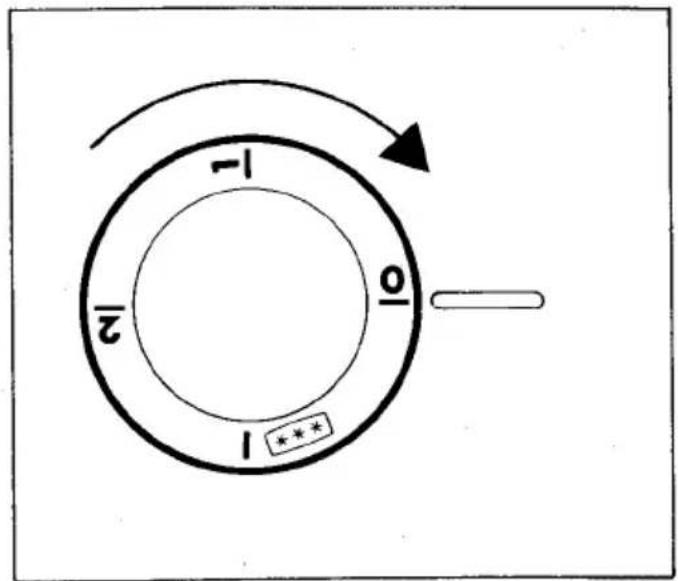
Fig. 1
The knob for temperature selection is located in the refrigerator compartment.
Setting "0" means: Off.
Rotation in direction "1": Lighting on, refrigerating unit on, the latter then operating automatically.
Setting "1" means:
highest refrigerating temperature, warmest setting.
Setting \*\*\* (end-Stop) means:
lowest refrigerating temperature, coldest setting.
a) For normal refrigeration without use of the freezer compartment, setting "1" should be selected. If you require a lower temperature, select setting "2" or the start of the "***" three-star range.
b) If you want to store frozen food or freeze fresh food in the freezer compartment, select setting "2" or the "***" three-star range.
Example: At a low ambient temperature of 16 °C, select the “***” three-star range. At a high ambient temperature of 25 °C, select a setting between “2” and “***”. At an ambient temperature of 32 °C, select setting “2”. On this setting, you can be sure that fresh food will be reliably frozen without it being too cold in the refrigerator compartment.
The ambient temperature, loading, and frequent door opening affect the internal temperature. When the setting is changed, the refrigerating unit does not start immediately if defrosting is then in progress.
Important note
High ambient temperature and too cold setting of the temperature regulator may lead to continuous operation of the refrigerating unit. Reset the temperature regulator to a warmer setting so that the refrigerating unit is regulated and the defrosting cycle of the refrigerator compartment evaporator automatically introduced.
Correct storage
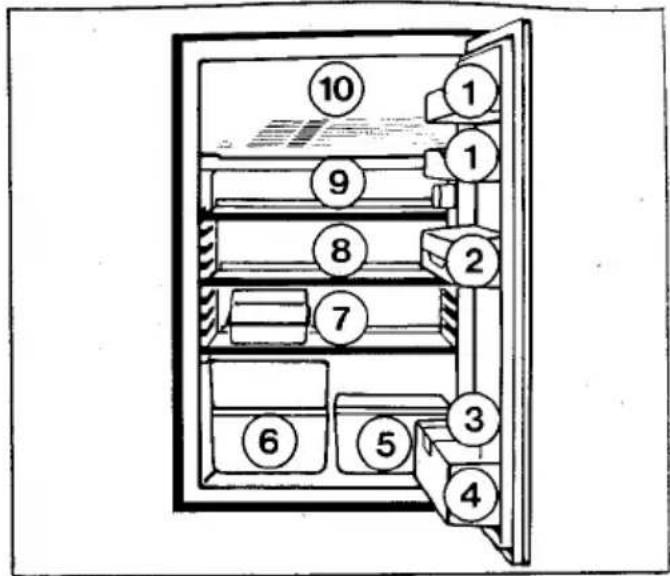
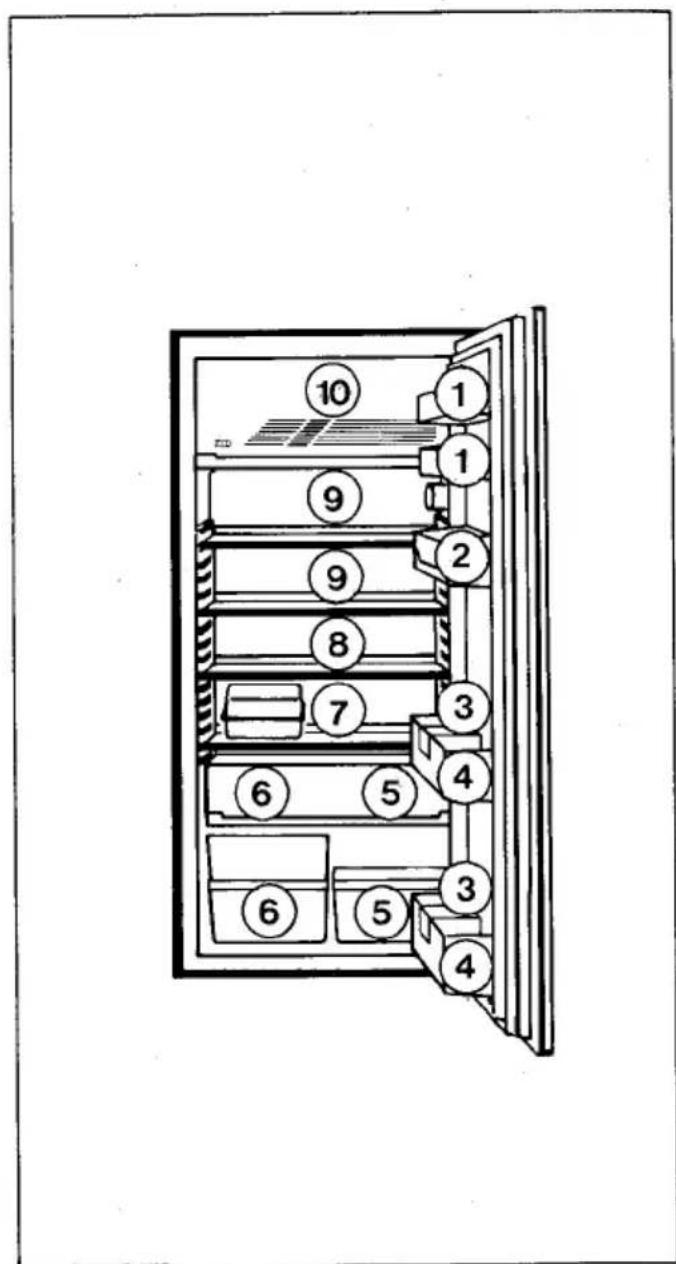
Figs. 2 and 3
① = Eggs, preserves
② = Butter, cheese
③ = Tubes
4 = Drinks
5 = Fruit
6 = Vegetables
⑦ = Meat, salami, cooked meats
⑧ = Dairy produce, margarine, preserves, marmelade
⑨ = Ready meals, baked goods, preserves
10 = Frozen food storage/freezing fresh food, ice-making
The ⚠️ mark tells you that frozen food can be stored in this compartment for several months.
The storage time depends on the type of food concerned (see manufacturer's instructions).
Smaller quantities of fresh food can also be frozen. See the section covering "Freezing fresh food and storing frozen food".
Low-temperature lock
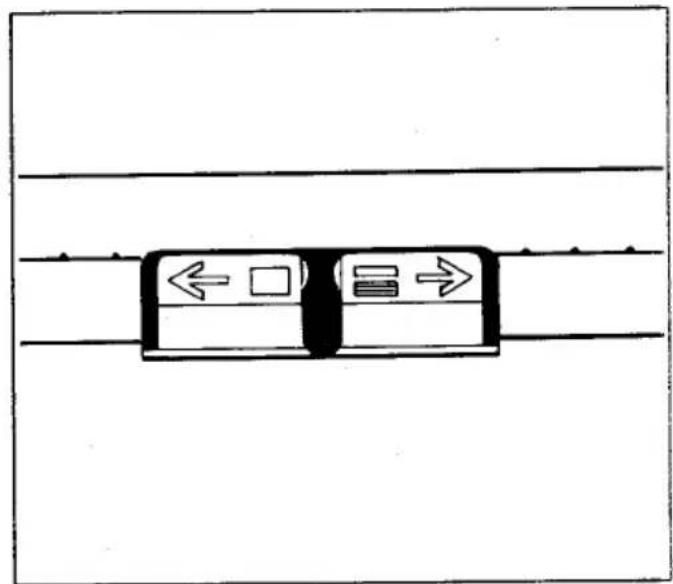
Fig. 4
On some larger models, the main refrigerator compartment can be subdivided by a low-temperature lock into a normal refrigerator compartment and cellar-temperature refrigerator compartment.
Slide to the right:
Ventilation slot closed, highest temperature, warmest setting in the cellar-temperature refrigerator compartment below.
Slide to the left:
Ventilation slot opened, lowest temperature, coldest setting in the cellar-temperature refrigerator compartment below. The temperature corresponds to the normal refrigerator compartment.
Important:
The cellar-temperature refrigerator compartment can be used to store easily perishable food.
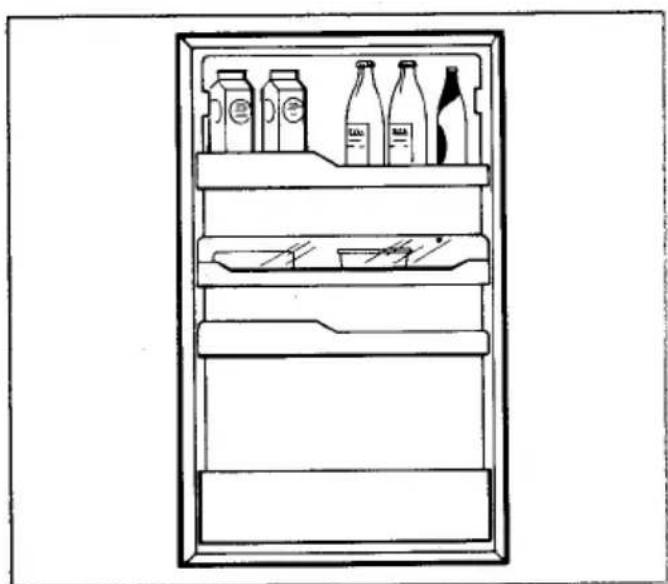
Variable inner door
Fig. 5
Depending on the type of food stored, the door racks can be placed in other holders.
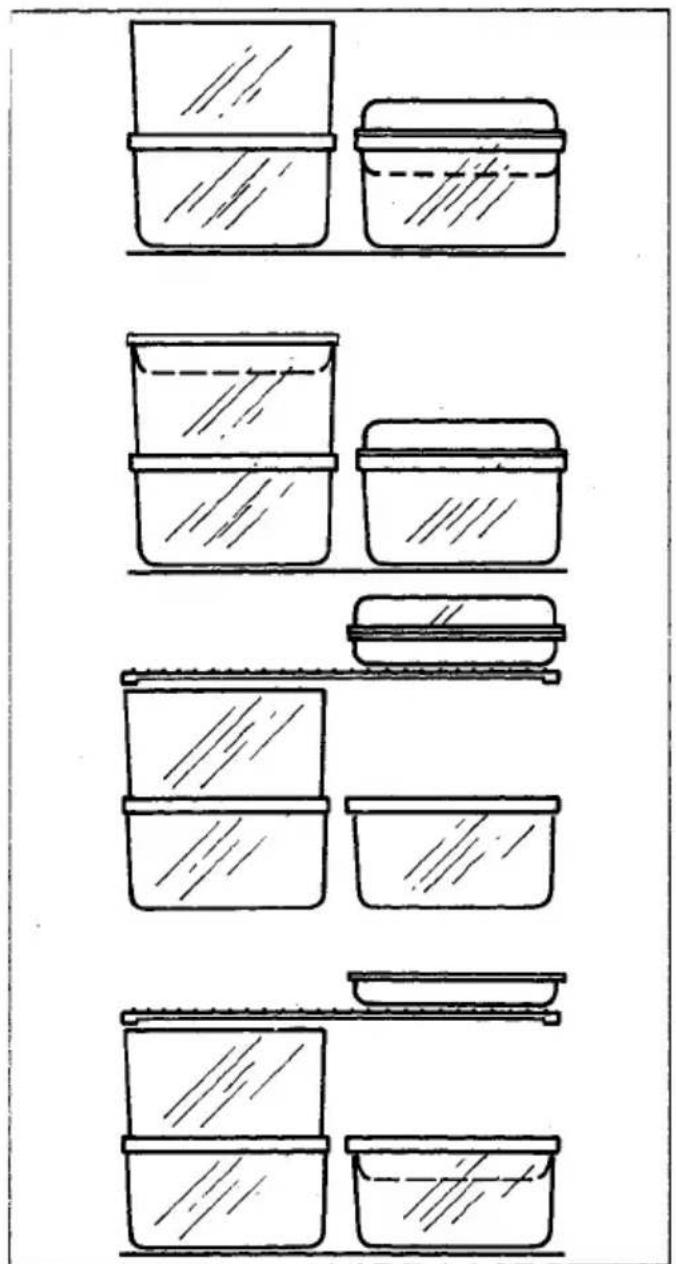
VARIO tray set
Fig. 6
Depending on model and features, your refrigerator is equipped with different trays allowing versatile combination. The half-trays can be individually or vertically stacked or used as a closed box. Smaller trays can be inserted in larger ones above and thus allow refrigerated food separation depending on type and size.
Clamping lugs for storage racks
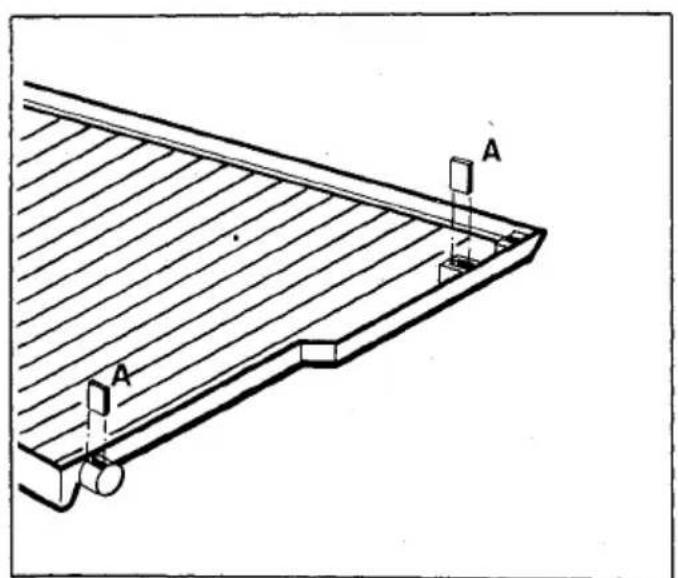
Fig. 7
Before arranging the storage racks in the correct height position, you should insert the clamping lugs (A) provided in the bag in the 4 appropriate pockets on the underside of the storage rack.
The clamping lugs ensure that the storage racks are snugly and safely supported.
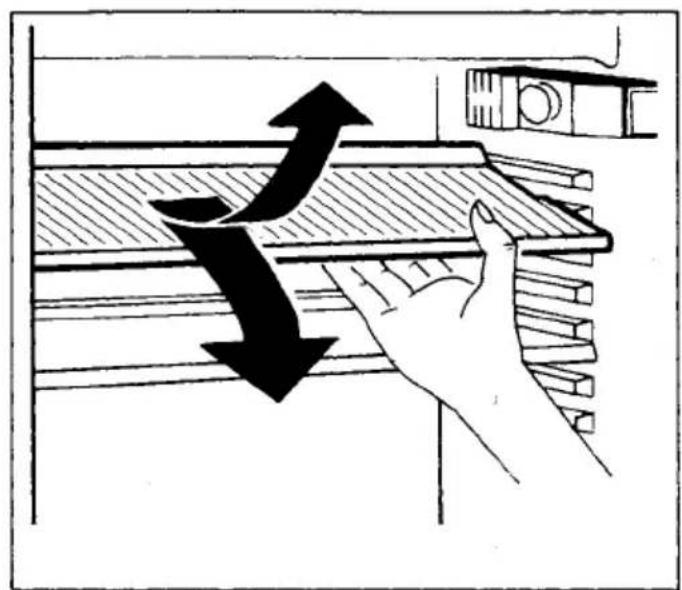
Inserting and adjusting the storage racks
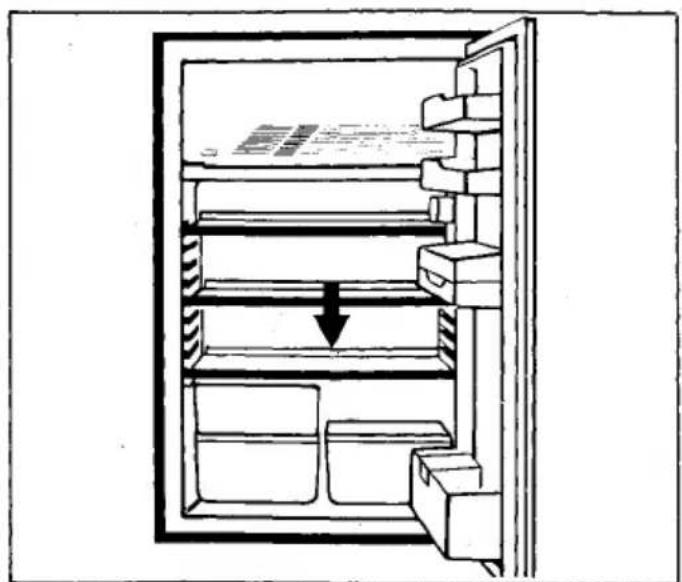
Fig. 8
One storage rack must be placed in the lowest guides above the fruit and vegetable trays.
If you want to adjust the distance between the storage racks, you should pull the storage rack slightly forwards until it can be swivelled upwards or downwards and removed (Fig. 8). To insert at another level, please proceed in the reverse sequence.
Freezing fresh food and storing frozen food in the star compartment
Before the freezer compartment is loaded with already frozen food (deep-frozen food) for the first time, the optimum storage temperature of -18^ must have been attained.
You can use the freezer compartment for freezing of fresh food yourself. Please observe the following instructions to be sure of obtaining the best results. Do not freeze too large a quantity at any one time (max. 1.5 kg per 24 h). The quality of the food is best preserved when it is frozen right through to the core as quickly as possible.
Packed food to be frozen should be placed on the floor of the freezer compartment directly on the refrigerating unit.
Take special care not to mix already frozen foods with those not yet frozen (minimum distance 4 cm)!
Tightly close the freezer compartment door.
A few useful hints before you start freezing
- Foodstuffs (with the exception of meat – see below) must be fresh, mature, and of superior quality. Only thus will you obtain really high-quality frozen food.
● Fruit and vegetables should be frozen as soon as possible after harvesting. Only thus will the nutrients, structure, consistency, colour, and flavour be retained.
● Meat/game must be hung sufficiently long before freezing.
● Always freeze foodstuffs cold or cooled.
● Foostuffs that have been defrosted or are starting to defrost should be immediately consumed, i.e. not refrozen, unless you intend to process the raw, defrosted food to make another dish. When cooked, defrosted food can be refrozen.
- Observe the storage time of max. 3 months, which should not be exceeded. When frozen food is stored, the manufacturer's storage time instructions must be followed.
- Do not leave the doors of the freezer compartment and refrigerator open unnecessarily long.
Avoid the following when storing and handling frozen food
With the exception of spirits and drinks containing a higher percentage of alcohol, beverages in glass bottles, particularly soft drinks containing carbon dioxide, juices, beer, wine, etc., should not be stored in the freezer. When the contents freeze, the glass bottles will crack or even burst.
Never handle deep-frozen food with wet hands. Your hands could easily become frozen to the food.
Icemaking
You can use the ice-tray to make ice-cubes in the freezer compartment.
Fill the ice-tray 34 full with cold water, place it in the freezer compartment, and allow it to freeze.
Never loosen the frozen-on ice-tray with sharp or pointed objects.
The ice-cubes can be easily loosened by twisting the ice-tray or by holding it briefly under running water.
Defrosting
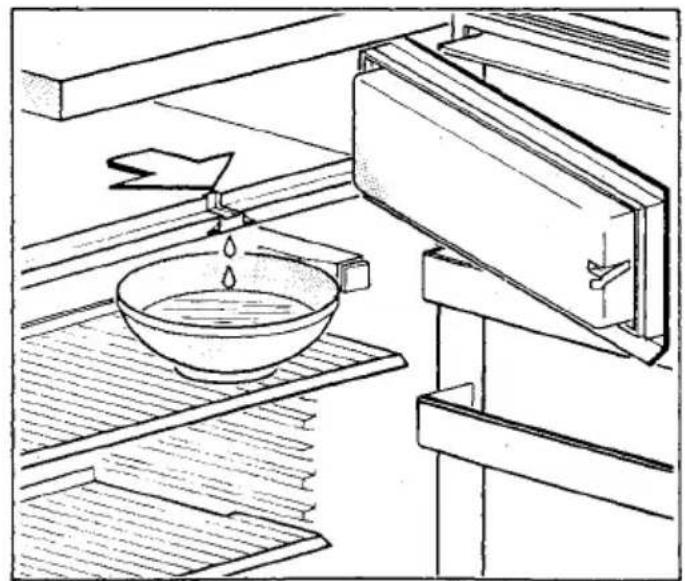
Fig. 9
The evaporator on the rear wall of the refrigerator compartment is defrosted fully automatically. The water automatically evaporates. Frost forming in the freezer compartment can be removed from time to time with a plastic scraper (never with a knife or similar sharp and pointed objects).
The three-star freezer compartment need not be defrosted very frequently. For this purpose, the appliance should be unplugged or otherwise disconnected from the mains supply (by removing the fuse) and the door left ajar.
During defrosting, wrap the frozen food in several layers of newspaper and store in a cool place.
For reasons of safety, never use additional heat sources for defrosting. Before defrosting starts, pull the upper storage rack slightly forwards and place a bowl underneath to collect the thaw water (Fig. 9).
When the layer of frost has melted, wipe the surfaces well dry.
Cleaning and care
Fig. 10
During cleaning, a refrigerator must basically not be connected to the mains supply (pull out the mains plug or remove the fuse).
Make sure that the drain opening of the drip gutter is always free. If it becomes choked, the thaw water cannot drain and freely evaporate and will run down on to the lower storage rack or under the fruit and vegetable tray. If the water drain opening becomes choked, it should be cleaned with the aid of a wire (Fig. 10).
Some organic solvents as well as essential oils (e. g. juice from lemon and orange peel, butyric acid) attack the plastic parts. Do not forget that, even in the refrigerator, food stored too long may spoil. To prevent any odours from forming, the contents should therefore be checked from time to time (including accessories) and thoroughly cleaned with lukewarm water to which a mild, non-abrasive detergent can be added. Finally, wash with clean water and wipe dry. After cleaning of the refrigerator compartment, promptly reconnect the appliance to the power supply (see section on Starting up).
When not in use
If your refrigerator is to remain unused for any length of time, it must be disconnected (unplugged) from the electricity supply.
The appliance should then be cleaned thoroughly and the appliance door left open to prevent any odours from forming.
Faults and servicing
To maintain the safety of your appliance, you should only have repairs, especially on live parts, performed by a trained electrician. In the event of a fault, please contact your retailer or the service centre direct.
Before calling the service centre, please check that the power supply is in order. Power supply faults will be rectified by your electrician.
In the event of appliance faults, please notify your nearest service centre promptly. To avoid unnecessary journeys and costs, please state the:
- model description
- E-number and
- F-number
of your appliance.
These indications are given on the rating plate inside your appliance on the LH side.
Important! Unjustified service centre calls must be paid for even during the guarantee period.
Minor repairs you can carry out yourself
- Interior lighting:
If the bulb is defective, you can easily change this yourself. To do this, unplug the appliance (or otherwise disconnect it, e.g. by removing the fuse). The bulb can be reached from the rear of the cover. Use only a 15 W spare bulb.
- Spare parts:
Spare parts can be ordered from the service centre. You can fit them yourself without any special skill or training.
For example
- Butter and cheese compartment
- Door racks and bottle compartment
- Egg holders
- Fruit and vegetable trays
- Storage racks
- Water on the storage rack or under the fruit and vegetable trays = clean thaw water drain opening (Fig. 10).
Hints on correct use
Store your food, depending on type and sensitivity, in the appropriate refrigerating zones. This will enable you to achieve an optimum storage duration (see "Correct storage"). Ensure good packaging or covering of the food to be stored in your refrigerator. This ensures that flavour, colour, moisture, and freshness are retained.
Clean the refrigerator space regularly. This ensures that your food is hygienically stored and that unwanted odours are avoided.
Never place hot food in your refrigerator for cooling.
Hints on energy-saving
Do not install your refrigerator next to a radiator or oven. Through high ambient temperature, the temperature regulator switches on the refrigerating unit more frequently and for longer.
Ensure good ventilation of your refrigerator. Never obstruct the ventilation slots.
Do not place any hot food in the freezer – first allow the food to cool to room temperature.
Do not open the doors unnecessarily and close it again as quickly as possible.
AEG Hausgeräte AG
Postfach 1036
D-90327 Nürnberg 1
© Copyright by AEG
H 271 268 000 - 0690/03 - 150
AEG Domestic Appliances Ltd
Customer Care Department
55-77 High Street
Slough
Berkshire SL1 1DZ
Telephone: 08705 350350