
Santo 1762-1i - Kühlschrank AEG - Kostenlose Bedienungsanleitung
Finden Sie kostenlos die Bedienungsanleitung des Geräts Santo 1762-1i AEG als PDF.


Benutzerfragen zu Santo 1762-1i AEG
0 Frage zu diesem Gerät. Beantworten Sie die, die Sie kennen, oder stellen Sie Ihre eigene.
Eine neue Frage zu diesem Gerät stellen
Laden Sie die Anleitung für Ihr Kühlschrank kostenlos im PDF-Format! Finden Sie Ihr Handbuch Santo 1762-1i - AEG und nehmen Sie Ihr elektronisches Gerät wieder in die Hand. Auf dieser Seite sind alle Dokumente veröffentlicht, die für die Verwendung Ihres Geräts notwendig sind. Santo 1762-1i von der Marke AEG.
BEDIENUNGSANLEITUNG Santo 1762-1i AEG
ÖKO_SANTO
2142 i / 2142 E, 1762 i,
1542 i / 1542 E
Build-In Refrigerators
Contents
Safety 24/25
Disposal 25
Appliance packaging information 25
Disposing of old appliances 25
Removing the transport packing 25
Installation 26
Choice of location 26
Your refrigerator needs air 26/27
Installation 28
Electrical connection 28
Appliance description 29
Preparing to start up 30
Starting up – Setting the temperature 30/31
Switching off your appliance 31
Accessories 32
Storage shelves 32
Tube holders/bottle antitilt feature 33
Correct storage 34/35
Automatic defrosting 35
Cleaning and care 36
Hints on energy-saving 37
If you think your refrigerator is not working properly 37/38
Changing the light bulb 38
Customer service 39
The sounds you may hear as your refrigerator operates 39
Regulations, standards, codes of practice 39
Technical terms 40

Safety
The safety of our refrigerators and freezers conforms to accepted rules of technology and the Appliance Safety Act. We as manufacturers, however, see ourselves as being obliged to familiarise you with the following safety instructions.
Using your refrigerator properly
☐ Your refrigerator is intended for domestic use. It is suitable for refrigeration of food. If your appliance is misused or used for any purposes other than that for which it is intended, the manufacturer cannot be held liable for any damage caused.
☐ For reasons of safety, it is unacceptable to convert or modify your refrigerator in any way.
☐ Should you use your refrigerator commercially or for any purposes other than refrigeration of food, please follow the statutory regulations valid in your area.
Before using your refrigerator for the first time
☐ Check your refrigerator for transport damage. Never connect a damaged appliance! If your refrigerator is damaged, please contact your specialist retailer.
☐ When transporting and installing your appliance, make sure that no parts of the refrigerant circuit are damaged.
Child safety
☐ Packaging parts (e. g. foils, styrene foam) may be dangerous for children, who could even be suffocated! You should therefore keep all packaging well away from children.
Before throwing away any appliances that have reached the end of their service lives, you should first make them unserviceable. Pull out the mains plug, cut the mains lead, and remove or destroy any snap catch or locks that are fitted. In this way, you can prevent children locking (and even suffocating) themselves in such appliances when playing and thus endangering their lives!
□ Children may not recognise the dangers of improper use of electrical appliances. You should therefore ensure proper supervision during operation and not allow your children to play with your refrigerator.
Your refrigerator in day-to-day use
□ Containers with flammable gases or liquids may be rendered untight by the effect of low temperature. They may even explode! Never store containers with flammable substances, such as e. g. spray cans, cigarette lighter refill cartridges, etc., in your refrigerator
☐ Never operate any electrical appliances (e. g. electric ice-makers, mixers, etc.) in your refrigerator.
Before cleaning your appliance, you should basically switch it off and unplug it from the electricity supply. Alternatively, switch off or unscrew the house fuse.
☐ Never pull the plug out of the plug socket by the supply lead, but by the plug itself.
Should your appliance ever have a fault, please first consult these operating instructions under "If you think your refrigerator is not working properly". If the hints given there are of no help to you, do not make any further adjustments yourself.
☐ Refrigerator and freezer repairs should only be performed by trained personnel. Improper repairs may seriously endanger the user. If your refrigerator needs to be repaired, you are recommended to contact your specialist retailer or our service centre.
Disposal
Appliance packaging information
All used packaging materials are environmentally compatible and can be safely disposed of or incinerated in a refuse incinerator!
Among the materials used, the plastic parts can also be recycled, being marked as follows:
PE< for polyethylene, e.g. on the outer casing and the bags inside
PS< for polystyrene foam, e.g. padding (basically CFC-free)
The cardboard parts are made of waste paper and should also be handed to your waste paper collection centre.
Disposing of old appliances
To protect the environment, refrigerators and freezers must be properly disposed of. This applies to your previous machine as well as to your new appliance when it one day reaches the end of its lifespan.
Caution! Before throwing away any appliances that have reached the end of their service lives, you should first make them unserviceable. Pull out the mains plug, cut the mains lead, and remove or destroy any snap catch or locks that are fitted. In this way, you can prevent children locking (and even suffocating) themselves in such appliances when playing and thus endangering their lives!
Removing the transport packing
The appliance and all accessories are protected for transport.
☐ The appliance door is secured with adhesive tapes. Depending on model, plastic seal protection parts or a polystyrene foam pad is inserted between the appliance door and housing. Please remove these parts.
Tip: Remove any adhesive tape residues with a suitable petroleum-based cleansing agent.
Installation
Choice of location
Your refrigerator should be installed in a well-ventilated, dry room. The ambient temperature has an effect on the power consumption. Your appliance should therefore
- not stand in the direct sunshine;
- not stand near radiator elements, a cooker, or other heat sources;
- only stand in a position where the ambient temperature corresponds to the climate category for which the appliance is designed.
The climate category is indicated on the rating plate located on the left inside your appliance (Fig. 2a/2b/2c).
The following table shows you which ambient temperature matches which climate category:
| Climate category | For ambient temperature of |
| SN | +10 to +32 °C |
| N | +16 to +32 °C |
| ST | +18 to +38 °C |
| T | +18 to +43 °C. |
Your refrigerator needs air
Integratable models (i-appliances)
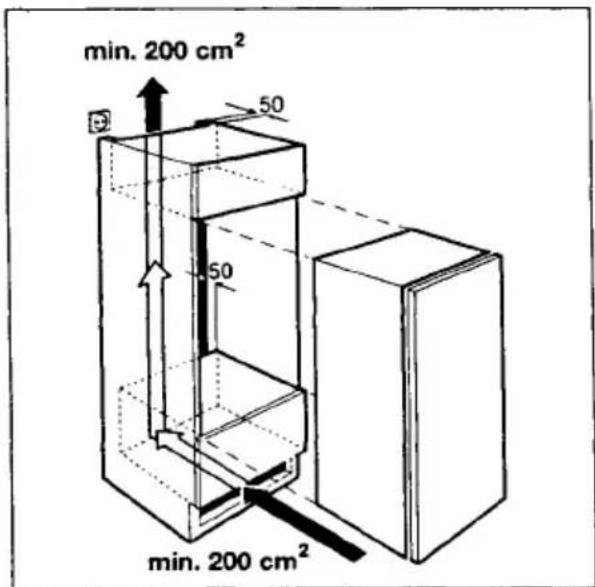
The integrated door of the furniture cabinet largely seals the installation recess. i-appliances must therefore be provided with ventilation by having an opening in the furniture plinth, as shown in Fig. 1a. The warmed air must be able to be exhausted upwards through the air shaft on the furniture back. The ventilation cross-sections should be at least 200 cm² (Fig. 1a).
Important note! In order not to impair the function of the appliance, never cover or obstruct the ventilation openings.
text_image
min. 200 cm² 50 50 min. 200 cm²Fig. 1a
Models fitted for matching front panel (E-appliances)
Installation option 1 (optimum):
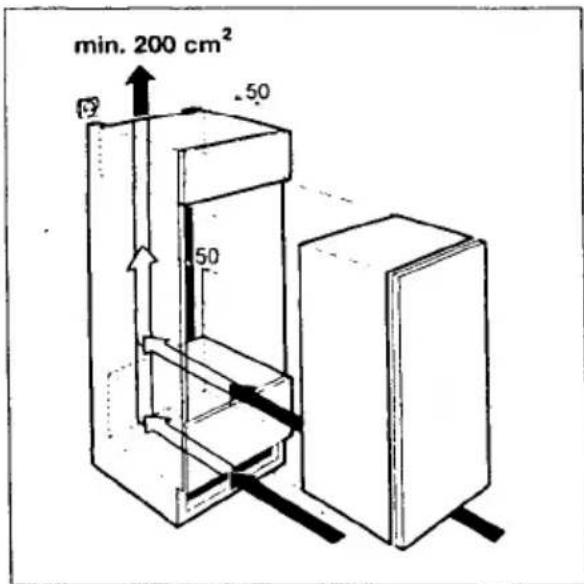
Optimum ventilation of E-appliances is ensured through fresh air being able to enter both under the appliance as well as through an opening in the furniture plinth (Fig. 1b). The warmed air must be able to be exhausted upwards through the air shaft (min. 200cm^2 ) on the furniture back.
text_image
min. 200 cm² 50 50Fig. 1b
Installation option 2:
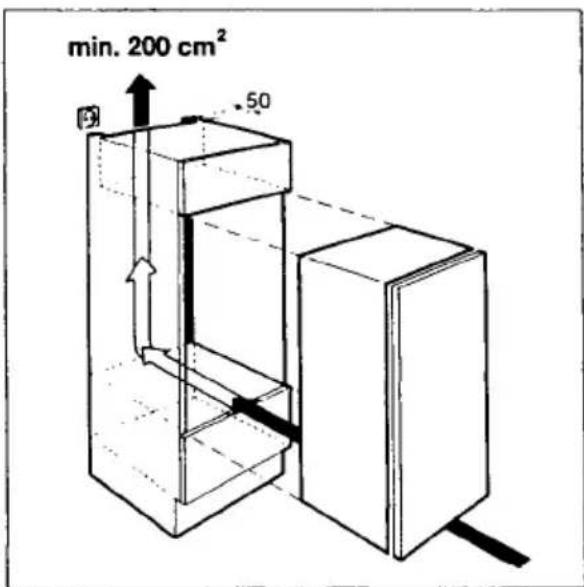
Operation of E-appliances is possible even without a ventilation opening in the furniture plinth. The fresh air able to enter under the appliance is sufficient for ventilation (Fig. 1c). The function and life of the appliance are not impaired. The warmed air must be able to be exhausted upwards through the air shaft (min. 200cm^2 ) on the furniture back. If the appliance is ventilated without a plinth opening, however, the energy consumption may differ from that specified in the brochure.
text_image
min. 200 cm² 50Fig. 1c
Important note! In order not to impair the function of the appliance, never cover or obstruct the ventilation openings.
Installation
Installation
See installation instructions supplied.
Please check whether, after installing your appliance and especially after rehingeing the door, the door seal seals right round. An untight door seal may lead to heavy frosting and thereby to a higher power consumption (see also "If you think your refrigerator is not working properly").
Electrical connection
WARNING - THIS APPLIANCE MUST BE EARTHED
Please ensure that the voltage and current indicated on the rating plate agree with the voltage of your electricity supply.
220/240 volts (i. e. 220/240 V AC).
If your appliance has been equipped with a mains lead with a moulded-on type plug, you must comply with the following regulations: The plug moulded on to the cord incorporates a fuse. For replacement, use a 13 amp BS 1362 fuse. Only ASTA approved or certified fuses should be used. The fuse cover/ carrier must be replaced in the event of changing the fuse. The plug must not be used if the fuse cover/carrier is lost. A replacement cover/carrier must be obtained from an electrical goods retailer. If the socket outlets in your home are not suitable for the plug fitted to the appliance, then the plug must be cut off and an appropriate one fitted. When fitting the plug please note the following points:
Important
The wires in the mains lead are coloured in accordance with the following code:
Green and Yellow Earth
Blue Neutral
Brown Live
As the colours of the wires in the mains lead of this appliance may not correspond with the coloured markings identifying the terminals in your plug, proceed as follows:
- The wire which is coloured green and yellow must be connected to the earth terminal in your plug, which is marked with the letter E or by the earth symbol ↓ or coloured green, or green and yellow.
- The wire which is coloured brown must be connected to the live terminal which is marked with the letter L or coloured red.
- The wire which is coloured blue must be connected to the neutral terminal which is marked with the letter N or coloured black.
When wiring the plug, ensure that all strands of wire are securely retained in each terminal. Do not forget to tighten the mains lead clamp on the plug.
Warning! A cut-off plug inserted into a 13 amp socket is a serious safety (shock) hazard. Ensure that the cut-off plug is disposed of safely.
Voltage 220/240 V AC
Fuse rating 13 amps
See rating plate for further information.
The rating plate is inside, on the left.
Appliance description
text_image
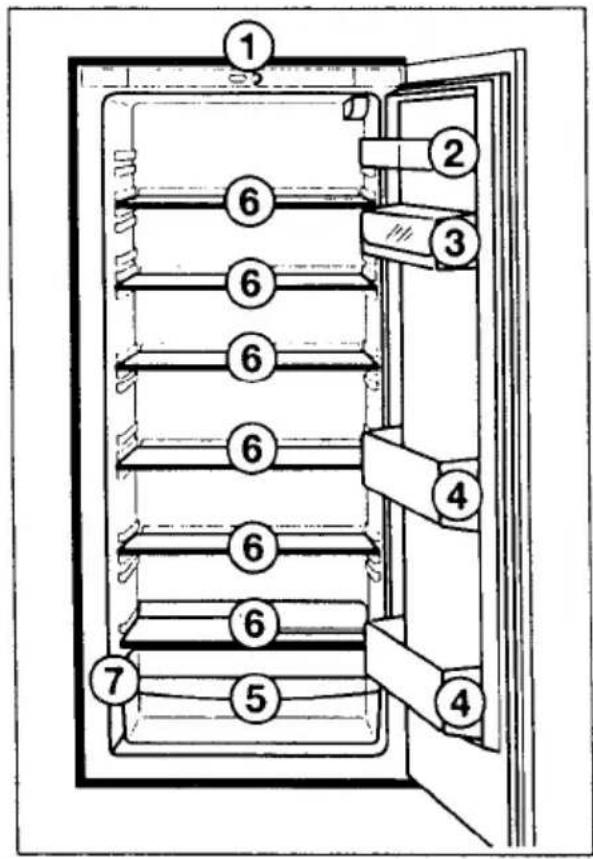
Diagram of a refrigerator interior with numbered compartments for identificationFig. 2a: ÖKO_SANTO 2142 i/2142 E
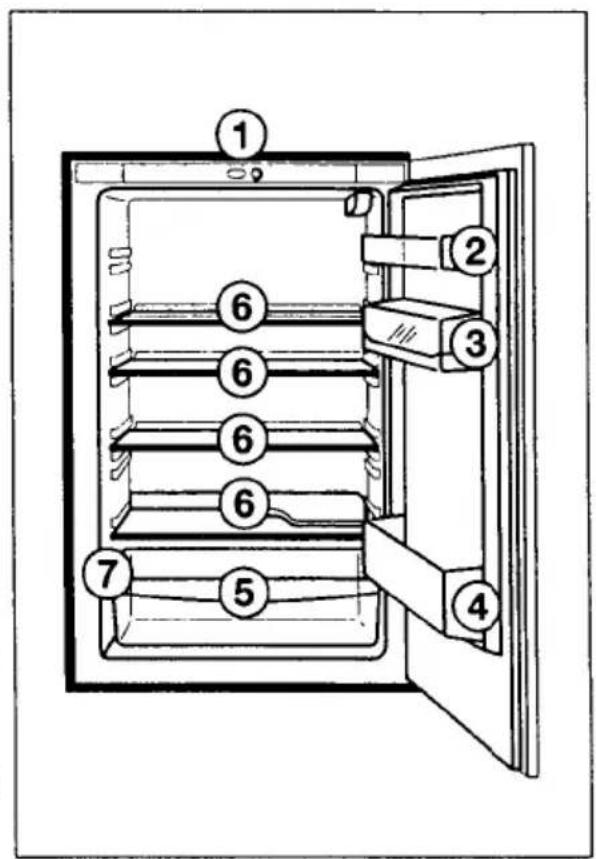
text_image
Diagram of a refrigerator interior with numbered compartments and door, showing front, back, and side views.Fig. 2c: ÖKO_SANTO 1542 i/1542 E
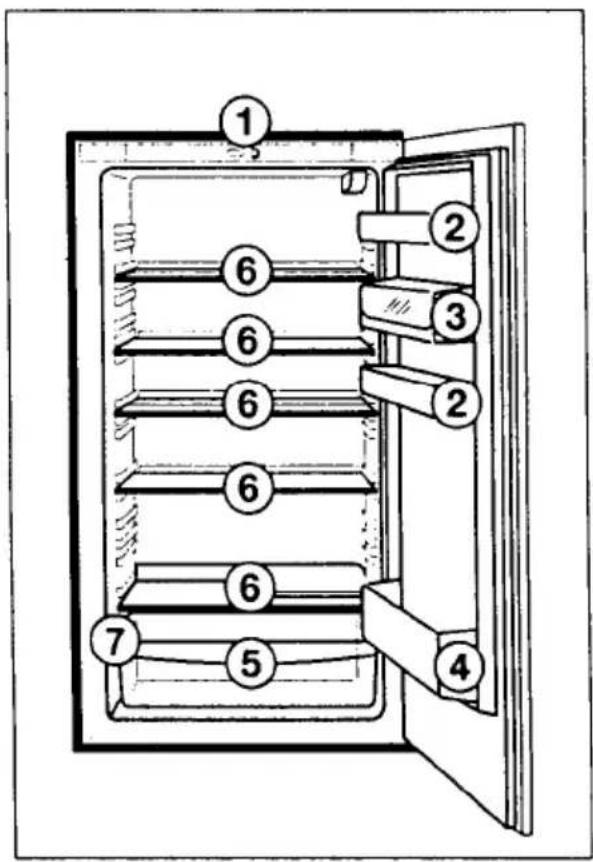
text_image
Diagram of a refrigerator interior with numbered compartments and door, showing front and back views.Fig. 2b: ÖKO_SANTO 1762 i
① Temperature regulator
② Door rack
③ Butter/cheese compartment with flap
④ Bottle holder
⑤ Fruit/vegetable tray
⑥ Storage shelves
⑦ Rating plate
Preparing to start up
Like all new appliances, your refrigerator will smell "new". For this reason, the interior and exterior of your refrigerator as well as all accessories should be cleaned before use (see "Cleaning and care").
Starting up – Setting the temperature
The temperature regulator (Fig 3/2) also doubles as the ON/OFF switch.
The large oval switch (Fig. 3/1) beside the temperature regulator is the light switch. When the door is opened and closed, the light switch turns the internal lighting on or off.
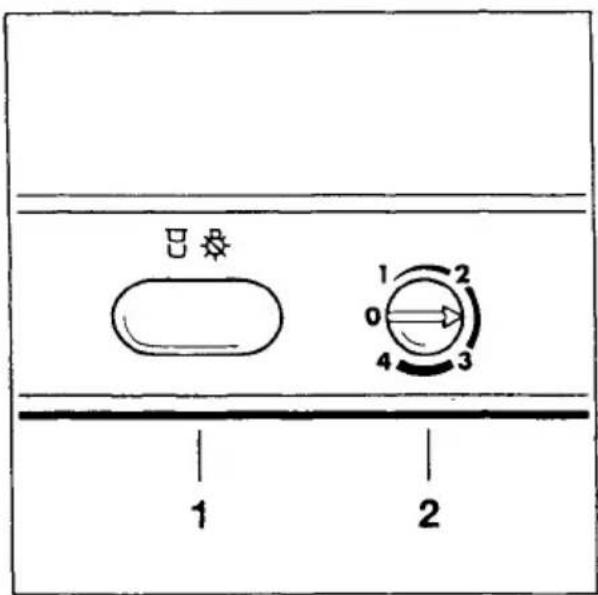
text_image
1 2 1 2 0 4 3Fig. 3
You need a coin to turn the temperature regulator. This makes any inadvertent adjustment of the temperature setting difficult (child safety).
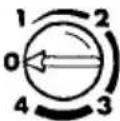
The position of the temperature regulator shown opposite means: refrigeration OFF
Turning in direction "1": refrigeration ON, compressor starts and then operates automatically.
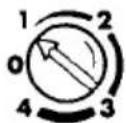
Position "1" means: highest internal temperature (warmest setting)
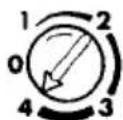
Position "4" means: lowest internal temperature (coldest setting)
☐ Plug your appliance into the electricity supply. The internal lighting comes on when the door is opened.
Now turn the temperature regulator to a medium position between "2" and "3". The compressor starts and then operates automatically.
Important: On a setting between "2" and "3", an average temperature of around +5 °C is established. This applies to ambient temperatures of +10 °C to +38 °C.
☐ If you want a higher or lower temperature, turn the temperature regulator to a warmer or colder setting.
Important note: The following factors decisively affect the internal temperature:
- ambient temperature;
- quantity of food stored;
- frequent or prolonged door opening.
Important!
A high ambient temperature (e.g. on hot summer days) and cold setting of the temperature regulator (position "3" to "4") may lead to continuous operation of the compressor.
Reason: The compressor must run continuously to maintain the low temperature in your machine at a high ambient temperature. The refrigerator compartment does not then defrost any longer, since automatic defrosting of the refrigerator compartment is possible only when the compressor has stopped (see also "Automatic defrosting"). This results in heavy frosting on the refrigerator compartment wall.
In this case, reset the temperature regulator to a warmer setting (position "2" to "3"). On this setting, the compressor regulation takes place and the defrosting process is automatically restarted.
Switching off your refrigerator
To switch off the refrigeration system, turn the temperature regulator to position "0".
☐ If the door is to remain open thereafter, switch off the internal lighting by retracting the oval light switch (Fig. 3/1).
Important: The light switch is withdrawn back in place as soon as the door is closed. When the door is next opened, the light switch switches on the lighting again.
Should your appliance be left unused for any length of time:
☐ Switch off the refrigeration system and unplug the appliance or switch off or unscrew the fuse.
☐ Thoroughly clean the inside space (see "Cleaning and care").
☐ Then leave the door ajar to prevent odours from forming.
Accessories
Storage shelves
The moulded storage shelf must always be placed in the lowest guides above the fruit and vegetable tray so that fruit and vegetables retain their freshness for a prolonged period.
The other storage shelves are height-adjustable:
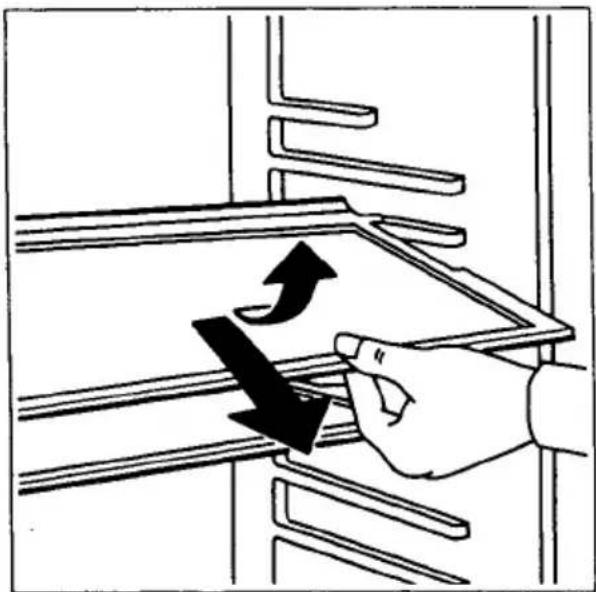
☐ To do this, pull the storage shelf slightly forwards until it can be swivelled upwards or downwards and removed (Fig. 4).
☐ To insert at another level, please proceed in the reverse sequence.
natural_image
Illustration of a hand holding a tablet with a black arrow indicating direction (no text or symbols)Fig. 4
Adjusting for tall items:
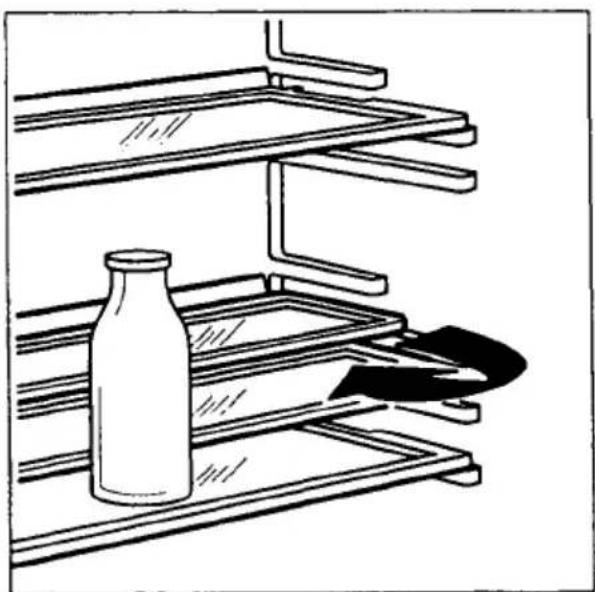
☐ Pull out the front half of the two-piece Vario storage shelf and slide it into another level (Fig. 5). You will thus gain the necessary space to store tall items on the shelf below.
natural_image
Line drawing of a shelf with a bottle and an arrow pointing to it (no text or symbols)Fig. 5
Tube holder/bottle antitilt feature
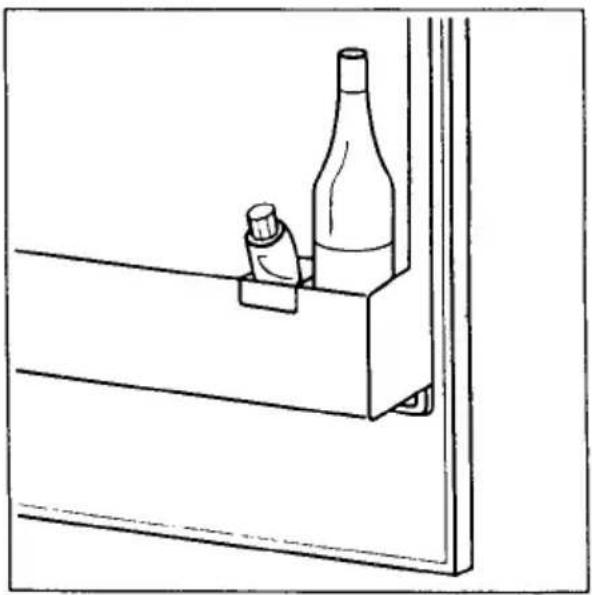
Some models are equipped with a holder for tubes and small items. When inserted in the bottle holder, the tube holder also doubles as an antitilt feature for individual bottles (Fig. 6).
natural_image
Line drawing of a wall-mounted shelf with two bottles, one partially submerged in a container (no text or symbols)Fig. 6
Correct storage
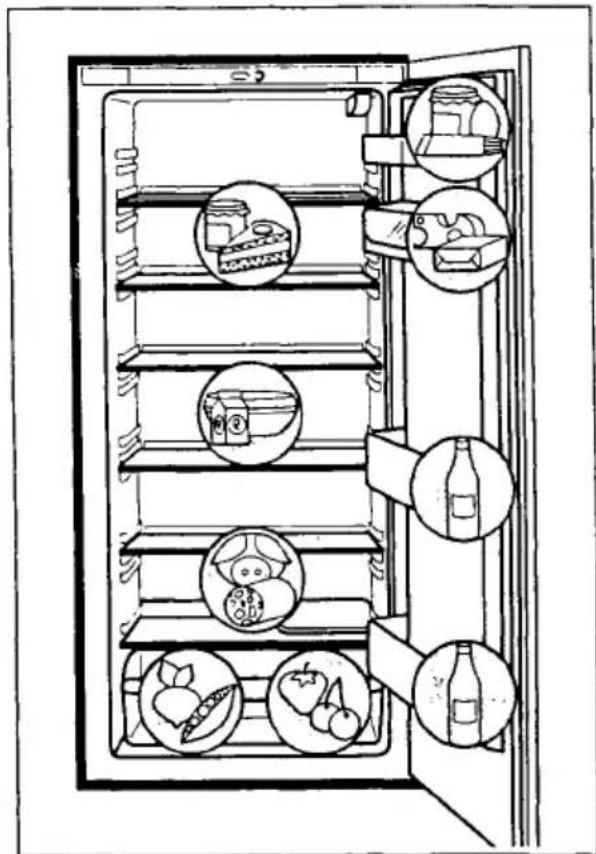
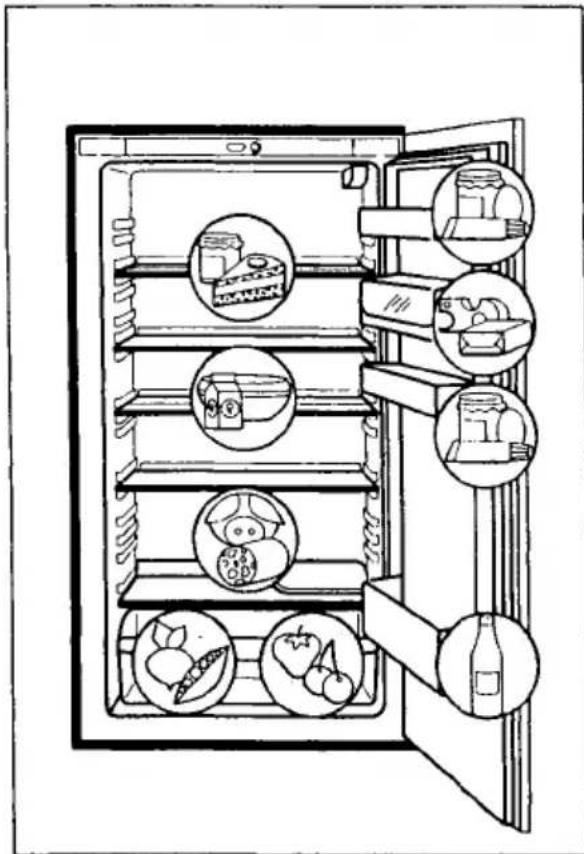
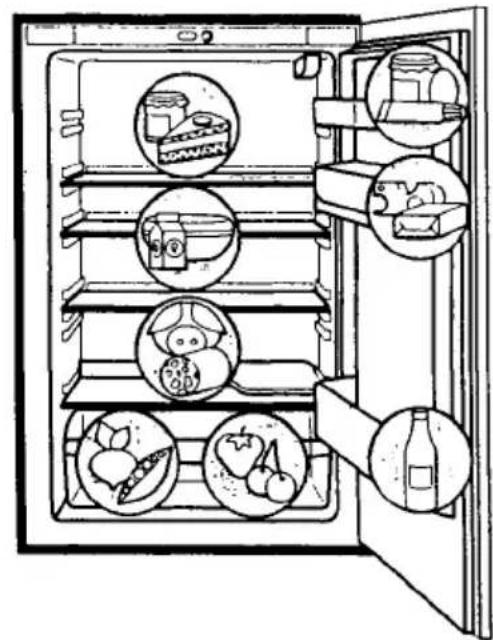
For physical reasons, the refrigerator compartment has different temperature zones. The coldest zone is on the lowest storage shelf above the fruit and vegetable tray. Warmer zones are the upper storage shelves and door racks. The arrangement examples in Figs. 7a, 7b and 7c show the refrigerator compartment position at which suitable temperatures for different types of food are available.
text_image
Diagram of a refrigerator interior with labeled compartments including food, bottles, and utensilsFig. 7a: ÖKO_SANTO 2142 i/2142 E
text_image
Diagram of a refrigerator with labeled food compartments showing various items inside and outside the door.Fig. 7b: ÖKO_SANTO 1762 i
text_image
Diagram of a refrigerator interior with labeled food compartments including snacks, beverages, and fruitFig. 7c: ÖKO_SANTO 1542 i/1542 E
Tip: Foods stored in the refrigerator compartment should always be covered or packed so that they do not dry out, lose their flavour, or transfer their flavour to any other refrigerated food.
The following are suitable for packing:
- polyethylene freshness bags and foil;
- plastic containers with lids;
- special plastic covers with rubber retainers;
- aluminium foil.
Automatic defrosting
The back wall of the refrigerator compartment gets encrusted with frost while the compressor is running and defrosts fully automatically while the compressor is at a standstill.
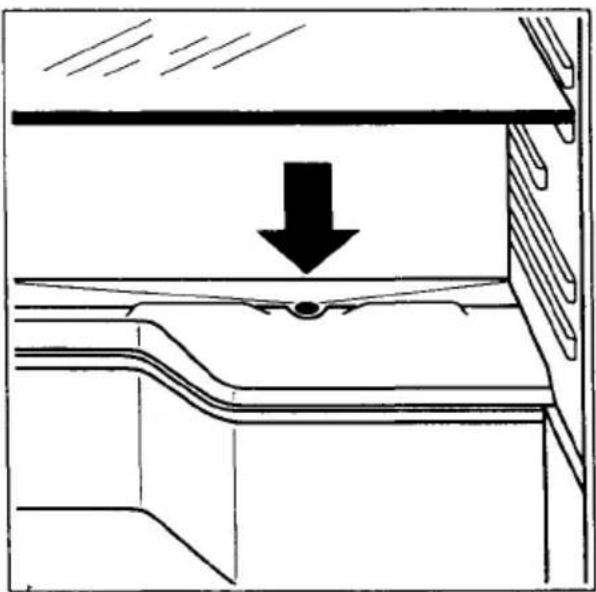
The meltwater is collected in the gutter transferred through the drain hole (Fig. 8), into the collector on the compressor, and there evaporated.
Cleaning and care
Caution!
- During cleaning, your appliance must basically not be connected to the electricity supply. Danger of electric shock! Before undertaking any cleaning work, pull out the mains plug or switch off or unscrew the fuse.
- For reasons of safety, your appliance should basically not be cleaned with steam cleaning appliances. Moisture could find its way into the electrical components, and hot steam could damage the plastic parts.
- Your appliance must be thoroughly dry before you restart it.
Important!
- Some organic solvents attack plastic parts. Such substances may be contained in food (e.g. juice from lemon or orange peel, butyric acid) or in cleansing agents containing acetic acid. Make sure that the appliance parts do not come into contact with such substances.
- Never use any abrasive cleansing agents.
For reasons of hygiene, the inside of the appliance, including accessories, should be cleaned regularly.
☐ Take out the refrigerated food and store it covered in a cool place.
☐ Defrost the appliance and pull out the mains plug or switch off or unscrew the fuse.
☐ After defrosting, thoroughly clean the inside of your refrigerator and all accessories with a clean cloth and lukewarm water. Add some commercial washing-up liquid as necessary. Finally rinse with clean water and wipe well dry.
☐ Check the meltwater drain hole on the back of the refrigerator compartment (Fig. 8). If the meltwater drain hole is clogged, free it with a wire.
natural_image
Technical line drawing of a mechanical component with a downward arrow indicating force or direction (no text or symbols)Fig. 8
☐ When all parts are thoroughly clean and dry, restart your appliance.
Hints on energy-saving
☐ Do not stand your appliance near cookers, radiators, or other heat sources. At a high ambient temperature, the compressor runs more frequently and for longer.
☐ Ensure good ventilation of your appliance. Never obstruct the ventilation openings.
☐ Let warm food cool before placing it in your refrigerator.
Leave the door open only as long as necessary.
☐ Do not set the temperature colder than necessary.
If you think your refrigerator is not working properly
The fault may possibly refer only to a small defect which you can rectify yourself on the basis of the following instructions. Do not make any further adjustments yourself if the information given below is of no help to you in any specific case.
Caution! Refrigerator and freezer repairs should only be performed by trained personnel. Improper repairs may seriously endanger the user. If your refrigerator needs to be repaired, you are recommended to contact your specialist retailer or our service centre.
| Fault | Possible causes/remedy |
| The appliance does not work | - The temperature regulator is on position "0".- The appliance is not plugged in, or the plug is loose.- The fuse has blown or is not switched on/ screwed in.- The plug socket is defective. Your electrician will rectify power supply faults. |
| The food is too warm | - The temperature setting is too warm. Turn the temperature regulator to a colder setting.- The door has been open for a prolonged period, or your refrigerator has been loaded with large quantities of fresh food. Temporarily turn the temperature regulator to a colder setting. Do not forget to reset it later! |
| The appliance is refrigerating too strongly | - The temperature is set too cold. Turn the temperature regulator to a warmer setting. |
| The compressor continuously operates | - You may possibly have set the temperature too cold. At a high ambient temperature, this may lead to continuous operation of the compressor. See "Starting up - Setting the temperature". |
| When the temperature setting is changed, the compressor does not start immediately. | - This is normal. No fault has occurred. The compressor will start after a while. |
| Water on the refrigerator compartment floor or storage shelves | - The meltwater drain hole is clogged. See "Cleaning and care". |
If you think your refrigerator is not working properly
| Fault | Possible causes/remedy |
| Heavy frosting in the appliance, possibly meltwater on storage shelves | - The door has been left ajar for a long time.- The door seal is untight (possibly after the door being rehinged). Remedy: Carefully warm the untight areas of the door seal with a hair dryer (not warmer than 50°C). Simultaneously shape the warmed door seal with your hand so that it bears properly again.- See also “The compressor continuously operates”. |
| Unusual sounds | - The accessories are not properly in position.- A part, such as e.g. a tube on the back of your appliance, is touching another appliance part or the wall.Carefully bend away this part as necessary. |
Changing the light bulb
If the bulb of the interior lighting is defective, you can easily replace this yourself.
Caution! Danger of electric shock! Before changing the light bulb, unplug the appliance or switch off or unscrew the fuse.
Light bulb data: 220–240 V, max. 15 W, holder: E 14
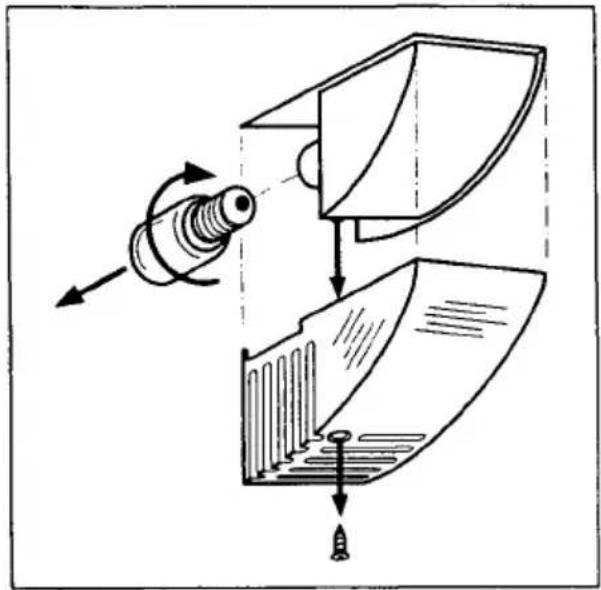
☐ To change the light bulb, loosen the Phillips screw and detach the light bulb cover downwards (Fig. 9).
☐ Change the defective light bulb.
☐ Refit the light bulb cover and fix the Phillips screw.
natural_image
Diagram of a mechanical device with rotating components and directional arrows, no text or symbols presentFig. 9
Customer service
If your refrigerator has a fault and you find no remedy in these operating instructions, please contact your specialist retailer or our service centre direct.
To avoid unnecessary journeys and costs, please state the:
model designation ....
product number (E-No.)
serial number (F-No.)
of your appliance.
These indications are given on the rating plate inside your appliance on the LH side. You are recommended to enter the numbers here to have them handy.
Important: Unjustified service centre calls must be paid for even during the guarantee period.
The sounds you may hear as your refrigerator operates
The following sounds are characteristic of refrigerators and freezers:
Clicking Whenever the regulator switches the compressor on or off, you will hear a clicking sound.
Humming As soon as the compressor starts, you will hear a humming sound.
Bubbling or splashing When the refrigerant flows into thin tubes, you may hear a bubbling or splashing sound. Even when the compressor switches off, this sound remains audible for some while.
Regulations, standards, codes of practice
Your refrigerator is intended for domestic use and has been manufactured in accordance with the standards valid for these appliances.
During manufacture, the necessary measures have been taken notably as required by the Appliance Safety Act (GSG), the Accident Prevention Regulations for Refrigerating Installations (VBG 20), and the Specifications of the Institute of German Electrical Engineers (VDE). The refrigeration circuit has been checked for leakage.
CE This appliance complies with the following EC Directives:
- 73/23/EEC of 19.02. 1973 - Low-Voltage Directive
- 89/336/EEC of 03. 05. 1989 (including Amendment Directive 92/31/EEC)
- EMC (Electromagnetic Compatibility) Directive.
Technical terms
| Refrigerant | Liquids that can be used for refrigeration are called refrigerants. They have a relatively low boiling point, so low that the heat of the food stored in the refrigerator or refrigerator can cause the refrigerant to boil or evaporate. |
| Refrigerant circuit | Closed circuit containing the refrigerant. The refrigerant circuit basically consists of evaporator, compressor, condenser, and tubing. |
| Evaporator | The refrigerant evaporates in the evaporator. Like all liquids, refrigerant needs heat to evaporate. This heat is extracted from the space inside the appliance, which is thereby cooled. The evaporator is therefore arranged inside the appliance or foam-insulated just behind the inside wall and thus not visible. |
| Compressor | The compressor looks like a small barrel. It is driven by an inbuilt electric motor, being arranged in the appliance base at the back. The compressor's function is to extract gaseous refrigerant from the evaporator, to compress it, and to transfer it to the condenser. |
| Condenser | The condenser mostly has the shape of a grille. The condenser condenses the refrigerant compressed by the compressor. This liberates heat that is dissipated across the surface of the condenser to the ambient air. The condenser is therefore arranged on the outside, mostly on the back of the appliance. |
AEG Hausgeräte AG
Postfach 1036
D-90327 Nürnberg 1
© Copyright by AEG
H 271 283 800 - 0197 / 03-150
AEG Domestic Appliances Ltd
Customer Care Department
55-77 High Street
Slough
Berkshire SL1 1DZ
Telephone: 08705 350350