Lavamat Domina SL w - Waschmaschine AEG - Kostenlose Bedienungsanleitung
Finden Sie kostenlos die Bedienungsanleitung des Geräts Lavamat Domina SL w AEG als PDF.


| Produkttyp | Waschmaschine |
| Marke | AEG |
| Modell | Lavamat Domina SL w |
| Füllmenge | 5 kg |
| Höhe | 85 cm |
| Breite | 60 cm |
| Tiefe | 55 cm |
| Gewicht | ca. 65 kg |
| Anschlussspannung | 230 V / 50 Hz |
| Anschlussleistung | 2000 W |
| Schleuderdrehzahl | 1200 U/min |
| Energieeffizienzklasse | B |
| Wasserverbrauch pro Waschgang | ca. 45 Liter |
| Geräuschpegel (Schleudern) | 76 dB(A) |
| Programme | Baumwolle, Pflegeleicht, Feinwäsche, Schnell/Mix, Wolle, Spülen, Schleudern, Abpumpen |
| Zusatzfunktionen | Startzeitvorwahl, Kindersicherung, Schaumerkennung, Unwuchtkontrolle |
| Flusensieb | Ja, regelmäßig reinigen |
| Waschmittelschublade | 3-Kammer-System (Vorwäsche, Hauptwäsche, Weichspüler) |
| Notentleerung | Notentleerungsschlauch vorhanden |
| Transportsicherung | Vor Inbetriebnahme entfernen |
| Ersatzteile | Erhältlich über AEG Kundenservice oder Fachhändler |
Häufig gestellte Fragen - Lavamat Domina SL w AEG
Benutzerfragen zu Lavamat Domina SL w AEG
0 Frage zu diesem Gerät. Beantworten Sie die, die Sie kennen, oder stellen Sie Ihre eigene.
Eine neue Frage zu diesem Gerät stellen
Laden Sie die Anleitung für Ihr Waschmaschine kostenlos im PDF-Format! Finden Sie Ihr Handbuch Lavamat Domina SL w - AEG und nehmen Sie Ihr elektronisches Gerät wieder in die Hand. Auf dieser Seite sind alle Dokumente veröffentlicht, die für die Verwendung Ihres Geräts notwendig sind. Lavamat Domina SL w von der Marke AEG.
BEDIENUNGSANLEITUNG Lavamat Domina SL w AEG
AEG
Operating Instructions
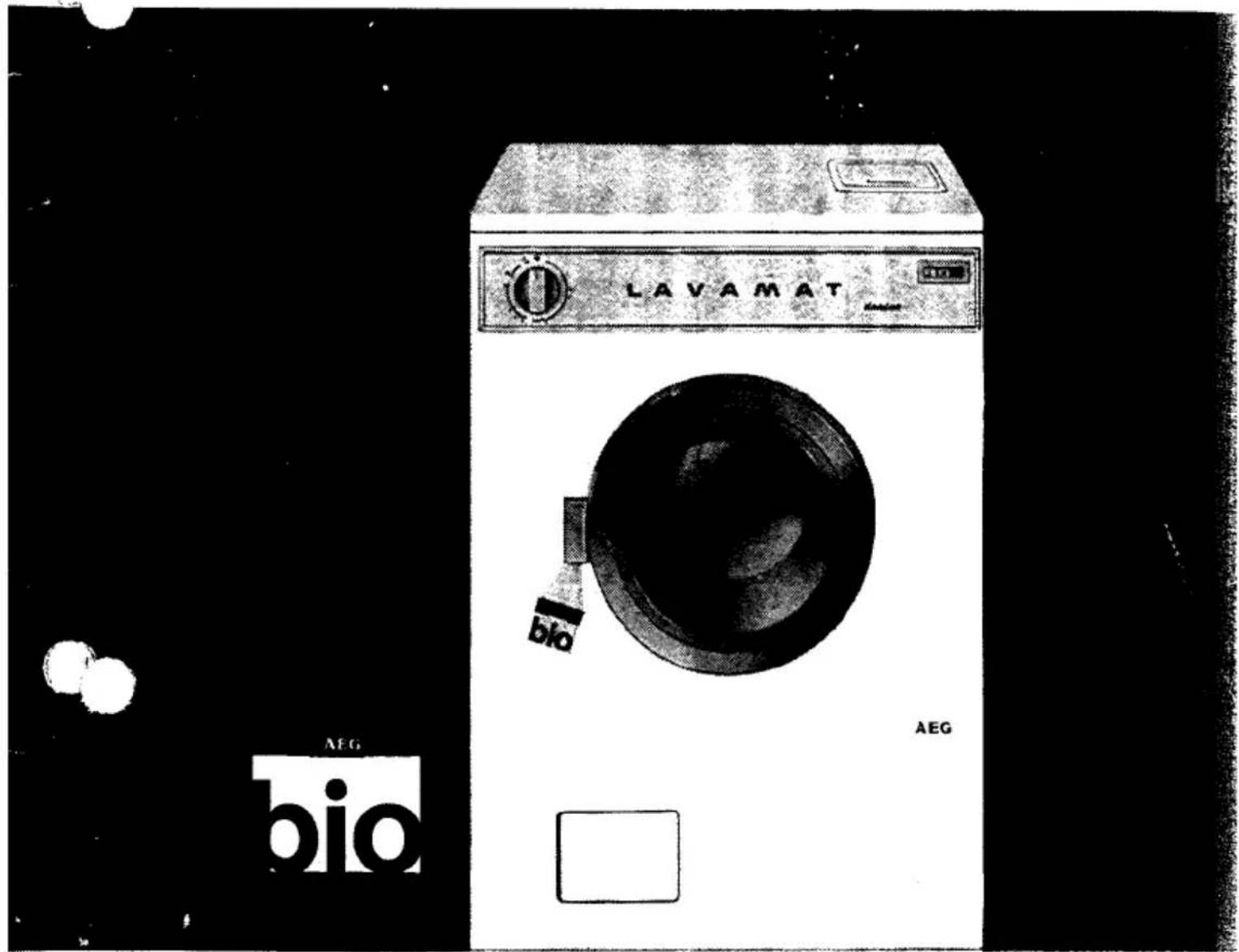
AEG-LAVAMAT domina
In selecting the fully automatic washing machine
LAVAMAT domina
you have made an excellent choice. This fully automatic appliance fulfils all the requirements you as a housewife make on a modern washing machine.
There is very little you have to do in order to wash with this fully automatic machine. This booklet will help you soon to become fully familiar with your washing machine and, in addition, it gives you valuable advice for the care and treatment of your laundry.
natural_image
Black-and-white illustration of a woman in a hat and checkered skirt, holding a bird, with books and papers nearby (no text or symbols)List of Contents
Connection page 4
Putting the appliance into operation page 6
Preparing the laundry page 6
Controls page 8
Wash programmes page 12
Wash powders page 18
Care and maintenance page 20
Installation
Because of its special construction, your fully automatic washing machine does not have to be fixed to the floor. It stands on rubber feet which do not need adjusting. Even if your floor is slightly uneven in places, the appliance still stands firmly.
In case of a sloping floor, for example towards a drain hole, adjustment for horizontal position must be made by placing something underneath the washing machine.
Electrical connection
Your fully automatic washing machine is designed for operation on 220 V (240 V U.K.) a.c. single phase. It is provided with a 3-core lead and has to be connected to a properly earthed plug and socket.
The connected load is 3.3 kW (3.1 kW U.K.).
The leads to the wall socket must be protected by a 16-A fuse (13 or 15 AMP U.K.).
If the wall socket is protected by a 10-A fuse, your LAVAMAT can be converted to 2.2 kW. The conversion must be carried out by an electrical engineer.
Your electrician will be pleased to advise you of how to connect your automatic washing machine properly.
This is all the more important as any electrical connections have to comply with requirements laid down by the local electricity boards.
Water supply
The washing machine is connected via the fixed rubber pressure hose (3/8", 1.5 m long [5 ft]) to a cold water tap (3/4" external thread) having a screwed hose connection (3/4" internal thread).
The pressure hose is provided for this purpose with a hose liner and a coupling unit. The built-in strainer should be cleaned from time to time.
Various washers are provided for the connection to the water tap, which have to be used as required (for example, in case of a tap with pipe ventilation and non-return valve with a short thread, the thick washer should be used).
The inlet valves have automatic throughput controls which, at a water pressure ranging from 1 to 10 atu (15 to 150 psi) keep the throughput to 12–16 l/min. (2 ^1/2 –3 ^1/2 gallons per minute).
In the case of pressures above 10 atu (150 psi) a pressure-reducing valve has to be incorporated (Type AD 723, E-No. 612 896 723).
In the case of pressures below 1 atu (15 psi) unscrew the supply hose from the washing machine and remove the throughput control. Please make sure that the snap ring and strainer are replaced. The washing machine will now operate at a water pressure of up to 0.5 atu (7.5 psi).
the case of pressures below 0.5 atu (7.5 psi) the AEG service should be called for advice.
The washing machine must not be connected to a central hot water system or to an existing hot water appliance as this might have a detrimental effect on the wash performance.
Your fully automatic washing machine is emptied by the suds pump. The drainage hose which is fixed to the appliance is hooked into the wash basin or sink with the help of the discharge knee.
The pump lift is approximately 1 m (3 ft).
The water must be able to flow out unobstructed.
The discharge knee must not be immersed in the liquid discharged, or else a reverse suction into the machine could be brought about or unintended emptying while the appliance is in operation (siphon effect).
If the washing machine is installed in a room which is a drain hole in the floor and if the water from the washing machine is to be discharged onto the floor, the discharge knee of the drainage hose has to be cut off at an angle and the hose placed on the floor.
Water drainage
If the drainage hose is to be connected permanently or if it has to be extended in the case of a floor drain hole, the drainage hose has to be provided with an air inlet. Required is the air-inlet hose, Et-No. 645 024 590, which is run from the upper arch of the drainage hose to the wash-powder dispenser overflow hose.
If your washing machine is to be installed next to a cooker or boiler, then see to it that there is sufficient insulation or sufficient clearance between the two.
Our Guarantee is granted only if the appliance has been properly installed and connected by a qualified person.

Putting the appliance into operation
Before putting the washing machine into operation for the first time, the transport security devices have to be removed. See red instruction label on the cover. Your dealer should carry this out after delivering the appliance. Keep the transport security devices in a safe place because they must be refitted should you move house.
If your washing machine contains small remnants of water, this is due to the very thorough testing to which each AEG washing machine is subjected.
Preparing the laundry
An old rule says that laundry should be changed often and that soiled laundry should be kept in a dry and well aired place, but only for a short period. Settled dirt is much more difficult to wash out and it impairs the durability and appearance of the fabric.
Before the washing, the laundry should be inspected and sorted. Pockets and seams should be thoroughly brushed, and any pins and other foreign bodies removed because, if they get into the drum together with the washing, they can damage the laundry and leave dirt and rust marks.

But to ensure that the drainage hose does not become obstructed, your washing machine is provided with a filter which retains all such foreign bodies. Please note the instruction in the Section "Care and Maintenance" on page 20 of this booklet.
Severe stains should be treated prior to washing.
If you use special stain-lifting agents, carefully follow the manufacturers' instructions. If your own attempts are unsuccessful, it might be advisable to have the item dry-cleaned.
Biological-Action Programmes
Stains containing albumen and grease do not have to be pre-treated. Your automatic washing machine is provided with biological-action programmes which in combination with a biological soaking or washing agent ensure that blood, egg, chocolate stains etc. are completely removed.
Laundry should be sorted into three main groups in accordance with the manufacturers' instructions for each fabric.
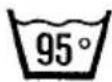
White linen and cottons, 95°C (205°F)
including white and colour-fast materials of cotton, linen and cellulose wool. They are washed at a low water level.
Colour-fast cottons, 60°C (140°F)
including:
a) the coloureds, i.e. all items made of cotton, linen or cellulose wool, the colours of which are not fast at higher temperatures. They are washed at a low water level.
b) white fabrics of man-made fibres, such as shirts and blouses. They are washed at a high water level.
Sensitive fabrics, 30°C (86°F)
including:
silk, Rayon, synthetic fibres and wool. They are washed at a high water level and with little drum action


In the case of fabric mixtures (such as Terylene/Wool), select the wash programme to suit the most delicate component.
If you are in doubt whether an item can be washed with the whites, then don't put it together with the whites when you wash it for the first time.
Controls
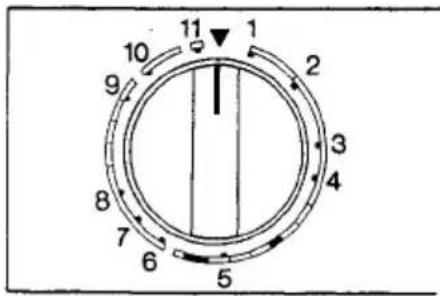
Programme selector switch
Push-buttons and pilot light
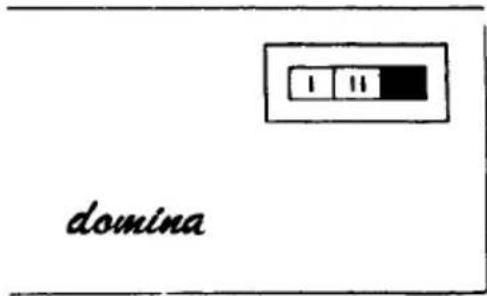

Programme selector switch
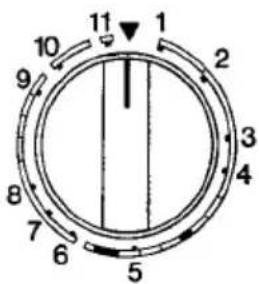
By turning the programme selector switch clockwise, you select the number corresponding to the wash programme required. The switch engages at each number. On the inside of the lid of the wash powder dispenser you will find a list of the most important wash programmes. By turning the programme selector to the setting required for the wash programme, you determine automatically the temperature, water level, rhythm of drum action and the number of rinsing cycles.
The fully automatic washing machine is switched on by pulling out the switch after you have selected the desired programme.
The switch rotates during the wash programme, always indicating which operation is being carried out. A complete normal programme consists of pre-wash, main wash and 5 rinsing cycles, spin-drying taking place after the 2nd and 5th rinsing cycles. The wash programme for sensitive fabrics consists of main wash and 4 rinsing cycles. While the water is heated, the switch does not rotate until the required temperature is reached.
Biological-Action programmes
By operating Push-button 1, you can select a biological-action programme for your whites (programme selector setting 1 or 2). This programme is designed for heavily albumen-soiled pieces, such as laundry with blood, perspiration, egg, chocolate and gravy stains. Please use one of the biological washing agents specially developed for these purposes; make sure they are suitable for front loading automatic washing machines.
During the main wash, your LAVAMAT operates at between 40° and 60°C (105° and 140°F) fully automatically, with reduced heating and for a longer period of time so that the enzymes contained in the wash powder can fully develop.
If you want to wash whites or coloureds without the spin-drying cycles, operate Push-button II (programme selector setting 1, 2, 3 or 4).
If you want to wash heavily albumen-soiled whites without spin-drying, you can of course depress both Push-button I and Push-button II.
Plug in the appliance or, in case of permanent connection, switch on.
Hook the drainage hose into basin or sink.
Open cold water tap.
Open door. The door can be opened only if the programme selector switch points to position ▼.
Load with dry laundry.
The drum is correctly loaded if you can turn your hand freely between the top of the drum and the laundry. The maximum amount for lightly soiled and small items is roughly 4 kg (9 lb) dry weight. For all programmes without spin-drying and in the case of sensitive fabrics, the drum is loaded with less washing, as specified for each individual programme.
Close the door.
The door is provided with a safety lock. It cannot be opened while the washing machine is in operation. Programme cannot be selected unless door is fully closed.
Turn programme selector switch to the appropriate setting for the programme required.
Push-button I
Push-button II
Operating the LAVAMAT
Add the wash powder
Depress Push-button I and / or Push-button II where applicable.
Pull programme selector switch.
The pilot light goes on indicating that the washing machine is switched on.
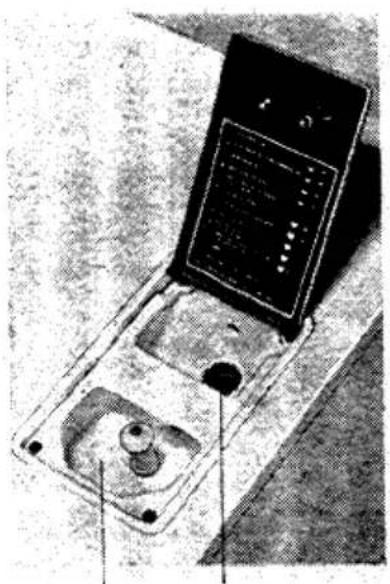
Add the wash powder.
Rear compartment of wash powder dispenser for pre-wash, front compartment for main wash; at the beginning of the main wash the wash powder is flushed in automatically.
natural_image
Close-up of a vintage electronic device with a display panel and control buttons (no visible text or symbols)Front Rear compartment compartment
natural_image
Top-down view of a vintage electronic device with a display and internal components (no visible text or symbols)Little cup
Soft-rinsing and starching
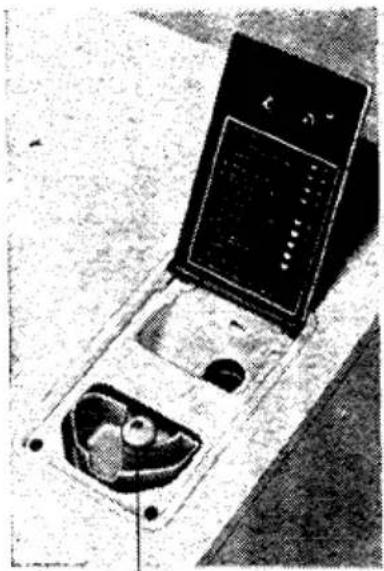
If you wish to soft-rinse or starch the full machine load, use the little cup provided with your washing machine. This little basin is inserted into the wash powder dispenser as illustrated above, during the period following the water supply for the main wash (5 minutes after the main wash starts) but before the beginning of the last rinsing cycle. In the case of whites and coloureds, the soft-rinse agent or starch is gauged for a water quantity of 20 l (4 ^1/2 gallons), in the case of delicate fabrics for 25 l (5 ^1/2 gallons). Pour agent into the little basin, it will then be flushed in automatically for the last rinsing cycle, Remove the little basin before you begin the next wash programme. The small amount of water left in it can be poured into the washing machine.
If you do not use synthetic starches, if you do not want to after-treat the full machine load or if you wish to be independent with regard to the time of adding the after-treatment agent, you can of course select a soft-rinse or starch programme, as described on pages 14 and 16, after the wash programme is completed.
While the washing machine is in operation, do not place anything which is impermeable to air (such as plastics materials) over the lid of the wash powder dispenser as this might impair the performance of your appliance.
A special cooling cycle is included at the end of the main wash – in all programmes – adding to the care with which your laundry is treated, and ensuring that the liquid discharged never exceeds about 60°C (140°F). This is important if your drainage pipes are made of plastics.
When the wash programme is completed, the washing machine switches off automatically. The selector switch always remains at the setting at which the machine is switched off (one of the four gaps on the dial).
In the case of wash programmes for delicate fabrics, the laundry remains in the water of the last rinsing cycle; in case of soaking, it remains in the soaking liquid.
Therefore always make sure that after the programmes 6, 7, 8, 9 and 10 are completed, the water of the last rinsing cycle or the steeping solution are pumped off (select programme 11) before the door is opened.
Depress selector switch.
The pilot light goes out.
If applicable, redepress Push-buttons I and II to cancel their function.
Turn programme selector switch to ▼.
Open the door.
Remove the laundry.
If you have finished washing, close the water tap, pull out plug or switch off.
Wash programmes
You will find a list of the most important wash programmes on the inside of the lid of the wash powder dispenser.
Below these programmes are described in detail:
The symbols have the following meaning:
Wash temperature, e.g. 95°C

Wash at normal water level

Wash at high water level

Opening the door.
1. Very hot wash
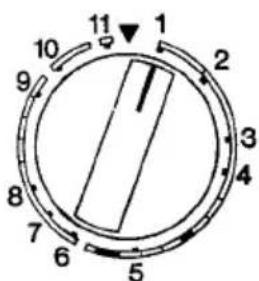


Whites and coloureds which are resistant to boiling.
If possible, wash whites and coloureds separately so that the white fabrics retain their degree of whiteness.
Pour the wash powder for the pre-wash into the rear compartment of the wash powder dispenser and that for the main wash into the front compartment.
Pre-wash - main wash - five rinsing cycles - spin-drying after the 2^nd and 5^th rinse.
In the case of stained or heavily albumen-soiled launrey, deperss Push-button I (bio-action programme). During the main wash your LAVAMAT operates at between 40° and 60°C (105° and 140°F) fully automatically, with reduced heating and for a longer period of time so that the enzymes contained in the wash powder can fully develop.
For whites or other items to be washed very hot but which must not be spindried, depress Push-button II (dry load approximately 2 kg [4 lb]). Please make sure that the Push-buttons are depressed again after the wash programme is completed, or else the next programme is inadvertently carried out as a biological-action programme or without the spin-drying cycles.
Pour the wash powder for the main wash into the front compartment of the wash powder dispenser.
Main wash - five rinsing cycles - spin-drying after the 2nd and 5th rinse.
In the case of stained or heavily albumen-soiled laundry, depress Push-button I (bio-action programme). During the main wash your LAVAMAT operates at between 40° and 60°C (105° and 140°F) fully automatically, with reduced heating action and for a longer period of time so that the enzymes contained in the wash powder can fully develop.
For very hot wash without spin-drying, depress Push-button II.
- Very hot wash, no pre-wash
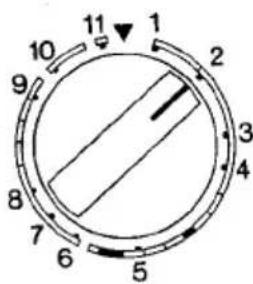


No pre-wash.
Pour the wash powder for the main wash into the front compartment of the wash powder dispenser.
Main wash - five rinsing cycles - spin-drying after 2nd and 5th rinse.
For coloureds not to be spin-dried, depress Push-button II.
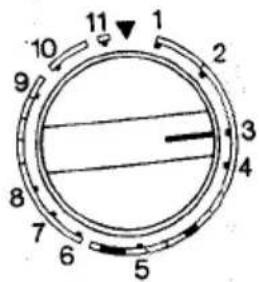
- Medium hot wash (coloureds)


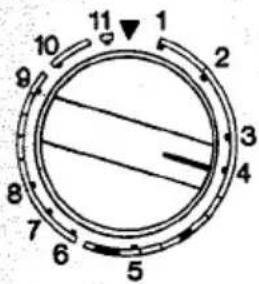
4. Sensitive coloureds
For delicate coloureds and Rayon.
No pre-wash.
Pour the wash powder for the main wash into the front compartment.
Main wash - five rinsing cycles - spin-drying after 2nd and 5th rinse.
For coloureds not to be spin-dried, depress Push-button II.

40^
5. Soft-rinsing, Starching, spin-drying
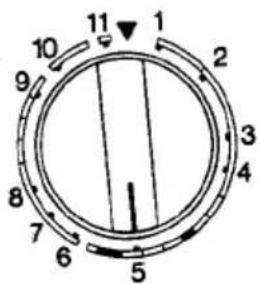
If you wish to give your whites or coloureds a special treatment after the wash programme is completed, turn the programme selector switch to position '5' (for washing not to be spin-dried, depress Push-button II). Gauge the quantity of starch for a water quantity of about 20 l (4 ^1/2 gallon). Pour the starch solution or soft-rinse agent into the rear compartment of the wash powder dispenser while the water is running in.
If you wish to spin-dry only, also select this programme. (In this case, close the water tap.)
Never turn the selector switch by hand directly to spin-drying.
6. White synthetics
such as white fabrics made of PERLON, Nylon, NYLtest, or cotton/polyester mixtures.
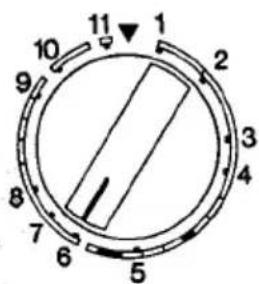
No pre-wash.
Your fully automatic washing machine carries out these wash programmes for delicate fabrics especially gently because the drum action is reduced and all the washing and rinsing cycles are done at high water level so that the washing can float.

60°
This programme is suitable for example for knitted shirts made of a porous PERLON or NYLtest etc. But do not wash white shirts or blouses together with coloured ones in order to ensure that the degree of whiteness is retained.
Dry load approximately 1 kg (2 lb) (about 5 to 6 shirts).
Pour the wash powder (normal grades for washing machines see page 18, or special wash powders see page 19) into the front compartment of the wash powder dispenser. (2-3 measures because of the larger water quantity which is about 20-30 l (4^1/2 - 6^1/2 gallons).
If collars and cuffs are heavily soiled, it is advisable to treat them at first with wash powder made up into a paste or with a fat-solvent.
Main wash - four rinsing cycles - no spin-drying.
The water of the last rinsing cycle is not discharged as part of the wash programme for delicate fabrics until you set the dial yourself to 'emptying' (Programme 11) (see page 17). Subsequently hang the washing up to drip-dry.

such as Dralon, Orlon, Treylene etc.
Programme 7 is a special wash programme for fabrics made of synthetic fibres, such as curtains and coloured Nylon or PERLON items.
Dry load approximately 1 kg (2 lb). In case of curtains, this would be equivalent to an area of 3×5 m (3×5 yds). No pre-wash.
Add only one lot of wash powder and pour it into the front compartment. But again for this programme 2 to 3 measures because of the larger water quantity. (Normal grades for washing machines see page 18, or special wash powders see page 19.)
If the curtains are heavily soiled, select at first a soaking cycle.
Main wash - four rinsing cycles - no spin-drying.
The washing remains floating in the water of the last rinsing cycle. To empty the drum, select programme 11 and hang the items up immediately afterwards to drip-dry.
Curtains made of synthetic fibres are very delicate and great care should be taken when handling them. They can easily be damaged by open windows, rings or gliders which have not been removed and get into the drum, or even by sharp-edged finger-rings while the curtains are taken down. Damage caused in this way is not really noticeable until after the washing when it shows in the form of pulled threads, in which case we cannot on principle undertake any liability.
Curtains made of synthetic fibres should be washed more frequently than those made of cotton.
7. Coloured synthetics, curtains
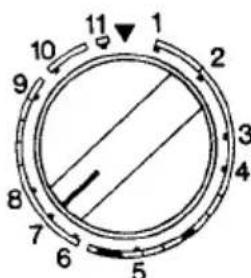


8. Wools and silks
Delicate wools and silks which may be washed.
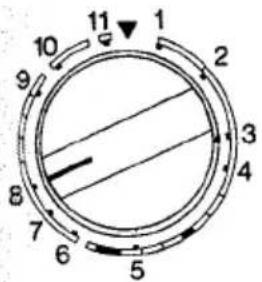

Some very sensitive woollen articles should be washed by hand or dry-cleaned. If you have several woollen articles of similar colour, however, it is worth-while using the washing machine. The recommended load is approximately 1 kg (2 lb) dry weight.
No pre-wash.
Pour the wash powder for the main wash into the front compartment.
For lightly soiled woollens use a wash powder which is specially recommended for delicate washing. But measure the amount carefully, or else too much lather will form. An ordinary wash powder for front loading automatic washing machines can be used for more heavily soiled woollens.
Main wash - four rinsing cycles - no spin-drying.
The washing remains floating in the water of the last rinsing cycle. To empty the drum, select Programme 11.
9. Soft-rinsing, synthetics and wools
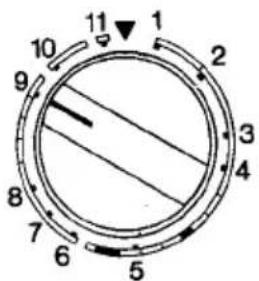

If you wish to give your delicate washing a special treat after the wash programme is completed, turn the programme selector switch to position '9'. Gauge the starch solution or soft-rinse agent for a water quantity of 25 to 20 l (5 ^1/2 - 6 ^1/2 gallons). Pour the starch solution or soft-rinse agent into the rear compartment of the wash powder dispenser while the water is running in.
This programme is designed for soaking stained and especially albumen-soiled items with the help of special biological agents. It is also suitable to carry out an extra pre-wash of heavily soiled laundry. Since this operation takes place at increased water level, gauge the soaking or pre-wash agent for a water quantity of 25-30 l (5 ^1/2 -6 ^1/2 gallons). The washing remains in the solution. To empty the drum, select programme 11. You can soak your laundry also for several hours or over night. In this case it is advisable to push back the selector swith after the washing machine has carried out the operation. The machine is switched on again for pumping out the water. After the soaking or pre-washing select a complete wash programme appropriate for the type of washing.
- Soaking or pre-washing separately (for special bio-action)
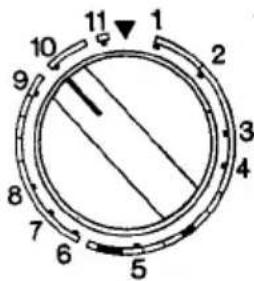

For pumping out the soaking solution or the water of the last rinsing cycle in the case of programmes for delicate articles.
- Emptying
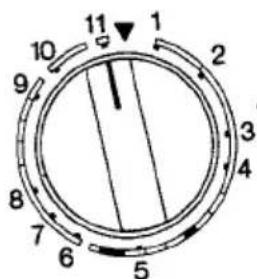


Each programme can be extended, shortened or combined with another one. To do this, depress selector switch, turn programme selector to the setting required (clockwise) and pull the switch again. If required, press push-buttons.
But please see to it that the programme selector is not turned direct to the setting of a spin-drying cycle.
Wash powders
A good brand of low lather wash powder such as Persil automatic is the pre-requisite for good washing. Please use only wash powder which are especially made for front loading automatic washing machines.
If unsuitable wash powders are used you may not achieve the washing results the machine is capable of. Also excessive lather may develop which will cause the machine to overfoam.
In the case of hard water, it is advisable to add a water-softening agent, such as Calgon, to the wash powder for the main wash into the front compartment of the wash powder dispenser. The following quantities are recommended:
Water between 20 and 25° d (UK 25 and 31°)
appr. 1 level soup spoon
Water above 25° d (UK 31°)
appr. 2 level soup spoons
(°d = Unit for water hardness)
If the water is very soft, if the laundry is less soiled, or if too much wash powder is used, too much foam is likely to develop. This difficulty can be overcome as well by using an anti-foam agent in the main wash.
For severely albumen-soiled items, biological wash powders are available which you should use in the bio-action programmes.
Details of how to use these wash powders are evident from the manufacturers' instructions.


Care and maintenance
There is very little you have to do for the care and maintenance of your fully automatic washing machine. When you have finished washing, close the water tap and pull out the plug or switch off. This prevents the machine from being switched on inadvertently.
natural_image
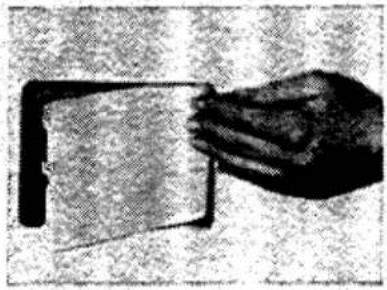
Hand holding a rectangular object with a curved handle, no visible text or symbolsIt is recommended to leave the door and the lid of the wash powder dispenser open for a while so that any moisture can evaporate from inside. Any remnants of wash powder adhering to the wash powder dispenser can be easily removed. Please remove also any traces of suds from the outside of the washing machine with the help of a damp cloth, wiping it dry afterwards.
natural_image
Close-up of a mechanical device with a circular component and lever mechanism (no visible text or symbols)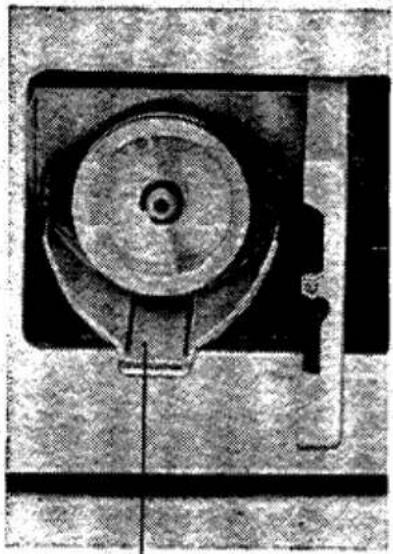
natural_image
Close-up of a mechanical component with a circular top and central shaft (no visible text or symbols)Draining tray
natural_image
Close-up of a mechanical device with a circular component and internal components (no visible text or symbols)Filter
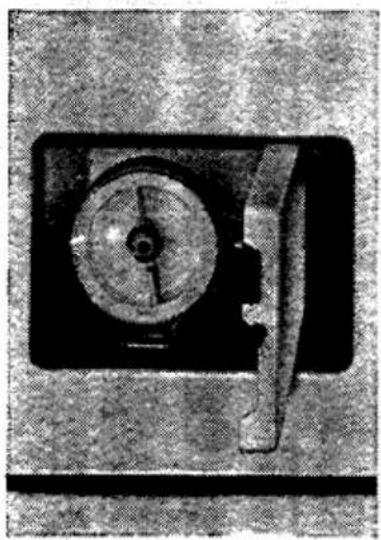
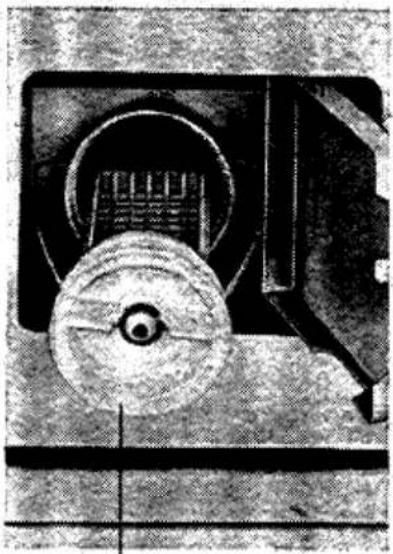
It is necessary from time to time to clean the filter which is designed to retain foreign bodies, fluff, etc. and which is located at the lower front of the washing machine. At first open, as illustrated above, the hinged flap behind which you will find the filter. Pull out the draining tray and place a shallow basin underneath. Turn the filter cap to the left, wait until the remaining water has drained off and then remove the filter.
The motor of your fully automatic washing machine is protected by a thermal overload cut-out which ensures in the case of overloading – e.g. when the filter is clogged up – that the machine is switched off. It switches on again automatically after a certain time. But if this happens repeatedly, you are advised to call the AEG Service for advice.
The drum and tub of your fully automatic washing machine are made of stainless steel. Any rust marks appearing on these parts inspite of this fact, are always due to foreign bodies containing iron which have been introduced with the laundry, or to ferruginous water, because extraneous rust is possible even on stainless steel. This type of contact rust can be removed with the help of fine-grain cleaning agents. But do not use scouring agents containing chlorine, or steel wool, wire brushes and the like. Acids and chlorine as well as strong bleaches or decolourants should not be used in the washing machine.

If your washing machine shows signs of a grey coating due to calcium deposition, do not remove it with anything that might be unsuitable, but contact the AEG service.
If your washing machine is installed in a place without heating facilities, where it can be endangered by frost, the washing machine should be emptied of any water in good time by opening the filter. (If necessary, tilt the machine slightly towards you.) The water supply hose should be detached from the water tap and also allowed to drain empty.
In case of any queries concerning the operation of your fully automatic washing machine, please contact your nearest AEG Office or agent, who will also be pleased to advise you on any other questions concerning your washing machine or any other AEG domestic appliance.
