CB250 (1992) - Motorrad Honda - Kostenlose Bedienungsanleitung
Finden Sie kostenlos die Bedienungsanleitung des Geräts CB250 (1992) Honda als PDF.


Benutzerfragen zu CB250 (1992) Honda
0 Frage zu diesem Gerät. Beantworten Sie die, die Sie kennen, oder stellen Sie Ihre eigene.
Eine neue Frage zu diesem Gerät stellen
Laden Sie die Anleitung für Ihr Motorrad kostenlos im PDF-Format! Finden Sie Ihr Handbuch CB250 (1992) - Honda und nehmen Sie Ihr elektronisches Gerät wieder in die Hand. Auf dieser Seite sind alle Dokumente veröffentlicht, die für die Verwendung Ihres Geräts notwendig sind. CB250 (1992) von der Marke Honda.
BEDIENUNGSANLEITUNG CB250 (1992) Honda
HONDA
HONDA
CB250
OWNER'S MANUAL
© HONDA MOTOR CO., LTD. 1992
IMPORTANT NOTICE
• OPERATOR AND PASSENGER
This motorcycle is designed to carry the operator and one passenger. Never exceed the maximum weight capacity as shown on the tyre information label.
• ON-ROAD USE
This motorcycle is designed to be used only on the road.
- READ THIS OWNER'S MANUAL CAREFULLY
Pay special attention to statements preceded by the following words:
WARNING
Indicates a strong possibility of severe personal injury or death if instructions are not followed.
CAUTION:
Indicates a possibility of personal injury or equipment damage if instructions are not followed.
NOTE: Gives helpful information.
This manual should be considered a permanent part of the motorcycle and should remain with the motorcycle when resold.
HONDA CB250 NIGHT HAWK OWNER'S MANUAL
All information in this publication is based on the latest production information available at the time of approval for printing. HONDA MOTOR CO., LTD. reserves the right to make changes at any time without notice and without incurring any obligation.
No part of this publication may be reproduced without written permission.
© Honda Motor Co., Ltd. 1991
WELCOME
The motorcycle presents you a challenge to master the machine, a challenge to adventure. You ride through the wind, linked to the road by a vehicle that responds to your commands as no other does. Unlike an automobile, there is no metal cage around you. Like an airplane, a pre-ride inspection and regular maintenance are essential to your safety. Your reward is freedom.
To meet the challenges safely, and to enjoy the adventure fully, you should become thoroughly familiar with this owner's manual BEFORE YOU RIDE THE MOTORCYCLE.
When service is required, remember that your Honda dealer knows your motorcycle best. If you have the required mechanical "know-how" and tools, your dealer can supply you with an official Honda Service Manual to help you perform many maintenance and repair tasks.
Pleasant riding, and thank you for choosing a Honda!
- Following codes in this manual indicate each country.
| E | England |
| U | Australia |
• The specifications may vary with each locale.
OPERATION
Page
1 MOTORCYCLE SAFETY
1 Safe Riding Rules
2 Protective Apparel
2 Modifications
3 Loading and Accessories
5 PARTS LOCATION
8 Instruments and Indicators
10 MAJOR COMPONENTS (Information you need to operate this motorcycle)
10 Suspension
11 Brakes
15 Clutch
17 Fuel
21 Engine Oil
22 Tyres
24 ESSENTIAL INDIVIDUAL COMPONENTS
24 Ignition Switch
25 Right Handlebar Controls
26 Left Handlebar Controls
Page
27 FEATURES (Not required for operation)
27 Steering Lock
28 Helmet Holder
29 Seat
30 Document Compartment
30 Side Cover
31 OPERATION
31 Pre-ride Inspection
32 Starting the Engine
35 Running-in
36 Riding
38 High ALTITUDE RIDING
39 Braking
40 Parking
40 Anti-theft Tips
MAINTENANCE
Page
41 MAINTENANCE
42 Maintenance Schedule
44 Tool Kit
45 Serial Numbers
46 Color Label
46 License Plate
47 Maintenance Precautions
48 Air Cleaner
49 Engine Oil
52 Crankcase Breather
53 Spark Plugs
55 Idle Speed
56 Drive Chain
60 Wheel Removal
65 Side Stand
66 Battery
68 Fuse Replacement
70 CLEANING
71 STORAGE GUIDE
Storage
72 Removal from Storage
73 NOISE CONTROL SYSTEM (AUSTRALIA ONLY)
74 SPECIFICATIONS
MOTORCYCLE SAFETY
WARNING
* Motorcycle riding requires special efforts on your part to ensure your safety. Know these requirements before you ride:
SAFE RIDING RULES
-
Always make a pre-ride inspection (page 31) before you start the engine. You may prevent an accident or equipment damage.
-
Many accidents involve inexperienced riders. Most countries require a special motorcycle riding test or license. Make sure you are qualified before you ride. NEVER lend your motorcycle to an inexperienced rider.
-
Many automobile/motorcycle accidents happen because the automobile driver does not "see" the motorcyclist.
Make yourself conspicuous to help avoid the accident that wasn't your fault:
- Wear bright or reflective clothing.
-
Don't ride in another motorist's "blind spot."
-
Obey all national and local laws and regulations.
-
Excessive speed is a factor in many accidents. Obey the speed limits, and NEVER travel faster than conditions warrant.
• Signal before you make a turn or lane change. Your size and maneuverability can surprise other motorists. -
Don't let other motorists surprise you. Use extra caution at intersections, parking lot entrances and exits, and driveways.
-
Keep both hands on the handlebars and both feet on the footpegs while riding. A passenger should hold on to the motorcycle or the operator with both hands and keep both feet on the passenger footpegs.
PROTECTIVE APPAREL
-
Most motorcycle accident fatalities are due to head injuries: ALWAYS wear a helmet. You should also wear a face shield or goggles as well as boots, gloves and protective clothing. A passenger needs the same protection.
-
The exhaust system becomes hot during operation, and it remains hot for a while after stopping the engine. Be careful not to touch the exhaust system while it is hot. Wear clothing that fully covers your legs.
-
Do not wear loose clothing which could catch on the control levers, footpegs, drive chain or wheels.
MODIFICATIONS
A WARNING
* Modification of the motorcycle, or removal of original equipment, may render the vehicle unsafe or illegal. Obey all national and local equipment regulations.
LOADING AND ACCESSORIES
A WARNING
*To prevent an accident, use extreme care when adding and riding with accessories and cargo. Addition of accessories and cargo can reduce a motorcycle's stability, performance and safe operating speed. Never ride an accessory-equipped motorcycle at speeds above 130 km/h (80 mph). And remember that this 130 km/h (80 mph) limit may be reduced by installation of non-Honda accessories, improper loading, worn tyres and overall motorcycle condition, poor road or weather conditions. These general guidelines may help you decide whether or how to equip your motorcycle and how to load it safely.
Loading
The combined weight of the rider, passenger, cargo and additional accessories must not exceed the maximum weight capacity:
160 kg (352 lbs)
Cargo weight alone should not exceed: 14 kg (30 lbs)
- Keep cargo and accessory weight low and close to the center of the motorcycle. Load weight equally on both sides to minimize imbalance. As weight is located further from the motorcycle's center of gravity, handling is proportionally affected.
- Adjust tyre pressure (page 23 and rear suspension (page 10) to suit load weight and riding conditions.
- Vehicle handling and stability can be adversely affected by loose cargo. Recheck cargo security and accessory mounts frequently.
4.
Accessories
Genuine Honda accessories have been specifically designed for and tested on this motorcycle. Because the factory cannot test all other accessories, you are personally responsible for proper selection, installation, and use of non-Honda accessories. Always follow the guidelines under Loading, and these:
- Carefully inspect the accessory to make sure it does not obscure any lights, reduce ground clearance and banking angle, or limit suspension travel, steering travel or control operation.
- Large fork-mounted fairings or windshields, or poorly designed or improperly mounted fairings can produce aerodynamic forces that cause unstable handling. Do not install fairings that decrease cooling air flow to the engine.
-
Accessories which alter your riding position by moving hands or feet away from controls may increase reaction time in an emergency.
-
Do not add electrical equipment that will exceed the motorcycle's electrical system capacity. A blown fuse could cause a dangerous loss of lights or engine power.
- This motorcycle was not designed to pull a sidecar or trailer. Handling may be seriously impaired if so equipped.
PARTS LOCATION
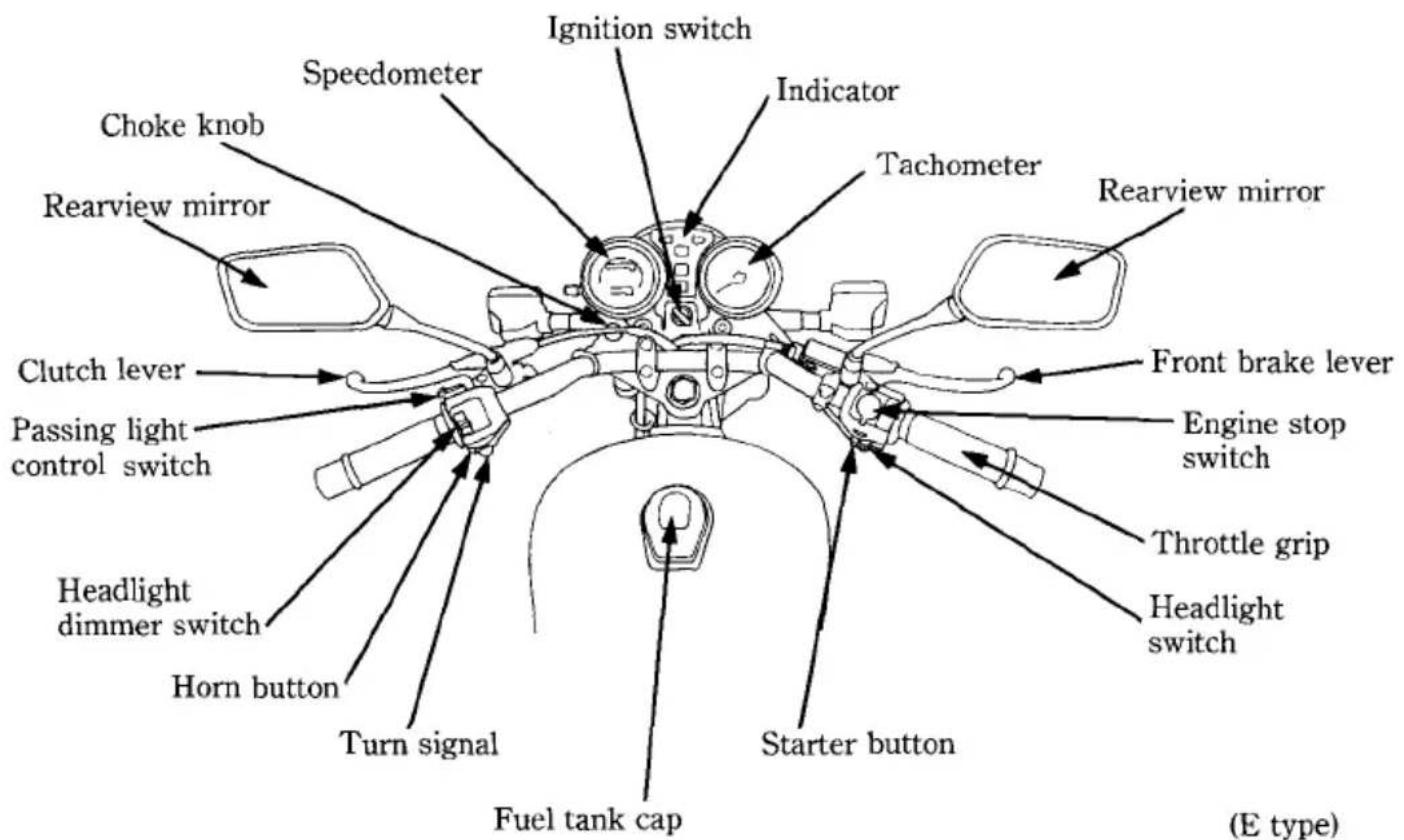
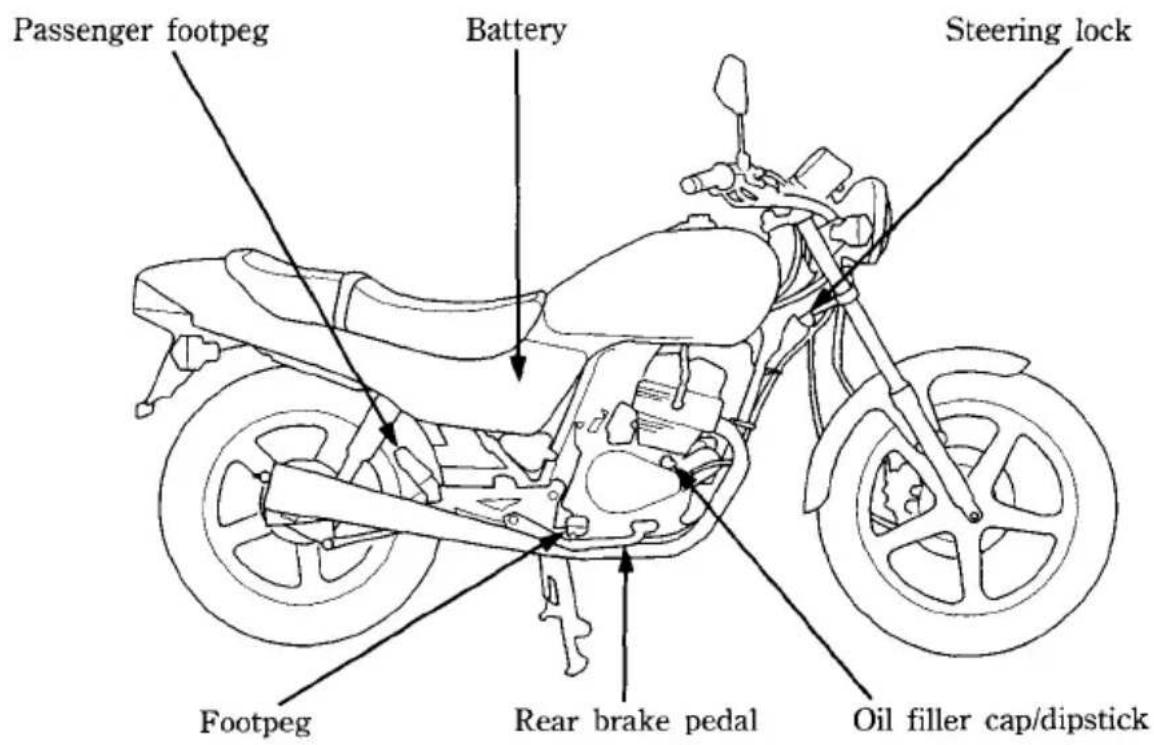
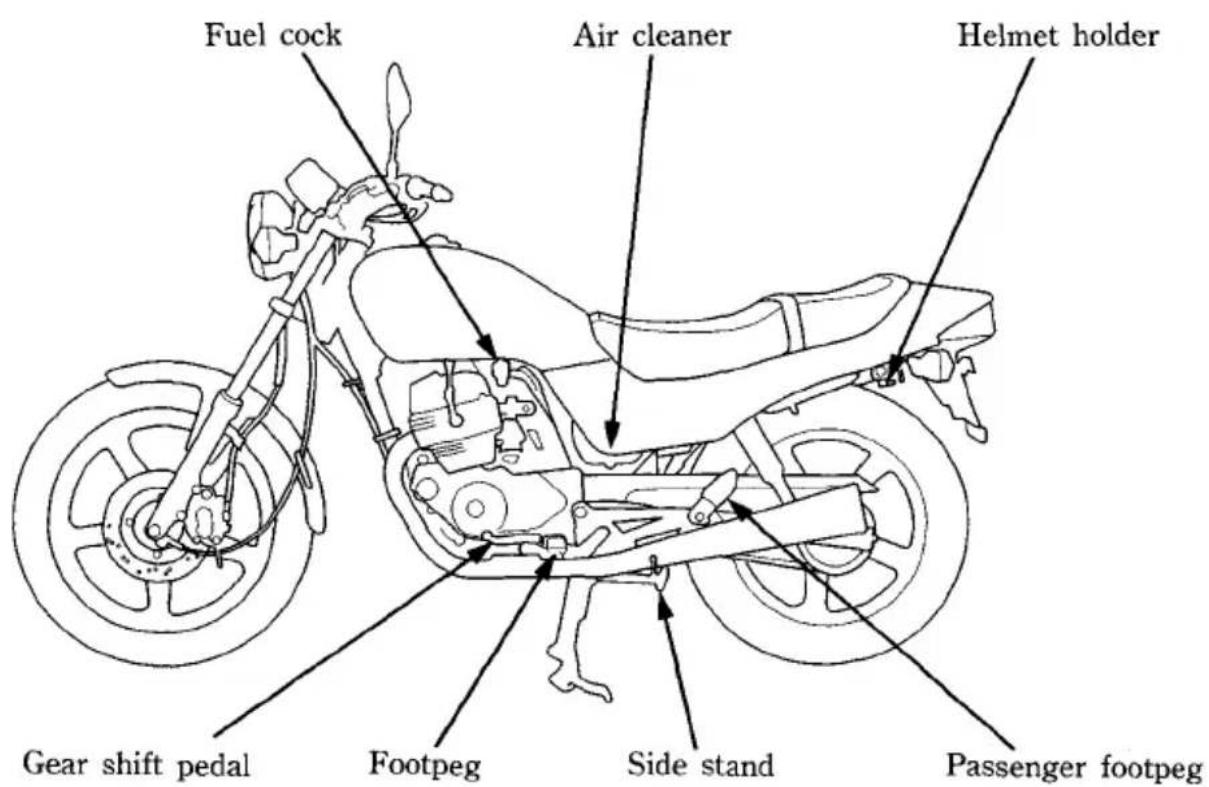
INSTRUMENTS AND INDICATORS
The indicator lights are grouped to the right of the speedometer. Indicator functions are described in the tables on the following pages.
(1) Speedometer
(2) Odometer
(3) Neutral indicator
(4) Side stand indicator
(5) Turn signal indicator
(6) High beam indicator
(7) Tripmeter
(8) Tripmeter reset knob
(9) Tachometer
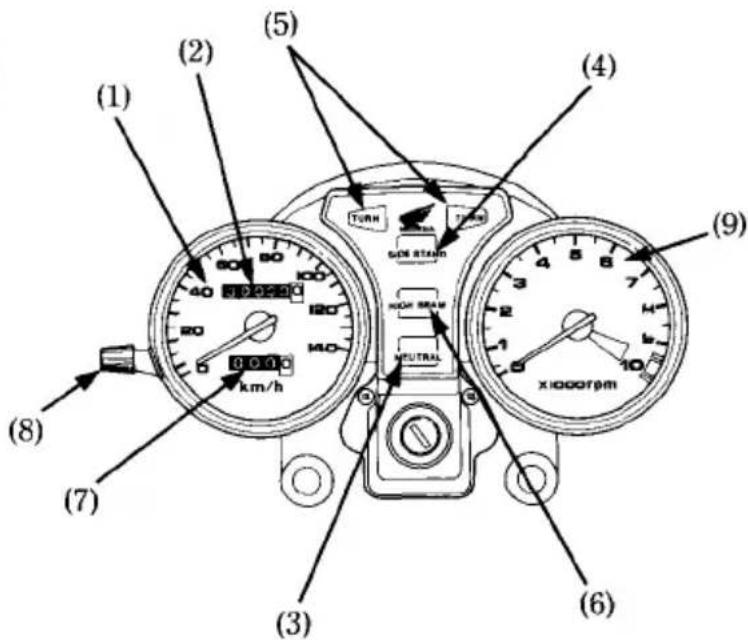
(U type)
| (Ref. No.) Description | Function |
| (1) Speedometer | Shows riding speed. |
| (2) Odometer | Shows accumulated mileage. |
| (3) Neutral indicator (green) | Lights when the transmission is in neutral. |
| (4) Side stand indicator (amber) | Lights when the side stand is put down.Before parking, check that the side stand is fully down;the light only indicates the side stand ignition cut-off system (page 32) is activated. |
| (5) Turn signal indicator (amber) | Flashes when either turn signal is operated. |
| (6) High beam indicator (blue) | Lights when the headlight is on high beam. |
| (7) Tripmeter | Shows mileage per trip. |
| (8) Tripmeter reset knob | Resets tripmeter to zero (0). Turn knob in direction shown. |
| (9) Tachometer | Shows engine rpm. |
MAJOR COMPONENTS (Information you need to operate this motorcycle)
WARNING
* If the Pre-ride Inspection (page 31) is not performed, severe personal injury or vehicle damage may result.
SUSPENSION
Each shock absorber (1) has adjustment positions for different load or riding conditions.
Use a pin spanner (2) to adjust the rear shocks.
Position 1 is for light loads and smooth road conditions. Positions 2 to 5 increase spring preload for a stiffer rear suspension, and can be used when the motorcycle is heavily loaded. Be certain to adjust both shock absorbers to the same position.
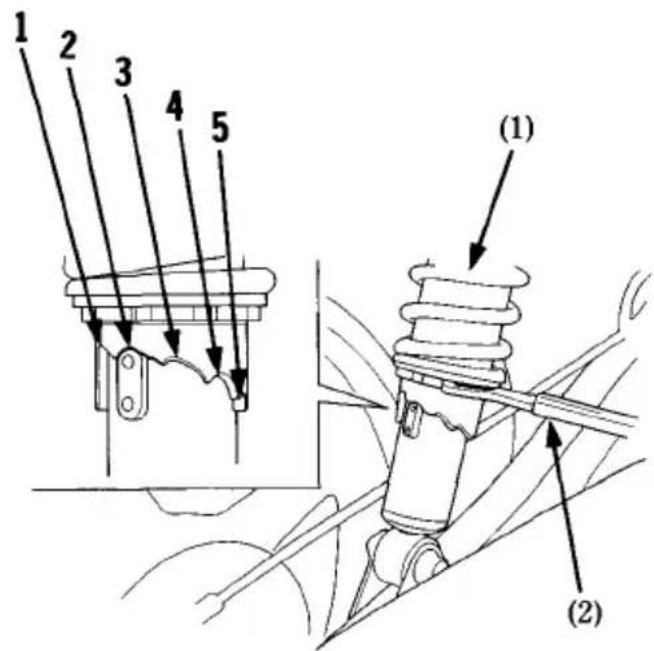
(1) Shock absorber
(2) Pin spanner
BRAKES
Front Brake
This motorcycle has a hydraulic front disc brake.
As the brake pads wear, brake fluid level drops.
There are no adjustments to perform, but fluid level and pad wear must be inspected periodically. The system must be inspected frequently to ensure there are no fluid leaks. If the control lever free travel becomes excessive and the brake pads are not worn beyond the recommended limit (page 23), there is probably air in the brake system and it must be bled. See your authorized Honda dealer for this service.
Brake Fluid Level:
A WARNING
* Brake fluid may cause irritation. Avoid contact with skin or eyes. In case of contact, flush thoroughly with water and call a doctor if your eyes were exposed.
A WARNING
* KEEP OUT OF REACH OF CHIL- DREN.
CAUTION:
* Handle brake fluid with care because it can damage plastic and painted surfaces.
* When adding brake fluid, be sure the reservoir is horizontal before the cap is removed or brake fluid may spill out.
* Use only DOT 4 brake fluid from a sealed container.
* Never allow contaminants such as dirt or water to enter the brake fluid reservoir.
Brake fluid must be added to the reservoir whenever the fluid level begins to reach the LOWER level mark (1). Remove the screws (2), reservoir cover (3), diaphragm plate (4), and diaphragm (5), Fill the reservoir with DOT 4 BRAKE FLUID from a sealed container up to the upper level mark (6). Reinstall the diaphragm, diaphragm plate, and cover. Tighten the screws securely.
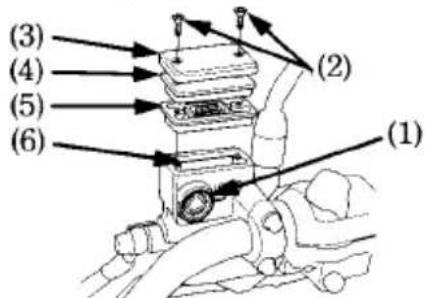
(1) LOWER level mark
(4) Diaphragm plate
(2) Screws
(5) Diaphragm
(3) Reservoir cover
(6) Upper level mark
Other checks:
Make sure the brake cable, brake arm, spring and fasteners are in good condition.
Brake Pad Wear
Brake pad wear will depend upon the severity of usage, type of riding, and condition of the roads. The pads will wear faster on dirty and wet roads. Inspect the pads visually during all regular service intervals to determine the pad wear. If either pad wears to the groove (2), both pads must be replaced as a set.
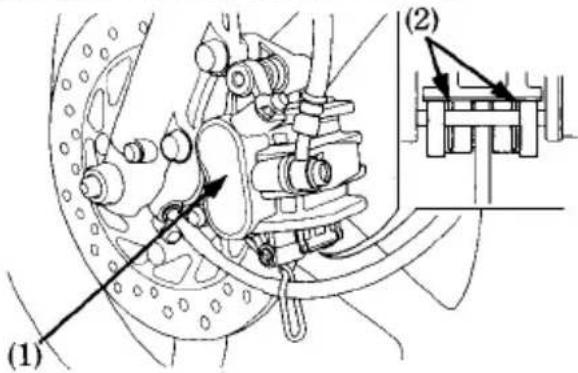
(1) Front brake caliper
(2) Groove
Other checks:
Make sure there are no fluid leaks. Check for deterioration or cracks in the hoses and fittings.
Rear Brake
- Place the motorcycle on its side stand.
- The stopper bolt (1) is provided to allow adjustment of the pedal height.
To adjust the pedal height, loosen the lock nut (2) and turn the stopper bolt.
Tighten the lock nut.
- Measure the distance the rear brake pedal (3) moves before the brake starts to take hold.
Free play should be:
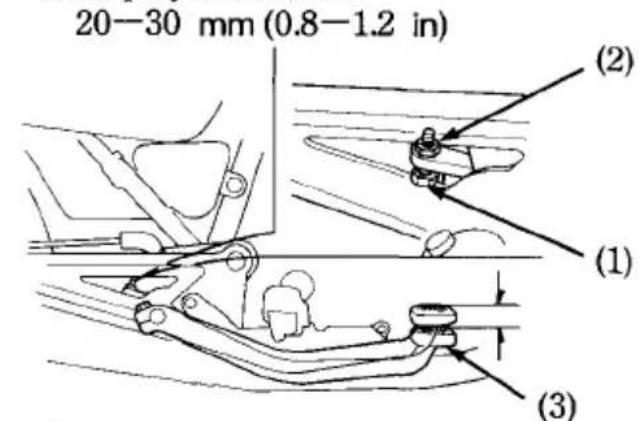
(1) Stopper bolt
(2) Lock nut
(3) Rear brake pedal
Make free play adjustments by turning the adjusting nut (4) at the brake arm. NOTE:
* Make sure the cut-out on the adjusting nut is seated on the brake arm pin (5) after making final free play adjustment.
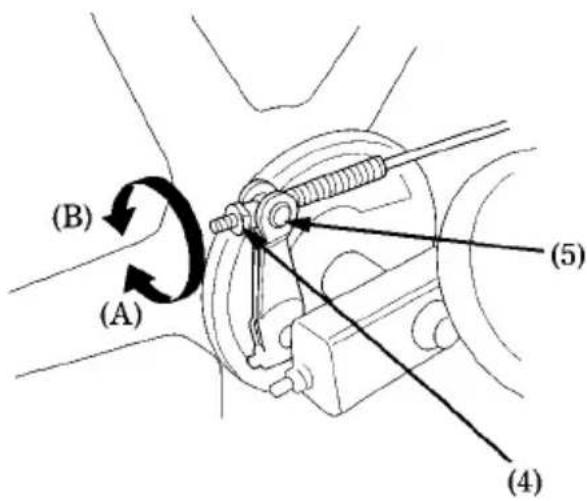
(4) Adjusting nut
(5) Arm pin
(A) Decrease free play
(B) Increase free play
- Apply the brake several times and check for free wheel rotation after the brake pedal is released.
NOTE:
* If proper adjustment cannot be obtained by this method see your authorized Honda dealer.
Other checks:
Make sure the brake cable, brake arm, spring and fasteners are in good condition.
Brake Shoe Wear
The front brake is equipped with a brake wear indicator.
When the brake is applied, an arrow (1) attached to the brake arm (2) moves toward a reference mark (3) on the brake panel (4). If the arrow aligns with the reference mark on full application of the brake, the brake shoes must be replaced.
See your authorized Honda dealer for this service.
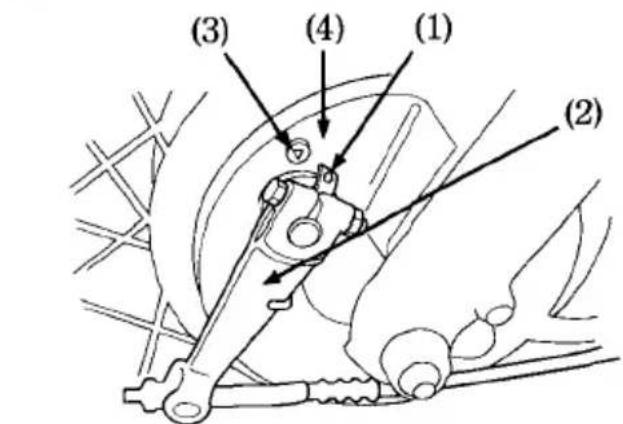
(1) Arrow
(2) Brake arm
(3) Reference mark
(4) Brake panel
CLUTCH
Clutch adjustment may be required if the motorcycle stalls when shifting into gear or tends to creep; or if the clutch slips, causing acceleration to lag behind engine speed. Minor adjustments can be made with the clutch cable adjuster (4) at the lever (1).
Normal clutch lever free play is:
10-20 mm (0.4-0.8 in)
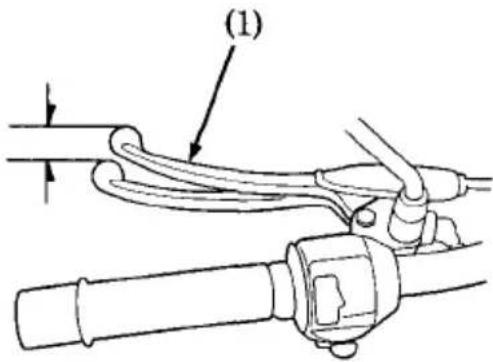
(1) Clutch lever
-
Pull back the rubber dust cover (2). Loosen the lock nut (3) and turn the adjuster (4). Tighten the lock nut (3) and check the adjustment.
-
If the adjuster is threaded out near its limit or if the correct free play cannot be obtained, loosen the lock nut (3) and turn in the cable adjuster (4) completely. Tighten the lock nut (3) and install the dust cover.
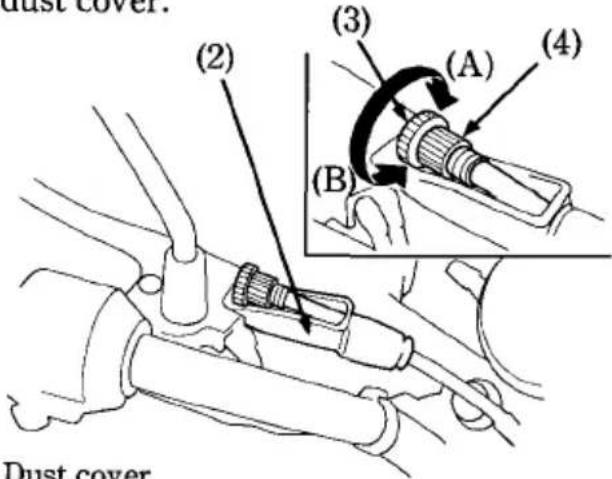
(2) Dust cover
(3) Lock nut
(4) Clutch cable adjuster
(A) Increase free play
(B) Decrease free play
- Loosen the lock nut (5) at the lower end of the cable. Turn the adjusting nut (6) to obtain the specified free play. Tighten the lock nut (5) and check the adjustment.
- Start the engine, pull in the clutch lever and shift into gear. Make sure the engine does not stall and the motorcycle does not creep. Gradually release the clutch lever and open the throttle. The motorcycle should begin to move smoothly and accelerate gradually.
NOTE:
* If proper adjustment cannot be obtained or the clutch does not work correctly, see your authorized Honda dealer.
Other Checks:
Check the clutch cable for kinks or signs of wear that could cause sticking or failure. Lubricate the clutch cable with a commercially available cable lubricant to prevent premature wear and corrosion.
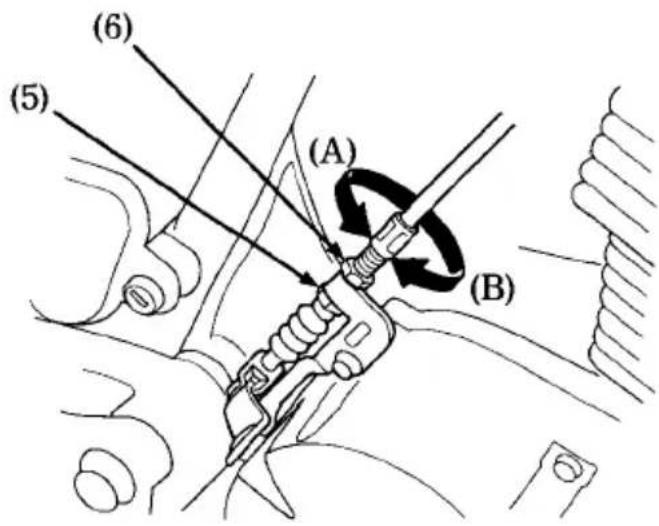
(5) Lock nut
(6) Adjusting nut
(A) Increase free play
(B) Decrease free play
FUEL
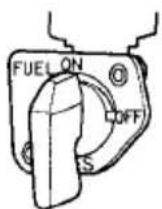
Fuel Cock
The three way fuel cock (1) is on the left side near the carburetor.
OFF
With the fuel cock in the OFF position, fuel cannot flow from the tank to the carburetor. Turn the cock OFF whenever the motorcycle is not in use.
ON
With the fuel cock in the ON position, fuel will flow from the main fuel supply to the carburetor.
RES
With the fuel cock in the RES position, fuel will flow from the reserve fuel supply to the carburetor. Use the reserve fuel only when the main supply is gone. Refill the tank as soon as possible after switching to RES.
The reserve fuel supply is:
3 ℓ (0.8 US gal, 0.7 Imp gal)
▲WARNING
* To avoid running out of fuel that may result in a sudden stop, learn how to operate the fuel cock when riding the motorcycle.
* Be careful not to touch any hot engine parts while operating the fuel cock.
NOTE:
* Remember to check that the fuel cock is in the ON position each time you refuel. If the cock is left in the RES position, you may run out of fuel with no reserve.
OFF
(1)
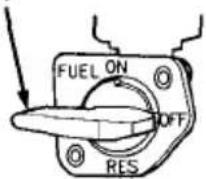
ON
RES
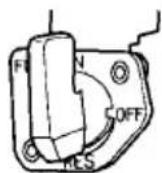
(1) Fuel cock
Fuel Tank
The fuel tank capacity including the reserve supply is:
16 ℓ (4.2 US gal, 3.5 Imp gal) To open the fuel tank cap (1), open the tank cap cover (2), insert the ignition key (3) and turn it clockwise. The cap will pop up and can be lifted off.
To close the fuel tank cap, align the latch in the cap with the solt in the filler neck. Push cap into the filler neck until it snaps closed and locks. Remove the key and close the tank cap cover.
Use unleaded or low-lead petrol with a research octane number of 91 or higher. We recommend that you use unleaded petrol because it produces fewer engine and spark plug deposits and extends the life of exhaust system components.
FOR AUSTRALIA ONLY:
Use unleaded petrol with a research octane number of 91 or higher.
CAUTION:
* If "spark knock" or "pinking" occurs at a steady engine speed under normal load, change brands of petrol. If spark knock or pinking persists, consult your authorized Honda dealer. Failure to do so is considered misuse, and damage caused by misuse is not covered by Honda's Limited Warranty.

(1) Fuel tank cap
(2) Tank cap cover
(3) Ignition key
(4) Filler neck
AWARNING
* Petrol is extremely flammable and is explosive under certain conditions. Refuel in a well-ventilated area with the engine stopped. Do not smoke or allow flames or sparks in the area where petrol is stored or where the fuel tank is refueled.
* Do not overfill the tank (there should be no fuel in the filler neck (3)). After refueling, make sure the fuel cap is closed securely.
* Be careful not to spill fuel when refueling. Spilled fuel or fuel vapor may ignite. If any fuel is spilled, make sure the area is dry before starting the engine.
* Avoid repeated or prolonged contact with skin or breathing of vapor. KEEP OUT OF REACH OF CHILDREN.
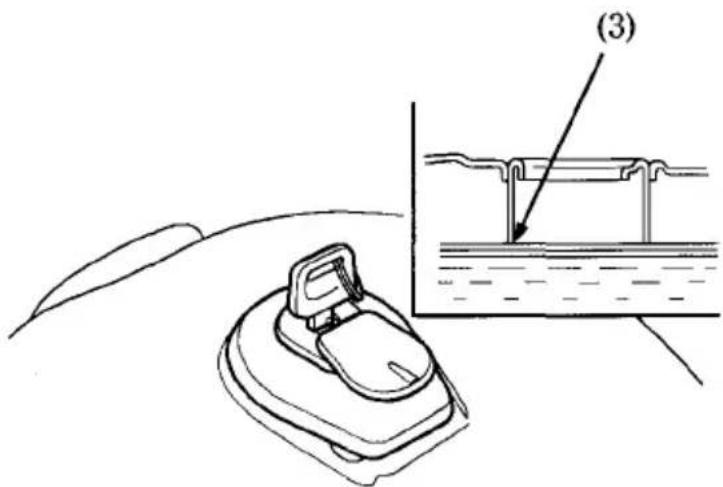
(3) Filler neck
Petrol Containing Alcohol
If you decide to use a petrol containing alcohol (gasohol), be sure it's octane rating is at least as high as that recommended by Honda. There are two types of "gasohol": one containing ethanol, and the other containing methanol. Do not use petrol that contains more than 10% ethanol. Do not use petrol containing methanol (methyl or wood alcohol) that does not also contain cosolvents and corrosion inhibitors for methanol. Never use petrol containing more than 5% methanol, even if it has cosolvents and corrosion inhibitors.
NOTE:
* Fuel system damage or engine performance problems resulting from the use of fuels that contain alcohol is not covered under the warranty. Honda cannot endorse the use of fuels containing methanol since evidence of their suitability is as yet incomplete.
* Before buying fuel from an unfamiliar station, try to find out if the fuel contains alcohol. If it does, confirm the type and percentage of alcohol used. If you notice any undesirable operating symptoms while using a petrol that contains alcohol, or one that you think contains alcohol, switch to a petrol that you know does not contain alcohol.
ENGINE OIL Engine Oil Level Check
Check the engine oil level each day before riding the motorcycle.
The level must be maintained between the upper (1) and lower (2) level marks on the dipstick (3).
- Start the engine and let it idle for a few minutes.
- Stop the engine and hold the motorcycle in an upright position on firm, level ground.
- After a few minutes, remove the oil filler cap/dipstick (3), wipe it clean, and reinsert the dipstick without screwing it in. Remove the dipstick. The oil level should be between the upper (1) and lower (2) level marks on the dipstick.
- If required, add the specified oil (see page 50) up to the upper level mark. Do not overfill.
- Replace the oil filler cap/dipstick. Check for oil leaks.
CAUTION:
* Running the engine with insufficient oil can cause serious engine damage.
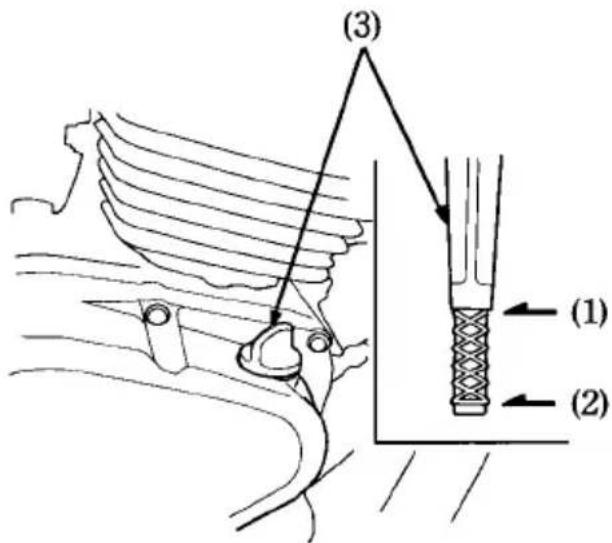
(1) Upper level mark
(2) Lower level mark
(3) Oil filler cap/dipstick
TYRES
Proper air pressure will provide maximum stability, riding comfort and tyre life.
Check tyre pressure frequently and adjust if necessary (page 23).
NOTE:
* Tyre pressure should be checked before you ride while the tyres are "cold".
* Check the tyres for cuts, embedded nails, or other sharp objects. See your authorized Honda dealer for replacement of damaged tyres or punctured inner tubes.
A WARNING
* Do not attempt to patch a damaged tyre or inner tube. Wheel balance and tyre reliability may be impaired.
* Improper tyre inflation will cause abnormal tread wear and create a safety hazard. Underinflation may result in the tyre slipping on, or coming off of the rim causing tyre deflation that may result in a loss of vehicle control.
A WARNING
* Operation with excessively worn tyres is hazardous and will adversely affect traction and handling.
* The use of tyres other than those listed in this manual may adversely affect handling.
Replace tyres before tread depth at the center of the tyre reaches the following limit:
| Minimum recommended tyre center tread depth | |
| Front | 1.5 mm (0.06 in) |
| Rear | 2.0 mm (0.08 in) |
| Front | Rear | ||
| Cold tyre pressure | Up to maximum weight capacity | 200 kPa (2.00 kg/cm2, 29 psi) | 200 kPa (2.00 kg/cm2, 29 psi) |
| Up to 90 kg (200 lbs) load | 200 kPa (2.00 kg/cm2, 29 psi) | 200 kPa (2.00 kg/cm2, 29 psi) | |
| Tyre size | 90/100-18 54S | 120/90-16 63S | |
| Tyre brand | DUNLOP | K300MA | K327AG |
| Maximum weight capacity | 160 kg (352 lbs) | ||
ESSENTIAL INDIVIDUAL COMPONENTS IGNITION SWITCH
The ignition switch (1) is beside the speedometer.
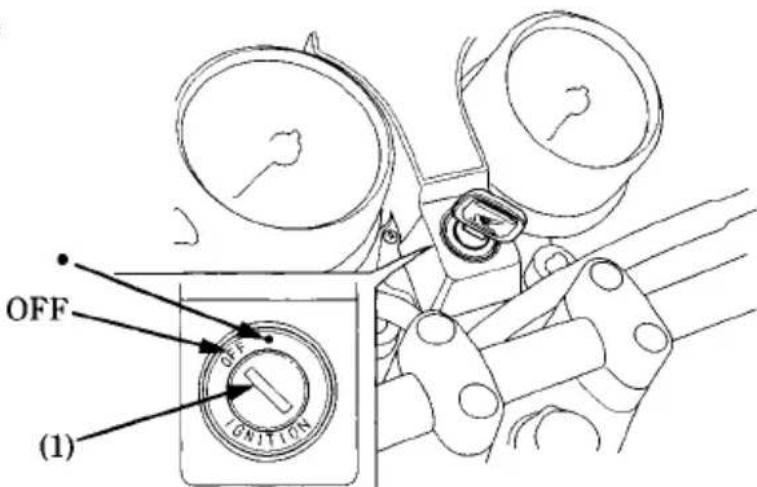
(1) Ignition switch
| Key Position | Function | Key Removal |
| O F F | Engine and lights cannot be operated. | Key can be removed |
| ● (O N) | Headlight, taillight and instrument lights are on and other lights can be operated.Engine can be started. | Key cannot be removed |
RIGHT HANDLEBAR CONTROLS Engine Stop Switch
The engine stop switch (1) is next to the throttle grip. When the switch is in the RUN position, the engine will operate. When the switch is in the OFF position, the engine will not operate. This switch is intended primarily as a safety or emergency switch and should normally remain in the RUN position.
NOTE:(E type)
* If your motorcycle is stopped with the ignition switch ON and the engine stop switch OFF, the headlight and taillight will still be on, resulting in battery discharge.
Headlight Switch (E type)
The headlight switch (3) has three positions, "H", "P" and "OFF" marked by a dot to the right of "P".
H: Headlight, taillight, position light and meter lights on.
P: Position light, taillight and meter lights on.
OFF (dot): Headlight, taillight, position light and meter lights off.
Starter Button
The starter button (2) is below the engine stop switch (1).
(E type)
When the starter button is pressed the starter motor will crank the engine, and the headlight will automatically go out, but the taillight will stay on.
See pages 33–35 or "Starting Procedure".
(U type)
When you press in the button, the starter cranks the engine.
See pages 33–35 or "Starting Procedure".

(1) Engine Stop switch (3) Headlight switch
(2) Starter Button
LEFT HANDLEBAR CONTROLS
The three controls next to the left handlebar grip are:
Headlight Dimmer Switch (1)
Select HI for beam, LO for low beam.
Turn Signal Switch (2)
Move to L to signal a left turn, R to signal a right turn. Return to the center (off) when finished.
Horn Button (3)
Press the button to sound the horn.
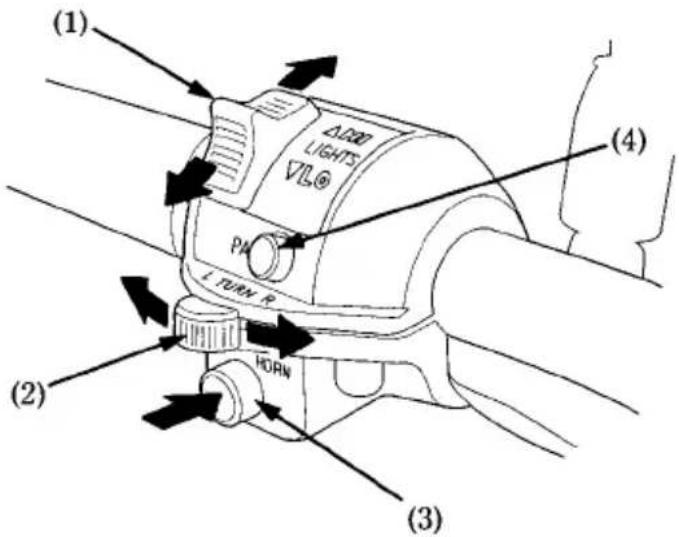
(1) Headlight dimmer switch
(2) Turn signal switch
(3) Horn button
(4) Passing light control switch
FEATURES
(Not required for operation)
STEERING LOCK
The steering lock (1) is on the steering stem.
To Lock:
Turn the handlebar all the way to the left or right, and insert the key into the lock, turn the key clockwise and remove it.
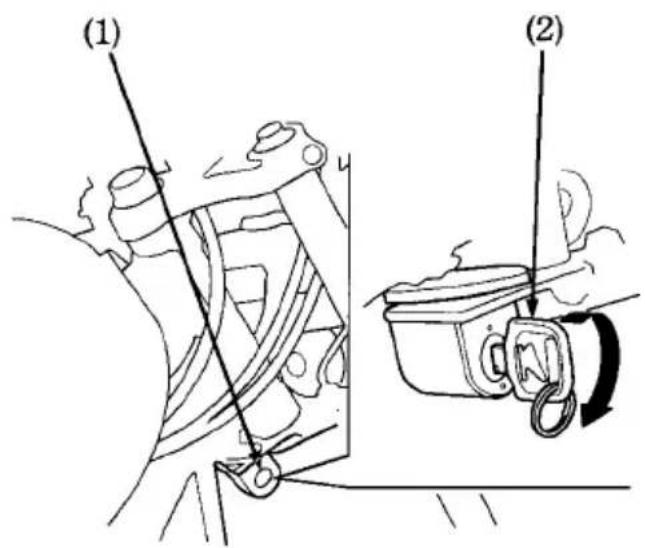
(1) Steering lock
(2) Ignition key
HELMET HOLDER
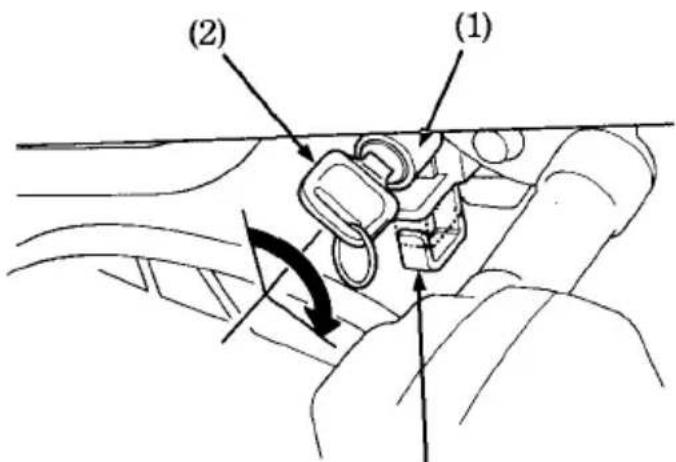
The helmet holder (1) is on the left side below the seat. Insert the ignition key (2) and turn it clockwise to unlock the holder. Hang your helmet on the holder pin (3). Turn the key counterclockwise to lock the holder and then remove the key.
(3)
(1) Helmet holder
(2) Ignition key
(3) Holder pin
WARNING
* The helmet holder is designed for helmet security while parked. Do not ride with a helmet attached to the holder; the helmet may interfere with safe operation and result in loss of control.
SEAT
To remove the seat (1), insert the ignition key (2) into the helmet holder (3), turn it clockwise and pull the seat lock lever (4) downward. Pull the seat back and up.
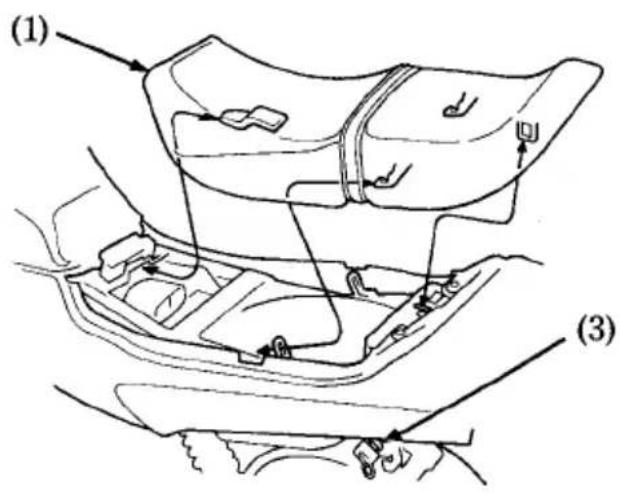
(1) Seat
(3) Helmet holder
To install the seat, insert the seat tab under the frame cross member and push down on the rear of the seat. Turn the key counterclockwise to lock the seat, then remove the key.
Lift the seat to make sure it is locked securely in position.
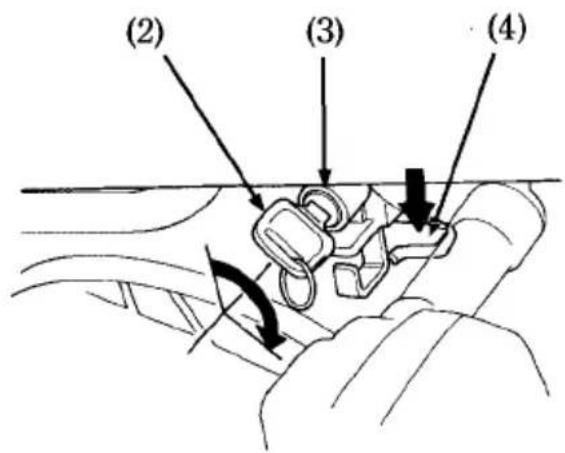
(2) Ignition key (3) Helmet holder
(4) Seat lock lever
DOCUMENT COMPARTMENT
The document compartment (1) is under the seat.
This owner's manual and other documents should be stored in the compartment.
When washing your motorcycle, be careful not to flood this area with water.
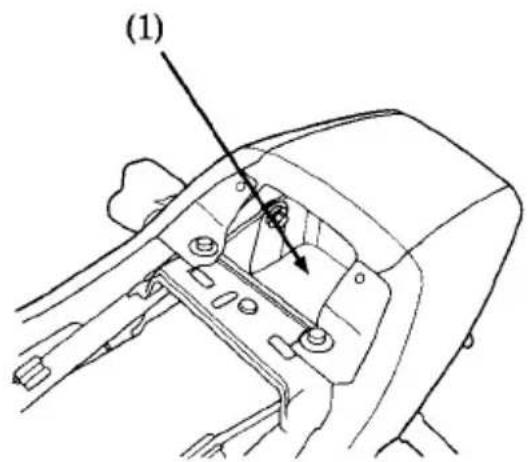
(1) Document compartment
SIDE COVER
To remove the side cover (1), remove the seat (see page 29), bolts (2) and pull out the studs (3).
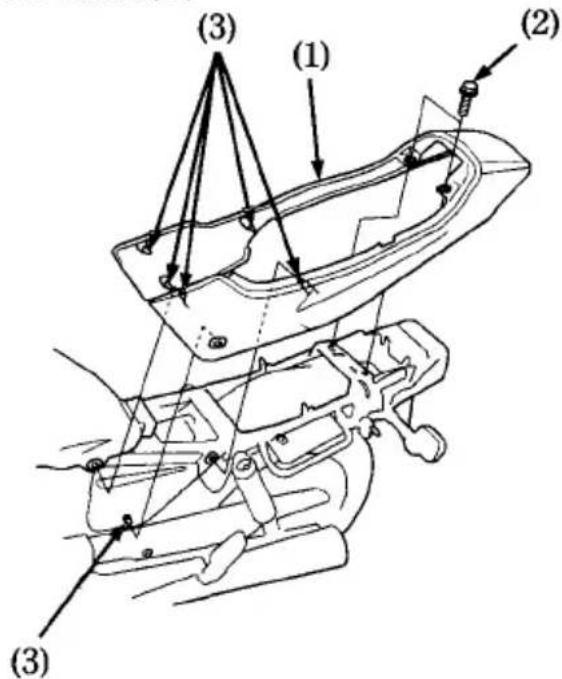
(1) Side cover
(2) Bolts
(3) Studs
OPERATION PRE-RIDE INSPECTION
A WARNING
* If the Pre-ride Inspection is not performed, severe personal injury or vehicle damage may result.
Inspect your motorcycle every day before you ride it. The items listed here will only take a few minutes to inspect, and in the long run they can save time, expense, and possibly your life.
- Engine oil level—add engine oil if required (page 21). Check for leaks.
- Fuel level—fill fuel tank when necessary (page 18). Check for leaks.
- Front and rear brakes—check operation and if necessary, adjust free play (pages 11 - 14).
- Tyres—check condition and pressure (page 22).
-
Drive chain—check condition and slack (page 58). Adjust and lubricate if necessary.
-
Throttle—check for smooth opening and closing in all steering positions.
- Lights and horn—check that headlight, tail/stoplight, turn signals, indicators and horn function properly.
- Engine stop switch—check for proper function (page 25).
- Side stand ignition cut-off system—check for proper function (page 65).
Correct any discrepancy before you ride. Contact your authorized Honda dealer for assistance if you cannot correct the problem.
STARTING THE ENGINE
This motorcycle is equipped with a side stand ignition cut-off system. The engine cannot be started if the side stand is down, unless the transmission is in neutral. If the side stand is up, the engine can be started in neutral or in gear with the clutch lever pulled in. After starting with the side stand down, the engine will shut off if the transmission is put in gear before raising the side stand.
▲WARNING
* Never run the engine in a closed area. The exhaust contains poisonous carbon monoxide gas that can cause loss of consciousness and may lead to death.
NOTE:
* Do not use the electric starter for more than 5 seconds at a time. Release the starter button for approximately 10 seconds before pressing it again.
Preparation
Before starting, insert the key, turn the ignition switch ON and confirm the following:
- The transmission is in NEUTRAL (neutral indicator light ON).
• The engine stop switch is at RUN.
• The fuel cock is ON.
Starting Procedure
To restart a warm engine, follow the procedure for "High Air Temperature."
Normal Air Temperature
$$ 1 0 ^ {\circ} - 3 5 ^ {\circ} \mathrm{C} (5 0 ^ {\circ} - 9 5 ^ {\circ} \mathrm{F}) $$
- Pull the chock knob (1) up all the way to Fully ON (A), if the engine is cold.
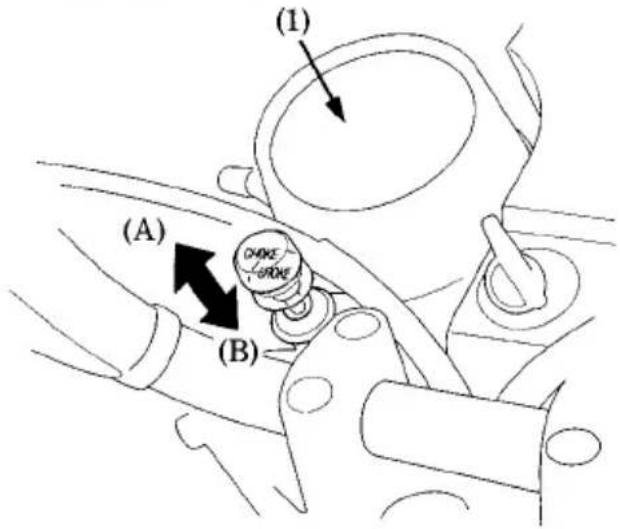
(1) Choke knob
(A) Fully ON
(B) Fully OFF
- Start the engine, leaving the throttle closed.
NOTE:
* Do not open the throttle when starting the engine with the choke ON. This will lean the mixture, resulting in hard starting.
-
Immediately after the engine starts, operate the choke knob (1) to keep fast idle.
-
About a half minute after the engine starts, push the choke knob (1) down all the way to Fully OFF (B).
-
If idling is unstable, open the throttle slightly.
Flooded Engine
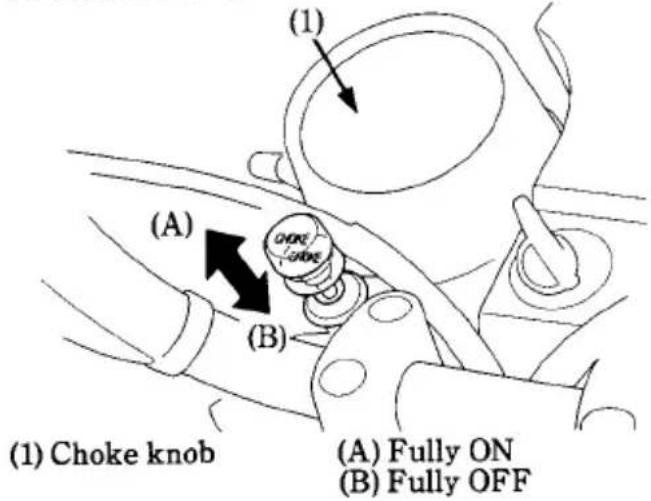
If the engine fails to start after repeated attempts, it may be flooded with excess fuel. To clear a flooded engine, turn the engine stop switch to OFF and push the choke knob to Fully OFF (B). Open the throttle fully and crank the engine for 5 seconds. Wait 10 seconds, then turn the engine stop switch to RUN and follow the "High Air Temperature" Starting Procedure (page 33).
RUNNING-IN
During the first 1,000 km (600 miles), avoid full throttle use and never labour the engine. Do not operate at any one speed for prolonged periods.
During initial running-in newly machined surfaces will be in contact with each other and these surfaces will wear in quickly. Running-in maintenance at 1,000km (600 miles) is designed to compensate for this initial minor wear. Timely performance of the running-in maintenance will ensure optimum service life and performance from the engine.
High Air Temperature
35°C (95°F) or above
- Do not use the choke.
- Open the throttle slightly.
- Start the engine.
Low Air Temperature
10 °C (50 °F) or below
- Follow steps 1-2 under "Normal Air Temperature."
- When engine rpm begins to pick up, operate the choke knob to keep fast idle.
- Continue warming up the engine until it runs smoothly and responds to the throttle when the choke knob (1) is at Fully OFF (B).
CAUTION:
* Snapping the throttle or fast idling for more than about 5 minutes at normal air temperature may cause exhaust pipe discoloration.
* Extended use of the choke may impair piston and cylinder wall lubrication.
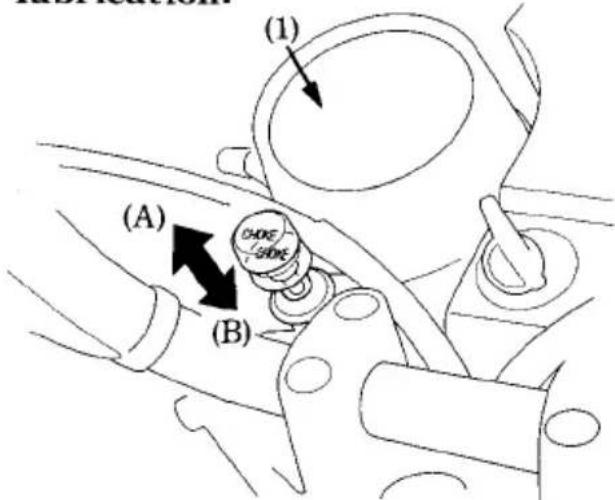
(1) Choke knob
(A) Fully ON
(B) Fully OFF
RIDING
▲WARNING
* Review Motorcycle Safety (pages 1—3) before you ride.
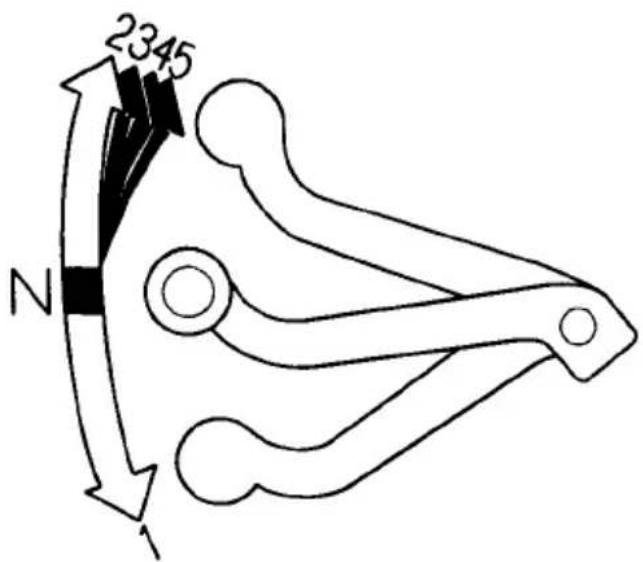
Shifting pattern
Proper shifting will provide better fuel economy. When changing gears under normal conditions, use these recommended shift points:
Shifting Up:
From 1st to 2nd : 12 mph (20 km/h)
From 2nd to 3rd : 19 mph (30 km/h)
From 3rd to 4th : 25 mph (40 km/h)
From 4th to 5th : 31 mph ( 50 km/h )
Shifting Down:
From 5th to 4th : 22 mph (35 km/h)
From 4th to 3rd : 15 mph (25 km/h)
Disengage the clutch when speed drops below 6 mph (10km/h), when engine roughness is evident, or when engine stalling is imminent; shift down to 1st gear for acceleration.
AWARNING
* Do not downshift when traveling at a speed that would force the engine to overrev in the next lower gear; the rear wheel may lose traction, resulting in a possible loss of vehicle control.
CAUTION:
* Do not shift gears without disengaging the clutch and closing the throttle. The engine and drive train could be damaged by overspeed and shock.
* Do not tow the motorcycle or coast for long distances while the engine is off. The transmission will not be properly lubricated and damage may result.
* Do not ride over a curb or rub the wheel against an obstacle, as wheel damage may result.
CAUTION:
* Do not run the engine at high rpm with the transmission in neutral or the clutch lever pulled in. Serious engine damage may result.
NOTE:
* The battery will not charge while the engine speed is near idle speed. Avoid idling for prolonged periods, or continuous operation below: 1,500rpm
HIGH ALTITUDE RIDING
When operating this motorcycle at high altitude, the air-fuel mixture becomes overly rich. Above 2,000 m (6,500 feet), driveability and performance may be reduced and fuel consumption increased. The carburetor can be modified to compensate for this high altitude richness. However, the carburetor must be returned to standard factory specifications when lower altitude riding is desired. See your authorized Honda dealer for high altitude modification.
CAUTION:
* Sustained operation at altitudes below 1,500 m (5,000 feet) with high altitude carburetor modifications may cause engine overheating and damage.
BRAKING
- For normal braking, gradually apply both front and rear brakes while downshifting to suit your road speed.
- For maximum deceleration, close the throttle and apply the front and rear brakes firmly. Disengage the clutch before the motorcycle stops.
A WARNING
* Independent use of only the front or rear brake reduces stopping performance. Extreme braking may cause either wheel to lock, reducing control of the motorcycle.
* When possible, reduce speed or brake before entering a turn; closing the throttle or braking in mid-turn may cause wheel slip. Wheel slip will reduce control of the motorcycle.
A WARNING
* When riding in wet or rainy conditions, or on loose surfaces, the ability to maneuver and stop will be reduced. All of your actions should be smooth under these conditions. Rapid acceleration, braking or turning may cause loss of control. For your safety, exercise extreme caution when braking, accelerating or turning.
* When descending a long, steep grade, use engine compression braking by downshifting, with intermittent use of both brakes. Continuous brake application can overheat the brakes and reduce their effectiveness.
* Riding with your foot resting on the brake pedal or your hands on the brake lever may actuate the brakelight, giving a false indication to other drivers. It may also overheat the brake, reducing effectiveness.
PARKING
-
After stopping the motorcycle, shift the transmission into neutral, turn the handlebar fully to the left, turn the ignition switch OFF and remove the key.
-
Use the side stand to support the motorcycle while parked.
CAUTION:
* Park the motorcycle on firm, level ground to prevent it from falling over.
* If you must park on a slight incline, aim the front of the motorcycle uphill to reduce the possibility of rolling off the side stand or overturning.
- Lock the steering to help prevent theft (page 27).
ANTI-THEFT TIPS
- Always lock the steering and never leave the key in the ignition switch. This sounds simple but people do forget.
- Be sure the registration information for your motorcycle is accurate and current.
- Park your motorcycle in a locked garage whenever possible.
- Use an additional anti-theft device of good quality.
- Put your name, address, and phone number in this Owner's Manual and keep it on your motorcycles at all times. Many times stolen motorcycles are identified by information in the Owner's Manuals that are still with them.
NAME:
ADDRESS:
PHONE NO: ____
MAINTENANCE
- When service is required, remember that your authorized Honda dealer knows your motorcycle best and is fully equipped to maintain and repair it. The scheduled maintenance may also be performed by a qualified service facility that normally does this kind of work; or you may perform most of the work yourself if you are mechanically qualified and have the proper tools and service data.
• These instructions are based on the assumption that the motorcycle will be used exclusively for its designed purpose. Sustained high speed operation, or operation in unusually wet or dusty conditions, will require more frequent service than specified in the MAINTENANCE SCHEDULE. Consult your authorized Honda dealer for recommendations applicable to your individual needs and use.
MAINTENANCE SCHEDULE
The following items require some mechanical knowledge. Certain items (particularly those marked * and **) may require more technical information and tools. Consult your authorized Honda Dealer.
Perform the Pre-ride Inspection (page 31) at each scheduled maintenance period.
I: INSPECT AND CLEAN, ADJUST, LUBRICATE OR REPLACE IF NECESSARY
C: CLEAN R: REPLACE A: ADJUST L: LUBRICATE
| ITEM\FREQUENCY | WHICHEVER → ODOMETER READING [NOTE (1)] | ||||||||||
| COMES FIRST↓NOTE | x 1,000 km | 1 | 6 | 12 | 18 | 24 | 30 | 36 | Refer to | ||
| x 1,000 mi | 0.6 | 4 | 8 | 12 | 16 | 20 | 24 | ||||
| MONTHS | 6 | 12 | 18 | 24 | 30 | 36 | |||||
| * | FUEL LINE | I | I | I | — | ||||||
| * | FUEL STRAINER SCREEN | C | C | C | C | C | C | — | |||
| * | THROTTLE OPERATION | I | I | I | — | ||||||
| * | CARBURETOR CHOKE | I | I | I | — | ||||||
| AIR CLEANER | NOTE (2) | R | R | Page 48 | |||||||
| CRANKCASE BREATHER | NOTE (3) | C | C | C | C | C | C | Page 52 | |||
| SPARK PLUG | I | R | I | R | I | R | Pages 53-54 | ||||
| * | VALVE CLEARANCE | I | I | I | I | I | I | I | — | ||
| ENGINE OIL | R | R | R | R | R | R | R | Pages 49-51 | |||
| ** | ENGINE OIL STRAINER SCREEN | C | C | C | — | ||||||
| * | CARBURETOR IDLE SPEED | I | I | I | I | I | I | I | Page 55 | ||
| BRAKE FLUID | NOTE (4) | I | I | R | I | I | R | Pages 11-12 | |||
| FREQUENCYITEM | WHICHEVER → ODOMETER READING [NOTE(1)] | |||||||||
| COMES FIRST↓NOTE | x1,000km | 1 | 6 | 12 | 18 | 24 | 30 | 36 | ||
| x1,000mi | 0.6 | 4 | 8 | 12 | 16 | 20 | 24 | |||
| MONTHS | 6 | 12 | 18 | 24 | 30 | 36 | ||||
| DRIVE CHAIN | I,L EVERY 1000km (600mi) | Pages 56-57 | ||||||||
| BRAKE SHOE WEAR | I | I | I | I | I | Pages 14 | ||||
| BRAKE SYSTEM | I | I | I | Pages 11-14 | ||||||
| * | BRAKE LIGHT SWITCH | I | I | — | ||||||
| * | HEADLIGHT AIM | I | I | — | ||||||
| CLUTCH SYSTEM | I | I | I | I | I | I | Pages 15-16 | |||
| SIDE STAND | I | I | Page 65 | |||||||
| * | SUSPENSION | I | I | — | ||||||
| * | NUTS, BOLTS, FASTENERS | I | I | I | — | |||||
| ** | WHEELS/TYRES | I | I | I | I | I | I | — | ||
| ** | STEERING HEAD BEARINGS | I | I | I | — | |||||
* SHOULD BE SERVICED BY AN AUTHORIZED HONDA DEALER, UNLESS THE OWNER HAS PROPER TOOLS AND SERVICE DATA AND IS MECHANICALLY QUALIFIED. REFER TO THE OFFICIAL HONDA SHOP MANUAL.
* * IN THE INTEREST OF SAFETY, WE RECOMMEND THESE ITEMS BE SERVICED ONLY BY AN AUTHORIZED HONDA DEALER.
NOTES: (1) At higher odometer readings, repeat at the frequency interval established here.
(2) Service more frequently when riding in unusually wet or dusty areas.
(3) Service more frequently when riding in rain or at full throttle.
(4) Replace every 2 years, or at indicated odometer interval, whichever came first. Replacement requires mechanical skill.
TOOL KIT
The tool kit (1) is stored in the tool compartment under the right side cover.
To open the tool compartment, insert the ignition key (2) and turn it clockwise to unlock.
To close the tool compartment, close the compartment cover and turn the ignition key counterclockwise to lock.
Some roadside repairs, minor adjustments and parts replacement can be performed with the tools contained in the kit.
- 10 x 12 mm open end wrench
- 14 x 17 mm open end wrench
• Pliers
•Standard/phillips screwdriver - Screwdriver grip
- 22 mm box end wrench
• Pin spanner
•Breaker bar - Spark plug wrench
- Handle bar
- Tool bag
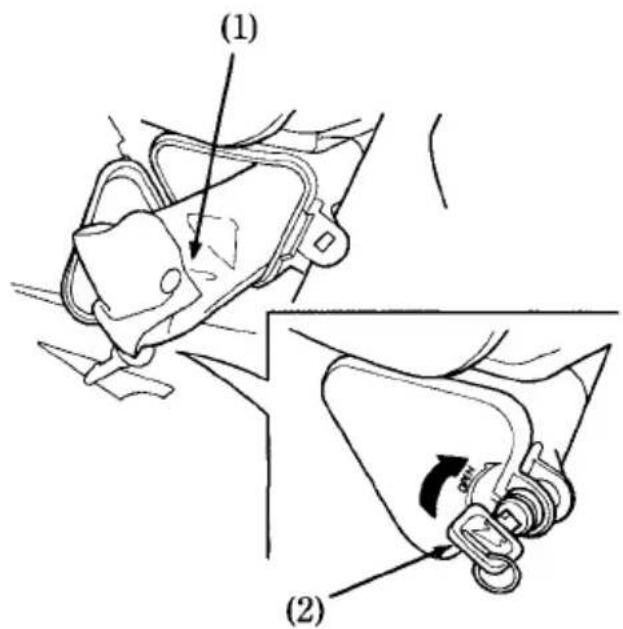
(1) Tool kit
(2) Ignition key
SERIAL NUMBERS
The frame and engine serial numbers are required when registering your motorcycle. They may also be required by your dealer when ordering replacement parts.
Record the numbers here for your reference.
FRAME NO. ____
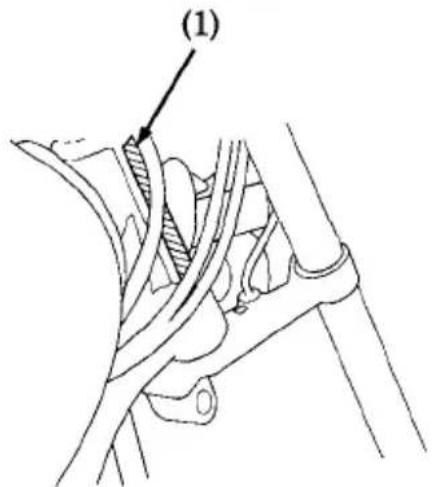
(1) Frame number
The frame number (1) is stamped on the right side of the steering head.
The engine number (2) is stamped on the left side of the crankcase.
ENGINE NO. ____
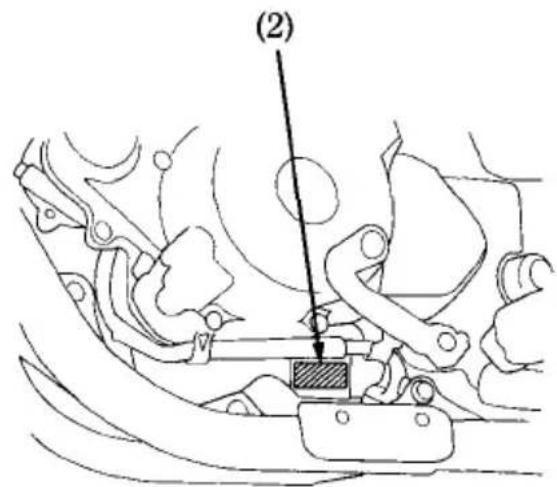
(2) Engine number
COLOUR LABEL
The color label (1) is attached to the frame below the seat.
It is helpful when ordering replacement parts. Record the colour and code here for your reference.
COLOR
CODE
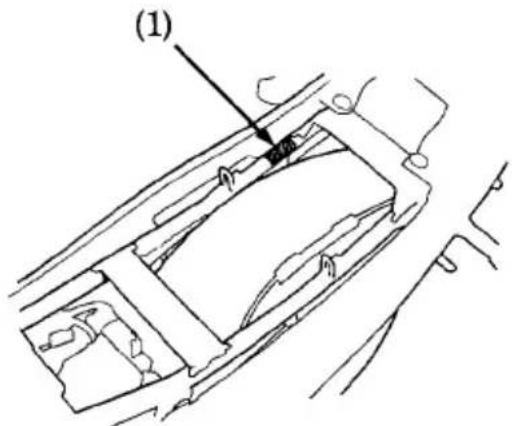
(1) Color label
LICENSE PLATE
When you install a license plate (1), be sure to use the washers (2) under the heads of the plate mounting screws, as shown.
Otherwise, the plate may damage itself.
NOTE:
* The washers are placed in a plastic bag in the document compartment.
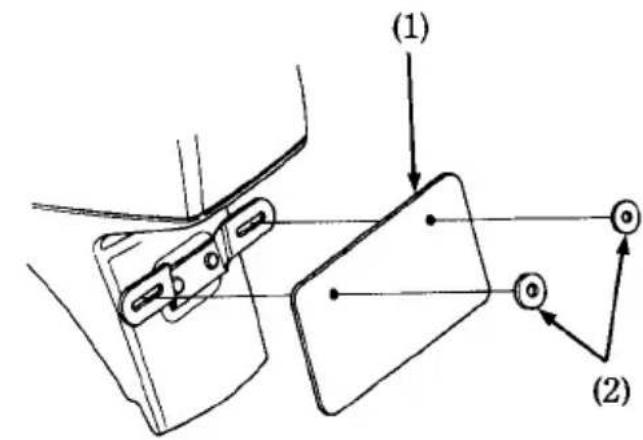
(1) Licsnse plate
(2) Washers
MAINTENANCE PRECAUTIONS
▲WARNING
* If your motorcycle is overturned or involved in a collision, inspect control levers, cables, brake hoses, calipers, accessories, and other vital parts for damage. Do not ride the motorcycle if damage impairs safe operation. Have your authorized Honda dealer inspect the major components, including frame, suspension and steering parts, for misalignment and damage that you may not be able to detect.
* Use new, genuine Honda parts or their equivalent for maintenance and repair. Parts which are not of equivalent quality may impair the safety of your motorcycle and the effective operation of the emission control systems.
WARNING
* Stop the engine and support the motorcycle securely on a firm, level surface before performing any maintenance.
AIR CLEANER
(Refer to the maintenance precautions on page 47).
The air cleaner should be serviced at regular intervals (page 43). Service more frequently when riding in unusually wet or dusty areas.
- Remove the seat (see page 29) and the side cover (see page 30).
- Remove the air cleaner cover (1) by removing the three screws (2).
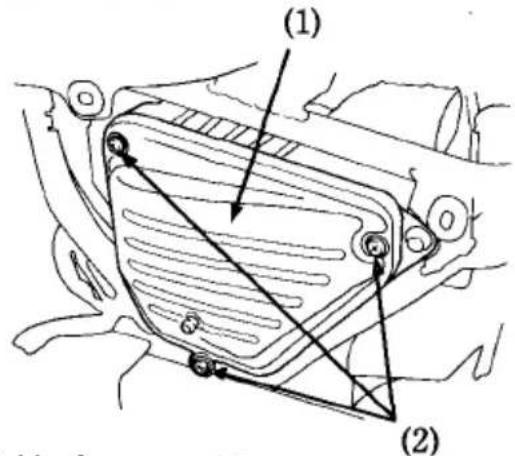
(1) Air cleaner cover
(2) Screws
- Pull out the element retainer (3) and remove the air cleaner element (4).
- Disconnect the tube (5) from the air cleaner element.
- Discard the air cleaner element.
- Install a new air cleaner element.
- Install the removed parts in the reverse order of removal.
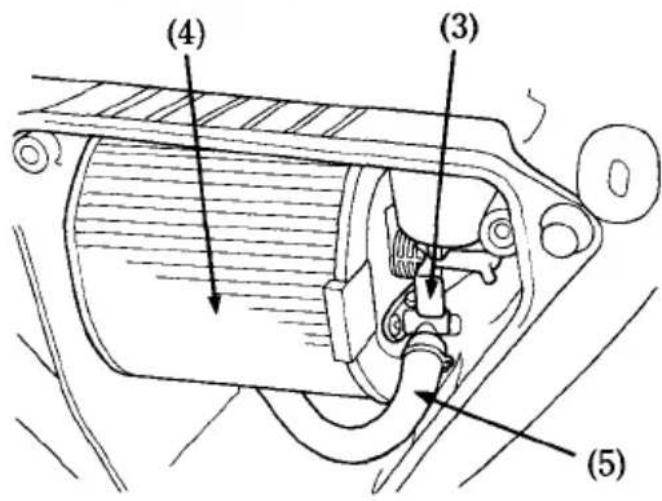
(3) Element retainer
(4) Air cleaner element
(5) Tube
ENGINE OIL
(Refer to the maintenance precautions on page 47).
Engine Oil
Good engine oil has many desirable qualities. Use only high detergent, quality motor oil certified on the container to meet or exceed requirements for service SE, SF or SG.
Viscosity:
Viscosity grade of engine oil should be based on average atmospheric temperature in your riding area. The following provides a guide to the selection of the proper grade or viscosity of oil to be used at various atmospheric temperatures.
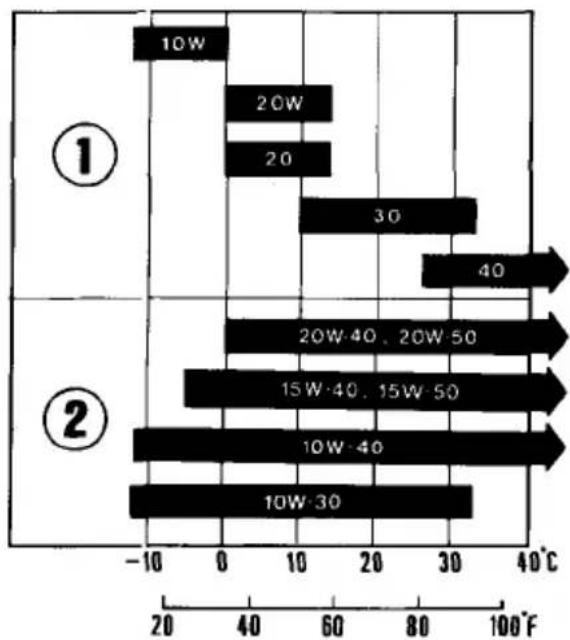
bar
| Temperature Range | Value | | :--- | :--- | | 10W | 10W | | 20W | 20W | | 20 | 20 | | 30 | 30 | | 40 | 40 | | 20W-40, 20W-50 | 20W-40, 20W-50 | | 15W-40, 15W-50 | 15W-40, 15W-50 | | 10W-40 | 10W-40 | | 10W-30 | 10W-30 |(1) Single grade
(2) Multigrade
Engine oil quality is the chief factor affecting engine service life. Change the engine oil as specified in the maintenance schedule (page 42).
NOTE:
* Change the engine oil with the engine at normal operating temperature and the motorcycle on its side stand to assure complete and rapid draining.
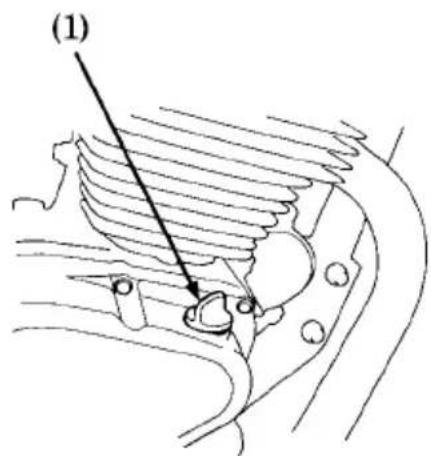
(1) Oil filler cap
-
To drain the oil, remove the oil filler cap (1), crankcase drain plug (2) and sealing washer (3).
-
Check that the sealing washer on the drain plug is in good condition and install the plug.
Oil Drain Plug Torque: 25 N·m (2.5 kg·m, 18 lb·ft)
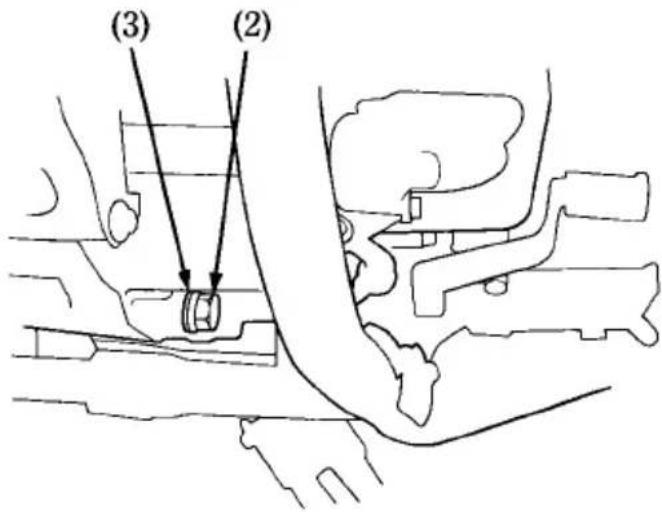
(2) Oil drain plug
(3) Sealing washer
-
Fill the crankcase with the recommended grade oil; approximately: 1.5 ℓ (1.6 US qt, 1.3 Imp qt)
-
Install the oil filler cap.
- Start the engine and let it idle for 2-3 minutes.
- Stop the engine and check that the oil level is at the upper level mark on the dipstick with the motorcycle upright on firm, level ground. Make sure there are no oil leaks.
NOTE:
* When running in very dusty conditions, oil changes should be performed more frequently than specified in the maintenance schedule.
NOTE:
* Please dispose of used engine oil in a manner that is compatible with the environment. We suggest you take it in a sealed container to your local recycling center or service station for reclamation. Do not throw it in the rubbish or pour it on the ground.
CAUTION:
* Used engine oil may cause skin cancer if repeatedly left in contact with the skin for prolonged periods. Although this is unlikely unless you handle used oil on a daily basis, it is still advisable to thoroughly wash your hands with soap and water as soon as possible after handling used oil.
CRANKCASE BREATHER
(Refer to the maintenance precautions on page 47).
-
Remove the drain plug (1) from the tube and drain deposits.
-
Reinstall the drain plug.
NOTE:
* Service more frequently when riding in rain or at full throttle.
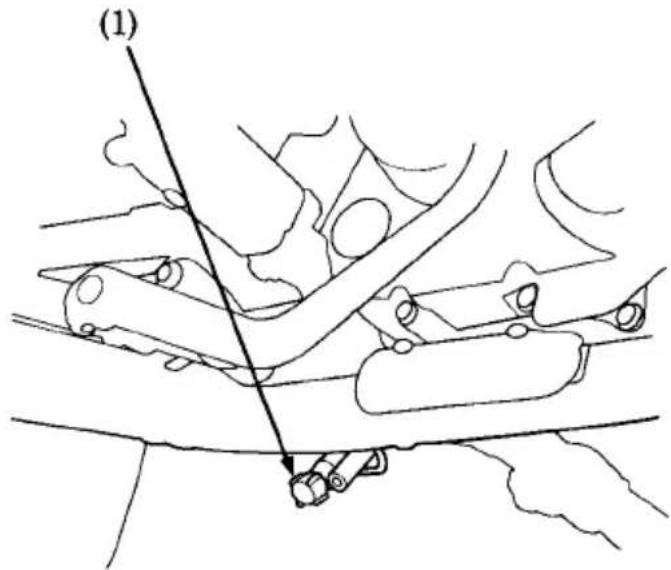
(1) Drain plug
SPARK PLUGS
(Refer to the maintenance precautions on page 47).
Recommended plugs:
Standard:
CR6HSA (NGK) or
U20FSR-U (NIPPONDENSO)
For cold climate: (Below 5°C, 41°F)
CR5HSA (NGK) or
U16FSR-U (NIPPONDENSO)
For extended high speed riding:
CR7HSA (NGK) or
U22FSR-U (NIPPONDENSO)
-
Disconnect the spark plug caps from the spark plugs.
-
Clean any dirt from around the spark plug bases.
-
Remove the spark plugs using the plug wrench furnished in the tool kit.
-
Inspect the electrodes and center porcelain for deposits, erosion or cabon fouling. If the erosion or deposit is heavy, replace the plug. Clean a carbon or wet-fouled plug with a plug cleaner, otherwise use a wire brush.
-
Check the spark plug gap (1) using a wire-type feeler gauge. If adjustment is necessary, bend the side electrode (2) carefully.
The gap should be:
0.60-0.70 mm(0.024-0.028 in)
Make sure the plug washer is in good condition.
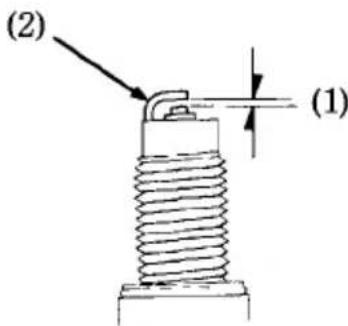
(1) Spark plug gap
(2) Side electrode
-
With the plug washer attached, thread the spark plug in by hand to prevent cross-threading.
-
Tighten a new spark plug 1/2 turn with a spark plug wrench to compress the washer. If you are reusing a plug, it should only take 1/8-1/4 turn after the plug seats.
-
Reinstall the spark plug caps.
CAUTION:
* The spark plug must be securely tightened. An improperly tightened plug can become very hot and possibly damage the engine.
* Never use a spark plug with an improper heat range. Severe engine damage could result.
IDLE SPEED
(Refer to the maintenance precautions on page 47).
The engine must be at normal operating temperature for accurate idle speed adjustment. Ten minutes of stop-and-go riding is sufficient.
NOTE:
* Do not attempt to compensate for faults in other systems by adjusting idle speed. See your authorized Honda dealer for regularly scheduled carburetor adjustments.
- Warm up the engine, shift to neutral and place the motorcycle on its center stand.
- Adjust idle speed with the throttle stop screw (1).
Idle speed (In neutral): 1,500 ± 100 min^-1 (rpm)
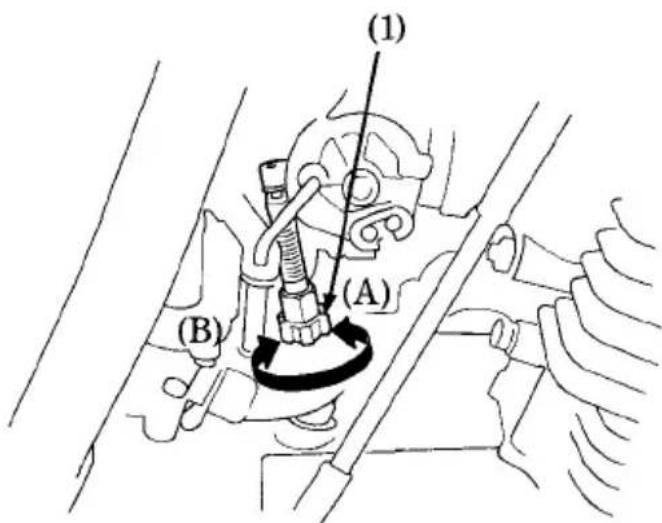
(1) Throttle stop screw
(A) Increase (B) Decrease
DRIVE CHAIN
(Refer to the maintenance precautions on page 47).
The service life of the drive chain is dependent upon proper lubrication and adjustment. Poor maintenance can cause premature wear or damage to the drive chain and sprockets.
The drive chain should be checked and lubricated as part of the Pre-ride Inspection (page 31). Under severe usage, or when the motorcycle is ridden in unusually dusty or muddy areas, more frequent maintenance will be necessary.
-
Turn the engine off, place the motorcycle on its side stand and shift the transmission into neutral.
-
Check slack in the lower drive chain run midway between the sprockets.
Drive chain slack should be adjusted to allow the following vertical movement by hand.
20-30 mm (0.8-1.2 in)
- Roll the motorcycle and check drive chain slack as the wheel rotates. Drive chain slack should remain constant as the wheel rotates. If the chain is slack only in certain sections, some links are kinked and binding. Binding and kinking can frequently be eliminated by lubrication.
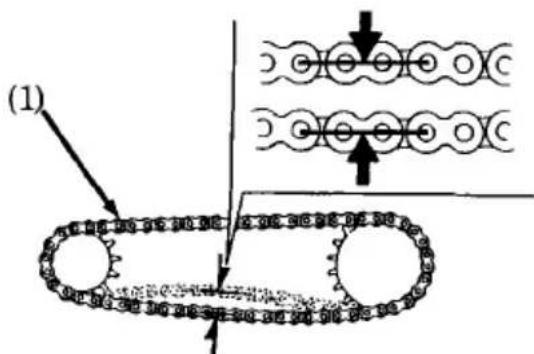
(1) Drive chain
- Rotate the rear wheel slowly and inspect the drive chain and sprockets for any of the following conditions:
DRIVE CHAIN
*Damaged Rollers
*Loose Pins
*Dry or Rusted Links
*Kinked or Binding Links
*Excessive Wear
*Improper Adjustment
*Missing O-rings
SPROCKETS
*Excessively Worn Teeth
*Broken or Damaged Teeth
A drive chain with damaged rollers, loose pins, or missing O-rings must be replaced. A chain which appears dry, or shows signs of rust, requires supplementary lubrication. Kinked or binding links should be thoroughly lubricated and worked free. If links cannot be freed, the chain must be replaced.
Damaged Sprocket Teeth
Worn Sprocket Teeth
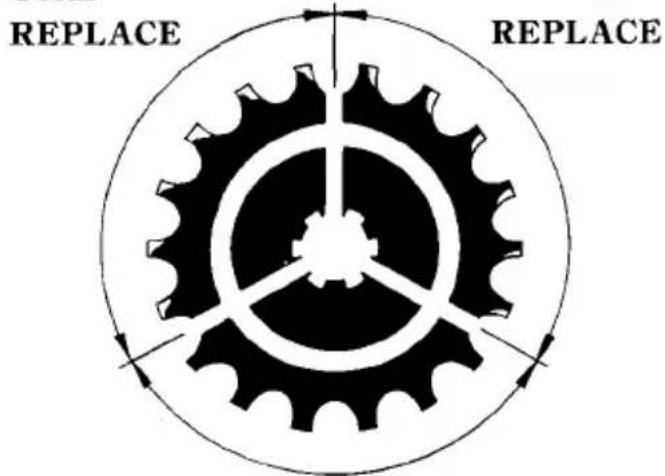
Normal Sprocket Teeth GOOD
This motorcycle has a staked master link drive chain which requires a special tool for cutting and staking. Do not use an ordinary master link with this chain. See your authorized Honda dealer.
Adjustment:
Drive chain slack should be checked and adjusted, if necessary, every 1,000 km (600 miles). When operated at sustained high speeds or under conditions of frequent rapid acceleration, the chain may require more frequent adjustment.
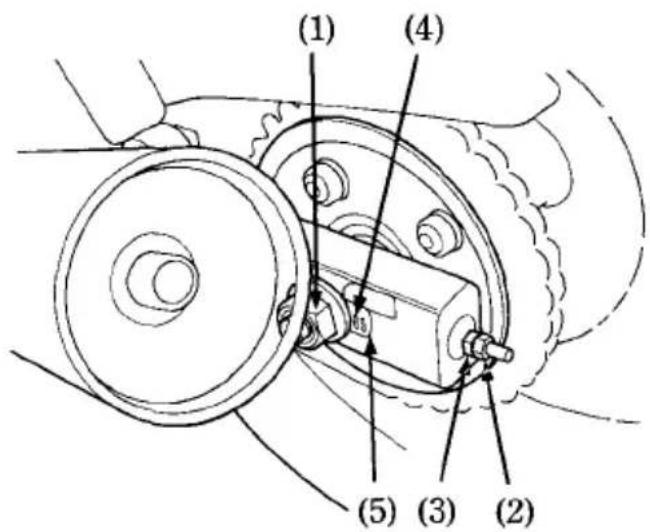
(1) Axle nut
(2) Lock nut
(3) Adjusting nut
(4) Index mark
(5) Rear edge of adjusting slot
If the drive chain requires adjustment, the procedure is as follows:
-
Place the motorcycle on its side stand with the transmission in neutral and the ignition switch off.
-
Loosen the axle nut (1).
-
Loosen both lock nuts (2) on the swingarm.
-
Turn both adjusting nuts (3) an equal number of turns until the correct drive chain slack is obtained. Turn the adjusting nuts clockwise to tighten the chain, or counterclockwise to provide more slack. Adjust the chain slack at a point midway between the drive sprocket and the rear wheel sprocket. Rotate the rear wheel and recheck slack at other sections of the chain.
Chain slack should be:
20-30 mm (0.8-1.2 in)
-
Check rear axle alignment by making sure the chain adjuster index marks (4) align with the rear edge (5) of the adjusting slots.
-
Both left and right marks should correspond. If the axle is misaligned, turn the left or right adjusting nut until the marks correspond on the rear edge of the adjusting slots and recheck chain slack.
-
Tighten the axle nut to specified torque. Axle nut torque:
60 N·m(6.0 kg-m,43 lb-ft)
- Tighten the adjusting nuts lightly, then tighten the lock nuts by holding the adjusting nuts with a spanner.
CAUTION:
* The drive chain on this motorcycle is equipped with small O-rings between the link plates. These O-rings retain grease inside the chain to improve its service life. However, special precautions must be taken when adjusting, lubricating, washing, and replacing the chain.
Wear inspection:
Check the chain wear label when adjusting the chain. If the red zone (1) on the label aligns with the long index mark (2) on the chain adjuster plates after the chain has been adjusted to the proper slack, the chain is excessively worn and must be replaced. The proper slack is:
20-30 mm (0.8-1.2 in)
CAUTION:
* Damage to the bottom part of the frame may be caused by excessive drive chain slack of more than: 40 mm (1.6 in)
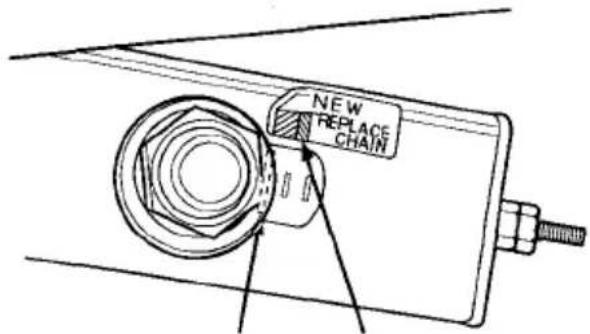
(2)
(1)
(1) Red zone
(2) Long index mark
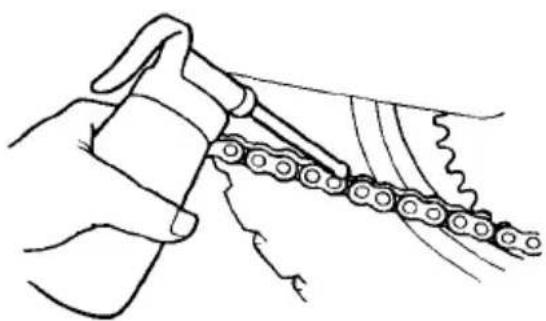
Lubrication and cleaning:
Lubricate every 1,000 km (600 miles) or sooner if chain appears dry.
The O-rings in this chain can be damaged by steam cleaning, high pressure washers, and certain solvents. Clean the chain with high flash-point solvent, such as kerosene. Wipe dry and lubricate only with SAE 80 or 90 gear oil. Commercial chain lubricants may contain solvents which could damage the rubber O-rings.
Chain Replacement:
DID 520VC6 or RK 520MOZ9
natural_image
Line drawing of a hand holding a chain link, no text or symbols presentWHEEL REMOVAL
(Refer to the maintenance precautions on page 47).
NOTE:
If front or rear wheel removal is required, it will be necessary to raise the center of the motorcycle with a jack or other firm support. If none is available, see your authorized Honda dealer for this service.
Front Wheel Removal
- Raise the front wheel off the ground by placing a support block under the engine.
- Remove the axle nut (1), and remove the axle (2).
- Remove the front wheel.
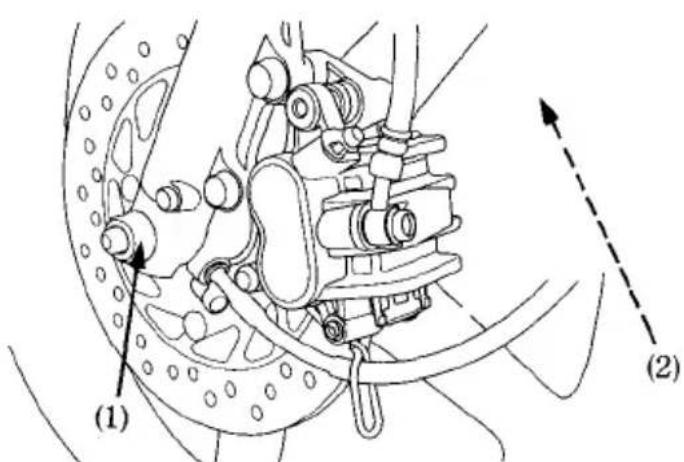
(1) Axle nut (2) Axle
Installation Note:
To install the front wheel assembly, position the wheel between the fork legs. Insert the front axle from the left side, through the left front fork leg and wheel hub. Position the lug on the speedometer gearbox against the lug (3) on the left fork leg. Install and tighten the axle nut to the specified torque.
Axle bolt torque:
60 N·m (6.0 kg-m, 44 lb-ft)
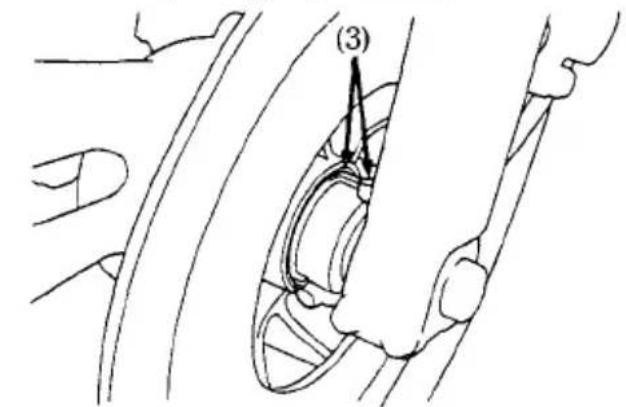
(3) Lugs
Brake pad wear will depend upon the severity of usage, type of riding and condition of the roads. The pads will wear faster on dirty and wet roads. Inspect the pads visually during all regular service intervals to determine the pad wear. If either pad wears to the groove (1), both pads must be replaced as a set.
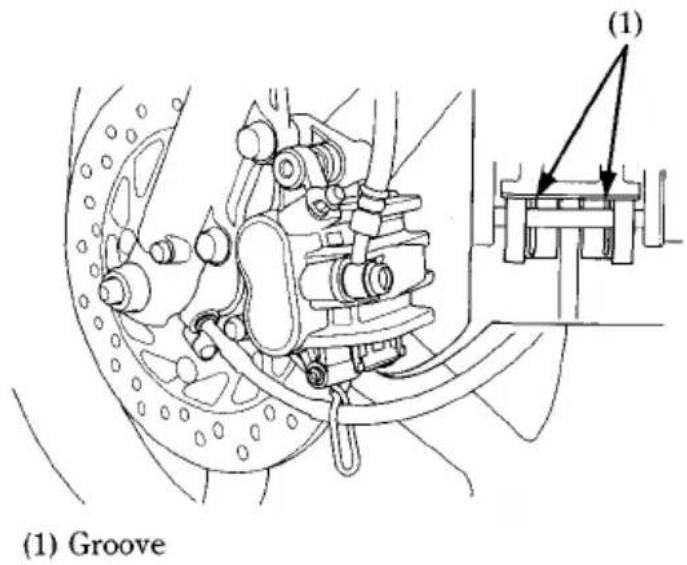
NOTE:
* Use only genuine Honda replacement friction pads offered by authorized Honda dealers. When brake service is necessary consult your Honda dealer.
WARNING
* Failure to provide adequate disc to caliper holder clearance may damage the brake discs and impair braking efficiency.
Rear Wheel Removal
- Raise the rear wheel off the ground by placing a support block under the engine.
- Remove the rear brake adjusting nut (1), disconnect the brake rod (2) from the brake arm (3).
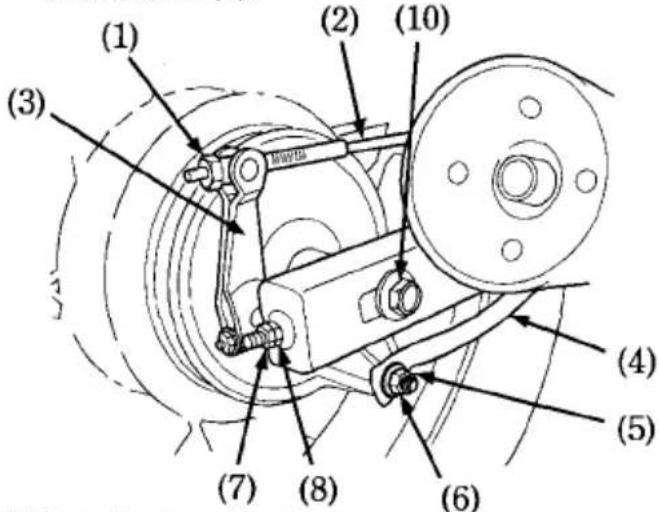
(1) Rear brake adjusting nut
(2) Brake rod (6) Stopper arm nut
(3) Brake arm (7) Lock nut
(4) Brake stopper arm (8) Chain adjusting nut
(5) Cotter pin (10) Axle
- Disconnect the brake stopper arm (4) from the brake panel by removing the cotter pin (5), stopper arm nut (6), washer and rubber grommet.
- Loosen the lock nuts (7) and drive chain adjusting nuts (8).
- Remove the axle nut (9).
- Remove the drive chain from the driven sprocket by pushing the rear wheel forward.
- Remove the axle (10), side collar and rear wheel from the swing arm.
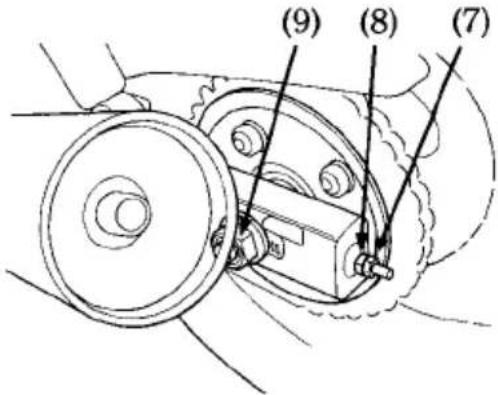
(7) Lock nut
(8) Chain adjusting nut
(9) Axle nut
Installation Notes:
- To install the rear wheel, reverse the removal procedure.
- Tighten and torque the nuts to the specification listed.
Axle nut torque:
60 N·m(6.0 kg-m,43 lb-ft)
Brake stopper arm nut torque:
22 N·m (2.2 kg-m, 16 lb-ft)
- Adjust the dirve chain (see page 57) and brake (see page 13).
- After installing the wheel, apply the brake several times and then check if the wheel rotates freely. Recheck the wheel if the brake drags or if the wheel does not rotate freely.
WARNING
* If a torque wrench was not used for installation, see your authorized Honda dealer as soon as possible to verify proper assembly. Improper assembly may lead to loss of braking capacity.
SIDE STAND
(Refer to the maintenance precautions on page 47).
Check the side stand system for proper function.
- Check the spring (1) for damage or loss of tension and the side stand assembly for freedom of movement.
-
Check the side stand ignition cut-off system:
-
Sit astride the motorcycle; put the side stand up and the transmission in neutral.
- Start the engine and with the clutch lever pulled in, shift the transmission into gear.
- The engine should stop as you put the side stand down.
If the side stand system does not operate as described, see your authorized Honda dealer for service.
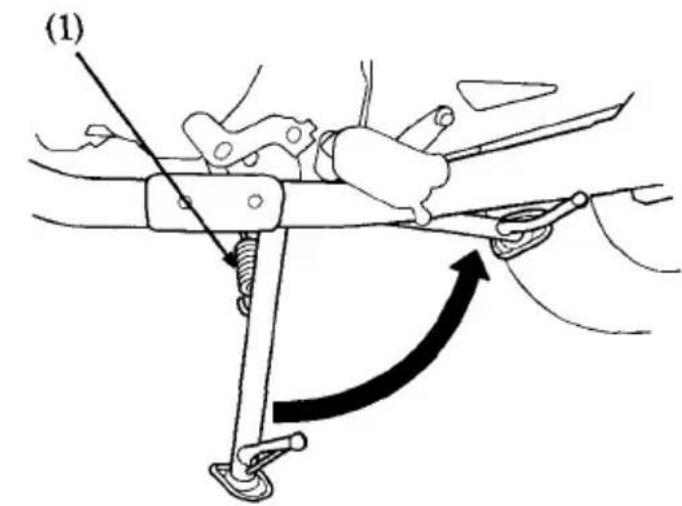
(1) Spring
BATTERY
(Refer to the maintenance precautions on page 47).
It is not necessary to check the battery electrolyte level or add distilled water as the battery is a maintenance-free (sealed) type. If your battery seems weak and/or is leaking electrolyte (causing hard starting or other electrical troubles), contact your authorized Honda dealer.
CAUTION:
*Removing the battery caps can damage the caps and result in leaks and eventual battery damage.
* When the motorcycle is to be stored for an extended period of time, remove the battery from the motorcycle and charge it fully. Then store it in a cool, dry place. If the battery is to be left in the motorcycle, disconnect the negative cable from the battery terminal.
A WARNING
* The battery gives off explosive gases; keep sparks, flames, and cigarettes away. Provide adequate ventilation when charging or using the battery in an enclosed space.
* The battery contains sulfuric acid (electrolyte). Contact with skin or eyes may cause severe burns. Wear protective clothing and a face shield.
—If electrolyte gets on your skin, flush with water.
—If electrolyte gets in your eyes, flush with water for at least 15 minutes and call a physician immediately.
* Electrolyte is poisonous.
—If swallowed, drink large quantities of water or milk and follow with milk of magnesia or vegetable oil and call a physician.
* KEEP OUT OF REACH OF CHILDREN.
Battery Removal:
- Remove the seat (see page 29) and the side cover (see page 30).
- Disconnect the negative (−) terminal lead (1) from the battery first.
- Disconnect the positive (+) terminal lead (2).
- Remove the battery holder (3) by removing the bolt (4) and nut (5).
- Pull out the battery from the battery box.
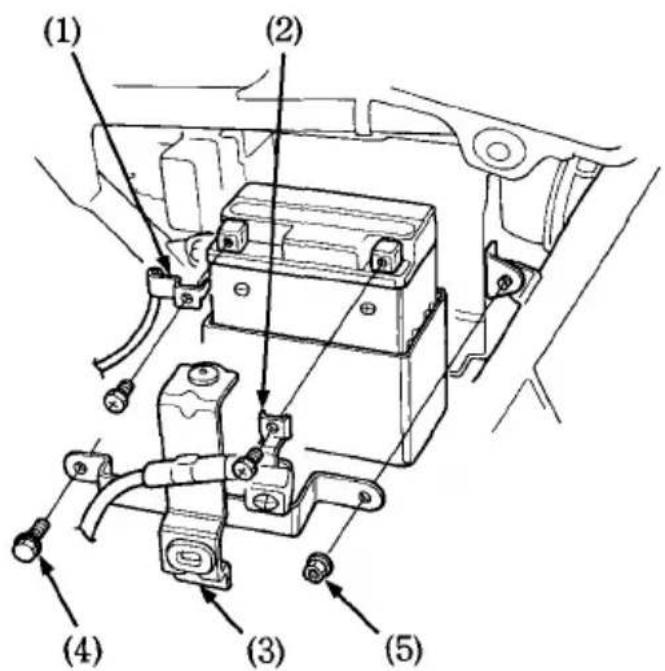
(1) Negative (−) terminal lead
(2) Positive (+) terminal lead
(3) Battery holder
(4) Bolt
(5) Nut
FUSE REPLACEMENT
(Refer to the maintenance precautions on page 47).
The main fuse (1), located on the starter magnetic switch (2) under the seat, is 20 A.
The fuse box (3) is located under the seat.
The spare fuses (4) are located near the fuse box.
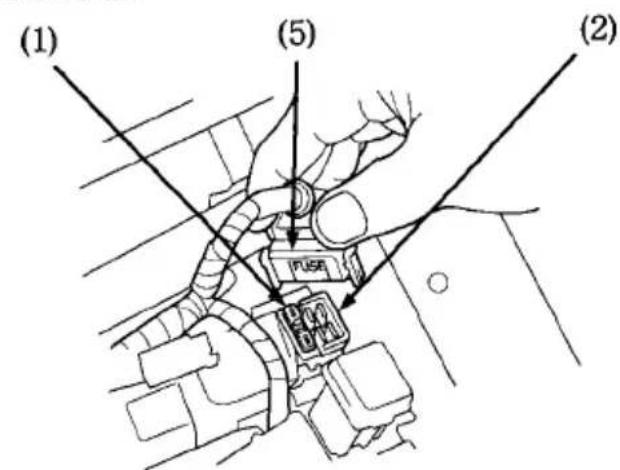
(1) Main fuse
(5) Wire coupler
(2) Starter magnetic switch
When frequent fuse failure occurs, it usually indicates a short circuit or an overload in the electrical system. See your authorized Honda dealer for repair.
CAUTION:
* Turn the ignition switch OFF before checking or replacing fuses to prevent accidental short-circuiting.
To replace the main fuse (1), remove the seat (see page 29), disconnect the wire coupler (5) and remove the old fuse. Install a new fuse and reconnect the wire coupler.
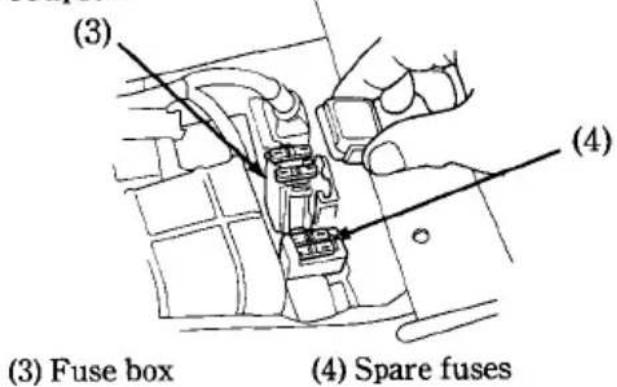
To replace fuses in the fuse box (3), remove the seat (see page 30), fuse box cover (6) and old fuse. Install a new fuse and fuse box cover.
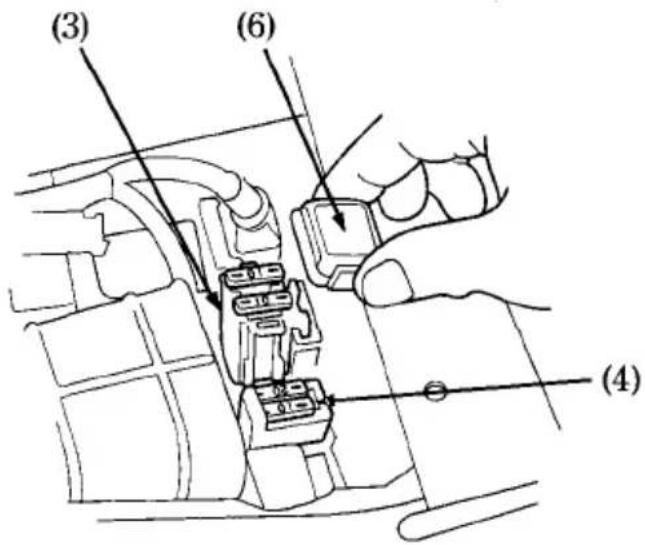
(3) Fuse box
(4) Spare fuses
(6) Fuse box cover
A WARNING
* Never use a fuse with a different rating from that specified. Serious damage to the electrical system or a fire may result, causing a dangerous loss of lights or engine power.
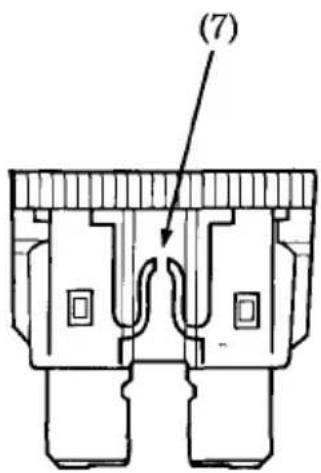
(7) Blown fuse
CLEANING
Clean your motorcycle regularly to protect the surface finishes and inspect for damage, wear and oil leakage.
CAUTION:
* High pressure water (or air) can damage certain parts of the motorcycle.
Avoid spraying high pressure water (typical in coin-operated car washes) at the following areas:
Ignition Switch
Instruments
Handlebar Switches
Carburetor
Wheel Hubs
Drive Chain
Muffler Outlets
Under Fuel Tank
Under Seat
- After cleaning, rinse the motorcycle thoroughly with plenty of clean water. Strong detergent residue can corrode alloy parts.
NOTE:
* Clean the plastic parts using a cloth or sponge dampened with a solution of mild detergent and water. Rub the soiled area gently rinsing it frequently with fresh water.
-
Dry the motorcycle, start the engine, and let it run for several minutes.
-
Test the brakes before riding the motorcycle. Several applications may be necessary to restore normal braking performance.
-
Lubricate the drive chain immediately after washing the motorcycle.
WARNING
* Braking efficiency may be temporarily impaired immediately after washing the motorcycle. Anticipate longer stopping distance to avoid a possible accident.
CAUTION:
* Do not use steel wool or a cleaner containing abrasives or compounds to clean the wheels, as they can cause damage.
STORAGE GUIDE
Extended storage, such as for winter, requires that you take certain steps to reduce the effects of deterioration from non-use of the motorcycle. In addition, necessary repairs should be made BEFORE storing the motorcycle; otherwise, these repairs may be forgotten by the time the motorcycle is removed from storage.
STORAGE
- Change the engine oil.
- Drain the fuel tank and carburetor into an approved petrol container. Spray the inside of the fuel tank with an aerosol rust-inhibiting oil.
Reinstall the fuel cap on the tank.
NOTE:
* If storage will last more than one month, carburetor draining is very important, to assure proper performance after storage.
▲WARNING
* Petrol is extremely flammable and is explosive under certain conditions. Do not smoke or allow flames or sparks near the equipment while draining fuel or where fuel is stored.
- Remove the spark plugs and pour a tablespoon (15–20 cm ^4 ) of clean engine oil into each cylinder. Crank the engine several times to distribute the oil, then reinstall the spark plugs.
NOTE:
* When turning the engine over, the engine Stop Switch should be OFF and each spark plug placed in its cable cap and grounded to prevent damage to the ignition system.
- Remove the battery. Store in an area protected from freezing temperatures and direct sunlight.
Slow charge the battery once a month.
- Wash and dry the motorcycle. Wax all painted surfaces. Coat chrome with rustinhibiting oil.
- Inflate the tyres to their recommended pressures. Place the motorcycle on blocks to raise both tyres off the ground.
- Cover the motorcycle (don't use plastic or other coated materials) and store in an unheated area, free of dampness with a minimum of daily temperature variation. Do not store the motorcycle in direct sunlight.
REMOVAL FROM STORAGE
- Uncover and clean the motorcycle.
Change the engine oil if more than 4 months have passed since the start of storage. - Charge the battery as required. Install the battery.
- Drain any excess aerosol rust-inhibiting oil from the fuel tank. Fill the fuel tank with fresh petrol.
- Perform all Pre-ride Inspection checks (page 31).
Test ride the motorcycle at low speeds in a safe riding area away from traffic.
NOISE CONTROL SYSTEM (AUSTRALIA ONLY)
TAMPERING WITH NOISE CONTROL SYSTEM PROHIBITED
Owners are warned to that the law may prohibit:
(a) The removal or rendering inoperative by any person other than for purposes of maintenance, repair or replacement, of any device or element of design incorporated into any new vehicle for the purpose of noise control prior to its sale or delivery to the ultimate purchaser or while it is in use; and
(b) the use of the vehicle after such device or element of design has been removed or rendered inoperative by any person.
SPECIFICATIONS DIMENSIONS
Overall length
Overall width
Overall height
Wheelbase
Ground clearance
2,090 mm (82.3 in)
755 mm (29.7 in)
1,090 mm (42.9 in)
1,425 mm (56.1 in)
165 mm (6.5 in)
WEIGHT
Dry weight
132 kg (291 lbs)
CAPACITIES
Engine oil
After draining
After disassembly
1.5 ℓ (1.6 US qt, 1.3 Imp qt)
1.8 ℓ (1.9 US qt, 1.6 Imp qt)
16 ℓ (4.2 US gal, 3.5 Imp gal)
3 ℓ (0.8 US gal, 0.7 Imp gal)
Fuel tank
Fuel reserve
Passenger capacity load
Maximum weight capacity
Operator and one passenger
174 kg (386 lbs)
ENGINE
Bore and stroke
Compression ratio
Displacement
Spark plug
Standard
For cold climate
(Below 5°C, 41°F)
For extended high speed
riding
Spark plug gap
Idle speed
Valve clearance (cold) Intake
Exhaust
53 x 53 mm (2.09 in x 2.09 in)
9.2:1
234 cm³ (14.3 cu-in)
CR6HSA (NGK) or
U20FSR-U (NIPPONDENSO)
CR5HSA (NGK) or
U16FSR-U (NIPPONDENSO)
CR7HSA (NGK) or
U22FSR-U (NIPPONDENSO)
0.60-0.70 mm (0.024-0.028 in)
1,500 ± 100 rpm
0.08 mm (0.003 in)
0.08 mm (0.003 in)
CHASSIS AND SUSPENSION
Caster
28°30'
Trail
109 mm (4.3 in)
Tire size, front
90/100-1854S
Tire size, rear
120/90-16 63S
POWER TRANSMISSION
Primary reduction
3.632
Gear ratio, 1st
2.846
2nd
1.778
3rd
1.333
4th
1.083
5th
0.913
Final reduction
2.214
ELECTRICAL
Battery
Generator
12V-6Ah
190W/5,000 min ^-1 (rpm)
LIGHTS
Headlight (HIGH/LOW)
Tail/stoplight
Turn signal light
Front
Rear
Instrument lights
Neutral indicator light
Turn signal indicator light
High beam indicator light
Side stand indicator light
12 V-40/45 W…E 12 V-35/50 W…U
12 V-5/21 W
12 V-21 W x 2
12 V-21 W x 2
12 V-3.4 W
12 V-3.4 W
12 V-3.4 W x 2
12 V-3.4 W
12 V-1.7 W
FUSE
10A
20A (Main fuse)
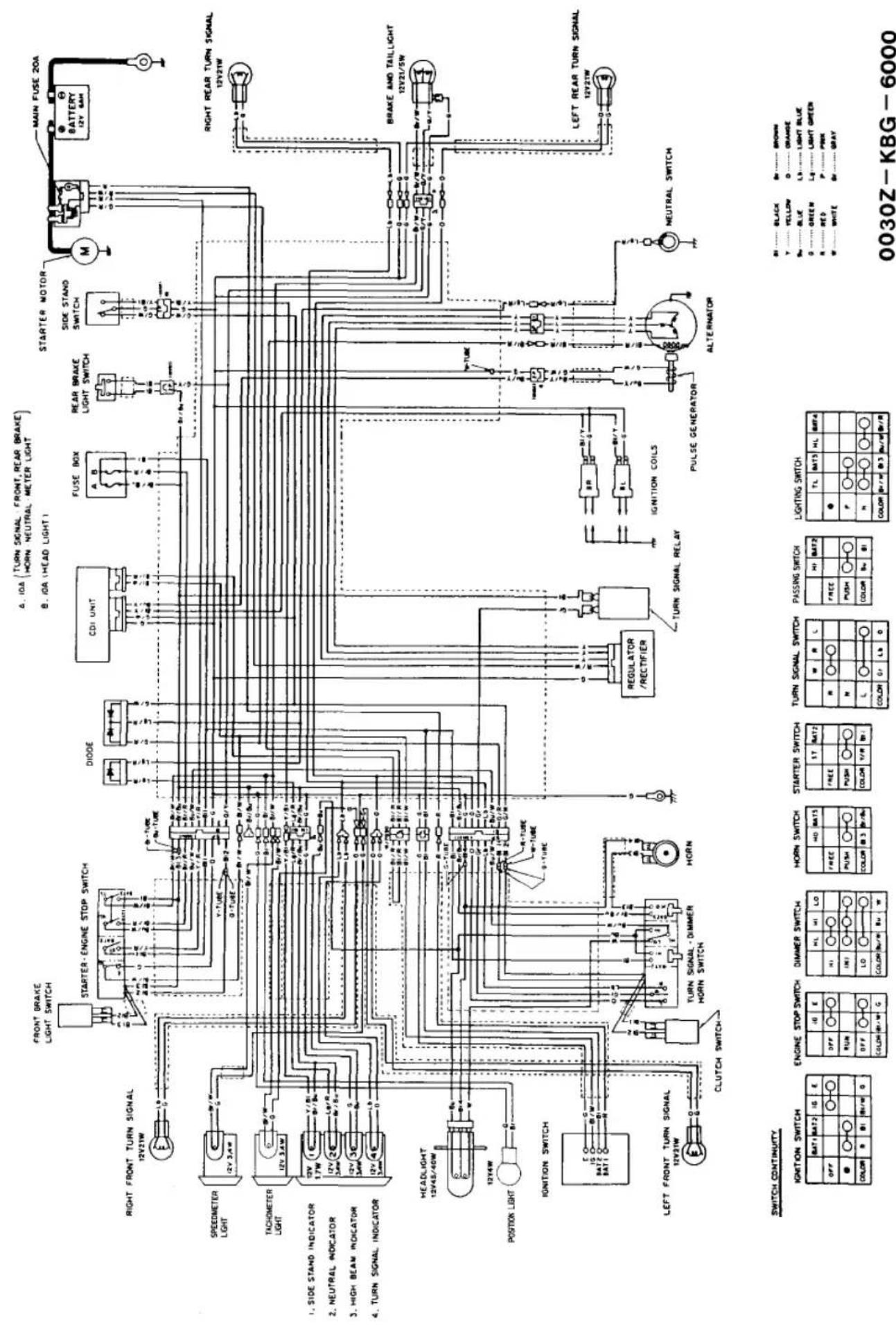
0030Z-KBG-6500
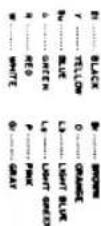
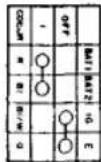
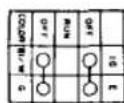
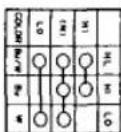

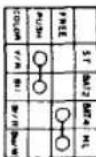
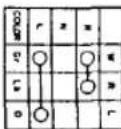
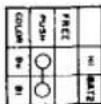
SWITCH CONTINUITY
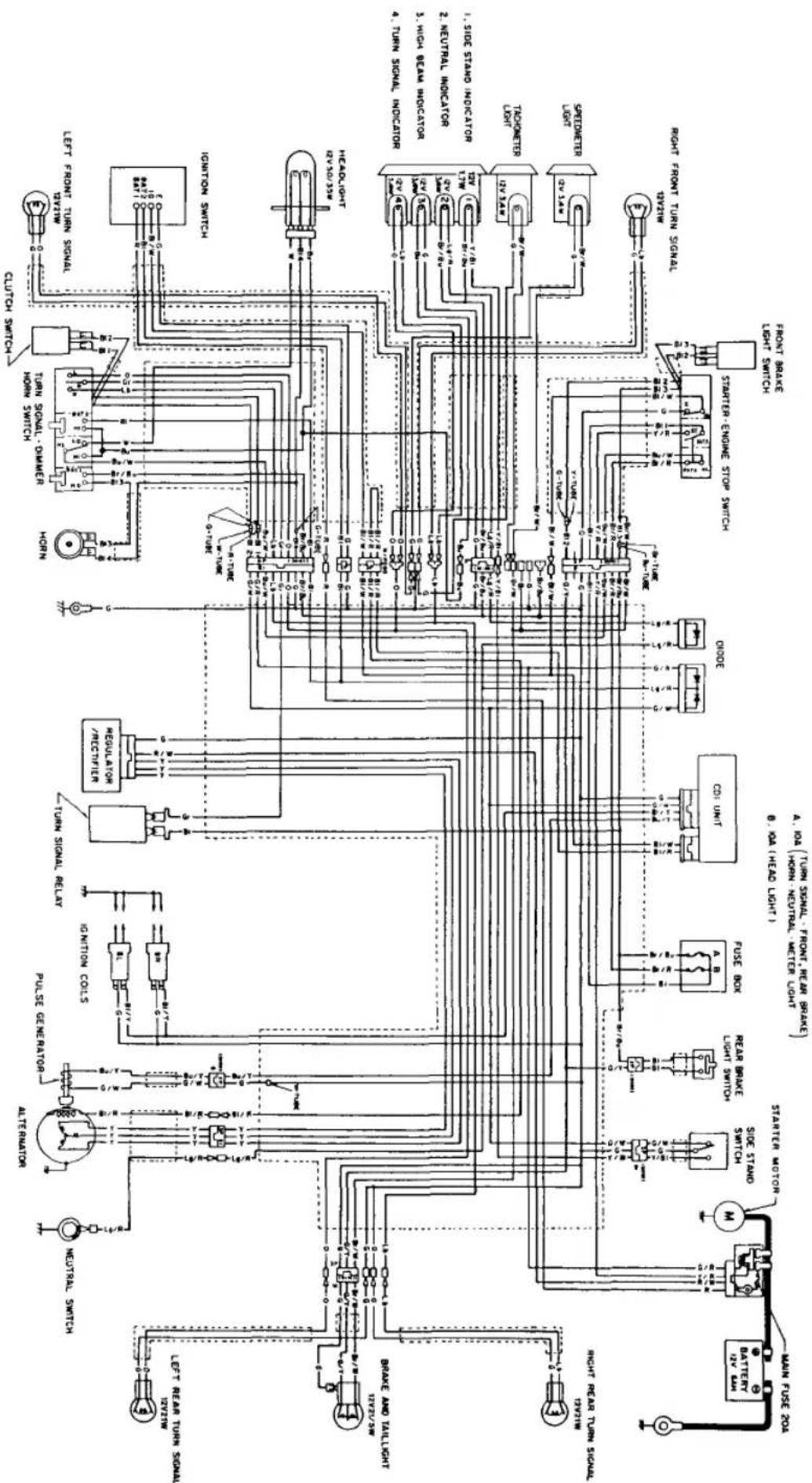
flowchart
graph TD
    A["MAIN FUSE 20A"] --> B["Battery 12V 3AM"]
    B --> C["BOOT REAR TUN SENSAL"]
    C --> D["MAKE AND TAILLIGHT"]
    D --> E["LEFT REAR TURN SIGNAL"]
    E --> F["NEUTRAL SWITCH"]
    F --> G["INTON COILS"]
    G --> H["PULSE GENERATOR"]
    H --> I["ALTENSION"]
    I --> J["Turn Signal RELAY"]
    J --> K["MOCAUTION / MCF/PIUM"]
    K --> L["COI UNIT"]
    L --> M["STARTER-CHNGE STOP SWITCH"]
    M --> N["STARTER"]
    N --> O["DCI UNIT"]
    O --> P["FUSE BOX"]
    P --> Q["RAS BRAKE SWITCH"]
    Q --> R["SIOC STAND SWITCH"]
    R --> S["STOP STAND SWITCH"]
    S --> T["SOC STAND SWITCH"]
    T --> U["MINIMUM MODE"]
    U --> V["ON/OFF"]
    V --> W["OFF/OFF"]
    W --> X["OFF/OFF"]
    X --> Y["OFF/OFF"]
    Y --> Z["OFF/OFF"]
    Z --> AA["OFF/OFF"]
    AA --> AB["OFF/OFF"]
    AB --> AC["OFF/OFF"]
    AC --> AD["OFF/OFF"]
    AD --> AE["OFF/OFF"]
    AE --> AF["OFF/OFF"]
    AF --> AG["OFF/OFF"]
    AG --> AH["OFF/OFF"]
    AH --> AI["OFF/OFF"]
    AI --> AJ["OFF/OFF"]
    AJ --> AK["OFF/OFF"]
    AK --> AL["OFF/OFF"]
    AL --> AM["OFF/OFF"]
    AM --> AN["OFF/OFF"]
    AN --> AO["OFF/OFF"]
    AO --> AP["OFF/OFF"]
    AP --> AQ["OFF/OFF"]
    AQ --> AR["OFF/OFF"]
    AR --> AS["OFF/OFF"]
    AS --> AT["OFF/OFF"]
    AT --> AU["OFF/OFF"]
    AU --> AV["OFF/OFF"]
    AV --> AW["OFF/OFF"]
    AW --> AX["OFF/OFF"]
    AX --> AY["OFF/OFF"]
    AY --> AZ["OFF/OFF"]
    AZ --> BA["OFF/OFF"]
    BA --> BB["OFF/OFF"]
    BB --> BC["OFF/OFF"]
    BC --> BD["OFF/OFF"]
    BD --> BE["OFF/OFF"]
    BE --> BF["OFF/OFF"]
    BF --> BG["OFF/OFF"]
    BG --> BH["OFF/OFF"]
    BH --> BI["OFF/OFF"]
    BI --> BJ["OFF/OFF"]
    BJ --> BK["OFF/OFF"]
    BK --> BL["OFF/OFF"]
    BL --> BM["OFF/OFF"]
    BM --> BN["OFF/OFF"]
    BN --> BO["OFF/OFF"]
    BO --> BP["OFF/OFF"]
    BP --> BQ["OFF/OFF"]
    BQ --> BR["OFF/OFF"]
    BR --> BS["OFF/OFF"]
    BS --> BT["OFF/OFF"]
    BT --> BU["OFF/OFF"]
    BU --> BV["OFF/OFF"]
    BV --> BW["OFF/OFF"]
CB250 u
CB250 E