
LN106 - Spüle LEISURE - Kostenlose Bedienungsanleitung
Finden Sie kostenlos die Bedienungsanleitung des Geräts LN106 LEISURE als PDF.


| Produkttyp | Einbau-Spüle |
| Marke | Leisure |
| Modell | LN106 |
| Material | Edelstahl |
| Oberfläche | Gebürstet (typisch) |
| Anzahl der Becken | 1 (Standard) |
| Einbauart | Aufsatz oder Unterbau (mit Holzleisten) |
| Montage ohne Holzleisten | Bohren von Führungslöchern, Befestigung mit Klammern (18 mm langer Schenkel) an der Innenseite |
| Montage mit Holzleisten | Holzklötze (12 mm) am Schrank befestigen, dann Schrauben in die Leisten |
| Mitgeliefertes Zubehör | Holzleisten (bei einigen Modellen) |
| Erforderliche Schrauben | 4 Möbelkonter (12 mm), 8 Kabinettschrauben (18 mm), 4 Holzschrauben (Nr. 8, 25 mm) – nicht im Lieferumfang |
| Wartung – täglich | Mit weichem, feuchtem Seifentuch abwischen, mit klarem Wasser nachspülen |
| Wartung – hartnäckige Flecken | Cif (oder mildes Scheuermittel) mit feuchtem Tuch auftragen, kräftig reiben, abspülen, trocknen |
| Vermeidung von Flecken | Oberfläche nach Gebrauch trocknen (besonders bei hartem Wasser) |
| Gefahrstoffe | Bleichmittel, Silbertauchbäder, säurehaltige Lebensmittel, starke Säuren – Kontakt vermeiden |
| Reinigungshinweise | Keine scheuernden Pulver oder Stahlwolle verwenden; weiche Tücher bevorzugen |
| Besondere Gefahr | Chlorhaltige Bleichmittel können Lochfraß verursachen |
| Nach der Reinigung | Nasse Reinigungshilfen nicht auf der Oberfläche liegen lassen |
| Allgemeine Pflege | Edelstahl ist langlebig, aber kratzempfindlich – scharfe Gegenstände vermeiden |
Häufig gestellte Fragen - LN106 LEISURE
Benutzerfragen zu LN106 LEISURE
0 Frage zu diesem Gerät. Beantworten Sie die, die Sie kennen, oder stellen Sie Ihre eigene.
Eine neue Frage zu diesem Gerät stellen
Laden Sie die Anleitung für Ihr Spüle kostenlos im PDF-Format! Finden Sie Ihr Handbuch LN106 - LEISURE und nehmen Sie Ihr elektronisches Gerät wieder in die Hand. Auf dieser Seite sind alle Dokumente veröffentlicht, die für die Verwendung Ihres Geräts notwendig sind. LN106 von der Marke LEISURE.
BEDIENUNGSANLEITUNG LN106 LEISURE
Stainless Steel Sink Installation
Note:
During installation care should be taken to ensure the sink is protected from scuffs and scratches.
Straining and over tightening of all plumbing fixtures connected to the sink should be avoided.
Installers should carefully check that the moulding and edges of the sink are dead level so that water will flow off the drainer.
Installation – General
- Fit the waste(s) to the sink, including any inter-connecting pipe work (supplied with multiple bowl sinks)
• Fit the tap(s) and plumb in any hoses or pipes.
Use either of the two methods of installation. Wooden battens are supplied with some models. The installer must supply the battens if this method of installation is required for other models.
Installation without wooden batons Installation with wooden batons
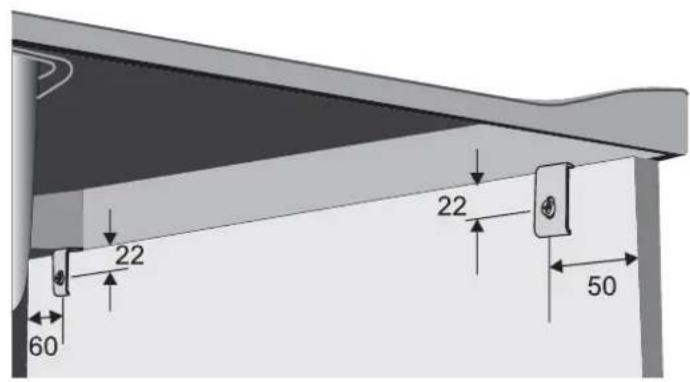
1) Drill 2 pilot holes in either side of the base unit as shown.
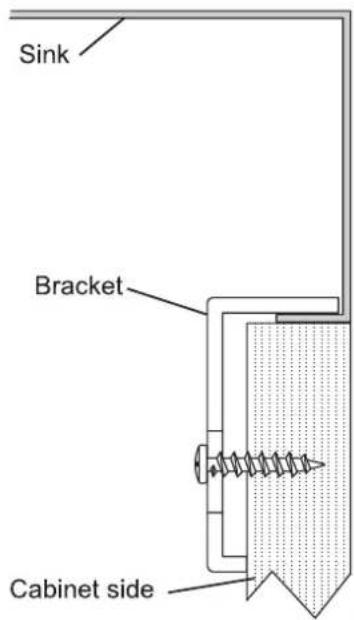
2) Fix the bracket with the long leg (18mm) clamping down onto the rim of the inner rim.
3) Attach the brackets to the cabinet with the Cabinet screws (screws are provided with some sink models).
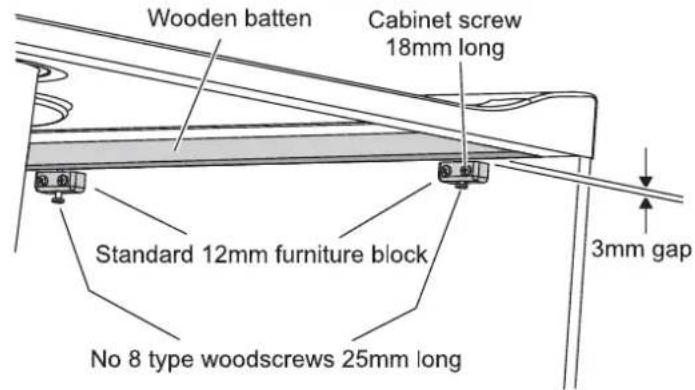
Items required too secure the sink (not supplied)
4 off Standard 12mm furniture block
8 off Cabinet screw 18mm long
4 off No 8 type woodscrews 25mm long
1) Position the sink over the cabinet in the desired location and mark the position of the screws, relative to the inside of the cabinet, using a soft pencil.
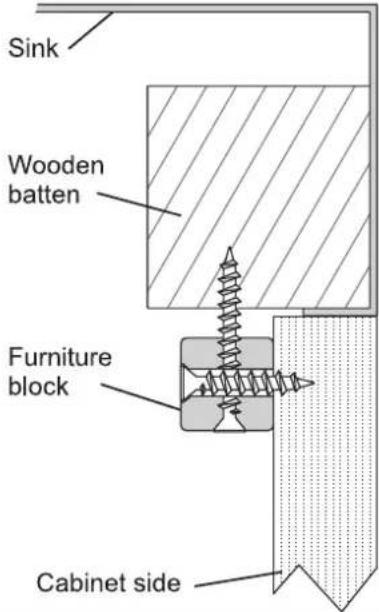
2) Using the pencil marks made previously as a guide, screw the 12mm furniture block to the cabinet using the Cabinet screws.
3) Put the No 8 type woodscrew into the furniture block and tighten the screw into the wooden baton.
Note: All dimensions shown are in millimetres and the sink is a typical installation
After Care - Stainless Steel Sinks
Day to Day Care
Routine cleaning of your stainless steel sink is easy if the following simple procedure is followed After use wipe the bowl and drainer with a soft damp soapy cloth, rinse with clean water. In hard-water areas, an application of Cif will avoid any build-up of dull fi lm of waterborne deposits.
Although stainless steel is an extremely durable material and will withstand a great deal of hard use, it can be scratched by hard or sharp objects. If the surfaces are to be kept in a blemish free condition reasonable care should be taken when handling such items.
Discolouration and Heavy Staining
Staining of stainless steel in most cases is due to something being deposited on the steel rather than an attack on the material itself. The most common cause of staining is the build up of a thin fi lm of water borne deposits on the sink surface, often fi rst seen as a rainbow effect. The build up of such a fi lm can be avoided by drying the surface of the sink after use as described above. However, should such a fi lm appear, it can be readily removed with a soft damp cloth and Cif. To remove the fi lm, apply the Cif neat and rub vigorously with a damp cloth along the length of the sink surface. After cleaning rinse thoroughly with clean water and dry. Wire wool products and ferrous water supply pipes can leave minute ferrous particles adhered to the sink surface. Since stainless steel under normal conditions does not rust, these particles can cause the appearance of small brown rust stains. These stains can be removed using the procedure described above.
CAUTION :
Certain household products contain substances which will attack the stainless steel surface, they are :
1. Bleaches :
Most common domestic bleaches contain Chlorine in the form of a hypochlorite. Chlorine attacks the microscopic Chromium Oxide film on the surface and can cause pitting of the surface. Bleaches should always be used in the prescribed strength specified by the manufacturers. Undiluted bleaches can cause pitting and staining of the surface and should be immediately rinsed off with plenty of clean water. All cleaning agents containing hypochlorites are unsuitable for use with stainless steel and, even highly diluted, can cause pitting under certain conditions. For this reason it is strongly recommended that the sink is not used for soaking clothes or cleaning clothes in hypochlorite solutions for long periods.
2. Silver Dip Cleaners :
These are particularly harmful since they contain strong acids which can cause discolouration and pitting. The first sign of this is an iridescent rainbow stain which turns an etched dull grey colour. Should any Silver Dip Cleaner come into contact with the surface of the sink it should be immediately rinsed off with plenty of clean water.
3. Corrosive Foodstuffs :
Fruit juices, damp salt, vinegar, readymade mustards, pickle and mayonnaise can cause pitting and corrosion if left in contact with the stainless steel surface for long periods.
4. Acids :
Sulphuric, Hydrochloric and other strong acids will cause pitting corrosion, as will photographic developing liquids. All should be immediately washed off with plenty of clean water if contact occurs.
Cleaning :
Always use a soft cloth. The use of coarse grit scouring powders or soap filled wire wool cleaning pads is not recommended, since both will mark the surface of the sink. Wire wool pads can leave tiny fragments of wire embedded in the surface and these can rust and leave small brown rust stains. Vigorous rubbing with a soft cloth, Cif, neat detergent, cleaning cream or liquid will remove these stains. Always remove wet cleaning aids (cloths, containers, etc.) from the sink surface after use in order to avoid the formation of water marks and rust stains.


Marke : LEISURE
Modell : LN106
Kategorie : Spüle