
PLMRW10 - Subwoofer Pyle - Kostenlose Bedienungsanleitung
Finden Sie kostenlos die Bedienungsanleitung des Geräts PLMRW10 Pyle als PDF.


| Produkttyp | Subwoofer |
| Marke | Pyle |
| Modell | PLMRW10 |
| Chassisgröße | 10 Zoll (25,4 cm) |
| Bauart | Geschlossen oder Bassreflex (abhängig von Variante) |
| Impedanz | 4 Ohm |
| Empfindlichkeit | 90 dB (1W/1m) |
| Frequenzbereich | 30–200 Hz |
| Belastbarkeit (RMS) | 200 Watt |
| Belastbarkeit (Spitze) | 400 Watt |
| Gehäusematerial | MDF (mitteldichte Faserplatte) |
| Abmessungen (B × H × T) | ca. 35 × 30 × 35 cm |
| Gewicht | ca. 12 kg |
| Stromversorgung | Netzbetrieb 110–240 V, 50/60 Hz (bei Aktivmodell) |
| Eingänge | RCA/Cinch, Lautsprecherklemmen |
| Regler | Lautstärke, Crossover-Frequenz, Phasenschalter (0°/180°) |
| Schutzschaltung | Überhitzung, Kurzschluss, Überspannung |
| Lieferumfang | Subwoofer, Netzkabel, Bedienungsanleitung |
| Reinigung | Staub mit weichem, trockenem Tuch entfernen; keine aggressiven Reiniger |
| Sicherheitshinweise | Gerät nicht in Feuchträumen betreiben; Belüftungsschlitze frei halten; nur vom Fachmann öffnen |
| Ersatzteile/Reparatur | Ersatzteile über den Hersteller oder autorisierte Händler; Reparatur nur durch qualifiziertes Personal |
Häufig gestellte Fragen - PLMRW10 Pyle
Benutzerfragen zu PLMRW10 Pyle
0 Frage zu diesem Gerät. Beantworten Sie die, die Sie kennen, oder stellen Sie Ihre eigene.
Eine neue Frage zu diesem Gerät stellen
Laden Sie die Anleitung für Ihr Subwoofer kostenlos im PDF-Format! Finden Sie Ihr Handbuch PLMRW10 - Pyle und nehmen Sie Ihr elektronisches Gerät wieder in die Hand. Auf dieser Seite sind alle Dokumente veröffentlicht, die für die Verwendung Ihres Geräts notwendig sind. PLMRW10 von der Marke Pyle.
BEDIENUNGSANLEITUNG PLMRW10 Pyle
PYLE®
PENTAGON
PYLE
PENTAGOR
SPECIFICATIONS
PYLE HYDRA—Series Woofer for small enclosures
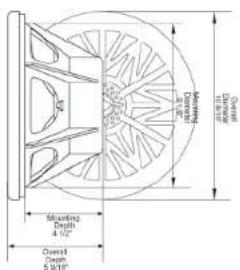
| Performance Parameters | PLMR W10 | Physical & Installation Parameters | |
| Power (Watts RMS) | 250W | Voice | 1.5" KSV |
| Power (Watts Peak) | 500W | Magnet | 60 oz |
| Nom. Impedance | 4 ohm | Cone | Polypropylene |
| Re (ohms) | 3.6 | Surround | Butyl Rubber |
| Fs (Hz) | 32 | Spider | Cotton |
| Qms | 5.269 | Dustcap | Polypropylene |
| Qes | 0.504 | Frame | Plastic |
| Qts | 0.46 | Terminals | Screw in |
| X-Max (mm) | 4 | ||
| Vis (ca. ft.) | 3.012 | ||
FILE 15.013 continually strives to improve the performance and value of its products - tall specifications are subject to change.
Suggested enclosure parameters


| speaker model | Sealed | Vented | |||
| Small | Large | Small | Large | ||
| PLMR W10 | Enclosure volume, cu. ft. Sealed or rented | 0.6 | 1 | 0.8 | 1.25 |
| Vent length, inches | 6 | 6.4 | |||
| Vent diameter, inches | 3 | 3 | |||
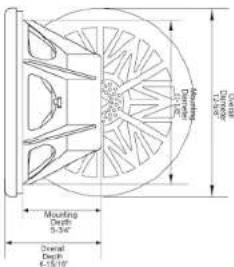
SPECIFIC
PYLE HYDRA - Series
| Performance Parameters | PLMR W12 |
| Power (Watts RMS) | 300W |
| Power (Watts Peak) | 600W |
| Nom. Impedance | 4 chm |
| Re (ohms) | 3.6 |
| Fs (Hz) | 28 |
| Qms | 3.674 |
| Qes | 0.463 |
| Qts | 0.411 |
| X-Max(mm) | 5 |
| Vas (cu. ft.) | 4.474 |
THE INFLIX continuity strives to improve the performance and
Suggested enclosure parameters
| speaker model | Sealed | ||
| Small | L | ||
| PLMR W12 | Enclosure volume, cu. ft. Sealed or vented | 0.8 | N |
| Vent length, inches | |||
| Vent diameter, inches | |||
VENTED ENCLOSURES
choose this type of end-of-use: • Increased bass response
• Enhanced efficiency
- Tuneable enclosure
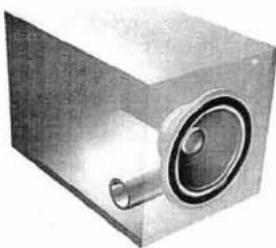
Vented enclosures, also known as "bass reflex" or "ported enclosures," utilize a tuned vent, called at "duct" or "port." This vent captures the energy of the worder's backwave to increase bass response and efficiency. The tuning frequency of the enclosure can be altered by changing either the size or the length of the vent. This means that the user can modify the bass output without changing the enclosure. Because the port supplies a portion of the bass to the listener, the port and the speaker must both vent into the vehicle's interior. Here are some general guidelines for utilizing vents on your enclosure:
- Vents can be of any shape. Use a material that is easy to work with when constructing the ducts. Cardboard mailing tubes or PVC pipe work well as port tubes. Remember to keep the port opening, inside and outside of the enclosure, free of obstructions for a distance equal to or greater than the port diameter.
- Typically, the larger the vent, the less duct noise created from the air being moved in and out. As the vent gets larger in diameter, the same tuning frequency can only be maintained by extending the length of the duct. The duct may extend beyond the outside of the enclosure or bend internally in order to achieve the desired length. Ultimately, the limitations of the size and length of the duct will be determined by the physical dimensions of the enclosure and installation area.
- When installing vents in the enclosure, try to keep the vent at least one vent diameter from any wall and at least two vent diameters from the woofer. There are pressure differences that exist surrounding the woofer and in proximity to the enclosure wall that can keep the vent from performing as designed.
- Because of lack of space in the enclosure, reducing the size of the vent or allowing the duct to protrude out of the enclosure are options that the occasional installation may require. Another method to get a duct to fit in an enclosure would be to use PVC pipe for the duct and a PVC elbow to create a bend in the duct. The length of the duct should be measured at its center to determine the length.
natural_image
3D rendering of a metallic rectangular box with a circular vent and cylindrical shaft (no text or symbols)FIG 2: Example of a vented enclosure
choose this type of enclosure for • Control of both low end response and high end cutoff
- Increased efficiency and lower distortion
- Can eliminate need for crossovers or electronics in signal path
BandPASS ENCLOSURES
Bandpass enclosures can be constructed in many different configurations. Often referred to as 4 th, 5th, 6th, 7th, or 8th order enclosures, these enclosures are named based on the sum of their highpass and lowpass orders. The common characteristics between all bandpass enclosures is that one can control both the low end response and the high end cutoff. This capability allows the user tremendous flexibility when tailoring a sound system to a particular vehicle.
Another benefit of the bandpass enclosure can be increased efficiency. Typical passband efficiency gains are in the 3db range, but gains over twice that amount can be achieved in some configurations. Lower distortion is also attainable because bandpass systems can integrate their own acoustic low pass filter, making it possible to eliminate low end passive inductors or electronic crossovers from the signal path.
Yet another benefit in bandpass enclosures is ease of installation. With a bandpass enclosure, all of the sound is delivered through a vent (s). This can be a big help in dealing with space limitations by only requiring enough area to vent the enclosure into the vehicle, not the entire woofer opening.
Critics of bandpass enclosures feel that because all of the sound is delivered through a vent, sound quality may suffer (when compared to other direct firing enclosures). A consideration when contemplating using a bandpass enclosure is the complexity of the enclosure. The box is more difficult to build and accessibility to the wofer for servicing is limited.
In a 4th order handpass enclosure (12db slope for highpass and lowpass), the woefer low frequency tuning is determined by the volume of the rear sealed enclosure. The vent determines the frequency for the acoustic low pass filter, while the volume of the front compartment determines the response curve in the passband. The greater the volume of the front compartment the greater is the rise in the mid passband. Conversely, the smaller the front compartment the greater is the dip. By adding a series inductor to a 4th order handpass enclosure it becomes a 5th order enclosure with a 18db lowpass rolloff.
A 6th order bandpass (or "dual vent") bandpass enclosure will have a rear chamber vent. This enclosure works similarly to a 4th order enclosure, with the efficiency and low frequency control of a vented system added. Similarly to other vented enclosures, the enclosure provides little control for the woofer below the tuned frequency of the vent. With both 6th order bandpass or vented enclosures a sub sonic or low frequency filter can aid in reducing inaudible and often excessive cone excursions, thereby minimizing premature driver failure.
All rules applying to building sealed or vented enclosures apply to constructing bandpass enclosures. The enclosures must be sealed, vents must be unobstructed and kept away from enclosure walls.
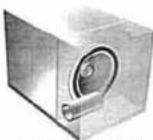
FIG 3: Example of a
sealed bandpass
enclosure
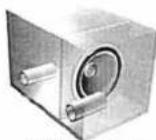
FIG 4: Example of a
vented bandpa
enclosure




Marke : Pyle
Modell : PLMRW10
Kategorie : Subwoofer