
UA-101 - Blutdruckmessgerät A&D Médical - Kostenlose Bedienungsanleitung
Finden Sie kostenlos die Bedienungsanleitung des Geräts UA-101 A&D Médical als PDF.


| Produkttyp | Blutdruckmessgerät, Oberarmmessgerät |
| Modell | UA-101 |
| Marke | A&D Medical |
| Messmethode | Oszillometrisch |
| Manschettengröße | Standard (22–32 cm Umfang) |
| Messbereich | Druck: 0–300 mmHg, Puls: 40–180 Schläge/min |
| Genauigkeit | Druck: ±3 mmHg, Puls: ±5% |
| Display | Digital-LCD mit großen Ziffern |
| Stromversorgung | 4x AA-Batterien (nicht enthalten) oder Netzteil (optional) |
| Abmessungen | Ca. 150 x 100 x 60 mm (ohne Manschette) |
| Gewicht | Ca. 300 g (ohne Batterien und Manschette) |
| Speicher | Bis zu 60 Messwerte mit Datum und Uhrzeit |
| Funktionen | Blutdruckmessung plus Puls, WHO-Klassifizierung, Mittelwertanzeige |
| Reinigung und Pflege | Außenfläche mit weichem, trockenem Tuch reinigen; Manschette nicht waschen |
| Sicherheit | Medizinprodukt nach EU-Richtlinie, CE-Kennzeichnung, automatische Abschaltung |
| Lagertemperatur | -20°C bis +60°C |
| Betriebstemperatur | +10°C bis +40°C |
| Garantie | 2 Jahre (Herstellergarantie) |
| Lieferumfang | Manschette, Bedienungsanleitung, Aufbewahrungstasche |
| Reparatur und Ersatzteile | Ersatzmanschette und Netzteil erhältlich; Reparatur durch autorisierten Service |
Häufig gestellte Fragen - UA-101 A&D Médical
Benutzerfragen zu UA-101 A&D Médical
0 Frage zu diesem Gerät. Beantworten Sie die, die Sie kennen, oder stellen Sie Ihre eigene.
Eine neue Frage zu diesem Gerät stellen
Laden Sie die Anleitung für Ihr Blutdruckmessgerät kostenlos im PDF-Format! Finden Sie Ihr Handbuch UA-101 - A&D Médical und nehmen Sie Ihr elektronisches Gerät wieder in die Hand. Auf dieser Seite sind alle Dokumente veröffentlicht, die für die Verwendung Ihres Geräts notwendig sind. UA-101 von der Marke A&D Médical.
BEDIENUNGSANLEITUNG UA-101 A&D Médical

HOME BLOOD PRESSURE KIT INSTRUCTIONS - MODEL UA-101
IMPORTANT INFORMATION
PLEASE READ THIS IMPORTANT INFORMATION BEFORE USING YOUR MONITOR.
Please remember that only a medical practitioner is qualified to interpret your blood pressure measurements. Use of this device should not replace regular medical examinations.
For Have your physician review the procedure for using this device. He or she will want to verify blood pressure measurements before prescribing or adjusting medications.
Consult your physician if you have any doubt about your readings. Should a mechanical problem error, contact ASD Medical.
Clean the monitor and cuff with a dry, soft cloth or a cloth dampened with water and a mild detergent. Never use alcohol, benzene, thinner or other bars chemicals to clean monitor or cuff.
PRECAUTIONS
This Blood Pressure monitor is designed to be used at home or in a doctor's/nurse's office, by these who are eighteen (84 years and older, to monitor blood pressure (astolic and diastolic) and pulse rate.
Caution: This product contains natural rubber latex which may cause allergic reactions.
HOME BLOOD PRESSURE KIT COMPONENTS
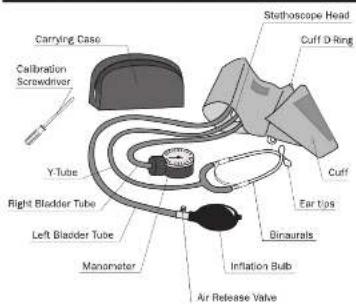
LIST OF COMPONENTS:
| Far Tips | Left Bladder Tube | Stethoscope Head |
| Illinamals | Right Bladder Tube | Carrying Case |
| Inflation Bulb | Y-Tube | Calibration Screwdriver |
| Air Reiser Valve | Cult D-Ring | |
| Manometer | Cull |
ASSEMBLY INSTRUCTIONS
- Place call on your upper arm.
- Make sure cell end has been inserted through the D-ring.
- Insert single end of the Y-Tube into stethoscope head.
- Insert each arm of the Y-Tube into each bottom end of the biranous
- Inserd air release valve into left bladder tube.
- Insert manometer into right bladder tube.
TAKING YOUR BLOOD PRESSURE
BLOOD PRESSURE TAKING TIPS
- Relax for several moments before measurement.
- Do not smoke or ingest caffeine at least 30 minutes prior to measurement.
- Remove restructuring clothing and place cuff on bare arm.
- Unless your physician recommends otherwise, use left arm to measure pressure.
- Do not talk during measurement.
• Do not cross legs and keep your feel flat on the floor - Unless your physician recommends otherwise, use left arm to measure pressure.
- Do not talk during measurement.
• Do not cross legs and keep your feel flat on the floor
NOW YOU ARE READY. FOLLOW THESE SIMPLE STEPS: 1. Set comfortably with your left arm resting on a flat surface so that the center of your upper arm is at the same height as your head.
- Lay left arm on the tube with palm up. Place the cuff on upper arm with the tube facing downward and toward the inside of your arm. Fasten cuff securely with hunk and loop listeners strap.
- The cuff should be snug but not too tight. You should be able to insert two fingers between the cuff and your arm.
- With your palm hcing up, place the slethoscope bead one inch above the bend of the elbow on the inside of the arm. This is where the main artery is located.
- Insert the ear tips of the stethoscope into your ears. Adjust by turning ear tips to fit comfortably in your
- I told the manooster in your left hand and the inflation bulb in your right hand.
- Close the air release valve on the bulb by turning the valve clockwise.
- Inflate the cuff by repeatedly squeezing the bulb with your right hand. Listen to the pulse heat while initiating the cuff.
- Watch the gauge. When you can no longer hear the pulse heat, raise the pressure an additional 30 mmHg.
NOTE: Do not inflate the cuff above 250 mmHg. You may injure yourself or damage the equipment. If you are uncertain about the proper cuff inflation level, consult your physician. - After reaching your inflation level, slowly deflate the cuff by opening the air release valve. To open the air release valve, turn it counter clockwise so that the pressure drops 2-4 monthly per second. The cuff is the mesoedler should drop an average of one to two months every second.
- Lay left arm on the tube with palm up. Place the cuff on upper arm with the tube facing downward and toward the inside of your arm. Fasten cuff securely with hunk and loop listeners strap.
- The cuff should be snug but not too tight. You should be able to insert two fingers between the cuff and your arm.
- With your palm hcing up, place the slethoscope bead one inch above the bend of the elbow on the inside of the arm. This is where the main artery is located.
- Insert the ear tips of the stethoscope into your ears. Adjust by turning ear tips to fit comfortably in your
- I told the manooster in your left hand and the inflation bulb in your right hand.
- Close the air release valve on the bulb by turning the valve clockwise.
- Inflate the cuff by repeatedly squeezing the bulb with your right hand. Listen to the pulse heat while initiating the cuff.
- Watch the gauge. When you can no longer hear the pulse heat, raise the pressure an additional 30 mmHg.
- After reaching your inflation level, slowly deflate the cuff by opening the air release valve. To open the air release valve, turn it counter clockwise so that the pressure drops 2-4 monthly per second. The cuff is the mesoedler should drop an average of one to two months every second.
NOTE: Pressurizing the cuff shuts off all blood flow to the arm. Do not leave it fully inflated any longer than absolutely necessary.
- After opening the air release valve, listen carefully for a pulse beat. The moment you hear the first thumping sounds of your pulse beat, note the reading on the gauge. This is your systolic blood pressure measurement.
- When you can no longer hear any sounds, read the gauge. This is your di-stolic blood pressure measurement.
- Remove cuff and make note of your blood pressure
- After opening the air release valve, listen carefully for a pulse beat. The moment you hear the first thumping sounds of your pulse beat, note the reading on the gauge. This is your systolic blood pressure measurement.
- When you can no longer hear any sounds, read the gauge. This is your di-stolic blood pressure measurement.
- Remove cuff and make note of your blood pressure
NOTE: To be certain your technique was good and the readings were as accurate as possible, wait 10-15 minutes and repeat the procedure.
TWO-PARTY METHOD:
- If you plan on taking someone else's blood pressure, have the person whose blood pressure is to be taken to rest and relax at least 15 minutes beforehand.
- I have the person extend his or her left arm toward you, palm up. He sure the arm rests at the same level as the heart.
- Position the cuff as indicated in the self-taking instructions.
- Attach the transrometer to the loop on the cuff, so that it is clearly visible to you.
- Perform Steps 1-13 in Taking your Blood Pressure. If possible, have your physician watch your technique to be sure it is correct.
- If you plan on taking someone else's blood pressure, have the person whose blood pressure is to be taken to rest and relax at least 15 minutes beforehand.
- I have the person extend his or her left arm toward you, palm up. He sure the arm rests at the same level as the heart.
- Position the cuff is indicated in the self-taking instructions.
- Attach the transrometer to the loop on the cuff, so that it is clearly visible to you.
- Perform Steps 1-13 in Taking your Blood Pressure. If possible, have your physician watch your technique to be sure it is correct.
ABOUT BLOOD PRESSURE
WHAT IS BLOOD PRESSURE?
Blood pressure is the force exerted by blood against the walls of the arteries. Systolic pressure occurs when the heart contracts; diastolic pressure occurs when the heart expands. Blood pressure is measured in millimeters of mercury (mmHg).
WHAT AFFECTS BLOOD PRESSURE?
Blood pressure is affected by many factors: age, weight, time of day, activity level, climate, altitude and season. Certain activities can significantly alter one's blood pressure. Walking will likely raise an individual's blood pressure. Sleeping will likely decrease blood pressure. Not relaxing for several moments before measurements can influence readings as well.
In addition to these factors, bezeugous consisting of advice or alcohol, certain medications, emotional stress and over-light-fitting clothes can make a difference in the readings.
Fluctuation within a day (case: 35 year old male)

WHAT CAUSES VARIATIONS IN BLOOD PRESSURE?
An individual's blood pressure varies greatly from day to day and season to season. For hypersensitive individuals, these variations are even more pronounced. Normally, blood pressure rises during work or play and falls to its lowest levels during sleep.
ASSESSING HIGH BLOOD PRESSURE FOR ADULTS
The following standards for assessing high blood pressure (without regard to age or gender) have been established as a guideline. Please note that other risk factors (e.g., diabetes, obesity, sex, smoking, etc.) need to be taken into consideration and may affect these figures. Consult with your physician for an accurate assessment.
JNC7 Classification Table – for adults within the U.S.
| BP Classification Systolic (mmHg) Diastolic (mmHg) | |||
| Normal | less than 120 | and | less than 80 |
| Prehypertension | 120-139 | or | 80-89 |
| Stage 1 Hypertension | 140-159 | or | 90-99 |
| Stage 2 Hypertension | grade forar quality 160 | or | grade thanar quality 100 |
SOURCE: The Seventh Report of the Joint National Committee on Prevention, Evaluation and Treatment of High Blood Pressure for scults. National Heart, Lung and Blood Institute - May 2001.
WHO Classification Table – for adults outside of the U.S. (e.g. Canada, Mexico)
| BP Classification | Systolic (mmHg) | Diastolic (mmHg) | |
| Optimal | less than 120 | and | less than 80 |
| Normal | less than 130 | or | less than 85 |
| High-Normal | 130-139 | or | 85-89 |
| Grade 1 Hypertension | 140-150 | or | 90-99 |
| Grade 2 Hypertension | 160-170 | or | 120-109 |
| Grade 3 Hypertension | pre-t or 150 | or | pre-t or 110 |
SOURCE: Standards to assess high blood pressure, without regard to age or gender, have been established by the World Health Organization (WHO).
WHAT IS HYPERTENSION?
Hypertension (high blood pressure) is the diagnosis given when readings consistently rise above normal. It is well known that hypertension can lead to stroke, heart attack or other illness if left untreated. Referred to as a "silent killer" because it does not always produce symptoms that alert you to the problem, hypertension is statistically when diagnosed early.
CAN HYPERTENSION BE CONTROLLED?
In many individuals, hypertension can be controlled by altering lifestyle and minimizing stress, and by appropriate medication prescribed and monitored by your doctor. The American Heart Association recommends the following lifestyle suggestions to prevent or control hypertension:
Don't smoke.
■ Reduce salt and fat intake.
Exercise routinely.
Exercise routinely
■ Have regular physical checkups.
■ Maintain proper weight.
■ Monitor your blood pressure at periodic intervals.
■ Maintain cover weight
■ Monitor your blood pressure at periodic intervals.
WHY MEASURE BLOOD PRESSURE AT HOME?
It is now well known that, for many individuals, blood pressure readings taken in a doctor's office or hospital setting might be elevated as a result of apprehension and anxiety. This response is commonly called "white coat hypertension."
In any case, self-measurement at home supplements your doctor's readings and provides a more accurate, complete blood pressure history. In addition, clinical studies have shown that the detection and treatment of hypertension is improved when patients both consult their physicians and record their own blood pressure at home.
MAINTENANCE INSTRUCTIONS
BASIC CARE OF YOUR HOME BLOOD PRESSURE KIT
With proper care, your Home Blood Pressure Kit will provide many years of reliable service. To insure a well functioning unit, follow these basic rules:
- Handle the pressure micrometer with one. Do not drop or jar. The nozzle should indicate zero when cuff is fully deflated.
• Always deflate half before storing.
- Avoid hitting objects against surface of silchoscope.
- Store all items, including instruction booklet, in the convenience, storage case provided.
A&E Medical has checked your blood pressure unit to assure reliability and accuracy prior to shipment. However, as with any sensitive instrument subject to repeated use, we recommend your blood pressure until he checked periodically for proper calibration to ensure accurate blood pressure readings.
CHECKING FOR ACCURACY
HOW TO CHECK YOUR HOME BLOOD PRESSURE KIT FOR ACCURACY
- Detach manometer from bladder tube. Held manometer in a vertical position.
- If the needle is the disk inside within the acro-indicator on the face plate, you are guaranteed to be accurate.
- If the needle rests outside the zero indicator, it should be recalibrated.
- To nonlibently insert the small screwdriver into the fuse connector end of the transducer. Turn the screw driver in either direction without going all the way around the dial to get the needle back to the zero indicator.
- If the unit cannot be recalibrated using this method, please contact A&D Medical at 1-305-728-9966
VISIT OUR WEBSITE AT WWW.ANOMEDICAL.COM
FOR ADDITIONAL SUPPORT.
CONTACT INFORMATION
Our products are designed and manufactured using the labed scientific and technological methods, and offer accurate, easy to use, home monitoring and treatment options. Our full product line includes:
■ Digital Blood Pressure Monitors
■ Manual Blood Pressure Monitors
■ Blood Pressure Cuffs
■ Wireless Products
This A&D blood pressure product is covered by a two-year warranty.
Distributul de
A&D Engineering, Inc.
12th Automation Fackway
San Jose, CA 9513
www.acmedical.com
LIFE(SOU)

LIFE SOURCE A&D Medical
LifeSource is a trademark of ASD Medical, ©2012 ASD Medical. All rights reserved. Specifications subject to change without notice. LMAN-LA-101-035012 REVS a Prime in China
NOW YOU ARE READY. FOLLOW THESE SIMPLE STEPS 1. Set comfortably with your left arm resting on a flat surface so that the center of your upper arm is at the same height as your heart.

NOTE: Pressurizing the cuff shuts off all blood flow to the arm. Do not leave it fully inflated any longer than absolutely necessary.
NOTE: To be certain your technique was good and the readings were as accurate as possible, wait 10-15 minutes and repeat the procedure.
TWO-PARTY METHOD:
ABOUT BLOOD PRESSURE
LifeSource is a trademark of A&D Medical, ©2012 A&D Medical. All rights reserved. Specifications subject to change without notice. LIMAX USA 100 085012 REVS a Prime in China
WHAT IS BLOOD PRESSURE?
Blood pressure is the force exerted by blood against the walls of the arteries. Systolic pressure occurs when the heart contracts; diastolic pressure occurs when the heart expands. Blood pressure is measured in millimeters of mercury (mmHg).
■ Reduce salt

INSTRUCCIONES PARA TOMAR LA PRESIÓN ARTERIAL EN CASA MODELO UA-101
INFORMACIÓN IMPORTANTE
SÍRVASE LEER ESTA IMPORTANTE INFORMACIÓN ANTES DE UTILIZAR EL MONITOR.
Recuerde que sólo los profesionales de la medicina están capacitados para interpretar las mediciones de la presión arterial. El uso de este dispositivo no debe susliuir los cheapos médicos periódicas.
B5F Fida a su médico que repase el procedimiento de uso de este monitor. El médico querá verificar las mediciones de la presión arterial antes de recitarle medicamentos e ajustarle la dosis.
Consulte con su medice si tiene alguna duda respecto a sus leclums. En caso de quac surja zijn prabik ma livrica, romaniquarse con A&D Medical.
Bar Limpie el monitor y el brazalete con un paño seco y suzve, o con un paño humedecido en agua y un detergente no abrasivo. Nunza utileo alcohol, benzene, diluyentes u otros productos químicos para limpiar el monitor o el brazalete.
PRECAUCIONES
El UA-103 estil discrado para medir la presión arterial (istética y disstólica) y la frecuencia del pulse en la casa e en el consultorie de un medico o enfermera, y debe ser empuesto por personas mayores de directocha (15) años de edad.
Precuación: Este producto contiene litex natural que puede causar reacciones alergicas. Siga los siguientes pasos para óptimos resultados.
COMPONETES DEL MONITOR DE PRESIÓN ARTERIAL
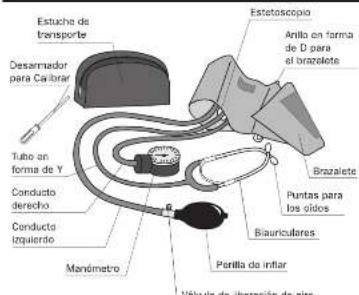
LISTA DE COMPONENTES
Puntas para los oídos
Biauriculares
Perilla de miñar
Valvula de liberación de aire
Manometro
Conelario 12quartes
Спектр holding
Estels de sinil pero anvaria
Desarmandar para Caílbra
INSTRUCCIONES DE ENSAMBLE
- Pivengro del breziale en la parte alta del prazo.
- Aspliarse de que la terminación del brazak le hoja sido insertado a través del anillo en forma de D.
- Inserte la terminación de la manguera en forma de "Y" dentro de la cabeza del estados para
- Inselete cada brazo de la minguera en forma de "Y" dentro de cada terminal de los bicariculares.
- Inserte la válvula de liberación de aire dentro del conducto aquierdo.
- Inserte el manómetro dentro del conducto derecho.
PARA TOMAR SU PRESIÓN ARTERIAL
CONSEIOS PARA EL CONTROL DE LA PRESIÓN ARTERIAL:
- Desarce coris minulas arte de realize la malición
- No fuente ni consuma cafeira por lo menos 30 minutos antes de la medición.
- Quilese: la repa ajustada y colúza se el brazalda en el brazo desmulos
- A neutrasque el medire le reciomierde la contraste, utilice el broza izquierda para modir la presión.
- No table durante la medición
- No cruce las pierras y manienga sus pies bien apoyados en el pieo durante la medicación.
PARA TOMAR SU PRESIÓN ARTERIAL:
-
Síntese comudamente con su brazo iaquidero descansado sobre una superficie plane para que el centro de la parte de arriba de su brazo este a la misma altara que su corazón.
-
Repose su brazo inquieto sobre la mesa con la palma hacia arriba. Coloque el branzlete alrededor del brazo con los conductos hacia scientre y hacia el interior de su brazo. Abrache el branzlete asegurado como la cinta lire sujetador.
-
□ brazalete deberá estar cómulo y no demasiado apetizado a una cera de poder insertar des dedos entre el brazalete y su luazo
-
Con la palma de su mano hacia arriba, coloque la cabera del esteroscopio una pulgada (2,5 cm) sobre el doblea del codo en la parte de adentro del brazo. Aqués es donde se encuentra la arteria principal.
-
Inserta los articulares del estetoscopia en sus niños, Ajustelos para que le quaten cómados.
b. Sostenga el manómetro en su mano izquierda y la perilla de infilar en su mano derecho.
7 Cierre la vila ola de liberación de aire en la perilla, dirado que es en sentido de las manecillas del relaj
-
Infe el brazalete apretando repetidamente la perilla con su mano derecia. Escuele el latido del pulse mientras india el brazalete.
-
Observe el indicador. Cuando no pruelo escuebar el falido del pulse, drew la presión toros 30 mmHg adiríorales.
NOTA: No infle el brazalete mas de 280 mmHg. Se puede lastimar usted mismo o danar el equipo. Si está inseguro en qué tan alto inflar el brazalete, consulte a su médico para el nivel correrbe de inflación.
- Después de alcanzar su aire de inflación, desde lentamente el brazalele abiendo la válculo de liberación de aire. Para abrir esta vástula, de vocla en dirección contrasta a los marcelles del reej y así la presión bujera a 24 mmHg por segundo. La agua del murómetro deberá bujera en procedir una a dos divisiones por segundos.
NOTA: Presurizar el brazalete costa la circulación arterial del brazo. No la deje totalmente inflada por más tiempo del que sea necesario.
II. Después de decir la válvula de liberación de aire, escueche cuindadusamente el latido del pulse. Al momento de escuchar el primer latido de su pulse, tiene noa de la lekura de la agua del marodimiento. Esta es su medida de presión arterial sistética.
-
Cuando ya no pueda escuchar ningún sonido, nuevamente tiene nota de la lectura de la agua del manémentro. Esta es su medida de presión arterial diastólica.
-
Quilese el benzalde y anón su récur de presión arteriel.
NOTA: Para verificar que su técnica estuvo bien y las lecturas fueron lo más exactas posibles, espere 10-13 minutos y repita el procedimiento.
MÉTODO PARA TOMAR LA PRESIÓN:
- Si Ud, placa lumar la presión anteriel a otra persona, haga que la persona a quien se le va a tomar la presión descanse y se relaje por la menos 15 minutos antes de supectar.
2 Haga que la persona extienda su brazo inzquierde hacia usted con la palma de su menor hacia arrilsa. Asegúo se de que el brazo esté al mismo nivel del cesozín.
-
Caloque el brazalate como se indicó en las instrucciones para usted mismo.
-
Ate a la correa del brazilete para que sea charamente visible para usted.
-
Siga les pasos del 1 al 13 en lúmre su presión arterial. Si es posible, que su médico observe en técnica para asegurarse de que sea correcta.
ACERCA DE LA PRESIÓN ARTERIAL
¿QUÉ ES LA PRESIÓN ARTERIAL?
La presión arterial es la fuerza que ejercy la sangre contra los parejos de las exterías. La presión sistólica se produce cuando el corazón se contraste: la diastálica, cuando el corazón se expande. La presión arterial se miete en milímetres de merzurio (minaligi).
¿QUÉ FACTORES AFECTAN LA PRESIÓN ARTERIAL?
La presión arterial puede verse afectada por muchos factores edad, pero momento del día, nivel de actividad, clima, alto y creación del año. Cientas actividades pueden llevar el ramen significativa la presión arterial de un individual. Una centrata puede elevar la presión arterial de una persona. Hormir puede recluir la presión arterial. Las lecturas también se pueden ver afectadas por la falta de descarse durante mucho tiempo arter de las mediciones.
Ademen de estos factores, las bebidas con caféria o alcohol, ciertos medicamentos, la tensión nervioso e incluso las prendas muy ajustadas al cuerpo pueden producti diferencias en las resultados de las mediciones.
¿QUÉ FACTORES PROVOCAN VARIACIONES EN LA PRESIÓN ARTERIAL?
La presión arterial de un indicular varies en groe, incluida de un día al otro y de una estación del año a otra. En el casa de los individuos hipensibles, estas variaciones son aún más marcadas. Generalmente, la presión arterial sabe cuando se trabaja o se tenga, y desciende a sus niveles más baje cuando se decirme.
Fluctuación en el transcurso de un día (caso: hombre de 35 años de edad)

EVALUACIÓN DE LA HIPERTENSIÓN ARTERIAL EN ADULTOS
Se han eselizable las siguientes murnes para evaluar la hipeleración arterial pain considerar la edad y el seat a moda de ericiación. Recuerde que es necesario tener en cuenta otros de riesgo (como diabetes, abestidad, tabaquismo, etc.) puede afectar estas ciras. Consulte al medio para obtener una evaluación excta.
Tabla de clasificación de JNC7 para adultos de EE. UU.
| Clasificación de la presión arterial | Sistólica (en mmHg) | Diastólica (en mmHg) | ||
| Normal | Inferior a 120 | y | Inferior a 80 | |
| Prehipertensión | 120-139 | o | 80-89 | |
| Hipertensión en etapa 1 | 140-159 | o | 90-99 | |
| Hipertensión en etapa 2 | superior 160 | o | superior 100 | |
FUENTE: El Sóptimo Informe del Comité Nacional Conjunto sobre Prevención, Evaluación y Tratamiento de Hiperetención Arterial en Adultos, Instituto Nacional de Curizados de Corazón, Los Pujones y la Sangre, mayo de 2020.
Tabla de clasificación de la OMS para adultos fuera de EE. UU. (por e.), Canadá, México)
| Classificación de la presión arterial | Sistúrica (en mmHg) | Distúrica (en mmHg) | ||
| Optima | inferior a 120 | y | inferior a 80 | |
| Normal | inferior a 130 | o | inferior a 85 | |
| Alta-normal | 130-139 | o | 85-89 | |
| Grado de hipertensión 1 | 140-159 | o | 90-99 | |
| Grado de hipertensión 2 | 160-179 | o | 100-109 | |
| Grado de hipertensión 3 | 180 | o | 110 | |
La Organización Mundial de la Salud (OMS) ha estaductido si hay hiper tensión crendal sin considerar la edad ni el socio.
¿QUÉ ES LA HIPERTENSIÓN?
La hypertensión (presión arterial alta) es el diagnóstico que se de cuando los resultados de las mediciones de la presión están constantemente por curinta del atel normal. Se sabe que la hypertensión no tratada puede resultar en accidentes cerebrezorescaleres, atquas cordiacos u otros enfermedades. Conocida como la "sesina silencioss"? porque no siempre presenta sícturnos que ¿clerlan al paciera, la hypertensión puede instarse si se diagnóstica a tiempo
¿ES POSIBLE MANTENER LA HIPERTENSIÓN BAJO CONTROL?
En muchos individuos, la hipertensión se puede mantener bajo control mediante cambios en el estilo de vida y la reducción de la tensión nerviosa, además de la modificación másada indicada y supercisoada por el medían. La Asociación Americana del Corzón hace las siguientes sugerencias en cuanto al estilo de vida, para evitar o controlar la hipertensión.
No time.
■ Consuma menos sal y grasas.
■ Mantenga un peso saludable.
■ Haga ejercicios con regularidad.
■ Controle la presión arterial
periodicamente.
¿POR QUÉ TOMARSE LA PRESIÓN ARTERIAL EN CASA?
Ahora se sabe que, en muchos individuales, las lecturas de la presión arterial tomadas en un consultorio médico o un hospital pueden resultar más elevadas, a causa del mieda y la anecidad. Esta reacción se llama comúnmente "hipertensión de consultario".
En todo caso, la medición hecha por uno mismo en casa scrue como complemento de las lectures realizadas por el médico y proporcionada un historial de presión arterial más exacto y compacte. Además, los estudios clínicos han demostrado que la detección y el tratamiento de la hipertensión se mejoran cuando los pacientes consultan a sus médicos y controlan la presión arterial en el hogar.
INSTRUCCIONES DE MANTENIMIENTO
INSTRUCCIONES DE MANTENIMIENTO
Cuidado óbice de su equipo para tomar la presión arterial en casa. Con el cauldade apropiendo, su equipo para tomar la presión arterial le dará machos arces de servicio recolíble. Para asquerar un buen funcionamiento de la unidad, sija estos reglas óbices
- Maneje el presión con cuidado. No lo tire o golpee. La ziguja deberá indicar cero cuando el brazalete esté completamente desinllado.
- Siempre desinfe el benzakte antes de guardarle.
- Evite galpear objetos contra la superficie del estetescinto,
- Guardo todos los aditamentos, incluyendo el instructivo, en el estuche proveido.
La Asociación Médica ha revisado su unidad de presión arterial para asegurar certibilidad y exactad antes de embarcada. Si embargo, como en cualquier instrumento sensible de una continuo, recomendamos que su unidad de presión arterial sea revisada periódicamente para una calibración apropiada para asegurar exactad en las lexuras de la presión arterial.
REVISAR LA PRECISION
COMO REVISAR LA PRECISION DE SU UNIDAD DE PRESIÓN ARTERIAL
- Desumado el escasmelo de la margarlo. Socérgalo en una posición vertical.
- Si la amía del indicación marca para su calidad esta cumplida.
a ser precisa. - Si la aguja marca una lectura diferente de cero, deberá ser
- Camelsa
- Para recalibrar, insertó un pequeño cesmendar dentro del conector de la manguera del manómetro. De vuelta al desar mador en caselquer dirección sin dar toda la vuelta, para que la seis respea a la misma desar
- Si la unidad no puede ser modificada usando este incluto, por favorable a A&D Mixlical (en los EF.DL) al 1-88-726-996
PARA ARA LA AYUDA ADICIONAL, VISITE NUESTRO SITIO WEB: WWW.ANDMEDICAL.COM
CON QUIEN COMUNICARSE
Nuestros productos se diseñan y fabrican conórcue a los más seciertes métodos científicos y tecnológicos, como tales ofrecen una alternativa exacta y fácil de usar en el hogar. Nuestra línea completa de productos abarca:
■ Monitores digitales de presión arterial Balanzide use personal
■ Monitores manuales de presión arterial ■ Monitores de actividades
■ Brazalete para presión arterial Termómetros digitales
■ Productos inalámbricos Estetoscopios
Este producto A&D Medical para la medición de la presión arterial este cubiertes por dos antes.
Distributed by:
A&D Engineering, Inc.
1756 Automation Packway
San Jose, CA 9513
1.839726956
www.arximedical.com

-
-
-
-
-
-
-
-
-
-
-
-
-
-
-
-
-
-
-
-
-
-
-
-
-
-
-
-
-
-
-
-
-
-
-
-
-
-
-
-
-
-
-
-
-
-
-
-
-
-
-
-
-
-
-
-
-
-
-
-
-
-
-
-
-
-
-
-
-
-
-
-
-
-
-
-
-
-
-
-
-
-
-
-
-
-
-
-
- 90.
-
-
-
-
-
-
-
-
-
-
-
-
-
-
-
-
-
-
-
-
-
-
-
-
-
-
-
-
-
-
-
-
-
-
-
-
-
-
-
-
-
-
-
-
-
-
-
-
-
-
-
-
-
-
-
-
-
-
-
-
-
-
-
-
-
-
-
-
-
-
-
-
-
-
-
-
-
-
-
-
-
-
-
-
-
-
-
- HOME BLOOD PRESSURE KIT INSTRUCTIONS - MODEL UA-101
- IMPORTANT INFORMATION
- PLEASE READ THIS IMPORTANT INFORMATION BEFORE USING YOUR MONITOR
- PRECAUTIONS
- LIST OF COMPONENTS
- ASSEMBLY INSTRUCTIONS
- TAKING YOUR BLOOD PRESSURE
- BLOOD PRESSURE TAKING TIPS
- TWO-PARTY METHOD
- ABOUT BLOOD PRESSURE
- WHAT IS BLOOD PRESSURE
- WHAT AFFECTS BLOOD PRESSURE
- WHAT CAUSES VARIATIONS IN BLOOD PRESSURE
- ASSESSING HIGH BLOOD PRESSURE FOR ADULTS
- WHAT IS HYPERTENSION
- CAN HYPERTENSION BE CONTROLLED
- DON'T SMOKE
- WHY MEASURE BLOOD PRESSURE AT HOME
- MAINTENANCE INSTRUCTIONS
- BASIC CARE OF YOUR HOME BLOOD PRESSURE KIT
- CHECKING FOR ACCURACY
- HOW TO CHECK YOUR HOME BLOOD PRESSURE KIT FOR ACCURACY
- VISIT OUR WEBSITE AT WWW.ANOMEDICAL.COM
- FOR ADDITIONAL SUPPORT
- CONTACT INFORMATION
- DIGITAL BLOOD PRESSURE MONITORS
- DISTRIBUTUL DE
- REDUCE SALT
- INSTRUCCIONES PARA TOMAR LA PRESIÓN ARTERIAL EN CASA MODELO UA-101
- INSTRUCCIONES DE ENSAMBLE
- PARA TOMAR SU PRESIÓN ARTERIAL
- ACERCA DE LA PRESIÓN ARTERIAL
- PARA ARA LA AYUDA ADICIONAL, VISITE NUESTRO SITIO WEB: WWW.ANDMEDICAL.COM
Marke : A&D Médical
Modell : UA-101
Kategorie : Blutdruckmessgerät