LCR230 - Ukategoriseret Vemer - Gratis brugsanvisning og manual
Find enhedens vejledning gratis LCR230 Vemer i PDF-format.


Brugerspørgsmål om LCR230 Vemer
0 spørgsmål om dette apparat. Besvar dem du kender, eller stil dit eget.
Stil et nyt spørgsmål om dette apparat
Download vejledningen til din Ukategoriseret i PDF-format gratis! Find din vejledning LCR230 - Vemer og tag din elektroniske enhed tilbage i hånden. På denne side er alle dokumenter nødvendige for brugen af din enhed offentliggjort. LCR230 af mærket Vemer.
BRUGSANVISNING LCR230 Vemer
1380196 01

Vemer S.p.A.
I - 32032 Feltra (BL) • Via Camp Lanc, 16
Tel +39 0439 80638 • Fax +39 0439 80619
e-mail info@vererit - web site: www.vererit
Mod. LCR
CE
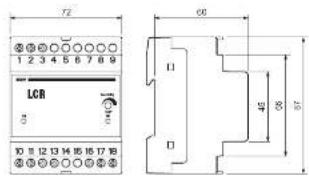
Dimensions
text_image
LCR 60 48 51 72 1 2 3 4 5 6 7 8 9 10 11 12 13 14 15 16 17 18 D DConnection diagram
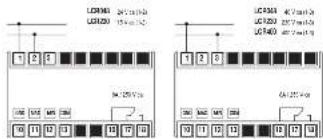
text_image
I2C1030 I2C1030 1 2 3 10 11 12 13 14 15 16 I2C1030 I2C1030 1 2 3 10 11 12 13 14 15 16 I2C1030 I2C1030 1 2 3 10 11 12 13 14 15 16Operating diagram 1
flowchart
graph TD
    A["Sample Collection"] --> B{Material Sample}
    B --> C["Day 1"]
    B --> D["Day 2"]
    B --> E["Day 3"]
    B --> F["Day 4"]
    B --> G["Day 5"]
    B --> H["Day 6"]
    B --> I["Day 7"]
    B --> J["Day 8"]
    B --> K["Day 9"]
    B --> L["Day 10"]
    B --> M["Day 11"]
    B --> N["Day 12"]
    B --> O["Day 13"]
    B --> P["Day 14"]
    B --> Q["Day 15"]
    B --> R["Day 16"]
    B --> S["Day 17"]
    B --> T["Day 18"]
    B --> U["Day 19"]
    B --> V["Day 20"]
    B --> W["Day 21"]
    B --> X["Day 22"]
    B --> Y["Day 23"]
    B --> Z["Day 24"]
    B --> AA["Day 25"]
    B --> AB["Day 26"]
    B --> AC["Day 27"]
    B --> AD["Day 28"]
    B --> AE["Day 29"]
    B --> AF["Day 30"]
    B --> AG["Day 31"]
    B --> AH["Day 32"]
    B --> AI["Day 33"]
    B --> AJ["Day 34"]
    B --> AK["Day 35"]
    B --> AL["Day 36"]
    B --> AM["Day 37"]
    B --> AN["Day 38"]
    B --> AO["Day 39"]
    B --> AP["Day 40"]
    B --> AQ["Day 41"]
    B --> AR["Day 42"]
    B --> AS["Day 43"]
    B --> AT["Day 44"]
    B --> AU["Day 45"]
    B --> AV["Day 46"]
    B --> AW["Day 47"]
    B --> AX["Day 48"]
    B --> AY["Day 49"]
    B --> AZ["Day 50"]
    B --> BA["Day 51"]
    B --> BB["Day 52"]
    B --> BC["Day 53"]
    B --> BD["Day 54"]
    B --> BE["Day 55"]
    B --> BF["Day 56"]
    B --> BG["Day 57"]
    B --> BH["Day 58"]
    B --> BI["Day 59"]
    B --> BJ["Day 60"]
    B --> BK["Day 61"]
    B --> BL["Day 62"]
    B --> BM["Day 63"]
    B --> BN["Day 64"]
    B --> BO["Day 65"]
    B --> BP["Day 66"]
    B --> BPB["Day 67"]
    B --> BPBb["Day 68"]
    B --> BPBbB["Day 69"]
    B --> BPBbBb["Bay at Day 70"]
    B --> BPBbBb["Bay at Day 71"]
    B --> BPBbBb["Bay at Day 72"]
    B --> BPBbBb["Bay at Day 73"]
    B --> BPBbBb["Bay at Day 74"]
    B --> BPBbBb["Bay at Day 75"]
    B --> BPBbBb["Bay at Day 76"]
    B --> BPBbBb["Bay at Day 77"]
    B --> BPBbBb["Bay at Day 78"]
    B --> BPBbBb["Bay at Day 79"]
    B --> BPBbBb["Bay at Day 80"]
    B --> BPBbBb["Bay at Day 81"]
    B --> BPBbBb["Bay at Day 82"]
    B --> BPBbBb["Bay at Day 83"]
    B --> BPBbBb["Bay at Day 84"]
    B --> BPBbBb["Bay at Day 85"]
    B --> BPBbBb["Bay at Day 86"]
    B --> BPBbBb["Bay at Day 87"]
    B --> BPBbBb["Bay at Day 88"]
    B --> BPBbBb["Bay at Day 89"]
    B --> BPBbBb["Bay at Day 90"]
    B --> BPBbBb["Bay at Day 91"]
    B --> BPBbBb["Bay at Day 92"]
    B --> BPBbBb["Bay at Day 93"]
    B --> BPBbBb["Bay at Day 94"]
    B --> BPBbBb["Bay at Day 95"]
    B --> BPBbBb["Bay at Day 96"]
    B --> BPBbBb["Bay at Day 97"]
    B --> BPBbBb["Bay at Day 98"]
    B --> BPBbBb["Bay at Day 99"]
    B --> BPBbBb["Bay at Day 100"]

Legend:
- Sample Collection
- Material Sample
- Material Sample
- Material Sample
- Material Sample
- Material Sample
- Material Sample
- Material Sample
- Material Sample
- Material Sample
- Material Sample
- Material Sample
- Material Sample
- Material Sample
- Material Sample
- Material Sample
- Material Sample
- Material Sample
- Material Sample
- Material Sample
- Material Sample
- Material Sample
- Material Sample
- Material Sample
- Material Sample
- Material Sample
- Material Supply
- Material Supply
- Material Supply
- Material Supply
- Material Supply
- Material Supply
- Material Supply
- Material Supply
- Material Supply
- Material Supply
- Material Supply
- Material Supply
- Material Supply
- Material Supply
- Material Supply
- Material Supply
- Material Supply
- Material Supply
- Material Supply
- Material Supply
- Material Supply
- Material Supply
- Material Supply
- Material Supply
- Material Supply
- Material Category
- Material Category
- Material Category
- Material Category
- Material Category
- Material Category
- Material Category
- Material Category
- Material Category
- Material Category
- Material Category
- Material Category
- Material Category
- Material Category
- Material Category
- Material Category
- Material Category
- Material Category
- Material Category
- Material Category
- Material Category
- Material Category
- Material Category
- Material Category
- Material Category
- Material Categories (Days) & Numbers (Days)
- Number of samples (Days)
- Number of days (Days)
- Number of days (Days)
- Number of days (Days)
- Number of days (Days)
- Number of days (Days)
- Number of days (Days)
- Number of days (Days)
- Number of days (Days)
- Number of days (Days)
- Number of days (Days)
- Number of days (Days)
- Number of days (Days)
- Number of days (Days)
- Number of days (Days)
- Number of days (days) & Numbers (days)
- Number of days (days) & Numbers (days)
- Number of days (days) & Numbers (days)
- Number of days (days) & Numbers (days)
- Number of days (days) & Numbers (days)
- Number of days (days) & Numbers (days)
- Number of days (days) & Numbers (days)
- Number of days (days) & Numbers (days)
- Number of days (days) & Numbers (days)
- Number in the number of samples (days) & numbers (days)
- Number in the number of samples (days) & numbers (days)
- Number in the number of samples (days) & numbers (days)
- Number in the number of samples (days) & numbers (days)
- Number in the number of samples (days) & numbers (days)
- Number in the number of samples (days) & numbers (days)
- Number in the number of samples (days) & numbers (days)
- Number in the number of materials (days) & numbers (days)
- Number in the number of materials (days) & numbers (days)
- Number in the number of materials (days) & numbers (days)
- Number in the number of materials (days) & numbers (days)
- Number in the number of materials (days) & numbers (days)
- Number in the number of materials (days) & numbers (days)
- Number in the number of materials (days) & numbers (days)
- Numbers in the number of samples (days) & numbers (days)
- Numbers in the number of samples (days) & numbers (days)
- Numbers in the number of samples (days) & numbers (days)
- Numbers in the number of samples (days) & numbers (days)
- Numbers in the number of samples (days) & numbers (days)
- Numbers in the number of samples (days) & numbers (days)
- Numbers in the number of samples (days) & numbers (days)
- Number in the number of samples (days) & numbers (days)
- Numbers in the number of samples (days) & numbers (days)
- Numbers in the number of samples (days) & numbers (days)
- Numbers in the number of samples (days) & numbers (days)
- Numbers in the number of samples (days) & numbers (days)
- Numbers in the number of samples (days) & numbers (days)
- Numbers in the number of samples (days) & populations.
- Numbers in the number of samples (days) & populations.
- Numbers in the number of samples (days) & populations.
- Numbers in the number of samples (days) & populations.
- Numbers in the number of samples (days) & populations.
- Numbers in the number of samples (days) & populations.
- Numbers in the number of samples (days) & populations.
- Numbers in the number of samples (days) & populations.
- Numbers in the number of samples (day) & populations.
- Numbers in the number of samples (day) & populations.
- Numbers in the number of samples (day) & populations.
- Numbers in the number of samples (day) & populations.
- Numbers in the number of samples (day) & populations.
- Numbers in the number of samples (day) & populations.
- Numbers in the number of samples (day) & populations.
- Numbers in the number of samples (day) & populations.
- Numbers in the population category: Days for production and drying; Maximum level control; Maximum level control; Maximum level control; Maximum level control; Maximum level control; Maximum level control; Maximum level control; Maximum level control; Maximum level control; Maximum level control; Maximum level control; Maximum level control; Maximum level control; Maximum level control; Maximum level control; Maximum level control; Maximum level control; Maximum level control; Maximum level control; Maximum level control; Maximum level control; Maximum level control; Maximum level control; Maximum level control; Maximum level control; Maximum level controls; Maximum levels are not specified.
Operating diagram 2
text_image
Control of a single liquid level (warning level) Flow: Flow: Flow: End End L100 L101 L102 L103 L104 L105 L106 L107 L108 L109 L110 L111 L112 L113 L114 L115 L116 L117 L118 L119 L120 L121 L122 L123 L124 L125 L126 L127 L128 L129 L130 L131 L132 L133 L134 L135 L136 L137 L138 L139 L140 L141 L142 L143 L144 L145 L146 L147 L148 L149 L150 L151 L152 L153 L154 L155 L156 L157 L158 L159 L160 L161 L162 L163 L164 L165 L166 L167 L168 L169 L170 L171 L172 L173 L174 L175 L176 L177 L178 L179 L180User Manual
CONTROL RELAY FOR ELECTRICALLY CONDUCTED LIQUID LEVELS
Read all the instructions carefully
■ Fine level control relay LCR is an electronic command device in a standardised
4-module DIN containers, to control the use of electrical conductive liquids.
SAFETY WARNINGS
During the installation and separation of the instrument, assessed in accordance with the
instructions behavior
1) The instrument should be installed by a competent operator following the installation
diagrams carefully
2) The instrument should be tested the following installation
2) Do not never or connect the instrument if any part of it is allowed.
4) The electrical system of the building in which the instrument is to be installed should
have a switch and a protective device against peer-currents
5) The instrument is designed for installations with over-voltage category III and
pollution level 2, in accordance with the EV 61010-1 standard.
Code Model Description
V7810600 LC5045
V780900 L021 Light and other
VPS0500 LCS11 2017 eal scnity (P)
TECHNICAL SPECIFICATIONS
• 2021.1.15
• Absorption 3,5 VA (2,5 W)
- Termination: 6 mm² block
- Output: rebay with exchange contact 8 A / 250 V
maximum reclassive power 2010 (V/326p = 1)
• Number of PAGES Application: 3
- 选择备份、同步、A V - (between the electrode)
- 选择备份的上按钮可选able
- Signaling:
Green LED power on
- Real LED adoption
- Open-up temperature -50°C = +50°C
- storage temperature = -10°C + 70°C
• Insulation power supply, load and power circuits insulated schematically at preformed
insulation in accordance with the XX 610.0 standard
- Contains 4-micronite DIN colour RM-7035 grey
- Going material: self-extinguiving in class M, in workers with the U-94 standard
- Degree of protection (IP2015P2) when correctly installed in an electrical panel
OPERATION
- The sensitivity of the relay can be annotated between 4 and 50 kΩ using the "sensitivity"
trimer, in order to adapt to the concentration of the liquid to be controlled during
the installation was. - For the correct operation of the relay, terminal 10, with its own electrode if necessary, should be necessary to test
- The conductors that represent
The concept of which connect it is by the 'the first thing' means a question of the 'the first thing' from the second class, especially where legal imbalance are involved.
If this is not possible, we recommend using screened cables
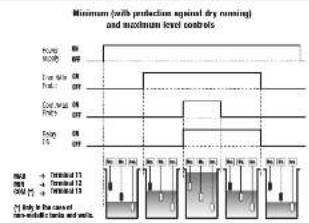
■ MINIMUM (WITH PROTECTION AGAINST DRY RUNNING)
AND MAXIMUM LEVEL CONTROLS
Filling a touch
using contact 16-17 (NC at rest) of the relay
- In the conditions with the trans empe, the electrodes are not submerged and the output
delay is no charged.
- The pump will come into action as soon as it has been started up by its commands, and will switch the following position will be liquid marks the maximum level is cancelled by
the MAX electrolyte
• A this point, the output, only will be excited and contact 15-17 well switch (see the
Operating diagram = 1".
Emptying a tank
uring contact 16-18 (NC at rest) of the relay
• In the conditions with the limits, the electron submethyl and the output relay is
excited.
• The pump will come into action as soon as it has been started up by its communicals, and will
continue the emptying operation until the liquid reaches the minimum level, as controlled in the MTR protection.
- At this point, the output play will be documented and allowed (6.1) will put in force (in
Oversing diagram 1 ^7
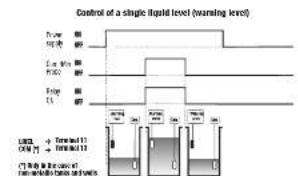
■ CONTROLLING A SINGLE LIQUID LEVEL (WARNING THRESHOLD)
• The output value will pass its exact time the bound reaches the level controlled by the LEVEL
electrodes.
• The operation will take place in reverse as soon as the electrode is no longer subopted.
in the liquid, as there is no self-powering of the relay with this type of control fuse the
Operating diagram 2
REFERENCE STANDARDS
Definitely in the EU's business
2016/5/EC (Low Village)
5931622C modified by 9201A88C and 10015EUC (L8K)
is declared with reference to the following harmonised standards
Safety: EN 61010-1
Electromagnetic compatibility: XV-1020-5-2, EN 61201-6-4
Applications (A)
Keeps the liquid level in the tank supplied between the two fixed points
(Max/Min), with alarm for excess level.
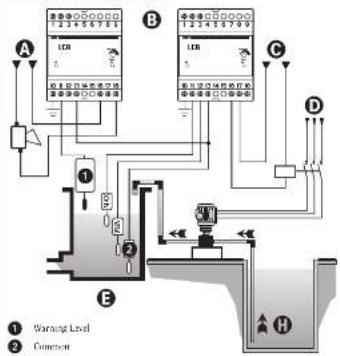
flowchart
graph TD
    A["Warning Level"] --> B["Component 1"]
    B --> C["Component 2"]
    C --> D["Component 3"]
    D --> E["Component 4"]
    E --> F["Component 5"]
    F --> G["Component 6"]
    G --> H["Component 7"]
    H --> I["Component 8"]
    I --> J["Component 9"]
    J --> K["Component 10"]
    K --> L["Component 11"]
    L --> M["Component 12"]
    M --> N["Component 13"]
    N --> O["Component 14"]
    O --> P["Component 15"]
    P --> Q["Component 16"]
    Q --> R["Component 17"]
    R --> S["Component 18"]
    S --> T["Component 19"]
    T --> U["Component 20"]
    U --> V["Component 21"]
    V --> W["Component 22"]
    W --> X["Component 23"]
    X --> Y["Component 24"]
    Y --> Z["Component 25"]
    Z --> AA["Component 26"]
    AA --> AB["Component 27"]
    AB --> AC["Component 28"]
    AC --> AD["Component 29"]
    AD --> AE["Component 30"]
    AE --> AF["Component 31"]
    AF --> AG["Component 32"]
    AG --> AH["Component 33"]
    AH --> AI["Component 34"]
    AI --> AJ["Component 35"]
    AJ --> AK["Component 36"]
    AK --> AL["Component 37"]
    AL --> AM["Component 38"]
    AM --> AN["Component 39"]
    AN --> AO["Component 40"]
    AO --> AP["Component 41"]
    AP --> AQ["Component 42"]
    AQ --> AR["Component 43"]
    AR --> AS["Component 44"]
    AS --> AT["Component 45"]
    AT --> AU["Component 46"]
    AU --> AV["Component 47"]
    AV --> AW["Component 48"]
    AW --> AX["Component 49"]
    AX --> AY["Component 50"]
A. Abso-Circuit, Abso-Supbu
A
B Power Supply 1-2-3
Melur Communal Circuit
(500) 0.1mm x 0.2mm
D. Euro-UK Group, Paris, Paris
© Film-Cratic Fox
E Tank Being Filled
WellTech Breakfast
Well tone: Deepening
Applications (B)
Keens the level of the liquid in the tank being filled between the two fused
cepts (May'30in), with insufficient level alarm.
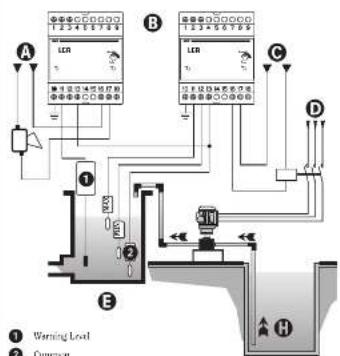
flowchart
graph TD
    A["Warning Load"] --> B["Duration"]
    B --> C["Control Unit"]
    C --> D["LED Indicator 1"]
    C --> E["LED Indicator 2"]
    C --> F["LED Indicator 3"]
    C --> G["LED Indicator 4"]
    C --> H["LED Indicator 5"]
    C --> I["LED Indicator 6"]
    C --> J["LED Indicator 7"]
    C --> K["LED Indicator 8"]
    C --> L["LED Indicator 9"]
    C --> M["LED Indicator 10"]
    C --> N["LED Indicator 11"]
    C --> O["LED Indicator 12"]
    C --> P["LED Indicator 13"]
    C --> Q["LED Indicator 14"]
    C --> R["LED Indicator 15"]
    C --> S["LED Indicator 16"]
    C --> T["LED Indicator 17"]
    C --> U["LED Indicator 18"]
    C --> V["LED Indicator 19"]
    C --> W["LED Indicator 20"]
2
A alarm clock power supply
Power Supply 1-2-3
©
© Melor Communal Cnvail
D. Jump Circuit Power Supply
© http://2022/11
E Task Being Killed
WellTask EngtyingallTank Engtying
USE
The operating principle is based on the variation in the reference value of the liquid, detected by excess or 2 or 3 electrodes, depending on whether the construction material of the wells and racks is reliable or not. This noise, coupled to suitable electrodes and inserted in the command circuit or pumping system to keep the level, in the wells and accumulator racks at the levels set, at the same time generating the production of the submerged pumps against dry cleaning. The relay can also be tested as an alarm device for the detection of the minimum and maximum levels of the liquid into its nominal, re as a protection device for the detection of the presence or absence of the liquid.
Applications (C)
Keeps the level in the tank supplied between the two final points (Max and Min levels), guaranteeing effective protection against dry watering of the pores, and controlling the level of the liquid in the well or tank being emptied.
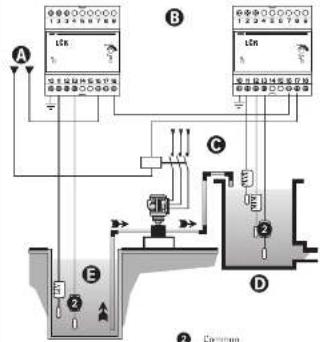
text_image
A B C D E 2 Common2 Common
A Motor Command Circuit
Tank Input Filed
①
0
B Power Supply 1-2-3
G Wells and Empiring
C Pump Circuit Power Supply
Applications (D)
Filling a tank by porngoing, with level control in the well or tank being emptied against dry running and control of the warning level in the tank being filled.
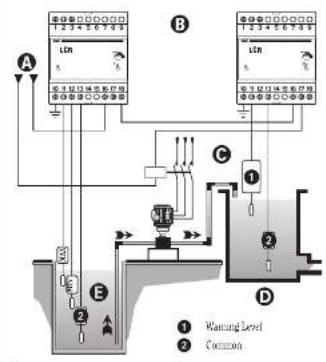
flowchart
graph TD
    A["Warning Level"] --> B["LTR"]
    B --> C{Condition}
    C --> D["Control Panel"]
    D --> E["Warning Level"]
    style A fill:#f9f,stroke:#333
    style B fill:#ccf,stroke:#333
    style C fill:#cfc,stroke:#333
    style D fill:#fcc,stroke:#333
- Wargué Level
(1)
2 Common
(二) 无须说明
D Tank Using Killed
0
E Well's Emplying
C Pump Circuit Power Supply
only
•
(五)
(No text)
The Ground Truth image displays a single, solid horizontal line. According to Rule 2 (UNDERSCORE & LINE RULES), this is a stylistic or background line, not a placeholder underscore. Therefore, the OCR result must ignore it and output nothing or only meaningful text. The provided OCR content is "____", which consists of four underscores. This is an incorrect interpretation of the line as a placeholder, violating the rule that stylistic lines must be ignored. The OCR has hallucinated underscores where none should exist based on the GT's visual context. Hence, the OCR result is inconsistent with the Ground Truth.
[Non-Text]
[Non-Text]
[Non-Text]
[Non-Text]
[Non-Text]
[Non-Text]
[Non-Text]
[Non-Text]
[Non-Text]
[Non-Text]
[Non-Text]
[Non-Text]
[Non-Text]
[Non-Text]
[Non-Text]
[Non-Text]
[Non-Text]
[Non-Text]
[Non-Text]
[Non-Text]
[Non-Text]
[Non-Text]
[Non-Text]
[Non-Text]
[Non-Text]
[Non-Text]
[Non-Text]
[Non-Text]
[Non-Text]
[Non-Text]
[Non-Text]
[Non-Text]
[Non-Text]
[Non-Text]
[Non-Text]
[Non-Text]
[Non-Text]
[Non-Text]
[Non-Text]
[Non-Text]
[Non-Text]
[Non-Text]
[Non-Text]
[Non-Text]
[Non-Text]
[Non-Text]
[Non-Text]
[Non-Text]
[Non-Text]
[Non-Text]
[Non-Text]
[Non-Text]
[Non-Text]
[Non-Text]
[Non-Text]
[Non-Text]
[Non-Text]
[Non-Text]
[Non-Text]
[Non-Text]
[Non-Text]
[Non-Text]
[Non-Text]
[Non-Text]
[Non-Text]
[Non-Text]
[Non-Text]
[Non-Text]
[Non-Text]
[Non-Text]
[Non-Text]
[Non-Text]
[Non-Text]
[Non-Text]
[Non-Text]
[Non-Text]
[Non-Text]
[Non-Text]
[Non-Text]
[Non-Text]
[Non-Text]
[Non-Text]
[Non-Text]
[Non-Text]
[Non-Text]
[Non-Text]
[Non-Text]
[Non-Text]
[Non-Text]
[Non-Text]
[Non-Text]
[Non-Text]
[Non-Text]
[Non-Text]
[Non-Text]
[Non-Text]
[Non-Text]
[Non-Text]
[Non-Text]
[Non-Text]
[Non-Text]
[Non-Text]
[Non-Text]
[Non-Text]
[Non-Text]
[Non-Text]
[Non-Text]
[Non-Text]
[Non-Text]
[Non-Text]