Pro 70 - Mikrofon Audio-Technica - Gratis brugsanvisning og manual
Find enhedens vejledning gratis Pro 70 Audio-Technica i PDF-format.


Brugerspørgsmål om Pro 70 Audio-Technica
0 spørgsmål om dette apparat. Besvar dem du kender, eller stil dit eget.
Stil et nyt spørgsmål om dette apparat
Download vejledningen til din Mikrofon i PDF-format gratis! Find din vejledning Pro 70 - Audio-Technica og tag din elektroniske enhed tilbage i hånden. På denne side er alle dokumenter nødvendige for brugen af din enhed offentliggjort. Pro 70 af mærket Audio-Technica.
BRUGSANVISNING Pro 70 Audio-Technica
Cardioid Condenser Lavalier Microphone
pro series

natural_image
Close-up of a black audio recording device with adjustable microphone and cable (no visible text or symbols)Features
- Clip-on lavalier mic provides articulate, full-sounding voice pickup
- Also excels as an instrument mic, especially for pickup of acoustic guitar with included AT8444 instrument adapter
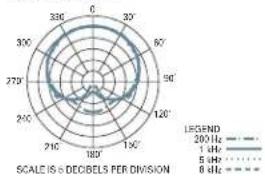
- Cardioid polar pattern reduces pickup of sounds from the sides and rear, improving isolation of desired sound source
- Offers the convenience of battery or phantom power operation
- Rugged design and construction for reliable performance
- Switchable 80 Hz high-pass filter minimizes pickup of undesired low-frequency sounds
Description
The PRO 70 is a miniature clip-on/lavalier condenser microphone with a cardioid polar pattern. It is designed for quality sound reinforcement, professional recording, television and other demanding sound pickup applications.
The microphone is intended to be worn on the clothing or used as an instrument mic for excellent yet unobtrusive sound pickup. The wide-range capability of the microphone ensures clean, accurate reproduction with high intelligibility for speakers and presenters as well as for instrument pickup. Its small size makes it ideal for use in applications where minimum visibility is required.
The microphone requires 11V to 52V phantom power or a 1.5V AA battery for operation. A battery need not be in place for phantom power operation.
The microphone's cardioid polar pattern provides a 120^ angle of acceptance.
The microphone includes a 1.8 m (6') permanently attached miniature cable. Its free end connects to the provided AT8531 power module via a TA3F-type connector. The output of the power module is a 3-pin XLRM-type connector.
A 3-position switch in the power module permits choice of off, on/flat response or on/low-roll-off (via integral 80 Hz high-pass filter). The roll-off position reduces the pickup of low-frequency ambient noise.
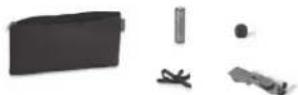
The microphone comes equipped with a power module, a clothing clip, an instrument adapter, a windscreen, a battery and a soft protective pouch.
Operation and Maintenance
The PRO 70 requires 11V to 52V phantom power or a 1.5V AA battery for operation. A battery need not be in place for phantom power operation.
To install the battery, remove the cap from the top of the power module. Insert a fresh 1.5V AA battery (" + " end toward the cap release button), then reassemble the power module. For longest battery life, the switch should remain off except when the microphone is in use. Alkaline batteries are recommended for longest life. Remove the battery during long-term storage.
Output is low impedance (Lo-Z) balanced. The signal appears across Pins 2 and 3; Pin 1 is ground (shield). Output phase is "Pin 2 hot"—positive acoustic pressure produces positive voltage at Pin 2.
To avoid phase cancellation and poor sound, all mic cables must be wired consistently: Pin 1-to-Pin 1, etc.
A 3-position switch in the power module permits choice of off, on/flat response, or on/low-roll-off (via integral 80 Hz high-pass filter). The roll-off position reduces the microphones sensitivity to popping in close vocal use. It also reduces the pickup of low-frequency ambient noise (such as traffic, air-handling systems, etc.), room reverberation and mechanically coupled vibrations. To engage the filter, slide the switch toward the "bent" line. To turn the microphone on without engaging the filter, slide the switch toward the flat line.
For use as a lavalier, attach the microphone about six inches below the chin. Anticipate movements that may cause the microphone to rub against or be covered by clothing, and position the microphone to avoid it.
Avoid leaving the microphone in the open sun or in areas where temperatures exceed 110^ F ( 43^ C) for extended periods. Extremely high humidity should also be avoided.
Architect's and Engineer's Specifications
The microphone shall be a fixed charge condenser. It shall have a cardioid polar pattern and a frequency response of 100 Hz to 14,000 Hz. The microphone shall operate from an external 11V to 52V DC phantom power source or, alternatively, from a 1.5V AA/UM3 battery. It shall be capable of handling sound input levels up to 123 dB (phantom and battery) with a dynamic range of 96 dB (phantom and battery). Nominal open-circuit output voltage shall be 5.6 mV (phantom) and (battery) at 1 V, 1 Pascal. Output shall be low impedance balanced (200 ohms—phantom and battery).
The microphone shall have a 1.8 m (6') permanently attached miniature cable connected to the power module. The power module shall house the battery, and shall contain a switch that permits choice of off, on/flat response or on/low-roll-off (80 Hz). The output of the power module shall be a 3-pin XLRM-type connector.
The microphone shall be 25.0 mm (0.98") long and have a diameter of 10.2 mm (0.40"). Weight shall be 8 grams (0.3 oz). The microphone shall include a power module, a clothing clip, a windscreen, a battery, an instrument adapter and a protective carrying case. Finish shall be low-reflectance black.
The Audio-Technica PRO70 is specified.
Specifications
| Element | Fixed-charge back plate, permanently polarized condenser |
| Polar pattern | Cardioid |
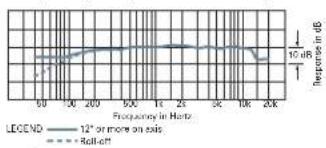
| Frequency response | 100-14,000 Hz |
| Low frequency roll-off | 80 Hz, 12 dB/octave |
| Open circuit sensitivity | Phantom: -45 dB (5.6 mV) re 1V at 1 PaBattery: -45 dB (5.6 mV) re 1V at 1 Pa |
| Impedance | Phantom: 200 ohmsBattery: 200 ohms |
| Maximum input sound level | Phantom: 123 dB SPL, 1 kHz at 1% T.H.D.Battery: 123 dB SPL, 1 kHz at 1% T.H.D. |
| Dynamic range (typical) | Phantom: 96 dB, 1 kHz at Max SPLBattery: 96 dB, 1 kHz at Max SPL |
| Signal-to-noise ratio ^1 | 67 dB, 1 kHz at 1 Pa |
| Phantom power requirements | 11-52V DC, 2 mA typical |
| Battery type | 1.5V AA/UM3 |
| Battery current / life | 0.4 mA / 1200 hours typical (alkaline) |
| Switch | Off, on-flat, on-roll-off |
| Weight | Microphone: 0.3 oz (8 g)Power module: 4.7 oz (134 g) |
| Dimensions | Microphone: 25.0 mm (0.98") long,10.2 mm (0.40") diameterPower module: 83.0 mm (3.27") H x63.0 mm (2.48") W x 22.0 mm (0.87") D |
| Output connector | Power module: Integral 3-pin XLRM-type |
| Cable | Integral 6' (1.8 m), permanently attached between microphone and power module |
| Audio-Technica case style | M1 |
| Accessories furnished | AT8411 clothing clip; ATB444 instrument adapter; power module; windscreen; battery; soft protective pouch |
In the interest of standards development, A.T.U.S. offers full details on its test methods to other industry professionals on request.
1 Pascal = 10 dynes/cm² = 10 microbars = 94 dB SPL
Typical, A-weighted, using Audio Precision System One
Specifications are subject to change without notice.
frequency response: 100–14,000 Hz
line
| Frequency in Hz | Frequency in Hz | | --------------- | --------------- | | 0 | 0 | | 50 | ~10 | | 100 | ~15 | | 150 | ~20 | | 200 | ~25 | | 250 | ~30 | | 300 | ~35 | | 350 | ~40 | | 400 | ~45 | | 450 | ~50 | | 500 | ~55 | | 550 | ~60 | | 600 | ~65 | | 650 | ~70 | | 700 | ~75 | | 750 | ~80 | | 800 | ~85 | | 850 | ~90 | | 900 | ~95 | | 950 | ~100 | | 1000 | ~105 | | 1050 | ~110 | | 1100 | ~115 | | 1150 | ~120 | | 1200 | ~125 | | 1250 | ~130 | | 1300 | ~135 | | 1350 | ~140 | | 1400 | ~145 | | 1450 | ~150 | | 1500 | ~155 | | 1550 | ~160 | | 1600 | ~165 | | 1650 | ~170 | | 1700 | ~175 | | 1750 | ~180 | | 1800 | ~185 | | 1850 | ~190 | | 1900 | ~195 | | 1950 | ~200 | | 2000 | ~205 | | 2050 | ~210 | | 2100 | ~215 | | 2150 | ~220 | | 2200 | ~225 | | 2250 | ~230 | | 2300 | ~235 | | 2350 | ~240 | | 2400 | ~245 | | 2450 | ~250 | | 2500 | ~255 | | 2550 | ~260 | | 2600 | ~265 | | 2650 | ~270 | | 2700 | ~275 | | 2750 | ~280 | | 2800 | ~285 | | 2850 | ~290 | | 2900 | ~295 | | 2950 | ~300 | | 3000 | ~305 | | 3050 | ~310 | | 3100 | ~315 | | 3150 | ~320 | | 3200 | ~325 | | 3250 | ~330 | | 3300 | ~335 | | 3350 | ~340 | | 3400 | ~345 | | 3450 | ~350 | | 3500 | ~355 | | 3550 | ~360 | | 3600 | ~365 | | 3650 | ~370 | | 3700 | ~375 | | 3750 | ~380 | | 3800 | ~385 | | 3850 | ~390 | | 3900 | ~395 | | 3950 | ~400 | | 4000 | ~405 | | 4050 | ~410 | | 4100 | ~415 | | 4150 | ~420 | | 4200 | ~425 | | 4250 | ~430 | | 4300 | ~435 | | 4350 | ~440 | | 4400 | ~445 | | 4450 | ~450 | | 4500 | ~455 | | 4550 | ~460 | | 4600 | ~465 | | 4650 | ~470 | | 4700 | ~475 | | 4750 | ~480 | | 4800 | ~485 | | 4850 | ~490 | | 4900 | ~495 | | 4950 | ~500 | | 5000 | ~505 | | 5667 | - | | Note: The frequency values are estimated based on the 'Frequency' column from the plot. The 'Response' values are calculated as a fraction of the 'Frequency' column. There is only one data series labeled 'LEGEVD'.polar pattern
radar
| Angle | 200 Hz | 1.4 Hz | 5.4 Hz | 8.6 Hz | |---|---|---|---|---| | 0° | 330 | 330 | 330 | 330 | | 30° | 300 | 300 | 300 | 300 | | 60° | 270 | 270 | 270 | 270 | | 90° | 240 | 240 | 240 | 240 | | 120° | 210 | 210 | 210 | 210 | | 150° | 180 | 180 | 180 | 180 | | 180° | 150 | 150 | 150 | 150 | | 210° | 120 | 120 | 120 | 120 | | 240° | 90 | 90 | 90 | 90 | | 270° | 60 | 60 | 60 | 60 | | 300° | 30 | 30 | 30 | 30 | | Scale is δ DEBELS PER DIVISIONaudio-technica.
Audio-Technica Corporation
audio-technica.com ©2017 Audio-Technica
0001-0330-01