GCV160E - Motor Honda - Gratis brugsanvisning og manual
Find enhedens vejledning gratis GCV160E Honda i PDF-format.


Brugerspørgsmål om GCV160E Honda
0 spørgsmål om dette apparat. Besvar dem du kender, eller stil dit eget.
Stil et nyt spørgsmål om dette apparat
Download vejledningen til din Motor i PDF-format gratis! Find din vejledning GCV160E - Honda og tag din elektroniske enhed tilbage i hånden. På denne side er alle dokumenter nødvendige for brugen af din enhed offentliggjort. GCV160E af mærket Honda.
BRUGSANVISNING GCV160E Honda
HONDA
POWER PRODUCTS
GCV135E·GCV160E
natural_image
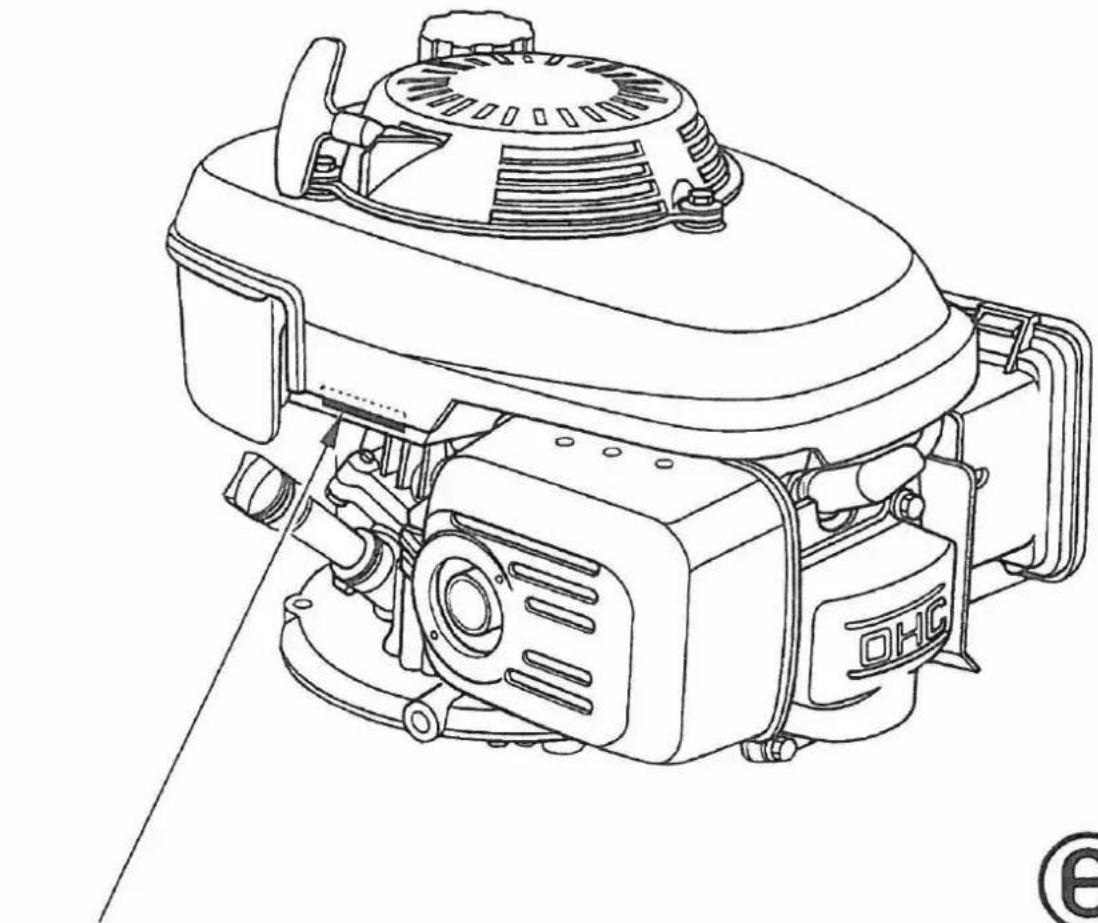
Line drawing of a grass lawn mower with visible blades and mounting bracket (no text or symbols)SERIAL NUMBER AND ENGINE TYPE

SPEC
ECOLOGY CONSCIOUS TECHNOLOGY
OWNER'S MANUAL
CE
32Z0M604
00X32-Z0M-6040
© Honda Motor Co., Ltd. 2007
Thank you for purchasing a Honda engine.
This manual covers the operation and maintenance of your engine: GCV135E-GCV160E
All information in this publication is based on the latest product information available at the time of printing.
The illustrations may vary according to the with top cover type.
Honda Motor Co., Ltd. reserves the right to make changes at any time without notice and without incurring any obligation.
No part of this publication may be reproduced without written permission.
This manual should be considered a permanent part of the engine and should remain with it if it is resold.
Pay special attention to statements preceded by the following words:
⚠ WARNING
Indicates a strong possibility of severe personal
injury or death if instructions are not followed.
CAUTION: Indicates a possibility of personal injury or equipment damage if instructions are not followed.
NOTICE
Indicates that equipment or property damage can
result if instructions are not followed.
NOTE: Gives helpful information.
If a problem should arise, or if you have any questions about your engine, consult an authorized Honda dealer.
WARNING
The Honda engine is designed to give safe and dependable service if operated according to instructions. Read and understand the Owner's Manual before operating the engine. Failure to do so could result in personal injury or equipment damage.
1 SAFETY INSTRUCTIONS
⚠ WARNING
To ensure safe operation—
text_image
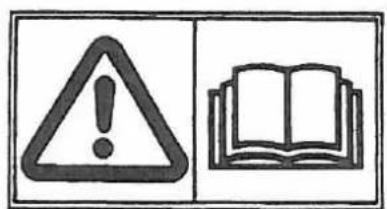
Warning symbol and open book icon with exclamation mark and open book symbol- Honda engine is designed to give safe and dependable service if operated according to instructions. Read and understand the Owner's Manual before operating the engine. Failure to do so could result in personal injury or equipment damage.
• Always make a pre-operation check (see page 7) before you start the engine. You may prevent an accident or equipment damage.
• To prevent fire hazards and to provide adequate ventilation, keep the engine at least 1 meter (3 feet) away from buildings and other equipment during operation. Do not place flammable objects close to the engine.
- Children and pets must be kept away from the area of operation due to a possibility of burns from hot engine components or injury from any equipment the engine may be used to operate.
- Know how to stop the engine quickly, and understand the operation of all controls. Never permit anyone to operate the engine without proper instructions.
- Do not place flammable objects such as gasoline, matches, etc., close to the engine while it is running.
- Refuel in a well-ventilated area with the engine stopped. Gasoline is highly flammable and explosive under certain conditions.
- Do not overfill the fuel tank. There should be no fuel in the filler neck.
Make sure that the filler cap is closed securely.
Safety Instruction
⚠ WARNING
To ensure safe operation—
- If any fuel is spilled, clean it up completely and allow petroleum vapours to dissipate before starting the engine.
- Do not smoke or allow flames or sparks where the engine is refueled or where gasoline is stored.
- Exhaust gas contains poisonous carbon monoxide. Avoid inhalation of exhaust gases. Never run the engine in a closed garage or confined area.
- Place the engine on a stable surface. Do not tilt the engine more than 15^ from horizontal. Operating at excessive angles may result in fuel spillage.
- Do not place anything on the engine, as it may create a fire hazard.
- A spark arrester is available as an optional part for this engine. It is illegal in some areas to operate an engine without a spark arrester. Check local laws and regulations before operating.
- The muffler becomes very hot during operation and remains hot for a while after stopping the engine. Be careful not to touch the muffler while it is hot. To avoid severe burns or fire hazards, let the engine cool before transporting it or storing it indoors.
SAFETY INDICATION LOCATION
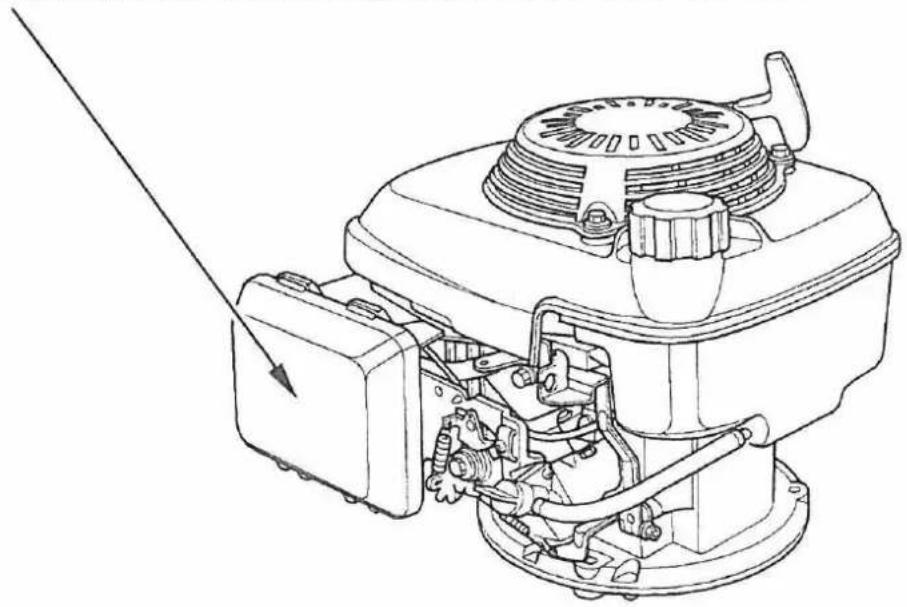
This indication warns you of potential hazards that can cause serious injury. Read it carefully.
READ OWNER'S MANUAL BEFORE OPERATION.
natural_image
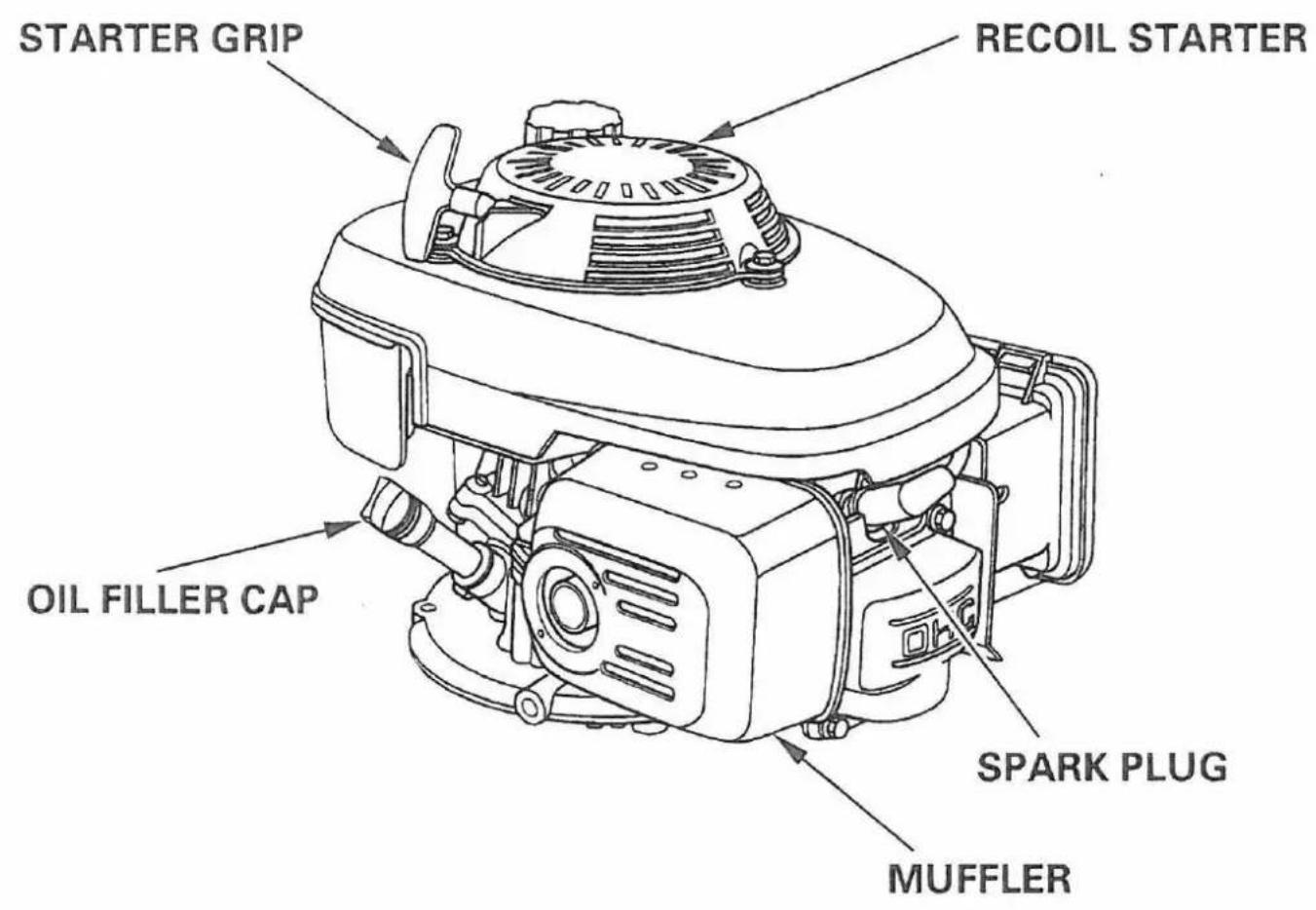
Technical line drawing of a mechanical engine assembly with no visible text or symbols2 COMPONENT IDENTIFICATION
text_image
STARTER GRIP RECOIL STARTER OIL FILLER CAP SPARK PLUG MUFFLERManual choke type (With CHOKE LEVER type)
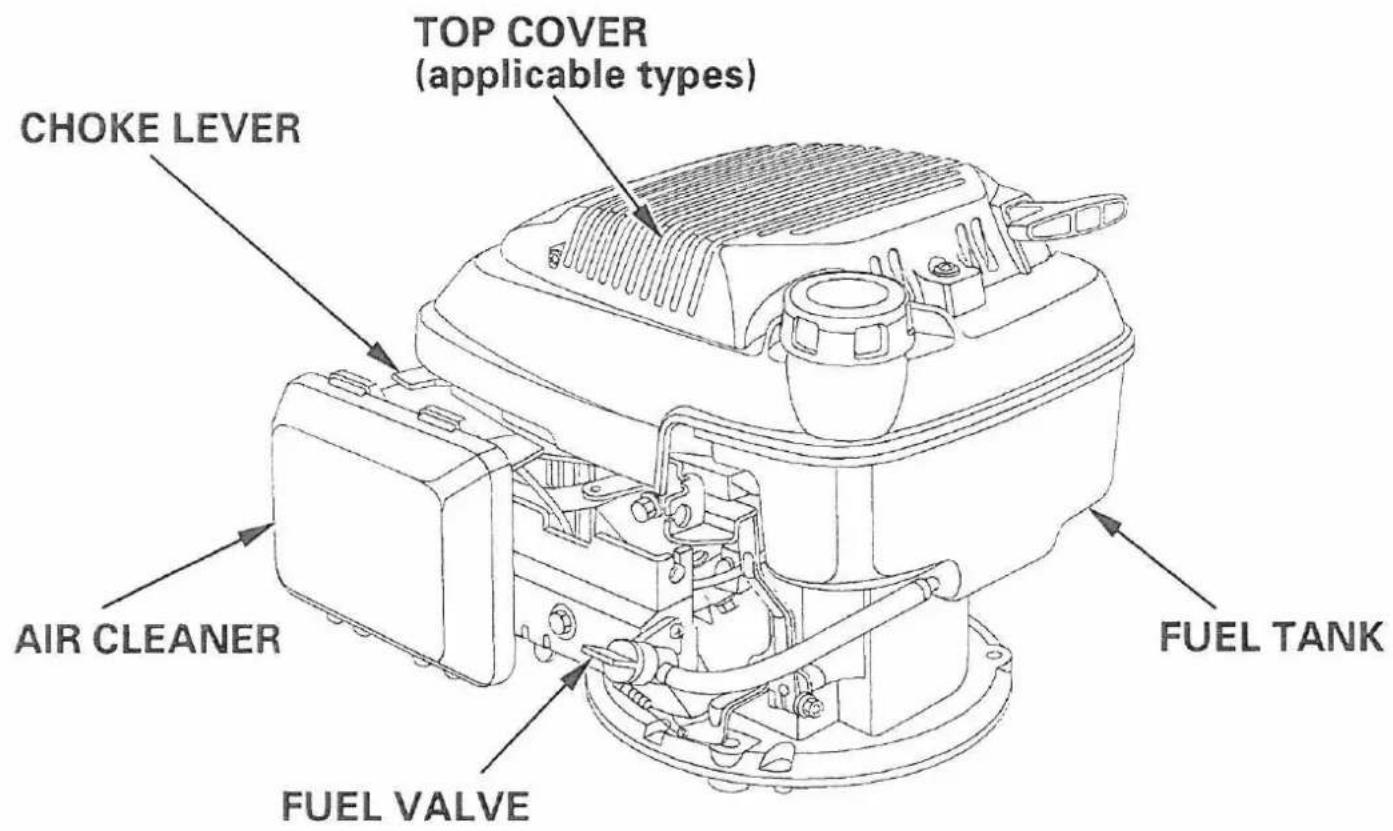
text_image
TOP COVER (applicable types) CHOKE LEVER AIR CLEANER FUEL VALVE FUEL TANKManual choke type (Without CHOKE LEVER type)
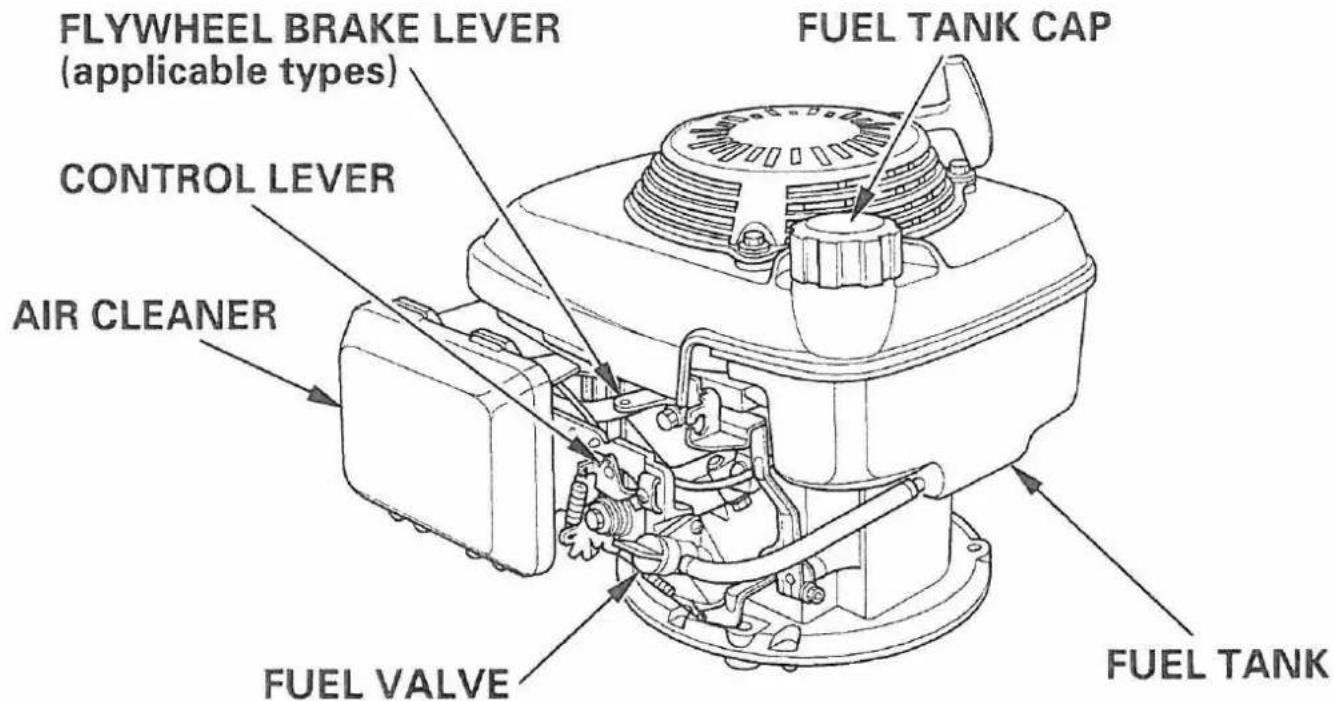
text_image
FLYWHEEL BRAKE LEVER (applicable types) CONTROL LEVER AIR CLEANER FUEL TANK CAP FUEL VALVE FUEL TANKAutomatic choke type (Fixed throttle type)
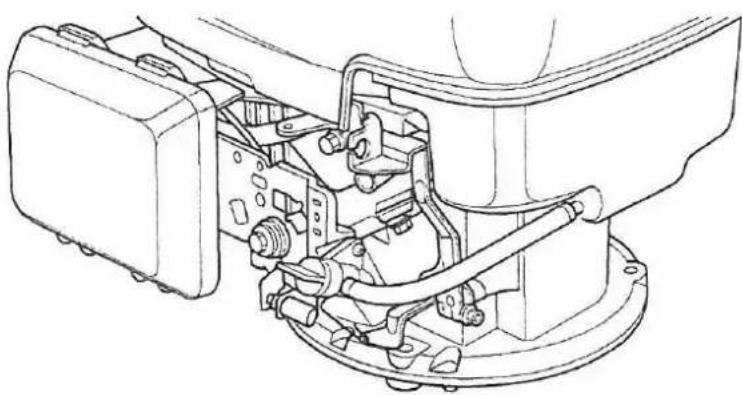
natural_image
Technical line drawing of a mechanical assembly with no visible text or symbolsAutomatic choke type (Manual throttle type)
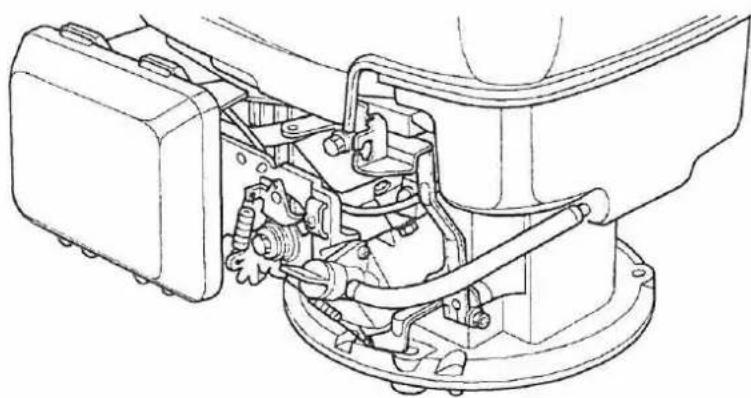
natural_image
Technical line drawing of a mechanical assembly with no visible text or symbols3 PRE-OPERATION CHECK
1. Engine oil level
CAUTION:
- Running the engine with insufficient oil can cause serious engine damage. - Be sure to check the engine on a level surface with the engine stopped.
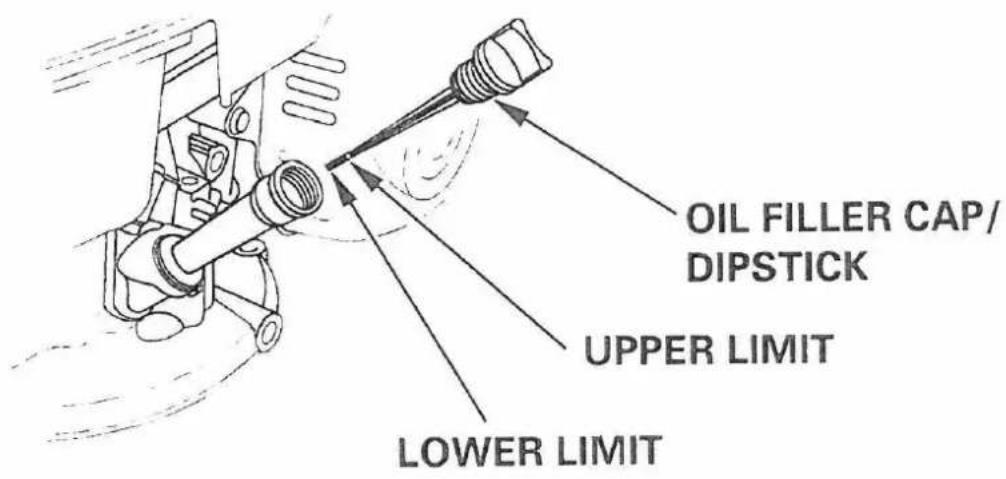
- Remove the oil filler cap and wipe the dipstick clean.
- Insert the dipstick into the oil filler neck, but do not screw it in.
- If the level is low, add the recommended oil to the upper limit on the dipstick.
Use 4-stroke motor oil that meets or exceeds the requirements for API service category SE or later (or equivalent). Always check the API service label on the oil container to be sure it includes the letters SE or later (or equivalent).
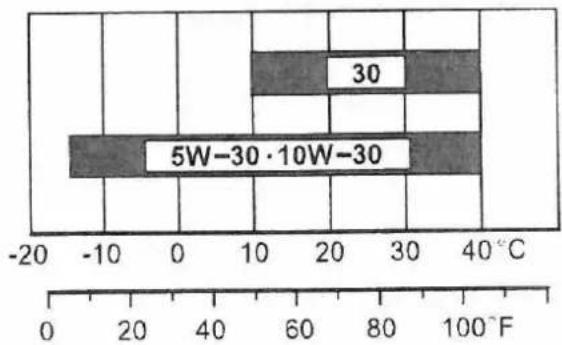
SAE 10W-30 is recommended for general use. Other viscosities shown in the chart may be used when the average temperature in your area is within the indicated range.
heatmap
| Range | Value | |---|---| | 30 | 30 | | 5W-30·10W-30 | 5W-30·10W-30 |AMBIENT TEMPERATURE
CAUTION:
Using nondetergent oil or 2-stroke engine oil could shorten the engine's service life.
text_image
OIL FILLER CAP/ DIPSTICK UPPER LIMIT LOWER LIMIT2. Air cleaner
CAUTION:
Never run the engine without the air cleaner. Rapid engine wear will result.
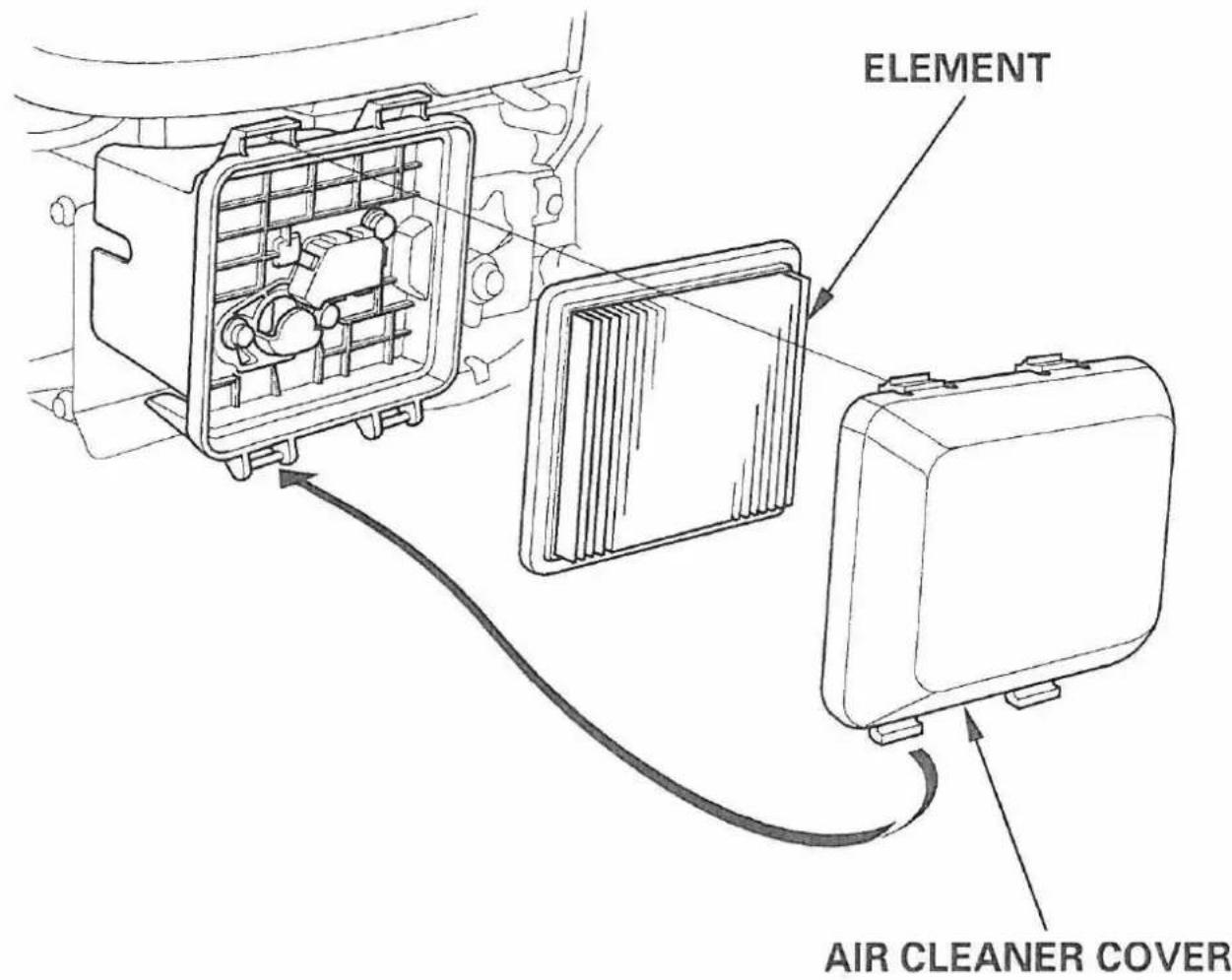
Remove the air cleaner cover and check the cleaner for dirt or obstruction of the element (see page 21).
text_image
ELEMENT AIR CLEANER COVER3. Fuel
Recommended Fuel
| Unleaded gasoline | |
| U.S. | Pump octane rating 86 or higher |
| Except U.S. | Research octane rating 91 or higher |
| Pump octane rating 86 or higher | |
⚠ WARNING
- Gasoline is extremely flammable and is explosive under certain conditions.
- Refuel in a well-ventilated area with the engine stopped. Do not smoke or allow flames or sparks in the area where the engine is refueled or where gasoline is stored.
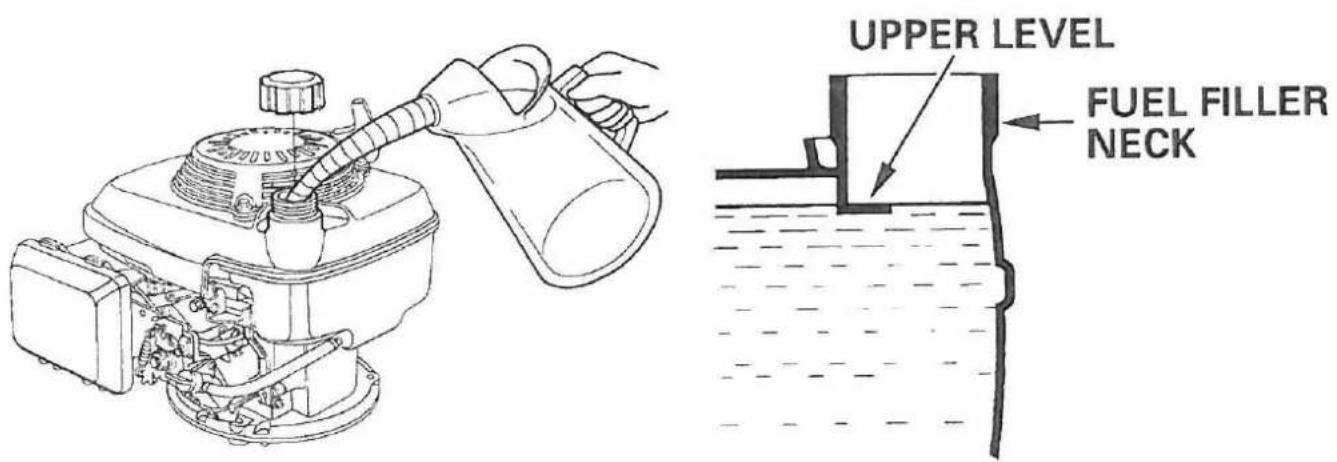
- Do not overfill the fuel tank (there should be no fuel in the filler neck). After refueling, make sure the tank cap is closed properly and securely.
- Be careful not to spill fuel when refueling. Spilled fuel or fuel vapor may ignite. If any fuel is spilled, make sure the area is dry before starting the engine.
- Avoid repeated or prolonged contact with skin or breathing of vapor.
KEEP OUT OF REACH OF CHILDREN.
text_image
UPPER LEVEL FUEL FILLER NECKThis engine is certified to operate on unleaded gasoline with a pump octane rating of 86 or higher (a research octane rating of 91 or higher).
Refuel in a well-ventilated area with the engine stopped. If the engine has been running, allow it to cool first. Never refuel the engine inside a building where gasoline fumes may reach flames or sparks.
You may use regular unleaded gasoline containing no more than 10% ethanol (E10) or 5% methanol by volume. In addition, methanol must contain cosolvents and corrosion inhibitors.
Use of fuels with content of ethanol or methanol greater than shown above may cause starting and/or performance problems. It may also damage metal, rubber, and plastic parts of the fuel system.
Engine damage or performance problems that result from using a fuel with percentages of ethanol or methanol greater than shown above are not covered under warranty.
NOTE:
Gasoline spoils very quickly depending on factors such as light exposure, temperature and time.
In worst cases, gasoline can be contaminated within 30 days.
Using contaminated gasoline can seriously damage the engine (carburetor clogged, valve stuck).
Such damage due to spoiled fuel is disallowed from coverage by the warranty.
To avoid this please strictly follow these recommendations:
- Only use specified gasoline (see page 9).
- Use fresh and clean gasoline.
• To slow deterioration, keep gasoline in a certified fuel container. - If long storage (more than 30 days) is foreseen, drain fuel tank and carburetor (see page 29).
4 STARTING THE ENGINE
Manual choke type
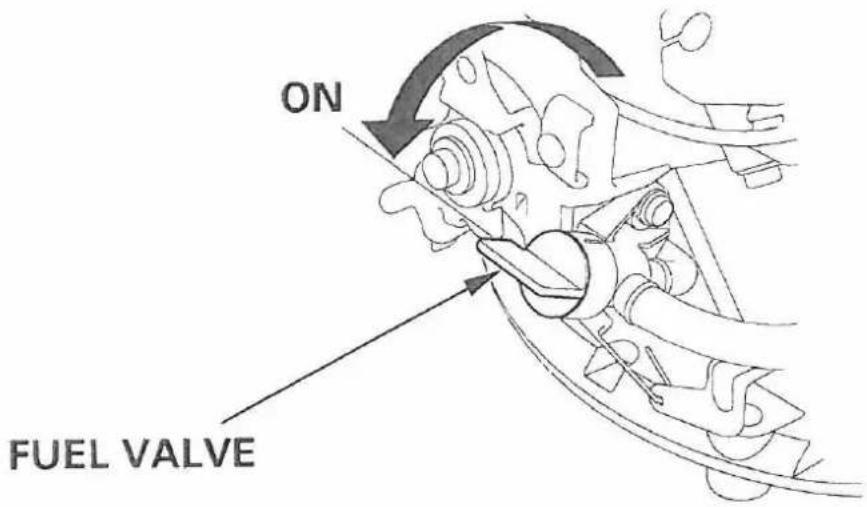
- Turn the fuel valve to the ON position.
text_image
ON FUEL VALVE- • Without CHOKE LEVER type:
Move the control lever to the CLOSE position.
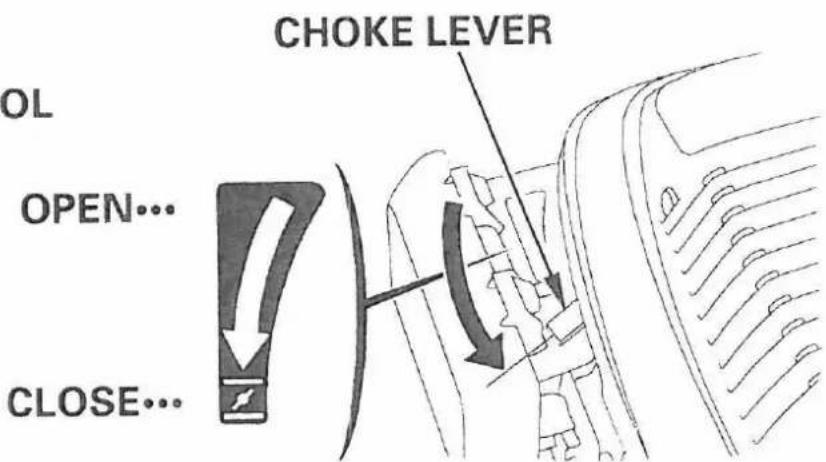
- With CHOKE LEVER type
(AUTOMATIC RETURN CHOKE type):
Move the choke lever to the CLOSE position.
NOTE:
Do not use the choke if the engine is warm or the air temperature is high.
[WITHOUT CHOKE LEVER TYPE]

text_image
CHOKE CONTROL LEVER CL[WITH CHOKE LEVER TYPE]
text_image
OL OPEN... CLOSE... CHOKE LEVER- With FLYWHEEL BRAKE LEVER type only:
Move the flywheel brake lever to the RELEASED position.
The engine switch, which is linked with the flywheel brake lever, is turned on when the flywheel brake lever is moved to the RELEASED position.
FLYWHEEL BRAKE LEVER
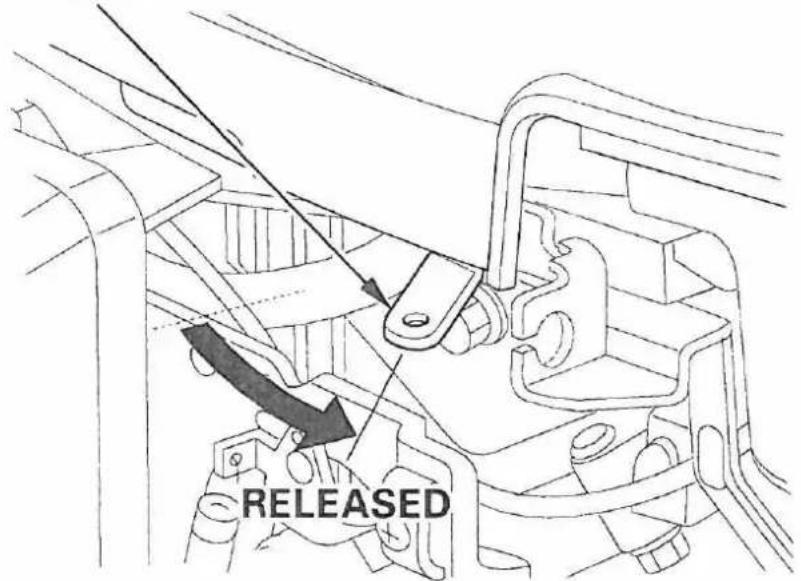
text_image
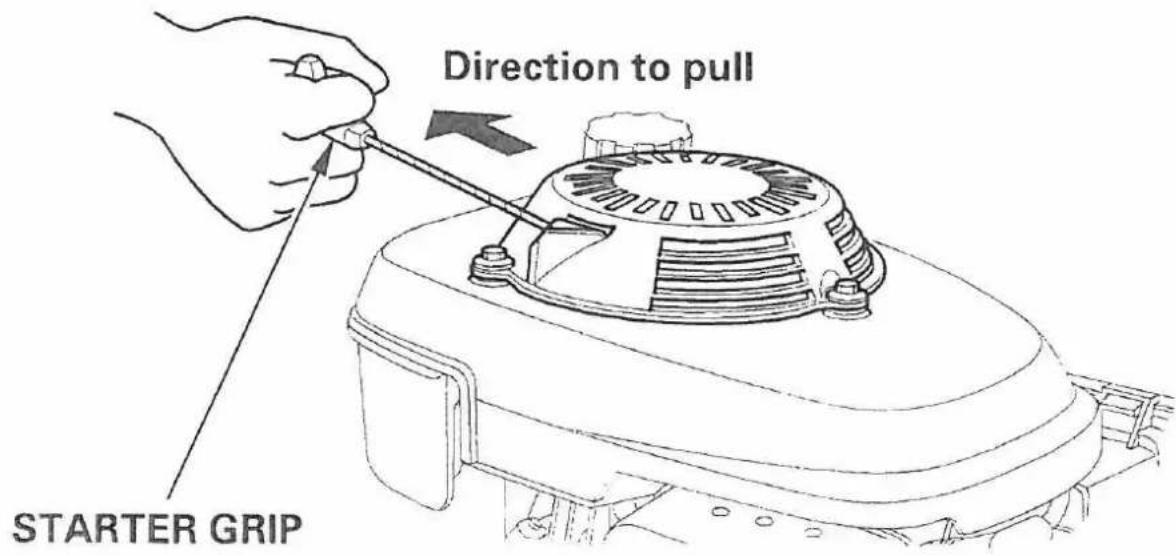
RELEASED- Pull the starter grip lightly until you feel resistance, then pull briskly in the direction of the arrow as shown below.
CAUTION:
Do not allow the starter grip to snap back against the engine. Return it gently to prevent damage to the starter.
text_image
Direction to pull STARTER GRIP[With CHOKE LEVER type (AUTOMATIC RETURN CHOKE type)] Operate the recoil starter as soon as you move the flywheel brake lever to the RELEASED position. The choke lever automatically begins moving to the OPEN position when the flywheel brake lever is moved to the RELEASED position.
-
If the engine does not start within several consecutive pulls of the recoil starter, move the flywheel brake lever to the ENGAGED position and move the choke lever to the CLOSE position.
-
Move the flywheel brake lever to the RELEASED position and immediately begin operating the recoil starter.
[Without CHOKE LEVER type]
- When engine warms up, move the control lever to FAST or SLOW.
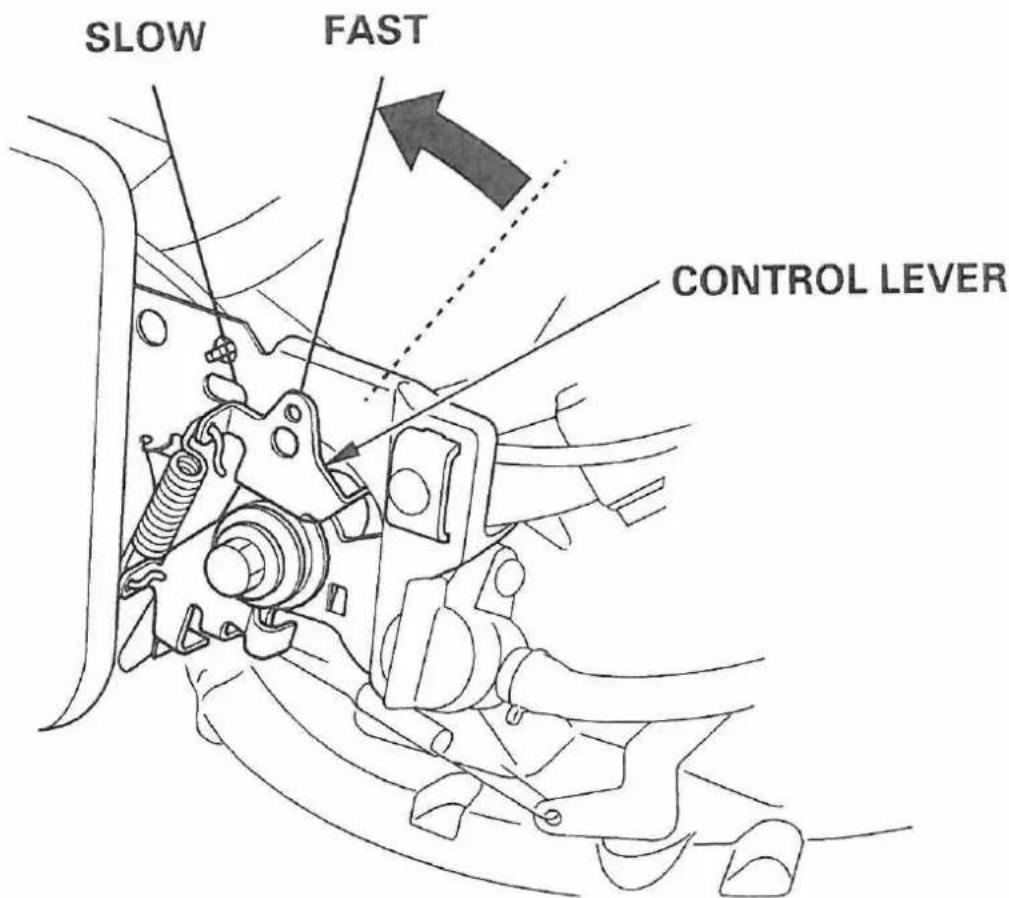
text_image
SLOW FAST CONTROL LEVERAutomatic choke type
- Turn the fuel valve to the ON position (see page 11).
- Move the flywheel brake lever to the RELEASED position (see page 12).
- Move the control lever to the FAST position (MANUAL THROTTLE type).
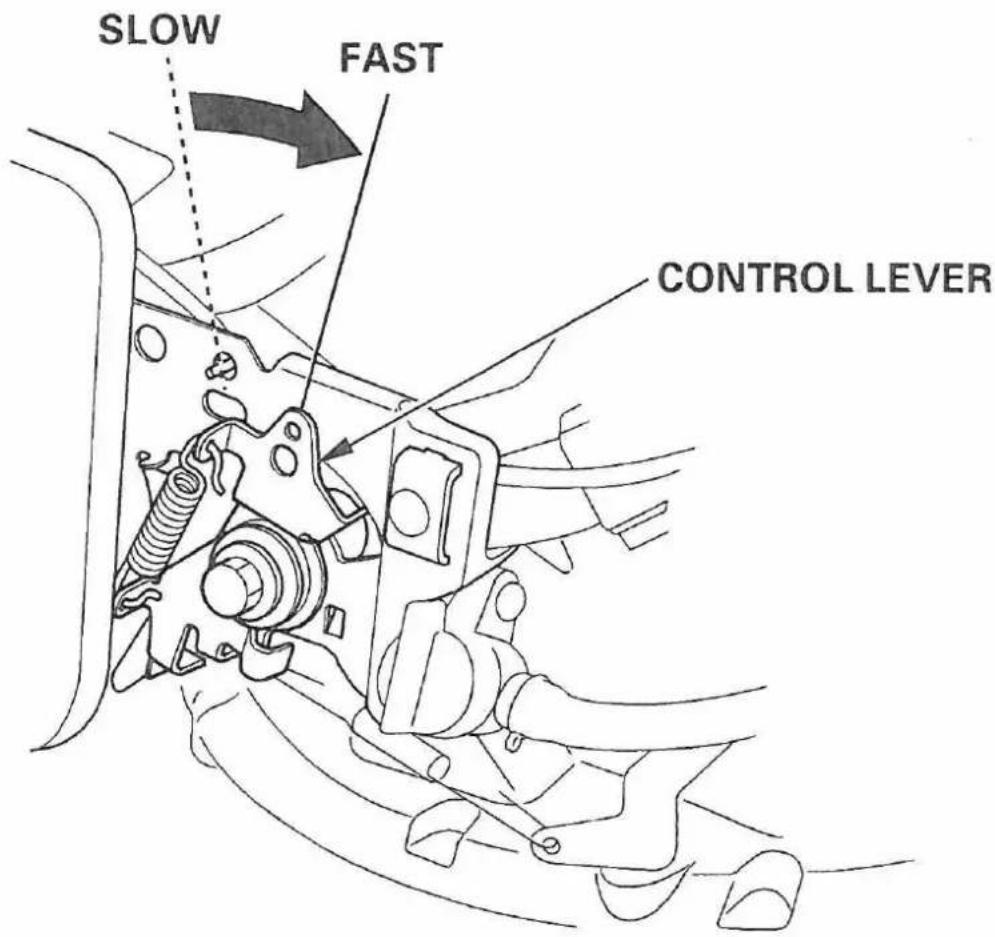
text_image
SLOW FAST CONTROL LEVER-
Pull the starter grip lightly until you feel resistance, then pull briskly in the direction of the arrow as shown on page 12.
-
Position the control lever for the desired engine speed (MANUAL THROTTLE type).
● High altitude operation
At high altitude, the standard carburetor air-fuel mixture will be excessively rich. Performance will decrease, and fuel consumption will increase.
High altitude performance can be improved by specific modifications to the carburetor. If you always operate the engine at altitudes higher than 1,500 m (5,000 feet) above sea level, have your authorized Honda dealer perform these carburetor modifications.
Even with suitable carburetor jetting, engine horsepower will decrease approximately 3.5% for each 300 m (1,000 feet) increase in altitude. The effect of altitude on the horsepower will be greater than this if no carburetor modification is made.
CAUTION:
Operation of the engine at an altitude lower than the carburetor is jetted for may result in reduced performance, overheating, and serious engine damage caused by an excessively lean air/fuel mixture.
5 STOPPING THE ENGINE
- Move the control lever to the SLOW position (MANUAL THROTTLE type).
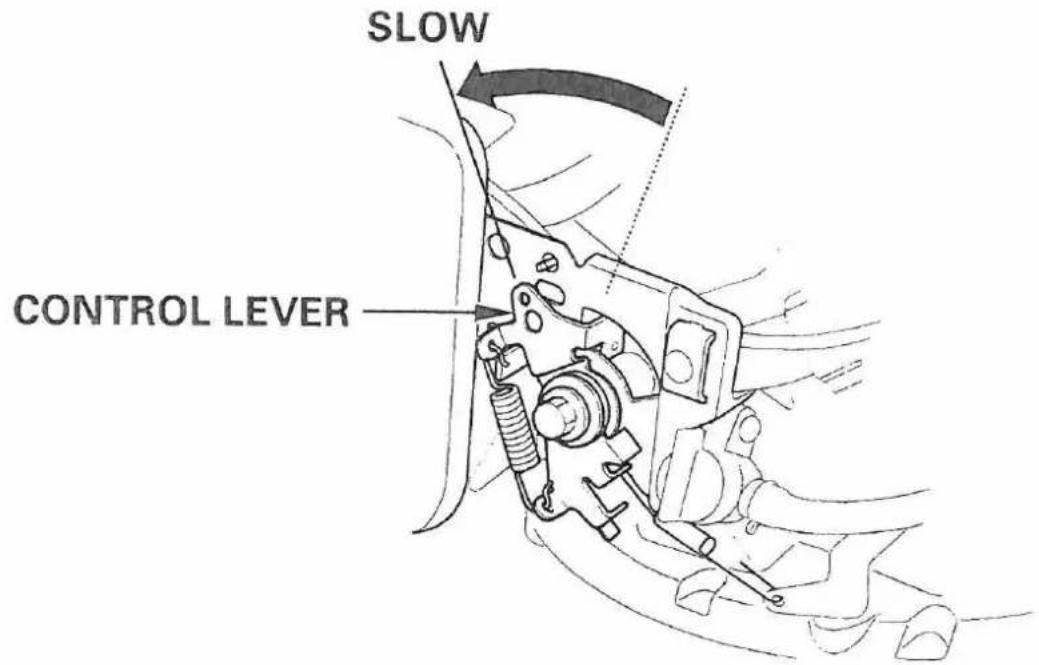
text_image
SLOW CONTROL LEVER- With FLYWHEEL BRAKE LEVER type:
Return the flywheel brake lever to the ENGAGED position.
The engine switch, which is linked with the flywheel brake lever, is turned off when the flywheel brake lever is moved to the ENGAGED position.
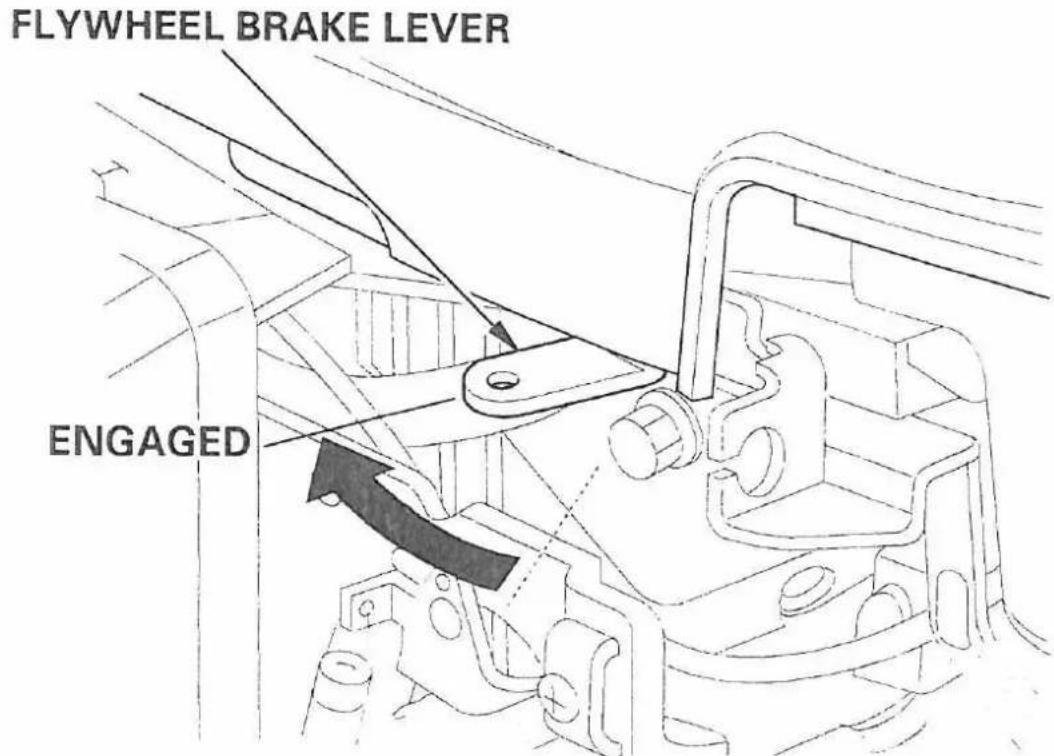
text_image
FLYWHEEL BRAKE LEVER ENGAGED- Without FLYWHEEL BRAKE LEVER type:
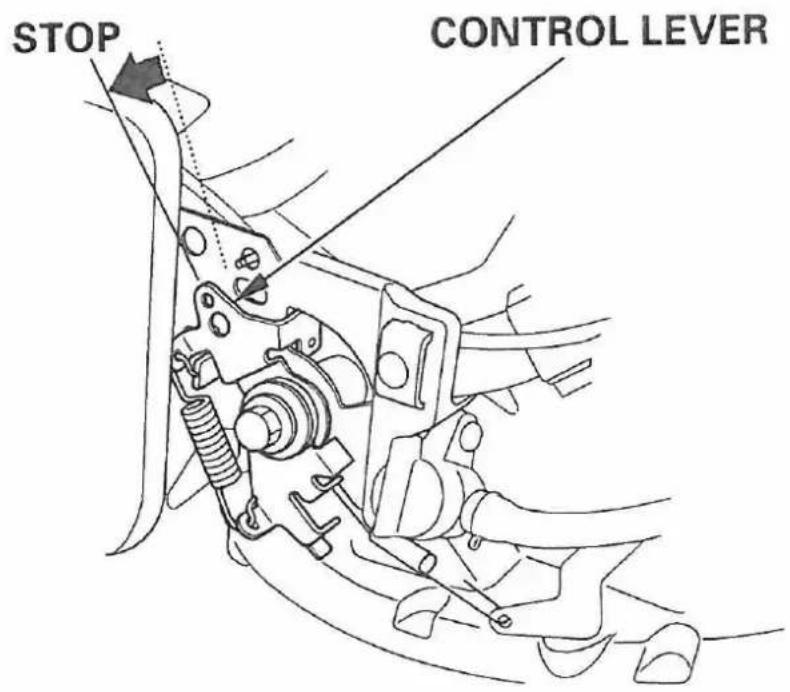
Move the control lever to the STOP position.
The engine switch, which is linked with the control lever, is turned off when the control lever is moved to the STOP position.
text_image
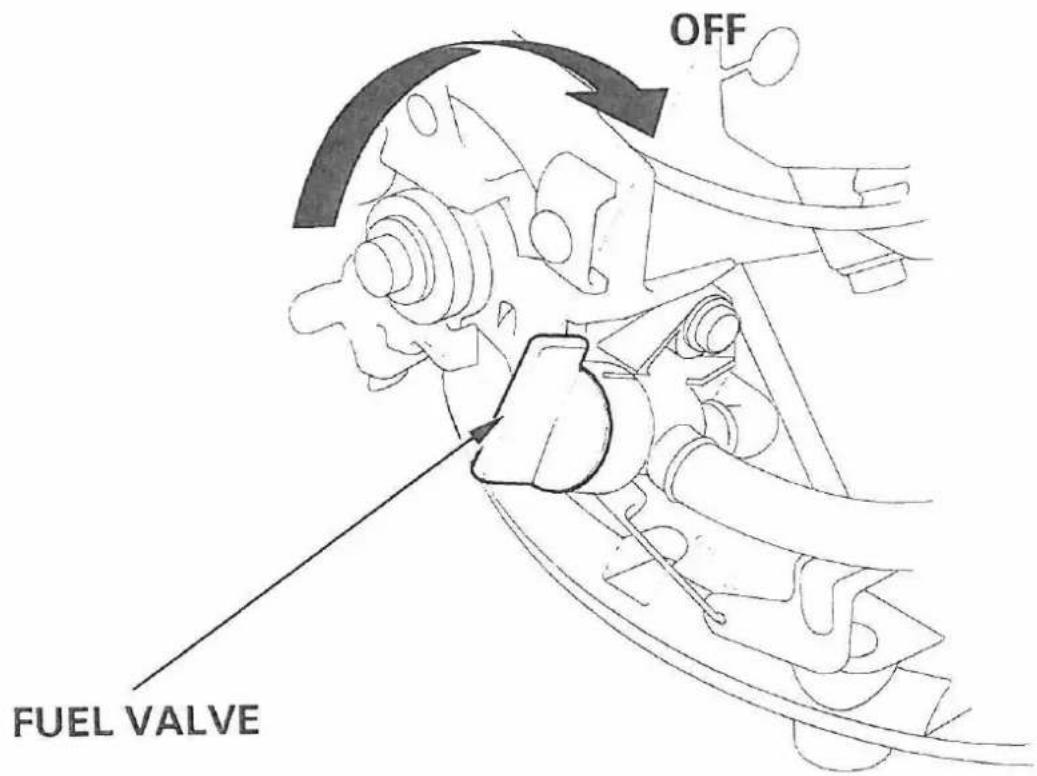
STOP CONTROL LEVER- Turn the fuel valve to the OFF position.
text_image
OFF FUEL VALVE6 MAINTENANCE
⚠ WARNING
- Shut off the engine before performing any maintenance.
• To prevent accidental start-up, disconnect the spark plug cap.
• The engine should be serviced by an authorized Honda dealer unless the owner has proper tools and service data and feels he is mechanically qualified.
CAUTION:
Use only genuine Honda parts or their equivalent. The use of replacement parts which are not of equivalent quality may damage the engine.
Periodic inspection and adjustment of the Honda engine is essential if high level performance is to be maintained. Regular maintenance will also ensure a long service life. The required service intervals and the kind of maintenance to be performed are described on the following table.
CAUTION:
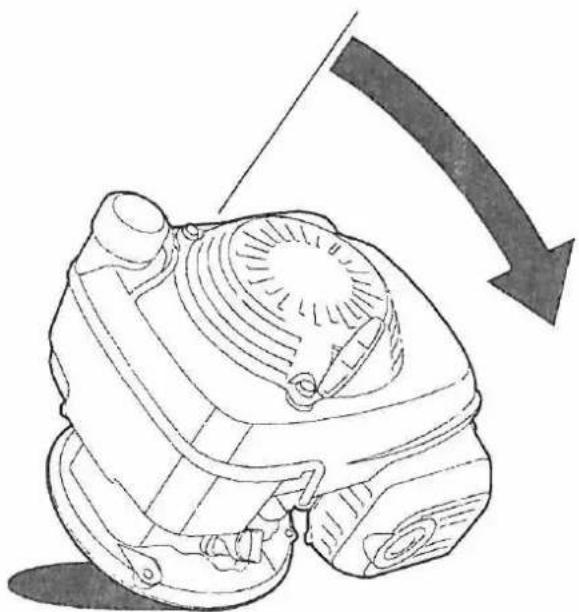
To perform maintenance on the lower part of the engine (Machine), turn it 90° and lay it down with the carburetor/air cleaner always at the top.
natural_image
Line drawing of a mechanical device with a curved arrow indicating rotation or change (no text or symbols)Maintenance Schedule
| REGULAR SERVICE PERIOD (4) | Each use | First month or 5 hrs. | Every 3 months or 25 hrs. | Every 6 months or 50 hrs. | Every year or 100 hrs. | Every 2 years or 250 hrs. | |
| ITEM Perform at every indicated month or operating hours interval, whichever comes first. | |||||||
| Engine oil | Check level | ○ | |||||
| Change | ○ | ○(2) | |||||
| Air cleaner | Check | ○ | |||||
| Clean | ○(1) | ||||||
| Replace | ○ | ||||||
| Timing belt | Check | After every 250 hrs. (3) (5) | |||||
| Flywheel brake pad | Check | ○ | |||||
| Spark plug | Check-adjust | ○ | |||||
| Replace | ○ | ||||||
| Spark arrester (applicable types) | Clean | ○ | |||||
| Idle speed | Check-adjust | ○(3) | |||||
| Fuel tank and filter | Clean | ○(3) | |||||
| Valve clearance | Check-adjust | ○(3) | |||||
| Combustion chamber | Clean | After every 250 hrs. (3) | |||||
| Fuel tube | Check | Every 2 years (Replace if necessary) (3) | |||||
NOTE:
(1): Service more frequently when used in dusty areas.
(2): Change engine oil every 25 hours when used under heavy load or in high ambient temperature.
(3): These items should be serviced by your Honda servicing dealer, unless you have the proper tools and are mechanically proficient. Refer to the Honda shop manual for service procedures.
(4): For commercial use, log hours of operation to determine proper maintenance intervals.
(5): Check that there is no crack and abnormal wear-out in the belt, and replace if it is abnormal.
-
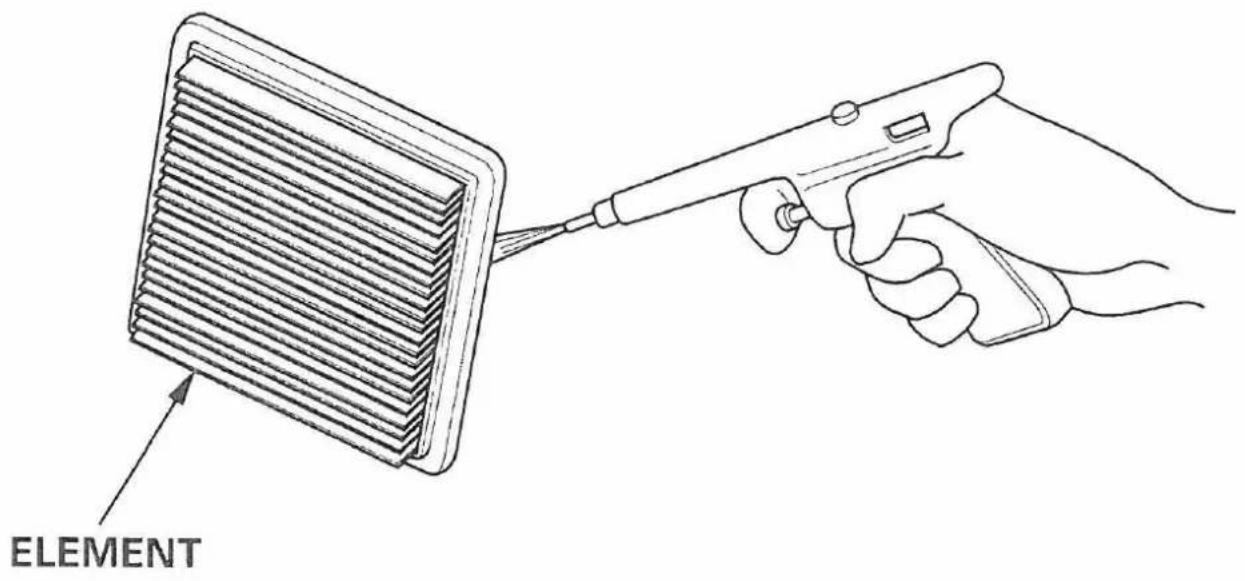
Tap the element lightly several times on a hard surface to remove excess dirt, or blow compressed air through the filter from the inside out. Never try to brush the dirt off; brushing will force dirt into the fibers. Replace the element if it is excessively dirty.
-
Install the element and air cleaner cover.
text_image
ELEMENT3. Flywheel brake inspection (applicable types)
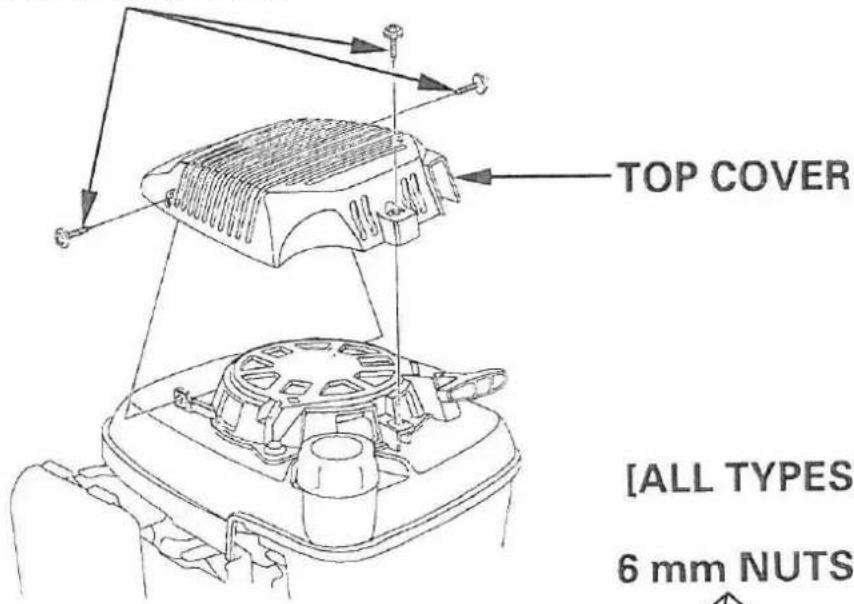
- Remove the top cover by removing the three tapping screws (with top cover type only).
- Remove the recoil starter by removing the three 6 mm nuts.
- Remove the fuel tank taking care not to disconnect the fuel tube from the fuel tank and fuel valve, and keeping the fuel tank to a level.
[WITH TOP COVER TYPE]
TAPPING SCREWS
text_image
TOP COVER [ALL TYPES 6 mm NUTS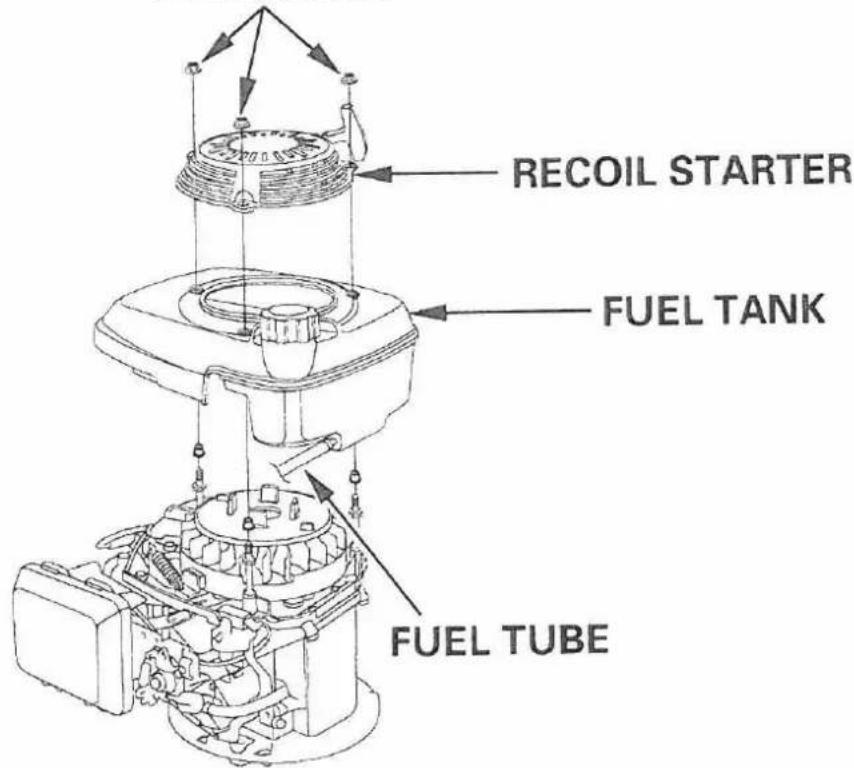
text_image
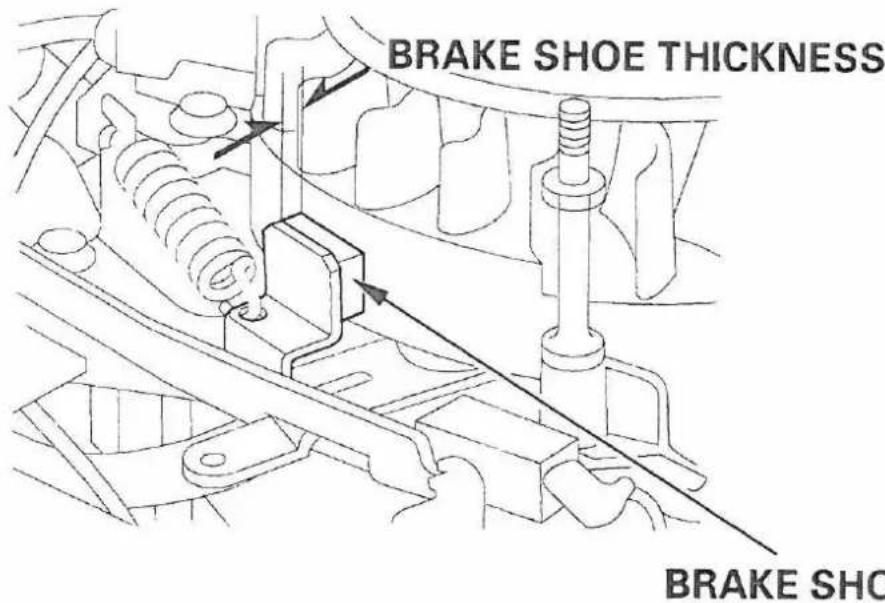
RECOIL STARTER FUEL TANK FUEL TUBE- Check the brake shoe thickness. If it is less than 3 mm (0.12 in), take the engine to an authorized Honda dealer.
text_image
BRAKE SHOE THICKNESS BRAKE SHO- Install the fuel tank and recoil starter, and tighten the three 6 mm nuts securely.
- Install the top cover, and tighten the three tapping screws securely (with top cover type only).
4. Spark plug service
Recommended spark plug:
GCV135E: BPR4ES (NGK)
GCV160E: BPR5ES (NGK)
For Hover Lawn mower:
GCV135E/GCV160E: BPR6ES (NGK)
CAUTION:
Never use a spark plug of incorrect heat range.
To ensure proper engine operation, the spark plug must be properly gapped and free of deposits.
- Remove the spark plug cap and use a spark plug wrench to remove each spark plug.
⚠ WARNING
If the engine has been running, the muffler will be very hot. Be careful not to touch the muffler.
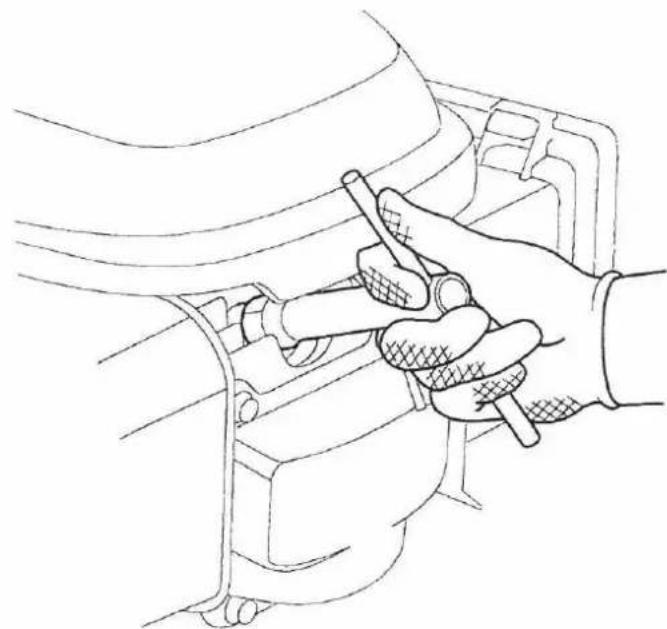
natural_image
Line drawing of a hand using a tool to adjust or install a mechanical component (no text or symbols present)-
Visually inspect the spark plug. Discard the spark plug if there is apparent wear, or if the insulator is cracked or chipped. Clean the spark plug with a wire brush if it is to be reused.
-
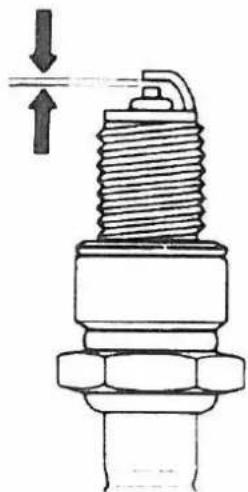
Measure the plug gap with a feeler gauge. Correct as necessary by bending the side electrode.
The gap should be: 0.7 - 0.8 mm (0.028 - 0.031 in)
0.7 - 0.8 mm (0.028 - 0.031 in)
natural_image
Technical line drawing of a spark plug with threaded body and bolted base (no text or symbols)-
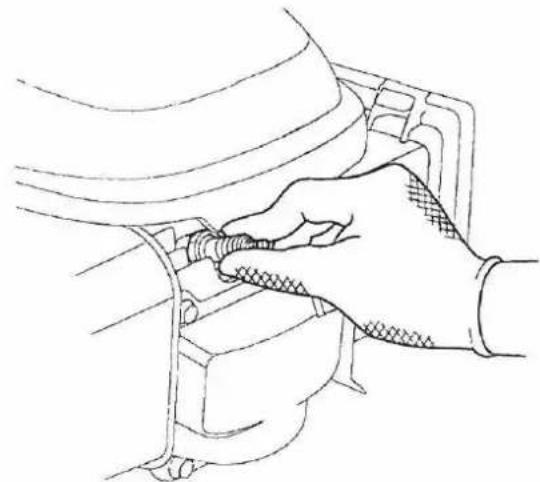
Check that the spark plug washer is in good condition and thread the spark plug in by hand to prevent cross-threading.
-
After the spark plug is seated, tighten with a spark plug wrench to compress the washer.
natural_image
Line drawing of a hand connecting a cable to a mechanical component (no text or symbols)NOTE:
When installing a new spark plug, tighten 1/2 turn after the spark plug seats to compress the washer. When reinstalling a used spark plug, tighten 1/8—1/4 turn after the spark plug seats to compress the washer.
CAUTION:
The spark plug must be securely tightened. An improperly tightened spark plug can become very hot and may damage the engine.
5. Spark arrester maintenance (applicable types)
⚠ WARNING
If the engine has been running, the muffler will be very hot. Allow it to cool before proceeding.
CAUTION:
The spark arrester must be serviced every 100 hours to maintain its efficiency.
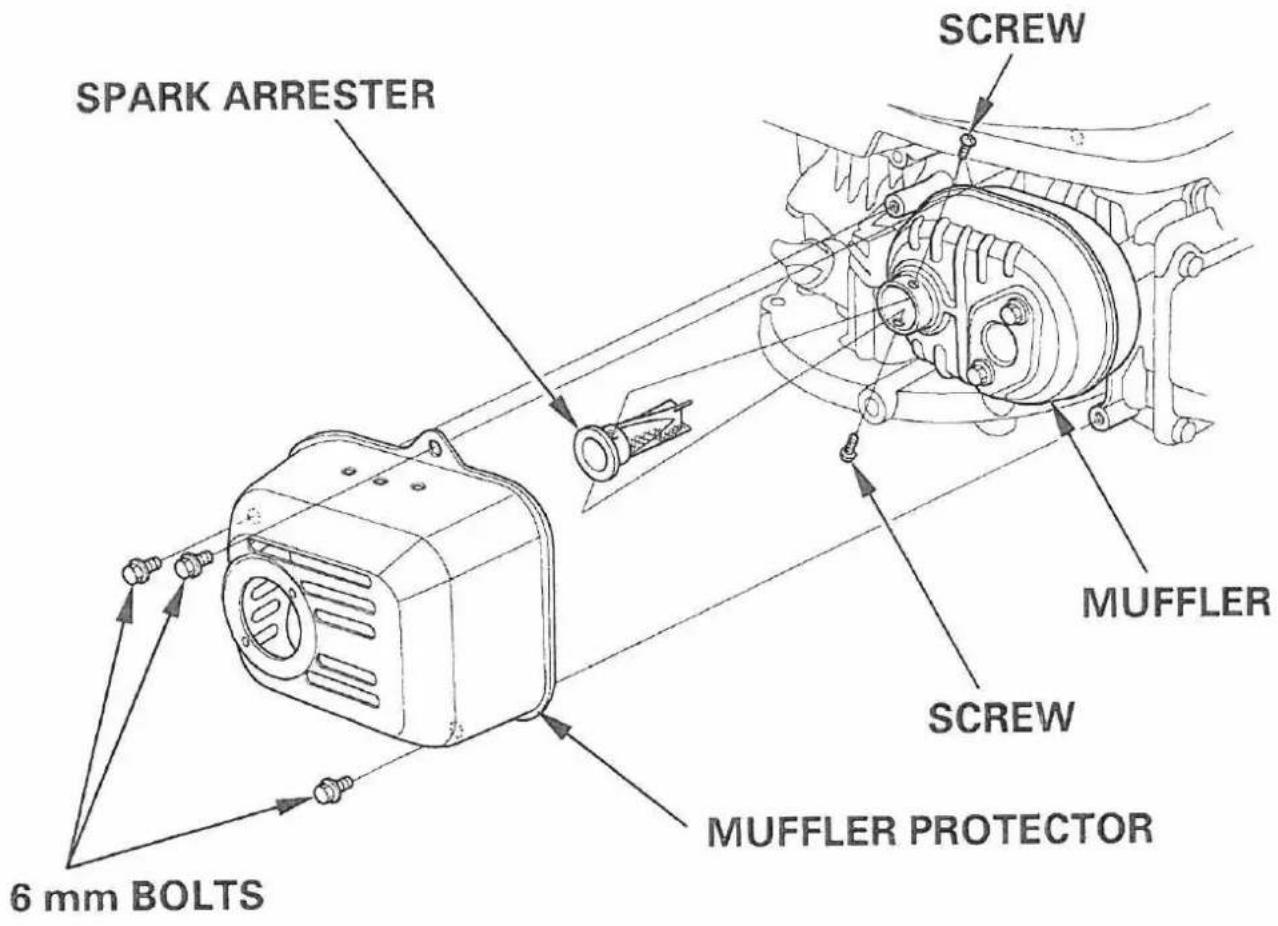
- Remove the muffler protector by removing the three 6 mm bolts.
- Remove the spark arrester from the muffler by removing the two screws. (Taking care not to damage the wire mesh.)
NOTE:
Check for carbon deposits around the exhaust port and the spark arrester, and clean if necessary.
text_image
SPARK ARRESTER SCREW MUFFLER SCREW MUFFLER PROTECTOR 6 mm BOLTS- Use a brush to remove carbon deposits from the spark arrester screen.
CAUTION:
Be careful not to damage the spark arrester screen.

text_image
SCREENNOTE:
The spark arrester must be free of breaks and holes. Replace, if necessary.
- Install the spark arrester and the muffler in the reverse order of disassembly.
7 TRANSPORTING/STORAGE
▲WARNING
When transporting the engine, turn the fuel valve OFF and keep the engine level to prevent fuel spillage. Fuel vapor or spilled fuel may ignite.
⚠ WARNING
Gasoline is extremely flammable and is explosive under certain conditions. Do not smoke or allow flames or sparks in the area.
Before storing the unit for an extended period;
- Be sure the storage area is free of excessive humidity and dust.
- Drain the fuel tank and carburetor into a suitable gasoline container:
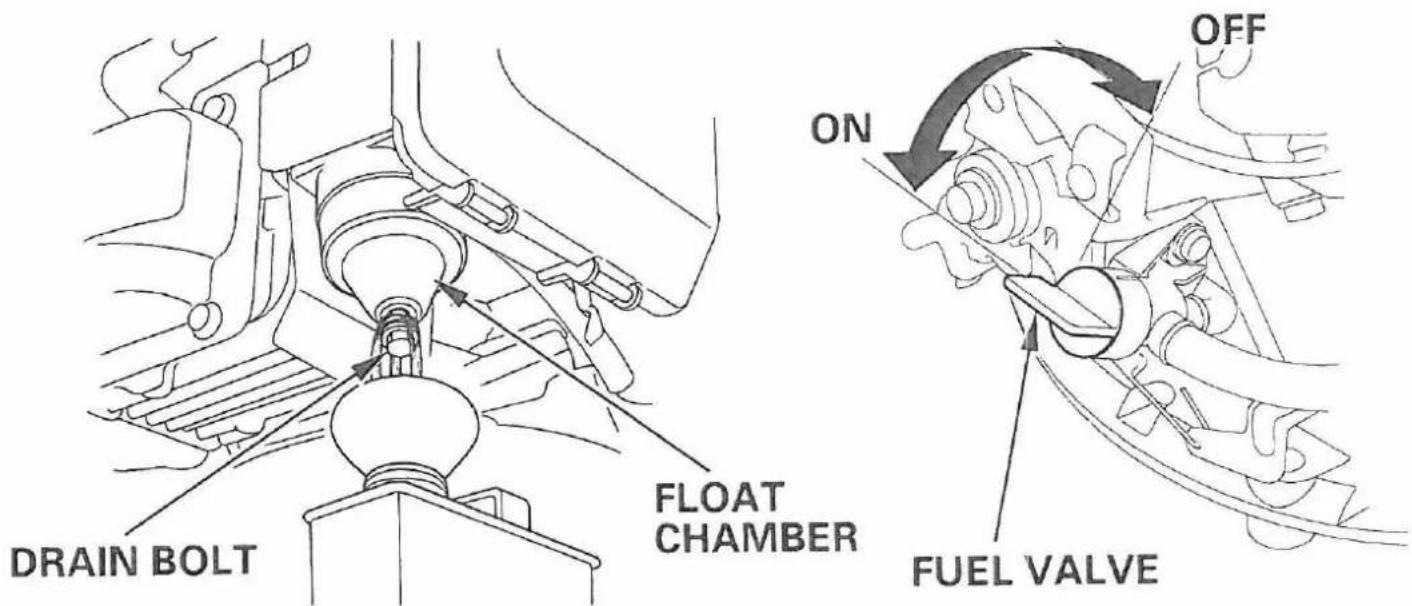
A. Turn the fuel valve to the OFF position.
B. Loosen the carburetor drain bolt 1-1 1/2 turn and drain the carburetor.
C. Turn the fuel valve to the ON position and drain the fuel in the fuel tank into the container.
D. Retighten the carburetor drain bolt so that the float chamber cannot be warped, and turn the fuel valve to the OFF position.
text_image
DRAIN BOLT FLOAT CHAMBER ON OFF FUEL VALVE- If you can not drain from the carburetor:
A. Empty the fuel tank into an approved gasoline container using a commercially available hand siphon.
B. Operate the engine until it stops from the lack of fuel.
-
Change the engine oil (see page 20).
-
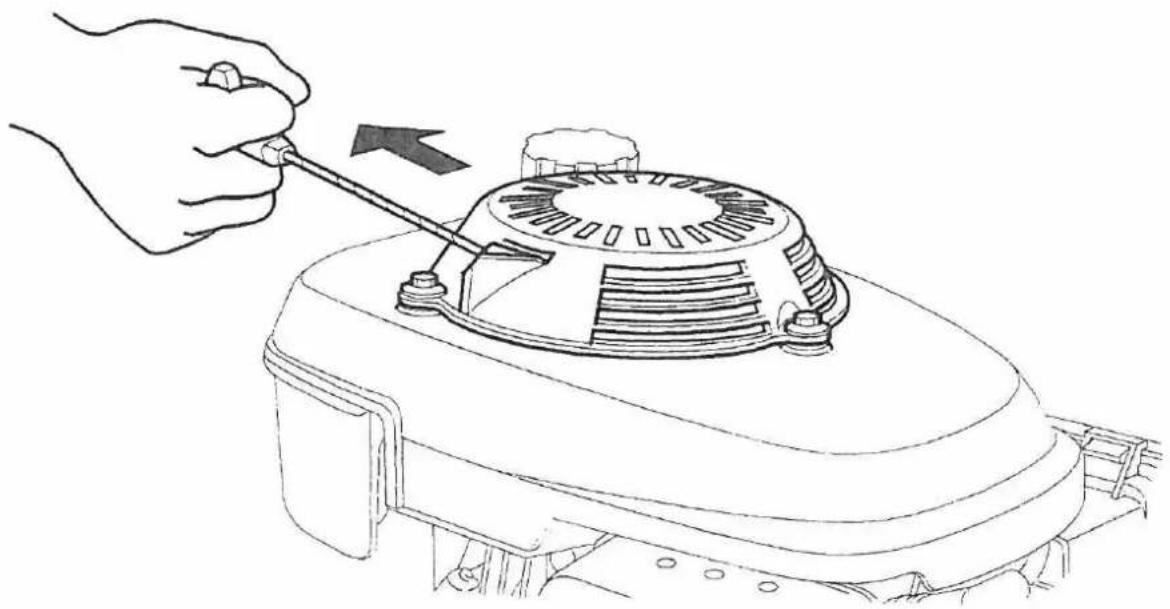
Pull the starter rope slowly until resistance is felt. This closes the valves, and protects them from dust and corrosion.
natural_image
Line drawing of a hand using a screwdriver to adjust the top of a lawn mower (no text or symbols present)- Coat areas that may rust with a light film of oil. Cover the engine and store it on a level surface in a dry, dust free area.
8 TROUBLESHOOTING
When the engine will not start:
- Is the fuel valve ON?
- Is there fuel in the fuel tank?
- Is gasoline reaching the carburetor?
To check, loosen the carburetor drain bolt 1-1 1/2 turn with the fuel valve ON (see page 29).
WARNING
If any fuel is spilled, make sure the area is dry before testing the spark plug or starting the engine. Fuel vapor or spilled fuel may ignite.
- Is the control lever positioned properly (see page 11)?
- Is the flywheel brake lever positioned to the RELEASED position (see page 12)? (applicable types)
- Is the spark plug in good condition (see page 25)?
- If the engine still does not start, take the engine to an authorized Honda dealer.
9 SPECIFICATIONS
| Model | GCV135E | GCV160E |
| Power equipment description code | GJAFE | GJAAE |
| Length | 351 mm (13.8 in) | 367 mm (14.4 in) |
| Width | 331 mm (13.0 in) | 331 mm (13.0 in) |
| Height | 340 mm (13.4 in) | 360 mm (14.2 in) |
| Dry mass [weight] | 10.7 kg (23.6 lbs) | 10.5 kg (23.1 lbs) |
| Engine type | 4-stroke, overhead cam, 1 cylinder | |
| Displacement | 135 cm^3 (8.2 cu-in) | 160 cm^3 (9.8 cu-in) |
| Bore × Stroke | 64.0 × 42.0 mm (2.52 × 1.65 in) | 64.0 × 50.0 mm (2.52 × 1.97 in) |
| Net power(in accordance with SAE J1349*) | 2.6 kW (3.5 PS, 3.5 bhp)/3,600 rpm | 3.3 kW (4.5 PS, 4.4 bhp)/3,600 rpm |
| Max. net torque(in accordance with SAE J1349*) | 6.9 N·m (0.70 kgf·m, 5.1 lbf·ft)/2,500 rpm | 9.4 N·m (0.96 kgf·m, 6.9 lbf·ft)/2,500 rpm |
| Cooling system | Forced air | |
| Ignition system | Transistor magneto | |
| PTO shaft rotation | Counterclockwise | |
| Fuel tank capacity | 0.77 L (0.203 US gal, 0.169 Imp gal) | 0.91 L (0.240 US gal, 0.200 Imp gal) |
| Engine oil capacity | 0.55 L (0.58 US qt, 0.48 Imp qt) | |
| Engine oil | SAE 10W-30, API SE or later | |
| Spark plugfor Hover lawn mower | BPR4ES (NGK) | BPR5ES (NGK) |
| BPR6ES (NGK) | ||
* The power rating of the engine indicated in this document is the net power output tested on a production engine for the engine model and measured in accordance with SAE J1349 at 3,600 rpm (Net Power) and at 2,500 rpm (Max. Net Torque). Mass production engines may vary from this value.
Actual power output for the engine installed in the final machine will vary depending on numerous factors, including the operating speed of the engine in application, environmental conditions, maintenance, and other variables.
NOTE:
Specifications may vary according to the types, and are subject to change without notice.