TDW14W - Opvaskemaskiner Tisira - Gratis brugsanvisning og manual
Find enhedens vejledning gratis TDW14W Tisira i PDF-format.


Brugerspørgsmål om TDW14W Tisira
0 spørgsmål om dette apparat. Besvar dem du kender, eller stil dit eget.
Stil et nyt spørgsmål om dette apparat
Download vejledningen til din Opvaskemaskiner i PDF-format gratis! Find din vejledning TDW14W - Tisira og tag din elektroniske enhed tilbage i hånden. På denne side er alle dokumenter nødvendige for brugen af din enhed offentliggjort. TDW14W af mærket Tisira.
BRUGSANVISNING TDW14W Tisira
USER MANUAL
14 PLACE DISHWASHER
TDW14X, TDW14W
IMPORTANT // Please ensure that you read through this user manual prior to installation and use. This manual contains important information to ensure optimal performance and keep you safe. Please retain your proof of purchase, as this will be required in the event that you require warranty service. Remember to retain this manual for future reference.
t tisira

HELLO
CONGRATULATIONS ON THE SELECTION OF THIS TISIRA APPLIANCE. TISIRA APPLIANCES HAVE BEEN SPECIFICALLY DESIGNED FOR AUSTRALIAN AND NEW ZEALAND KITCHENS.
Please read through this user manual carefully as it contains information that will ensure that your appliance is installed correctly, important operating & care instructions and also some advice of what you need to do if this appliance is not performing as intended.
CONTENTS
| HELLO | 2 |
| CONTENTS | 3 |
| WARNINGS | 4 |
| PRODUCT OVERVIEW | 5 |
| PRODUCT OVERVIEW | 6 |
| OPERATING INSTRUCTIONS | 7-11 |
| MAINTENANCE | 18-21 |
| TROUBLESHOOTING | 22-23 |
| PRODUCT SPECIFICATIONS | 24 |
| WARRANTY TERMS & CONDITIONS | 25 |
| NOTES | 26-27 |
| CONTACT DETAILS | 28 |
WARNINGS
IMPORTANT // To get the best performance from your dishwasher, read all operating instructions before using it for the first time.
SAFETY INFORMATION
WARNING // HYDROGEN GAS IS EXPLOSIVE Under certain conditions, Hydrogen gas may be produced in a hot water system that has not been used for two weeks or more. If the hot water system has not been used for such a period, before using the dishwasher turn on all hot water faucets and let the water flow from each for several minutes. This will release any accumulated hydrogen gas. As the gas is flammable, do not smoke or use an open flame during this time.
- Do not touch the heating element during or immediately after use.
Do not operate your dishwasher unless all enclosure panels are properly in place. Open the door very carefully if the dishwasher is operating. There is a risk of water leaking out.
Do not place any heavy objects or stand on the door when it is open. The appliance could tip forward. - Use only detergent and rinse additives designed for an automatic dishwasher. Never use soap, laundry detergent, or hand washing detergent in your dishwasher.
- Young children should be supervised to ensure that they do not play with the appliance.
The door should not be left in the open position since this could present a tripping hazard.
This appliance is not intended for use by persons (including children) with reduced physical, sensory or mental capabilities, or lack of experience and knowledge, unless they have been given supervision or instruction concerning use of the appliance by a person responsible for their safety.
If the supply cord is damaged, it must be replaced by the manufacturer or its service agent or a similarly qualified person in order to avoid a hazard.
- Please dispose of packing materials properly.
This appliance is intended to be used in household and similar applications such as: staff kitchen areas in shops, offices and other working environments; farm houses: by clients in hotels, motels and other residential type environments; bed and breakfast type environments.
- Dishwasher detergents are strongly alkaline. They can be extremely dangerous if swallowed. Avoid contact with the skin and eyes, and keep children away from the dishwasher when the door is open. Check that the detergent receptacle is empty after completion of the wash cycle.
PRODUCT OVERVIEW
CONTROL PANEL
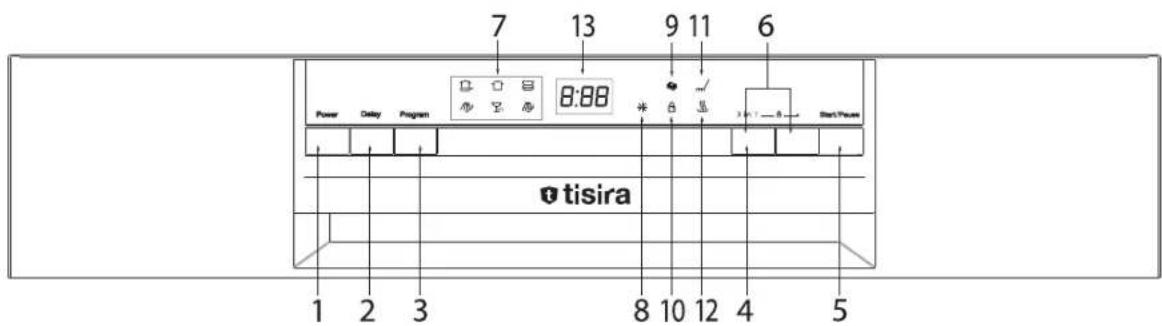
- Power switch: To turn on/off the power supply.
- Delay button The START DELAY will allow you to delay the start time of any cycle automatically up to 24 hours.
- Program key-press: Press the key to scroll through the wash cycles. The corresponding programme light will be ON to indicate which WASH CYCLE has been selected.
- "3 in 1" button: Press this button you can choose or cancel the "3 in 1" function.
- Start \pause button: The appliance will start or pause the expected washing cycle.
- Child lock buttons: Press and hold the two indicated buttons for 3 seconds and all the control buttons will be locked.
-
Program indicator light: When you select a washing programme, the corresponding light will display.
-
Rinse aid refill indicator: The indicator lights up when dispenser needs to be refilled.
- 3 in 1 indicator: The indicator lights up when the additional function is selected.
- Child lock indicator The "Child Lock" will be available when you press and hold the Child lock buttons for 3 seconds, and the "Child lock" indicator lights up after flashing 6 times.
- Washing light: It comes on when the dishwasher is washing.
- Drying light: It comes on when the dishwasher is drying.
- Digital display: It displays the running time remain, malfunction codes and delay time.
PRODUCT OVERVIEW
DISHWASHER FEATURES
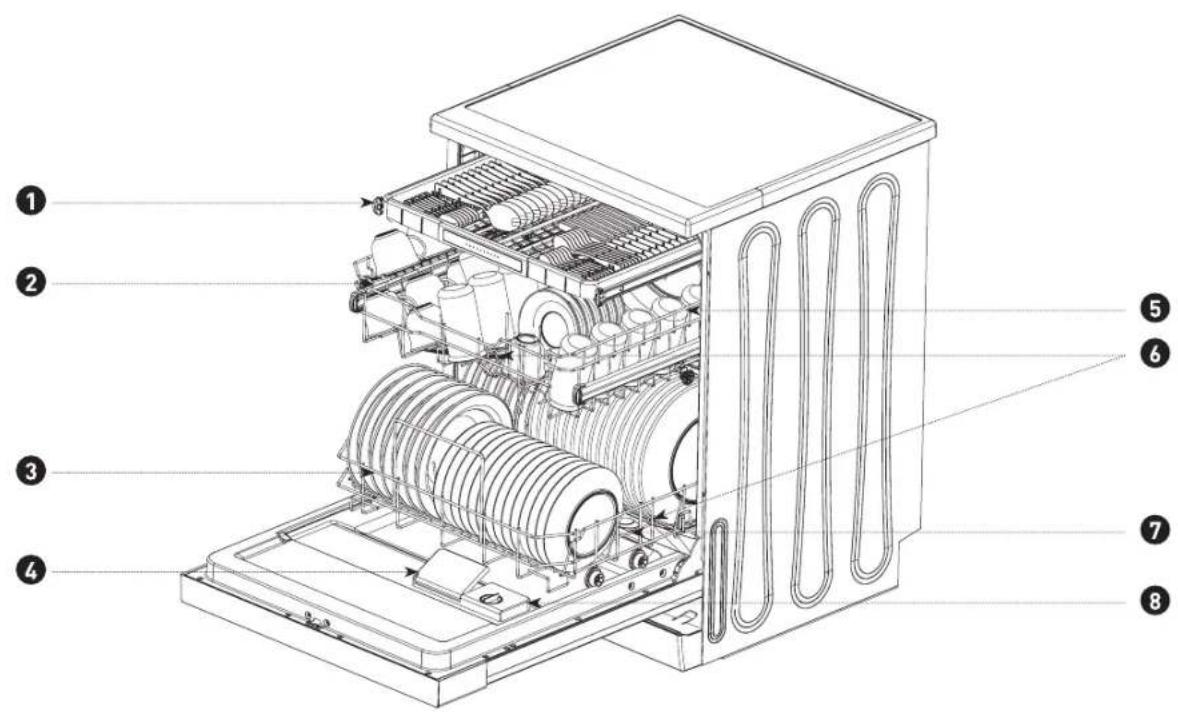
FRONT VIEW
- Cutlery Tray
- Upper Basket
-
Lower Basket
-
Detergent Dispenser
- Cup Holder
-
Spray Arms
-
Filters
- Rinse Aid Dispenser
OPERATING INSTRUCTIONS
ATTENTION // Before using your dishwasher for the first time, please make sure that you read the following sections:
A. Fill the rinse aid dispenser B. Fill the detergent dispenser
A. FILL THE RINSE AID DISPENSER
FUNCTION OF RINSE AID
The rinse aid is automatically released during the last rinse in order to prevent water from forming droplets on your dishes that can leave spots and streaks.
ATTENTION // Only use branded rinse aid in the dishwasher.
Never fill the rinse aid dispenser with any other substances (e.g. dishwasher cleaning agent, liquid detergent). This would damage the appliance.
The rinse aid dispenser is located inside the door next to the detergent dispenser.
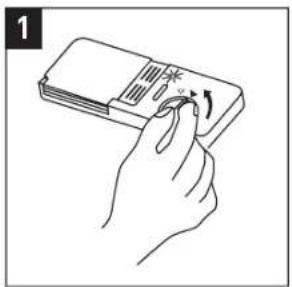
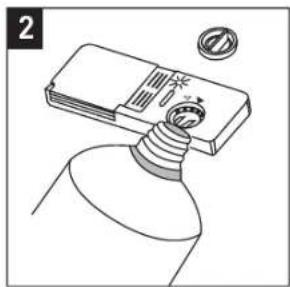
To fill the dispenser, open the cap and pour the rinse aid into the dispenser until the level indicator turns completely black. The volume of the rinse aid container is about 140ml.
Be careful not to overfill the dispenser, because this could cause over sudsing. Wipe away any spills with a damp cloth. Don't forget to close the cap before you close the dishwasher door.
natural_image
Illustration of a light bulb with a screwdriver inserted, no text or symbols present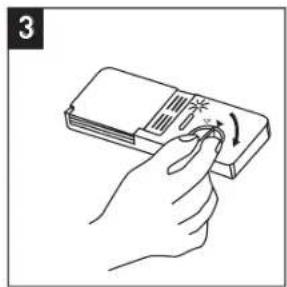
- To open the dispenser, turn the cap to the "open" (left) arrow and lift it out.
- Pour the rinse aid into the dispenser, be careful not to overfill.
- Replace the cap by inserting it aligned with "open" arrow and turning it to the "closed" (right) arrow.
ATTENTION // Clean up any rinse aid split during filling with an absorbent cloth to avoid excess foaming during the next wash.
OPERATING INSTRUCTIONS
WHEN TO REFILL THE RINSE AID DISPENSER
You can judge the amount of rinse-aid by the colour of the optical level indicator "D" located next to the cap. When the rinse-aid container is full, the whole indicator will be dark. As the rinse aid diminishes, the size of the dark dot decreases.
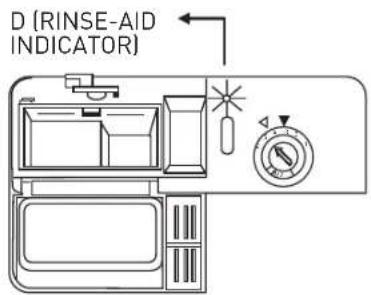
IMPORTANT // You should never let the rinse aid get below 1 / 4 full.
Full
3 / 4 full
1 / 2 full
- 1 / 4 full - Should refill to eliminate spotting
○ Empty
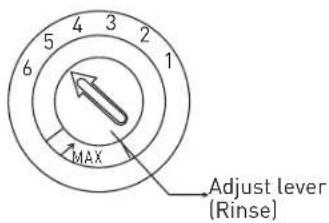
ADJUSTING RINSE AID DISPENSER
The rinse aid dispenser has six settings. Always start with the dispenser set on "4" If spots and poor drying are problems, increase the amount of rinse aid dispensed by removing the dispenser lid and rotating the dial to "5". If the dishes still are not drying properly or are spotted, adjust the dial to the next higher number until your dishes are spot-free. The dose is factory set in position 5.
NOTE // Increase the dose if there are drops of water or lime spots on the dishes after washing. Reduce it if there are sticky whitish streaks on the dishes or a bluish film on glassware or knife blades.
FILL THE DETERGENT DISPENSER
Detergents with its chemical ingredients are necessary to remove dirt, crush dirt and transport it out of the dishwasher. Most of commercial quality detergents are suitable for this purpose.
CONCENTRATED DETERGENT
Based on their chemical composition, dishwasher can be split in two basic types:
- conventional, alkaline detergents with caustic components
- low alkaline concentrated detergents with natural enzymes
The use of "normal" washing programme in conjunction with concentrated detergents reduces pollution and is good for your dishes; these washing programmes are specially matched to the dirt dissolving properties of the enzymes of the concentrated detergents. For this reason "normal" washing programme in which concentrated detergents are used can
OPERATING INSTRUCTIONS
achieve the same results that can otherwise only be achieved using "intensive" programme.
DETERGENT TABLETS
Detergent tablets of different brands dissolve at different speeds. For this reason some detergent cannot dissolve and develop their full cleaning power during short programmes. Therefore please use long programmes when using detergent tablets, to ensure the complete removal of detergent residuals.
DETERGENT DISPENSER
The dispenser must be refilled before the start of each washing cycle following the instructions provided in the "Washing Cycle Table". Your dishwashers use less detergent and rinse aid than conventional dishwashers. Generally, only one tablespoon of detergent is needed for a normal wash load. Also, more heavily soiled items need more detergent. Always add the detergent just before
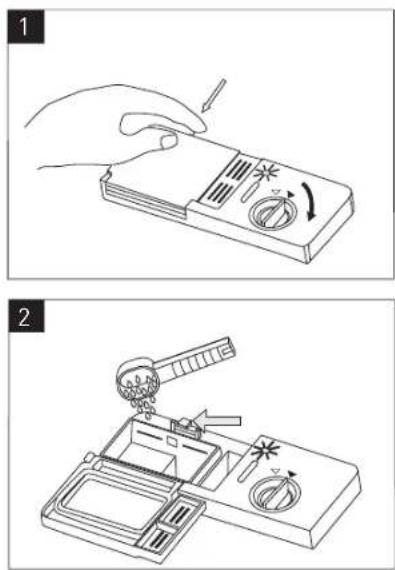
starting the dishwasher, otherwise the tablet can get damp and it will not dissolve properly.
- If the lid is closed: press release button. The lid springs open.
- Always add the detergent just before starting each washing cycle. Only use branded detergent aid for dishwasher.
WARNING // Dishwasher detergent is corrosive! Take care to keep it out of reach of children. Use only detergent specifically made for use in dishwashers. Keep your detergent fresh and dry. o not put powder detergent into the dispenser until you're ready to wash the dishes.
FILL IN THE DETERGENT
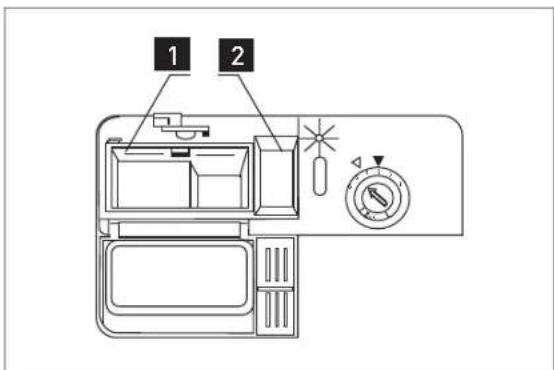
Fill the detergent dispenser with detergent.
The marking indicates the dosing levels, as illustrated above:
- Main washing cycle detergent dispenser. MIN means approximately 20g of detergent.
- Pre washing cycle detergent dispenser. Approximately 5g of detergent.
Close the lid and press until it locks in place.
OPERATING INSTRUCTIONS
If the dishes are heavily soiled, place an additional detergent dose in the pre-wash detergent chamber. This detergent will take effect during the pre-wash phase.
NOTICE // Information about the amount of detergent to be used for each type of programme can be found on the Washing Cycle Table in the "Starting a washing programme" section.
Please be aware that according to the level of soiling and the specific hardness of water, differences are possible. Please observe the manufacturer's recommendations on the detergent packaging.
DETERGENTS
There are 3 sorts of detergents:
- With phosphate and with chlorine
- With phosphate and without chlorine
- Without phosphate and without chloride
Normally, new pulverized detergents don't have phosphate. The water softener function of phosphate is not given. In this case, we recommend to fill the salt dispenser with salt even when the hardness of the water is only 6 dH. If detergents without phosphate are used in cases where hard water is supplied, often white spots appear on dishes and glasses. In this case, please increase the amount of detergent to achieve better results.
Detergents without chlorine can only bleach a little. Strong and coloured spots will not be removed completely. In this case, please choose a programme with higher temperature.
USE OF "3 IN 1" DETERGENT TABLETS
GENERAL ADVICE
- Before using these type of detergents, you should first ready the manufacturer instructions to check if their tablets are compatible to the water hardness of your water supply.
- These products should be strictly used according to the detergent manufacturers instructions.
- If you encounter problems when using "3 in 1" products for the first time then please contact the detergent manufacturers care line (the telephone number is given on the product packaging). These products are detergents with integrated and combined detergent/rinse aid and salt functions.
SPECIAL ADVICE
When using combination products, the rinse-aid and salt lights are no longer useful. It may be helpful to select the lowest possible setting for water hardness.
TO SELECT "3 IN 1" FUNCTION:
- Close the door and select the 3 in 1 washing cycle by pressing the "3 in 1" button until the "3 in 1" indicator blinks.
- The 3 in 1 washing cycle will be available after pressing the start/pause button, and the "3 in 1" indicator lights.
OPERATING INSTRUCTIONS
TO CANCEL "3 IN 1" FUNCTION:
Follow the 'Cancelling a programme in progress' instructions.
If you decide to switch to the use of a standard detergent system we advise that you:
- Refill both the salt and rinse aid compartments.
- Switch the water hardness setting to the highest possible position and run for three normal cycles without load.
- Readjust the water hardness settings again according to the conditions for your region (For more information please refer to your instruction manual).
TURNING ON THE APPLIANCE
- Close the door.
- Make sure the spray arms are not obstructed.
- Switch the dishwasher on using the "Power" button.
The additional indicators, delay start indicators and status indicator could light up periodically one bye one.
NOTE // A click could be heard when the door is closed perfectly.
SELECT A PROGRAMME
Choose your programme according to the type of load and how dirty it is.
The different programmes and their uses are described in the "washing cycle table" (see page 15). Use the programme selector to select the expected programme.
CHANGE THE PROGRAMME.
A cycle that is underway can only be modified if it has only been running for a short time.
Otherwise, the detergent may have already been released, and the appliance may have already drained the wash water. If this is the case, the detergent dispenser must be refilled (see the section entitled "Filling the Detergent").
Turn the appliance off and then turn it on again by pressing the "Power" button. Press the "Programme" button to choose the expected cycle settings.
NOTE // If you open the door when the washing cycle underway, the appliance will pause and emit warning signals, the display appears E1. When you close the door, the machine will keep on working after 10 seconds.
The 6 programme lights show the state of the dishwasher and the following situations can be found:
a) One of the programme lights on --> cycle running
b) One of the programme lights blinking
--> pause
NOTE // If all the lights begin to glimmer, that indicates the machine is out of order, please turn off the main power and water supply before calling a service.
OPERATING INSTRUCTIONS
FORGET TO ADD A DISH
A forgotten dish can be added any time before the detergent cup opens.
- Open the door a little to stop the washing.
- After the spray arms stop working, you can open the door completely.
- Add forgotten dishes.
- Close the door, the dishwasher will work after ten seconds.
WARNING // It is dangerous to open the door when washing, because the hot water may scald you.
SWITCH OFF THE DISHWASHER
The digital display appears “---” and the buzzer rings 6 times, only in this case the programme has ended. Turn off the dishwasher by pressing the Power button.
Open the door carefully. Hot steam may escape when the door is opened!
Hot dishes are sensitive to knocks. The dishes should therefore be allowed to cool down around 15 minutes before removing from the appliance.
Open the dishwasher's door, leave it ajar and wait a few minutes before removing the dishes. In this way they will be cooler and the drying will be improved.
WHEN LOADING ITEMS TO BE WASHED:
- Locate sharp items so that they are not likely to damage the door seal.
Knives and other utensils with sharp points must be loaded in the basket with their - points down or placed in a horizontal position.
- When using your dishwasher, you should prevent plastic items from contacting with heating element.
Do not wash plastic items unless they are marked dishwasher safe or the equivalent. For plastic items not so marked, check the manufacturer's recommendations.
OPERATING INSTRUCTIONS
LOADING THE DISHWASHER BASKETS
NOTE// Features and appearances of baskets and cutlery tray may vary from your model.
ATTENTION // Before or after loading the dishwasher baskets, scrape off any large amounts of leftover food.
Place objects in the dishwasher in the following way:
Items such as cups, glasses, pots/pans, etc. are placed upside down.
- Curve items, or those with recesses, should be at a slant so that water can run off.
- They are stacked securely and can not tip over.
- They do not prevent the spray arms from rotating while washing takes place.
To avoid damage to glasses, ensure they are not touching other items in the dishwasher.
NOTE // Very small items should not be washed in the dishwasher as they could easily fall out of the baskets.
THE UPPER BASKET
The upper basket is designed to hold more delicate and lighter dishware such as glasses, coffee and tea cups, saucers, as well as plates, small bowls and shallow pans. Position the dishes and cookware so that they do not get moved by the spray of water.
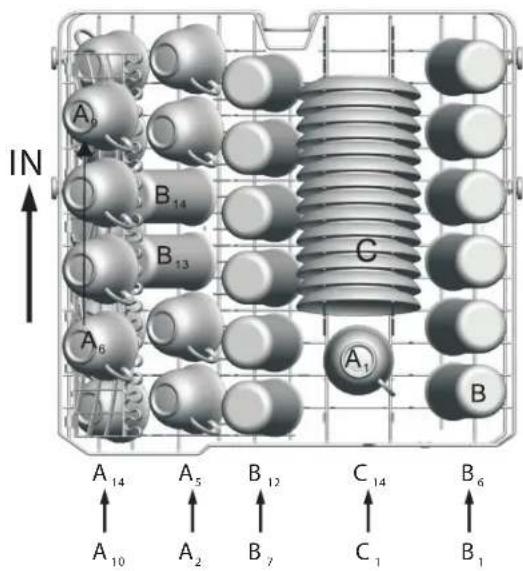
| UPPER BASKET | |
| Type | Item |
| A | Cup |
| B | Glass |
| C | Saucer |
ADJUSTING THE UPPER BASKET
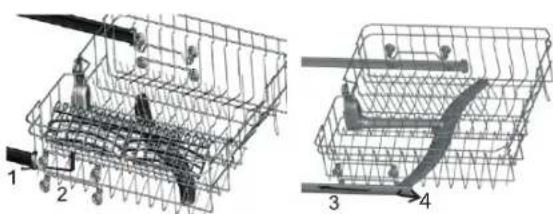
The upper basket can be adjusted for height by putting wheels of different height into the rails. Long items, serving cutlery, salad servers or knives should be placed on the shelf so that they do not obstruct the rotation of the spray arms. The shelf can be folded back or removed when not be required for use.
natural_image
Technical line drawing of a mechanical device with numbered components (no text or symbols)OPERATING INSTRUCTIONS
LOADING THE LOWER BASKET
We recommend that you place large items which are most difficult to clean in to the lower basket: pots, pans, lids, serving dishes and bowls, as shown in the figure below.
It is preferable to place serving dishes and lids on the side of the baskets in order to avoid blocking the rotation of the top spray arm. Pots, serving bowls, etc. must always be placed top down.
Deep pots should be slanted to allow water to flow out.
The bottom basket features fold down tine rows so that larger or more pots and pans can be loaded.
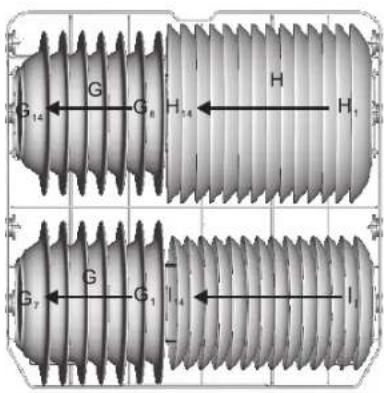
| LOWER BASKET | |
| Type | Item |
| G | Soup Plate |
| H | Dinner Plate |
| I | Dessert Plate |
CUTLERY TRAY
Arrange the cutlery in the tray as shown.
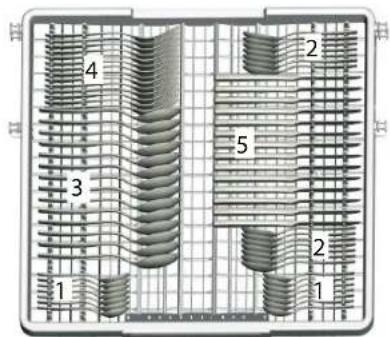
| CUTLERY TRAY | |
| Type | Item |
| 1 | Teaspoons |
| 2 | Dessert Spoons |
| 3 | Soup Spoons |
| 4 | Forks |
| 5 | Knives |
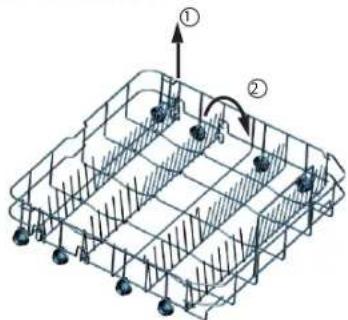
FOLDING RACKS
Folding racks consist of two parts and are located on the lower basket of the machine. Using the folding racks allows for more room on the lower basket for larger items. To use the folding racks, lift them up then fold down as shown.
www.tisira.com
tisira

OPERATING INSTRUCTIONS
LOADING CUTLERY & DISHES
Before loading the dishes you should remove large left-over food scraps and soften remnants of burnt food in pans.
The following items are not suitable for washing in the dishwasher:
- Cutlery with wooden or mother-of-pearl handles
- Plastic items that are not heat resistant
- Older cutlery with glued parts that is not temperature resistant
Bonded cutlery items or dishes
Pewter or copper items
Lead crystal glass
Steel items subject to rusting
Wooden platters
Items made from synthetic fibre
Take caution when loading dishwasher as:
Some types of glasses can become dull after a large number of washes
Silver and aluminium parts have a tendency to discolour during washing
Glazed patterns may fade if machine washed frequently
NOTE // Do not load items that are dirty of cigarette ash, candle wax, lacquer or paint. When buying new dishes, ensure they are suitable for dishwashers.
NOTE // Please do not overload your dishwasher. There is only space for 14 standard dishes. This is important for good results and for reasonable energy consumption.
AT THE END OF THE WASH
When the working cycle has finished, the buzzer of dishwasher will ring for 6 times, then stop. Turn off the appliance using the "Power" button and open the door of the dishwasher. Wait a few minutes before unloading the dishwasher to avoid handling the dishes and utensils while they are still hot and more susceptible to breakage. They will also dry better.
REMOVING THE DISHES
To prevent water dripping from the upper basket onto dishes on the lower basket, empty the lower basket first and then the upper basket.
TURNING ON THE APPLIANCE
- Close the door.
- Make sure the spray arms are not obstructed.
- Switch the dishwasher on using the "Power" button.
The additional indicators, delay start indicators and status indicator could light up periodically one bye one.
NOTE // A click could be heard when the door is closed perfectly.
OPERATING INSTRUCTIONS
SELECT A PROGRAMME
Choose your programme according to the type of load and how dirty it is.
The different programmes and their uses are described in the "washing cycle table" (see page 15). Use the programme selector to select the expected programme.
CHANGE THE PROGRAMME.
A cycle that is underway can only be modified if it has only been running for a short time.
Otherwise, the detergent may have already been released, and the appliance may have already drained the wash water. If this is the case, the detergent dispenser must be refilled (see the section entitled "Filling the Detergent").
Turn the appliance off and then turn it on again by pressing the "Power" button. Press the "Programme" button to choose the expected cycle settings.
NOTE // If you open the door when the washing cycle underway, the appliance will pause and emit warning signals, the display appears E1. When you close the door, the machine will keep on working after 10 seconds.
The 6 programme lights show the state of the dishwasher and the following situations can be found:
a) One of the programme lights on --> cycle running
b) One of the programme lights bliking --> pause
NOTE // If all the lights begin to glimmer, that indicates the machine is out of order, please turn off the main power and water supply before calling a service.
FORGET TO ADD A DISH
A forgotten dish can be added any time before the detergent cup opens.
- Open the door a little to stop the washing.
- After the spray arms stop working, you can open the door completely.
- Add forgotten dishes.
- Close the door, the dishwasher will work after ten seconds.
WARNING // It is dangerous to open the door when washing, because the hot water may scald you.
SWITCH OFF THE DISHWASHER
The digital display appears “---” and the buzzer rings 6 times, only in this case the programme has ended. Turn off the dishwasher by pressing the Power button.
Open the door carefully. Hot steam may escape when the door is opened!
Hot dishes are sensitive to knocks. The dishes should therefore be allowed to cool down around 15 minutes before removing from the appliance.
Open the dishwasher's door, leave it ajar and wait a few minutes before removing the dishes. In this way they will be cooler and the drying will be improved.
OPERATING INSTRUCTIONS
WASHING CYCLE TABLE
| Program | Cycle Selection Information | Description of Cycle | Detergent Pre/Main | Running Time (min) | Energy (kWh) | Water (L) |
 Intensive Intensive | For the heaviest soiled loads, such as pots, pans, casserole dishes and dishes that have been sitting with dried food on them for a while. | Pre-wash(40°C)Main wash(55°C)Rinse 1Rinse 2Hot rinse(65°C)Drying | 5/27.5g (or 3 in 1) | 150 | 1.35 | 20.0 |
 Heavy Heavy | For heavy soiled loads, such as pots, plates, glasses and lightly soiled pans. Standard daily cycle. | Main wash(60°C)Rinse 1Rinse 2Hot rinse(65°C)Drying | 5/27.5g (or 3 in 1) | 135 | 1.25 | 16.0 |
 Normal Normal | For normally soiled loads, such as pots, plates, glasses and lightly soiled pans. standard daily cycle. | Main wash(45°C)RinseHot rinse(50°C)Drying | 5/27.5g (or 3 in 1) | 113 | 0.83 | 13.7 |
 Rinse Rinse | For dishes that need to be rinsed and dried only. | Pre-washHot rinse(70°C)Drying | - | 67 | 0.85 | 8.0 |
 _Rapid _Rapid | A shorter wash for lightly soiled loads that do not need drying. | Main wash(40°C)Hot rinse(50°C) | 20g | 50 | 0.60 | 8.0 |
 Soak Soak | To rinse dishes that you plan to wash later on that day | Pre-wash | - | 8 | 0.07 | 4.0 |
MAINTENANCE
FILTERING SYSTEM
The filter is used to avoid the big remnants and other sundries getting inside the pump. Sometimes, an extra deposit of residues can obstruct the water flow.
The filter system consists of a coarse filter, a flat (Main filter) and a micro filter (fine filter).
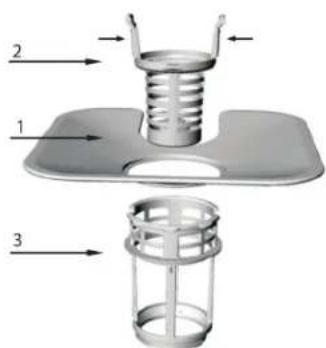
- Flat filter - Food and debris will be trapped by a jet on the lower spray arm.
- Coarse filter - Big debris, such as bone and glass that could clog the drain will be trapped in the coarse filter.
- To remove an item caught in this filter, gently squeeze the tabs on the top of this filter and lift it out.
-
Micro filter - This filter holds soil and food residue in the sump area and prevents it from being redeposit on the dishes during a cycle.
-
Inspect the filters for obstructions every time the dishwasher has been used.
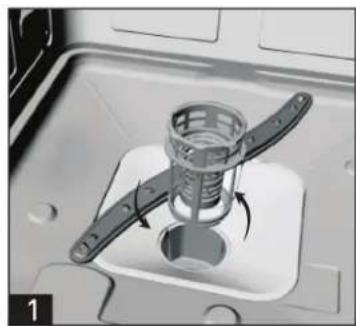
By unscrewing the coarse filter, you can remove the filter system. Remove any food remnants and clean the filters under running water.
STEP 1 // Rotate the coarse filter anticlockwise, filter, and then lift it up;
natural_image
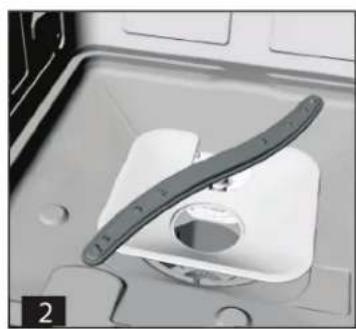
Close-up of a mechanical component with a central spring and directional arrows indicating motion (no text or symbols)STEP 2 // lift the flat filter up
natural_image
Close-up of a white plastic bag with a black handle inserted into it, placed on a mechanical component (no visible text or symbols)Repeat the steps in reverse to reinstall the filtering system.
FILTER ASSEMBLY
The filter assembly should be cleaned once a week with a brush. Then, reassemble the filter parts as shown in the figures above and reinsert the assembly in the dishwasher, positioning in its seat and pressing downward. Improper replacement of the filter may reduce the performance level of the appliance and damage dishes and utensils.
WARNING // Never run the dishwasher without the filters in place.
MAINTENANCE
natural_image
Technical line drawing of a mechanical device with rotating components and directional arrows (no text or symbols)CLEANING THE SPRAY ARMS
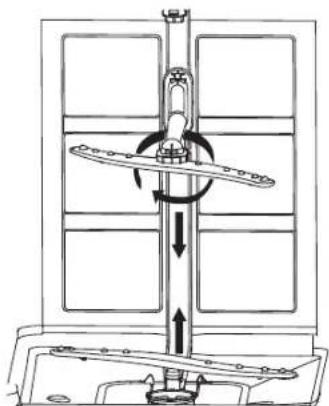
It is necessary to clean the spray arms regularly to ensure efficient operation of the spray arm jets and bearings.
To remove the spray arms, screw off the nut clockwise to take out the washer on top of the spray arm and remove the arm. Wash the arms in warm soapy water and use a soft brush to clean the jets. Rinse thoroughly and replace.
CLEANING THE DISHWASHER
To clean the exterior and rubber parts of the dishwasher, do not use solvents or abrasive cleaning products. Use only a cloth and warm soapy water. To remove spots or stains from the surface of the interior, use a cloth dampened with water and a little white vinegar, or a cleaning product made specifically for dishwashers.
AFTER EVERY WASH
After every wash, leave the door slightly ajar so that moisture and odours are not trapped inside.
REMOVE THE PLUG
Before cleaning or performing maintenance, always remove the plug from the socket.
WHEN YOU GO ON HOLIDAY
When you go on holiday, it is recommended that you run a wash cycle with the dishwasher empty and then remove the plug from the socket, turn off the water supply and leave the door of the appliance slightly ajar. This will help the seals last longer and prevent odours from forming in the appliance.
TO REMOVE SPOTS FROM GLASSWARE:
- Take out all metal utensils out of the dishwasher.
- Do not add detergent.
- Choose the longest cycle.
- Start the dishwasher and allow it to run for about 18 to 22 minutes, then it will be in the main wash.
- Open the door to pour 2 cups of white vinegar into the bottom of the dishwasher.
- Close the door and let the dishwasher complete the cycle. If the vinegar does not work: Repeat as above, except use 1/4 cup (60 ml) of citric acid crystals instead of vinegar.
MOVING THE APPLIANCE
If the appliance must be moved, try to keep it in the vertical position. If absolutely necessary, it can be positioned on its back.
SEALS
One of the factors that cause odours to form in the dishwasher is food that remains trapped in the seals. Periodic cleaning with a damp sponge will prevent this.
INSTALLATION
WARNING // Disconnect electrical power before installing dishwasher. Failure to do so can result in death or electrical shock.
POSITIONING AND LEVELLING
- Remove the appliance from all packaging and check that it has not been damaged during transportation. If it has been damaged, contact the retailer and do not proceed any further with the installation process.
- Check the dishwasher by placing it so that its sides or back panel are in contact with the adjacent cabinets or even with the wall. This appliance can also be recessed under a single work top
- Position the dishwasher on a level and sturdy floor. If the floor is uneven, the front feet of the appliance may be adjusted until it reaches a horizontal position. If the appliance is levelled correctly, it will be more stable and much less likely to move or cause vibrations and noise while it is in operation.
NOTICE // The maximum adjustment height of the feet is 20 mm.
Make sure that the carpet does not obstruct the openings at the bottom base.
CONNECTING THE WATER AND ELECTRIC SUPPLIES
ATTENTION // Connection to the water and electrical supplies should only be performed by a qualified technician.
The dishwasher should not stand on top of the water hoses or the electric supply cable
The appliance must be connected to the water supply network using new piping. Do not use old piping.
natural_image
Line drawing showing a hand adjusting a pipe fitting with a separate mechanical component (no text or symbols)CONNECTING THE WATER INLET HOSE\*
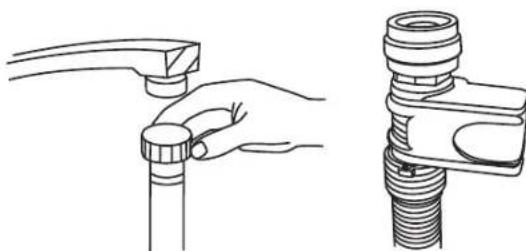
Connect the cold water supply hose to a threaded 3/4 inch connector and make sure that it is fastened tightly in place.
If the water pipes are new or have not been used for an extended period of time, let the water run to make sure that the water is clear and free of impurities. If this precaution is not taken, there is a risk that the water inlet can get blocked and the appliance could be damaged.
CONNECTING THE WATER OUTLET HOSE
Fit the drainage hose of your machine to the drainage pipe without bending.
If the length of the hose is not sufficient, apply to the authorized service for an extension made from the same material as the original. Remember that the length of the hose should not exceed 4 meters even when with an extension.
If the drainage hose is longer than 4 meters the dishes will not be cleaned.
Properly secure your hose firmly to the drainage pipe to avoid it coming off during the washing process.
INSTALLATION
ELECTRICAL CONNECTION
NOTICE // During installation, the power supply must not be excessively or dangerously bent or flattened.
Before inserting the plug into the electrical socket, make sure that:
the socket is earthed and complies with current regulations;
the socket can withstand the maximum load of the appliance, which is indicated on the data plate located on the inside of the door(see description of the appliance);
the power supply voltage falls within the values indicated on the data plate on the inside of the door;
the socket is compatible with the plug of the appliance. If this is not the case, ask an authorised technician to replace the plug (seek assistance); do not use extension cables or multiple sockets.
Once the appliance has been installed, the power supply cable and the electrical socket should be easily accessible.
The cable should not be bent or compressed.
If the power supply cable is damaged, it must be replaced by the manufacturer or its Technical Assistance Service in order to prevent all potential hazards.
The company shall not be held responsible for any incidents that occur if these regulations are not observed.
HOW TO DRAIN EXCESS WATER FROM HOSES
If the sink is 1000mm higher from the floor, the excess water in hoses cannot be drained directly into the sink. It will be necessary to drain excess water from hoses into a bowl or a suitable container that is held outside and lower than the sink.
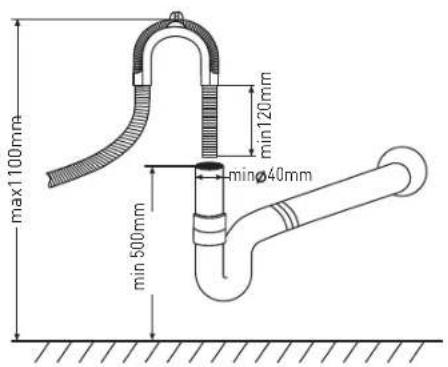
SYPHON CONNECTION
The waste connection must be at a height of between 50cm (minimum) and 100cm (maximum) from the bottom of the dish. The water drain hose should be fixed by a hose clip.
STARTING YOUR DISHWASHER
The followings should be checked before starting the dishwasher:
- Whether the dishwasher is level and fixed
- Whether the inlet valve is opened
- Whether there is leakage at the connections of the conducts
- Whether the wires are tightly connected
- Whether the power is switched on
- Whether the inlet and drain hoses are knotted
- All packing materials and printings should be taken out from the dishwasher
NOTICE // After installation, please put this manual into the bags of printings. The content of this manual is very helpful to the users.
NOTICE // Other means for disconnection from the supply must be incorporated in the fixed wiring with at least 3mm contact separation in all poles.
TROUBLESHOOTING
ERROR CODES
When some malfunctions happen, the appliance will display error codes to warn you.
| CODES | MEANINGS | POSSIBLE CAUSES |
| E1 | Door open | The door is opened when the dishwasher is operating |
| E2 | Water inlet | Water inlet malfunction |
| E3 | Water drainage | Water drainage malfunction |
| E4 | Temperature sensor | Temperature sensor malfunction |
| E5 | Overflow/leakage | Overflow occurs/Water leakage occurs |
| E6 | Water leakage | Water leakage occurs |
| E7 | Heating element | Abnormal heating |
BEFORE CALLING CUSTOMER SERVICE
Reviewing the charts on the following pages to help you resolve the problem without having to call for service.
| PROBLEM | POSSIBLE CAUSES | WHAT TO DO |
| Dishwasher doesn't run | Fuse blown, or the circuit breaker acted | Replace fuse or reset circuit breaker. Remove any other appliances sharing the same circuit with the dishwasher. |
| Power supply is not turned on | Make sure the dishwasher is turned on and the door is closed securely. Make sure the power cord is properly plugged into the wall socket. | |
| Water pressure is low | Check that the water supply is connected properly and the water is turned on. | |
| Drain pump doesn't stop | Overflow | The system is designed to detect an overflow. When it does, it shuts off the circulation pump and turns on the drain pump. |
| Noise | Some audible sounds are normal | Sound from detergent cup opening. |
| Utensils are notSecure in the baskets or something small has dropped into the basket | To ensure everything is secured in the dishwasher. | |
| Motor hums | Dishwasher has not been used regularly. If you do not use it often, remember to set it to fill and pump out every week, which will help keep the seal moist. | |
| Suds in the tub | Improper detergent | Use only the special dishwasher detergent to avoid suds. If this occurs, open the dishwasher and let suds evaporate. Add 1 gallon of cold water to the tub. Close and latch the dishwasher, then start the "soak" wash cycle to drain out the water... Repeat if necessary. |
| Spilled rinse agent | Always wipe up rinse agent spills immediately. |
TROUBLESHOOTING
| PROBLEM | POSSIBLE CAUSES | WHAT TO DO |
| Dishes and flatware not clean | Improper programImproper basket loading | Select a stronger programmeMake sure that the action of the detergent dispenser and spray arms are not blocked by large dishware. |
| Cloudiness on glassware | Combination of soft water and too much detergent | Use less detergent if you have soft water and select a shortest cycle to wash the glassware and to get them clean. |
| Yellow or brown film on inside surfaces | Tea or coffee stains | Using a solution of 1/2 cup of bleach and 3 cups of warm water to remove the stains by hand.WARNING // You have to wait for 20 minutes after a cycle to let the heating elements cool down before cleaning interior; otherwise, burns will happen. |
| Iron deposits in water can cause an overall film | You have to call a water softener company for a special filter. | |
| White film on inside surface | Hard water minerals | To clean the interior, use a damp sponge with dishwasher detergent and wear rubber gloves. Never use any other cleaner than dishwasher detergent for the risk of foaming or suds |
| The detergent dispenser lid cannot be closed properly | Clogged detergent residue is blocking the catch | Clean the detergent from the catch. |
| Detergent left in dispenser cups | Dishes block detergent cups | Re-loading the dishes properly. |
| Black or gray marks on dishes | Aluminum utensils have rubbed against dishes | Use a mild abrasive cleaner to eliminate those marks. |
| Dishwasher leaks | Overfill dispenser or rinse aid spills | Be careful not to overfill the rinse aid dispenser.Spilled rinse aid could cause over sudsing and lead to overflowing. Wipe away any spills with a damp cloth. |
| Dishwasher isn't level | Make sure the dishwasher is level. | |
| Stained tub interior | Detergent with colorant was used | Make sure that the detergent is the one without colorant. |
WARNING! // If overflow occurs, turn off the main water supply before calling a service. If there is water in the base pan because of an overfill or small leak, the water should be removed before restarting the dishwasher.
PRODUCT SPECIFICATIONS
| W x D x H | 600mm x 600mm x 850mm |
| Voltage connected load: | 220 - 240V~ 50Hz |
| Water pressure: | 0.04-1.0MPa |
| Power supply: | 1850W |
| Capacity: | 14 Place settings |
| Hot water connection: | Max 60° C |
WARRANTY TERMS & CONDITIONS
These Terms and Conditions apply only to Tisira products distributed in Australia and New Zealand by Arisit Pty Limited.
- This warranty applies for a period of 2 years parts and labour, Australia and New Zealand, commencing from date of purchase.
- Evidence of the date of purchase must be shown to the technician, when he calls, to obtain benefit under this warranty.
-
This warranty applies only to the original purchaser/hire purchaser of this appliance and cannot be assigned or transferred. Failure to produce documentary proof of the date of original acquisition by the original purchaser will result in a charge being levied for work done, labour and parts supplied.
-
This warranty does not apply to:
a) Serviceable items such as filters, fuses, light bulbs, door seals, drive belts, external hoses, etc.
b) Damage to body work, paint work, glass, trivets and plastic items (such as, but not limited to windows, covers, baskets, trays, worktops, door handles, control and kick panels.)
c) Corrosion & rust damage.
d) Damages/blockages caused by laundry or foreign objects.
A fee for service will be charged following warranty claims where no fault is found with the appliance.
- This warranty will not apply where:
a) The fault is caused by accident, misuse, oversuds, an infestation of vermin, fire, flood or the use of products not approved by Arisit Pty. Limited.
b) There has been a failure to comply, with the manufacturer's operating and installation instructions.
c) Service, modification or repair has been carried out by anybody other than an approved Tisira Service Technician.
d) The appliance has been used/installed anywhere other than a private dwelling, or where it has been used other than for domestic use.
e) The appliance is subject to a rental agreement.
-
Any defective part that has been replaced becomes the property of Arisit Pty Limited.
-
This warranty applies only to Tisira appliances purchased and installed in Australia and New Zealand.
-
Loss of use of the appliance or consequential loss of any nature is not covered.
-
A charge may be levied at the discretion of Arisit Pty Limited if the call is deemed unnecessary or if the cause of failure is traced to external sources such as, but not limited to: blown fuses, power failure, faulty installation, etc.
-
Where the appliance, the subject of a warranty claim or repair, is used or installed more than TWENTY [20] kilometres from the nearest
Arisit Service Division or Authorised Service Agent, the cost of delivery to the nearest Service Division or travel costs for a technician or Authorised Service Agent shall be for the account of the Purchaser. Where a built-in appliance is located or installed outside the Arisit Authorised Service Agent's normal service area, additional travel and labour costs shall be the account of the Purchaser
-
Arisit Pty Limited shall not under any circumstances be responsible in terms of this warranty for the replacement or repair of any part of the equipment which may have been damaged in transit, during and after installation or imperfections after installation.
-
Losses caused by act of God, failure to obtain spare parts, strikes or lockouts are not covered.
-
Service is offered during normal working hours only, also appliances to a have clear access in a serviceable area.
-
This warranty does not effect your statutory rights.
-
Our goods come with guarantees that cannot be excluded under the Australian Consumer Law. You are entitled to a replacement or refund for a major failure and for compensation for any other reasonably foreseeable loss or damage. You are also entitled to have the goods repaired or replaced if the goods fail to be of acceptable quality and the failure does not amount to a major failure.
We reserve the right to amend any of the above without prior notice.
Registration Form
To register for your warranty please complete and return this form to Arisit Pty Limited within 30 days of purchase.
t tisira
Where did you first hear about Tisira?
Advertising Tradesman's Recommendation
☐ In Store Display ☐ Recommendation by Friend/Relative
☐ Other (please specify)....
Would you like any further information on other Tisira appliances? Please specify
□ Cooking
□ Dishwashers
□ Laundry
□ All
Please print in block letters
Date of Purchase / /
Name of Retailer
Address
Model Number
Serial Number
□ Mr □ Mrs □ Ms
Initials
Surname
Address
State Postcode
Telephone
NOTES
NOTES
CONTACT DETAILS
AUSTRALIA
ARISIT PTY LIMITED
40-44 Mark Anthony Drive, Dandenong South, VIC 3175, Australia
P // 1300 762 219
F // 03 9768 0838
consumer.care@arisit.com
NEW ZEALAND
ARISIT PTY LIMITED
PO Box 68-140
Newton, Auckland 1145,
New Zealand
P // 09 306 1020
F // 09 302 0077
sales@aristonappliances.co.nz
TISIRA IS COMMITTED TO ONGOING RESEARCH AND DEVELOPMENT. EVERY EFFORT HAS BEEN MADE TO ENSURE ALL INFORMATION IN THIS USER MANUAL IS CORRECT AT TIME OF GOING TO PRINT, DIMENSIONS SHOULD BE USED AS A REFERENCE ONLY AND ACTUAL DIMENSIONS SHOULD BE TAKEN FROM THE PHYSICAL PRODUCT ONLY.
MANUFACTURER RESERVES THE RIGHT TO CHANGE SPECIFICATIONS WITHOUT NOTICE.
t tisira
Version1.1

natural_image
Solid dark gray image with no visible content, text, or symbols.- USER MANUAL
- PLACE DISHWASHER
- HELLO
- CONTENTS
- WARNINGS
- SAFETY INFORMATION
- PRODUCT OVERVIEW
- CONTROL PANEL
- FRONT VIEW
- OPERATING INSTRUCTIONS
- FILL THE RINSE AID DISPENSER
- FUNCTION OF RINSE AID
- WHEN TO REFILL THE RINSE AID DISPENSER
- ADJUSTING RINSE AID DISPENSER
- FILL THE DETERGENT DISPENSER
- CONCENTRATED DETERGENT
- DETERGENT TABLETS
- DETERGENT DISPENSER
- DETERGENTS
- USE OF "3 IN 1" DETERGENT TABLETS
- GENERAL ADVICE
- SPECIAL ADVICE
- TO SELECT "3 IN 1" FUNCTION:
- TO CANCEL "3 IN 1" FUNCTION:
- TURNING ON THE APPLIANCE
- SELECT A PROGRAMME
- CHANGE THE PROGRAMME.
- FORGET TO ADD A DISH
- SWITCH OFF THE DISHWASHER
- WHEN LOADING ITEMS TO BE WASHED:
- LOADING THE DISHWASHER BASKETS
- THE UPPER BASKET
- ADJUSTING THE UPPER BASKET
- LOADING THE LOWER BASKET
- CUTLERY TRAY
- FOLDING RACKS
- LOADING CUTLERY & DISHES
- AT THE END OF THE WASH
- REMOVING THE DISHES
- MAINTENANCE
- FILTERING SYSTEM
- FILTER ASSEMBLY
- CLEANING THE SPRAY ARMS
- CLEANING THE DISHWASHER
- AFTER EVERY WASH
- REMOVE THE PLUG
- WHEN YOU GO ON HOLIDAY
- TO REMOVE SPOTS FROM GLASSWARE:
- MOVING THE APPLIANCE
- SEALS
- INSTALLATION
- POSITIONING AND LEVELLING
- CONNECTING THE WATER AND ELECTRIC SUPPLIES
- CONNECTING THE WATER INLET HOSE\*
- CONNECTING THE WATER OUTLET HOSE
- ELECTRICAL CONNECTION
- HOW TO DRAIN EXCESS WATER FROM HOSES
- SYPHON CONNECTION
- STARTING YOUR DISHWASHER
- TROUBLESHOOTING
- ERROR CODES
- BEFORE CALLING CUSTOMER SERVICE
- PRODUCT SPECIFICATIONS
- WARRANTY TERMS & CONDITIONS
- These Terms and Conditions apply only to Tisira products distributed in Australia and New Zealand by Arisit Pty Limited.
- Registration Form
- t tisira
- NOTES
- CONTACT DETAILS
- ARISIT PTY LIMITED
Mærke : Tisira
Model : TDW14W
Kategori : Opvaskemaskiner