Carina 8 - Telt Wynnster - Gratis brugsanvisning og manual
Find enhedens vejledning gratis Carina 8 Wynnster i PDF-format.


Brugerspørgsmål om Carina 8 Wynnster
0 spørgsmål om dette apparat. Besvar dem du kender, eller stil dit eget.
Stil et nyt spørgsmål om dette apparat
Download vejledningen til din Telt i PDF-format gratis! Find din vejledning Carina 8 - Wynnster og tag din elektroniske enhed tilbage i hånden. På denne side er alle dokumenter nødvendige for brugen af din enhed offentliggjort. Carina 8 af mærket Wynnster.
BRUGSANVISNING Carina 8 Wynnster
ASSEMBLY INSTRUCTIONS: CARINA 8
Please read the General Information before starting and familiarise yourself with each of the component parts. Please refer to the diagrams as you proceed.
Your tent comprises the following parts: (As you unpack the component parts make a mental note of how the tent was packed in the carry bag as this will help you when you come to repack it.) TAKE EXTRA CARE ON WINDY DAYS SO THAT THE TENT DOES NOT BECOME DAMAGED.
COMPONENT PARTS
-
The flysheet, which is the PU coated shell of the tent that has an integral sewn in groundsheet; other features include the pole sleeves, attached guy ropes, windows etc.
-
Three inner tents or sleeping compartments each have an integral ground-sheet & a "D" shaped door with secondary mesh insect proof ventilatio panel.
-
A pole carry bag that contains 4 fibreglass poles that are strung in sections on elasticated shock cord; the mid section of each pole is colour coded to match with coloured taping on its correct pole sleeve. Plus, steel poles, all are in sections and are connected with spring linkages. All of them are colour coded to aid with their assembly and to correspond with coloured taping on each pole sleeve on the flysheet.
-
A peg bag that contains sufficient pegs to erect the tent.
-
An emergency Repair Kit that contains fabric cuttings, seam sealant, spare
pegs & guy rope, peg point elastic and an emergency pole repair sleeve.
AS THE ASSEMBLY PROCESS REQUIRES THE POLES AND OTHER COMPONENT PARTS TO BE PUT UNDER TENSION, CARE MUST BE TAKEN AT ALL TIMES TO PREVENT PERSONAL INJURY OR HARM TO OTHERS.
ASSEMBLY INSTRUCTIONS
-
Having selected your site, unfold the flysheet ensuring the doors are zipped closed and orientate it so that where possible they face away from the prevailing wind.
-
Unpack the steel pole sections. Those with the spring linkages should be gently slotted together to form 9 poles for the frame of the tent (comprising 3 curved roof poles plus 6 straight roof support poles).
-
The steel poles form the main frame of the tent and are in three parts, all are colour coded to aid with their assembly. The roof pole should form a gentle "C" shaped curve if assembled correctly; the shaped connections will help ensure this happens, plus two straight poles which are the roof support poles that have a shaped connection at one end and a spike at the other.
-
Taking the assembled curved roof poles in turn, gently PUSH them through the pole sleeves in the flysheet that have the same colour taping as the colour coding on these roof poles. Where possible avoid standing on the flysheet, as this will damage it. (See figure 1).
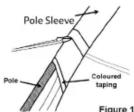
Always push the poles, never pull them otherwise the sections will come apart and the spring linkages will break.
-
Connect all the roof support poles to their corresponding roof pole with matching colour coding. The now complete poles should look a little like the letter "U" in shape.
-
Unfold the fibreglass pole sections and gently slot them together to form 4 complete poles.
-
Taking these assembled fibreglass poles in turn, gently PUSH them through the pole sleeves in the flysheet with the same colour taping as the mid section of the pole. (See figure 1)
Always push the poles, never pull them otherwise the sections will come apart and the elastic shock cord will break
- Now taking each complete steel pole in turn, insert the spike that is at the bottom end of the roof support pole the into the eyelet in the webbing tab at the base of and nearest to the flysheet (the outer one is always for the peg) and repeat with the other end by grasping the web-
bing tab firmly and pushing the pole remaining steel poles (see figure 2).
- Next take the longest fibreglass pole; this will create the canopy over the main entrance. insert one end tip into the eyelet in the webbing tab at the base of and nearest to the flysheet (the other is for the peg) and repeat with the other end, by grasping the webbing tab firmly and pushing the pole through the sleeve (see figure
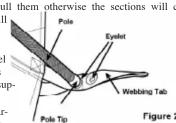
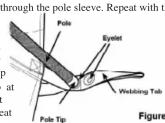
2A). To achieve this the pole sleeves must be eased over the poles, especially over the metal joints or ferrules. Repeat with the fibreglass pole over the largest bedroom at the opposite end or rear of the tent. Leave the remaining bedroom poles until later.
- Before starting to put in the pegs, check that the tent's position is acceptable, adjusting if necessary. Initially only a few pegs should be put in, enough to give the tent its rough shape and none under any great tension. This will significantly ease the installation of the inner sleeping compartments. Start by pegging the rear of the tent at the back of the largest bedroom, then
stand up each steel pole in turn proceeding towards the main entrance and canopy at the front of the tent; a little like extending a concertina. All three arched steel poles should be in line with each other.
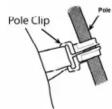
Figure 6
- With the remaining fibreglass poles, insert one end tip into the eyelet in the webbing tab at the base of and nearest to the flysheet (the other is for the peg) and repeat with the other end, by grasping the webbing tab firmly and pushing the pole through the sleeve (see figure 2A). To achieve this the pole sleeves must be eased over the poles, especially over the metal joints or ferrules.
Peg down these parts as before.
- Between the ends of the pole sleeves and the eyelets in the webbing there are pole clips, these should now be attached to the poles (see figure 6).
Some will have a guy line attached so ensure that these are not tangled
- Gather up the inner tents, ensuring that their doors are closed, and take them inside the tent. The correct location for each inner is identified by the colour of the elastic of the uppermost hanging point on each bedroom as it matches a coloured tab that is next to the correct eyelet in the flysheet (see figure 3). Start at the rear edge of the inner and attach the hooks that are on
the corners of its groundsheet to the "D" rings located on the main groundsheet (see figure 5).
-
Then, working systematically, using the hooks attach the inner to the eyelets located on a fabric tabs sewn to the inside of the flysheet (see figure 3).
-
Once the inners have been suspended, readjust the tension on the pegs already in position followed by the remaining pegs. Remember to angle the pegs away from the tent. This must be done systematically so that the tent ends up being symmetrically
pitched, taking care to balance the tension at each point so that the tents fabric is stretched evenly. Ensure that the main door is zipped closed or too much tension will be placed in the zip area and prevent their smooth operation.
The apron style groundsheet will clip to the "D" rings located at the base of the canopy poles. (See figure 5)
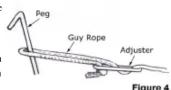
- Unravel the guy ropes and loosely peg out each one ensuring that they are all pegged directly in line with the seam or pole to which they will apply
tension and support. Once this is achieved tighten the adjusters so that equal tension is applied to each guy point (see figure 4).
- The doors may be rolled back and secured using the conveniently located ties or stowed in the special door pockets where the zips end.
HOW TO TAKE DOWN YOUR TENT
- Please note that the pegs should be extracted by either using a tent peg extractor or more simply by using another peg. Do not pull them out by using the guy rope or the elastic.
AGAIN TAKING EXTRA CARE AND PRECAUTIONS ON WINDY DAYS SO THAT THE TENT DOES NOT BECOME DAMAGED.
-
Unclip and remove the inner sleeping compartments.
-
Unpeg the guy ropes, slide the adjuster up to the flysheet and neatly tie them up to prevent them becoming tangled.
-
Unpeg the flysheet and remove the fibreglass pole ends from the eyelets taking great care, as these will be under tension. Keep them away from your face and children at a safe distance.
-
Gently PUSH the fibreglass poles through the sleeves in the flysheet.
-
Remove the ends of the steel poles from the eyelets again taking great care, as these will be under tension. Keep them away from your face and children at a safe distance.
-
Gently PUSH the steel poles through the pole sleeves in the flysheet.
-
To pack the poles away, simply pull each of their sections apart and fold up and store them in their carry bag. Collect the pegs together, cleaning them as
you go, and put them in their storage bag.
- Ensuring that the tent is thoroughly dry if it is to be stored for some time, pack the tent away into its carry bag. The easiest way to achieve this is to individually fold the inner tent and the flysheet to the rough width of the carry bag and lay them on top of each other. Then slowly roll them up around the poles, ensuring that as much of the trapped air as possible is squeezed out. The more slowly & tightly this is done the easier it will be to get it back into the carry bag.
Remember that this tent has a sewn in groundsheet and should be folded/rolled in such a way so that the air is squeezed out through an opened door or vent, otherwise it will become trapped and very difficult to pack away.
- If the tent is wet or dirty when you temporarily pack it away remember to fold “wet to wet” and “dry to dry”, as this will help reduce the soiling of the inner tent etc.
GENERAL INFORMATION
The following tips and information may help make your trip more enjoyable.
BEFORE USING YOUR TENT
-
Get to know your tent before your trip by practising pitching and familiarising yourself with its component parts and features. This will also double check that it is complete and undamaged and will not spoil your holiday.
-
Whilst there is a small repair kit included with the tent, it contains only basic items so it may be worth considering taking a more comprehensive kit; such spares are available through your local Wynster stockist. It is also advisable to assemble a spares and tool kit so that should any accidental breakage occur then this will enable the repair to be effected without delay. Items that should be considered are: additional pegs (to cover varying soil types such as very hard ground or even loose sandy soils); extra/spare guy ropes (to cover losses or to be used in adverse weather conditions to strengthen the structure); extra seam sealer (as whilst every effort has been taken to ensure that they are adequately taped, leakage may develop during heavy or prolonged rainfall); spare pole sections; shock cord elastic etc.
-
A multi tool of some description (or pliers, a pen knife and a junior hack saw), plus a roll of water proof tape and some quick drying, multi-purpose glue will get you out of most difficulties.
-
A rubber mallet will help you cope with very hard ground plus a tent peg extractor for the end of your holiday.
-
We suggest that you have some form of insurance cover against theft, accidental or storm damage.
Should you have any queries then in all instances these must be directed to the retailer from whom the tent was purchased.
CHOOSING A SITE
-
Ideally this should be as flat as possible for both your comfort and stability of the tent.
-
Avoid low lying ground or other such areas that may flood in heavy rain, the presence of long green grass will help you spot these places.
-
It should also be clear of any object that may puncture the ground sheet or give you discomfort in the night.
-
Avoid pitching under trees as they may drip sap or water (long after the rain has stopped falling) and aim for sites that are in shadow at the height of the day as you may wish for some shade during the hotter months. For extended use it is advisable to seek a shady site, as most tent materials will be weakened by prolonged exposure to strong sunlight; this is manifested in a fading of colour and a weakening of the fabric. The amount of fading in not an indicator of the degree of weakening. The polyester fabric used in the manufacture of this tent as opposed to nylon will deteriorate is significantly more resistant to the affects of ultraviolet light.
-
Make use of natural windbreaks such as walls and hedges etc, avoiding exposed and or high level site that may cause problems in the event of high winds, as a tent of this size offers a very large profile to the wind.
-
For Fire Safety it is advisable to site your tent at least 6 metres from adjacent tents.
ERECTING YOUR TENT
-
Whenever possible try to pitch the tail or the lowest part of the tent into the wind as this will help the wind blow over the structure more easily, and with the door facing away from the wind so that rain cannot be blown inside.
-
As the assembly process requires the poles and other component parts to be put under tension, care must be taken at all times.
-
If pitching the tent in windy conditions then extra care and precautions must be taken to guard against personal injury and to ensure the tent does not become damaged. Whilst the poles are being installed the flysheet may need to be pegged down so that it is not blown away. The most critical point when most damage occurs is when the poles have been fully installed but before the pegs have been fully put in; emergency but temporary guying and pegging may be required at this stage. Try and enlist the help of fellow campers if you are having difficulties.
-
Pitch with all zips closed and drive all pegs in at an angle (ideally of 45^ or less to the horizontal) and in line with the seams. Do not overstretch the elasticated peg loops but apply sufficient pressure to tension the fabric; spend a little time to make sure all are correctly positioned. Do not peg the ground sheet down too tightly and if possible lay a polythene sheet (or similar such as Damp Proof Membrane material available from builders merchants) underneath, as this will extend the life of the tent's groundsheet and help keep it clean. Furthermore this will help alleviate the build up of condensation by blocking the evaporation of moisture from the ground.
IN USE
-
Keep the exit(s) clear and free from obstruction to prevent accidental damage to you and the tent, especially in an emergency.
-
To help keep the doors closed, cross over the peg points at the base of zips on the flysheet. Avoid treading on the zips and keep them free from dirt, as this will maintain their smooth operation. Should the zips become difficult to operate: do not force them but adjust the pegging/guying of the tent to ease the pressure on them and lubricate with a silicon or similar lubricant to maintain their smooth operation. Specialist products are available from your Camping retailer.
-
Even though the tent's outer fabric has been coated to provide protection from the weather it will stop moisture vapour that is inside from escaping. This may result in water droplets appearing on its inner surface as condensation.
Condensation may come from moisture contained in the ground or expired from the occupants of the tent and held in the air as humidity, and it is most likely to appear upon the onset of rain, as this will rapidly chill the flysheet fabric. This may also happen at night time when the outside air temperature drops. These droplets may fall from the flysheet and this cannot altogether be avoided but it can certainly be alleviated.
To help prevent this, increase ventilation as much as possible by opening vents and zips and promoting a flow of air under the flysheet. Cooking and lighting are also sources of condensation particularly if using fossil fuels such as gas, petrol or paraffin; therefore it is obviously best to cook outside when the weather allows or in an alternative structure (and also from a safety point of view). Condensation should not be confused with leakage.
-
Periodically check each peg point and re adjust as necessary, especially during/after stormy weather. In adverse weather conditions extra precautions will need to be taken; more guy lines may be needed to strengthen the structure; more or alternative types or sizes of pegs may be required especially if the ground is soft or becomes saturated, double pegging some points as necessary; the communal area groundsheet may need to be unclipped in the doorways and folded back to prevent rainwater running back into the tent.
-
FIRE WARNING: The Fire Retardant fabrics that are used for the ground-sheet, inner, mesh ventilation panels and flysheet of this tent will significantly reduce the rate of flame propagation, but the tent is still flammable.
- Keep naked flames and other heat sources well away from all the tent's fabrics.
- Do not refill stoves or change fuel cartridges inside or near to the tent. - Never leave heating, lighting or cooking appliances unattended in the vicinity of the tent.
- THINK SAFETY FIRST -
STORAGE & MAINTENANCE
-
NEVER store the tent unless it is completely dry. Storing when damp allows the formation of mildew which will damage the tent. Clean all components and store separately.
-
Light soiling may be removed either by the gentle use of a soft brush or a soft, dampened cloth. Never use detergents or wash in a washing machine, as this will damage the waterproof coatings.
-
Should the tent show signs of leakage along any of the flysheet seams, the inner tent suspension points, lantern loops etc, seam sealant should be applied. A tube may be found in the repair kit with replacements readily available from your Outdoor Leisure retailer.
-
Tears and holes from accidental damage or otherwise may be repaired. Please contact your local Camping retailer from your nearest specialist repairer.