
GEHM 34200 X - Ovn GRUNDIG - Gratis brugsanvisning og manual
Find enhedens vejledning gratis GEHM 34200 X GRUNDIG i PDF-format.


Brugerspørgsmål om GEHM 34200 X GRUNDIG
0 spørgsmål om dette apparat. Besvar dem du kender, eller stil dit eget.
Stil et nyt spørgsmål om dette apparat
Download vejledningen til din Ovn i PDF-format gratis! Find din vejledning GEHM 34200 X - GRUNDIG og tag din elektroniske enhed tilbage i hånden. På denne side er alle dokumenter nødvendige for brugen af din enhed offentliggjort. GEHM 34200 X af mærket GRUNDIG.
BRUGSANVISNING GEHM 34200 X GRUNDIG
INTEGRIERTER OFEN INTEGRATED OVEN
GEBRAUCHSANLEITUNG USER MANUAL
GEHM 34200 X
natural_image
Simple geometric diagram with a shaded rectangle and two horizontal lines above it, no text or symbols present.Bitte zuerst diese Bedienungsanleitung lesen!
Sehr geehrte Kundin, sehr geehrter Kunde,
vielen Dank für den Kauf eines Grundig-Produktes. Wir hoffen, dass dieses Produkt, das mit hochwertiger und hochmoderner Technologie hergestellt wurde, beste Ergebnisse erzielt. Daher bitte die gesamte Bedienungsanleitung und alle beiliegenden Dokumente aufmerksam durchlesen und zum zukünftigen Nachschlagen aufbewahren. Bei Weitergabe des Produktes auch die Bedienungsanleitung mit aushändigen. Alle Warnungen und Informationen in der Bedienungsanleitung einhalten.
Bitte beachten, dass diese Bedienungsanleitung für unterschiedliche Modelle geschrieben wurde. Unterschiede zwischen den verschiedenen Modellen werden natürlich in der Anleitung erwähnt.
Die Symbole
In dieser Anleitung verwenden wir folgende Symbole:

Wichtige Informationen oder nützliche Tipps zum Gebrauch.
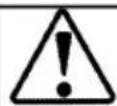
Warnung vor gefährlichen Situationen, in denen es zu Verletzungen oder Sachschäden kommen kann.
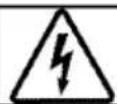
Warnung vor Stromschlägen.
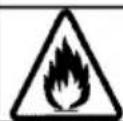
Warnung vor Brandgefahr.
Warnung vor heißen Flächen.
1 Wichtige Sicherheits- und Umwelthinweise 4
Allgemeine Sicherheit 4
Elektrische Sicherheit....4
Produktsicherheit....6
Bestimmungsgemäße Verwendung ..... 8
Sicherheit von Kindern 8
Altgeräte entsorgen....9
Verpackungsmaterialien entsorgen ..... 9
2 Allgemeine Informationen 10
Geräteübersicht 10
Technische Daten 11
Lieferumfang 13
3 Installation 14
Vor der Installation.... 14
Einbauen und Anschließen....16
Transport....19
4 Vorbereitungen 21
Tipps zum Energiesparen 21
Erste Inbetriebnahme 21
Uhrzeit 21
Erstreinigung des Gerätes 22
Erstaufheizung 23
5 Bedienung Kochfeld 24
Allgemeine Hinweise zum Kochen......24
Kochfeld verwenden....26
Kochzonen abschalten: 26
6 Bedienung des Backofens 31
Allgemeine Hinweise zum Backen, Braten und Grillen....31
Backofen bedienen....31
Betriebsarten....34
Backofen bedienen 36
Tastensperre....39
Alarmfunktion....39
Garzeitentabelle 40
Einstellungsmenü 41
So bedienen Sie den Grill....42
Garzeitentabelle zum Grillen....43
7 Reinigung und Wartung 44
Allgemeine Hinweise 44
Kochfeld reinigen 44
Bedienfeld reinigen 45
Backofen reinigen 45
Backofentür ausbauen 46
Türinnenscheibe ausbauen 46
Beleuchtung des Backofens auswechseln 47
8 Problemlösungen 48
1 Wichtige Sicherheits- und Umwelthinweise
Dieser Abschnitt enthält Hinweise, die für die Sicherheit des Benutzers und anderer Personen unerlässlich sind. Diese Hinweise müssen beachtet werden, damit es nicht zu Verletzungen oder Sachschäden kommt. Bei Nichteinhaltung dieser Anweisungen erlöschen sämtliche Garantieansprüche.
Allgemeine Sicherheit
- Dieses Gerät darf von Kindern (ab acht Jahren) oder Personen bedient werden, die unter körperlichen, sensorischen oder geistigen Einschränkungen leiden oder denen es an der nötigen Erfahrung und Wissen im Umgang mit solchen Geräten mangelt, wenn solche Personen beaufsichtigt werden und, zuvor gründlich mit der sicheren Bedienung des Gerätes vertraut gemacht wurden und sich der damit verbundenen Gefahren voll und ganz bewusst sind.
- Kinder dürfen nicht mit dem Gerät spielen. Reinigungs- und Wartungsarbeiten dürfen von Kindern nicht ohne Aufsicht
eines Erwachsenen durchgeführt werden.
• Installation und Reparaturen müssen grundsätzlich vom autorisierten Kundendienst ausgeführt werden. Der Hersteller haftet nicht für Schäden, die durch den Eingriff nicht autorisierter Personen entstehen; zudem kann dadurch die Garantie erlöschen. Vor der Installation aufmerksam alle Anweisungen lesen.
- Gerät nicht nutzen, falls es nicht ordnungsgemäß funktioniert oder sichtbare Beschädigungen aufweist.
- Nach jeder Benutzung prüfen, ob die Funktionsknöpfe des Produktes ausgeschaltet sind.
Elektrische Sicherheit
• Falls das Produkt einen Fehler aufweist, sollten es bis zur Reparatur durch einen autorisierten
Kundendienstmitarbeiter nicht in Betrieb genommen werden. Es besteht Stromschlaggefahr!
- Schließen Sie das Produkt nur an eine geerdete Steckdose an, deren Spannung und Schutz
den Angaben unter „Technische Daten“ entsprechen. Lassen Sie durch einen qualifizierten Elektriker eine Erdung vornehmen. Unser Unternehmen haftet nicht für Probleme, die durch ein nicht entsprechend den örtlichen Richtlinien geerdetes Produkt entstehen.
- Reinigen Sie das Produkt niemals, indem Sie Wasser darauf verteilen oder schütten! Es besteht Stromschlaggefahr!
- Das Produkt darf während Installation, Wartung, Reinigung und Reparatur nicht an eine Steckdose angeschlossen sein.
- Falls das Netzkabel des Produktes beschädigt ist, muss es zur Vermeidung von Gefahren vom Hersteller, einem Kundendienstmitarbeiter oder vergleichbar qualifizierten Personen ausgetauscht werden.
- Verwenden Sie nur das unter „Technische Daten“ angegebene Anschlusskabel.
• Das Gerät muss so installiert sein, dass es vollständig vom
Netzwerk getrennt werden kann. Die Trennung muss entsprechend den Baurichtlinien entweder durch einen Netzstecker oder einen in der festen elektrischen Installation eingebauten Schalter ermöglicht werden.
• Die Rückseite des Ofens wird im Betrieb heiß. Achten Sie darauf, dass der Elektroanschluss die Rückseite nicht berührt; andernfalls kann der Anschluss beschädigt werden.
- Klemmen Sie das Netzkabel nicht zwischen Backofentür und Rahmen ein; führen Sie es nicht über heiße Oberflächen. Andernfalls kann die Kabelisolierung schmelzen und in Folge eines Kurzschlusses einen Brand verursachen.
- Jegliche Arbeiten an elektrischen Geräten und Systemen sollten von autorisierten und qualifizierten Personen ausgeführt werden.
- Schalten Sie das Gerät bei Schäden aus, unterbrechen Sie die Stromversorgung. Schalten Sie dazu die Sicherungen im Haus ab.
- Stellen Sie sicher, dass die Sicherungsangaben mit dem Produkt kompatibel sind.
Produktsicherheit
- Das Gerät und seine zugänglichen Teile werden während des Betriebs heiß. Keine Heizelemente berühren. Kinder unter 8 Jahren fernhalten, sofern nicht kontinuierlich beaufsichtigt.
- Produkt niemals nutzen, wenn Urteilsvermögen oder Koordination durch Alkohol und/oder Drogen beeinträchtigt sind.
- Bei alkoholischen Getränken in den Gerichten entsprechend vorsichtig sein. Alkohol verdampft bei hohen Temperaturen und kann durch Entzünden bei Kontakt mit heißen Oberflächen Feuer verursachen.
- Keine brennbaren Materialien in der Nähe des Produktes aufstellen, da die Seiten während des Gebrauchs heiß werden können.
- Während des Gebrauchs wird das Gerät heiß. Keine Heizelemente im Inneren des Backofens berühren.
- Darauf achten, dass keine Belüftungsschlitze blockiert werden.
- Keine geschlossenen Dosen und Glasgefäße im Ofen erhitzen. Der in der Dose/im Glasgefäß entstehende Druck könnte Dose/Glasgefäß bersten lassen.
- Backbleche, Gerichte und Alufolie nicht direkt auf den Boden des Backofens stellen. Der Hitzestau kann den Boden des Backofens beschädigen.
- Zur Reinigung der Backofen-Glastür keine aggressiven scheuernden Reiniger oder scharfen Metallschaber verwenden, da diese die Oberfläche zerkratzen und so das Glas springen lassen können.
- Zur Reinigung des Gerätes keine Dampfreiniger verwenden; andernfalls besteht Stromschlaggefahr.
- Gitterroste wie unter „Backofen bedienen“ beschrieben verwenden.
- Produkt nicht verwenden, falls das Glas der Fronttür entfernt oder gesprungen ist.
- Griff der Ofentüre nicht zum Trocknen von Geschirrtüchern verwenden. Keine Geschirrtücher, Handschuhe oder vergleichbare Textilprodukte aufhängen, wenn die Grillfunktion bei geöffneter Tür arbeitet.
- Beim Hineingeben oder Herausnehmen von Gerichten in den/aus dem heißen Ofen immer hitzebeständige Handschuhe verwenden.
- Zur Vermeidung von Stromschlaggefahr vor dem Auswechseln der Lampe sicherstellen, dass das Gerät abgeschaltet ist.
- Unbeaufsichtigtes Garen auf einem Kochfeld mit Fett oder Öl kann gefährlich sein und Brände verursachen. Niemals versuchen, ein Feuer mit Wasser zu löschen; stattdessen das Gerät abschalten und Flammen z. B. mit einem Deckel oder einer Feuerlöschdecke abdecken.
- Brandgefahr: Keine Gegenstände auf den Kochoberflächen aufbewahren.
• Falls die Oberfläche gesprungen ist, Gerät zur
Vermeidung möglicher Stromschlaggefahr abschalten.
- Kochfeld nach dem Einsatz über den Regler abschalten und nicht auf Kochgeschirrdetektor verlassen.
- Metallische Objekte, wie Messer, Gabeln, Löffel und Deckel, sollte nicht auf dem Kochfeld abgelegt werden, da sie heiß werden können.
• Das Gerät darf nicht über externe Timer oder separate Fernsteuerungssysteme betrieben werden.
- Dampfdruck, der aufgrund von Feuchtigkeit an der Kochfeldoberfläche oder an der Unterseite des Kochgeschirrs entsteht, kann dazu führen, dass sich das Kochgeschirr bewegt. Daher muss sichergestellt werden, dass Ofenoberfläche und Unterseite des Kochgeschirrs immer trocken sind.
- Kochfelder sind mit Induktionstechnologie ausgestattet. Das Induktionskochfeld, das sowohl Zeit- als auch Kosteneinsparungen bedeutet, muss mit zum Induktionskochen geeignetem Kochgeschirr
verwendet werden; andernfalls funktionieren die Kochfelder nicht. Siehe.Allgemeine Hinweise zum Kochen, Seite 24, Kochgeschirrauswahl
• Da Induktionskochfelder ein magnetisches Feld erzeugen, können sie für Menschen, die Geräte wie Insulinpumpen oder Herzschrittmacher verwenden, gefährlich sein.
Brandschutzvorkehrungen des Produktes:
- Sicherstellen, dass der Stecker richtig in die Steckdose eingesteckt ist und keine Funken erzeugt.
- Keine beschädigten oder abgeschnittenen Kabel bzw. Verlängerungskabel verwenden; nur das Originalkabel einsetzen.
- Beim Anschließen des Produktes sicherstellen, dass sich keine Flüssigkeit oder Feuchtigkeit am Stecker befindet.
Bestimmungsgemäße Verwendung
- Dieses Gerät wurde für den reinen Hausgebrauch entwickelt. Eine gewerbliche Nutzung ist nicht zulässig.
- Dieses Gerät dient ausschließlich der Zubereitung von Speisen. Es darf nicht zu anderen Zwecken eingesetzt werden.
- Benutzen Sie das Gerät nicht zum Vorwärmen von Tellern, hängen Sie keine Küchentücher, Handtücher und dergleichen zum Trocknen oder Anwärmen an die Griffe.
- Der Hersteller haftet nicht für Schäden, die durch unsachgemäßen Gebrauch oder falsche Bedienung verursacht werden.
• Das Gerät ist zum Garen, Auftauen, Backen, Braten und Grillen von Lebensmitteln geeignet.
Sicherheit von Kindern
- Verschiedene Teile des Gerätes werden während des Gebrauchs heiß. Daher kleine Kinder vom Gerät fernhalten.
- Verpackungsmaterialien können eine Gefahr für Kinder darstellen. Sämtliche Verpackungsmaterialien an einem sicheren Ort und außerhalb der Reichweite von Kindern aufbewahren.
• Elektrische Produkte können eine Gefahr für Kinder
darstellen. Kinder im Betrieb daher unbedingt vom Gerät fernhalten. Kinder nicht mit dem Gerät spielen lassen.
• Keine Gegenstände auf das Gerät stellen, die Kinder erreichen können.
- Wenn die Ofentür geöffnet ist, keine schweren Gegenstände darauf ablegen und keine Kinder darauf sitzen lassen. Das Gerät kann kippen oder die Ofentüroder die Türscharniere können beschädigt werden.
Altgeräte entsorgen
Entsorgen Sie Altgeräte grundsätzlich auf umweltfreundliche Weise. Dieses Gerät ist mit dem Sammelsymbol für elektrische und elektronische Altgeräte (WEEE) gekennzeichnet. Das bedeutet, dass das Gerät nach den Vorgaben der EG-Richtlinie recycelt und zerlegt werden muss,
damit die Umwelt möglichst wenig beeinträchtigt wird. Weitere Informationen erhalten Sie bei Ihrer Stadtverwaltung.
Hinweise zur richtigen Entsorgung des Gerätes erhalten Sie von Ihrem Händler oder bei entsprechenden Sammelstellen in Ihrer Nähe.
Bevor Sie das Gerät entsorgen, schneiden Sie das Netzkabel ab und machen die Türverriegelung (sofern vorhanden) unbrauchbar, damit Kinder nicht in Gefahr geraten.
Verpackungsmaterialien entsorgen
• Die Verpackung des Gerätes besteht aus wiederverwertbaren Materialien. Entsorgen Sie diese vorschriftsgemäß und entsprechend sortiert. Entsorgen Sie solche Materialien nicht mit dem normalen Hausmüll.
2 Allgemeine Informationen
Geräteübersicht
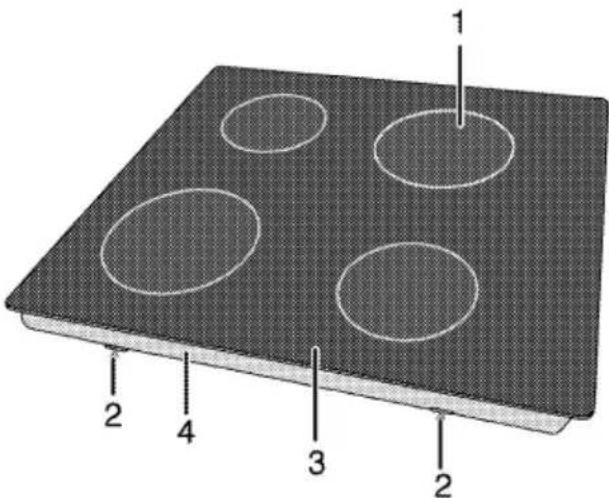
1 Induktionskochplatte
2 Montagekiemme
3 Getempertes Glas
4 Basisabdeckung
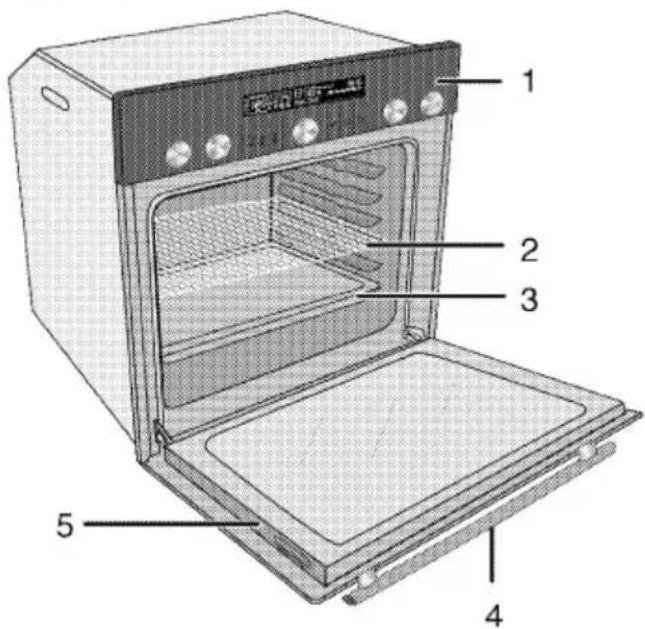
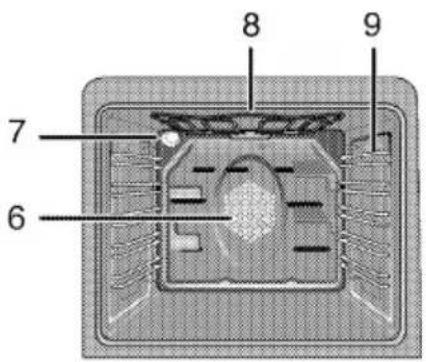
1 Bedienfeld
2 Gitterrost
3 Backblech
4 Griff
5 Backofentür
6 Lüftermotor (hinter der Metallplatte)
7 Beleuchtung
8 Oberes Heizelement
9 Einschubpositionen
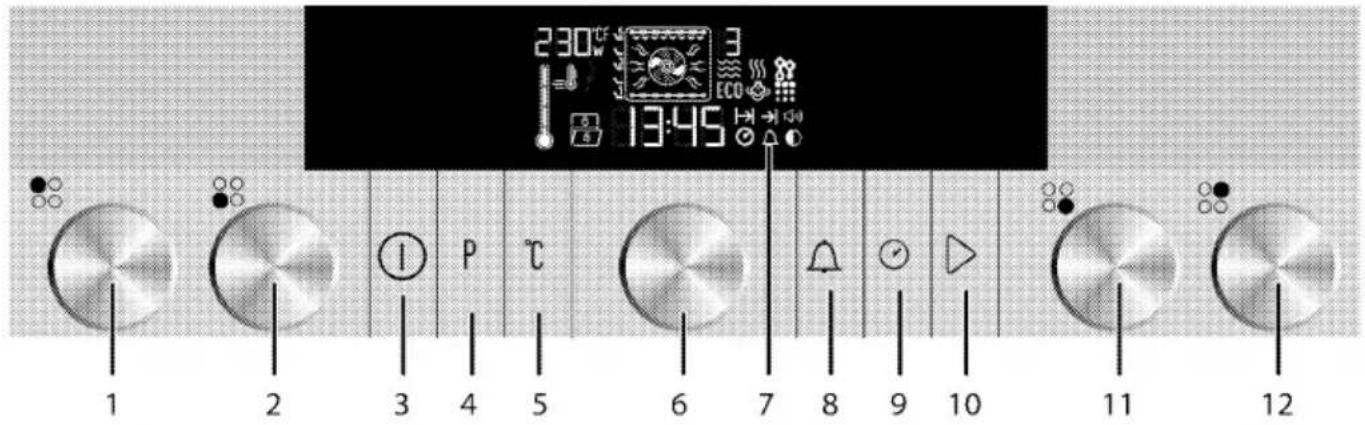
1 Induktionskochplatte Hinten links
2 Induktionskochplatte Vorne links
3 Ein-/Austaste
4 Zurück-Taste nach Funktionsanzeige
5 Drehknopf für Temperatur/Zeit erhöhen oder vermindern
6 Alarmtaste
7 Zeiteinstelltaste
8 Start-/Stoppiaste
9 Induktionskochplatte Vorne rechts
10 Induktionskochplatte Hinten rechts
Technische Daten
| ALLGEMEIN | |
| Spannung/Frequenz | 220-240 V / 380-415 V 3N ~ 50 Hz |
| Leistungsaufnahme gesamt | max. 10.3 kW |
| Sicherung | Minimum 32 A / 3 x 16 A |
| Kabeltyp/Kabelquerschnitt | H05VV-FG 3 × 4 mm^2 / 5 × 1,5 mm^2 |
| Kabellänge | max. 2 m |
| KOCHFELD | |
| Außenabmessungen (Höhe/Breite/Tiefe) | 43 mm/580 mm/510 mm |
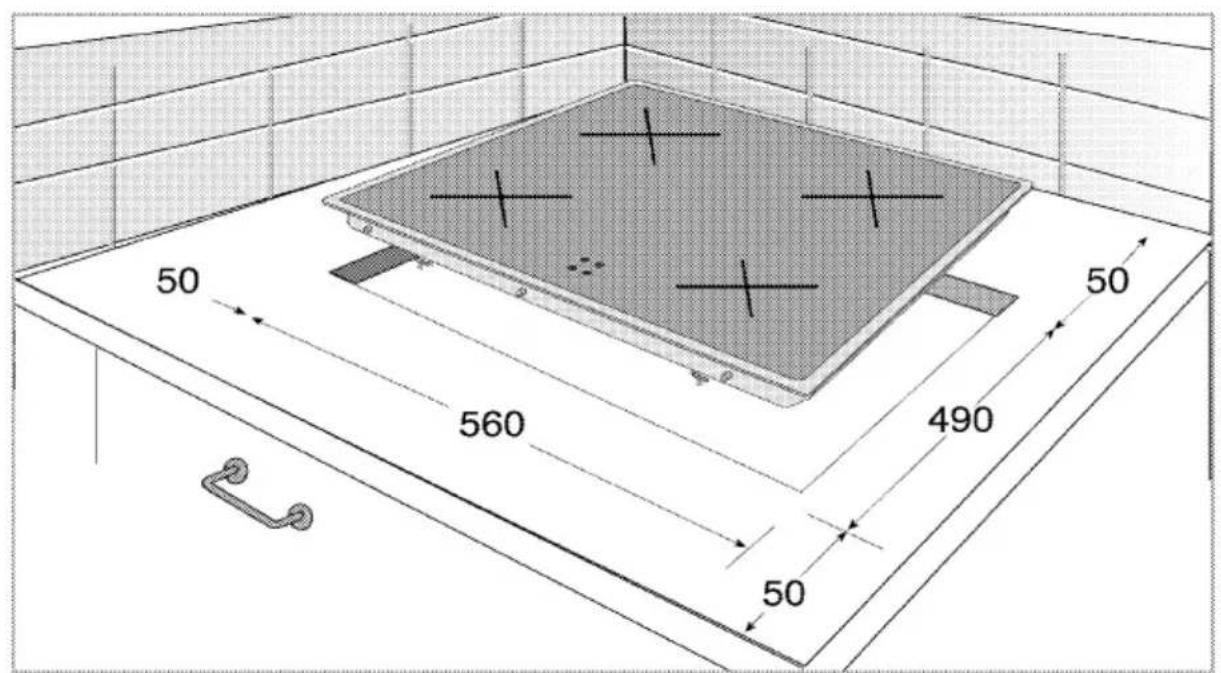
| Einbaumaße (Breite/Tiefe) | 560 mm/490 mm |
| Kochzonen | |
| Hinten links | Induktionskochplatte |
| Abmessungen | 160 mm |
| Leistung | 1400 W |
| Vorne links | Induktionskochplatte |
| Abmessungen | 200 mm |
| Leistung | 2300/3000 W |
| Vorne rechts | Induktionskochplatte |
| Abmessungen | 160mm |
| Leistung | 1400 W |
| Hinten rechts | Induktionskochplatte |
| Abmessungen | 200 mm |
| Leistung | 2300/3000 W |
| BACKOFEN/GRILL | |
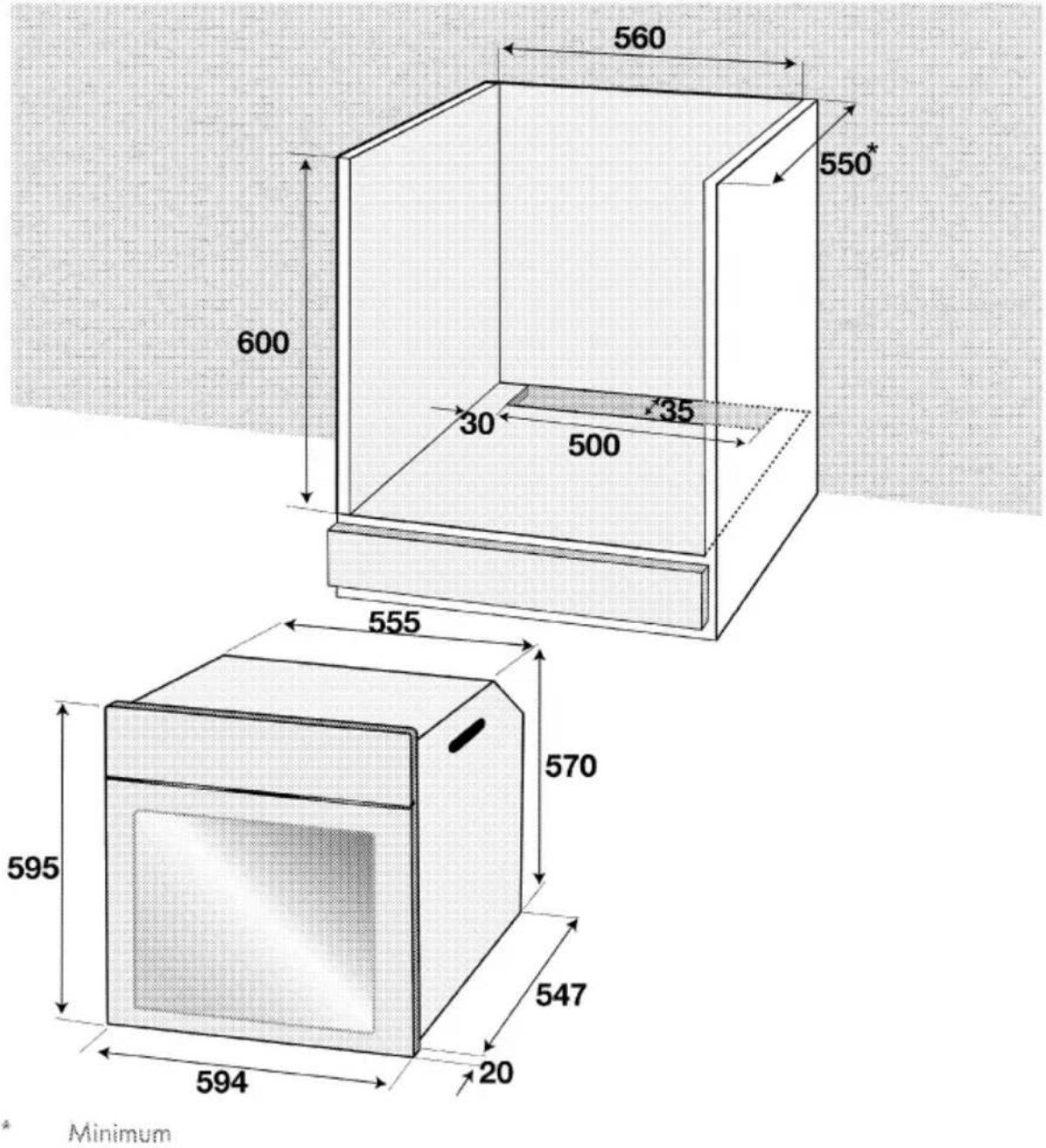
| Außenabmessungen (Höhe/Breite/Tiefe) | 595 mm/594 mm/567 mm |
| Einbaumaße (Höhe/Breite/Tiefe) | **590 oder 600 mm/560 mm/Minimum 550 mm |
| Hauptofen | Multifunktionsofen |
| Energieeffizienzklasse* | A |
| Garraumleuchte | 15/25 W |
| Leistungsaufnahme Grill | 2.2 kW |
# Allgemeine Hinweise: Energieangaben von Elektroöfen werden gemäß der Richtlinie EN 50304 ermittelt. Die entsprechenden Werte werden unter üblichen Einsatzbedingungen bei Ober-/Unterhitze oder im Umluftbetrieb (sofern vorhanden) ermittelt.
Die Energieeffizienzklasse wird gemäß Funktion ermittelt: Garen mit Eco-Umluft.

Im Zuge der Qualitätsverbesserung können sich technische Daten ohne Vorankündigung ändern.

Die Abbildungen in dieser Anleitung dienen lediglich der Veranschaulichung und können etwas vom tatsächlichen Aussehen des Gerätes abweichen.

Angaben am Produkt oder in der begleitenden Dokumentation wurden unter Laborbedingungen unter Berücksichtigung der zutreffenden Richtlinien ermittelt. Solche Werte können je nach Einsatzumgebung und Nutzungsweise des Gerätes abweichen.
Lieferumfang

Je nach Modell wird eventuell unterschiedliches Zubehör mitgeliefert. Daher kann es vorkommen, dass nicht sämtliches in der Anleitung erwähntes Zubehör mit Ihrem Gerät geliefert wird.
1. Bedienungsanleitung
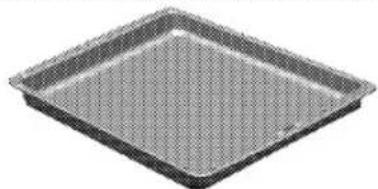
2. Backblech
Für Backwaren, Tiefkühlgerichte und große Braten.
natural_image
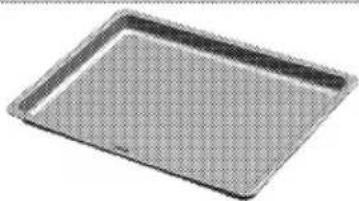
Exterior view of a square baking tray with a perforated inner surface (no text or symbols)3. Kuchenblech
Für Gebäck wie Kekse, Biskuits und Kuchen.
natural_image
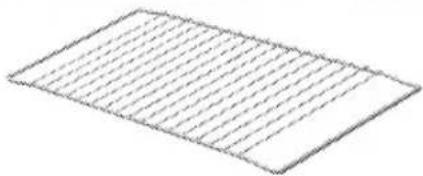
Exterior view of a rectangular baking tray with a grid pattern (no text or symbols)4. Gitterrost
Zum Rösten und Grillen und als Unterlage für Behälter, in denen unterschiedlichste Lebensmittel gegart werden können.
natural_image
Pure geometric diagram of a rectangular plate with diagonal lines, no text or symbols present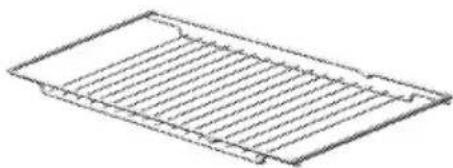
natural_image
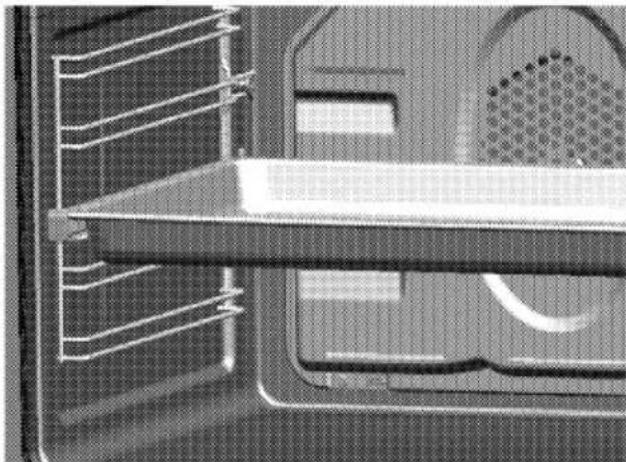
Isometric line drawing of a rectangular metal grate or rack structure (no text or symbols)5. Gitterrost und Backblech richtig in die Teleskopeinschübe einschieben
Durch die Teleskopeinschübe lassen sich Bleche und Rost besonders leicht einlegen und entfernen.
Achten Sie beim Einsatz von Backblech und Gitterrost mit den
Teleskopeinschüben darauf, dass die Stifte am rückwärtigen Teil des
Teleskopeinschubs die Kanten von Backblech und Gitterrost berühren
natural_image
Close-up of a mechanical component with internal channels and a textured surface (no visible text or symbols)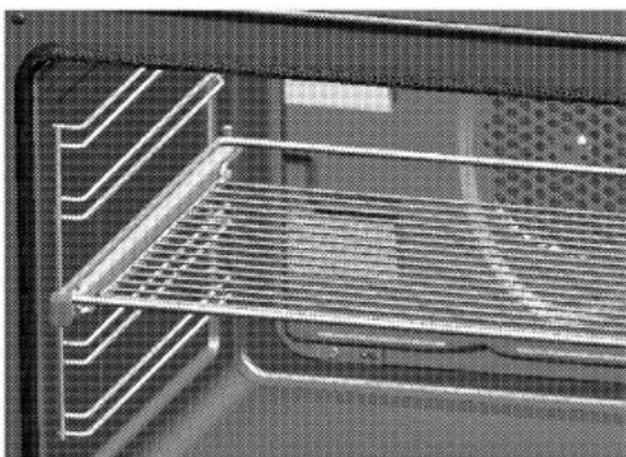
natural_image
Interior view of an oven with metal grating and ventilation grilles (no text or symbols visible)3 Installation
Gerät vom nächstgelegenen autorisierten Kundendienst gemäß gültigen Bestimmungen installieren lassen. Andernfalls erlischt die Garantie. Der Hersteller haftet nicht für Schäden, die durch Aktivitäten nicht autorisierter Personen entstehen; zudem kann dadurch die Garantie erlöschen.

Die Vorbereitung des Aufstellungsortes und der elektrischen und Anschlüsse sind Sache des Kunden.
GEFAHR:
Die Installation des Gerätes muss in Übereinstimmung mit sämtlichen zutreffenden Vorschriften zur Elektroinstallation erfolgen.
GEFAHR:
Gerät vor der Installation auf eventuelle, sichtbare Defekte untersuchen. Falls Defekte vorliegen, darf das Gerät nicht installiert werden. Beschädigte Geräte müssen grundsätzlich als Sicherheitsrisiko betrachtet werden.
Vor der Installation
Die Geräte sind für den Einbau in handelsübliche Küchenmöbel vorgesehen. Zwischen Gerät und angrenzenden Küchenwänden und -möbeln muss ein Sicherheitsabstand verbleiben. Siehe Abbildung auf der nächsten Seite (Angaben in mm)..
-
Der Ofen kann auch freistehend benutzt werden. Achten Sie auf einen minimalen Abstand von 750 mm oberhalb des Kochfeldes.
• (*) Wenn eine Dunstabzugshaube über dem Herd installiert werden soll, beachten Sie die Anweisungen des Herstellers zur Installationshöhe (mindestens 650 mm Abstand).
• Verpackungsmaterial und Transportsicherungen entfernen. -
Oberflächen, Kunststoffbeläge und verwendete Kleber müssen hitzebeständig sein (bis mindestens 100 °C).
• Das Kochfeld wird für die Stromversorgung mit dem Backofen verbunden. Beide Geräte müssen dazu übereinander eingebaut werden.
• Die Küchenarbeitsplatte entsprechend den Einbaumaßen ausschneiden.
• Die Schnittflächen versiegeln und Abschlusskanten abdichten. - Küchenarbeitsplatte und Küchenmöbel müssen waagerecht ausgerichtet und fixiert sein.
• Das Kochfeld darf nur mit einer Gerätekante neben höheren Küchenmöbeln, Geräten oder Wänden eingebaut werden. - Zwischen Backofenrückwand und Küchenwand muss für die Luftzirkulation ein Abstand bleiben.
- Befindet sich unter dem Backofen eine Schublade, muss zwischen Backofen und Schublade ein Trennboden eingesetzt werden.
- Tragen Sie das Gerät grundsätzlich mit mindestens zwei Personen.

Stellen Sie das Gerät nicht neben Kühl- oder Gefriergeräten auf. Die Wärmeabgabe des Gerätes führt zu steigendem Energieverbrauch der Kühlgeräte.

Missbrauchen Sie die Tür/den Türgriff nicht zum Anheben oder Bewegen des Gerätes.

Bei Geräten mit Drahtgriffen schieben Sie die Griffe nach dem Transport des Gerätes wieder in die Seitenwände zurück.
Einbauen und Anschließen
• Die Installation des Gerätes muss in Übereinstimmung mit sämtlichen zutreffenden Vorschriften zur Gas- und Elektroinstallation erfolgen.

Stellen Sie den Herd nicht in der Nähe von scharfen Ecken oder Kanten auf. Glaskeramik kann bei unsachgemäßer Handhabung brechen!
Elektrischer Anschluss
Schließen Sie das Gerät an eine geerdete Schutzkontaktsteckdose/Leitung an, die mit einer Sicherung passender Stromstärke abgesichert wird, siehe dazu den Abschnitt „Technische Daten“. Lassen Sie die Erdung in jedem Fall von einem qualifizierten Elektriker vornehmen oder überprüfen. Der Hersteller haftet nicht bei Schäden, die durch den Einsatz des Gerätes ohne vorschriftsmäßige Erdung entstehen.
GEFAHR:
Das Gerät darf nur von einer autorisierten Fachkraft an das Stromnetz angeschlossen werden. Die Garantiezeit beginnt erst mit der fachgerechten Installation. Der Hersteller haftet nicht für Schäden, die durch Aktivitäten nicht autorisierter Dritter entstehen.
GEFAHR:
Das Netzkabel darf nicht eingeklemmt, geknickt oder gequetscht werden und darf nicht mit heißen Geräteteilen in Berührung kommen. Beschädigte Netzkabel müssen durch einen zugelassenen Elektriker ausgetauscht werden. Andernfalls kann es zu Stromschlägen, Kurzschlüssen und Bränden kommen!
• Der Anschluss muss gemäß nationalen Richtlinien erfolgen.
• Die Netzanschlussdaten müssen mit den Daten auf dem Typenschild des Gerätes übereinstimmen. Das Typenschild finden
Sie nach Öffnen der Ofentür an der Unterseite des Gerätes.
• Die Netzanschlussdaten müssen mit den Daten auf dem Typenschild des Gerätes übereinstimmen. Das Typenschild befindet sich an der Rückseite des Gerätes.
- Verwenden Sie nur Netzkabel, die den Angaben im Abschnitt „Technische Daten“ entsprechen.
GEFAHR:
Trennen Sie das Gerät vollständig von der Stromversorgung, bevor Sie mit der Elektroinstallation beginnen. Es besteht Stromschlaggefahr!
Netzkabel anschließen
- Falls bei Ihrem Produkt kein Netzkabel mitgeliefert wurde, wählen Sie bitte entsprechend der Elektroinstallation bei Ihnen zuhause ein Netzkabel aus der Tabelle(Technische Daten, Seite 11); befolgen Sie zum Anschließen Ihres Produktes die Anweisungen im Kabeldiagramm. Falls der Netzanschluss nicht vollständig getrennt werden kann, muss ein Trennschalter (Sicherung, Netzschalter oder dergleichen) mit mindestens 3 mm Kontaktabstand zwischengeschaltet werden. Die einschlägigen Installationsvorschriften (in Deutschland VDE 0100) sind dabei einzuhalten. Bei Nichtbeachtung kann es zu Betriebsstörungen und zum Erlöschen der Garantie kommen.

Wir empfehlen eine zusätzliche Absicherung mit einem Fehlerstromschutzschalter (Fl-Schuizschalter).
- Öffnen Sie die Anschlussabdeckung mit einem Schraubendreher.
- Stecken Sie das Netzkabel durch die Kabelklemme unter dem Anschluss; befestigen Sie es mit der an der
Kabelklemmkomponente integrierten Schraube am Hauptgerät.
- Schließen Sie die Kabel gemäß Abbildung an.
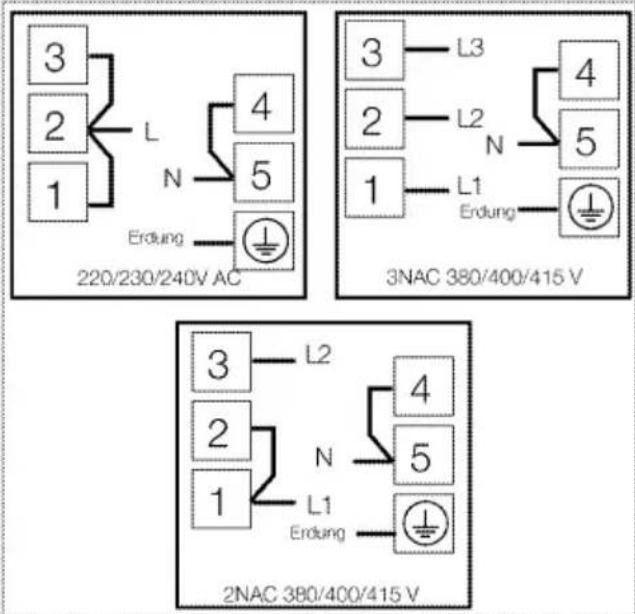
- Nach Abschluss der Verkabelung schließen Sie die Anschlussabdeckung.
- Verlegen Sie das Netzkabel so, dass es weder das Produkt berührt noch zwischen Produkt und Wand eingeklemmt wird.

Die Länge des Netzkabels darf aus Sicherheitsgründen nicht mehr als 2 m betragen.
Gerät installieren

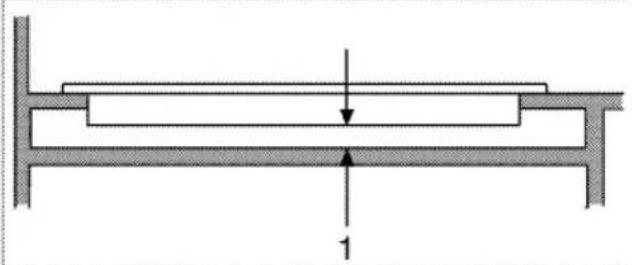
Wenn Sie die Unterseite des Produktes berühren können, da dieses über einer Schublade installiert ist, muss dieser Bereich mit einer Holzplatte abgedeckt werden.
natural_image
Pure mechanical diagram showing a beam supported by two supports with a central load, no text or symbols present.1 Minimum 25mm

Bei der Installation des Kochfeldes in einem Möbel muss ein Einlegeboden installiert werden, damit das Möbel vom Kochfeld getrennt wird (vgl. Abbildung oben). Dies ist bei der Installation eines integrierten Ofens nicht erforderlich.
Wenn sich der Ofen darunter befindet:
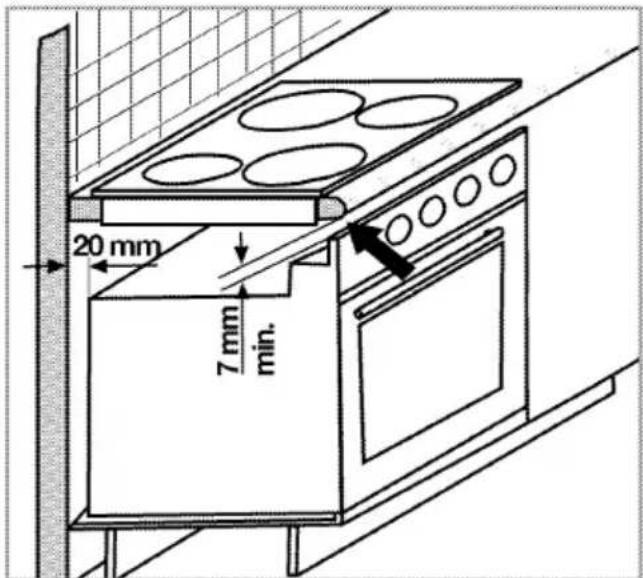
* Minimum
Beachten Sie eine Belüftungsöffnung von mindestens 180 cm ^2 im hinteren Bereich des Möbels (vgl. nachstehende Abbildung).
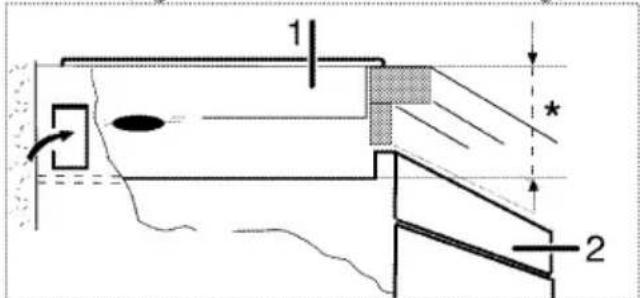
* Minimum 25 mm
Wenn sich ein Brett darunter befindet:
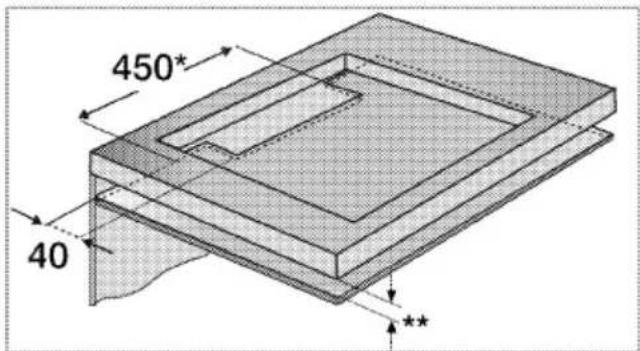
* Minimum
** Minimum 25 mm
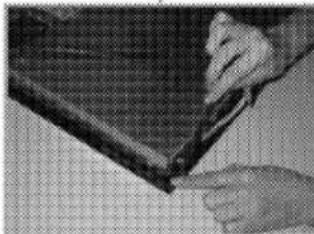
Platzieren Sie Ihr Induktionskochfeld während der Installation parallel zur Installationsfläche. Tragen Sie zudem die Dichtung auf die Teile des Kochfelds auf, welche die Arbeitsplatte berühren (vgl. nachstehende Beschreibung); dadurch verhindern Sie, dass Flüssigkeiten zwischen Produkt und Arbeitsplatte eindringen.
- Bereiten Sie die Oberfläche der Arbeitsplatte wie abgebildet vor.
- Tragen Sie die beim Produkt mitgelieferte Dichtung an den Kanten des unteren Kochfeldgehäuses auf, welche die Arbeitsplatte berühren (vgl. Abbildung).
natural_image
Close-up of hands holding a pen or tool, partially visible against a plain background (no text or symbols)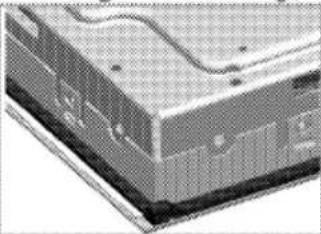
natural_image
Close-up of a mechanical component with textured surfaces and mounting holes (no visible text or symbols)-
Zentrieren Sie das Produkt auf der Arbeitsplatte.
-
Fixieren Sie das Kochfeld durch die Aussparungen im Unterteil hindurch mit den Montageklemmen.
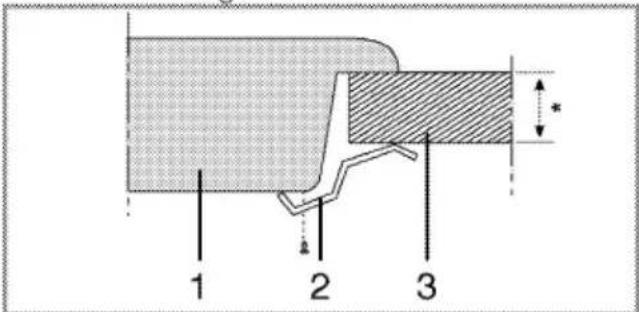
* Minimum 30 mm
1 Kochfeld
2 Montageklemme
3 Arbeitsplatte
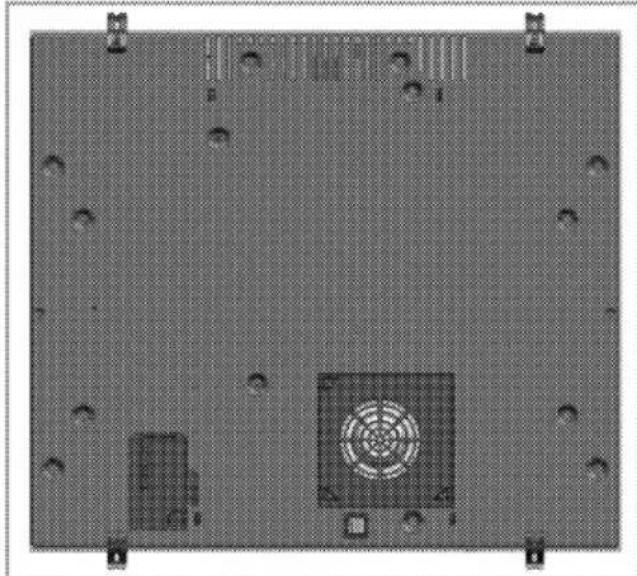
» Rear view (connection holes)
natural_image
Top-down view of a microchip or integrated circuit board with two square components and circular holes (no text or symbols visible)
Der Anschluss über mehrere Öffnungen sollte vermieden werden, da es unter Umständen zu Beschädigungen des Gas- und elektrischen Systems kommen kann.
- Befestigen Sie das Kochfeld.
- Stellen Sie die Ofenanschlüsse her.
- Schieben Sie den Ofen zur Hälfte in das Möbel.
- Verbinden Sie Kochfeld und Backofen.
» The product has three type cables;
» Power cable (5)
» Communication cable (4)
» Ground cable (Green/yellow) = (E)
(3) Connections of cables are shown as in the following picture.
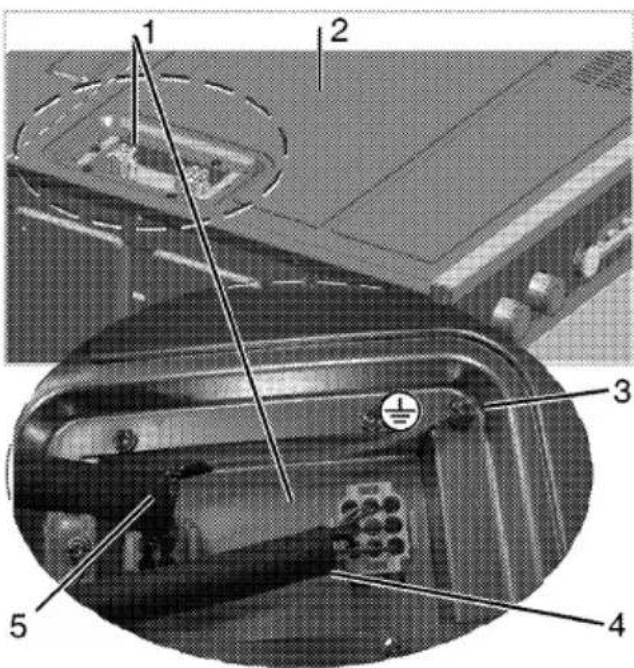
1 Terminal Block
2 Oven top Wall
3 (E) Ground
4 Communication cable
5 Power cable

Before power cable (5) connection, the hob must be connected to the earth with Green/Yellow cable (3) on Terminal Block. (1).
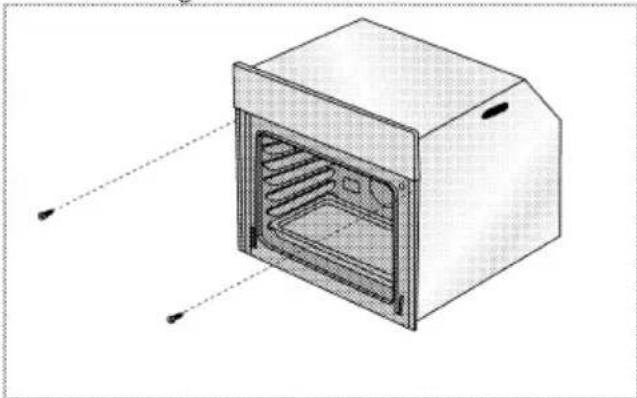
- Schieben Sie den Ofen in das Möbel ein, richten Sie ihn richtig aus und fixieren Sie ihn - achten Sie dabei unbedingt darauf, dass das Netzkabel nicht beschädigt oder eingeklemmt wird.
natural_image
Isometric line drawing of a microwave oven with internal grating and ventilation slots (no text or labels)Fixieren Sie den Backofen wie in der Abbildung gezeigt mit zwei Schrauben.
Bei Geräten mit Lüfter
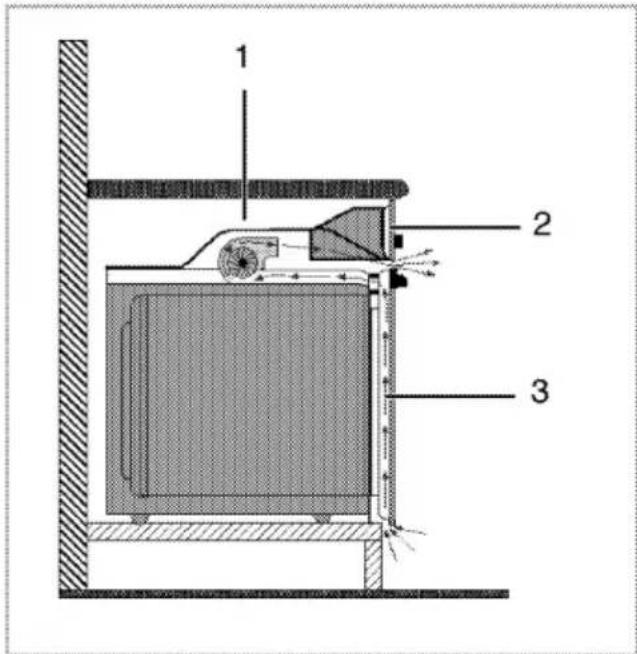
1 Lüfter
2 Bedienfeld
3 Tür
Der integrierte Lüfter kühlt den Einbauschrank und die Vorderseite des Gerätes.

Der Kühlungslüfter läuft auch nach dem Abschalten des Backofens noch etwa 20 bis 30 Minuten lang nach. Wenn Sie Lebensmittel Timerprogrammiert zubereiten, schaltet sich gemeinsam mit den restlichen Funktioner auch der Lüfter zum Ende der Garzeit ab.
Endkontrolle
- Schalten Sie die entsprechende Sicherung ein.
- Prüfen Sie die Funktion.
Transport
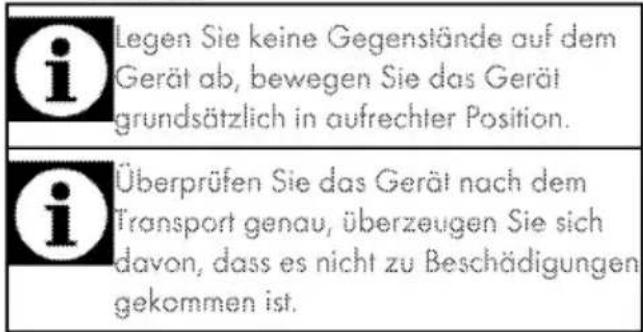
- Bewahren Sie den Originalkarton auf, falls Sie das Gerät künftig transportieren müssen. Halten Sie sich an die Hinweise auf dem Karton. Falls Sie den Originalkarton nicht mehr besitzen sollten, verpacken Sie das Gerät in Luftpolsterfolie oder starken Karton, anschließend gut mit Klebeband sichern.
- Damit Gitterroste und Bleche nicht zu Beschädigungen der Ofentür führen, schützen Sie die Ofentür von innen mit
einem passenden Stück Karton. Fixieren Sie die Ofentür mit Klebeband.
- Verwenden Sie die Tür/den Türgriff nicht zum Anheben oder Bewegen des Gerätes.
4 Vorbereitungen
Tipps zum Energiesparen
Mit den folgenden Hinweisen nutzen Sie Ihr Gerät umweltbewusst und energiesparend:
- Verwenden Sie am besten dunkles oder emailliertes Kochgeschirr – dies leitet die Wärme besser.
- Lassen Sie den Backofen vorheizen, wenn dies durch Bedienungs- oder Zubereitungsanleitung empfohlen wird.
- Verzichten Sie bei der Zubereitung auf häufiges Öffnen der Backofentür.
- Bereiten Sie mehrere Gerichte gleichzeitig zu, sofern dies möglich ist. Dazu stellen Sie einfach mehrere Behälter auf den Gitterrost.
- Größere Gerichte und solche, deren Geschmack sich nicht gegenseitig beeinflussen soll, bereiten Sie nacheinander zu. Der Backofen ist dann bereits vorgeheizt.
- Sie können zusätzliche Energie sparen, indem Sie den Backofen ein paar Minuten vor Ende der Garzeit bereits abschalten. Verzichten Sie während der Zubereitung möglichst auf ein Öffnen der Backofentür.
• Tauen Sie gefrorene Gerichte vor der Zubereitung auf.
- Kochen Sie mit Deckel. Beim Kochen ohne Deckel kann der Energieverbrauch auf das Vierfache ansteigen.
- Wählen Sie stets die zum Bodendurchmesser des Kochgeschirrs passende Kochstelle. Entscheiden Sie sich immer für Kochgeschirr in der passenden Größe. Größeres Kochgeschirr verbraucht mehr Energie.
- Achten Sie darauf, beim Kochen mit Elektroherden grundsätzlich Kochgeschirr mit flachem Boden zu verwenden.
Kochgeschirr mit dickem Boden leitet die Wärme besser und speichert diese eine Weile. Auf diese Weise können Sie bis zu ein Drittel Energie einsparen.
• Die Größe des Kochgeschirrs muss grundsätzlich zur Kochzone passen. Der Boden des Kochgeschirrs darf nicht kleiner als die Kochstelle sein. - Halten Sie das Kochfeld und den Boden des Kochgeschirrs sauber. Verschmutzungen verschlechtern die Wärmeübertragung zwischen Kochfeld und Kochgeschirrboden.
Erste Inbetriebnahme Uhrzeit

Die Uhrzeit muss eingestellt werden, bevor Sie den Backofen benuizen können. Der Backofen arbeitet erst nach dem Einstellen der Uhrzeit.
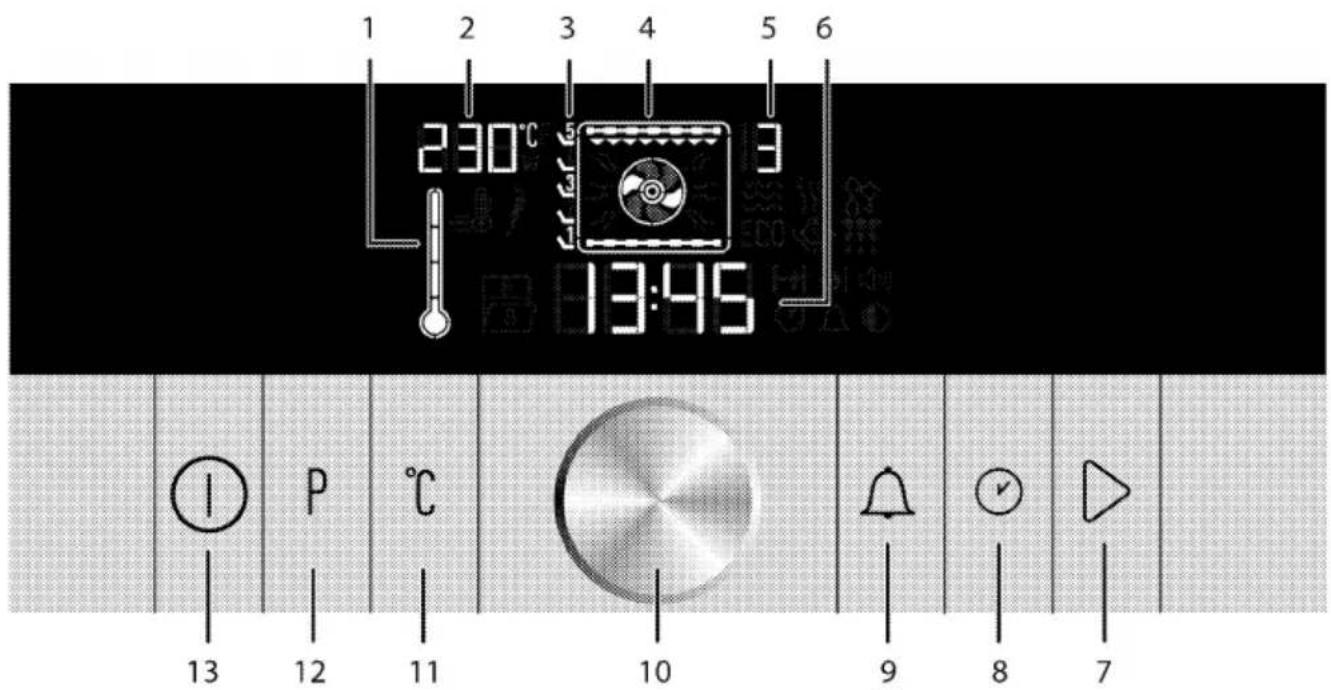
1 Temperatursymbol
2 Temperaturanzeige
3 Einschubpositionen
4 Funktionsanzeige
5 Funktionsnummer
6 Uhrzeitanzeige
7 Start-/Stopptaste
8 Zeiteinstelltaste
9 Alarmtaste
10 Drehknopf für Temperatur/Zeit erhöhen oder vermindern
11 Temperatur- und Schnellheiztaste
12 Zurück-Taste nach Funktionsanzeige
13 Ein-/Austaste
Zeit einstellen
00:00
- Netzkabel anschließen und die entsprechende Sicherung einschalten.
- In der Anzeige erscheint "00.00", das Symbol ⚙ blinkt in der Anzeige. Stunde mit dem Drehknopf einstellen.
- Zum Aktivieren des Minutenwertes die ✅-Taste berühren. Die Minute und das
Symbol ⚙ blinken in der Anzeige. Minute mit dem Drehknopf einstellen.
- Zum Bestätigen der Einstellung berühren.
» Die Bereitschaftsanzeige erscheint und die aktuelle Uhrzeit wird angezeigt.
10:08

Nach Stromausfällen oder wenn der Netzstecker gezogen und wieder eingesteckt wurde, wird das Menü zur Zeiteinstellung erneut angezeigt. Die eingestellte Tageszeit wird bei kurzen Stromausfällen beibehalten. In diesem Fall kann die Zeiteinstellung einfach bestätigt und damit übernommen werden.
Erstreinigung des Gerätes

Durch bestimmte Reinigungsmittel können die Oberflächen des Gerätes beschädigt werden. Verwenden Sie keine aggressiven Reinigungsmittel, keine Scheuermittel und keine scharfen oder spitzen Gegenstände bei der Reinigung.
- Entfernen Sie sämtliches Verpackungsmaterial.
- Geräteoberflächen mit einem feuchten Tuch oder Schwamm abwischen und mit einem Tuch trocknen.
Erstaufheizung
Lassen Sie das Gerät etwa 30 Minuten lang aufheizen, schalten Sie es anschließend ab. Auf diese Weise werden sämtliche Rückstände und Beschichtungen entfernt.
WARNUNG
Verbrennungsgefahr durch heiße flächen!
Das Gerät kann sich im Betrieb stark aufheizen. Berührung Sie niemals heiße Brenner, das Innere des Backofens, Heizelemente und so weiter. Halten Sie Kinder fern.
Tragen Sie grundsätzlich hitzebeständige Schutzhandschuhe, wenn Sie etwas in den Backofen stellen oder herausnehmen.
Backofen-Funktion
-
Nehmen Sie sämtliches Zubehör (z. B. Backbleche und Gitterrost) aus dem Backofen heraus.
-
Schließen Sie die Backofentür.
-
Wählen Sie die Einstellung „Ober- und Unterhitze“.
- Wählen Sie die höchste Backofentemperatur.
- Lassen Sie den Backofen etwa 30 Minuten lang heizen.
- Schalten Sie den Backofen ab.
Grill-Funktion
- Nehmen Sie sämtliches Zubehör (z. B. Backbleche und Gitterrost) aus dem Backofen heraus.
- Schließen Sie die Backofentür.
- Wählen Sie die Einstellung „Grill, groß“.
- Wählen Sie die höchste Temperatureinstellung; siehe "So bedienen Sie den Grill, Seite 42".
- Lassen Sie den Grill etwa 30 Minuten lang heizen.
- Schalten Sie den Grill ab; siehe "So bedienen Sie den Grill, Seite 42"

Bei der ersten Inbetriebnahme kann es über mehrere Stunden zu Rauch- und Geruchsentwicklung kommen. Dies ist völlig normal. Lüften Sie den Raum gut durch, damit Rauch und Gerüche schnell abziehen können. Atmen Sie die Dämpfe möglichst nicht ein.
5 Bedienung Kochfeld
Allgemeine Hinweise zum Kochen
Füllen Sie Kochgeschirr maximal bis zu einem Drittel mit Öl. Lassen Sie das Kochfeld niemals unbeaufsichtigt, wenn Sie mit heißem Öl arbeiten. Überhitzte Öle und Fette können Brände verursachen. Versuchen Sie niemals, vorher mit Wasser zu löschen! Falls Öle oder Fette Feuer fangen, ersticken Sie die Flammen mit einer Löschdecke, notfalls mit einem leicht feuchten Tuch. Trennen Sie den Herd von der Stromversorgung, falls dies gefahrlos möglich ist, rufen Sie die Feuerwehr.
- Vor dem Frittieren trocknen Sie die Lebensmittel gründlich und lassen sie langsam in das heiße Öl hinab. Achten Sie darauf, dass gefrorene Lebensmittel vor dem Frittieren restlos aufgetaut sind.
- Decken Sie das Kochgeschirr beim Frittieren nicht ab.
- Platzieren Sie das Kochgeschirr so auf dem Kochfeld, dass dessen Griffe oder Stiele nicht von anderen Kochstellen erhitzt werden. Stellen Sie keine Behälter auf das Kochfeld, die zum Kippen neigen.
- Stellen Sie kein leeres Kochgeschirr auf eingeschaltete Kochzonen. Es kann zu Beschädigungen kommen.
- Wenn Sie eine Kochzone verwenden, ohne Kochgeschirr darauf zu platzieren, verursacht dies Schäden am Gerät. Schalten Sie die Kochzonen nach dem Gebrauch aus.
• Da sich die Oberfläche des Gerätes erhitzt, legen Sie niemals Gegenstände aus Kunststoff oder Aluminium darauf ab.
Entfernen Sie geschmolzene Rückstände solcher Materialien sofort von der Oberfläche.
* Übrigens sollten Lebensmittel grundsätzlich nicht in solchen Gefäßen gelagert werden.
- Verwenden Sie ausschließlich Kochgeschirr mit flachem Boden.
- Geben Sie die richtige Menge an Lebensmitteln in das jeweilige Kochgeschirr; nicht überfüllen. Dadurch ersparen Sie sich unnötige Reinigungsarbeit durch überlaufende Speisen.
* Legen Sie die Deckel des Kochgeschirrs nicht auf den Kochzonen ab.
* Stellen Sie Kochgeschirr so auf das Kochfeld, dass es exakt in der Mitte der Kochzone steht. Wenn Sie Kochgeschirr von einer Kochzone zur nächsten bewegen möchten, heben Sie das Kochgeschirr an, anstatt es über das Kochfeld zu schieben.
Kochgeschirr wählen
- Glaskeramik ist hitzefest und beständig gegen starke Temperaturdifferenzen.
- Missbrauchen Sie die Glaskeramik nicht als Ablage oder als Schneidbrett.
- Verwenden Sie ausschließlich Kochgeschirr mit entsprechend bearbeitetem Boden. Scharfe Kanten verursachen Kratzer auf der Oberfläche.
natural_image
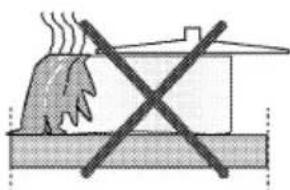
Diagram showing a hand holding a chimney above a structure with crossed-out X marks (no text or symbols)Überlaufende Speisen können die Glaskeramik beschädigen und Brände verursachen.
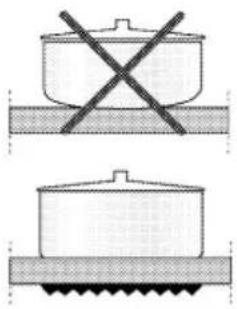
natural_image
Two identical diagrams of a cooking pot with crossed x marks above and below, placed on a surface (no text or symbols)Kein Kochgeschirr mit gewölbtem Boden verwenden.
Ausschließlich Kochgeschirr mit ebenem Boden verwenden. Dadurch wird die Hitze optimal übertragen.
Verwenden Sie bei Induktionsherden nur Kochgeschirr, das zum Kochen mit Induktion geeignet ist. Kochgeschirr testen
Prüfen Sie anhand folgender Methoden, ob Ihr Kochgeschirr mit dem Induktionsherd kompatibel ist.
- Ihr Kochgeschirr ist kompatibel, wenn an dessen Unterseite ein Magnet haften bleibt.
- Ihr Kochgeschirr ist kompatibel, wenn nicht blinkt, sobald Sie Ihr Kochgeschirr auf der Kochzone abstellen und den Herd einschalten.
Sie können Kochgeschirr aus Stahl, Teflon oder Aluminium mit spezieller magnetischer Unterseite verwenden, an denen sich Angaben bzw. Warnungen befinden, die darauf hinweisen, dass das Kochgeschirr zum Kochen mit Induktion eingesetzt werden kann. Glas- und Keramikkochgeschirr sowie Töpfe und Edelstahlkochgeschirr ohne magnetische Aluminiumunterseite sollten nicht verwendet werden.
Kochgeschirrerkennungssystem
Beim Kochen mit Induktion wird nur der Bereich aktiviert, der auf der entsprechenden Kochzone durch das Kochgeschirr abgedeckt ist. Der Unterseite des Kochgeschirrs wird vom System erkannt; ausschließlich dieser Bereich wird automatisch erhitzt. Die Kochzone wird deaktiviert, sobald das Kochgeschirr von der Kochzone heruntergenommen wird. Die ausgewählte Kochzone und das -Symbol blinken abwechselnd.
Sichere Benutzung
Wählen Sie keine hohen Temperaturenstufen, wenn Sie ein antihaftbeschichtetes (Teflon) Kochgeschirr ohne bzw. mit nur wenig Öl verwenden.
Platzieren Sie keine metallischen Gegenstände, wie z. B. Gabeln, Messer oder Deckel von Kochgeschirr auf der Kochstelle; andernfalls werden diese erhitzt. Verwenden Sie zum Kochen keinesfalls Aluminiumfolie. Platzieren Sie niemals in Aluminiumfolie eingewickelte Lebensmittel auf der Kochzone.

Falls sich unter Ihrem Kochfeld ein Ofen befindet und dieser in Betrieb ist, können die Sensoren des Kochfeldes die Kochstufe verringern oder den Ofen ausschalten.

Halten Sie Gegenstände mit magnetischen Eigenschaften (z. B. Kreditkarten oder Kassetten) vom Kochfeld fern, solange dieses in Betrieb ist.
Kochzone passend zum Kochgeschirr wählen
| Große Kochzone | Normale Kochzone | Kleine Kochzone | |||
∅ 25 cm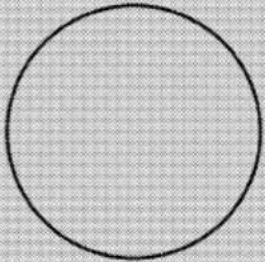 | ∅ 20 cm | ∅ 16 cm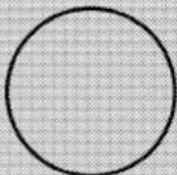 | |||
| Große KochzonePasst sich automatisch an das Kochgeschirran.Verteilt die Leistung ideal.Bietet perfekte Hitzeverteilung. Ideal zur Zubereitung von Gerichten, wie z. B. großen Pfannenkuchen, bzw. zum leichten Anbraten von großen Fischen. | Normale KochzonePasst sich automatisch an das Kochgeschirran.Verteilt die Leistung ideal.Bietet perfekte Hitzeverteilung. Ideal bei allerlei Gerichte. | Kleine KochzoneIdeal zum langsamen Erhitzen (Saucen, Rahmsaucen)Ideal zur Zubereitung kleiner Portionen bzw. einer geringen Anzahl an Portionen. |
Große Kochzone
• Passt sich automatisch an das Kochgeschirr an.
• Verteilt die Leistung ideal.
- Bietet perfekte Hitzeverteilung. Ideal zur Zubereitung von Gerichten, wie z. B. großen Pfannenkuchen, bzw. zum leichten Anbraten von großen Fischen.
Normale Kochzone
• Passt sich automatisch an das Kochgeschirr an.
• Verteilt die Leistung ideal.
• Bietet perfekte
Hitzeverteilung. Ideal
bei allerlei Gerichte.
Kleine Kochzone
- Ideal zum langsamen Erhitzen (Saucen, Rahmsaucen)
- Ideal zur Zubereitung kleiner Portionen bzw. einer geringen Anzahl an Portionen.
Kochfeld verwenden
GEFAHR:
lassen Sie keine Gegenstände auf das Kochfeld fallen. Selbst kleine Gegenstände wie Salzstreuer können das Kochfeld beschädigen. Verwenden Sie keine Kochfelder, die gesprungen sind. Durch die Sprünge kann Wasser eindringen und einen gehörigen Kurzschluss verursachen. Falls Sie Beschädigungen der Glaskeramik (z. B. sichtbare Sprünge) bemerken sollten, unterbrechen Sie sofort die Stromversorgung, damit es nicht zu Stromschlägen kommt.
Kochzonen abschalten:

Sämlliche Abbildungen dienen lediglich der Veranschaulichung. Das Aussehen Ihres Kochfeldes kann je nach Modell etwas abweichen..
Durch Drehen des Kochfeldknopfs im Uhrzeigersinn kann die Leistung der entsprechenden Kochzone erhöht werden. Wenn Sie die Leistung der Kochzone wieder reduzieren möchten, müssen Sie den Kochfeldknopf gegen den Uhrzeigersinn drehen. Die aktuelle Leistung wird am Display des Kochfeldes angezeigt.
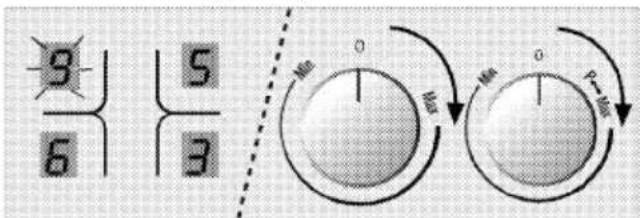
Kochzonen abschalten:
Wenn der Kochzonenknopf von der gesperrten „0“-Position auf eine andere Position gedreht wird, schaltet sich die Kochzone ein; schalten Sie die Kochzone aus, indem Sie den Kochzonenknopf wieder zurück auf die „0“-Position drehen.

Wenn sich alle Knöpfe in der „0“-Position befinden, schaltet sich das Display nach kurzer Zeit aus. Falls ein Summer implementiert ist, wird beim Abschalten ein Signalton ausgegeben.
Restwärmeanzeige
Das Symbol „H“ in der Kochzonenanzeige signalisiert, dass die jeweilige Kochstelle noch heiß ist und zum Warmhalten kleinerer Speisen verwendet werden kann. Das Symbol verschwindet, wenn die Kochzone ausreichend abgekühlt ist oder wieder eingeschaltet wird.

Bei unterbrochener Stromversorgung leuchtet die Restwärmeanzeige nicht, warnt also auch nicht vor heißen Kochstellen.
Hochleistung (Turbo)
Die Hochleistung-Funktion sorgt dafür, dass sich die Kochzonen besonders schnell aufheizen. Mit der Hochleistung-Funktion sind sämtliche Kochzonen ausgestattet, die in der Tabelle mit technischen Daten mit einem „P“ gekennzeichnet sind.
Hochleistung einschalten
- Drehen Sie den Kochzonenknopf im Uhrzeigersinn auf die „Max“-Position.
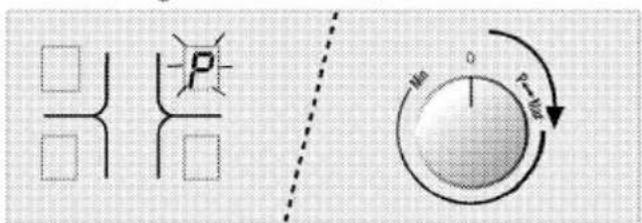
- Drehen Sie den Kochzonenknopf zur Aktivierung der Hochleistung-Funktion (Turbo, „P“) in die rechte
Überdrehposition. „P“ erscheint in der entsprechenden Kochzonenanzeige.

Das Kochfeld schaltet nach wenigen Minuten automatisch auf Stufe 9 zurück (optional).
Hochleistung abschalten:
Drehen Sie den Kochzonenknopf zum Abschalten der Hochleistung-Funktion (Turbo, „P“) in die rechte Überdrehposition. „9“ erscheint in der entsprechenden Kochzonenanzeige.
Kindersicherung
Sie können das Kochfeld sperren - beispielsweise, damit Kinder keine Funktionen im Betrieb verstellen können.
Kindersicherung einschalten
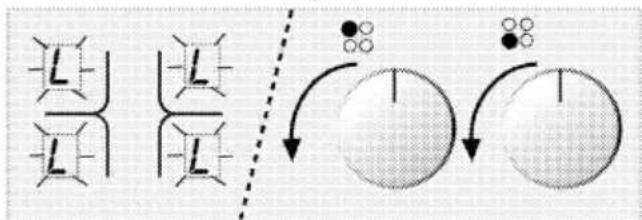
- Drehen Sie die ersten beiden Kochzonenknöpfe von links gleichzeitig in die linke Überdrehposition und halten sie mindestens 2 Sekunden in dieser Position.
» Die Kindersicherung wird aktiviert.
chemical
Diagram illustrating molecular interaction with a central atom and two molecules, showing structural changes and electron density distribution.
Falls bei aktiver Kindersicherung Tasten betätigt werden, erscheint das Symbol „L“ in der Kochzonenanzeige.
Kindersicherung abschalten
Drehen Sie die ersten beiden Kochzonenknöpfe von links gleichzeitig in die linke Überdrehposition und halten sie mindestens 2 Sekunden in dieser Position. Die Kindersicherung wird deaktiviert.

Falls das Kochfeld in dieser Situation aus- und wieder eingeschaltet wird, bleibt die Kindersicherung aktiv.

Falls sich ein Kochzonenknopf in einer anderen Position als „0“ befand, müssen nach der Freigabe alle Kochzonenknöpfe zurück in die „0“. Position gedreht werden.
Schnellheizen-Funktion
Die Schnellheizen-Funktion sorgt dafür, dass sich die Kochzonen besonders schnell aufheizen. Sämtliche Kochzonen sind mit der Schnellheizen-Funktion ausgestattet. Diese Funktion können Sie nutzen, indem Sie die gewünschte Leistungsstufe zuvor auswählen.
Schnellheizen-Funktion einschalten:
- Drehen Sie den entsprechenden Kochzonenknopf in die linke Überdrehposition und halten ihn mindestens 2 Sekunden in dieser Position. » „A“ erscheint in der entsprechenden Kochzonenanzeige.
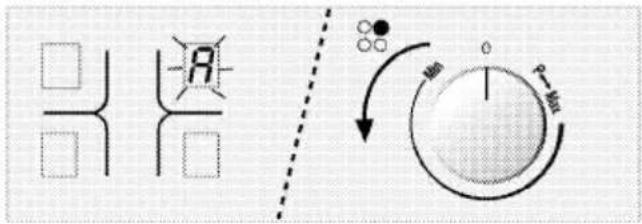
- Drehen Sie den Kochzonenknopf zum Einstellen der Temperaturstufe im Uhrzeigersinn (im Beispiel wird die Stufe 7 ausgewählt).
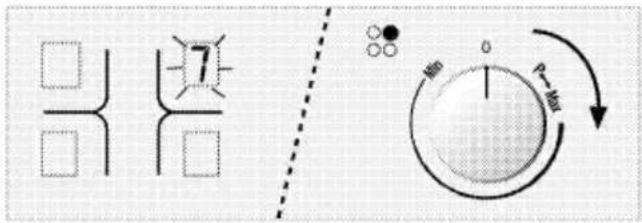
» „A“ und „7“ erscheinen gleichzeitig in der entsprechenden Kochzonenanzeige.

Innerhalb der nächsten 10 Sekunden muss eine gültige Temperaturstufe ausgewählt werden.

Wenn die Schnellheizen-Betriebszeit abgelaufen ist, setzt das Kochfeld den Betrieb bei der eingestellten Temperaturstufe fort.
Schnellheizen-Funktion abschalten:
Drehen Sie den Kochzonenknopf zum Abschalten der Schnellheizen-Funktion auf die gesperrte „O“-Position.
Tabelle: Schnellheizen-Betriebszeiten
| Temperaturstufe | Schnellheizen-Betriebszeiten in Sekunden |
| 0 | 0 |
| 1 | 48 |
| 2 | 144 |
| 3 | 230 |
| 4 | 312 |
| 5 | 408 |
| 6 | 120 |
| 7 | 168 |
| 8 | 216 |
Induktionskochzonen sicher und effizient verwenden
Funktionsweise: Als Merkmal seiner Funktionsweise erhitzt das Induktionskochfeld das Kochgeschirr selbst. Daher bietet es im Vergleich zu anderen Kochfeldarten verschiedene Vorteile. Es arbeitet effizienter und die Oberfläche des Kochfeldes erhitzt sich nicht.
Induktionskochfelder sind mit ausgezeichneten Sicherheitssystemen ausgestattet, die beim Einsatz maximale Sicherheit bieten.

Ihr Kochfeld ist je nach Modell mit Induktionskochzonen mit einem Durchmesser von 160, 200 und 250 mm ausgestattet. Per Induktion wird automatisch erkannt, auf welcher Kochzone Kochgeschirr platziert wurde. Energie wird nur dort erzeugt, wo das Kochgeschirr mit der Kochzone in Kontakt steht; dadurch wird ein minimaler Energieverbrauch gewährleistet.
Betriebszeitbegrenzung
Ihr Kochfeld ist mit einer praktischen Betriebszeitbegrenzung ausgestattet, die zur Sicherheit beiträgt und auch gehörig Energie sparen kann. Wenn Sie bei einer oder mehreren Kochzonen das Abschalten vergessen sollten, werden die Kochzonen nach Ablauf einer bestimmten Zeit (siehe Tabelle 1) automatisch abgeschaltet. Falls die Kochzone mit einem Timer arbeitet, wird auch die Timeranzeige mit abgeschaltet. Die Betriebszeitbegrenzung ist von der ausgewählten Temperaturstufe abhängig. Die maximale Betriebszeit wird bei dieser Temperaturstufe angewandt. Nachdem eine Kochzone auf diese Weise abgeschaltet wurde, kann sie natürlich auch wieder eingeschaltet werden.
Tabelle 1: Betriebszeitbegrenzungen
| Temperaturstufe | Betriebszeitbegrenzung in Minuten |
| 0 | 0 |
| 1 | 520 |
| 2 | 402 |
| 3 | 318 |
| 4 | 260 |
| 5 | 212 |
| 6 | 170 |
| 7 | 139 |
| 8 | 113 |
| 9 | 90 |
| Schnellheizen | 5 (*) |
| (*) Nach 5 Minuten schaltet das Kochfeld auf Stufe 9 zurück (optional). | |
Überhitzungsschutz
Ihr Kochfeld ist mit einigen Sensoren ausgestattet, die einen guten Schutz gegen Überhitzung bieten. Folgendes gilt bei Überhitzung:
- Aktive Kochzonen können abgeschaltet werden.
• Die Temperaturstufe kann verringert werden. Dies wird allerdings nicht angezeigt. - Der Fehlercode E2 kann ausgegeben werden.
Präzise Leistungseinstellungen
Ein Merkmal seiner Arbeitsweise ist, dass das Induktionskochfeld umgehend auf die Befehle reagiert. Es ändert die Leistungseinstellungen sehr schnell. Dadurch können Sie verhindern, dass Speisen in einem Kochgeschirr (Wasser, Milch etc.) überkochen; selbst wenn dies kurz bevorsteht.
Betriebsgeräusche
Das Induktionskochfeld gibt im Betrieb Geräusche aus. Diese Geräusche sind normal und beim Kochen mit Induktion typisch.
• Je höher die Temperatur, desto markanter das Geräusch.
• Die Legierung des Kochgeschirrs kann Geräusche verursachen.
• Aufgrund der Funktionsweise wird bei geringen Stufen ein reguläres Geräusch beim Ein-/Ausschalten ausgegeben.
- Wenn ein leeres Kochgeschirr erhitzt wird, kann dies Geräusche verursachen. Sobald Sie Wasser oder Lebensmittel hineingeben, verschwindet auch das Geräusch.
- Der Lüfter, der die Elektrik kühlt, gibt Geräusche aus.
Fehlermeldungen
Tabelle 2: Fehlermeldungen und Ursachen
| Fehlerursache | Fehlerursache | Anzeige |
| Überhitzung | "E2" Symbol blinkt | Zugehörige Kochzonenanzeige |
| Kochfeld überhitzt | "H" Symbol blinkt | Kochzonenanzeige |
| Netzstromfehler | "E6" Symbol blinkt | Kochzonenanzeige |
| Sensorfehler | "E9" Symbol blinkt | Zugehörige Kochzonenanzeige |
| Permanente Nutzung von Knöpfen | "-" Symbol blinkt | Kochzonenanzeige |

Weitere Hinweise zu möglichen Fehlermeldungen finden Sie in Tabelle 2.

Falls das Bedienfeld starkem Dampf ausgesetzt wird, kann sich das Bedienfeld abschalten, ein Fehlersignal erfönt.

Halten Sie die Oberfläche des Bedienfeldes sauber. Andernfalls kann es zu Funktionsstörungen kommen.
6 Bedienung des Backofens
Allgemeine Hinweise zum Backen, Braten und Grillen
WARNUNG
Verbrennungsgefahr durch heiße Flächen!
Das Gerät kann sich im Betrieb stark aufheizen. Berührung Sie niemals heiße Brenner, das Innere des Backofens, Heizelemente und so weiter. Halten Sie Kinder fern.
Tragen Sie grundsätzlich hitzebeständige Schutzhandschuhe, wenn Sie etwas in den Backofen stellen oder herausnehmen.
damit das Fett aufgefangen wird. Geben Sie etwas Wasser in die Tropfschale – so wird die Reinigung einfacher.
Lebensmittel, die nicht zum Grillen geeignet sind, können sich im schlimmsten Fall entzünden. Grillen Sie nur Lebensmittel, die bei der starken Hitze beim Grillen keinen Schaden nehmen.
Platzieren Sie das Grillgut nicht nahe der Backofenrückwand. Dort wird es besonders heiß, fettes Grillgut kann in Brand geraten.
GEFAHR:
Öffnen Sie die Backofentür vorsichtig: Heißer Dampf kann austreien. Der ausretende Dampf kann zu Verbrühungen von Händen, Gesicht und Augen führen.
Tipps zum Grillen
Fleisch, Geflügel und Fisch werden durch das Grillen schnell braun, bekommen eine schöne Kruste und trocknen dabei nicht aus. Insbesondere flache Stücke, Fleischspieße und Würstchen sowie Gemüse mit hohem Wasseranteil (wie Tomaten oder Zwiebeln) sind zum Grillen gut geeignet.
- Verteilen Sie das Grillgut so auf dem Gitterrost, dass es nicht über die Kanten des Gitterrostes hinausragt.
- Schieben Sie den Gitterrost (mit darunter eingeschobener Tropfschale) in die richtige Einschubposition. Vergessen Sie nicht, die Tropfschale beim Grillen in den untersten Einschub einzuschieben,
Backofen bedienen

Die Uhrzeit muss eingestellt werden, bevor Sie den Backofen benutzen können. Der Backofen arbeitet erst nach dem Einstellen der Uhrzeit.
Der Backofen ist mit einem Drehknopf ausgestattet, der bei Betätigung herausspringt.
- Drücken Sie den Knopf und nehmen Sie dann die gewünschte Einstellung vor.
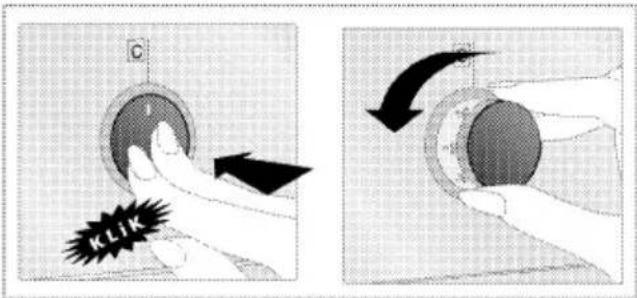
- Nach Abschluss des Garens drehen Sie den Knopf in die Aus-Position (oben) und drücken ihn hinein.
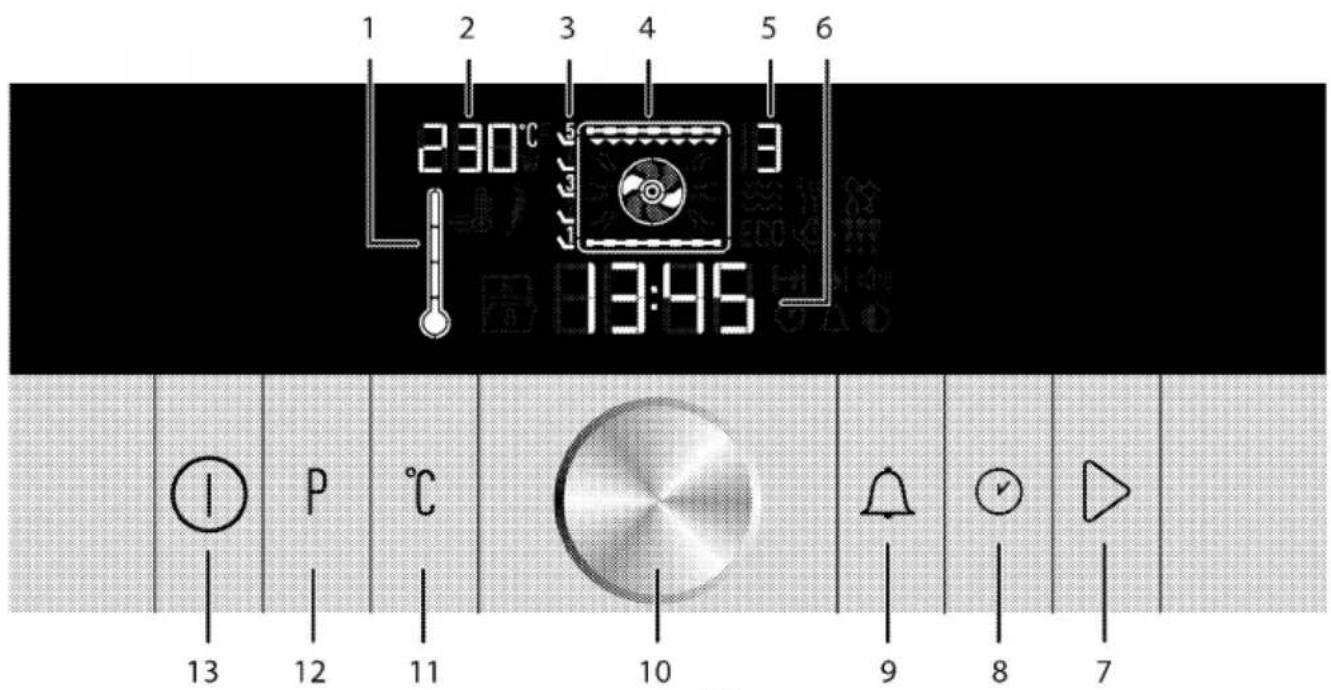
1 Temperatursymbol
2 Temperaturanzeige
3 Einschubpositionen
4 Funktionsanzeige
5 Funktionsnummer
6 Uhrzeitanzeige
7 Start-/Stopptaste
8 Zeiteinstelltaste
9 Alarmtaste
10 Drehknopf für Temperatur/Zeit erhöhen oder vermindern
11 Temperatur- und Schnellheiztaste
12 Zurück-Taste nach Funktionsanzeige
13 Ein-/Austaste
Anzeigesymbole:

Schnellheizen
Garzeit
Garzeitende
Alarm
Aktuelle-Zeit
Lautstärkeeinstellung
Helligkeitseinstellung
Auftauen
Tastensperre
Tür geöffnet
Backofentemperatur
Temperaturfühler *
Nachdem der Backofen eingeschaltet und die aktuelle Zeit eingestellt wurde, kehrt der Backofen zur Bereitschaftsanzeige zurück. Lediglich die aktuelle Uhrzeit wird angezeigt. Bei dieser Anzeige funktionieren lediglich die die Tasten ⏻ und ⚙. Sämtliche Funktionen können im Einstellungsmenü ausgeführt werden.
Während der Backofen heiß ist, ist es möglich, die Innentemperatur des Backofens durch Berühren der Taste ^° anzuzeigen.
Temperatur und Betriebsart einstellen
- Das Gerät mit der Taste ① einschalten.
- Nach dem Einschalten des Backofens erscheint in der Anzeige Informationen zur ersten Inbetriebnahme.
Die Anzeige informiert über die empfohlene Temperatur, aktive Heizelemente, Funktionsnummer und die empfohlene Einschubposition.

Wenn Taste ① kurz gedrückt wird, gibt der Backofen eine akustische Warnung aus. Zum Einschalten des Backofens die Taste ① mindestens 1 Sekunde gedrückt halten.
- Den gewünschten Betriebsmodus (Funktion) durch Drehen des Drehknopfes nach rechts oder links einstellen.
Nach der Funktionsauswahl können "Temperatur", "Garzeit", "Garzeitende" und "Schnellheizen" festgelegt werden.
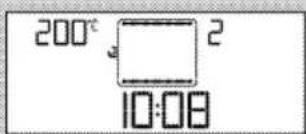
- Zum Ändern der Temperatur einmal die Taste °C berühren. Das °C-Symbol blinkt.
-
Den Drehknopf nach rechts/links drehen, bis die gewünschte Temperatur in der Temperaturanzeige erscheint. Sobald der gewünschte Wert in der Anzeige erscheint, einmal die Taste °C, △ oder √ berühren. Falls keine Taste berührt wird, wird der eingestellte Wert nach 10 Sekunden automatisch bestätigt.
-
Wenn Betriebsart, Temperatur und Zeiteinstellungen zufriedenstellend festgelegt sind, ▶ berühren und das Garen startet. ↓ erscheint in der Anzeige, das Gerät beginnt zu arbeiten.
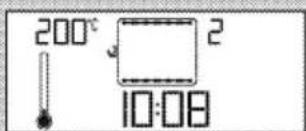

Falls die Backofentür im Betrieb geöffnet wird, erscheinen das Symbol in der Anzeige.
Backofen ausschalten
Das Gerät mit der Taste ① ausschalten.
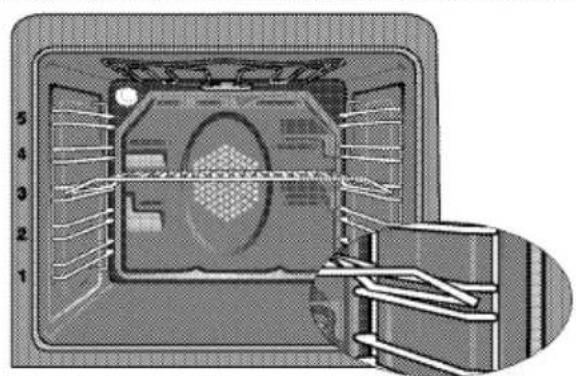
natural_image
Diagram of a device interior with numbered components and a hand inserting a cable (no text or symbols)Einschubpositionen (bei Modellen mit Grillrost)
Es ist wichtig, dass der Grillrost richtig in die Einschübe eingesetzt wird. Den Grillrost wie in der Abbildung gezeigt in den Einschub einsetzen.
Darauf achten, dass der Grillrost nicht die Rückwand des Backofens berührt. Den Rost daher nur so weit einschieben, bis sich die Backofentür problemlos schließen lässt - so funktioniert der Grill am besten.
Funktionstabelle
In der Funktionstabelle stehen sämtliche Funktionen des Backofens mit den jeweiligen Maximal- und Minimaltemperaturen.

Die Funktionen können je nach Modell unterschiedlich ausfallen.

Die Funktionen können je nach Modell unterschiedlich ausfallen.

Aus Sicherheitsgründen wird die maximale Garzeit bei sämtlichen Betriebsarten (mit Ausnahme der Warmhaltefunktion) auf 6 Stunden begrenzt.

Wenn Einstellungen geändert werden, blinken die entsprechenden Symbole in der Anzeige.

Durch Berühren von P an einem beliebigen Bildschirm wird die Funktion wieder aufgerufen.
| i | Bei Stromausfällen wird die aktuelle Funktion aufgehoben. Der Backofen muss wieder neu eingestellt werden. |
| i | Solange der Backofen arbeitet, kann die aktuelle Uhrzeit nicht eingestellt werden. |
| i | Die Backofenbeleuchtung leuchtet beim öffnen der Tür auch dann auf, wenn der Backofen abgeschaltet ist. |
| Funktion | Empfohlene Temperatur (°C) | Temperaturbereich (°C) |
| Normal | 200 | 40-280 |
| Statisch + Umluft | 175 | 40-280 |
| Umluft | 180 | 40-280 |
| Multi (3D) | 205 | 40-280 |
| Umluft + Unterhitze | 210 | 40-280 |
| Grill, groß + Umluft | 200 | 40-280 |
| Grill, groß | 280 | 40-280 |
| Grill, klein | 280 | 40-280 |
| Öko-Umluft | 180 | 160-220 |
| Unterhitze | 180 | 40-220 |
| Warmhalten | 60 | 40-100 |
| Aufbauen | ||
| * Die Funktionen können je noch Modell unterschiedlich ausfallen | ||
Betriebsarten
Die hier gezeigte Reihenfolge der Betriebsarten kann je nach Gerätemodell etwas abweichen.
1. Ober- und Unterhitze
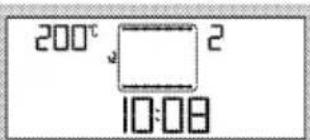
Das Gargut wird gleichzeitig von oben und unten erhitzt. Diese Betriebsart eignet sich beispielsweise für Kuchen, Gebäck und Aufläufe. Nur ein Blech verwenden.
* Die geeignete Einschubposition wird in der Anzeige dargestellt.
2. Ober-/Unterhitze mit Umluft
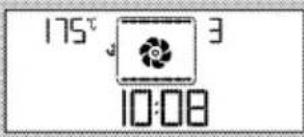
* Durch den Lüfter wird heiße Luft von den oberen und unteren Heizelementen gleichmäßig und schnell im Backofen verteilt. Nur ein Blech verwenden.
3. Umluft
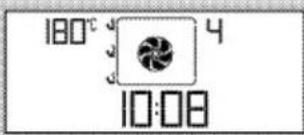
* Durch den Lüfter wird heiße Luft vom Umluft-gestützten Heizelement mit hoher Geschwindigkeit im Backofen verteilt. Diese Betriebsart eignet sich zum Garen auf unterschiedlichen Einschubebenen; in den meisten Fällen ist kein Vorheizen erforderlich. Mehrere Bleche können verwendet werden.

Bei geöffneter Backofentür schaltet sich der Lüfter ab, damit die heiße Luft im Inneren verbleibt.
4. "3D"-Funktion
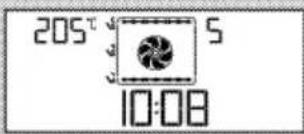
* Oberhitze, Unterhitze und Umluft sind in Betrieb. Das Gargut wird gleichmäßig und schnell von allen Seiten gegart. Nur ein Blech verwenden.
5. Pizza-Funktion
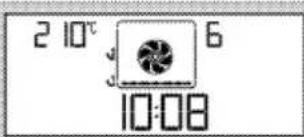
* Unterhitze und Umluft sind in Betrieb. Besonders zum Backen von Pizza geeignet.
6. Grill, groß + Umluft
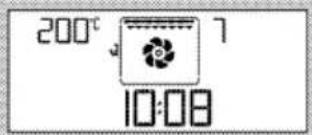
* Durch den Lüfter wird heiße Luft vom Grillelement sehr schnell im Inneren des Backofens verteilt. Diese Betriebsart eignet sich insbesondere zum Grillen größerer Fleischmengen.
- Stellen Sie mittelgroße bis große Portionen auf dem richtigen Einschub direkt unter das Grillelement.
• Stellen Sie die maximale Temperatur ein.
• Wenden Sie das Grillgut nach der Hälfte der Garzeit.
7. Grill, groß
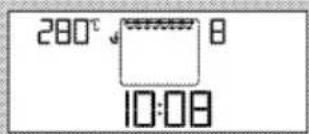
Der große Grill an der Oberseite des Backofens ist in Betrieb. Diese Betriebsart eignet sich insbesondere zum Grillen größerer Fleischmengen.
• Stellen Sie mittelgroße bis große Portionen auf dem richtigen Einschub direkt unter das Grillelement.
• Stellen Sie die maximale Temperatur ein.
• Wenden Sie das Grillgut nach der Hälfte der Garzeit.
8. Grill
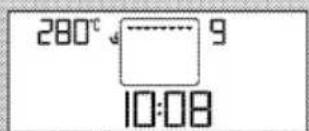
Der kleine Grill an der Oberseite des Backofens ist in Betrieb. Geeignet zum Grillen und Überbacken.
- Kleine oder mittelgroße Portionen in der richtigen Einschubposition unter dem Grill-Heizkörper grillen.
• Stellen Sie die maximale Temperatur ein.
- Wenden Sie das Grillgut nach der Hälfte der Garzeit.
Eco-Umluft
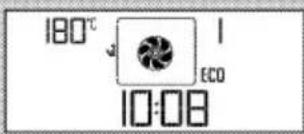
- Wenn Sie Strom sparen möchten, können Sie diese Funktion statt der üblichen Umluft-Funktion im Temperaturbereich 160 bis 220 °C nutzen. Die Garzeit verlängert sich dabei allerdings ein wenig.
* Bitte entnehmen Sie die entsprechenden Garzeiten der Tabelle „Garen mit Eco-Umluft“.
10. Unterhitze
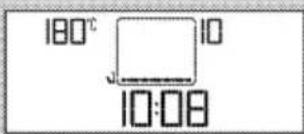
Bei dieser Betriebsart wird lediglich das untere Heizelement eingesetzt. Geeignet z. B. für Pizza und zum Nachbräunen von unten.
11. Warmhalten
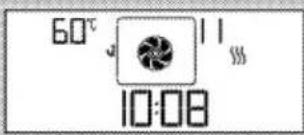
Hiermit können Sie Speisen bei niedriger Temperatur über einen längeren Zeitraum bis zum Servieren warmhalten.
12. Umluftbetrieb
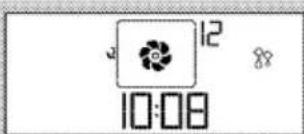
Der Backofen wird nicht beheizt. Nur der Lüfter (in der Rückwand) arbeitet. Gefrorene Lebensmittel werden langsam bei Zimmertemperatur aufgetaut, heiße Lebensmittel abgekühlt.
Backofen bedienen
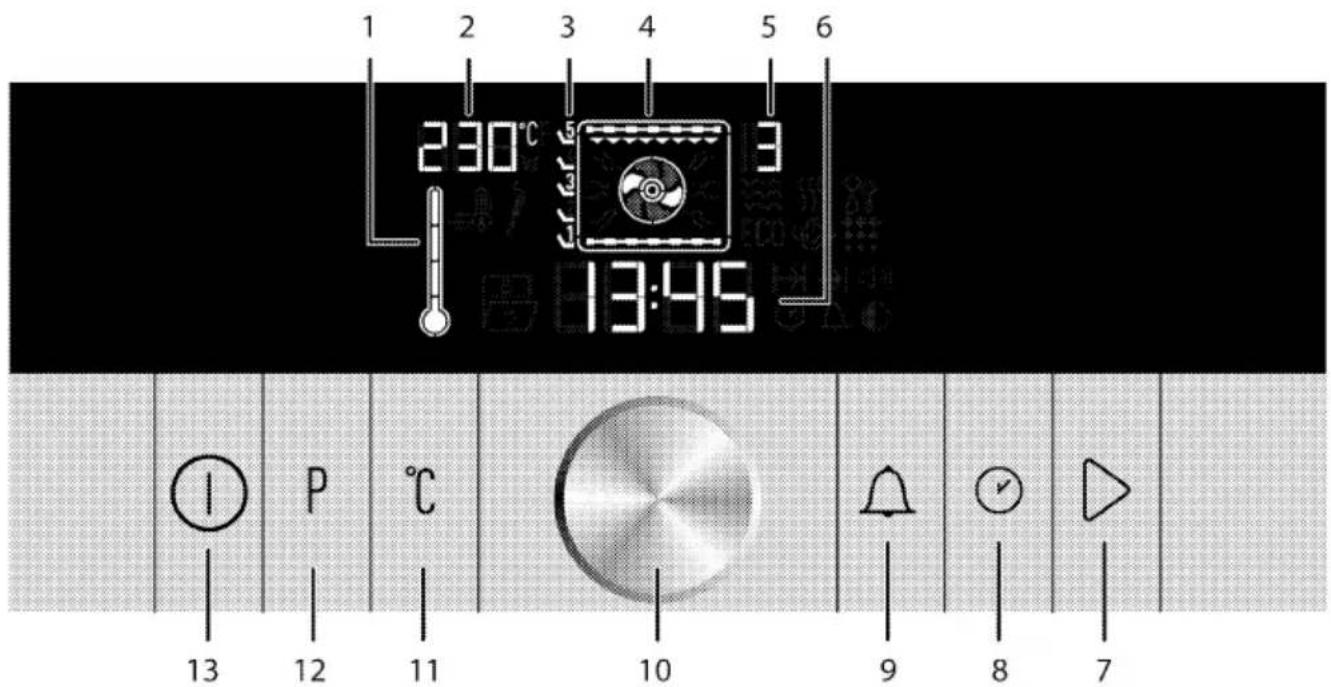
1 Temperatursymbol
2 Temperaturanzeige
3 Einschubpositionen
4 Funktionsanzeige
5 Funktionsnummer
6 Uhrzeitanzeige
7 Start-/Stopptaste
8 Zeiteinstelltaste
9 Alarmtaste
10 Drehknopf für Temperatur/Zeit erhöhen oder vermindern
11 Temperatur- und Schnellheiztaste
12 Zurück-Taste nach Funktionsanzeige
13 Ein-/Austaste
Halbautomatischer Betrieb
In diesem Betriebsmodus kann vorgegeben werden, wie lange der Backofen arbeiten soll (Garzeit).
- Das Gerät mit der Taste ① einschalten.

Wenn Taste ① kurz gedrückt wird, gibt der Backofen eine akustische Warnung aus. Zum Einschalten des Backofens die Taste ① mindestens 1 Sekunde gedrückt halten.
- Den gewünschten Betriebsmodus (Funktion) durch Drehen des Drehknopfes nach rechts oder links einstellen.
- Zum Ändern der Temperatur einmal die Taste °C berühren. Das "°C"-Symbol blinkt
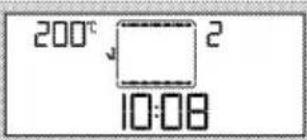
- Den Drehknopf nach rechts/links drehen, bis die gewünschte Temperatur in der Temperaturanzeige erscheint. Sobald der gewünschte Wert in der Anzeige erscheint, einmal die Taste Ⓒ, △ oder √ berühren. Falls keine Taste berührt wird, wird der eingestellte Wert nach 10 Sekunden automatisch bestätigt.
- Zum Einstellen der Garzeit die Taste ☑ drücken und blättern, bis "Garzeit" in der Anzeige erscheint. Gleichzeitig blinkt das Symbol |→|.
- Die gewünschte Garzeit durch Drehen des Drehknopfes nach rechts oder links einstellen, die Einstellung mit der Taste ☑ bestätigen. Nachdem die Garzeit eingestellt wurde, leuchtet → dauerhaft.
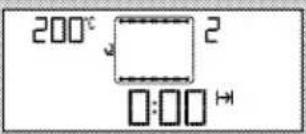
- Die Speisen in den Backofen geben, Backofentür schließen.
- Wenn Betriebsart, Temperatur und Zeit eingestellt wurden, ▷ berühren und das Garen startet. ↓ erscheint in der Anzeige, das Gerät beginnt zu arbeiten.

Wenn in diesem Bildschirm kurz gedrückt wird, gibt der Backofen eine akustische Warnung aus. Zum
Starten des Garens die Taste mindestens 1 Sekunde lang gedrückt halten.
» Der Backofen heizt sich bis zur vorgegebenen Temperatur auf und hält diese Temperatur bis zum eingestellten Garzeitende. Während des Garens bleibt die Backofenbeleuchtung eingeschaltet.

Alle Segmente des Symbols leuchten auf, sobald der Backofen die eingestellte Temperatur erreicht.
-
Nach Abschluss des Garens gibt der Backofen ein akustisches Signal aus.
-
Zum Abstellen des akustischen Signals einfach eine beliebige Taste berühren. Wenn ▷ berührt wird, setzt der Backofen den Betrieb im ausgewählten Modus fort. Der Signalton wird abgeschaltet.
-
Wenn die Taste ▷ nicht berührt wird, schaltet sich der Backofen automatisch ab, die aktuelle Uhrzeit erscheint in der Anzeige.
Vollautomatischer Betrieb
Bei dieser Betriebsart können Garzeit und Garzeitende vorgegeben werden.
-
Das Gerät mit der Taste ① einschalten.
-
Den gewünschten Betriebsmodus (Funktion) durch Drehen des Drehknopfes nach rechts oder links einstellen.
- Falls die Temperatur geändert werden soll, ℃ einmal berühren - die Temperaturanzeige erscheint.
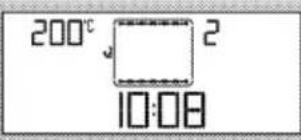
- Den Drehknopf nach rechts/links drehen, bis die gewünschte Temperatur in der Temperaturanzeige erscheint. Sobald der gewünschte Wert in der Anzeige erscheint, einmal die Taste °C, △ oder √ berühren. Falls keine Taste berührt wird, wird der eingestellte Wert nach 10 Sekunden automatisch bestätigt.
- Zum Einstellen der Garzeit die Taste ☑ drücken und blättern, bis "Garzeit" in der Anzeige erscheint. Gleichzeitig blinkt das Symbol |→|
- Die gewünschte Garzeit durch Drehen des Drehknopfes nach rechts oder links einstellen, die Einstellung mit der Taste ☑ bestätigen. Nachdem die Garzeit eingestellt wurde, leuchtet → dauerhaft.
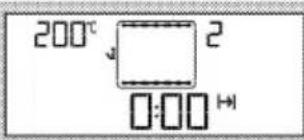
- Die Taste ☑ zur Eingabe des Garzeitendes zweimal drücken. Währenddessen blinkt → in der Anzeige.
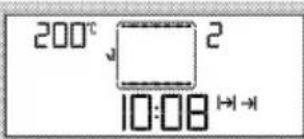
-
Das gewünschte Garzeitende durch Drehen des Drehknopfes nach rechts oder links einstellen, die Einstellung mit der Taste ☑ bestätigen. Nachdem das Garzeitende eingestellt wurde, leuchtet → dauerhaft.
-
Die Speisen in den Backofen geben, Backofentür schließen.
-
Wenn Betriebsart, Temperatur, Zeiteinstellungen und Garzeitende zufriedenstellend festgelegt sind, berühren und damit das Garen starten.
» Der Timer des Backofens berechnet die richtige Startzeit anhand von Garzeitende und Garzeit automatisch.
- Der ausgewählte Betriebsmodus wird aktiviert, sobald die Startzeit erreicht ist erscheint in der Anzeige, das Gerät beginnt zu arbeiten. Der Backofen heizt sich auf die eingestellte Temperatur auf. Diese Temperatur wird bis zum Garzeitende beibehalten. Während des Garens bleibt die Backofenbeleuchtung eingeschaltet.

Alle Segmente des Symbols ↓ leuchten auf, sobald der Backofen die eingestellte Temperatur erreicht.
- Nach Abschluss des Garens gibt der Backofen ein akustisches Signal aus.
- Zum Abstellen des akustischen Signals einfach eine beliebige Taste berühren. Wenn ▷ berührt wird, setzt der Backofen den Betrieb im ausgewählten Modus fort. . Der Signalton wird abgeschaltet.

Falls die halbautomatische oder automatische Programmierung wieder abgebrochen werden soll, muss die Garzeit zurückgesetzt werden. Bei Bedarf kann der Backofen auch durch Berühren der Taste ① abgeschaltet werden.
Schnellheizen
Mit der Schnellheizen-Funktion wird der Backofen schneller auf die gewünschte Temperatur gebracht; dies ist sehr praktisch beim Vorheizen.

Schnellheizen kann in den Modi Auftauen, Öko-Umluft und Warmhalten nicht ausgewählt werden. Bei einem Stromausfall wird die Schnellheizen-Funktion wieder aufgehoben.
Die gewünschte Betriebsart wählen; anschließend:
- Die Taste C zweimal berühren. "OFF (Aus)" erscheint in der Anzeige.
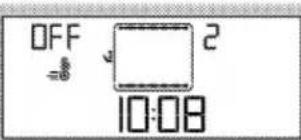
- Drehknopf einmal nach rechts drehen. "On (Ein)" und das Symbol ≡ erscheinen in der Anzeige. Zum Bestätigen der Einstellung °C berühren.
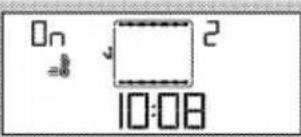
- Wenn Betriebsart und Temperatur eingestellt wurden, ▷ berühren und damit das Garen starten. ! erscheint in der Anzeige, das Gerät beginnt zu arbeiten.
» Das Symbol ≡ erlischt, sobald der Backofen die gewünschte Temperatur erreicht hat. Der Backofen wechselt nun zu der Betriebsart, die vor dem Einschalten der Schnellheizen-Funktion ausgewählt wurde.
-
Zum Aufheben der Schnellheizen-Funktion die Taste ℃ mehrmals kurz hintereinander berühren, bis "ON (Ein)" in der Anzeige erscheint.
-
Drehknopf einmal nach links drehen. "OFF (Aus)" erscheint in der Anzeige und das Symbol ≡ wird ausgeblendet. Zum Bestätigen der Einstellung ℃ berühren.
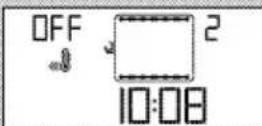
Tastensperre
Die Tastensperre verhindert die unerwünschte Bedienung des Backofens.

Die Tastensperre kann im laufenden Betrieb verwendet werden und auch dann, wenn der Backofen nicht arbeitet. Auch bei aktiver Tastensperre lässt sich der Backofen nach wie vor durch Berühren der Taste ① abschalten.
Tastensperre einschalten
-
Die Taste ⚙ mehrmals kurz hintereinander berühren, bis das Symbol ⏻ in der Anzeige erscheint. "OFF (Aus)" erscheint und das Symbol ⏻ blinkt in der Anzeige.
-
Zum Einschalten der Tastensperre den Drehknopf einmal nach rechts drehen. Nach dem Einstellen der Tastensperre wird "ON (Ein)" angezeigt. Anschließend erscheint das Symbol
- Zum Bestätigen der Einstellung √ berühren.
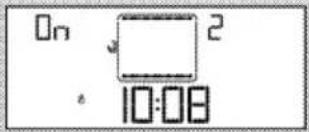
» Bei aktiver Tastensperre wird ein akustisches Signal ausgegeben und das Symbol ☐ erscheint in der Anzeige, wenn Tasten betätigt werden (mit Ausnahme des Menüauswahlknopfes).

Bei eingeschalteier Tastensperre sind die Bedientasten ohne Funktion. Auch nach einem Stromausfall bleibt die Tastensperre weiterhin eingeschaltet.
Tastensperre ausschalten
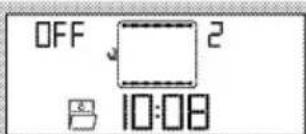
- Zum Abschalten der Tastensperre den Drehknopf zweimal nach links drehen. » Die Tastensperre wird abgeschaltet, das Symbol erlischt.
Alarmfunktion
Die Alarmfunktion des Gerätes kann zur Erinnerung auch als Kurzzeitwecker eingesetzt werden.
Der Kurzzeitwecker hat keinen Einfluss auf die Funktionen des Backofens. Er wird lediglich zur Erinnerung eingesetzt. Dies ist beispielsweise sinnvoll, wenn Speisen nach einer bestimmten Zeit gewendet werden müssen. Nach Ablauf der eingestellten Zeit wird ein Tonsignal ausgegeben.

Die Alarmfunktion kann auf maximal 23 Stunden und 59 Minuten eingesiellt werden.
Alarm einstellen:
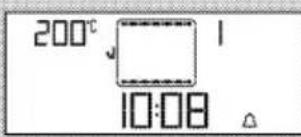
- Die Taste △ berühren. Das Symbol △ blinkt in der Anzeige.
- Die gewünschte Zeit durch Drehen des Drehknopfes nach rechts oder links einstellen, die Einstellung mit der Taste △ bestätigen. Das Symbol △ leuchtet auch nach Einstellung der Alarmzeit weiter.
- Nach Ablauf der Alarmzeit blinkt ⬆, ein Tonsignal erklingt.
- Durch Betätigen einer beliebigen Taste das Tonsignal abstellen.
Alarm aufheben:
- Die Taste △ berühren. Das Symbol △ blinkt in der Anzeige.
- "00:00" durch Drehen des Drehknopfes nach rechts oder links einstellen, die Einstellung mit der Taste △ bestätigen.
» Der Alarm wird abgeschaltet, das Symbol △ erlischt.
Garzeitentabelle

Die Zeitangaben in dieser Tabelle sollen als Richtwerte dienen. Zeitangaben können aufgrund von Temperatur, Dicke, Typ der Lebensmittel und Ihren eigenen Vorlieben abweichen.
Backen und Braten

Der erste Einschub ist der untere Einschub.
| Gericht | Leistungsstufe | Einschubposition | Temperatur (°C) | Gardauer (ca.-Angabe in Min.) | ||
| Kuchenblech* | Einschub 1 | [GGTS] | 3 | 175 | 25 ... 30 | |
| Kuchen, Form* | Einschub 1 | 2 | 180 | 40 ... 50 | ||
| Kuchen in Backpapier* | Einschub 1 | 3 | 175 | 25 ... 30 | ||
| Einschub 2 |  | 1 - 5 | 175 | 30 ... 40 | ||
| Einschub 3 | 1 - 3 - 5 | 180 | 45 ... 55 | |||
| Biskuitkuchen* | Einschub 1 | [XXTX] | 3 | 200 | 5 ... 10 | |
| Einschub 2 | 1 - 5 | 175 | 20 ... 30 | |||
| Kekse* | Einschub 1 | 3 | 175 | 25 ... 30 | ||
| Einschub 2 |  | 1 - 5 | 170 ... 190 | 30 ... 40 | ||
| Einschub 3 | 1 - 3 - 5 | 175 | 35 ... 45 | |||
| Teiggebäck* | Einschub 1 | 2 | 200 | 30 ... 40 | ||
| Einschub 2 |  | 1 - 5 | 200 | 45 ... 55 | ||
| Einschub 3 | 1 - 3 - 5 | 200 | 55 ... 65 | |||
| Teilchen* | Einschub 1 |  | 2 | 200 | 25 ... 35 | |
| Einschub 2 | 1 - 5 | 200 | 35 ... 45 | |||
| Einschub 3 | 1 - 3 - 5 | 190 | 45 ... 55 | |||
| Sauerteig* | Einschub 1 |  | 2 | 200 | 35 ... 45 | |
| Einschub 2 | 1 - 3 | 190 | 35 ... 45 | |||
| Losogne* | Einschub 1 | 2 - 3 | 200 | 30 ... 40 | ||
| Pizza* | Einschub 1 |  | 2 | 200 ... 220 | 15 ... 20 | |
| Einschub 1 | 3 | 200 | 10 ... 15 | |||
| Rindersteak (ganz)/Braten | Einschub 1 |  | 3 | 25 Min. bei 250 max., dann 180 ... 190 | 100 ... 120 | |
| Lammkeuie (Auftauf) | Einschub 1 | 3 | 25 Min. bei 250 max., dann 190 | 70 ... 90 | ||
| Einschub 1 | [HSCS] | 3 | 25 Min. bei 250 max., dann 190 | 60 ... 80 | ||
| Brathörschen | Einschub 1 | 2 | 15 Min. bei 250 max., dann 180 ... 190 | 55 ... 65 | ||
| Einschub 1 |  | 2 | 15 Min. bei 250 max., dann 180 ... 190 | 55 ... 65 | ||
| Pute (5,5 kg) | Einschub 1 |  | 1 | 25 Min. bei 250 max., dann 180 ... 190 | 150 ... 210 | |
| Einschub 1 | 1 | 25 Min. bei 250 max., dann 180 ... 190 | 150 ... 210 | |||
| Fisch | Einschub 1 |  | 3 | 200 | 20 ... 30 | |
| Einschub 1 | 3 | 200 | 20 ... 30 | |||
| Wenn Sie mit zwei Blechen gleichzeitig arbeiten, wählen Sie den oberen Einschub für das tiete, den unteren Einschub für das andere Blech.* Wir empfehlen, den Ofen grundsätzlich vorzuheizen. | ||||||
(**) Wenn vorgeheizt werden muss, lassen Sie den Ofen zu Beginn vorheizen, bis die
Eco-Umluft

Verändern Sie die Temperatureinstellung nach Beginn des Garens nicht mehr, wenn Sie Eco-Umluft nutzen.
Temperaturleuchte erlischt.

Halten Sie die Backofentür im Eco-Umluft-Betrieb geschlossen.
| Gericht | Leistungsstufe | Einschubposition | Temperatur(°C) | Gardauer (ca.-Angabe inMin.) | ||
| Kuchen inBackpapier | Einschub 1 | 3 | 200 | 35...40 | ||
| Kekse | Einschub 1 | 3 | 200 | 30...35 | ||
| Telggebäck | Einschub 1 | 3 | 200 | 40...45 | ||
| Teilchen | Einschub 1 | 3 | 200 | 40...45 | ||
Tipps zum Kuchenbacken
• Falls Gebäck zu trocken wird, erhöhen Sie die Temperatur etwas und vermindern gleichzeitig die Garzeit.
- Werden Kuchen zu feucht, reduzieren Sie die Flüssigkeiten oder senken die Temperatur um 10 °C.
- Sofern die Oberseite des Kuchens zu stark gebräunt wird, backen Sie etwas länger mit reduzierter Temperatur.
- Wenn der Kuchen außen gut gelingt, innen jedoch noch klebrig ist, geben Sie weniger Flüssigkeit hinzu, senken die Temperatur und verlängern dafür die Garzeit etwas.
Tipps für Gebäck
- Falls Gebäck zu trocken wird, erhöhen Sie die Temperatur etwas und vermindern gleichzeitig die Garzeit. Befeuchten Sie den Teig mit einer Mischung aus Milch, Öl, Ei und Joghurt.
- Sollte Gebäck sehr lange zum Garen benötigen, achten Sie darauf, dass das Gebäck nicht über die Oberkante des Backblechs hinausragt.
- Wird Gebäck an der Oberseite gut gebräunt, innen jedoch nicht richtig gar, achten Sie darauf, dass sich Flüssigkeiten nicht am Boden des Gebäcks konzentrieren. Versuchen Sie, Flüssigkeitsmischungen gleichmäßig
zwischen den Teigschichten zu verteilen; so erreichen Sie eine gleichmäßige Bräunung.

Halten Sie sich beim Backen an die Betriebsart- und Temperaturempfehlungen der Zubereitungstabelle. Falls die Unterseite nicht ausreichend gebräun! wird, nutzen Sie beim nächsten Mal den nächstniedrigeren Einschub.
Tipps zur Zubereitung von Gemüse
- Falls Gemüsegerichte zu trocken werden, bereiten Sie diese in einem Geschirr mit Deckel statt auf dem Blech zu. Geschlossene Behälter sorgen dafür, dass nicht zu viel Flüssigkeit verloren wird.
• Falls Gemüsegerichte nicht richtig gar werden, kochen Sie das Gemüse zuvor und geben es erst danach in den Ofen.
Einstellungsmenü
Helligkeit
Die Helligkeit kann nur bei abgeschaltetem Backofen eingestellt werden.
- Die Taste ⚙ mehrmals kurz hintereinander berühren, bis das Symbol
D in der Anzeige erscheint. Das Symbol
● blinkt in der Anzeige.
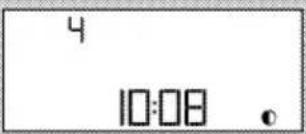
- Es gibt 4 Helligkeitsstufen (1, 2, 3 und 4). Die gewünschte Stufe durch Drehen des Drehknopfes nach rechts oder links einstellen.
- Zum Bestätigen der Einstellung berühren.

Bei abgeschaltetem Backofen wird die Helligkeit automatisch vermindert; dies spart etwas Energie. Beim Einschalten des Backofens wird wieder die ursprüngliche Helligkeit eingestellt.
» Die Bereitschaftsanzeige erscheint und die aktuelle Uhrzeit wird angezeigt.
Sprachlautstärke
Die Sprachlautstärke kann nur bei abgeschaltetem Backofen eingestellt werden.
- Die Taste 🚙 mehrmals kurz hintereinander berühren, bis das Symbol 🏠 in der Anzeige erscheint. Das Symbol 🏠 blinkt in der Anzeige.
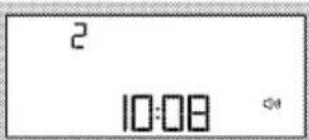
- Die Sprachlautstärke lässt sich in zwei Stufen einstellen: 1 und 2. Die gewünschte Stufe durch Drehen des Drehknopfes nach rechts oder links einstellen.
- Zum Bestätigen der Einstellung berühren.
» Die Bereitschaftsanzeige erscheint und die aktuelle Uhrzeit wird angezeigt.
Aktuelle Uhrzeit
Die aktuelle Uhrzeit kann nur bei abgeschaltetem Backofen eingestellt werden. So wird die bei der ersten Inbetriebnahme eingestellte Uhrzeit geändert:
00:00
- Die Taste ✅ mehrmals kurz hintereinander berühren, bis das Symbol ✅ in der Anzeige erscheint. Das Stundensymbol blinkt in der Anzeige. Stunde mit dem Drehknopf einstellen.
- Zum Aktivieren des Minutenwertes die √-Taste berühren. Die Minute und das Symbol √ blinken in der Anzeige. Minute mit dem Drehknopf einstellen.
- Zum Bestätigen der Uhreinstellung berühren.
» Die Bereitschaftsanzeige erscheint und die aktuelle Uhrzeit wird angezeigt.
10:08
So bedienen Sie den Grill

Die Uhrzeit muss eingestellt werden, bevor Sie den Backofen benutzen können. Der Backofen arbeitet erst nach dem Einstellen der Uhrzeit.
WARNUNG
Backofentür beim Grillen geschlossen halten. Verbrennungsgefahr durch heiße Flächen!
Grill einschalten
- Drehen Sie den Funktionswähler auf das gewünschte Grillsymbol.
- Wählen Sie dann die gewünschte Grilltemperatur.
- Heizen Sie den Grill bei Bedarf etwa 5 Minuten vor.
» Die Temperaturleuchte schaltet sich ein.
Grill ausschalten
- Drehen Sie den Funktionswähler in die Aus-Position (oben).
Grill einschalten
- Schalten Sie das Gerät mit der Taste ① ein.
- Wählen Sie die gewünschte Grillfunktion durch Drehen des Drehknopfes (11) nach rechts oder links aus.
Nach der Funktionsauswahl können
"Temperatur", "Garzeit", "Garzeitende" und "Schnellheizen" festgelegt werden.
- Zum Ändern der Temperatur einmal die Taste °C berühren. Das °C-Symbol blinkt.
- Den Drehknopf nach rechts/links drehen, bis die gewünschte Temperatur in der Temperaturanzeige erscheint. Sobald der gewünschte Wert in der Anzeige erscheint, einmal die Taste °C, △ oder √ berühren. Falls keine Taste berührt wird, wird der eingestellte Wert nach 10 Sekunden automatisch bestätigt.
- Wenn Betriebsart, Temperatur und Zeiteinstellungen zufriedenstellend festgelegt sind, berühren und das Garen startet. erscheint in der Anzeige, das Gerät beginnt zu arbeiten.
Grill ausschalten
- Das Gerät mit der Taste ① ausschalten.
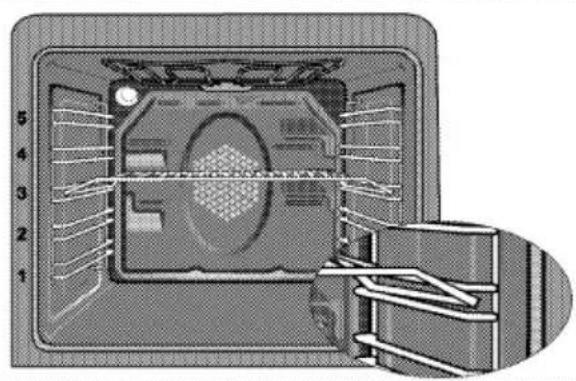
Einschubpositionen
Die Grillleistung nimmt ab, wenn der Grillrost die Rückwand des Backofens berührt. Schieben Sie den Grillrost daher nur so weit ein, bis sich die Backofentür problemlos schließen lässt – so funktioniert der Grill am besten.
natural_image
Cross-sectional diagram of a device showing internal components and a close-up of a device with labeled parts (no text or symbols present)
Lebensmittel, die nicht zum Grillen geeignet sind, können sich im schlimmsten Fall entzünden. Grillen Sie nur Lebensmittel, die bei der starken Hitze beim Grillen keinen Schaden nehmen.
Platzieren Sie das Grillgut nicht nahe der Backofenrückwand. Dort wird es besonders heiß, fettes Grillgut kann in Brand geraien.
Garzeitentabelle zum Grillen
Elektrischer Grill
| Speise | Einschubebene | Grilldauer (ca.) |
| Fisch | 4...5 | 20...25 Min. * |
| Höhnerklein | 4...5 | 25...35 Min. |
| Lammkoteletts | 4...5 | 20...25 Min. |
| Rinderbraten | 4...5 | 25...30 Min. * |
| Kalbskoteletts | 4...5 | 25...30 Min. * |
| Toastbrot | 4 | 1...2 min. |
| *je nach Dicke | ||
7 Reinigung und Wartung
Allgemeine Hinweise
Durch regelmäßiges Reinigen verlängern Sie die Lebenserwartung Ihres Gerätes und beugen Fehlfunktionen vor.
GEFAHR:
Trennen Sie das Gerät von der Stromversorgung, bevor Sie es reinigen. Es besteht Stromschlaggefahr!
GEFAHR:
Lassen Sie das Gerät vor dem Reinigen gründlich abkühlen. Verbrennungsgefahr durch heiße Flächen!
- Reinigen Sie das Gerät nach jedem Gebrauch gründlich. Dadurch lassen sich Speisereste leichter entfernen und können sich beim nächsten Einsatz des Backofens nicht einbrennen.
- Zur Reinigung benötigen Sie keine Spezialreiniger. Verwenden Sie am besten warmes Wasser mit etwas herkömmlichem Reiniger, ein weiches Tuch oder einen Schwamm. Anschließend mit einem Tuch trocknen.
- Achten Sie stets darauf, überschüssige und verschüttete Flüssigkeiten nach der Reinigung gründlich ab- bzw. aufzuwischen.
- Wenn Sie Edelstahl und Griffe reinigen verzichten Sie auf Reinigungsmittel, die Säuren oder Chlor enthalten. Reinigen Sie diese Teile mit einem weichen Tuch und etwas Flüssigreiniger (kein Scheuermittel); wischen Sie dabei am besten nur in eine Richtung.

Durch bestimmte Reinigungsmittel können die Oberflächen des Gerätes beschädigt werden. Verwenden Sie keine aggressiven Reinigungsmittel, keine Scheuermittel und keine scharfen oder spitzen Gegenstände bei der Reinigung.

Nutzen Sie keine Dampfreiniger zur Reinigung des Gerätes – es besteht Stromschlaggefahr.
Kochfeld reinigen
Glaskeramik
Wischen Sie die Glaskeramik mit einem mit kaltem Wasser angefeuchteten Tuch sauber. Anschließend mit einem weichen Tuch trocknen. Achten Sie darauf, dass keine Rückstände auf der Glaskeramik verbleiben; andernfalls kann das Kochfeld bei der nächsten Nutzung beschädigt werden. Versuchen Sie niemals, Rückstände mit Messern, Stahlwolle und ähnlichen Hilfsmitteln von der Glaskeramik zu entfernen. Entfernen Sie Kalkflecken (beige bis gelbe Flecken) mit etwas Kalkentferner; Essig oder Zitronensaft funktionieren ebenfalls. Alternativ können Sie entsprechende handelsübliche Produkte verwenden. Bei hartnäckigen Verschmutzungen tragen Sie Reinigungsmittel mit einem Schwamm auf und warten ab, bis das Mittel richtig in den Schmutz eingezogen ist. Anschließend wischen Sie die Glaskeramik des Kochfeldes mit einem feuchten Tuch sauber.

Stark zuckerhaltige Lebensmittel müssen sofort entfernt werden, bevor die Glaskeramik abkühlt. Andernfalls kann die Glaskeramik dauerhaft beschädigt werden.
Mit der Zeit kann es zu leichten Farbveränderungen der Glaskeramik und
der Markierungen kommen. Die Funktion des Gerätes wird dadurch nicht beeinträchtigt. Farbveränderungen und sonstige leichte optische Veränderungen sind bei Glaskeramik normal; es handelt sich nicht um einen Defekt.
Bedienfeld reinigen
Reinigen Sie Bedienfeld und Tasten mit einem weichen Tuch; anschließend trockenreiben.

Ziehen Sie die Knöpfe zum Reinigen des Bedienfelds nicht ab. Das Bedienfeld kann beschädigt werden!
Backofen reinigen
So reinigen Sie die Seitenwand
- Lösen Sie den vorderen Bereich der seitlichen Halterungen, indem Sie diese von der Seitenwand wegziehen.
- Ziehen Sie die seitliche Halterung komplett zu sich hin heraus.
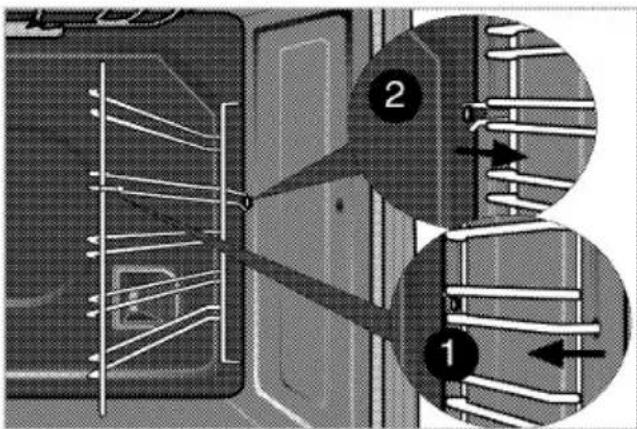
Katalytische Seitenwände
Seitenwände und Rückwand des Backofens können mit katalytischer Emaille beschichtet sein.
Die katalytischen Seitenwände des Backofens müssen nicht gereinigt werden. Die poröse Oberfläche der Seitenwände sorgt für eine Selbstreinigung, indem Fettspritzer aufgesaugt und umgewandelt werden (Wasserdampf und Kohlendioxid).
Backofenoberseite reinigen
Zum Reinigen der Oberseite des Backofens kann das Grillelement abgeklappt werden.
- Lösen Sie die Fixierschrauben am Grill-Heizelement mit einem Schraubendreher oder einer Münze.
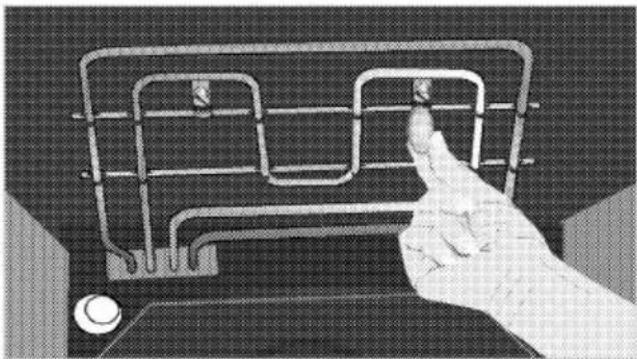
natural_image
Hand pointing at a grid-based maze diagram on a keyboard (no text or symbols visible)
Das Grillelement klappt nach unten. Es bleibt weiterhin an der Backofendecke verankert.
- Reinigen Sie die Backofendecke mit einem feuchten Tuch.
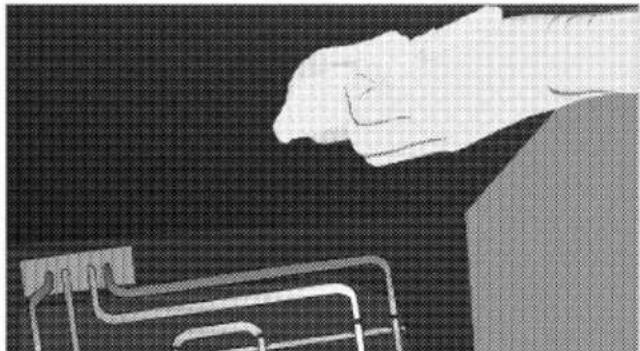
natural_image
Illustration of a hand holding a tool above a wire fence, with no visible text or symbols.- Klappen Sie das Grill-Heizelement wieder nach oben, ziehen Sie die Fixierschrauben mit einem Schraubendreher oder einer Münze fest.
Backofentür reinigen
Verwenden Sie zum Reinigen der Backofentür am besten warmes Wasser mit etwas herkömmlichem Reiniger, ein weiches Tuch oder einen Schwamm. Anschließend mit einem Tuch trocknen.

Verzichten Sie bei der Reinigung der Backofentür auf aggressive Reinigungsmittel und auf scharfkantige Schaber aus Metall. Solche Hilfsmittel können die Oberflächen zerkratzen und das Glas beschädigen.

Die Innenscheibe der Ofentür ist zur besseren Reinigung beschichtet. Reinigen Sie die Innenscheibe nicht mit aggressiven Reinigern, Metallschabern oder Bleiche -können dadurch verkratzt werden Das Beschichtungsmaterial könnte zerstört werden.
Backofentür ausbauen
- Öffnen Sie die Backofentür (1).
- Öffnen Sie die Clips am Scharniergehäuse links und rechts der Backofentür, indem Sie diese wie in der Abbildung gezeigt nach unten drücken.
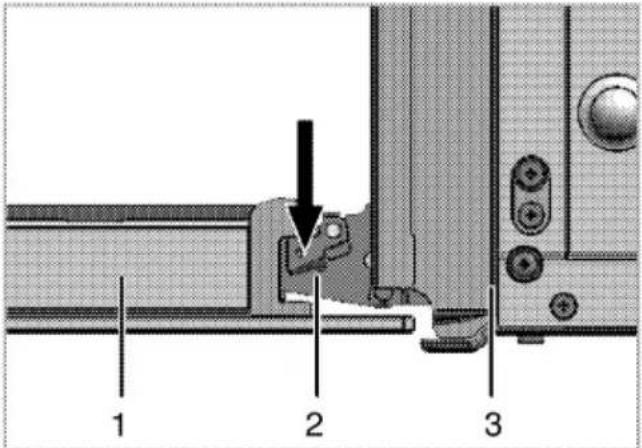
1 Backofentür
2 Scharnier
3 Backofen
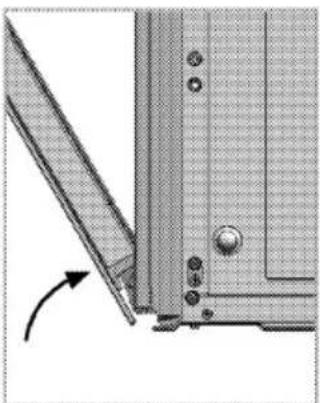
natural_image
Technical diagram of a mechanical component with a curved arrow indicating rotation (no text or symbols present)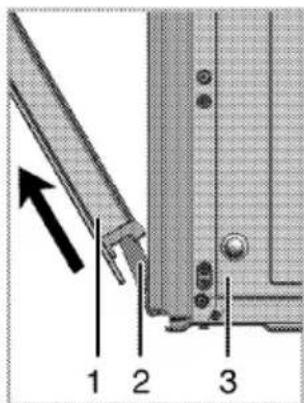
- Öffnen Sie die Backofentür zur Hälfte.
- Nehmen Sie die Ofentür heraus, indem Sie diese etwas anheben und von den Scharnieren rechts und links lösen.

Zum Einbau führen Sie die obigen Schritte wieder in umgekehrter Reihenfolge aus. Vergessen Sie nicht, die Clips am Scharniergehäuse nach dem Wiedereinsetzen der Tür wieder zu schließen.
Türinnenscheibe ausbauen
Die Türinnenscheibe kann zur Reinigung ausgebaut werden.
Die Türinnenscheibe kann zur Reinigung ausgebaut werden.
- Öffnen Sie die Backofentür folgenderweise;
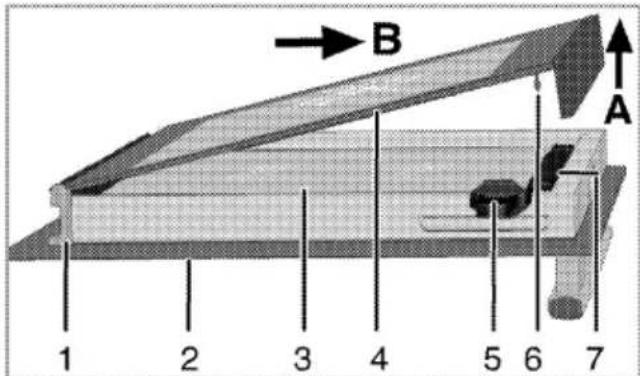
1 Scharnierhülle
2 Äußere Glasscheibe
3 Innere Scheibe
4 Innerste Scheibe
5 Spachtel
6 Pin
7 Pinhalterung
-
Heben Sie mit Hilfe der Spachtel die innerste Scheibe (4) wie in der Abbildung gezeigt leicht in Richtung A an, bis Sie ein Klicken hören. Dann ziehen Sie sie in Richtung B heraus.
-
Reinigen Sie Türinnenscheibe (3). Sie brauchen diese nicht komplett auszubauen.
-
Nachdem Sie die äußere Glasscheibe (2) gereinigt haben, können Sie die innerste Glasscheibe (4) zurück einsetzen.
-
Zuerst setzen Sie die untere Kante der innersten Scheibe (4) in die Scharnierhülle (1). Dann drücken Sie den
Pin (6) in die Pinhalterung (7) hinein bis Sie ein Klicken hören.
Beleuchtung des Backofens auswechseln
GEFAHR:
Bevor Sie die Beleuchtung des Backofens auswechseln, sorgen Sie dafür, dass das Gerät vollständig von der Stromversorgung getrennt und komplett abgekühlt ist; ansonsten droht Verbrennungs- und Stromschlaggefahr. Verbrennungsgefahr durch heiße Flächen!

Als Leuchtmittel wird eine spezielle Glühlampe eingesetzt, die für Temperaturen bis 300 °C ausgelegt ist. Weitere Hinweise finden Sie in "Technische Daten, Seite 11" Passende Leuchtmittel erhalten Sie beim autorisierten Kundendienst.

Die Position der Beleuchtung kann etwas von der Abbildung abweichen.
Wenn Ihr Ofen mit einer runden Leuchte ausgestattet ist:
- Trennen Sie das Gerät vollständig von der Stromversorgung.
- Schrauben Sie die Glasabdeckung gegen den Uhrzeigersinn ab.
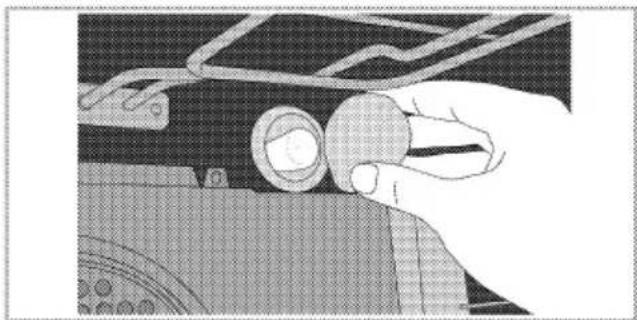
natural_image
Close-up of a hand operating a mechanical component with a circular knob (no visible text or symbols)- Drehen Sie die Lampe gegen den Uhrzeigersinn heraus, setzen Sie eine neue Lampe ein.
- Glasabdeckung wieder anbringen.
8 Problemlösungen
Aus dem Backofen tritt im Betrieb Dampf aus
- Während des Betriebs ist ein Dampfaustritt normal. >>> Dies ist kein Fehler.
Beim Aufheizen und Abkühlen sind metallische Geräusche zu hören.
- Wenn sich die Temperatur von Metallteilen ändert, dehnen sich diese aus oder ziehen sich zusammen – dabei entstehen Geräusche. >>> Dies ist kein Fehler.
Das Gerät funktioniert nicht.
• Die Sicherung ist durchgebrannt oder ausgelöst. >>> Kontrollieren Sie die Sicherungen im Sicherungskasten. Bei Bedarf austauschen oder zurücksetzen.
Das Gerät ist nicht richtig an die (geerdete) Steckdose angeschlossen. >>> Überprüfen Sie die Steckerverbindung.
• Die Tasten/Knöpfe am Bedienfeld funktionieren nicht. >>> Die Tastensperre ist eventuell aktiv. Bitte abschalten.
• Der Überhitzungsschutz ist aktiv. >>> Lassen Sie das Kochfeld abkühlen.
• Das Kochgeschirr ist nicht geeignet. >>> Prüfen Sie Ihr Geschirr.
Die Ofenbeleuchtung funktioniert nicht.
• Das Leuchtmittel ist defekt. >>> Tauschen Sie das Leuchtmittel aus.
• Die Stromversorgung wurde unterbrochen. >>> Überprüfen Sie die Stromversorgung. Kontrollieren Sie die Sicherungen im Sicherungskasten. Sicherungen bei Bedarf austauschen oder zurücksetzen.
Backofen heizt nicht.
- Falsche Funktion ausgewählt und/oder Temperatur nicht richtig eingestellt. >>> Stellen Sie Funktion und Temperatur entsprechend ein.
• Die Stromversorgung wurde unterbrochen. >>> Überprüfen Sie die Stromversorgung. Kontrollieren Sie die Sicherungen im Sicherungskosten. Sicherungen bei Bedarf austauschen oder zurücksetzen.
Nun erscheint das Symbol auf der Kochzonenanzeige.
- Sie haben das Kochgeschirr nicht auf der aktiven Kochzone aufgestellt. >>> Prüfen Sie, ob sich ein Kochgeschirr auf der Kochzone befindet.
- Ihr Kochgeschirr nicht zum Kochen mit Induktion geeignet. >>> Prüfen Sie, ob Ihr Kochgeschirr mit Induktionsherden kompatibel ist.
Das Kochgeschirr ist nicht richtig zentriert oder die Unterseite des Kochgeschirrs ist nicht breit genug für die Kochzone. >>> Wählen Sie ein Kochgeschirr, das breit genug ist; zentrieren Sie es auf der Kochzone. - Kochgeschirr oder Kochzone sind überhitzt. >>> Lassen Sie sie abkühlen.
Die ausgewählte Kochzone schaltet sich im Betrieb plötzlich ab.
- Eventuell ist der Timer der ausgewählten Kochzone abgelaufen. >>> Sie können den Timer neu einstellen, das Kochen beenden oder die Kochstelle auf normale Weise wieder einschalten.
• Der Überhitzungsschutz ist aktiv. Lassen Sie das Kochfeld abkühlen. - Möglicherweise liegt ein Gegenstand auf dem Bedienfeld. Nehmen Sie den störenden Gegenstand vom Bedienfeld herunter.
Das Kochgeschirr wird nicht gleichmäßig warm, wenn die Kochzone eingeschaltet ist.
- Ihr Kochgeschirr nicht zum Kochen mit Induktion geeignet. >>> Prüfen Sie, ob Ihr Kochgeschirr mit Induktionsherden kompatibel ist.
Das Kochgeschirr ist nicht richtig zentriert oder die Unterseite des Kochgeschirrs ist nicht breit genug für die Kochzone. >>> Wählen Sie ein Kochgeschirr, das breit genug ist; zentrieren Sie es auf der Kochzone.

Falls sich ein Problem nicht mit den obigen Hinweisen lösen lassen sollte, wenden Sie sich bitte an den autorisierten Kundendienst oder an den Händler, bei dem Sie das Gerät gekauft haben. Versuchen Sie niemals, ein defektes Gerät selbst zu reparieren.
Please read this user manual first!
Dear Customer,
Thank you for purchasing this Grundig product. We hope that you get the best results from your product which has been manufactured with high quality and state-of-the-art technology.
Therefore, please read this entire user manual and all other accompanying documents carefully before using the product and keep it as a reference for future use. If you handover the product to someone else, give the user manual as well. Follow all warnings and information in the user manual.
Remember that this user manual is also applicable for several other models. Differences between models will be identified in the manual.
Explanation of symbols
Throughout this user manual the following symbols are used:

Important information or useful hints about usage.

Warning of hazardous situations with regard to life and property.
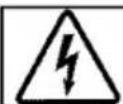
Warning of electric shock.
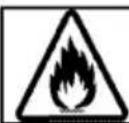
Warning of risk of fire.
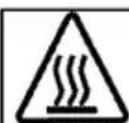
Warning of hot surfaces.
1 Important instructions and warnings for safety and environment 4
General safety 4
Electrical safety....4
Product safety 5
Intended use 7
Safety for children 7
Disposing of the old product 8
Package information 8
2 General information 9
Overview 9
Technical specifications 10
Package contents 12
3 Installation 13
Before installation....13
Installation and connection 15
Future Transportation 18
4 Preparation 19
Tips for saving energy....19
Initial use 19
Day time 19
First cleaning of the appliance....20
Initial heating 21
5 How to use the hob 22
General information about cooking .....22
Using the hobs 24
Turning on cooking zones 24
6 How to operate the oven 28
General information on baking, roasting and grilling 28
How to operate the electric oven 28
Operating modes....31
How to operate the oven control unit.....33
Using the keylock 35
Using the clock as an alarm 36
Cooking times table 37
Settings menu 38
How to operate the grill....39
Cooking times table for grilling....40
7 Maintenance and care 41
General information....41
Cleaning the hob....41
Cleaning the control panel....42
Cleaning the oven 42
Removing the oven door 43
Removing the door inner glass....43
Replacing the oven lamp....44
8 Troubleshooting 45
1 Important instructions and warnings for safety and environment
This section contains safety instructions that will help protect from risk of personal injury or property damage. Failure to follow these instructions shall void any warranty.
General safety
• This appliance can be used by children aged from 8 years and above and persons with reduced physical, sensory or mental capabilities or lack of experience and knowledge if they have been given supervision or instruction concerning use of the appliance in a safe way and understand the hazards involved.
Children shall not play with the appliance. Cleaning and user maintenance shall not be made by children without supervision.
• Installation and repair procedures must always be performed by Authorized Service Agents. The manufacturer shall not be held responsible for damages arising from procedures carried out by unauthorized
persons which may also void the warranty. Before installation, read the instructions carefully.
- Do not operate the product if it is defective or has any visible damage.
• Control that the product function knobs are switched off after every use.
Electrical safety
- If the product has a failure, it should not be operated unless it is repaired by the Authorized Service Agent. There is the risk of electric shock! - Only connect the product to a grounded outlet/line with the voltage and protection as specified in the "Technical specifications". Have the grounding installation made by a qualified electrician while using the product with or without a transformer. Our company shall not be liable for any problems arising due to the product not being earthed in accordance with the local regulations.
• Never wash the product by spreading or pouring water
onto it! There is the risk of electric shock!
• The product must be unplugged during installation, maintenance, cleaning and repairing procedures.
- If the power connection cable for the product is damaged, it must be replaced by the manufacturer, its service agent or similar qualified persons in order to avoid a hazard.
- Only use the connection cable specified in the "Technical specifications".
- The appliance must be installed so that it can be completely disconnected from the network. The separation must be provided either by a mains plug, or a switch built into the fixed electrical installation, according to construction regulations.
- Rear surface of the oven gets hot when it is in use. Make sure that the electrical connection does not contact the rear surface; otherwise, connections can get damaged.
- Do not trap the mains cable between the oven door and frame and do not route it over hot surfaces. Otherwise, cable
insulation may melt and cause fire as a result of short circuit.
• Any work on electrical equipment and systems should only be carried out by authorized and qualified persons.
• In case of any damage, switch off the product and disconnect it from the mains. To do this, turn off the fuse at home.
• Make sure that fuse rating is compatible with the product.
Product safety
• The appliance and its accessible parts become hot during use. Care should be taken to avoid touching heating elements. Children less than 8 years of age shall be kept away unless continuously supervised.
- Never use the product when your judgment or coordination is impaired by the use of alcohol and/or drugs.
- Be careful when using alcoholic drinks in your dishes. Alcohol evaporates at high temperatures and may cause fire since it can ignite when it comes into contact with hot surfaces.
- Do not place any flammable materials close to the product as the sides may become hot during use.
- During use the appliance becomes hot. Care should be taken to avoid touching heating elements inside the oven.
- Keep all ventilation slots clear of obstructions.
- Do not heat closed tins and glass jars in the oven. The pressure that would build-up in the tin/jar may cause it to burst.
- Do not place baking trays, dishes or aluminium foil directly onto the bottom of the oven. The heat accumulation might damage the bottom of the oven.
- Do not use harsh abrasive cleaners or sharp metal scrapers to clean the oven door glass since they can scratch the surface, which may result in shattering of the glass.
- Do not use steam cleaners to clean the appliance as this may cause an electric shock.
-
Use the shelves as described in "How to operate the electric oven".
-
Do not use the product if the front door glass removed or cracked.
- Oven handle is not towel dryer. Do not hang up towel, gloves, or similar textile products when the grill function is at open door.
• Always use heat resistant oven gloves when putting in or removing dishes into/from the hot oven. - Ensure that the appliance is switched off before replacing the lamp to avoid the possibility of electric shock.
- Unattended cooking on a hob with fat or oil can be dangerous and may result in fire. NEVER try to extinguish a fire with water, but switch off the appliance and then cover flame e.g. with a lid or a fire blanket.
• Danger of fire: Do not store items on the cooking surfaces.
• If the surface is cracked, switch off the appliance to avoid the possibility of electric shock.
• After use, switch off the hob element by its control and do not rely on the pan detector.
• Metallic objects such as knives, forks, spoons and lids should
not be placed on the hob surface since they can get hot.
- The appliance is not intended to be operated by means of an external timer or separate remote-control system.
• Vapour pressure that build up due to the moisture on the hob surface or at the bottom of the pot can cause the pot to move. Therefore, make sure that the oven surface and bottom of the pots are always dry.
- Hotplates are equipped with "Induction" technology. Your induction hob that provides both time and money savings must be used with pots suitable for induction cooking; otherwise hotplates will not operate. See.General information about cooking, page 22, selecting the pots.
• As induction hobs create a magnetic field, they may cause harmful impacts for people who use devices such as insulin pump or pacemaker.
For the reliability of the fire of the product;
• Make sure the plug is fitting to socket as well for not cause to spark.
- Do not use damaged or cutted or extension cable except the original cable.
• Make sure that not whether liquid or moisture on the socket is plugged to product.
Intended use
• This product is designed for domestic use. Commercial use will void the guarantee.
• This appliance is for cooking purposes only. It must not be used for other purposes, for example room heating.
- This product should not be used for warming the plates under the grill, drying towels, dish cloths etc. by hanging them on the oven door handles. This product should also not be used for room heating purposes.
• The manufacturer shall not be liable for any damage caused by improper use or handling errors.
• The oven can be used for defrosting, baking, roasting and grilling food.
Safety for children
- Accessible parts may become hot during use. Young children should be kept away.
- The packaging materials will be dangerous for children. Keep the packaging materials away from children. Please dispose of all parts of the packaging according to environmental standards.
• Electrical products are dangerous to children. Keep children away from the product when it is operating and do not allow them to play with the product.
• Do not place any items above the appliance that children may reach for. - When the door is open, do not load any heavy object on it and do not allow children to sit on it. It may overturn or door hinges may get damaged.
Disposing of the old product
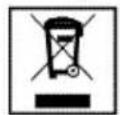
Dispose of the old product in an environmentally friendly manner. This equipment bears the selective sorting symbol for waste electrical and electronic equipment (WEEE). This means that this equipment
must be handled pursuant to European Directive 2002/96/EC in order to be recycled or dismantled to minimize its impact on the environment. For further information, please contact local or regional authorities.
Refer to your local dealer or solid waste collection centre in your area to learn how to dispose of your product.
Before disposing of the product, cut off the power cable plug and make the door lock (if any) unusable to avoid dangerous conditions to children.
Package information
• Packaging materials of the product are manufactured from recyclable materials in accordance with our National Environment Regulations. Do not dispose of the packaging materials together with the domestic or other wastes. Take them to the packaging material collection points designated by the local authorities.
2 General information
Overview
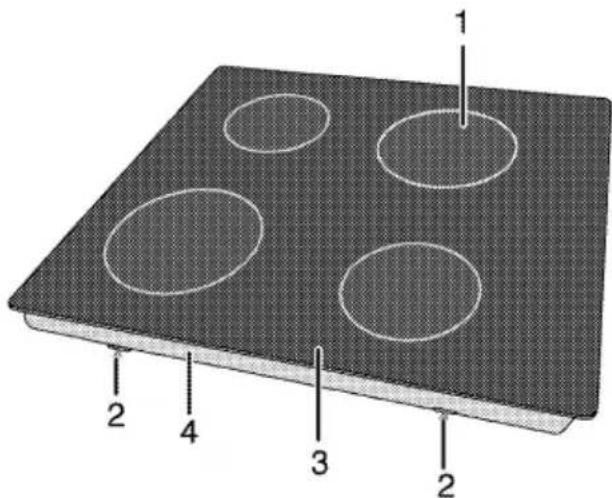
1 Induction cooking plate
2 Assembly clamp
3 Tempered glass
4 Base cover
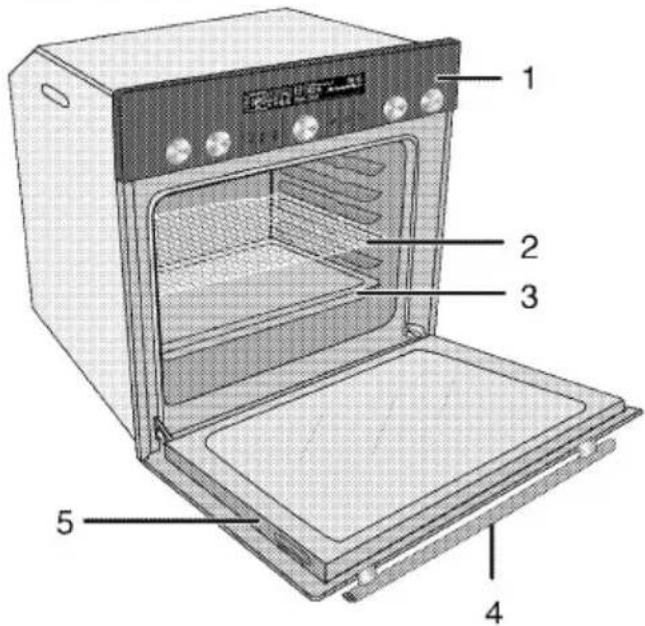
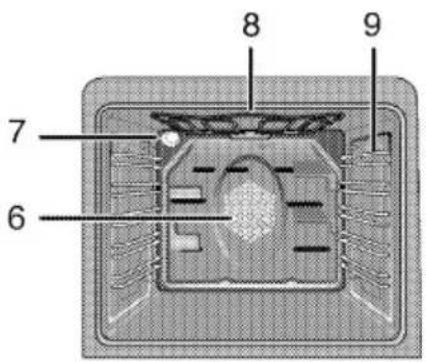
1 Control panel
2 Wire shelf
3 Tray
4 Handle
5 Front door
6 Fan motor (behind steel plate)
7 Lamp
8 Top heating element
9 Shelf positions
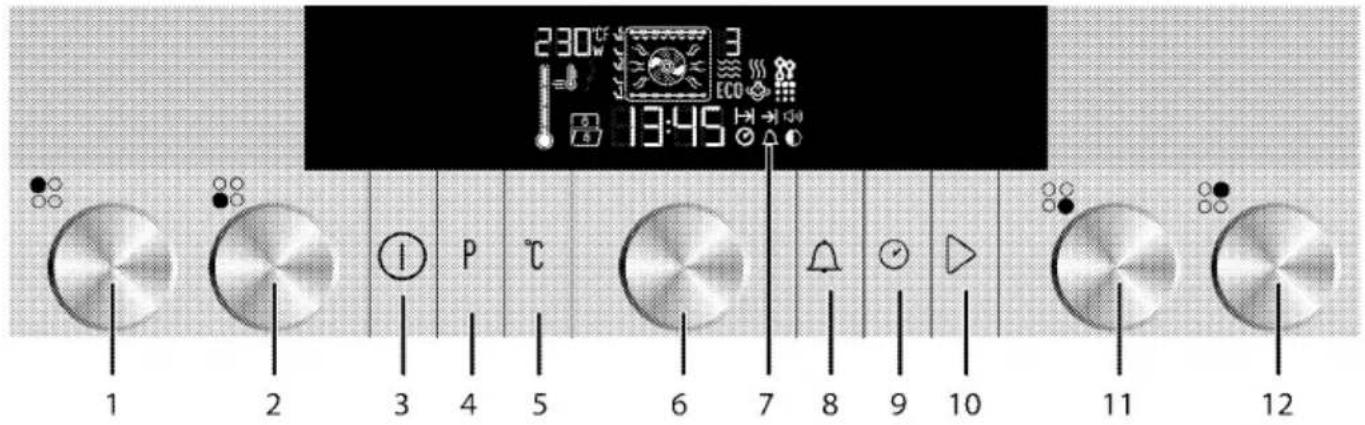
1 Induction cooking plate Rear left
2. Induction cooking plate Front left
3 ON/OFF key
4 Return Key to function display
5 Temperature-time increase/decrease-
navigate knob
6 Alarm key
7 Time and settings key
8 Start/stop cooking key
9 Induction cooking plate Front right
10 Induction cooking plate Rear right
Technical specifications
| GENERAL | |
| Voltage / frequency | 220-240 V / 380-415 V 3N ~ 50 Hz |
| Total power consumption | max. 10.3 kW |
| Fuse | min. 32 A / 3 x 16 A |
| Cable type / section | H05VV-FG 3 x 4 mm ^2 / 5 x 1,5 mm ^2 |
| Cable length | max. 2 m |
| HOB | |
| External dimensions (height / width / depth) | 43 mm/580 mm/510 mm |
| Installation dimensions (width / depth) | 560 mm/490 mm |
| Burners | |
| Rear left | Induction cooking plate |
| Dimension | 160 mm |
| Power | 1400 W |
| Front left | Induction cooking plate |
| Dimension | 200 mm |
| Power | 2300/3000 W |
| Front right | Induction cooking plate |
| Dimension | 160mm |
| Power | 1400 W |
| Rear right | Induction cooking plate |
| Dimension | 200 mm |
| Power | 2300/3000 W |
| OVEN/GRILL | |
| External dimensions (height / width / depth) | 595 mm/594 mm/567 mm |
| Installation dimensions (height / width / depth) | **590 or 600 mm/560 mm/min. 550 mm |
| Main oven | Multifunction oven |
| Energy efficiency class# | A |
| Inner lamp | 15/25 W |
| Grill power consumption | 2.2 kW |
# Basics: Information on the energy label of electrical ovens is given in accordance with the EN 50304 standard. Those values are determined under standard load with bottom-top heater or fan assisted heating (if any) functions.
The energy efficiency class is determined according to function: Cooking with eco-fan.

Technical specifications may be changed without prior notice to improve the quality of the product.

Figures in this manual are schematic and may not exactly match your product.

Values stated on the product labels or in the documentation accompanying it are obtained in laboratory conditions in accordance with relevant standards. Depending on operational and environmental conditions of the product, these values may vary.
Package contents

Accessories supplied can vary depending on the product model. Not every accessory described in the user manual may exist on your product.
1. User manual
2. Oven tray
Used for pastries, frozen foods and big roasts.
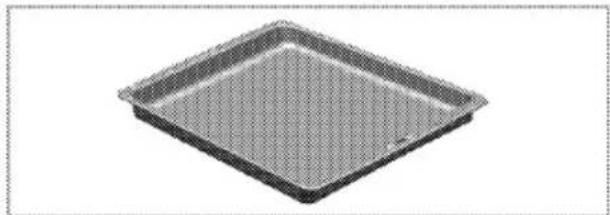
natural_image
3D rendering of a square baking tray with a mesh pattern (no text or symbols)3. Cake tray
Used for pastries such as cookies and biscuits.
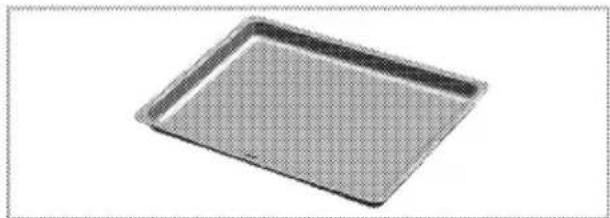
natural_image
Exterior view of a rectangular baking tray with a grid pattern (no text or symbols)4. Wire Shelf
Used for roasting and for placing the food to be baked, roasted or cooked in casserole dishes to the desired rack.
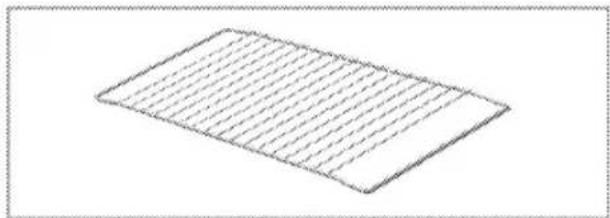
natural_image
Isometric view of a rectangular sheet with horizontal dashed lines, no text or symbols present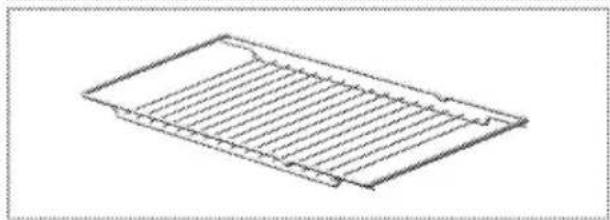
natural_image
Isometric line drawing of a rectangular grid structure with horizontal lines, no text or symbols present5. Placing the wire shelf and tray onto the telescopic racks properly
Telescopic racks allow you to install and remove the trays and wire shelf easily. When using the tray and wire shelf with telescopic racks, make sure that the pins at the rear section of the telescopic rack stands against the edges of the wire shelf and tray.
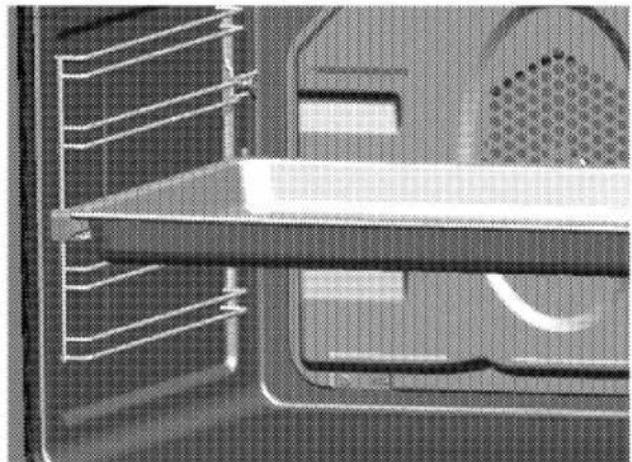
natural_image
Close-up of a mechanical component with grid pattern and ventilation grilles (no visible text or symbols)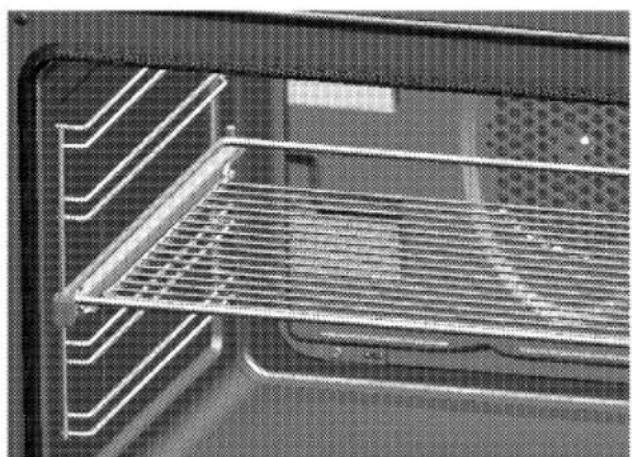
natural_image
Interior view of an oven with metal grating and ventilation slots (no text or symbols visible)3 Installation
Product must be installed by a qualified person in accordance with the regulations in force. The manufacturer shall not be held responsible for damages arising from procedures carried out by unauthorized persons which may also void the warranty.
| Preparation of location and electrical installation for the product is under customer's responsibility. | |
| DANGER:The product must be installed in accordance with all local electrical regulations. | |
| DANGER:Prior to installation, visually check if the product has any defects on it. If so, do not have it installed.Damaged products cause risks for your safety. |
Before installation
The appliances are intended for installation in commercially available kitchen cabinets. A safety distance must be left between the appliance and the kitchen walls and furniture. See figure (values in mm).
• It can also be used in a free standing position. Allow a minimum distance of 750 mm above the hob surface.
• (*) If a cooker hood is to be installed above the cooker, refer to cooker hood manufacturer' instructions regarding installation height (min 650 mm).
- Remove packaging materials and transport locks.
- Surfaces, synthetic laminates and adhesives used must be heat resistant (100 °C minimum).
• Power to the hob is supplied from the oven. Both appliances must be installed on top of each other. - Cut aperture for the hob in worktop as per installation dimensions.
• Seal cut edges and bordering edges.
• Worktop and kitchen cabinets must be set level and fixed.
• The hob may be installed with only one edge next the higher cabinets, appliances or walls.
• Some space must remain between the oven's rear wall and the kitchen wall for air to circulate.
• If there is a drawer beneath the oven, a shelf must be installed between oven and drawer. - Carry the appliance with at least two persons.
| Do not install the appliance next to refrigerators or freezers. The heat emitted by the appliance will lead to an increased energy consumption of cooling appliances. |
| The door and/or handle must not be used for lifting or moving the appliance. |
| If the appliance has wire handles, push the handles back into the side walls after moving the appliance. |
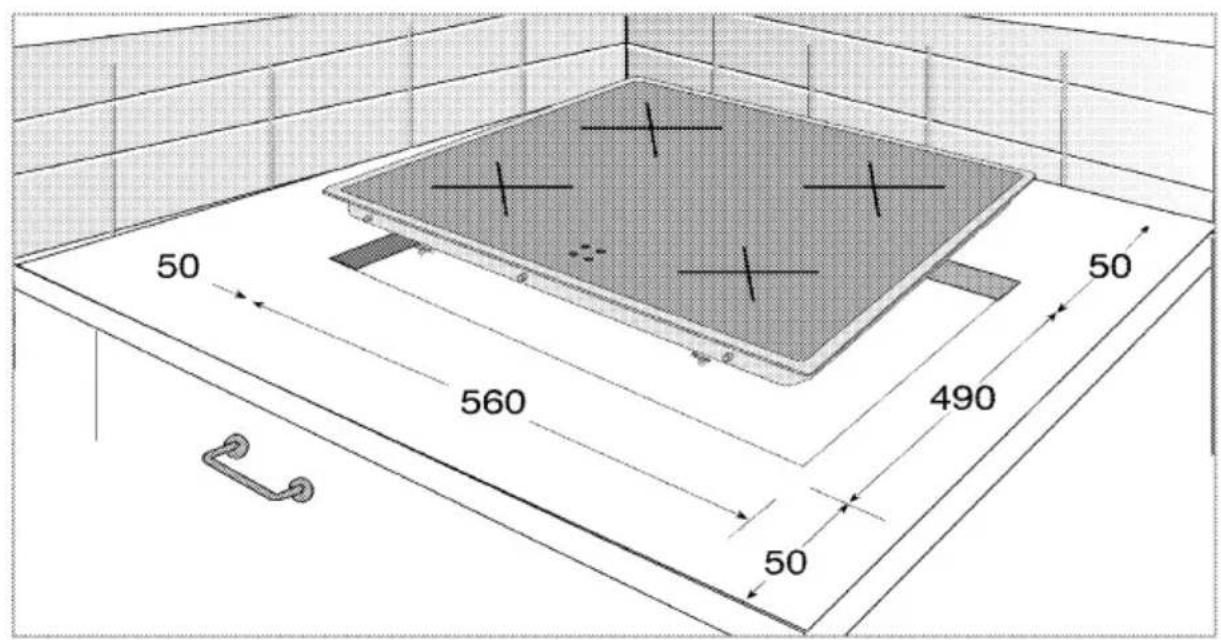
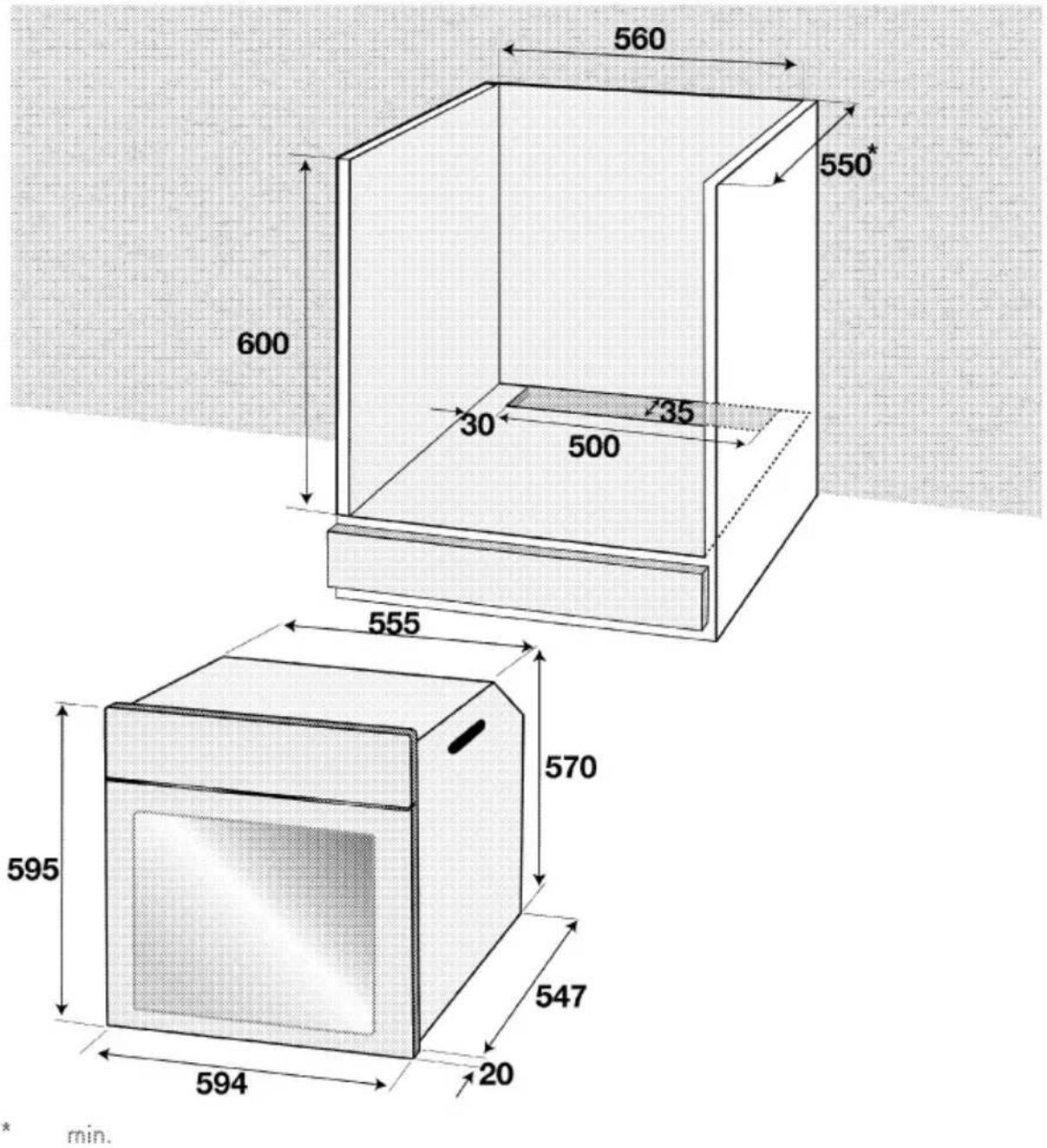
Installation and connection
• The product must be installed in accordance with all local gas and electrical regulations.

Do not install the hob on places with sharp edges or corners. There is the risk of breaking for glass ceramic surface!
Electrical connection
Connect the product to a grounded outlet/line protected by a fuse of suitable capacity as stated in the "Technical specifications" table. Have the grounding installation made by a qualified electrician while using the product with or without a transformer. Our company shall not be liable for any damages that will arise due to using the product without a grounding installation in accordance with the local regulations.
DANGER:
The product must be connected to the mains supply only by an authorised and qualified person. The product's warranty period starts only after correct installation. Manufacturer shall not be held responsible for damages arising from procedures carried out by unauthorised persons.
DANGER:
The power cable must not be clamped, bent or trapped or come into contact with hot parts of the product. A damaged power cable must be replaced by a qualified electrician. Otherwise, there is risk of electric shock, short circuit or fire!
• Connection must comply with national regulations.
• The mains supply data must correspond to the data specified on the type label of the product. Open the front door to see the type label.
• The mains supply data must correspond to the data specified on the type label of the product. Type label is at the rear housing of the product.
• Power cable of your product must comply with the values in "Technical specifications" table.
DANGER:
Before starting any work on the electrical installation, disconnect the product from the mains supply. There is the risk of electric shock!
Connecting the power cable
- If a power cable is not supplied together with your product, a power cable that you would select from the table (Technical specifications, page 10) in accordance with the electrical installation at your home must be connected to your product by following the instructions in cable diagram.
If it is not possible to disconnect all poles in the supply power, a disconnection unit with at least 3 mm contact clearance (fuses, line safety switches, contactors) must be connected and all the poles of this disconnection unit must be adjacent to (not above) the product in accordance with IEE directives. Failure to obey this instruction may cause operational problems and invalidate the product warranty.

Additional protection by a residual current circuit breaker is recommended.
- Open the terminal block cover with a screwdriver.
- Insert the power cable through the cable clamp below the terminal and secure it to the main body with the integrated screw on cable clamping component.
- Connect the cables according to the supplied diagram.
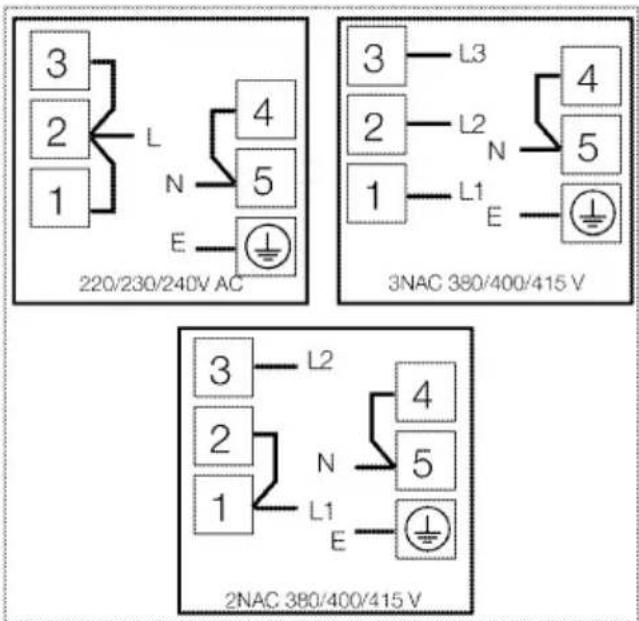
- After completing the wire connections, close the terminal block cover.
- Route the power cable so that it will not contact the product and get squeezed between the product and the wall.

Power cable must not be longer than 2 m because of safety reasons.
Installing the product

If it is possible to touch the bottom of the product since it is installed onto a drawer, this section must be covered with a wooden plate.
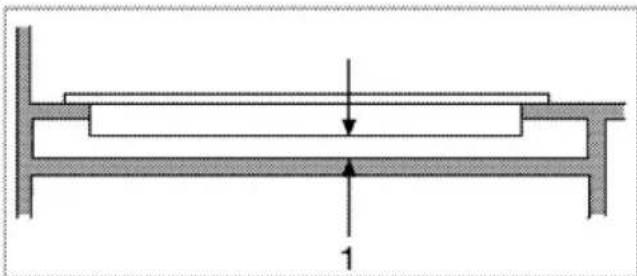
natural_image
Pure mechanical diagram showing a beam supported by two vertical supports with a central load and dimension label '1' (no text or symbols beyond basic geometry)1 min. 25mm

When installing the hob onto a cabinet, a shelf must be installed in order to separate the cabinet from the hob as illustrated in the above figure. This is not required when installing onto a built-in oven.
If the oven is below:
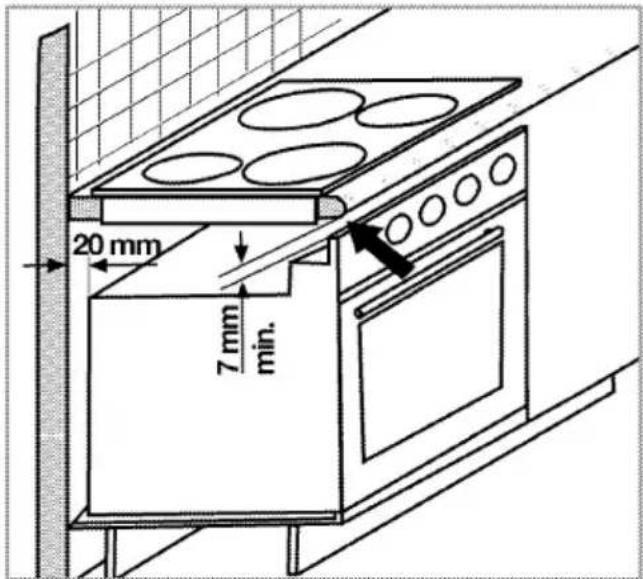
* min.
It is required to leave a ventilation opening of minimum 180 cm ^2 at the rear section of the furniture as illustrated in the following figure.
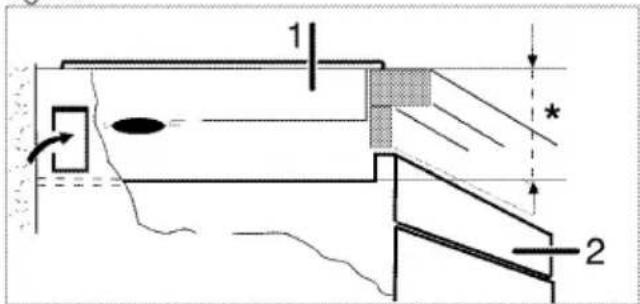
* min. 25 mm
If the board is below:
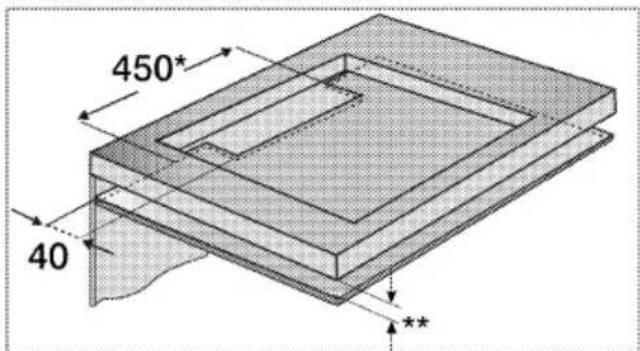
* min. ** min. 25 mm
During installation of your induction hob, place the product parallel to the installation surface. Also, apply sealing gasket to the parts of the hob contacting the counter as described below in order to prevent any liquid from penetrating between the product and the counter.
- Prepare the surface of the counter as shown in the figure.
- Apply the sealing gasket provided with the product to the edges of the hob's lower housing that contact with the counter as illustrated in figure.
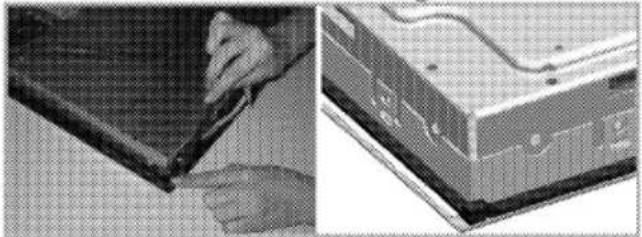
natural_image
Close-up of hands using a tool to clean or inspect the interior of a laptop case (no visible text or symbols)-
Center the product in the counter.
-
Using the installation clamps secure the hob by fitting through the holes on the lower casing.
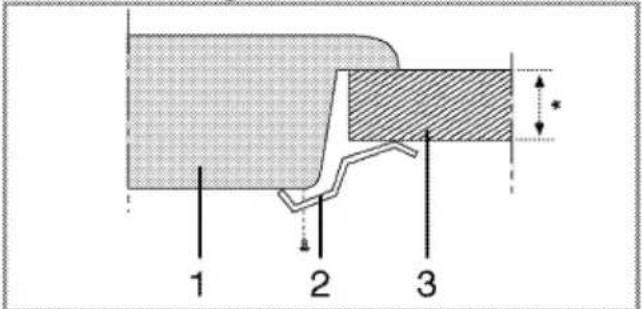
* min. 30 mm
1 Hob
2 Installation clamp
3 Counter
» Rear view (connection holes)
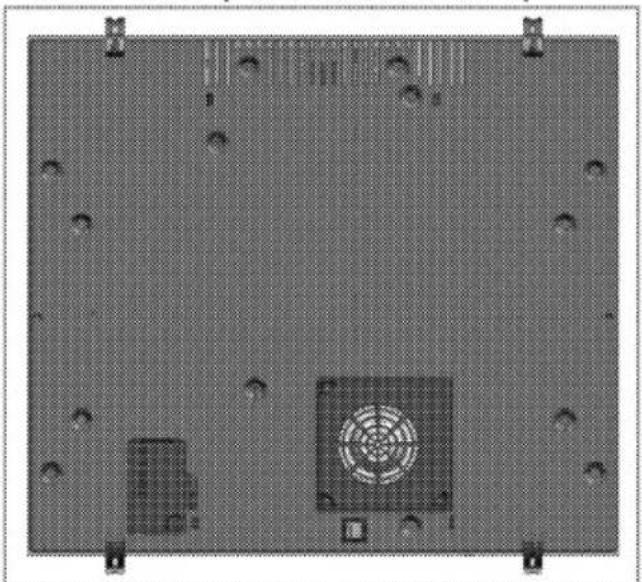
natural_image
Top-down view of a computer monitor with a central square and circular pattern, surrounded by mounting holes (no text or symbols visible)i Making connections to different holes is not a good practice in terms of safety since it can damage the gas and electrical system.
- Fix the hob.
- Make oven connections.
- Slide the oven into the cabinet until half way.
- Connect the hob to the oven.
» The product has three type cables;
» Power cable (5)
» Communication cable (4)
» Ground cable (Green/yellow) = (E) ≡
(3) Connections of cables are shown as in the following picture.
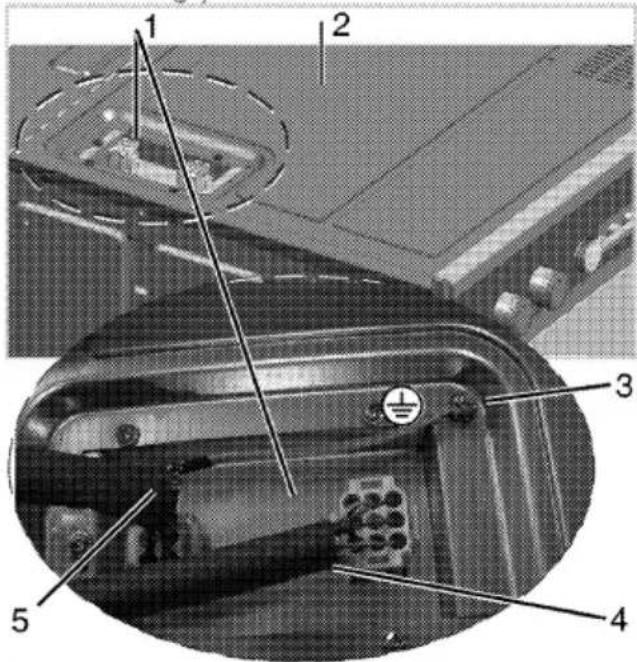
1 Terminal Block
2 Oven top Wall
3 (E) Ground
4 Communication cable
5 Power cable

Before power cable (5) connection, the hob must be connected to the earth with Green/Yellow cable (3) on Terminal Block. (1).
- Slide the oven into the cabinet, align and secure it while making sure that the power cable is not broken and/or trapped.
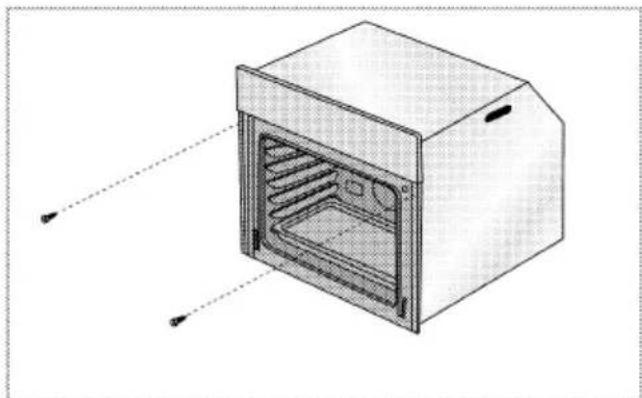
natural_image
Diagram of a microwave oven with internal grating and ventilation slots (no text or labels)Secure the oven with 2 screws as illustrated.
For products with cooling fan
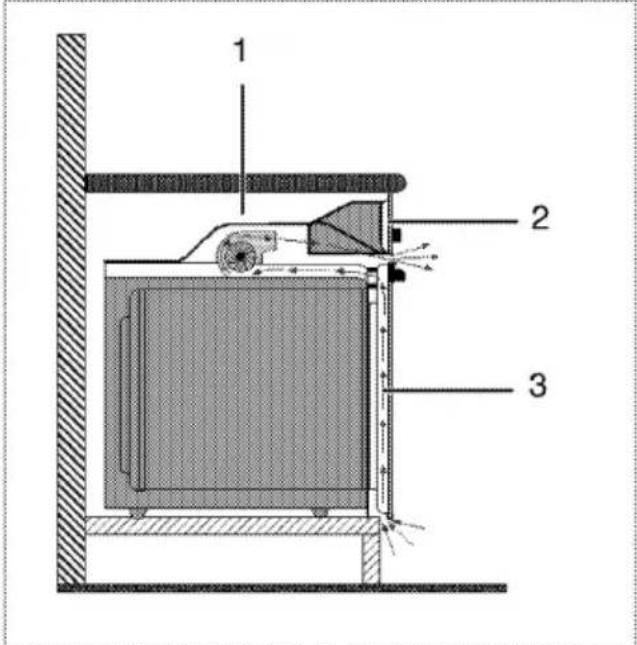
1 Cooling fan
2 Control panel
3 Door
The built-in cooling fan cools both the built-in cabinet and the front of the product.

Cooling fan continues to operate for about 20-30 minutes after the oven is switched off.
If you have cooked by programming the timer of the oven, cooling fan will also be switched off at the end of the cooking time together with all functions.
Final check
- Plug in the power cable and switch on the product's fuse.
- Check the functions.
Future Transportation
- Keep the product's original carton and transport the product in it. Follow the instructions on the carton. If you do not have the original carton, pack the product in bubble wrap or thick cardboard and tape it securely.
• To prevent the wire grill and tray inside the oven from damaging the oven door, place a strip of cardboard onto the inside of the oven door that lines up with the position of the trays. Tape the oven door to the side walls.
• Do not use the door or handle to lift or move the product.

Do not place any objects onto the product and move it in upright position.

Check the general appearance of your product for any damages that might have occurred during transportation.
4 Preparation
Tips for saving energy
The following information will help you to use your appliance in an ecological way, and to save energy:
• Use dark coloured or enamel coated cookware in the oven since the heat transmission will be better.
• While cooking your dishes, perform a preheating operation if it is advised in the user manual or cooking instructions.
• Do not open the door of the oven frequently during cooking.
• Try to cook more than one dish in the oven at the same time whenever possible. You can cook by placing two cooking vessels onto the wire shelf.
• Cook more than one dish one after another. The oven will already be hot.
• You can save energy by switching off your oven a few minutes before the end of the cooking time. Do not open the oven door.
• Defrost frozen dishes before cooking them.
• Use pots/pans with cover for cooking. If there is no cover, energy consumption may increase 4 times.
- Select the burner which is suitable for the bottom size of the pot to be used. Always select the correct pot size for your dishes. Larger pots require more energy.
• Pay attention to use flat bottom pots when cooking with electric hobs.
* Pots with thick bottom will provide a better heat conduction. You can obtain energy savings up to 1/3.
• Vessels and pots must be compatible with the cooking zones. Bottom of the vessels or pots must not be smaller than the hotplate. - Keep the cooking zones and bottom of the pots clean. Dirt will decrease the heat conduction between the cooking zone and bottom of the pot.
Initial use
Day time

Before you can use the oven, the time must be set. If the time is not set, oven will not operate.
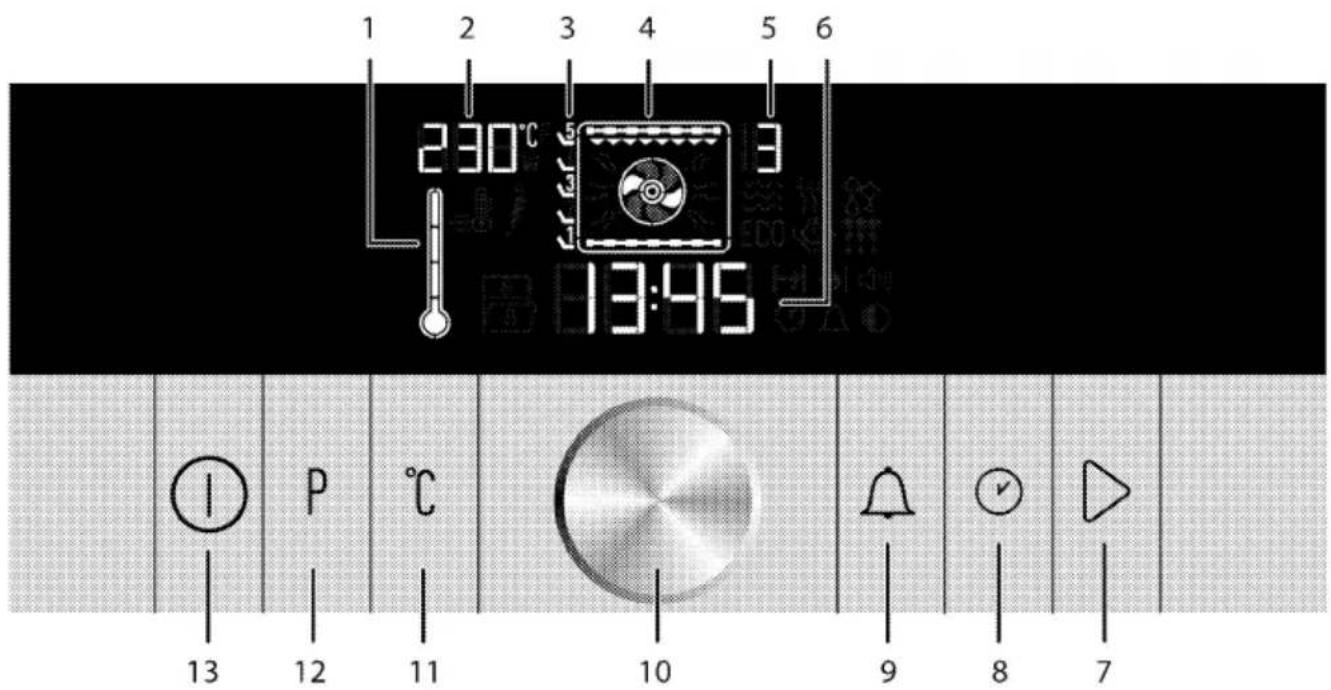
1 Oven Inner Temperature symbol
2 Temperature indicator field
3 Shelf positions
4 Function display
5 Function number
6 Current time indicator field
7 Start/stop cooking key
8 Time and settings key
9 Alarm key
10 Temperature-time increase/decrease-
navigate knob
11 Temperature/booster setting key
12 Return Key to function display
13 ON/OFF key
Set the time
00:00
- Plug in the power cable and switch on the product's fuse.
- "00.00" appears and √ symbol flash on the display. Turn the Navigate in Menus knob to right/left to set the hour section.
- Touch the ⏻ key to activate the minute section. Minute field and ⏻ symbol flash on the display. Turn the Navigate in
Menus knob to right/left to set the minute section.
- Touch ⏻ to confirm the setting.
» It returns to the stand-by display. Only the current time appears on the display.
10:08

In case of power outage or when the product is unplugged and plugged in again, time setting menu is displayed again. The set day time is preserved in short power outages. In such cases, you can continue by confirming the time value.
First cleaning of the appliance

The surface might get damaged by some detergents or cleaning materials. Do not use aggressive detergents, cleaning powders/creams or any sharp objects during cleaning. Do not use harsh abrasive cleaners or sharp metal scrapers to clean the oven door glass since they can scratch the surface, which may result in shattering of the glass.
-
Remove all packaging materials.
-
Wipe the surfaces of the appliance with a damp cloth or sponge and dry with a cloth.
Initial heating
Heat up the product for about 30 minutes and then switch it off. Thus, any production residues or layers will be burnt off and removed.
WARNING
Hot surfaces cause burns! Product may be hot when it is in use. Never touch the hot burners, inner sections of the oven, heaters and etc. Keep children away. Always use heat resistant oven gloves when putting in or removing dishes into/from the hot oven.
Electric oven
-
Take all baking trays and the wire grill out of the oven.
-
Close the oven door.
-
Select Static position.
- Select the highest grill power.
- Operate the oven for about 30 minutes.
- Turn off your oven.
Grill oven
- Take all baking trays and the wire grill out of the oven.
- Close the oven door.
- Select the highest grill power; see How to operate the grill, page 39.
- Operate the grill about 30 minutes.
- Turn off your grill; see How to operate the grill, page 39

Smoke and smell may emit for a couple of hours during the initial operation. This is quite normal. Ensure that the room is well ventilated to remove the smoke and smell. Avoid directly inhaling the smoke and the smell that emits.
5 How to use the hob
General information about cooking
Never fill the pan with oil more than one third of it. Do not leave the hob unattended when heating oil. Overheated oils bring risk of fire.
Never attempt to extinguish a possible fire with water!
When oil catches fire, cover it with a fire blanket or damp cloth. Turn off the hob if it is safe to do so and call the fire department.
• Before frying foods, always dry them well and gently place into the hot oil. Ensure complete thawing of frozen foods before frying.
• Do not cover the vessel you use when heating oil.
- Place the pans and saucepans in a manner so that their handles are not over the hob to prevent heating of the handles. Do not place unbalanced and easily tilting vessels on the hob.
• Do not place empty vessels and saucepans on cooking zones that are switched on. They might get damaged.
• Operating a cooking zone without a vessel or saucepan on it will cause damage to the product. Turn off the cooking zones after the cooking is complete.
• As the surface of the product can be hot, do not put plastic and aluminum vessels on it.
- Clean any melted such materials on the surface immediately.
* Such vessels should not be used to keep foods either.
• Use flat bottomed saucepans or vessels only.
- Put appropriate amount of food in saucepans and pans. Thus, you will not have to make any unnecessary cleaning by preventing the dishes from overflowing.
* Do not put covers of saucepans or pans on cooking zones. - Place the saucepans in a manner so that they are centered on the cooking zone. When you want to move the saucepan onto another cooking zone, lift and place it onto the cooking zone you want instead of sliding it.
Saucepan selection
• Glass ceramic surface is heatproof and is not affected by big temperature differences.
• Do not use the glass ceramic surface as a place of storage or as a cutting board.
• Use only the saucepans and pans with machined bottoms. Sharp edges create scratches on the surface.
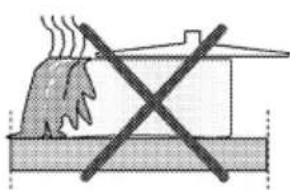
natural_image
Diagram showing a fire with smoke rising above a building, crossed out by a black X (no text or symbols present)Spills may damage the glass ceramic surface and cause fire.
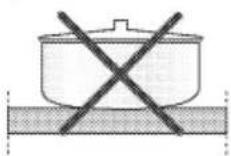
Do not use vessels with concave or convex bottoms.
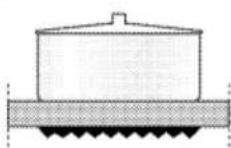
Use only the saucepans and pans with flat bottoms. They ensure easier heat transfer.
For induction hobs, use only vessels suitable for induction cooking.
Saucepan test
Use following methods to test whether your saucepan is compatible with the induction hob or not.
- Your saucepan is compatible if its bottom holds magnet.
- Your saucepan is compatible if does not flash when you place your saucepan on cooking zone and start the hob.
You can use steel, teflon or aluminium saucepans with special magnetic bottom that contains labels or warnings indicating that the saucepan is compatible with induction cooking. Glass and ceramic vessels, pots and the stainless steel vessels with non-magnetic aluminium bottom should not be used.
Saucepan recognition-focusing
system
In induction cooking, only the area covered by the vessel on the relevant cooking zone is energised. The vessel's bottom is recognised by the system and only this area is heated automatically. Cooking stops if the cooking vessel is lifted from the cooking zone during
cooking. Selected cooking zone and symbol flashes alternately.
Safe use
Do not select high heating levels when you will use a non-sticking (teflon) saucepan with no oil or with very little oil.
Do not put metal items such as forks, knives or saucepan covers onto your hob since they can get heated.
Never use aluminium folio for cooking.
Never place food items wrapped with aluminium folio onto the cooking zone.

If there is an oven under your hob and if it is running, sensors of the hob can decrease the cooking level or turn off the oven.

When the hob is running, keep items with magnetic properties such as credit cards or cassettes away from the hob.
Selecting cooking zone suitable to the vessel
| Large cooking zone | Normal cooking zone | Small cooking zone |
| ∅ 25 cm | ∅ 20 cm | ∅ 16 cm |
 |  |  |
| Large cooking zone• Automatically fits to the saucepan.• Distributes the power ideally.• Provides perfect heat distribution. Used to cook dishes such as large crepes or large fishes rare or very rare. | Normal cooking zone• Automatically fits to the saucepan.• Distributes the power ideally.• Provides perfect heat distribution. Used for all kinds of cookings. | Small cooking zone• Used for slow cookings (sauces, creams)• Used to prepare small portions or portions based on number of persons. |
Using the hobs
DANGER:
Do not allow any object to drop on the hob. Even small objects such as a saltshaker may damage the hob.
Do not use cracked hobs. Water may leak through these cracks and cause short circuit.
In case of any kind of damage on the surface (eg., visible cracks), switch off the product immediately to minimize the risk of electric shock.
Turning on cooking zones

Graphics and figures are for informational purposes only. Actual displays and functions may vary according to the model of your hob.
Turning the hob control knob clockwise the power of the according cooking zone can be increased. To reduce the power of the cooking zone again it is necessary to turn the hob control knob counterclockwise.
The current power level is on the display unit of the hob.
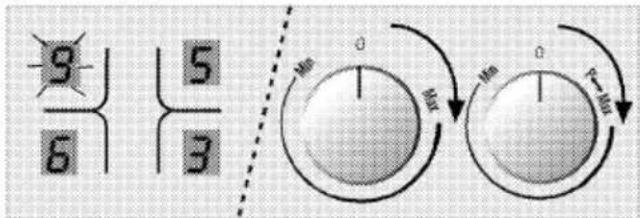
Turning off the cooking zones:
The hob control knob is turned from the locked "0" position to switch a cooking zone on as well as when the hob control knob is turned back to the zero position to switch a cooking zone off.

If all knobs are turned to zero locked position the display disappears after several times. If a buzzer is implemented a signal is played when the control is switched off.
Residual heat indicator
"H" symbol that appears on the cooking zone display indicates that the hob is still hot and may be used to keep a small amount of
food warm. The symbol will disappear when the cooking zone cools down or when it is activated.

When power is cut off, residual heat indicator will not light up and does not warn the user against hot cooking zones.
High Power (Booster)
Booster is a function which facilitates cooking. All cooking zones indicated with "P" symbol in the Technical Specifications table are equipped with Booster function.
Turning on High Power (Booster):
- Turn the hob control knob clockwise to position "Max".
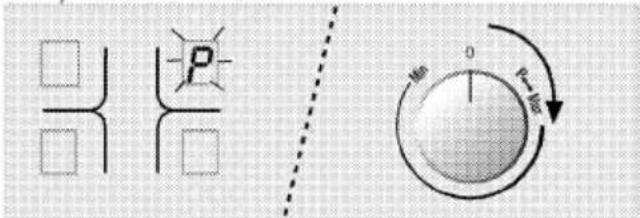
- Turn the hob control knob in the right overwind position to activate High power (Booster "P"). "P" will appear on related cooking zone display.

The hob will drop to level 9 after several minutes (optional) automatically.
Turning off High Power (Booster):
Turn the hob control knob in the right overwind position to turn off High power (Booster "P"). "9" will appear on related cooking zone display.
Child Lock
You can protect the hob by child lock to prevent children from changing hob functions.
Activating the Child Lock
- Turn the first two hob control knobs from the left simultaneously in to the left overwind and hold in that position at least 2 second.
» Child lock function will be activated.
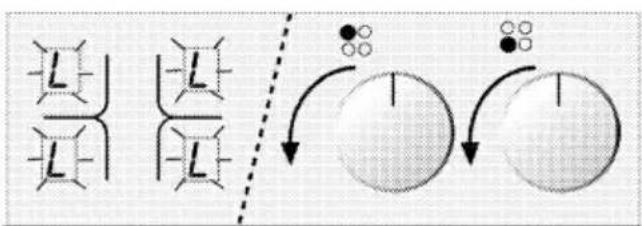
chemical
Diagram illustrating molecular interaction with L-ligands, showing electron transfer and particle distribution
If any key is pressed when the child lock is active, "L" symbol will appear on cooking zone displays.
Deactivating child lock
Turn the first two hob control knobs from the left simultaneously in to the left overwind and hold in that position at least 2 second. Child lock function will be deactivated.

If the hob is turned off and on in this condition, child lock will be still active.

If any hob control knob was in a position different from "0", after unlocking all hob control knobs have to be turned back in the "0" position
Quick Heating Function
Quick heating is a function which facilitates cooking. All cooking zones are equipped with Quick heating function. This function can be operated by setting temperature level beforehand.
Turning on Quick Heating Function:
- Turn the related hob control knob in to the left overwind and hold in that position at least 2 second.
» "A" will appear on related cooking zone display.
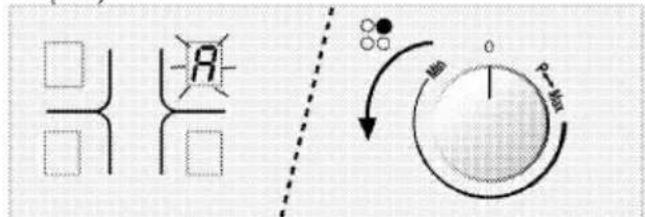
- Turn the hob control knob clockwise to set heating level (it is supposed that level 7 is selected for the example).
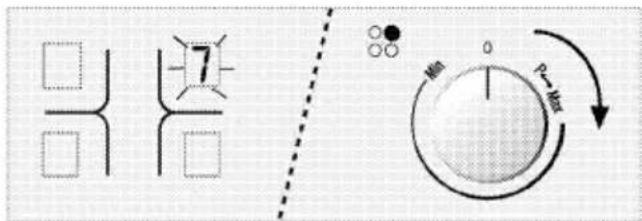
» "A" and "7" will appear on related cooking zone display alternately.

Within the next 10 seconds a valid cooking level has to be selected.

When the Quick operation time is up, the hob will continue operating at the set temperature level.
Turning off Quick Heating Function:
The hob control knob is turned from the locked "0" position to turn off the Quick Heating function.
Table: Quick Heating Operation Times
| Temperature level | Quick Heating Operation Times - Second |
| 0 | 0 |
| 1 | 48 |
| 2 | 144 |
| 3 | 230 |
| 4 | 312 |
| 5 | 408 |
| 6 | 120 |
| 7 | 168 |
| 8 | 216 |
Using induction cooking zones safely and efficiently
Operating principles: Induction hob heats directly the cooking vessel as a feature of its operating principles. Therefore, it has various advantages when compared to other hob types. It operates more efficiently and the hob surface does not heat up. Induction hob is equipped with superior safety systems that will provide you maximum usage safety.

Your hob can be equipped with induction cooking zones with a diameter of 160, 200 and 250 mm depending on the model. With induction feature, each cooking zone detects each vessel placed on them. Energy builds up only where the vessel contacts with the cooking zone and thus, minimum energy consumption is achieved.
Operation time constraints
The hob control is equipped with an operation time limit. When one or more cooking zones are left on, the cooking zone will automatically be deactivated after a certain period of time (see Table-1). If there is a timer assigned to the cooking zone, the timer display will also turn off later.
Operation time limit depends on the selected temperature level. Maximum operation time is applied at this temperature level.
The cooking zone may be restarted by the user after it is turned off automatically as described above.
Table-1: Operation time limits
| Temperature level | Operation time limit - minutes |
| 0 | 0 |
| 1 | 520 |
| 2 | 402 |
| 3 | 318 |
| 4 | 260 |
| 5 | 212 |
| 6 | 170 |
| 7 | 139 |
| 8 | 113 |
| 9 | 90 |
| Booster | 5 (*) |
| (*) The hob will drop to level 9 after 5 minutes (optional) | |
Overheating protection
Your hob is equipped with some sensors ensuring protection against overheating. Following may be observed in case of overheating:
• Active cooking zone may be turned off.
- Selected level may drop. However, this condition cannot be seen on the indicator.
• E2 error might be given.
Precise power setting
Induction hob reacts the commands immediately as a feature of its operating principles. It changes the power settings very fast. Thus, you can prevent a cooking pot (containing water, milk and etc.) from overflowing even if it was just about to overflow.
Operating noisy
Some noises may arise from the induction hob. These sounds are normal and a part of induction cooking.
• Noise becomes prominent in high temperature levels.
• Alloy of the saucepan can cause noise.
• In low levels, a regular on/off sound can be heard because of the operating principles.
- Noise can be heard if an empty saucepan is heated. When you put water or food in it, this sound will clear away.
• The noise of the fan that cools electric system can be heard.
Error messages
Table-2: Error codes and error sources
| Cause of error | Indicator | Display |
| Overheat error | "E2" symbol flashes | Relevant cooking zone display |
| Hob overheated | "H" symbol flashes | Cooking zone display |
| Mains errors | "E6" symbol flashes | Cooking zone display |
| Sensor failure | "E9" symbol flashesr | Relevant cooking zone display |
| Permanent use of knobs | "¬"symbol flashes | Cooking zone display |

For further information about error messages that may appear on the touch control panel, see Table-2.

If the surface of the touch control panel is exposed to intense vapor, entire control system may become deactivated and give error signal.

Keep the surface of the touch control panel clean. Erroneous operation may be observed.
6 How to operate the oven
General information on baking, roasting and grilling
WARNING
Hot surfaces cause burns! Product may be hot when it is in use. Never touch the hot burners, inner sections of the oven, heaters and etc. Keep children away. Always use heat resistant oven gloves when putting in or removing dishes into/from the hot oven.
DANGER:
Be careful when opening the oven door as steam may escape. Exiting steam can scald your hands, face and/or eyes.
Tips for grilling
When meat, fish and poultry are grilled, they quickly get brown, have a nice crust and do not get dry. Flat pieces, meat skewers and sausages are particularly suited for grilling as are vegetables with high water content such as tomatoes and onions.
* Distribute the pieces to be grilled on the wire shelf or in the baking tray with wire shelf in such a way that the space covered does not exceed the size of the heater.
- Slide the wire shelf or baking tray with grill into the desired level in the oven. If you are grilling on the wire shelf, slide the baking tray to the lower rack to
collect fats. Add some water in the tray for easy cleaning.
Foods that are not suitable for grilling carry the risk of fire. Only grill food which is suitable for intensive grilling heat. Do not place the food too far in the back of the grill. This is the hottest area and fatty food may catch fire.
How to operate the electric oven

Before you can use the oven, the time must be set. If the time is not set, oven will not operate.
Your oven is equipped with pop-out knob that protrude when you press them.
- Press inwards to protrude the knob and then turn it to make the desired setting.
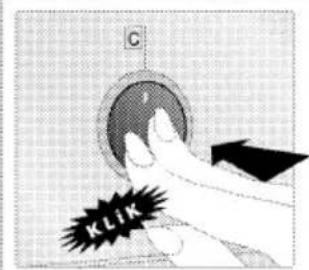
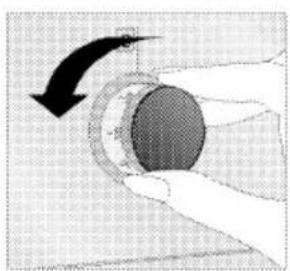
natural_image
Hand holding a circular object with a black arrow indicating rotation (no text or symbols)- When the cooking process is finished, turn the knob to off (upper) position and press it inwards.
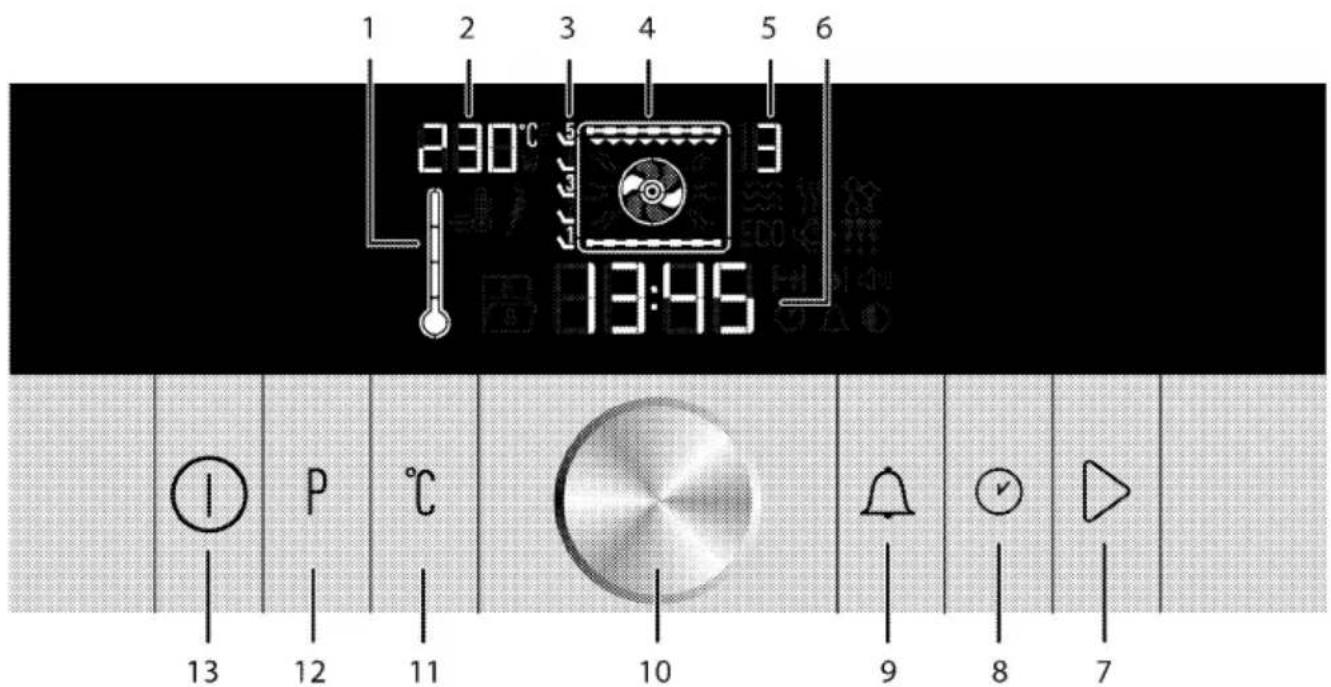
1 Oven Inner Temperature symbol
2 Temperature indicator field
3 Shelf positions
4 Function display
5 Function number
6 Current time indicator field
7 Start/stop cooking key
8 Time and settings key
9 Alarm key
10 Temperature-time increase/decrease-
navigate knob
11 Temperature/booster setting key
12 Return Key to function display
13 ON/OFF key
Display symbols:
Rapid heating (Booster) symbol
Cooking time symbol
End of cooking time symbol
Alarm symbol
Current time symbol
Volume setting symbol
Brightness setting symbol
Defrost symbol
Keylock symbol
Door open symbol
Oven inner temperature symbol
Meat probe symbol *

Pyro symbol *
Steam symbol *
Varies depending on the product model.
Oven returns to stand-by display after it is switched on and the current time is set. Only the current time appears on the display.
Only the ① and ⚙ keys are functional when the display is in this status. You can perform all actions in the Settings menu. While the oven is hot, it is possible to see inner tempature of oven by touching key ℃.
Select temperature and operating mode
- Touch ① key to switch on the oven.
- Initial operation screen appears when the oven is turned on.
This screen contains the recommended temperature in the temperature indicator, and the active heaters, function number and recommended tray position appear in the function display.

If you touch Ⓘ key briefly in this screen, the oven will give an audible warning. Touch the Ⓘ key for longer than 1 second to switch on the oven.
- Turn the Navigate in Menus knob to right/left to set the desired operating mode (function).
After the function is selected, "Temperature", "Cook time", "Cook end time" and "Booster" (rapid heating) can be set.
- Touch the ^ C key for once to change the temperature. "°C" symbol flashes
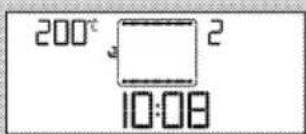
-
Turn the Navigate in Menus knob to right/left until the desired temperature appears in the Temperature indicator. Touch °C, △ or ⏻ key once when the desired value appears on the display. If you do not touch any key, the set value will be automatically confirmed after 10 seconds.
-
If cooking function and temperature values are suitable, touch ▷ key to start cooking. Cooking starts and ↓ appears on the display. As the inner temperature increases, the level in the middle of the symbol also increases.
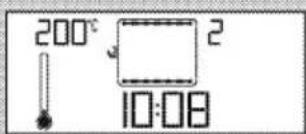

If the oven door is opened during cooking, symbol appears on the display.
Switching off the electric oven
Touch ① key to switch off the oven.
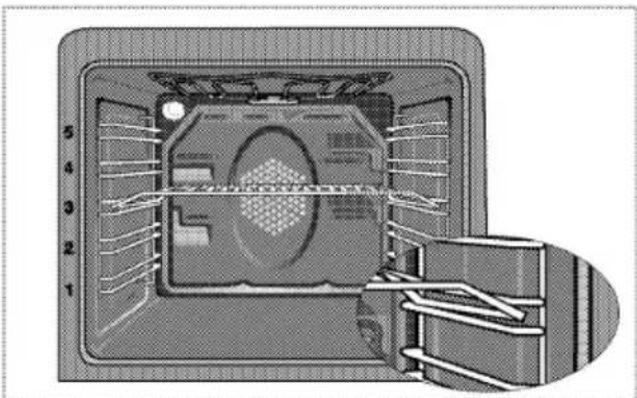
natural_image
Cross-sectional diagram of a refrigerator interior showing internal compartments and ventilation ducts (no text or labels)Rack positions (For models with wire grill)
It is important to place the wire grill onto the wire rack correctly. Wire grill must be inserted between the wire racks as illustrated in the figure.
Do not let the wire grill stand against the rear wall of the oven. Slide your wire grill to the front section of the rack and settle it with the help of the door in order to obtain a good grill performance.
Function table
Function table indicates the functions that can be used in the oven and their respective maximum and minimum temperatures.

Functions vary depending on the product model.

Maximum adjustable cooking time in modes except "warm keeping" function is limited with 6 hours due to safety reasons.

While making any adjustment, related symbols will flash on the display.

You can return to the function display by touching P key in any screen.

Program will be cancelled in case of power failure. You must reprogram the oven.

Current time cannot be set while the oven is operating in any function, or if semi-automatic or full automatic programming is made on the oven.

Even if the oven is switched off, oven lamp lights up when the oven door is opened.
| Function | Recommended temperature (°C) | Temperature range (°C) |
| Static | 200 | 40-280 |
| Static + fan | 175 | 40-280 |
| Fan heating | 180 | 40-280 |
| Multi (3D) | 205 | 40-280 |
| Fan heat +bottom | 210 | 40-280 |
| Full grill+Fan | 200 | 40-280 |
| Full grill | 280 | 40-280 |
| Low grill | 280 | 40-280 |
| Eco fan | 180 | 160-220 |
| Bottom heating | 180 | 40-220 |
| Warm keeping | 60 | 40-100 |
| Defrost | - | - |
| * Functions vary depending on the product model | ||
Operating modes
The order of operating modes shown here may be different from the arrangement on your product.
1. Top and bottom heating
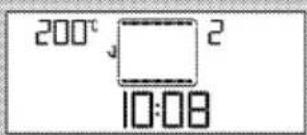
* Food is heated simultaneously from the top and bottom. For example, it is suitable for cakes, pastries, or cakes and casseroles in baking moulds. Cook with one tray only.
* Suitable rack position will be displayed on screen.
2. Fan supported bottom/top heating
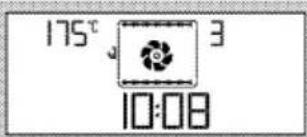
Hot air heated by the bottom and top heaters is evenly distributed throughout the oven rapidly by means of the fan. Cook with one tray.
3. Fan Heating
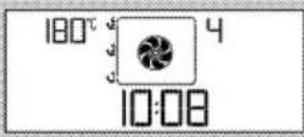
* Warm air heated by the rear heater is evenly distributed throughout the oven rapidly by means of the fan. It is suitable for cooking your meals in different rack levels and preheating is not required in most cases. Suitable for cooking with multi trays.

When the oven door is opened, the fan motor will not run in order to keep the hot air inside.
4. "3D" function
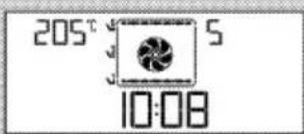
* Top heating, bottom heating and fan assisted heating are in operation. Food is cooked evenly and quickly all around. Cook with one tray only.
Pizza function
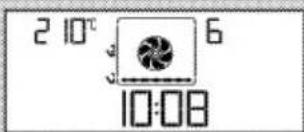
The bottom heating and fan assisted heating are in operation. Suitable for baking pizza.
6. Full grill+Fan
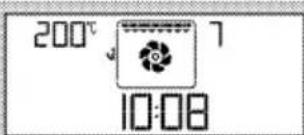
Hot air heated by the full grill is distributed very fast in the oven by means of the fan. It is suitable for grilling large amount of meat.
- Put big or medium-sized portions in correct rack position under the grill heater for grilling.
- Set the temperature to maximum level.
• Turn the food after half of the grilling time.
7. Full grill
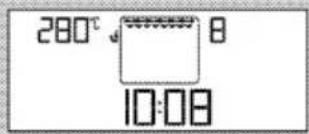
* Large grill at the ceiling of the oven is in operation. It is suitable for grilling large amount of meat.
- Put big or medium-sized portions in correct rack position under the grill heater for grilling.
- Set the temperature to maximum level.
• Turn the food after half of the grilling time.
8. Grill
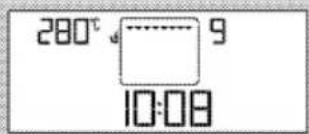
* Small grill at the ceiling of the oven is in operation. Suitable for grilling and gratin dishes.
- Put small or medium-sized portions in correct shelf position under the grill heater for grilling.
- Set the temperature to maximum level.
• Turn the food after half of the grilling time.
9. Eco Fan Heating
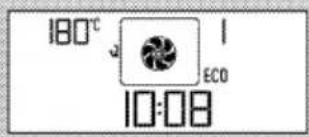
To save power, you can use this function instead of the cooking operations that you would perform by using Fan Heating at 160-220°C temperature range. But, the cooking time will increase a little bit.
* Cooking times related to this function are indicated in 'Eco-fan cooking' table.
10. Bottom heating
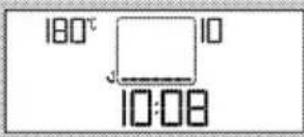
* Only bottom heating is in operation. It is suitable for pizza and for subsequent browning of food from the bottom.
11. Keep warm
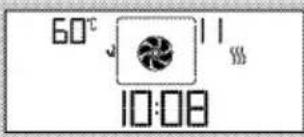
* Used for keeping food at a temperature ready for serving for a long period of time.
12. Operating with fan
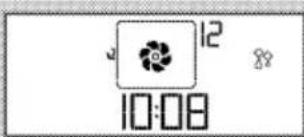
The oven is not heated. Only the fan (in the rear wall) is in operation. Suitable for thawing frozen granular food slowly at room temperature and cooling down the cooked food.
How to operate the oven control unit
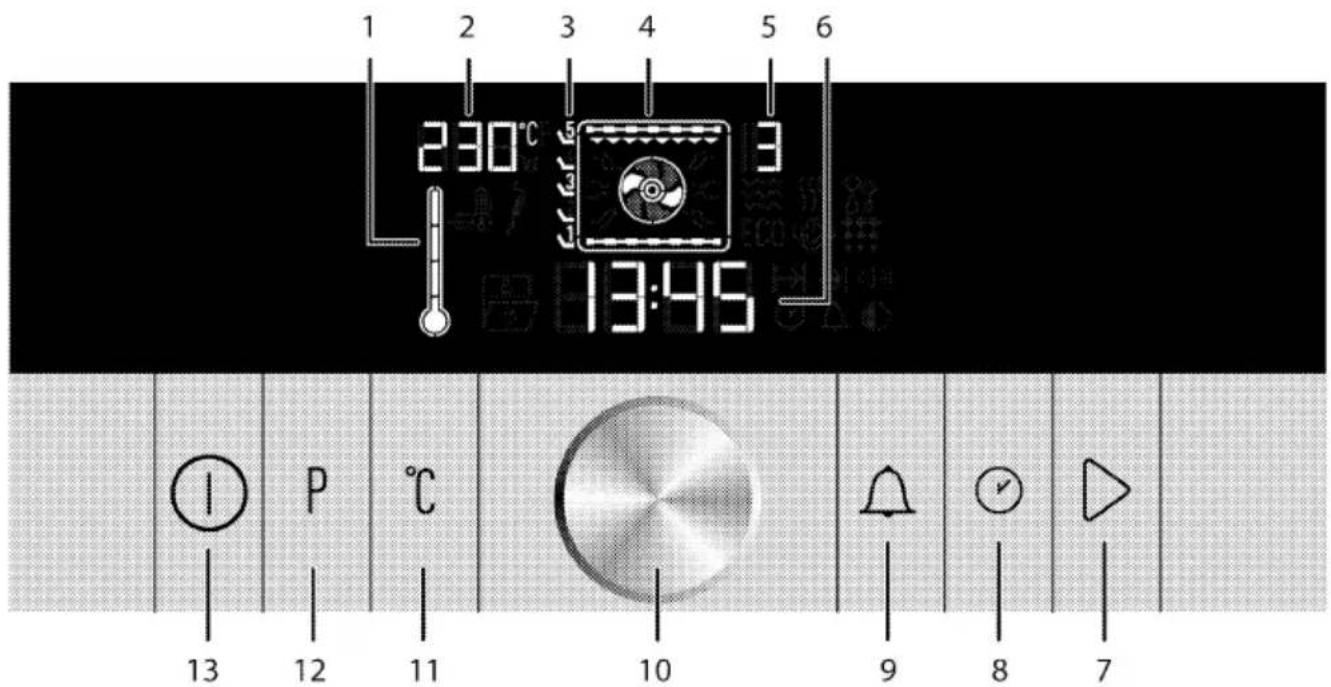
1 Oven Inner Temperature symbol
2 Temperature indicator field
3 Shelf positions
4 Function display
5 Function number
6 Current time indicator field
7 Start/stop cooking key
8 Time and settings key
9 Alarm key
10 Temperature-time increase/decrease- navigate knob
11 Temperature/booster setting key
12 Return Key to function display
13 ON/OFF key
Enable semi-automatic operation
In this operation mode, you may adjust the time period during which the oven will operate (cook time).
- Touch ① key to switch on the oven.

If you touch Ⓘ key briefly in this screen, the oven will give an audible warning. Touch the Ⓘ key for longer than 1 second to switch on the oven.
- Turn the Navigate in Menus knob to right/left to set the desired operating mode (function).
- Touch the ℃ key for once to change the temperature. "°C" symbol flashes
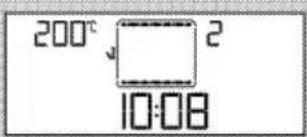
- Turn the Navigate in Menus knob to right/left until the desired temperature appears in the Temperature indicator. Touch ℃, △ or ⏻ key once when the desired value appears on the display. If you do not touch any key, the set value will be automatically confirmed after 10 seconds.
- For cooking time, press ⬇ key for once to scroll to the "Cook time" on the text display. |→| symbol flashes at the same time.
- Turn the Navigate in Menus knob to right/left to set the desired cooking time and confirm the setting by touching the ⏻ key. Once the Cook Time is set, |→| will be displayed continuously.
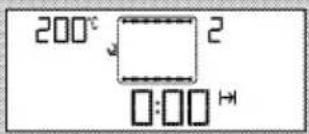
- Put your dish into the oven and close the door.
- If cooking function, temperature and time values are suitable, touch ▷ key to start cooking. Cooking starts and ↓ appears on the display.

If you touch ▷ key briefly in this screen, the oven will give an audible warning. Touch the ▷ key for longer than 1 second to start cooking.
» The oven will be heated up to the preset temperature and will maintain this temperature until the end of the cooking time you selected. The oven lamp is lit during the cooking process.

All segments of the ⚡ symbol will light up when the oven reaches the set temperature.
- After the cooking is completed, the oven will give an audible warning.
- To stop the audible warning, just touch any key. If ▷ is touched, the oven will continue operating in the selected mode. Audible warning stops.
- Oven is switched off automatically and the current time is displayed if you do not touch the ▷ key.
Switch on fully automatic operation
In this operation mode you can adjust cooking time and end of cooking time.
- Touch ① key to switch on the oven.
-
Turn the Navigate in Menus knob to right/left to set the desired operating mode (function).
-
If you want to change the temperature, touch ℃ once to reach the temperature display.
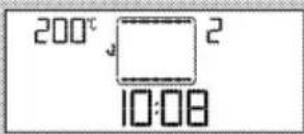
- Turn the Navigate in Menus knob to right/left until the desired temperature appears in the Temperature indicator. Touch ℃, △ or ⏻ key once when the desired value appears on the display. If you do not touch any key, the set value will be automatically confirmed after 10 seconds.
- For cooking time, press ⬇ key for once to scroll to the "Cook time" on the text display. |→| symbol flashes at the same time.
- Turn the Navigate in Menus knob to right/left to set the desired cooking time and confirm the setting by touching the ⏻ key. Once the Cook Time is set, |→| will be displayed continuously.
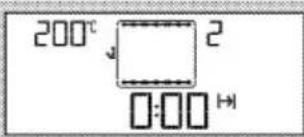
- Touch the ⬇ key twice for the End of Cooking Time. Meanwhile, →| flashes in the display.
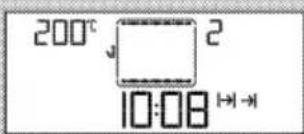
- Turn the Navigate in Menus knob to right/left to set the desired end of cooking time and confirm the setting by touching the ⬇ key. Once the Cook end time is set, →| will be displayed continuously.
-
Put your dish into the oven and close the door.
-
If cooking function, temperature, time and end of cooking time values are suitable, touch ▷ key to start cooking.
» Oven timer automatically calculates the startup time for cooking by deducting the cooking time from the end of cooking time you have set.
- Selected operation mode is activated when the startup time of cooking has come. Cooking starts and appears on the display. Oven heats up to the adjusted temperature. It maintains this temperature until the end of the cooking time. The oven lamp is lit during the cooking process.

All segments of the ↓ symbol will light up when the oven reaches the set temperature.
-
After the cooking is completed, the oven will give an audible warning.
-
To stop the audible warning, just touch any key. If ▷ is touched, the oven will continue operating in the selected mode. Audible warning stops.

If you want to cancel the semi-automatic or automatic programming after you have set them, you need to reset the cooking time. You can also switch off the oven by touching the ① key if you want.
Setting the booster (Quick heating)
Use Booster (rapid pre-heating) function to make the oven reach the desired temperature faster.

Booster cannot be selected in defrost, eco-fan heating and keep warm modes. Booster settings will be cancelled in case of power outage.
Select the desired cooking function and then:
- Touch the ℃ key twice. "OFF" will appear on the display.
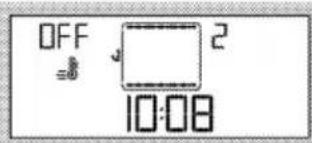
- Turn the Navigate in Menus knob to right for once. "ON" and ≡ symbol appear on the display. Touch the ℃ key to confirm the setting.
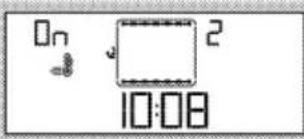
- If cooking function and temperature values are suitable, touch ▷ key to start cooking. Cooking starts and ↓ appears on the display.
» ≡ symbol disappears as soon as the oven reaches the desired temperature and oven resumes operating in the function it was in before the Booster function.
-
To cancel Booster function, touch the °C key with short intervals until "ON" appears on the display.
-
Turn the Navigate in Menus knob to left for once. "OFF" will appear and ≡ symbol disappears on the display. Touch the ℃ key to confirm setting.
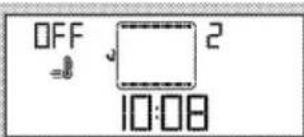
Using the keylock
You can prevent oven from being intervened with by activating the Keylock function.

Keylock can be used either when the oven is operating or not. Oven can be switched off by touching the ① key even when the keylock is activated while the oven is operating.
Activating the keylock
- Touch the ⏻ key with short intervals until ⏻ symbol appears on the display. "OFF" appears and the ⏻ symbol flashes on the display.
- Turn the Navigate in Menus knob to right for once to activate the keylock. "ON" will be displayed once the keylock is set. Then, the symbol will appear.
- Touch ⏻ to confirm the setting.
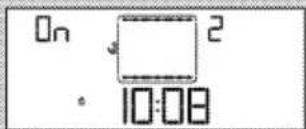
» After activating the keylock, an audible warning is given and symbol will appear on the display when you press any key (except Navigate in Menus knob).

Oven keys are not functional when the Keylock function is activated. Keylock will not be cancelled in case of power outage.
Deactivating the keylock
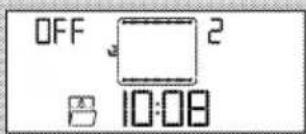
- Turn the Navigate in Menus knob to left for twice to deactivate the keylock.
» Key lock is deactivated and the symbol on the display disappears.
Using the clock as an alarm
You can use the clock of the product for any warning or reminder apart from the cooking programme.
The alarm clock has no influence on the functions of the oven. It is only used as a warning. For example, this is useful when you want to turn food in the oven at a certain point of time. Alarm clock will give a signal once the time you set is over.

Maximum alarm time can be 23 hours and 59 minutes.
To set the alarm:
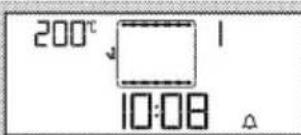
- Touch the △ key. △ symbol flashes on the display.
- Turn the Navigate in Menus knob to right/left to set the desired time and confirm the setting by touching the △ key. △ symbol remains lit after setting the alarm time.
- After the alarm time is finished, will start flashing and an alarm signal is heard.
- Press any key to stop the alarm.
To cancel the alarm:
- Touch the △ key. △ symbol flashes on the display.
- Turn the Navigate in Menus Knob to left until "00:00" appears on the display and confirm the setting by touching the △ key.
» Alarm is cancelled and 🔒 symbol disappears.
Cooking times table

The timings in this chart are meant as a guide. Timings may vary due to temperature of food, thickness, type and your own preference of cooking.
Baking and roasting

1st rack of the oven is the bottom rack.
| Dish | Cooking level number | Rack position | Temperature (°C) | Cooking time (approx. in min.) | |
| Cakes in tray* | One level | 3 | 175 | 25...30 | |
| Cakes in mould* | One level | 2 | 180 | 40...50 | |
| Cakes in cooking paper* | One level | 3 | 175 | 25...30 | |
| 2 levels | 1-5 | 175 | 30...40 | ||
| 3 levels | 1-3-5 | 180 | 45...55 | ||
| Sponge cake* | One level | 3 | 200 | 5...10 | |
| 2 levels | 1-5 | 175 | 20...30 | ||
| Cookies* | One level | 3 | 175 | 25...30 | |
| 2 levels | 1-5 | 170...190 | 30...40 | ||
| 3 levels | 1-3-5 | 175 | 35...45 | ||
| Dough pastry* | One level | 2 | 200 | 30...40 | |
| 2 levels | 1-5 | 200 | 45...55 | ||
| 3 levels | 1-3-5 | 200 | 55...65 | ||
| Rich pastry* | One level | 2 | 200 | 25...35 | |
| 2 levels | 1-5 | 200 | 35...45 | ||
| 3 levels | 1-3-5 | 190 | 45...55 | ||
| leaven* | One level | 2 | 200 | 35...45 | |
| 2 levels | 1-3 | 190 | 35...45 | ||
| Losagna* | One level | 2-3 | 200 | 30...40 | |
| Pizza* | One level | 2 | 200...220 | 15...20 | |
| One level | 3 | 200 | 10...15 | ||
| Beef steak (whole)/Roast | One level | 3 | 25 min. 250/max, then 180...190 | 100...120 | |
| Leg of Lamb (casserole) | One level | 3 | 25 min. 250/max, then 190 | 70...90 | |
| One level | 3 | 25 min. 250/max, then 190 | 60...80 | ||
| Roasted chicken | One level | 2 | 15 min. 250/max, then 180...190 | 55...65 | |
| One level | 2 | 15 min. 250/max, then 180...190 | 55...65 | ||
| Turkey (5.5 kg) | One level | 1 | 25 min. 250/max, then 180...190 | 150...210 | |
| One level | 1 | 25 min. 250/max, then 180...190 | 150...210 | ||
| Fish | One level | 3 | 200 | 20...30 | |
| One level | 3 | 200 | 20...30 | ||
| When cooking with 2 trays at the same time, place the deeper tray on the upper rack and the other one on the lower rack.* It is suggested to perform areheating for all foods. | |||||
(**) In a cooking that requires preheating, preheat at the beginning of cooking until the thermostat lamp turns off.
Eco Fan Heating

Do not change the cooking temperature after cooking starts in Eco Fan Heating mode.

Do not open the door during cooking in the Eco Fan Heating mode.
| Dish | Cooking level number | Rock position | Temperature (°C) | Cooking time (approx. in min.) | ||
| Cakes-in-cooking paper | One level | 3 | 200 | 35...40 | ||
| Cookie | One level | 3 | 200 | 30...35 | ||
| Dough pastry | One level | 3 | 200 | 40...45 | ||
| Rich pastry | One level | 3 | 200 | 40...45 | ||
Tips for baking cake
• If the cake is too dry, increase the temperature by 10^ C and decrease the cooking time.
• If the cake is wet, use less liquid or lower the temperature by 10^ C.
• If the cake is too dark on top, place it on a lower rack, lower the temperature and increase the cooking time.
• If cooked well on the inside but sticky on the outside use less liquid, lower the temperature and increase the cooking time.
Tips for baking pastry
• If the pastry is too dry, increase the temperature by 10^ C and decrease the cooking time. Dampen the layers of dough with a sauce composed of milk, oil, egg and yoghurt.
• If the pastry takes too long to bake, pay care that the thickness of the pastry you have prepared does not exceed the depth of the tray.
• If the upper side of the pastry gets browned, but the lower part is not cooked, make sure that the amount of sauce you have used for the pastry is not too much at the bottom of the pastry. Try to scatter the sauce equally between the dough layers and on the top of pastry for an even browning.

Cook the pastry in accordance with the mode and temperature given in the cooking table. If the bottom part is still not browned enough, place it on one lower rack next time.
Tips for cooking vegetables
• If the vegetable dish runs out of juice and gets too dry, cook it in a pan with a lid instead of a tray. Closed vessels will preserve the juice of the dish.
• If a vegetable dish does not get cooked, boil the vegetables beforehand or prepare them like canned food and put in the oven.
Settings menu
Brightness setting
Brightness can only be set when the oven is switched off.
- Touch ⚙ key with short intervals until Ⓞ symbol appears on the display. ⏻ symbol flashes on the display.
-
There are 4 brightness levels, namely 1, 2, 3 and 4. Turn the Navigate in Menus knob to right/left to select the desired level.
-
Touch ⏻ to confirm the setting.

Brightness level decreases to save power when the oven is switched off. It restores to the set level again when the oven is switched on.
» It returns to the stand-by display. Only the current time appears on the display.
Voice Level setting
Voice level can only be set when the oven is switched off.
- Touch the ⏻ key with short intervals until 🔊 symbol appears on the display. 🔊 symbol flashes on the display.
- There are 2 voice levels, namely 1 and 2. Turn the Navigate in Menus knob to right/left to select the desired level.
- Touch ⏻ to confirm the setting. » It returns to the stand-by display. Only the current time appears on the display.
Current time setting
Current time can only be set when the oven is switched off. If you want to change the time that was set during initial setup:
□□:□□
- Touch ⚙ key with short intervals until ⚙ symbol appears on the display. Hour field symbol flashes on the display. Turn the Navigate in Menus knob to right/left to set the hour.
- Touch the ⏻ key to activate the minute section. Minute field and ⏻ symbol flash on the display. Turn the Navigate in Menus knob to right/left to set the minute section.
- Touch ⏻ to confirm the hour. » It returns to the stand-by display. Only the current time appears on the display.

How to operate the grill

Before you can use the oven, the time must be set. If the time is not set, oven will not operate.
WARNING
Close oven door during grilling. Hot surfaces may cause burns!
Switching on the grill
- Turn the Function knob to the desired grill symbol.
- Then, select the desired grilling temperature.
- If required, perform a preheating of about 5 minutes.
» Temperature light turns on.
Switching off the grill
- Turn the Function knob to Off (top) position.
Switching on the grill
- Touch Ⓐ key to switch on the oven.
-
Turn the Menu navigate knob to right/left to select the desired grill function.
After the function is selected, "Temperature", "Cook time", "Cook end time" and "Booster" (rapid heating) can be set. -
Touch the °C key for once to change the temperature. "°C" symbol flashes
-
Turn the Navigate in Menus knob to right/left until the desired temperature appears in the Temperature indicator. Touch ℃, △ or ⏻ key once when the desired value appears on the display. If you do not touch any key, the set value will be automatically confirmed after 10 seconds.
-
If cooking function and temperature values are suitable, touch ▷ key to start cooking. Cooking starts and ↓ appears
on the display. As the inner temperature increases, the level in the middle of the symbol also increases.
Switching off the grill
- Touch Ⓐ key to switch off the oven.
Rack positions
Grill performance will decrease if the wire grill stands against rear part of the oven. Slide your wire grill to the front section of the rack and settle it with the help of the door in order to obtain the best grill performance.
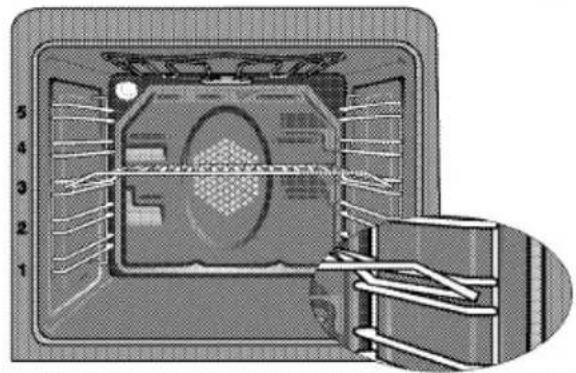
natural_image
Cross-sectional diagram of a refrigerator interior showing internal seating and ventilation duct (no text or labels)
Foods that are not suitable for grilling carry the risk of fire. Only grill food which is suitable for intensive grilling heat. Do not place the food too far in the back of the grill. This is the hottest area and fatty food may catch fire.
Cooking times table for grilling
Grilling with electric grill
| Food | Insertion level | Grilling time (approx.) |
| Fish | 4...5 | 20...25 min.1 |
| Sliced chicken | 4...5 | 25...35 min |
| Lamb chops | 4...5 | 20...25 min. |
| Roast beef | 4...5 | 25...30 min.# |
| Veat chops | 4...5 | 25...30 min.# |
| Toast bread | 4 | 1...2 min. |
| *depending on thickness | ||
7 Maintenance and care
General information
Service life of the product will extend and the possibility of problems will decrease if the product is cleaned at regular intervals.
DANGER:
Disconnect the product from mains supply before starting maintenance and cleaning works.
There is the risk of electric shock!
DANGER:
Allow the product to cool down before you clean it.
Hot surfaces may cause burns!
- Clean the product thoroughly after each use. In this way it will be possible to remove cooking residues more easily, thus avoiding these from burning the next time the appliance is used.
• No special cleaning agents are required for cleaning the product. Use warm water with washing liquid, a soft cloth or sponge to clean the product and wipe it with a dry cloth.
• Always ensure any excess liquid is thoroughly wiped off after cleaning and any spillage is immediately wiped dry.
Do not use cleaning agents that contain acid or chloride to clean the stainless or inox surfaces and the handle. Use a soft cloth with a liquid detergent (not abrasive) to wipe those parts clean, paying attention to sweep in one direction.

The surface might get damaged by some detergents or cleaning materials.
Do not use aggressive detergents, cleaning powders/creams or any sharp objects during cleaning.
Do not use harsh abrasive cleaners or sharp metal scrapers to clean the oven door glass since they can scratch the surface, which may result in shattering of the glass.

Do not use steam cleaners to clean the appliance as this may cause an electric shock.
Cleaning the hob
Glass ceramic surfaces
Wipe the glass ceramic surface using a piece of cloth dampened with cold water in a manner as not to leave any cleaning agent on it. Dry with a soft and dry cloth. Residues may cause damage on the glass ceramic surface when using the hob for the next time. Dried residues on the glass ceramic surface should under no circumstances be scraped with hook blades, steel wool or similar tools. Remove calcium stains (yellow stains) by a small amount of lime remover such as vinegar or lemon juice. You can also use suitable commercially available products. If the surface is heavily soiled, apply the cleaning agent on a sponge and wait until it is absorbed well. Then, clean the surface of the hob with a damp cloth.

Sugar-based foods such as thick cream and syrup must be cleaned promptly without waiting the surface to cool down. Otherwise, glass ceramic surface may be damaged permanently.
Slight color fading may occur on coatings or other surfaces in time. This will not affect operation of the product.
Color fading and stains on the glass ceramic surface is a normal condition, and not a defect.
Cleaning the control panel
Clean the control panel and control knobs with a damp cloth and wipe them dry.

Do not remove the control buttons/knobs to clean the control panel.
Control panel may get damaged!
Cleaning the oven
To clean the side wall
- Remove the front section of the side rack by pulling it in the opposite direction of the side wall.
- Remove the side rack completely by pulling it towards you.
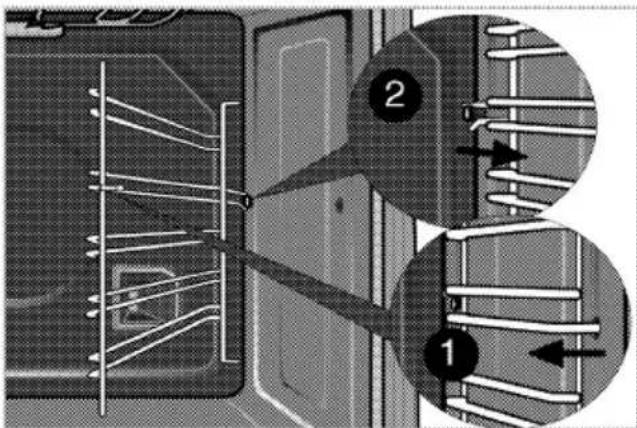
Catalytic walls
Side walls or just back wall of oven interior may be covered with catalytic enamel.
The catalytic walls of the oven must not be cleaned. The porous surface of the walls is self-cleaning by absorbing and converting spitting fat (steam and carbon dioxide).
Clean oven ceiling
The grill element can be folded out for cleaning the oven ceiling.
- Loosing locking screws at the grill element with a screwdriver or a coin.
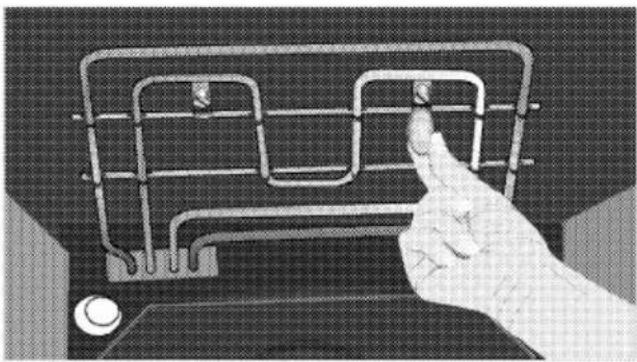
natural_image
Hand interacting with a wire maze-like structure (no text or symbols visible)
The grill element folds down. It remains anchored at the oven ceiling.
- Clean oven ceiling with a damp cloth.
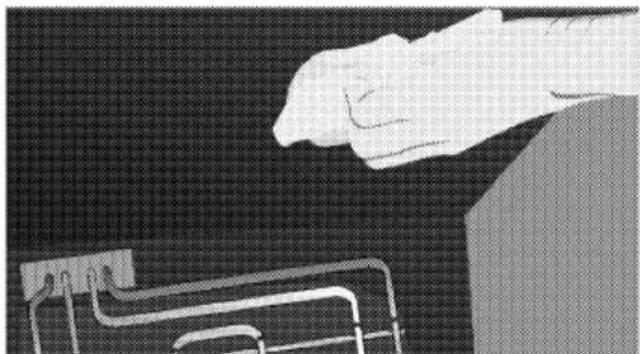
natural_image
Close-up of a hand holding a tool above a wire mesh structure (no text or symbols visible)- Fold the grill element up again and tighten the locking screws with a screwdriver or a coin.
Clean oven door
To clean the oven door, use warm water with washing liquid, a soft cloth or sponge to clean the product and wipe it with a dry cloth.

Don't use any harsh abrasive cleaners or sharp metal scrapers for cleaning the oven door. They could scratch the surface and destroy the glass.

Front door inner glass is coated to easy clean material. Do not use any harsh abrasive cleaners, hard metal scrapers, scouring pads or bleach to clean front door inner glass as they may scratch the surface. This may destroy the coating material.
Removing the oven door
- Open the front door (1).
- Open the clips at the hinge housing (2) on the right and left hand sides of the front door by pressing them down as illustrated in the figure.
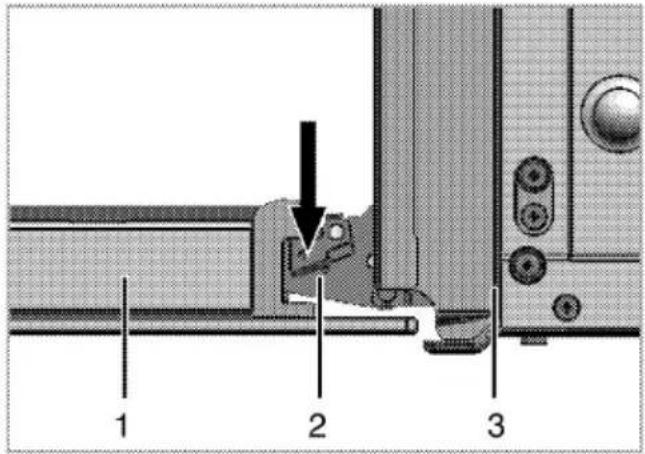
1 Front door
2 Hinge
3 Oven
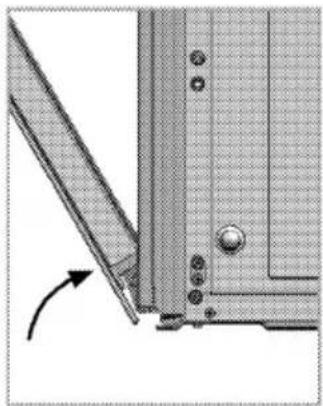
natural_image
Technical diagram of a mechanical joint or bracket with bolt holes and an arrow indicating rotation (no text or symbols present)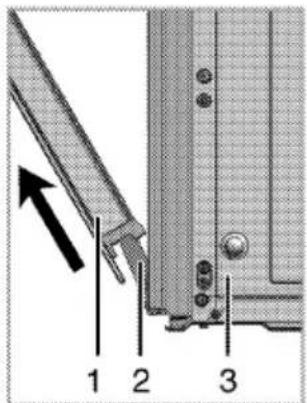
- Move the front door to half-way.
- Remove the front door by pulling it upwards to release it from the right and left hinges.

Steps carried out during removing process should be performed in reverse order to install the door. Do not forget to close the clips at the hinge housing when reinstalling the door.
Removing the door inner glass
The inner glass panel of the oven door can be removed for cleaning.
In case of the cleaning for the inner glass pane;
- After removing the oven door, proceed to following steps;
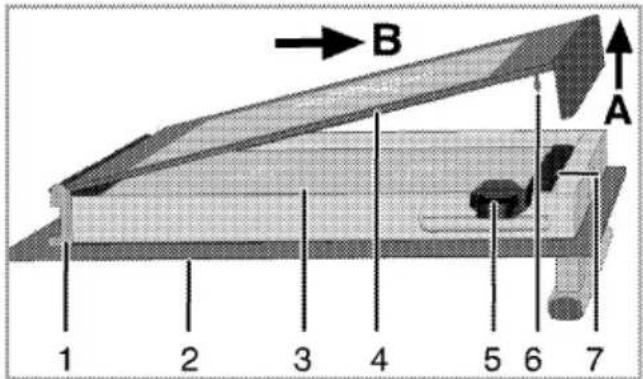
1 Hinge housing
2 Outer glass pane
3 Inner glass pane
4 Inmost glass pane
5 Spade
6 Pin
7 Pin housing
- As illustrated in figure, raise the inmost glass pane (4) slightly in direction A by means of spade (5) until you hear a "click" and pull it out in direction B.
- Then clean the inner glass pane (3) surface directly. No need to remove it from its location.
- After finishing to clean the outer glass pane (2), the first step to regroup the door is reinstalling inmost glass panel (4).
- First locate the bottom part of the inmost glass (4) into the hinge housing (1). Then push the inmost glass upper side pins (6) towards to the housing (7) until you hear a "click".
Replacing the oven lamp
DANGER:
Before replacing the oven lamp, make sure that the product is disconnected from mains and cooled down in order to avoid the risk of an electrical shock. Hot surfaces may cause burns!

The oven lamp is a special electric light bulb that can resist up to 300 °C. See Technical specifications, page 10 for details. Oven lamps can be obtained from Authorised Service Agents.

Position of lamp might vary from the figure.
If your oven is equipped with a round lamp:
- Disconnect the product from mains.
- Turn the glass cover counter clockwise to remove it.
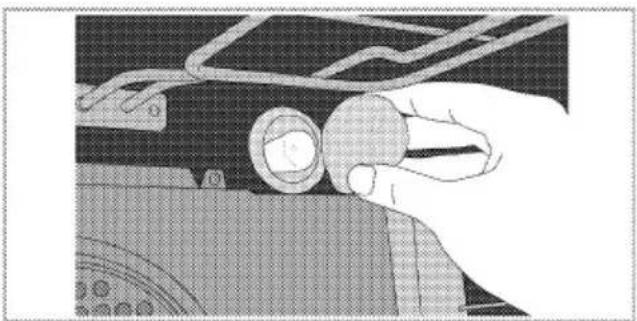
natural_image
Close-up of a hand holding a circular object with a ring, next to a mechanical component (no visible text or symbols)-
Remove the oven lamp by turning it counter clockwise and replace it with the new one.
-
Install the glass cover.
8 Troubleshooting
Oven emits steam when it is in use
It is normal that steam escapes during operation. >>> This is not a fault.
Product emits metal noises while heating and cooling.
- When the metal parts are heated, they may expand and cause noise. >>> This is not a fault.
Product does not operate.
• The mains fuse is defective or has tripped. >>> Check fuses in the fuse box. If necessary, replace or reset them.
• Product is not plugged into the (grounded) socket. >>> Check the plug connection.
- Buttons/knobs/keys on the control panel do not function. >>> Keylock may be enabled. Please disable it.
• Overheat protection is active. >>> Allow your hob to cool down.
• The cooking pot is not suitable. >>> Check your pot.
Oven light does not work.
- Oven lamp is defective. >>> Replace oven lamp.
• Power is cut. >>> Check if there is power. Check the fuses in the fuse box. If necessary, replace or reset the fuses.
Oven does not heat.
* Function and/or Temperature are not set. >>> Set the function and the temperature with the Function and/or Temperature knob/key.
Power is cut. >>> Check if there is power. Check the fuses in the fuse box. If necessary, replace or reset the fuses.
symbol appears on the cooking zone display.
• You have not placed the pot on the active cooking zone. >>> Check if there is a pot on the cooking zone.
- Your pot is not compatible with induction cooking. >>> Check if your cooking pot is compatible with induction hob.
The cooking pot is not centered properly or the bottom surface of the pot is not wide enough for the cooking zone. >>> Choose a pot wide enough and center the pot on the cooking zone properly.
• Cooking pot or cooking zone is overheated. >>> Allow them to cool down.
Selected cooking zone suddenly turns off during operation.
• Cooking time for the selected cooking zone may be over. >>> You may set a new cooking time or finish cooking.
• Overheat protection is active. >>> Allow your hob to cool down.
• An object may be covering the touch control panel. >>> Remove the object on the panel.
The pot does not get warm even if the cooking zone is on.
- Your pot is not compatible with induction cooking. >>> Check if your cooking pot is compatible with induction hob.
- The cooking pot is not centered properly or the bottom surface of the pot is not wide enough for the cooking zone. >>> Choose a pot wide enough and center the pot on the cooking zone properly.

Consult the Authorised Service Agent or the dealer where you have purchased the product if you can not remedy the trouble although you have implemented the instructions in this section. Never attempt to repair a defective product yourself.
Grundig Intermedia GmbH
Beuthener Strasse 41
90471 Nürnberg
www.grundig.com
72011 411 5900 12/45
AUS GUTEM GRUND
GRUNDIG
- INTEGRIERTER OFEN INTEGRATED OVEN
- Bitte zuerst diese Bedienungsanleitung lesen!
- Die Symbole
- Wichtige Sicherheits- und Umwelthinweise 4
- Allgemeine Informationen 10
- Installation 14
- Vorbereitungen 21
- Bedienung Kochfeld 24
- Bedienung des Backofens 31
- Reinigung und Wartung 44
- Problemlösungen 48
- Wichtige Sicherheits- und Umwelthinweise
- Allgemeine Sicherheit
- Elektrische Sicherheit
- Produktsicherheit
- Bestimmungsgemäße Verwendung
- Sicherheit von Kindern
- Altgeräte entsorgen
- Verpackungsmaterialien entsorgen
- Allgemeine Informationen
- Geräteübersicht
- Lieferumfang
- Bedienungsanleitung
- Backblech
- Kuchenblech
- Gitterrost
- Gitterrost und Backblech richtig in die Teleskopeinschübe einschieben
- Installation
- GEFAHR:
- Vor der Installation
- Einbauen und Anschließen
- Elektrischer Anschluss
- Netzkabel anschließen
- Gerät installieren
- Wenn sich der Ofen darunter befindet:
- Wenn sich ein Brett darunter befindet:
- Endkontrolle
- Transport
- Vorbereitungen
- Tipps zum Energiesparen
- Erste Inbetriebnahme Uhrzeit
- Zeit einstellen
- 00:00
- 10:08
- Erstreinigung des Gerätes
- Erstaufheizung
- WARNUNG
- Backofen-Funktion
- Grill-Funktion
- Bedienung Kochfeld
- Allgemeine Hinweise zum Kochen
- Kochgeschirr wählen
- Verwenden Sie bei Induktionsherden nur Kochgeschirr, das zum Kochen mit Induktion geeignet ist. Kochgeschirr testen
- Kochgeschirrerkennungssystem
- Sichere Benutzung
- Große Kochzone
- Normale Kochzone
- Kleine Kochzone
- Kochfeld verwenden
- Kochzonen abschalten:
- Restwärmeanzeige
- Hochleistung (Turbo)
- Hochleistung einschalten
- Hochleistung abschalten:
- Kindersicherung
- Kindersicherung einschalten
- Kindersicherung abschalten
- Schnellheizen-Funktion
- Schnellheizen-Funktion einschalten:
- Schnellheizen-Funktion abschalten:
- Induktionskochzonen sicher und effizient verwenden
- Betriebszeitbegrenzung
- Überhitzungsschutz
- Präzise Leistungseinstellungen
- Betriebsgeräusche
- Fehlermeldungen
- Bedienung des Backofens
- Allgemeine Hinweise zum Backen, Braten und Grillen
- Tipps zum Grillen
- Backofen bedienen
- Anzeigesymbole:
- Temperatur und Betriebsart einstellen
- Backofen ausschalten
- Einschubpositionen (bei Modellen mit Grillrost)
- Funktionstabelle
- Betriebsarten
- Ober- und Unterhitze
- Ober-/Unterhitze mit Umluft
- Umluft
- "3D"-Funktion
- Pizza-Funktion
- Grill, groß + Umluft
- Grill, groß
- Grill
- Eco-Umluft
- Unterhitze
- Warmhalten
- Umluftbetrieb
- Halbautomatischer Betrieb
- Vollautomatischer Betrieb
- Schnellheizen
- Tastensperre
- Tastensperre einschalten
- Tastensperre ausschalten
- Alarmfunktion
- Alarm einstellen:
- Alarm aufheben:
- Garzeitentabelle
- Backen und Braten
- Tipps zum Kuchenbacken
- Tipps für Gebäck
- Tipps zur Zubereitung von Gemüse
- Einstellungsmenü
- Helligkeit
- Sprachlautstärke
- Aktuelle Uhrzeit
- So bedienen Sie den Grill
- Grill einschalten
- Grill ausschalten
- Einschubpositionen
- Garzeitentabelle zum Grillen
- Reinigung und Wartung
- Allgemeine Hinweise
- Kochfeld reinigen
- Glaskeramik
- Bedienfeld reinigen
- Backofen reinigen
- So reinigen Sie die Seitenwand
- Katalytische Seitenwände
- Backofenoberseite reinigen
- Backofentür reinigen
- Backofentür ausbauen
- Türinnenscheibe ausbauen
- Beleuchtung des Backofens auswechseln
- Wenn Ihr Ofen mit einer runden Leuchte ausgestattet ist:
- Problemlösungen
- Aus dem Backofen tritt im Betrieb Dampf aus
- Beim Aufheizen und Abkühlen sind metallische Geräusche zu hören.
- Das Gerät funktioniert nicht.
- Die Ofenbeleuchtung funktioniert nicht.
- Backofen heizt nicht.
- Nun erscheint das Symbol auf der Kochzonenanzeige.
- Die ausgewählte Kochzone schaltet sich im Betrieb plötzlich ab.
- Das Kochgeschirr wird nicht gleichmäßig warm, wenn die Kochzone eingeschaltet ist.
- Please read this user manual first!
- Explanation of symbols
- Important instructions and warnings for safety and environment
- General safety
- Electrical safety
- Product safety
- Intended use
- Safety for children
- Disposing of the old product
- Package information
- General information
- Overview
- Package contents
- User manual
- Oven tray
- Cake tray
- Wire Shelf
- Placing the wire shelf and tray onto the telescopic racks properly
- Before installation
- Installation and connection
- Electrical connection
- DANGER:
- Connecting the power cable
- Installing the product
- Final check
- Future Transportation
- Preparation
- Tips for saving energy
- Initial use
- Day time
- Set the time
- First cleaning of the appliance
- Initial heating
- WARNING
- Electric oven
- Grill oven
- How to use the hob
- General information about cooking
- Never attempt to extinguish a possible fire with water!
- Saucepan selection
- For induction hobs, use only vessels suitable for induction cooking.
- Saucepan test
- Saucepan recognition-focusing
- system
- Safe use
- Using the hobs
- Turning on cooking zones
- Turning off the cooking zones:
- Residual heat indicator
- High Power (Booster)
- Turning on High Power (Booster):
- Turning off High Power (Booster):
- Child Lock
- Activating the Child Lock
- Deactivating child lock
- Quick Heating Function
- Turning on Quick Heating Function:
- Turning off Quick Heating Function:
- Using induction cooking zones safely and efficiently
- Operation time constraints
- Overheating protection
- Precise power setting
- Operating noisy
- Error messages
- How to operate the oven
- General information on baking, roasting and grilling
- Tips for grilling
- How to operate the electric oven
- Display symbols:
- Select temperature and operating mode
- Switching off the electric oven
- Rack positions (For models with wire grill)
- Function table
- Operating modes
- Top and bottom heating
- Fan supported bottom/top heating
- Fan Heating
- "3D" function
- Pizza function
- Full grill+Fan
- Full grill
- Eco Fan Heating
- Bottom heating
- Keep warm
- Operating with fan
- How to operate the oven control unit
- Enable semi-automatic operation
- Switch on fully automatic operation
- Setting the booster (Quick heating)
- Using the keylock
- Activating the keylock
- Deactivating the keylock
- Using the clock as an alarm
- To set the alarm:
- To cancel the alarm:
- Cooking times table
- Baking and roasting
- Eco Fan Heating
- Tips for baking cake
- Tips for baking pastry
- Tips for cooking vegetables
- Settings menu
- Brightness setting
- Voice Level setting
- Current time setting
- How to operate the grill
- Switching on the grill
- Switching off the grill
- Rack positions
- Cooking times table for grilling
- Maintenance and care
- General information
- Cleaning the hob
- Glass ceramic surfaces
- Cleaning the control panel
- Cleaning the oven
- To clean the side wall
- Catalytic walls
- Clean oven ceiling
- Clean oven door
- Removing the oven door
- Removing the door inner glass
- Replacing the oven lamp
- If your oven is equipped with a round lamp:
- Troubleshooting
- Oven emits steam when it is in use
- Product emits metal noises while heating and cooling.
- Product does not operate.
- Oven light does not work.
- Oven does not heat.
- symbol appears on the cooking zone display.
- Selected cooking zone suddenly turns off during operation.
- The pot does not get warm even if the cooking zone is on.
Mærke : GRUNDIG
Model : GEHM 34200 X
Kategori : Ovn