
SINEAX VS46 - Lyd/video konverter Camille Bauer - Gratis brugsanvisning og manual
Find enhedens vejledning gratis SINEAX VS46 Camille Bauer i PDF-format.


Brugerspørgsmål om SINEAX VS46 Camille Bauer
0 spørgsmål om dette apparat. Besvar dem du kender, eller stil dit eget.
Stil et nyt spørgsmål om dette apparat
Download vejledningen til din Lyd/video konverter i PDF-format gratis! Find din vejledning SINEAX VS46 - Camille Bauer og tag din elektroniske enhed tilbage i hånden. På denne side er alle dokumenter nødvendige for brugen af din enhed offentliggjort. SINEAX VS46 af mærket Camille Bauer.
BRUGSANVISNING SINEAX VS46 Camille Bauer
SINEAX VS46
Signalkonverter
Thermoelemente auf DC Strom-Spannung 162 975 02.12
Allgemeine Eigenschaften
Der VS46 wandelt ein Signal von einem Thermoelement in ein Spannungssignal (V) oder Stromsignal (mA) um. Zusätzlich kann über eine Fronttaste ein Relaiskontakt (Schliesser) als Alarmwert programmiert werden.
Merkmale/Nutzen:
- Höhe Gehäufigkeit - Sehr schmalen Gehäure (6,2 mm)
- Sehr schimales Gehäuse (0,2 mm) - Befestigung auf 35 mm DIN - Schiene
- Spannungsversorgung über Rückwandbus möglich
- Anschluss über Zugfederklemme
• Galvanische 3-Wege Trennung
- Konfiguration über DIP-Schalter
Technische Daten
Hilfsenergie 19,2 ... 30 V DC
| Stromaufnahme Max. 24 mA bei 24 V DC | |
| Eingang Thermoelemente Typ: J, K, E, N, S, R, B, T nach EN 60 584-1 (ITS-90) | |
| Messbereich Abhängig vom Thermoelement (siehe Tabelle) | |
| Minimale Spanne 100 °C | |
| Impedanz 10 MΩ | |
| Fühlerstrom < 50 nA | |
Eingangsgrössen, Messbereiche
| Thermoelement Berjlich Fehler Aufl ügung | |||
| J - 210...120 °C 0,025% + 0,29 °C | 0,12 °C | ||
| K - 200...137 °C 0,025% + 0,4 °C | 0,17 °C | ||
| E - 200...100 °C 0,025% + 0,2 °C | 0,92 °C | ||
| N | -200...1300 °C 0,025% + 0,42 °C | 0,19 °C | |
| S | - 50...1768 °C 0,025% + 1,34 °C | 0,66 °C | |
| R | - 50...1768 °C 0,025% + 1,19 °C | 0,59 °C | |
| B | 250...1820 °C (*) | 0,025% + 1,87 °C 0,9 °C | |
| T - 200... 400 °C 0,025% + 0,31 °C | 0,13 °C | ||
(*) Bis 250 °C wird der Ausgang als Temperatur gleich Null betrachtet.
| Spannungsausgang | 0...5 V DC, 1...5 V DC, 0...10 V DC und 10...0 V DCMin. Bürde 2 kΩ |
| Stromausgang | 0...20 mA, 4...20 mA, 20...0 mA und 20...4 mAMax. Bürde 500 Ω |
| Max. Spannung | Ca. 12.5V |
| Max. Strom | Ca. 25 mA |
| Aufl备用 | 1 ml f/4 Stpannungsausgang, 2 μA für Stromausgang |
| Relaissausgang (ALIX) Schaltstrom | Sachtwornung maximal 24 V AC, Schaltstrom maximal 60 mA |
| Einstellzeit (10...90%) | < 25 ms (ohne Filter), < 55 ms (mit Filter) |
| Prüfspannung | 1,5 kV (50 Hz für 1 Min.) |
| Schutzart | IP20 |
Genauigkeitsangaben
| Referenzbedingungen | Umgebungstemperatur | 25°C |
| Hilfsenergie | 24 V | |
| Bezugswert | Messspanne | |
| Grundgenauigkeit (bei Referenz) | ±0,1% | |
| Temperatureinfl uss | 120 ppm/K | |
| Vergleichsstellenfehler | max. 1,5 °C | |
Umgebungsbedingungen
| Betriebstemperatur | - 20...+ ... 65°C |
| Lagertemperatur | - 40...+ ... 85°C |
| Luftfuethigkeit | 10... 30% bei 40°C (nicht kondensierend) |
| Einsatzbereich | Innenräume bis 2000m über Meer |
| LED | Fehler, Status des Schaltausgang |
| Anschlüsse Zufederklemme | |
| Leitfrequerschnitt | 0,2 ... 2,5 mm2 |
| Gehäuse | PBT (schwarz) |
| Abmessungen, Gewicht | 6,2 x 93,1 x 102,5 mm, 46 gEN: 61000-4-4/2002 (elektromagnetische Emission, industrielle Umgebung) |
Das Instrument entspricht folgenden Standards: EN 61000-6-2/2005 (elektromagnetische Immunität, industrielle Umgebung)
| CE | EN 61010-172001 (Sicherheit)Alle Schaltungen müssen mit doppelter Isolierung gegen Schaltungen mit gefährlicher Spannung isoliert werden. Der Speisungstransformator muss der Norm EN 60742: «Isolierungstransformatoren und Sicherheitstransformatoren» ent sprechen. |
RELAISAUSGANG (AUX)
Beschreibung
Der SINEAX VS46 verfügt über einen Relaisausgang, welcher über einen einstellbaren Grenzwert aktiviert werden kann.
Um den Grenzwert einzustellen wird ein Multimeter zum Messen des Ausgangs (in V oder mA), sowie eine Spannungsquelle zur Speisung der Hilfsenergie benötigt.
Einstellen des Grenzwertes
- Schliessen Sie den Signalkonverter an die Hilfsenergie an. - Verbinden Sie das Multimeter mit dem Ausgang des Signalkonverters und stellen sie den gewählten Messbereich (V oder mA) ein.
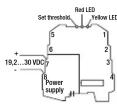
Die Einstellung des Grenzwertes wird über den weissen Taster (unter der Frontabdeckung, siehe auch Bild bei Hilfsenergieversorgung) vorgenommen.
- Kurzes Drücken der Taste startet die Einstellung des Grenzwertes – die rote LED blinkt langsam.
- Wenn die Taste 5 Sekunden lang nicht gedrückt wird, kehrt der Signalkonverter zum normalen Betrieb zurück.
- Jeder Tastendruck erhöht oder vermindert den Grenzwert um 0,2%. Während der Einstellung entspricht der Grenzwert dem Wert am Ausgang und kann über das Multimeter abgelesen werden.
• Die Richtung der Einstellung (steigend oder fallend) hängt von der Einstellung des DIP-Schalters SW2.7 ab.
- Der Schaltpunkt liegt immer genau auf dem eingestellten Wert. Beim Zurückfallen entsteht eine Hysterese.
- Hält man den Taster 2 Sekunden gedrückt, verändert sich der Grenzwert in 3% Schritten.
- Wird der Maximum- bzw. Minimum-Wert erreicht, so startet der Zyklus neu. - Wird der Taster länger als 5 Sekunden nicht betätigt, so werden die eingestellten Werte gespeichert und das Gerät kehrt zum normalen Betrieb zurück.
Bemerkung: Sollte die Spannungsversorgung während der Einstellung oder vor der Wartezeit (5s) nicht ausreichend sein, wird der eingestellte Wert nicht gespeichert.
Details von DIP-Schalter SW2.7
| SW2.7 | Schaltrichtung | Relais Status |
| OFF | Bei Überschreiten | Geschlossen (LED ON) |
| ON Bei | Unterschreiten | Often (LED OFF) |
Anweisungen zur Installation
Der Signalkonverter ist für die Montage auf Schienen nach DIN 46277 ausgelegt.
| Montage des Signalkonverters auf der Schiene | Entfernung des Signalkonverters von der Schiene |

- Setzen Sie den Signalkonverter in den oberen Teil der Schiene ein.
- Drücken Sie den Signalkonverter nach unten.
Für eine bessere Belüftung des Signalkonverters empfehlen wir die Montage in vertikaler Stellung. Vermeiden Sie die Installation der Signalkonverter über Geräten, die Wärme erzeugen. Wir empfehlen die Installation im unteren Bereich des Schaltschrankes.
Verwenden des CB-Power-Bus

1 – Stecken Sie die CB-Power-Bus Anschlüsse zusammen, um die erforderlichen Anzahl von Steckplätzen zu erzielen.
2 – Setzen Sie den CB-Power-Bus in die Schiene ein, indem Sie ihn dazu auf der oberen Seite einsetzen und nach unten drücken.
WICHTIG! Wichtig: Beachten Sie die Einbaulage gemäss Bild. Andernfalls sind die Signalkonverter kopfüber montiert.
| ⚠️ | - Schliessen Sie nie die Spannung direkt am CB-Power Bus an! |
| - Greifen Sie die Spannung nie direkt über die Klemme des CB-Power Buses ab! |

Einstellungen der DIP-Schalter
Werkseinstellung
Der Signalkonverter wird mit allen DIP-Schaltern in OFF Position ausgeliefert. Die Einstellungen entsprechen den folgenden werten:
| Thermoelement | Typ J |
| Storfrequenzunterdrückung | 50 Hz |
| Eingangsfil liter | aktiv |
| Messbereich | 0...1000 °C |
| Ausgangssignal | 4...20 mA |
| Ausgangssignal bei Fehler | steigend |
| Bereichsüberschreitung | aktiv: bis 102,5% vom Endwert wird Ausgang linear angezeigt. Bei Fehler geht der Ausgang auf 105% des Endwertes |
| Schaltausgang (AUX) | Grenzwert 0% |
Obige Einstellungen sind also nur gültig, wenn alle DIP-Schalter auf OFF stehen. Wird ein DIP-Schalter verändert, ist es erforderlich, alle andern Parameter separat, entsprechend nachfolgenden Tabellen einzustellen.
ACHTUNG: Für alle nachfolgenden Tabellen:
Einstellungen über DIP-Schalter nur im spannungslosen Zustand vornehmen! Das Symbol • zeigt an, dass der DIP-Schalter in der ON Position ist.
Keine Angabe bedeutet, dass der DIP-Schalter in der OFF Position ist.
Thermoelement Typ
| SW1 | 1 | 2 | 3 | SW1 | 4 | SW1 | 5 | |||
| J | ● | 60 Hz | ● aktiv | |||||||
| ● | K | 50 Hz | inaktiv | |||||||
| ● | R |
(°) Der Filter stabilisiert die Anzeige, indem er das Signalrauschen verringert. Daher ist es besser den Filter immer zuzuschalten, ausser man benötigt minimale Einstellzeit.
Messbereich Anfangswert
| SW1 | 16 | 7 | 8 | Typ J | Typ K | Typ R | Typ S | Typ T | Typ B | Typ E | Typ N |
| Stand. (*) | 0 °C | 0 °C | 0 °C | 0 °C | 0 °C | 0 °C | 0 °C | ||||
| ● | 0 °C | 100 °C | 100 °C | 100 °C | 50 °C | 400 °C | 100 °C | 100 °C | |||
| ● | 100 °C | 200 °C | 200 °C | 200 °C | 100 °C | 500 °C | 200 °C | 200 °C | |||
| ● | 200 °C | 400 °C | 300 °C | 300 °C | 200 °C | 600 °C | 300 °C | 300 °C | |||
| ● | 300 °C | 600 °C | 400 °C | 400 °C | -50 °C | 800 °C | 400 °C | 500 °C | |||
| ● | 500 °C | 800 °C | 600 °C | 600 °C | -150 °C | 1000 °C | 500 °C | 700 °C | |||
| ● | -100 °C | -100 °C | 800 °C | 800 °C | -100 °C | 1200 °C | -100 °C | -100 °C | |||
| ● | -200 °C | -200 °C | 1000 °C | 1000 °C | -200 °C | 1400 °C | -200 °C | -200 °C |
(*) Standardkonfi gu
Messbereich Endwert
| SW2 | 1 | 2 | 3 | Typ J | Typ K | Typ R | Typ S | Typ T | Typ B | Typ E | Typ N |
| 1200 °C | 1350 °C | 1750 °C | 1750 °C | 400 °C | 1800 °C | 1000 °C | 1300 °C | ||||
| ● | 1000 °C | 1200 °C | 1500 °C | 1500 °C | 350 °C | 1600 °C | 800 °C | 1200 °C | |||
| ● | ● | 800 °C | 1000 °C | 1300 °C | 1300 °C | 300 °C | 1500 °C | 600 °C | 1000 °C | ||
| ● | ● | 600 °C | 800 °C | 1100 °C | 1100 °C | 250 °C | 1300 °C | 500 °C | 800 °C | ||
| ● | 500 °C | 700 °C | 900 °C | 900 °C | 200 °C | 1100 °C | 400 °C | 600 °C | |||
| ● | ● | 400 °C | 500 °C | 700 °C | 700 °C | 150 °C | 900 °C | 300 °C | 500 °C | ||
| ● | ● | 300 °C | 300 °C | 500 °C | 500 °C | 100 °C | 700 °C | 200 °C | 400 °C | ||
| ● | ● | ● | 200 °C | 200 °C | 300 °C | 300 °C | 50 °C | 500 °C | 100 °C | 200 °C |
Ausgang
| SW2 | 4 | 5 | 6 | ||
| 4...20 mA | |||||
| ● | 0...20 mA | ||||
| ● | 20...4 mA | ||||
| ●● | 20...0 mA | ||||
| ● | 0...10 V | ||||
| ● | ● | 1...5 V | |||
| ●● | 10...0 V | ||||
| ●● | ● | 0...5 V | |||
Bereichsüberschreitung (siehe Tabelle unten für die entsprechenden Werte)
| SW2 | 8 |
| ● inaktiv: Der Ausgang bewegt sich nur innerhalb des eingestellten Messbereiches. Bei einem Fehler geht der Ausgang je nach Einstellung des SW2-7, entweder 2,5% unter den Messbereichanfang oder 2,5% über den Messbereichsendwert | |
| ● aktiv: Der Ausgang bewegt sich nur innerhalb des eingestellten Messbereiches. Bei einem Fehler geht der Ausgang je nach Einstellung des SW2-7, entweder 5% unter den Messbereichanfang oder 5% über den Messbereichsendwert |
| Ausgangsignal | SW2-8 inaktiv SW2-8 adv |
| 4...20 mA | Ausgang: 4...20 mAFehler: 3,5 mA / 20,5 mA |
| Ausgang: 0...20 mAFehler: 0 mA / 20,5 mA | |
| 0...20 mA | Ausgang: 0...20 mAFehler: 0 mA / 21 mA |
| 0...10 V | Ausgang: 0...10 VFehler: 0 V / 10,25 V |
| Ausgang: 0...10 VFehler: 0 V / 5,125 V | |
| 0...5 V | Ausgang: 1...5 V |
| Ausgang: 1...5 V | |
| 1...5 V | Ausgang: 0.875...5.125VFehler: 0.75 V / 5,25 V |
LED-Anzeige
| Rote LED | Bedeutung | Ausgang Fehler |
| Schnelles blinken | Interner Fehler | JA |
| Langsames blinken | DIP-Schalter Einstellungsfehler | JA |
| Einstellung Grenzwert wird vorgenommen NEIN (*) | ||
| Konstantes Leuchten | Fühlerbruch, Eingang ausserhalb des Bereiches JA | |
| Ausgangbegrenzung ist aktiv | NEIN |
(*) In diesem Zustand entspricht das Ausgangssignal dem Grenzwert.
| Gelbe LED | Bedeutung |
| ON | Der Schaltausgang (AUX) ist geschlossen |
| OFF | Der Schaltausgang (AUX) ist geöffnet |
Elektrische Anschlüsse

Der Signalkonverter besitzt Federklemmen für die elek-
trischen Anschlüsse: Nehmen Sie bei den Anschlüssen auf die folgenden
Anweisungen Bezug:
- Entfernen Sie 0,8 cm der Isolierung am Ende der
Kabel 2. Führen Sie einen Schraubendreher in die quadratische
- Pahren die einen Schraubenarchen in die quadratische Öffnung ein und drücken Sie ihn, bis sich die Feder
öffnet, die das Kabel blockiert
-
Führen Sie das Kabel in die runde Öffnung ein
-
Ziehen Sie den Schraubendreher heraus und überprü- fen Sie, ob das Kabel sicher in den Klumme befasirt.
ten Sie, ob das Kabel sicher in der Klemme befestigt jet.
Hilfsenergieversorgung
Zur Speisung der Signalkonverter der VS-
Linie gibt es 3 Möglichkeiten:
- Direkte Speisung der Signalkonverter: Jeder einzelne Signalkonverter wird über die Klemmen 7 (+) und 8(-) mit Hilfsenergie versorgt.
2. Verwenden des CB-Power-Bus:
Beim CB-Power-Bus (Art.Nr. 162826) handelt es sich um einen Rückwandbus für
die VS-Signalkonventenlinie, welcher direkt auf der Hutschliene montiert wird. Es genügt so, nur einen Signalkonverter mit Hilfsenergie zu verbinden. Die Hilfsenergie wird vom Signalkonverter auf den CB-Power-Bus übertragen.
So können bis zu 16 Signalkonverter gespeist werden. Es darf maximal ein Strom von 400mA im Hilfsenergiekreis fl iessen.
- Verwenden des CB-Power-Bus und des Spannungsversorgungsmoduls VS70:
Der VS70 ist ein Spannungsversorgungsmodul für den CB-Power-Bus und ist in der Lage bis zu 75 Geräte der VS-Signalkonverterlinie über den Rückwandbus mit Hilfsenergie zu versorgen. Es darf maximal ein Strom von 1,6A im Hilfsenergiekreis fl lessen.
Sollen mehr als 75 Geräte gespiessen werden, so muss ein neuer CB-Power-Bus Strang installiert werden, welcher nicht mit dem ersten Strang verbunden ist.
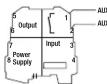
Eingang
Am Messumformer können folgende
Sensortypen angeschlossen werden: J, K,
Die Verwendung von geschirmten Kabeln
wird empfohlen.
Ausgang
Spannung oder Strom.
Die Verwendung von geschirmten Kabeln wird empfohlen.
•
Schaltausgang (AUX)
Relaisausgang (Schliessen)


Geräte dürfen nur fachgerecht entsorgt werden!
m = 311
SINEAX VS46
Signal converter
Thermocouples to DC current-voltage
CAMILLE BAUER
162 975 02.12
General characteristics
VS46 converts a signal from a thermocouple to a voltage signal (V) or current signal (mA). In addition, a relay contact (normally open) can be programmed as an alarm value via a key on the front side.
Features/benefits:
• High accuracy
• very narrow housing (6.2mm)
- Installation on 50mm DIN rail - Power can be supplied via book plane bus
• Connection via spring cage terminal
• Galvanic 3-way isolation
- Confi guration via DIP switch
Technical data
| Power supply 192 ... 30V DC | |
| Power consumption Max. | 24mA at 24V DC |
| Input | Thermocouples type: J, K, E, N, S, R, B, T according to EN 60 584-1 (ITS-90) |
| Measuring range Depends on the thermocouple (see table) | |
| Minimum span 100°C | |
| Impedance 10MΩ | |
| Sensor current < 50nA | |
Input variables, measuring ranges
| Thermocouple Range Error Resolution | ||||
| J -210...120°C | 0.025% + 0.29°C | 0.12°C | ||
| K -200...137°C | 0.025% + 0.4°C | 0.17°C | ||
| E -200...100°C | 0.025% + 0.2°C | 0.92°C | ||
| N | -200...1300°C | 0.025% + 0.42°C | 0.19°C | |
| S | -50...1768°C | 0.025% + 1.34°C | 0.66°C | |
| R | -50...1768°C | 0.025% + 1.19°C | 0.59°C | |
| B | 250...1820°C (*) | 0.025% + 1.87 C 0.9°C | ||
| T -200...400°C | 0.025% + 0.31°C | 0.13°C | ||
(*) Up to 250°C the output is considered zero in relation to temperature.
| Voltage output | 0...5V DC, 1...5V DC, 0...10V DC and 10...0V DCMin. load 2 kΩ |
| Current output | 0...20mA, 4...20mA, 20...0mA and 20...4mAMax. load 500 Ω |
| Max. voltage | Approx. 12.5V |
| Max. current | Approx. 25mA |
| Resolution | 1mV for voltage output, 2μA for current output |
| Relay output (AUX) | Switching voltage maximum 24V AC, switching current maximum 60mA |
| Response time(10...90%) | < 2ms (without fi liter), < 55ms (with fi liter) |
| Test voltage | 1.5kV (50Hz for 1 min.) |
| Ingress protection | IP20 |
Accuracy
| Reference conditions | Ambient temperature | 25°C |
| Power supply | 24V | |
| Reference value | Span | |
| Basic accuracy (at reference) | ±0.1% | |
| Temperature impact | 120 ppm/K | |
| Cold junction error | Max. 1.5°C | |
Ambient conditions
| Operating temperature | -20...+65°C |
| Storage temperature | -40...+85°C |
| Air humidity | 10...90% at 40°C (non-condensing) |
| Scope of application | Indoors up to 2000m above sea level |
| LED | Error, status of the switching output |
| Connections Spring cage terminal | |
| Conductor cross-section | 2..2.5mm |
| Housing | PBT (black) |
| Dimensions, weight 6.2" | 93.1 x 102.5mm, 46g |
| The instrument corresponds to the following standards: | EN 61000-6-4/2002 (electromagnetic emission, industrial environment) EN 61000-6-2/2005 (electromagnetic immunity, industrial environment) EN 61010-1/2001 (safety)All circuits must be insulated against circuits with dangerous voltage by double insulation. The power transformer must correspond to the EN 60742 standard:-isation transformers and safety transformers- |
RELAY OUTPUT (AUX)
Description
SINEAX VS46 features a relay output which can be activated via a settable limit value.
Setting of the limit value requires a multimeter to measure the output (in V or mA) as well as a power supply.
Setting of the limit value
- Connect the signal converter to the power supply.
- Connect the multimeter to the output of the signal converter and
set the selected measuring range (V or mA).
Limit values are set via the white button (below the front cover, see also image under power supply).
- Briefly pressing the button starts the setting operation of the limit value – the red LED fl ashes slowly.
- If the button is not pressed for 5 seconds, the signal converter returns to normal operation.
- Every time the button is pressed, the limit value increases or decreases by 0.2% . During setting, the limit value corresponds to the value at the output which is indicated on the multimeter.
- The direction of the adjustment (rising or descending) depends on the setting of the DIP switch SW2.7.
- The switching point is always exactly on the set value. Dropping back causes a hysteresis.
- Pressing the button for 2 seconds changes the limit value in 3% steps.
- The cycle restarts as a maximum of minimum value is reached.
- If the button is not pressed for more than 5 seconds, the set values are stored and the device returns to normal operation.
Note: If the power supply is not sufficient during setting or the inactive period (5s) the set value is not stored.
Details of DIP switch SW2.7
| SW2.7 Switching direction | Relay status | |
| OFF | If exceeded | Closed (LED ON) |
| ON | If below the limit | Open (LED OFF) |
Installation instructions
The signal converter is designed for rail assembly according to DIN 46277.
| Rail assembly of the signal converter | Removal of the signal converter from the rail |
| 1. Place the signal converter in the upper part of the rail.2. Press the signal converter downwards. | 1. Use a screw driver to apply leverage (as shown in the image)2. Turn the signal converter upwards. |
To achieve improved ventilation, we recommend installing the signal converter in a vertical position. Avoid the installation of the signal converter above heat-generating devices. We recommend the installation in the lower part of the control cabinet.
Using the CB-Power-Bus
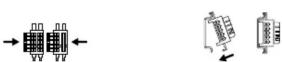
1 - Combine the CB-Power-Bus connections to obtain the required number of positions.
2 – Place the CB-Power-Bus in the rail by inserting it in the top part and pressing it downwards.
IMPORTANT! Ensure the position as shown in the image. Otherwise the signal converters are mounted upside down.
- Never connect the power supply directly on the CB-Power-Bus! - Never tap the power supply directly via the terminal of the CB-Power-Bus!
DIP switch setting
Factory setting
The signal converter is delivered with all DIP switches in the OFF position.
| Thermocouple | Type J |
| Line-frequency rejection | 50Hz |
| Input filter | Active |
| Measuring range | 0...1000°C |
| Output signal | 4...20mA |
| Output signal in case of an error | Rising |
| Active: Linear output indication up to 102.5% of the maxi- |
| over-range | minimum value: in case of all error, the output moves to 105% of the maximum value |
Switching output (AUX) Limit value 0%
The settings stated above are only valid if all DIP switches are in the OFF position. If a DIP switch is changed, all other parameters must be set separately in accer
dance with the subsequent tables.
ATTENTION PLEASE: For all of the subsequent tables:
Set DIP switch only when it is not energised!
The symbol indicates that the DIP switch is in the ON position.
No indication means that the DIP switch is in the OFF position.
Thermocouple Type
| SW1 | 1 | 2 | 3 | SW1 | 4 | SW1 | 5 | |||
| J | ● | 60Hz | ●Active | |||||||
| ● | K | 50Hz | Inactive | |||||||
| ● | R | |||||||||
| ● | ● | S | ||||||||
| ● | T | |||||||||
| ● | ● | B | ||||||||
| ● | ● | E | ||||||||
| ● | ● | N |
Measuring range minimum value
| SW1 | 6 | 7 | 8 | Type J | Type K | Type R | Type S | Type T | Type B | Type E | Type N |
| Stand. (*) | 0°C | 0°C | 0°C | 0°C | 0°C | 0°C | 0°C | ||||
| ● | 0°C | 100°C | 100°C | 100°C | 50°C | 400°C | 100°C | 100°C | |||
| ● | 100°C | 200°C | 200°C | 200°C | 100°C | 500°C | 200°C | 200°C | |||
| ●● | 200°C | 400°C | 300°C | 300°C | 200°C | 600°C | 300°C | 300°C | |||
| 300°C | 600°C | 400°C | 400°C | -50°C | 800°C | 400°C | 500°C | ||||
| ● | 500°C | 800°C | 600°C | 600°C | -150°C | 1000°C | 500°C | 700°C | |||
| ● | -100°C | -100°C | 800°C | 800°C | -100°C | 1200°C | -100°C | -100°C | |||
| ●●● | -200°C | -200°C | 1000°C | 1000°C | -200°C | 1400°C | -200°C | -200°C |
(*) Standard configuration
| Measuring range maximum value | ||||||||||
| SW2 | 1 | 2 | 3 | Type J | Type K | Type R | Type S | Type T | Type B | Type E |
| 1200°C | 1350°C | 1750°C | 1750°C | 400°C | 1800°C | 1000°C | 1300°C | |||
| ● | 1000°C | 1200°C | 1500°C | 1500°C | 350°C | 1600°C | 800°C | 1200°C | ||
| ● | 800°C | 1000°C | 1300°C | 1300°C | 300°C | 1500°C | 600°C | 1000°C | ||
| ● | ● | 600°C | 800°C | 1100°C | 1100°C | 250°C | 1300°C | 500°C | 800°C | |
| ● | 500°C | 700°C | 900°C | 900°C | 200°C | 1100°C | 400°C | 600°C | ||
| ● | ● | 400°C | 500°C | 700°C | 700°C | 150°C | 900°C | 300°C | 500°C | |
| ● | ● | 300°C | 300°C | 500°C | 500°C | 100°C | 700°C | 200°C | 400°C | |
| ● | ● | 200°C | 200°C | 300°C | 300°C | 50°C | 500°C | 100°C | 200°C | |
| Output | ||||
| SW2 | 4 | 5 | 6 | |
| 4...20mA | ||||
| ● | 0...20mA | |||
| ● | 20...4mA | |||
| ● | ● | 20...0 mA | ||
| ● | 0...10 V | |||
| ● | ● | 1...5 V | ||
| ● | ● | 10...0 V | ||
| ● | ● | ● | 0...5 V | |
Output signal in case of an error
| SW2 | 7 | |
| ● | Descending | |
| Rising |
Over-range (see table below for the respective values)
| SW2 | 8 | Inactive: The output covers only the set measuring range.In case of an error, the output moves, depending on the SW2-7 setting, either 2.5 % below the minimum or 2.5 % above the maximum value of the measuring range. |
| ● | ||
| Active: The output only covers the set measuring range. In case of an error, the output moves, depending on the SW2-7 setting, either 5 % below the minimum or 5 % above the maximum value of the measuring range. | ||
| Output signal | SW2-8 inactive | SW2-8 active |
| 4...20mA | Output: 4...20mAError: 3.5mA / 20.5mA | Output: 3.5mA...20.5mAError: 3mA / 21mA |
| 0...20mA | Output: 0...20mAError: 0mA / 20.5mA | Output: 0mA...20.5mAError: 0mA / 21mA |
| 0...10V | Output: 0...10VError: 0 / 10.25 V | Output: 0mA...10.25mAError: 0V / 10.5V |
| 0...5V | Output: 0...5VError: 0V / 5.125V | Output: 0...5VError: 0V / 5.125V |
| 1...5V | Output: 1...5VError: 0.875V / 5.125V | Output: 0.875...5.125VError: 0.75V / 5.25V |
LED
| Red LED | Meaning | Output error |
| Rapid fl ashing | Internal error | YES |
| Slow fl ashing | DIP switch setting error | YES |
| Limit setting is made | NO (*) | |
| Steady light | Sensor failure, input out of range | YES |
| Limit of the output over-range | NO | |
| (*) In this state, the output signal to the limit. | ||
| Yellow LED | Meaning | |
| ON | The switching output (AUX) is closed | |
| OFF | The switching output (AUX) is open | |
Electric connections
The signal converter features spring cage terminals for electric connections.
Please observe the following when realising the connections:
1. Strip 0.8cm of the insulation at the end of the cables.
2. Enter the screw driver into the square opening and
press until the spring opens which blocks the cable. 3. Enter the cable into the round opening.
4. Pull the screwdriver out and check whether the cable

is firmly fastened in the terminal.
Power supply
There are 3 options to supply power to the
signal converters of the VS line
- Direct supply to signal converters:
Each individual signal converter is supplied
with power via the 7 (+) and 8(-) terminals.

2. Using the CB-Power-Bus:
The CB-Power-Bus (Art.No. 162826) is a back plane bus for the VS signal converter line which is assembled directly on the top-hat rail.
In this case only one signal converter has to be connected to the power supply. The power is transferred by the signal converter to the CB-Power-Bus.
Up to 16 signal converters can be supplied in this way. The maximum current in the power circuit amounts to 400mA .
- Using the CB-Power-Bus and the VS70 power supply module:
VS70 is a power supply module for the CB-Power-Bus and can supply power to a maximum of 75 devices of the VS signal converter line via the back plane bus. The maximum current in the power circuit amounts to 1.6A.
If more than 75 devices are supposed to be supplied, a new CB-Power-Bus string must be installed which is not connected to the first string.
Input
The following sensor types can be connected to the transmitter: J, K, E, N, S, R, B, T. The use of shielded cables is recommended
Output
Voltage or current. The use of shielded cables is recommended.
Switching output (AUX)
Relay output (normally open)



Phone +41 56 618 21 11
Carmille Bauer Metrawall AG Fax +41 56 618 21 21
CH-5610 Wohlen/Switzerland www.camillebauer.com
SINEAX VS46 ENGLISH 4/4
- SINEAX VS46
- Signalkonverter
- Allgemeine Eigenschaften
- Merkmale/Nutzen:
- Technische Daten
- RELAISAUSGANG (AUX)
- Beschreibung
- Einstellen des Grenzwertes
- Anweisungen zur Installation
- Verwenden des CB-Power-Bus
- Einstellungen der DIP-Schalter
- Werkseinstellung
- Elektrische Anschlüsse
- Hilfsenergieversorgung
- Verwenden des CB-Power-Bus:
- Eingang
- Ausgang
- Schaltausgang (AUX)
- Signal converter
- Thermocouples to DC current-voltage
- CAMILLE BAUER
- General characteristics
- Features/benefits:
- Technical data
- RELAY OUTPUT (AUX)
- Description
- Setting of the limit value
- Installation instructions
- Using the CB-Power-Bus
- DIP switch setting
- Factory setting
- Electric connections
- Power supply
- Using the CB-Power-Bus:
- Input
- Output
- Switching output (AUX)
Mærke : Camille Bauer
Model : SINEAX VS46
Kategori : Lyd/video konverter