TB155-046 - Termostat PECO - Gratis brugsanvisning og manual
Find enhedens vejledning gratis TB155-046 PECO i PDF-format.


Brugerspørgsmål om TB155-046 PECO
0 spørgsmål om dette apparat. Besvar dem du kender, eller stil dit eget.
Stil et nyt spørgsmål om dette apparat
Download vejledningen til din Termostat i PDF-format gratis! Find din vejledning TB155-046 - PECO og tag din elektroniske enhed tilbage i hånden. På denne side er alle dokumenter nødvendige for brugen af din enhed offentliggjort. TB155-046 af mærket PECO.
BRUGSANVISNING TB155-046 PECO
INSTALLATION
- Install the T155 with the two furnished mounting screws to a standard 2" x 4" electrical box, 4-11/16" x 2-1/8" square device box with a 2" x 4" adapter ring or to a 4" x 4" box with accessory adapter plate.
- For wall installations, mount the thermostat on an inside wall approximately 5 feet above the floor. The location should provide circulation at average room temperature. Avoid direct sunlight or sources of hot or cold air in the room or wall.
- Remove the knob and then the cover. Mount thermostat base assembly to the outlet box using the screws provided, tighten the screws evenly but do not over tighten. Make wiring connections as noted.
- To use a remote sensor, remove jumper JP-1 to disable local sensing. Failure to remove JP-1 when using a remote sensor will cause improper operation of the thermostat. Some units do not have remote sensing capability. See Application Notes.
- Reinstall the cover assembly. Install cover locking screw provided. Reinstall the knob.

CAUTION
INSTALL COVER LOCKING SCREW
- Use Copper wire only, insulate or wire nut all unused leads.
- Any wiring, including the remote probe, may carry the full operating voltage of the thermostat.
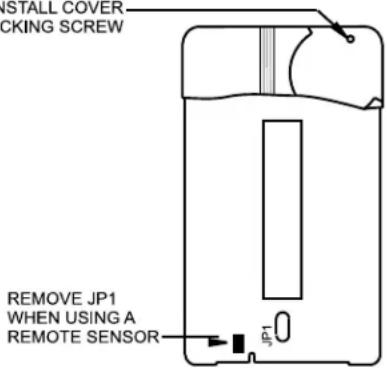
KNOB REMOVAL AND REPLACEMENT

CAUTION
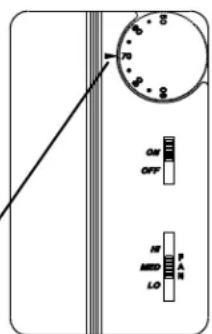
When removing and re-installing the T-155 knob, care must be taken.
- Align arrow to 70^ on the knob (22C) or midrange when removing the knob.
- Reinstall knob by aligning arrow to 70^ (22C) or midrange.
- Do not force it. When properly aligned, the knob will slip into position.
Align arrow to 70°F on the knob (22C)

WARNING
- READ THESE INSTRUCTIONS CAREFULLY BEFORE ATTEMPTING TO INSTALL, OPERATE OR SERVICE THIS THERMOSTAT.
- Failure to observe safety information and comply with instructions could result in PERSONAL INJURY, DEATH AND/OR PROPERTY DAMAGE.
- To avoid electrical shock or damage to equipment, disconnect power before installing or servicing.
- To avoid electric shock or damage to equipment, use only wiring with insulation rated for full thermostat operating voltage.
- To avoid potential fire and/ or explosion do not use in potentially flammable or explosive atmospheres.
- Retain these instructions for future reference. This product, when installed, will be part of an engineered system whose specifications and performance characteristics are not designed or controlled by PECO, Inc. You must review your application and national and local codes to assure that your installation will be functional and safe.
THERMOSTAT OPERATION
Temperature Range: 50°F - 90°F (10°C - 32°C)
TA155: A HEAT-OFF-COOL system switch manually selects heating or cooling mode. In the HEAT position, only the heat output cycles with demand. In the COOL position, only the cool output cycles with demand. In the OFF position, heating and cooling outputs are off. Units with a two position system switch or without a system switch must use a load transfer switch when both heating and cooling outputs are used. This prevents control failure and equipment damage caused by direct cycling between loads.
TB155: An ON-OFF system switch enables auto-changeover of heating and cooling modes. In the ON position the thermostat activates heating or cooling outputs dependant upon the relationship between set point and ambient temperature. Heat on to cool on dead band is 4^ F. In the OFF position, heating and cooling outputs are off. Units without a system switch cycle between heating and cooling with a 4^ F dead band.
FAN: Some units have a switch for manual selection of fan speed. On these units fan operation is either internally wired for fan continuous operation or is dependant upon connection to the fan supply input. When internally wired for fan continuous operation, the fan will be off when the system switch is off. When dependant upon external connections the fan may not be off with the system switch in the off position. The fan supply input is switched to fan speed outputs (HI - MED - LO).
SWITCHED POWER: L1 power is switched to this output any time the system switch is out of the OFF position.
RATINGS
| FAN AND SYSTEM SWITCHES | |||||
| Voltage Rating | Inductive | Resistive Amps | Pilot Duty | Thermostatic Switching | |
| FLA LRA | |||||
| 24 VAC | N.A. N.A. | N.A. N.A. | 24 VA | 10 VA | |
| 120 VAC | 5.8 | 34.8 | 6.0 125 | VA 20 VA | |
| 240 VAC | 2.9 | 17.4 | 5.0 | 125 VA | 20 VA |
| 277 VAC | 2.4 | 14.4 | 4.2 | 125 VA | 20 VA |
WIRING CONNECTIONS
| White with Orange Stripe | Fan High | |
| White with Red Stripe | Fan Medium | |
| White with Brown Stripe | Fan Low | |
| Red | Heat | |
| Blue | Cool | |
| Black | L1 | |
| Yellow | L2 or Neutral | |
| Orange | Switched Power | |
| Violet | Fan Supply | |
| Brown | Remote Probe 1 | |
| Brown | Remote Probe 2 | |
| *If applicable | ||
APPLICATION NOTES
- To use a remote sensor, remove jumper JP-1 to disable local sensing.

CAUTION
Failure to remove JP-1 when using a remote sensor will cause improper operation of the thermostat. Some units do not have remote sensing capability.
- Remote probe wiring should be located away from any electrical motors or power wiring
- Some units are internally wired for permanent fan continuous operation.
- On units with a Fan Supply input the operation of the fan is determined by wiring connection. For fan continuous, jumper the Fan Supply input (TB2-5) to the Switched Power output (TB3-3).
- For fan cycling operation with a call for heat or cool, a fan relay must be used.
- Observe electrical ratings. Thermostatic outputs are pilot duty only.
WIRING DIAGRAM
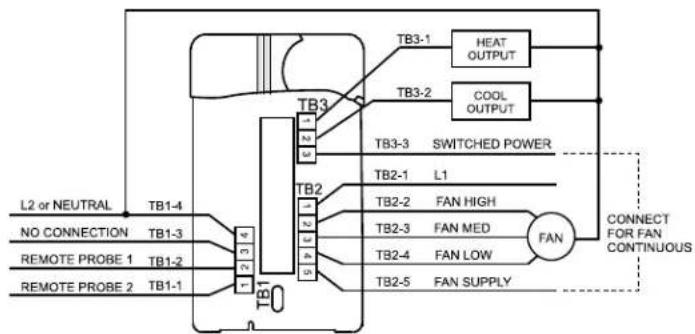
flowchart
graph TD
    A["L2 or NEUTRAL"] --> B["TB1-4"]
    C["NO CONNECTION"] --> D["TB1-3"]
    E["REMOTE PROBE 1"] --> F["TB1-2"]
    G["REMOTE PROBE 2"] --> H["TB1-1"]
    I["TB1"] --> J["TB2"]
    K["TB2"] --> L["TB3"]
    M["TB3-1"] --> N["HEAT OUTPUT"]
    O["TB3-2"] --> P["COOL OUTPUT"]
    Q["TB3-3"] --> R["SWITCHED POWER"]
    S["TB2-1"] --> T["L1"]
    U["TB2-2"] --> V["FAN HIGH"]
    W["TB2-3"] --> X["FAN MED"]
    Y["TB2-4"] --> Z["FAN LOW"]
    AA["TB2-5"] --> AB["FAN SUPPLY"]
    AC["FAN"] --> AD["CONNECT FOR FAN CONTINUOUS"]
UNITS WITH SWITCHES
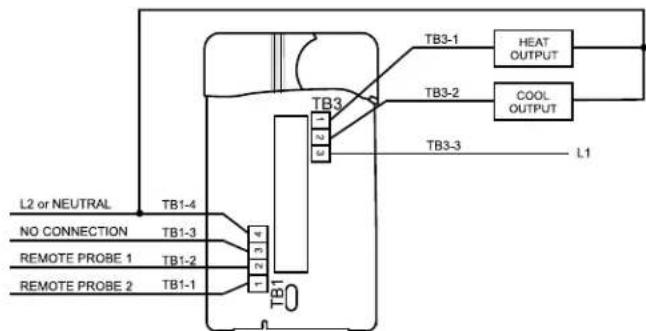
flowchart
graph TD
    A["L2 or NEUTRAL"] --> B["TB1-4"]
    C["NO CONNECTION"] --> D["TB1-3"]
    E["REMOTE PROBE 1"] --> F["TB1-2"]
    G["REMOTE PROBE 2"] --> H["TB1-1"]
    I["TB3"] --> J["TB3-1"]
    K["TB3"] --> L["TB3-2"]
    M["TB3"] --> N["TB3-3"]
    O["HEAT OUTPUT"] --> P["L1"]
    Q["COOL OUTPUT"] --> R["L1"]
UNITS WITH NO SWITCHES